Quarantanamo, New Jersey, Ctd

Chris Christie went on TV this morning to defend his mandatory quarantine policy for health workers returning from Ebola-afflicted countries:

“I don’t think it’s draconian,” Christie, appearing on the Today show, said of New Jersey’s mandatory 21-day quarantine on health care workers returning from Liberia, Sierra Leone, or Guinea. “The members of the American public believe it is common sense, and we are not moving an inch. Our policy hasn’t changed and our policy will not change.” … The governor also said the CDC has been too slow to change its policies, and is now “incrementally taking steps to the policy we put in effect in New Jersey.” The CDC announced on Monday new guidelines for people traveling from West Africa, but still recommends voluntary at-home isolation rather than state-mandated quarantines.

Ben Wallace-Wells thinks “that Christie, and also [New York Governor] Cuomo, simply misread the nature of the public alarm”:

Despite the tone on cable news, and despite the wildly over-publicized decisions of a few parents in a few school districts to keep their kids home, there hasn’t been a public panic over Ebola. People are still traveling on airplanes. They are not flooding the hospitals with anxieties that minor symptoms might portend Ebola. Everyone whose job it is to predict public opinion seems to have been bracing for a panic. But it hasn’t come.

A dumb and snotty cottage industry has developed in making fun of those who are freaking out. (As I write, the most-viewed story on The New Yorker‘s website is a “humor” column by Andy Borowitz titled, “Study: Fear of Ebola Highest Among People Who Did Not Pay Attention During Math and Science Classes.”) But really there hasn’t been much excess fear at all.

Earlier Dish on that media coverage here. In Alex Altman’s view, Christie tried to score some political points from the crisis, but his plan backfired:

For Christie, the panic wrought by the lethal virus may have seemed a prime opportunity to run his favorite play: the one where the tough leader takes a common-sense stand in the face of federal dithering. This is the move that drew bipartisan plaudits after Hurricane Sandy ravaged the Jersey shore in 2012, and one Christie may hope will propel a possible presidential candidacy in 2016. The play has worked swimmingly when run against teachers’ unions, or bungling bureaucrats, or “idiots” loitering on a stretch of beach in the face of an oncoming storm. It doesn’t wear as well when the target is a nurse who risked her life to fight a deadly disease.

The Bloomberg View editors chastise the governors:

Clearly, their decision was unnecessary and premature. Yet it also displays a worrisome disconnect in national public-health networks. Some amount of public panic is to be expected, and must be addressed. State health officials, however, should know better — both about how Ebola spreads and the dangers of mandatory quarantines. … During the SARS epidemic of 2003, public health officials learned that voluntary quarantines — simply requesting that people who might have infectious illness limit their social interactions for a period of time — are as effective as forced quarantines in helping stem an outbreak.

But Noah Rothman defends Christie from the flak he’s taking from both left and right:

Chris Christie did not deserve the left’s self-satisfied recriminations when he instituted stricter measures aimed at curtailing the spread of Ebola in America, programs which enjoy broad support, and he does not merit the scorn heaped upon him by the right for refusing to indefinitely intern a person who likely does not carry the disease. The right is deeply mistrustful of Chris Christie and, on some level, he has earned their suspicion. In this case, it is clear that apprehension among the right toward Christie is verging on compulsive and insidious. Liberals did not enjoy a victory when [Kaci] Hickox was transferred out of containment, but, by insisting Christie somehow endorsed the White House’s position, the right is busily handing them one.

Has The CDC Been Too Blasé?

Yesterday, the Centers for Disease Control and Prevention issued new guidelines for people at risk of coming down with Ebola, meaning primarily health workers returning from West Africa:

On Monday, the CDC broke down people in the orbit of Ebola into four categories. Those at highest risk are anyone who’s had direct contact with an Ebola patient’s body fluids, including health care workers who suffer a needle-stick injury during a patient’s care. For those people who are at highest risk and asymptomatic, the CDC recommended restrictions on commercial travel or attendance at public gatherings. The guidelines were not specific about where a person should stay, but officials said they meant home or hospital isolation. For those with some risk, like who lived in a household with an Ebola patient but didn’t have direct contact, travel restriction can be decided on a case-by-case basis, government officials said.

But states are not bound by these guidelines and are free to implement their own protocols, as several more states have done following New York and New Jersey’s lead:

Virginia Gov. Terry McAuliffe (D) and Maryland Gov. Martin O’Malley (D) held separate news conferences Monday announcing their plans for Ebola containment. Travelers from Guinea, Liberia and Sierra Leone will be assessed by health workers and asked to agree to a 21-day monitoring protocol. Higher-risk travelers will be visited at home by health workers and asked to stay there. Individuals refusing to sign the protocol agreement or not following the rules could be involuntarily quarantined, officials said.

Georgia Gov. Nathan Deal (R) on Monday announced a more aggressive Ebola-containment policy. Travelers from West Africa who don’t show symptoms, but who are considered high risk because of “known direct exposure” to Ebola patients, will be subject to quarantine at a designated facility, Deal’s office said.

With military personnel helping fight the epidemic in Africa, the Pentagon is also taking a more cautious tack than the CDC:

Army spokesman Col. Steve Warren did not call the move a quarantine in a statement issued on Monday. Rather, he said that “about a dozen” troops were being monitored. “Out of an abundance of caution, the Army did direct a small number of military personnel (about a dozen) that recently returned to Italy to be monitored in a separate location at their home station (Vicenza),” Warren stated. “There has been no decision to implement this force wide and any such decision would be made by the secretary of Defense. None of these individuals have shown any symptoms of exposure.”

According to reports, the soldiers are being monitored away from their families for 21 days. The Army refuses to call the isolation a quarantine, although separating people for medical reasons meets the Centers for Disease Control and Prevention’s definition of quarantine.

Allahpundit ridicules the CDC’s recommendations, which in his opinion are “one notch more casual than [they] should be”:

To this day, if I’m not mistaken, Kent Brantly and Nancy Writebol don’t know how they contracted the disease in Africa; Doctors Without Borders, which naturally follows strict protocols in treating patients, has nonetheless seen 16 staffers come down with it, nine of whom died. Presumably Spencer had no reason to think he’d contracted it or he wouldn’t have gone bowling. If even trained professionals are getting caught by surprise in their exposure, why would the CDC err on the side of less quarantine once they’re back home? The public’s confidence in the agency is going to get much, much worse, needless to say, if we end up with another transmission from the “low” or “some risk” category.

The irony of all this, as Tim Cavanaugh notes, is that it’s the doctors at the centers of it who are making the public more, not less, anxious (not “panicked,” as is often wrongly said). If Spencer and Snyderman had diligently quarantined themselves, the public would have greater faith that voluntary quarantines are an acceptable alternative to the sort of state-imposed measure that Christie’s getting hammered for today.

And Jazz Shaw insists that protocols that rely on voluntary quarantines and self-reporting simply aren’t good enough:

People facing a potentially dire situation will frequently be in denial. We see that all the time with folks who avoid going to the doctor only to find out later that all of those warning signs were, indeed, cancer. But if you can’t bring yourself to admit it in your own mind, you likely won’t be checking off those boxes on a form either. Further, you might be thinking that it can’t possibly be Ebola, so why would I go through all the hassle of reporting this? Where would they get that idea? Maybe from hearing an endless stream of government spokesmodels being paraded across your television screen telling you that it’s almost impossible to catch in the first place. And if you’ve had that drilled into your head often enough, who wants to go get locked up in their house for three weeks for what is almost certainly just a case of the flu?

Follow all of our Ebola coverage here, compiled primarily by Jonah Shepp, the irrepressible young Dish editor.

Book Club: Does The Self Exist? Ctd

A reader flags the long podcast seen above:

I started reading Waking Up after watching Sam Harris on Joe Rogan’s podcast. In it, Harris recounts his case against free will and mentioned that he thought that the self was an illusion. I am sympathetic to that view and in a manner believe it to be true, so I purchased Waking Up primarily to read his case on the question of self.

I can’t say I really came away with the tools to feel I can prove this belief. Harris writes in the mode of a skeptic and does so well. But nowhere does the book move fully beyond skepticism to proactive persuasion. So you ultimately end up with firm evidence that common conceptions of self are false, but then the final leap seems to be that moments of awe and the truth are … just self-evident. Something that just is. But some people aren’t going to interpret these moments in that way. Certainly many Christians will associate with the idea of divine light in these moments, as you do. People of other backgrounds will see it in other ways.

Another is more critical:

bookclub-beagle-trI love both you and Sam. I really do. I’m with him on the dangers and damage wrought by religion. With you on most political issues. But on this question from Waking Up, regarding the nature of the so-called “selfless” state of mind human beings sometimes experience during meditation or prayer, I’m afraid you are both wrong.

Andrew, why do you both seek transcendence so badly? For what you feel, what we all feel in these oceanic moments, is neither an experience of being flooded by God’s love (your view) or a glimpse into the underlying “selflessness” of consciousness (Sam’s view).

It is simply one way – one particularly harmonious and happy way! – that our particular species of primate experiences neuronal/electrical activity in our brains. We may speculate that meditation, prayer and the like probably have the effect of quieting activity in the left hemisphere and facilitating a more direct experience of the intuitive, non-verbal right hemisphere …  something like that …

Whatever it is, it is most certainly NOT anything transcendent, nor showing us a “truth” about the selfless nature of the universe. It is part of what our limited biology, fashioned by millions upon millions of years of adaptation, does.

Why is it so hard for you, and now Sam too, to accept your body and brain for what they are: your ONLY portal to experience, limited as they are, sometimes impulsive and directed, sometimes undifferentiated and peaceful, but always YOURS, beautiful and mortal and precious.

It is always self, and that is okay. Andrew, I say lovingly: go with the love you feel, and you can leave out the “God” part. To Sam I want to say: go with the love you feel, and you can leave out the incoherent idea of some “selflessness” uncannily experienced by the self.

155 years after On the Origin of Species and this is still hard for people to accept. But once you do it is clarifying, and liberating. It’s all natural, all animal – all the way down.

Another reader wonders:

One question I would ask Harris: why do we have a sense of self in the first place? Despite its evanescent nature, it likely evolved over time through natural selection because it provided an evolutionary advantage at some point. It may very well be true that it is no longer useful to thrive in the 21st century, but to dismiss it out of hand and call it an illusion, without placing it in a scientific context, is kind of misleading.

Another reminds me why I am so fortunate to be a part of this blog-community:

For many years now I have had the experience of no-self (it is not my philosophy, it is actually my experience).  This experience is almost impossible to write about, but I will do my best.

To begin with, it is not the case that my self vanished one day. Rather, I stopped identifying with the self.  I realized that the self is a just thought that I am aware of, but the self is not what I am.  The self has continued to exist as a thought that is very useful for survival and I expect it to continue to exist until death.

So if I am not the self, then what am I?  I honestly have no idea.  For many years, I felt like I was nothing.  This sounds terrible, but it was actually very liberating.  I did not feel like a dead, cold nothing, I just felt like I was no thing in particular.  Compared with identifying as a separate person that is perpetually fearful, lonely, and confused, being nothing is wonderful.

Several years ago, I experienced a shift.  I started to feel more and more like I was everything.  The first time the feeling came on very strongly, I was sitting in Newark airport staring out at the Queens skyline. I experienced a unity between what I am and everything I am aware of: the beautiful sunrise, the sad buildings, the bagel I was eating, all my thoughts and feelings, etc.  I felt like there was no inside and outside to what I truly am (even though I was aware of a self as a thought).  For the first time in my life, I truly understood what it meant to love everything unconditionally.  This feeling has never really gone away since then, although it is often more in the background of my experience while the self is in the foreground.

Regarding the apparent conflict between Sam Harris’s writings and Catholicism, I see them as emphasizing different partial truths.  Harris, in line with meditative traditions, emphasizes breaking identification with the self.  This can alleviate suffering, but it overlooks the unity of everything and the possibility of universal love.  Catholicism, and other devotional religions, emphasize allowing the self to be “overcome by divine love” as you aptly put it.  But when Catholicism insists on the existence of an eternal soul, it makes God something separate that exists outside of a person.

My own experience is that there is no separate self, there is only God, but a God does not exist apart from me.  This is what St. Teresa of Avila calls “spiritual marriage” in the seventh mansion, or what Meister Eckhart meant when he said “my eye and God’s eye are one eye, one seeing”.

Here are four other thoughts that seem important.  First, I have no idea why this grace came to me.  I am not a special person in any way.  Second, I have no idea how common this realization is or if it is becoming more common.  Third, it has not impaired my ability to live a normal life with a family and job.  People often remark that I seem really calm, but otherwise I look like an ordinary guy.  Fourth, I have no desire to evangelize about this.  I am only writing about it now because I feel that your readers will benefit by hearing that freedom from self is possible.

Anyway, I don’t know if I did a very good job explaining myself, but this is the best I can manage.  If you would like to push further on this, I would suggest interviewing an American teacher named Adyashanti.  He speaks eloquently about these matters and his realization is very deep. And as always, I appreciate the chance to contribute to the Dish.

That reader also wrote an eloquent email about his experiences with ibogaine, a powerful psychedelic from West Africa. Follow the whole Book Club discussion here. And join in by emailing your thoughts to bookclub@andrewsullivan.com.

A Tale Of Two Brazils

20141101_wom001_2

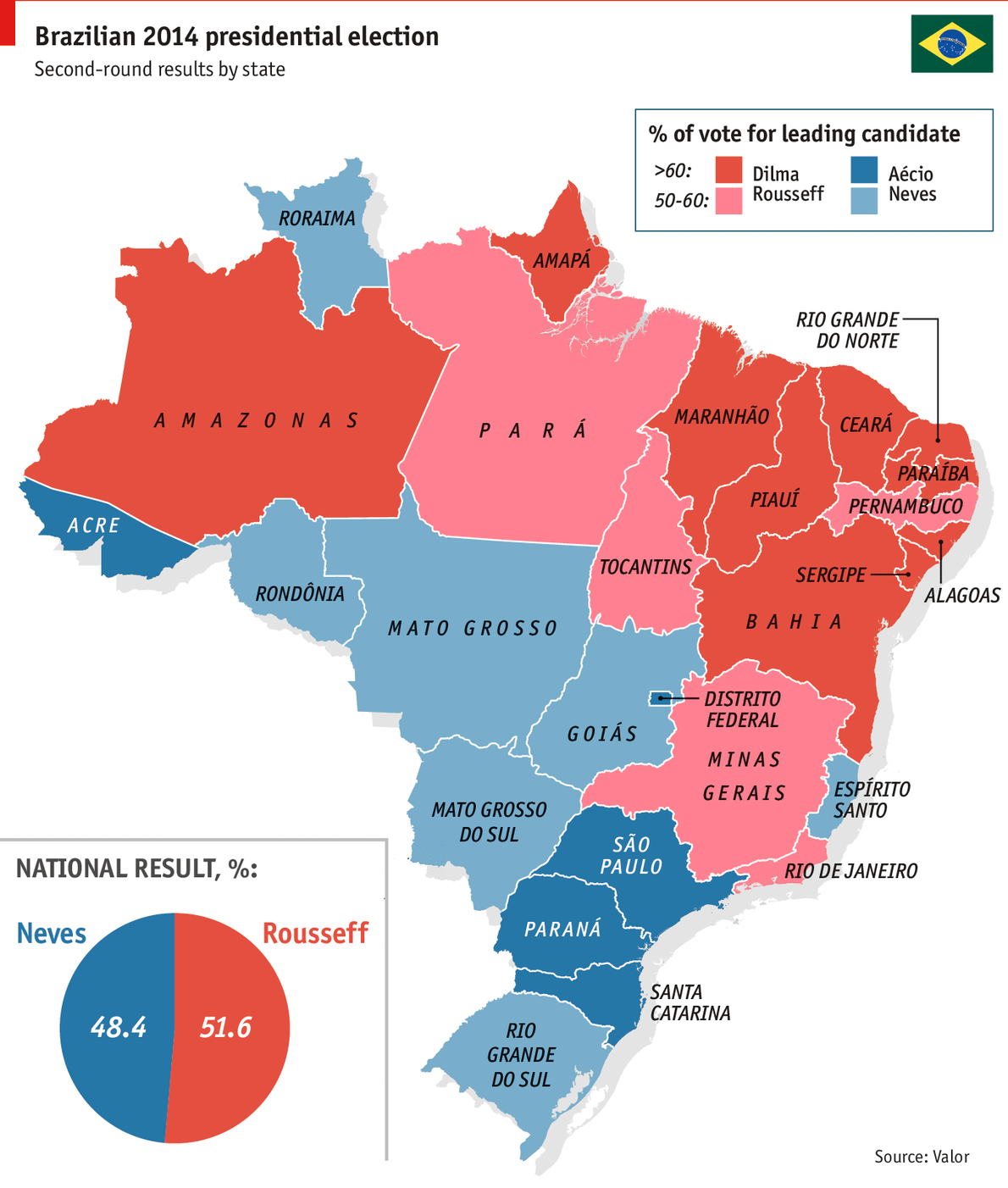
Jan Piotrowski discusses the results of Sunday’s other big election, in which incumbent president Dilma Rousseff, head of the left-wing Workers’ Party (PT), narrowly won re-election over her center-right, pro-market competitor Aécio Neves:

The upshot is that the president will lead a riven country. She romped to victory across swathes of the poor north and north-east—helped by less fortunate Brazilians’ gratitude for the PT’s popular social programmes, but also her campaign’s baseless insistence that Mr Neves would do away with them. Most of the richer south, south-east and centre-west plumped convincingly for her market-friendly rival.

“Despite winning the presidency for the fourth time in a row,” Anthony Pereira writes, “this was not a particularly good election for the PT “:

The party lost 18 seats in the lower house of Congress (though it remains the largest party) and one seat in the Senate (where it is the second-largest bloc). Congress as a whole has become more conservative and more fragmented, its 22 parties swelling to 28. The PT did win five governorships, but only one of them, Neves’s state of Minas Gerais, is in the populous and wealthy south-east. That means the centrist PMDB, a party committed to almost nothing except supporting the government in exchange for patronage, will once again be Dilma’s most important – and most problematic – political partner. The PT’s base, meanwhile, is clearly no longer the solid coalition it once was.

Mac Margolis casts doubt on Dilma’s ability to reunite the country, or even her own government:

Magnanimity is the victor’s disclaimer, but not once in her 27-minute rambling victory lap did Rousseff mention Neves or acknowledge the vote that clove Brazil in two. Lula Inc. don’t do gracious. What their Workers’ Party does do is power, and this is where Rousseff’s victory could sour. It’s not just the widening of the congressional aisle she must reach across. The hazard lies in her own court. Rousseff sits astride a nine-party coalition, where the appetites for patronage and power are now sharper.

Dom Phillips highlights the large numbers of Brazilians who didn’t vote for her, or anybody:

Rousseff needs to address another serious problem: corruption. A total of 54 million people voted for her, but 51 million voted for her opponent. A staggering 30 million simply abstained, even though voting is obligatory in Brazil, while more than seven million voted for no party. This represents a very high rejection of the Workers’ Party, a very real contempt for its repeated sleaze scandals and a widespread distrust of politicians of all stripes.

Pointing to the country’s troubled economy, the Bloomberg View editors advise Dilma to get cracking on reform:

Brazil’s economy entered a recession last quarter, and inflation is running above its targeted range. A global slowdown has hit the prices of commodities that comprise almost half its exports. Its budget deficit is widening, its credit rating in peril. Its economy remains hampered by a Byzantine tax system and formidable thicket of labor regulations. Thanks in part to its poor business climate, Brazil garners less investment than any other member of the BRICS (18 percent of its gross domestic product versus 31 percent for India). Upon news of her re-election, Brazil’s markets and currency promptly tanked. So what can Rousseff do? Her promise to revamp her cabinet offers the opportunity both to bring the country together politically and move it forward economically.

But Juan Carlos Hidalgo doubts she will move in that direction:

Can Rousseff deliver reform? Doubtful. As Mary O’Grady points out today in the Wall Street Journal, “Ms. Rousseff ran as the anti-market, welfare-state candidate.” With an economy not even growing by 1% and a stubbornly high inflation rate, the question Brazilians are asking themselves is whether Rousseff will reform or instead double-down on interventionist policies. One area to pay particular attention to is freedom of the press. What we’ve seen in a number of other Latin American countries ruled by left-wing governments is that, as the economy sours and corruption scandals mushroom, the authorities push for more regulations on the media. Will Brazil follow this pattern? There are good reasons not to be optimistic about Brazil in the next four years.

Meanwhile, Daniel Altman suspects we haven’t seen the last of Aécio – nor of Luiz Inácio Lula da Silva, Dilma’s political godfather:

As I’ve written here before, parties with a stranglehold on their countries for many years tend to become complacent and even crooked. Rousseff’s Workers Party will complete 16 years in the Palácio do Planalto at the end of her second term. At that point, it’s conceivable and even likely that Lula would come back and run again at the age of 72. Rousseff will have to earn him that third term. For now, given her record, the odds of Neves running again and winning must be quite high. He’s only 54, and hey — it took Lula four attempts to win the country’s highest office.

The Flower Of The Arab Spring

Big election news out of Tunisia, where the moderate Islamist party Ennahda has conceded Sunday’s vote to their secular rivals Nidaa Tounes:

Official results have yet to be announced, but Nidaa Tounes said it has won at least 83 seats in the 217-member assembly over about 65 seats secured by Ennahda. Senior Ennahda official Lotfi Zitoun congratulated Nidaa Tounes, but called for the inclusion of Ennahda in the new coalition, for the formation of a unity government. Nidaa Tounes was established to counter Ennahda, and is led by Beji Caid Essebsi, a former parliament speaker under ousted President Zine el-Abidine Ben Ali, and the party includes other former Ben Ali officials, as well as union leaders and independent and secular politicians.

Pre-election Dish coverage here. As we noted, the vote was the first full parliamentary election since the 2011 revolution, and the first held under a new constitution adopted in January. Lindsay Benstead and colleagues breathe a sigh of relief at how smoothly it went:

Sunday’s elections were enormously significant precisely because they were seemingly uneventful.

The turnout was unexpectedly high, reaching over 60 percent of registered voters. Voting was peaceful, and as strong turnout figures came in, Tunisians were exuberant. Perhaps most important, the elections saw peaceful turnover of power. Nidaa Tunis, a party that emerged after uprisings against the Ennahda-led government, emerged the winner, and Ennahda conceded defeat. Now, negotiations over the Cabinet will begin, with all the usual haggling. In stark contrast to experiences in Egypt or Libya, Tunisia’s elections are “politics as normal.”

This is not to say that Tunisians are satisfied. A Transitional Governance Project (TGP) poll conducted in June in conjunction with the Center for Maghreb Studies (CEMAT), with funding from the United Nations Democracy Fund, found that 48 percent of Tunisians believed that they were worse off than they were before 2011. Moreover, Tunisians are disillusioned with parties, elections and politicians.

They sound like Americans. So now what’s the main challenge for Sunday’s victors? John Thorne points to the country’s economic woes:

Tunisia’s economy is ensnarled in red tape that chokes investment and job creation while maintaining a Ben Ali-era economic system that empowers a small elite and concentrates wealth in coastal cities, says a Sept. 17 World Bank report. Wealth gaps, unemployment, and sheer oppression helped trigger 2011’s revolution. Tunisia’s international partners “need to help Tunisia tackle the structural problems that have created economic underperformance and social tensions,” says Antonio Nucifora, the World Bank’s former lead economist on Tunisia. “Tunisians are calling for fundamental changes.”

In particular, they’re calling for jobs. Unemployment and economic problems top public concerns, says a poll by the National Democratic Institute released Aug. 19, while 65 percent of Tunisians say political parties are mainly interested in power.

They sound like Americans. Dalibor Rohac cheers the results as proof that the Arab Spring hasn’t been a complete failure, but worries about the winners’ agenda:

For those who feared that democratization in the MENA region could bring about theocracy and extremism, the status-quo nature of Nidaa Tounes is probably good news. At the same time, however, it seems unlikely that the party, whose sympathizers largely overlap with those of the country’s influential labor unions, will bring about the deep institutional and economic changes that Tunisia needs in order to extend access to economic opportunity to ordinary Tunisians by dismantling Byzantine red tape and corruption and freeing up its economy.

For example, while it is certainly praiseworthy that the party has promised to improve the economic situation of women, one should worry that it plans to do so by what are likely to be popular yet ineffective measures: creating a new government bureau fighting discrimination, investing in social housing for young female workers, and extending statutory maternity leave. More importantly, in many areas the exact economic platform of Nidaa Tounes remains blurry.

Max Boot shares those concerns:

[I]t will be up to Nidaa Tounes to reform a moribund bureaucracy and get the economy moving again. There is little reason to expect that Nidaa Tounes will be up to the task; its leaders appear to be united by little more than their opposition to Ennahda. Many of them have backgrounds in the Ben Ali administration, which they tout as evidence of their managerial experience–but keep in mind that it was the very stagnation of the country in those years that led to the revolution that toppled Ben Ali.

I came away from Tunisia cheered that democracy is functioning and happy that it is not leading automatically in an Islamist direction, but I also came away skeptical about the ability of Tunisia’s political class to address its deep-seated malaise.

But Hussein Ibish gives the winning party more credit:

[I]n the last election Ennahda campaigned on social and economic issues, presenting themselves as the authentic representatives of “the revolution.” Most of its secular and non-Islamist rivals focused on trying to spread fear of Ennahda. It was never going to work.

This time around Nidaa Tounes concentrated on the bellwether issues of economic decline, unemployment and the threat of violent extremism. Of course there was an implicit, and sometimes even explicit, critique of the performance of the Ennahda-led troika government on all these matters. But there was no effort to demonize Ennahda or urge people to vote for Nidaa Tounes out of fear of Ennahda. This time the secularists were clear about what they were for, not just who they were against.

Simon Martelli wonders if Nidaa Tounes and Ennahda will form in coalition:

With neither of the two main parties commanding a majority in the 217-member parliament, they may have to work together to form a strong unity government. Many will balk at the prospect of the Islamists taking part in a new coalition. Their opponents accused them of lacking competence, failing to fix the economy and being a soft touch on extremists, who ran amok during the Islamists’ two years in office. But for all its shortcomings, the Islamist party is widely regarded as moderate, and did make concessions in order to keep Tunisia’s political transition on track – in striking contrast to the Muslim Brotherhood, its Egyptian counterpart, which paid a heavy price for clinging to power as the situation in Egypt deteriorated.

Noah Feldman hopes they will, arguing that an inclusive coalition would guard against extremism:

In the medium to long term, Tunisia faces a real danger from the surprisingly large numbers of young Salafis who reportedly have gone to join Islamic State in Syria and Iraq, and who may ultimately return home and threaten the safety of the government. The existence of this threat could be used by Essebsi as an excuse to exclude Ennahda, which was initially soft on Salafism before eventually cracking down. But if Essebsi is wise, he will see the Salafi threat as a reason to keep Ennahda within a national unity government. Islamists are much better positioned ideologically to crack down on radical Islam than secularists like Essebsi.

What Tunisia needs is a consensus against terrorism and radicalism — and in favor of democratic institutions. With both, the small country may be able to continue as a beacon of democracy in the Arabic-speaking world.

Totten is confident on that score:

Much hay is being made of the fact that a large percentage of Islamic State terrorists in Syria and Iraq hail from Tunisia. We can speculate about the reasons for that, but I can tell you with absolute confidence that it’s not because Tunisia has a broader base of support for totalitarian political Islam than other Muslim countries. … There is no chance of establishing an ISIS-like “caliphate” on that soil unless an army invades and conquers it from the outside. The ideology can appear there, but it cannot grow there.

A Social Issues Candidacy

Sen. Mark Udall has made social issues a prominent focus in his campaign against Republican Cory Gardner, so much so that The Denver Post joked that if the race “were a movie, the set would be a gynecologist’s office, complete with an exam table and a set of stirrups.” Udall has not only dinged Gardner for past support of an unpopular personhood amendment, but also run an ad claiming that Gardner was engaged in a decade-long campaign to “outlaw contraception.” Udall has been dubbed “Mark Uterus” for these efforts and his lead in the polls has shrunk to a tie.

But in the case of Wendy Davis, the miscalculation about how far social issues could carry liberals is even clearer.

Davis was an obscurity in the Democratic Party before her 2013 filibuster of abortion regulations that threatened Texas clinics with closure. Fascination with her shoes exceeded that normally given to the Roman Pontiff‘s footwear. The money poured in. Here was a national figure for the moment, a Joan of Arc ready to win the War on Women.

Alas, social issues are not enough. Polls show that Attorney General Greg Abbott, an anti-abortion Catholic, is attracting as much or more support from Texas women as Wendy Davis.

His bottom line:

[S]ocial issues are rating near the bottom of voter concerns heading into the 2014 election. Abortion and other social issues rarely rate more than a few percentage points above zero when Gallup polls voters on their concerns. It turns out that the Republican implosion on social issues in 2012 was not a prelude to Democratic triumphs on the same.

Judis takes a close look at Democrats’ chances in Texas. He focuses on Davis’ weakness with Hispanic voters:

Success in mobilizing the Hispanic vote … depends on nominating candidates in Texas (and also nationally) who can appeal to these voters. According to several Democrats I talked to, Davis hasn’t “connected” to these voters. In the primaries, she even lost several small counties to a token Hispanic opponent. She is principally known in the state for her stand on behalf of abortion rightswhereas many of Texas’s Hispanics oppose abortion. Democrats urged San Antonio’s former mayor Julian Castro, now the secretary of Housing and Urban Development, to run, but he declined, probably one San Antonio political leader speculated, because he feared certain defeat.

But there are places where she may have made inroads:

By garnering support in the Dallas, Austin, San Antonio, Houston, and El Paso metro areas, the Democrats might be able to get the 30 percent or more of the [white] vote they need in presidential elections, and eventually the 35 percent they need in state elections.

In these metro areas, Texas Democrats can attract the same white voters who boosted Democrat hopes in states like Virginia and North Carolina: younger voters, who came of age after the Reagan-Bush era, professionals, and women. Davis’s candidacy has probably helped among these voters. In a late September poll that showed Davis behind Abbott by fourteen points, she still had an edge among women and voters 18 to 44, while getting trounced among male and older voters. (In the same poll, Davis only get 50 percent of Hispanic vote.)

The View From Your Window Contest: Winner #228

VFYWC-228

A reader squeals:

FINALLY one I recognize at first glance! I can’t pinpoint the exact location (Google Street View is limited in the marshy/industrial areas by the Bay), but I could drive there on my way home from work. The yellow building is San Quentin Prison.

Another is thinking Reyjavik, while this one looks to mainland Europe:

Reminded me of Sète, on the southern French coast. Took a look at a couple of photos and … it’s not. Probably nearby, though!

Relatively nearby. A principled reader gets us closer:

Penzance, England. Looking eastward. I don’t think it’s fair to research these.

Another gets lost in Cornwall:

Classic VFYW: at first glance, impossible. Then, I find one clue to substantially narrow the range of my search and feel like it is within my grasp. Four hours later, it once again seems impossible.

Another thinks through the evidence:

This week’s photo really fascinates me, though I have no idea where it is, except that it’s someplace in Britain or Ireland. That’s easy enough to tell because of the double, yellow no-parking lines painted on the street, the stonework in the wall, and the fact that this place looks rather chilly. What is that white, round building anyway? A lifeguard station? Really? An old bunker for observing Nazi planes? (That would explain the observation platform on top.) What about that thing in the ocean in the right-hand side of the picture, between the rock and the lamppost – what is that? Is it really attached by a line to the aluminum pole just to the left of the lamppost or am I seeing things? If this really is somewhere in Britain or Ireland, why is the hillside on the left so devoid of vegetation?

I could go on and on. I’m really looking forward to finding out at least some of the answers to these questions.

This reader just misses the mark:

Stalwart folks enjoying the beach in cold weather, the double line, and the kerbstones scream British Isles. The color and shape of the houses is more Ireland than England, I’m thinking. Sandy beach AND rocky shore suggests north.  The shadow of the building suggests east/northeast coast. No scraggly palm trees, so not Man. Googling “cement blue bench” and “UK promenade light post” returns nothing helpful. Might be Cornwall or Wales or Scotland too. But I can’t find it so I’m hoping for proximity here. Bangor, Northern Ireland, UK?

Another hits the target by heading south:

On the “Coffee Difficulty Scale”  (the temperature of the coffee upon getting the answer corresponds to the difficulty of the window), this one scores Lukewarm.

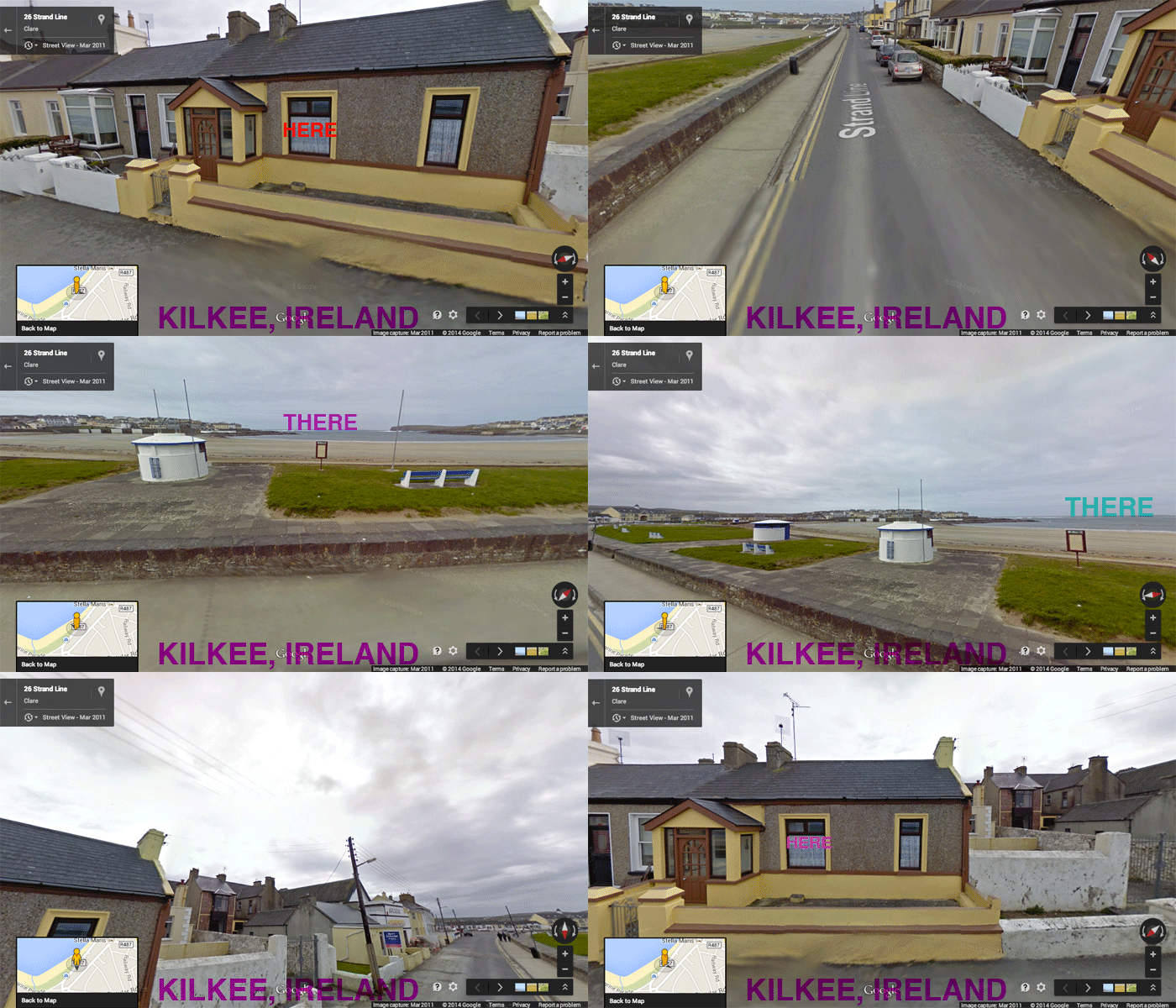
The British influence is strong with the houses here. The double yellow line on the roadside confirms we are somewhere on the British Isles. I was pretty solid on this being either Scottish or Irish, with a possibility of somewhere in Cornwall. I almost looks like St. Ives, but without a seawall, I ruled it out. With some tinkering of search terms, I found Kilkee, Ireland pretty quickly. I could not make out any house numbers, but I think it’s either 26 or 28 Strand Line, Kilkee Ireland. Since I’m putting off raking the leaves outside, I made a picture this week:

Kilkee Ireland Contest 10-25

Now the only question is, do I stick this last half cup of coffee in the microwave, or just down it and get on with my yardwork?

For the record, it’s 26 Strand Line, but that reader nailed the right window. Meanwhile, a father feels some in-home pressure from the next generation of contest savants:

My 9-year-old son is now in the game (and playing Geoguessr on the rare occasions he’s allowed on the computer) and will soon be an force to be reckoned with. He got half way around the coast of Ireland from Dublin before I found a tipoff image under “Irish coastal towns.” Two minutes more and he would have beaten me to it.

But nobody can touch our favorite GIF-contestant, who really gives this week’s view a spin:
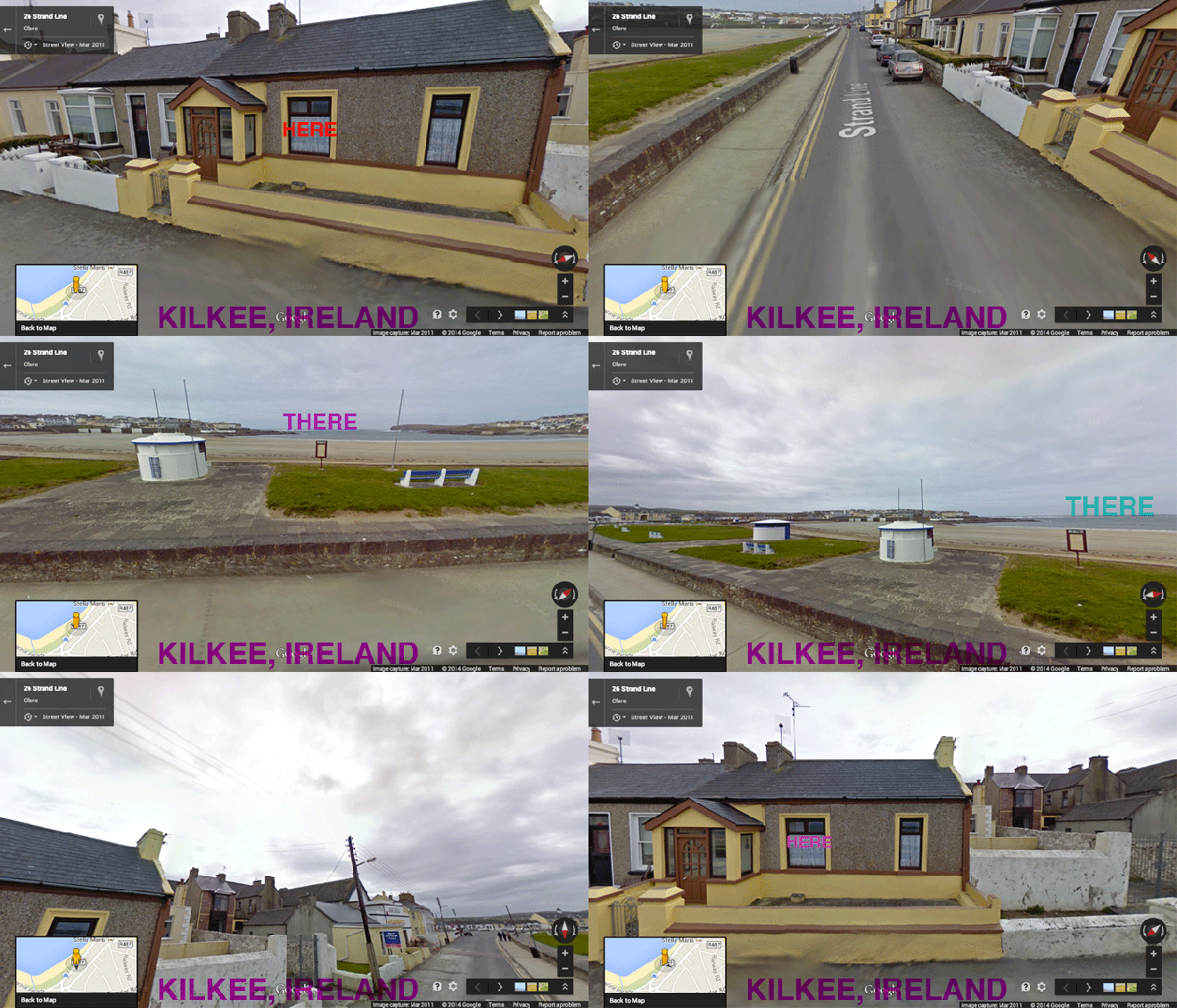
kilkee

A former winner really does his research on Kilkee:

Attached is the contest picture with labels for features in the scenery and directions to the statute of the late actor Richard Harris playing squash and one of the murals of Che Guevara around the town.
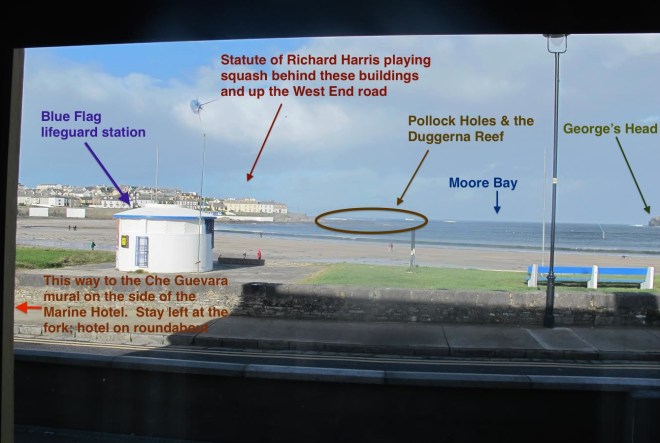
228 with labels

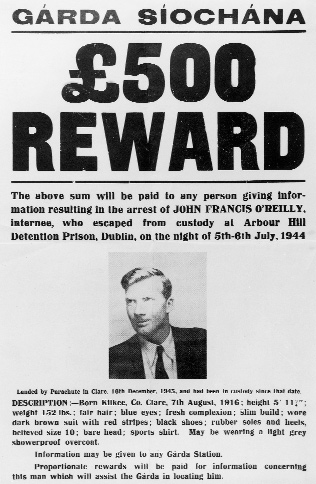
One of the features in the picture is George’s Head, the 100-foot cliff rising up from the bay on the right.  It was off George’s Head that John Francis O’Reilly claimed to have ditched the wireless set provided by his German handlers of the Sicherheitsdienst (a/k/a/ “SD”) before turning himself in to the gardaí on the night of 16 December 1943.  O’Reilly parachuted (out of a Heinkel He 111 or a Junkers JU-88 bomber) into Ireland a short distance from his parent’s home in Kilkee around 2 am and presented himself to the authorities later that evening after he learned the authorities were making inquiries.  His radio transmitter and £143 of the £300 the SD handed him were recovered in the yard of his parent’s house.  (See Terence O’Reilly’s book Hitler’s Irishmen and Anthony Kinsella’s article John Francis O’Reilly: The “Flighty Boy”).

Prior to his insertion as a German spy, O’Reilly read bulletins, poetry and other content on the Nazi’s Irland-Redacktion radio service aimed at spreading pro-German and anti-British propaganda to Irish audiences.  Given his quick arrest and subsequent military prison sentence, O’Reilly did not feed the Germans information on US and British army and navy activity in Northern Ireland as originally instructed. As for the Richard Harris statute, Harris won the Tivoli Cup for Racquets in Kilkee four years in a row (1948-51).

Another has a personal connection to the view:

I’ve tried in vain to find the location, but haven’t been successful.  The frustrating bit is the Royal National Lifeboat Institution (RNLI) lifeguard station in the picture – I thought that would help.

As an aside, I live in NYC and I am married to a Londoner.  A few months before I met my (now) wife, her mother passed away. That I didn’t get the chance to meet my wife’s mother is my great loss – by every account she was an amazing and loving person and inspired all who knew her. She was also a supporter of good works, including the RNLI. And as a tribute to this amazing woman, I make a donation to the RNLI in her memory every year on the anniversary of her death.

This Irish Dishhead is very familiar with the area:

Total time to recognise this location: 0.05 seconds. But that’s hardly surprising as I’m from County Limerick, Ireland and most people from Limerick would be able to recognise Kilkee in less than a second. Kilkee, for most Limerick folk, is like a second home. During the summer months, Kilkee becomes Little Limerick for there is scarcely a family from Limerick that doesn’t have a relative who doesn’t own or rent a mobile home (caravan or trailer) or holiday home in Kilkee where they spend the majority of their summer holidays.

Personally, I’ve been going to Kilkee since before I can remember. When I was a kid, my parents used to rent a holiday home on the West End (the exact area isn’t actually captured n the photo but the white walls on the beech in the photo is an area where people play a hybrid of tennis/squash and our holiday home was just off the Dunlicky Road just behind that. It’s common for most Limerick people to leave work on a Friday evening and wish everyone well and tell them that you’ll see them on Monday, take the 70 minute trip down to Kilkee, get a bite to eat and head of to The Greyhound Bar or Fitzpatricks Pub or Scotts Bar (or any other Kilkee pub) and wind up having a drink with half of the people they’ve just wished a good weekend to at work.
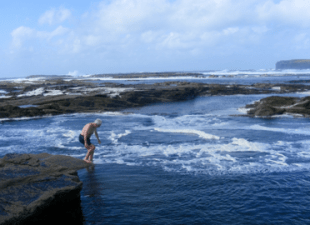
Untitled1The Dunlicky Road is very well known in Kilkee and is one of the famous walking routes in the area. The walk takes you up the Dunlicky Road over towards Intrinsic Bay (not too far away from the Diving Boards) and finally over to the Pollack Holes. It’s considered one of the best natural cures for a hangover. The Pollack Holes are natural holes that have formed in the rocks that are covered by the Atlantic during high and for six months of the year, are a breeding ground for Atlantic Pollack, but during the summer months, when the tide is out, they are one of the most populated swimming spots in Kilkee. But they’re bloody freezing at the best of times! If anyone from the Dish ever decides to visit the area, I have one recommendation: bring a wetsuit! I Googled the Pollack Holes just to see what I’d get back and came across this photo of a brave man who evidently had no fear of the cold … Christ only knows how he survived.

Springsteen played a gig in Limerick last year in Thomond Park (home to the Munster Rugby Team – “G’Wan Munster!”). During his stay in Ireland, The Boss took a trip down to bossKilkee and stopped in Scotts Bar on the Main Street (properly known as O’Curry Street) in Kilkee and the photo went viral on Facebook and twitter for all Limerick people who were raging that they missed the opportunity to get locked (drunk) with The Boss in one of Kilkee’s better watering holes (another tip for anyone planning on visiting Kilkee – avoid Miles Creeks pub – kind of a rough crowd.) [Ed note: see reader update debunking this story at the bottom of the post.]

The window I found is different from the one in Google Maps, but that could be as a result of damage caused by a storm on February 12th of this year (subsequently nicknamed “Wild Wednesday”) that battered Kilkee and other locations on Ireland West Coast including Limerick City. The main bandstand in Kilkee was practically destroyed and quite a bit of damage was done to the promenade on Kilkee beach, but the local town council did a fantastic job of cleaning the area up and repairing the damage in time for the annual summer pilgrimage of Limerick residents to the area. I’m therefore assuming that the new looking wall and window were recently installed.

Another reader has a look at the damage from the storm:

Kilkee - Blue Flag

More on the town from one of several contestants who’s been there::

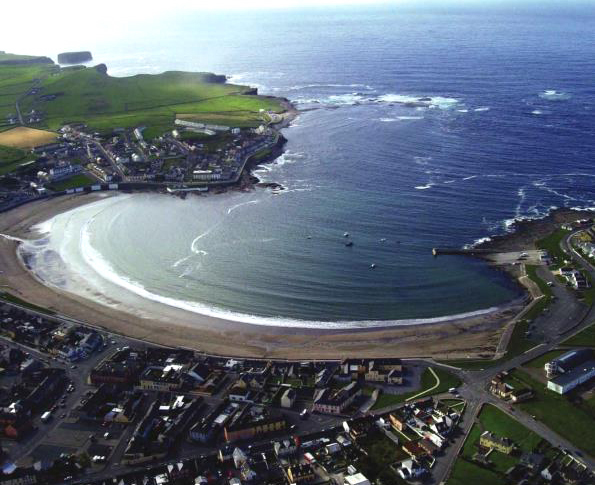
Kilkee is a Victorian seaside resort in Co.Clare in the west of Ireland that was hugely popular with Irish families in the sixties and seventies before cheap flights to Spain and Portugal took them to more reliable sunshine. The small round white building is the lifeguards’ hut on the Strand Line promenade.  The absence of a small flag from the roof indicates that they’re not in residence today, or not yet anyway. The shadows show the picture was taken in the morning. The hut is one of three round shelters that were originally built to cover fleeing beachgoers from the always imminent rain. The Strand Line seawall dates from Kilkee’s Victorian heyday, when Kilkee was popular with English visitors. Charlotte Bronte visited on her honeymoon in 1854. The seawall wraps around a magnificent horseshoe-shaped beach:

418110

Sponsored Content: The Irish Tourist Board has asked me to point out that the Kilkee/Loop Head area has some truly stunning Atlantic seascapes, less well known than the Cliffs of Moher in the same county, but not as tourist-infested:

doonaha3

Kilkee is also a major centre for safe and spectacular scuba diving. And here’s Kilkee’s beach on a recent summer’s day, just as I remember it in the ’70s.  Note the cloud shadow:

x_large

Speaking of shadows, Chini admits that even he suffers from routine bouts of contest terror:

After this much time and experience, you’d think it would go away; that terrifying feeling every time a new one pops up. That a sort of confidence would have developed. But no, it’s always the same. The mad desire to look around, that growing, gnawing sense of imminent failure, and the voice in the back of the head whispering “…you may never get this one.” Then, from nowhere, a sudden insight and a realization that there was nothing to worry about at all:

VFYW Kilkee Overhead Marked - Copy

This week’s winner is a four-year-veteran who hails from our esteemed list of players who have guessed difficult contests in the past but never won:

This view shows us a day at the beach in Kilkee, a resort town in County Clare, Ireland.  The double yellow lines next to the curb suggested we were somewhere in the British Isles.  My gut told me this was probably a seaside town in Ireland, but I ignored my gut and went on an extended detour through the beaches of the United Kingdom.  Bad call.

When that didn’t work, I went down a list of beaches in Ireland and found the beach in Kilkee.  The view was taken from a one-story home on the Strand Line, a scenic street that runs parallel to the beach.
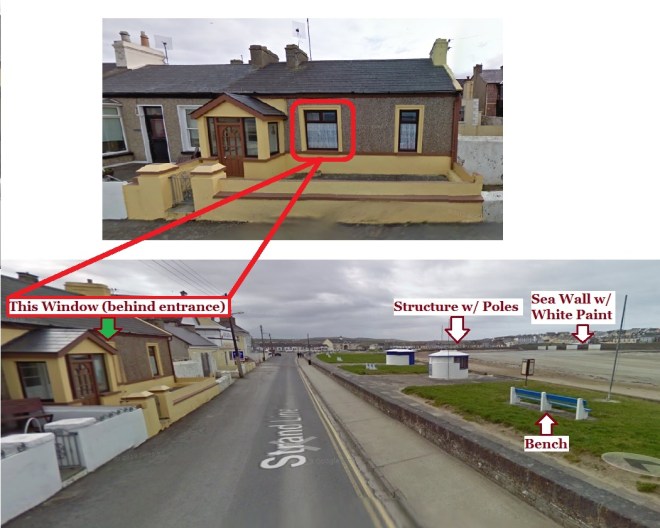
VFYW Kilkee

Kilkee has a number of claims to fame, one of which is that the actor Richard Harris used to summer there.  The town honored him with a statue of him playing squash, which was unveiled by Harris’ family and Russell Crowe.  Also, the sea wall in the background used to host (improbably) a 20-foot mural with the iconic image of Che Guevara, which would’ve been just out of view to the left had it not been painted over last year.  Guevara spent a night in Kilkee and was recognized there by the artist Jim Fitzpatrick, who went on to create the famous image.  The mural was painted over after it upset some Americans who saw it and apparently left town in protest.  It’s fair to say that either the statue or the now-departed mural would’ve made memorable clues.

Congrats on a long-deserved victory. For everyone else, get ready for the next view Saturday!


Update from an Irish reader:

We have a “Bruce Springsteen in Kilkee” controversy! Your reader was duped by a photo supposedly showing Bruce Springsteenboss-orig outside Scott’s bar in the town. This was Photoshopped. The real picture took place in New Jersey. It’s very obvious when you compare pictures which one is real. Your reader is not alone in these parts to believe Bruce visited Kilkee while he played a concert in Limerick last summer, but unfortunately there is no evidence he was ever in Kilkee.

Update from a Californian reader:

The first guess of San Quentin Prison made me laugh out loud. I had noticed the similarity as well. In case you are not familiar with that view, here’s a photo I took recently from the Corte Madera Ecological Reserve looking toward San Quentin and the Richmond-San Rafael Bridge. It’s almost like a Kilkee parallel universe:

IMG_0163

(Archive: Text|Gallery)

There He Goes Again

VATICAN-POPE-AUDIENCE

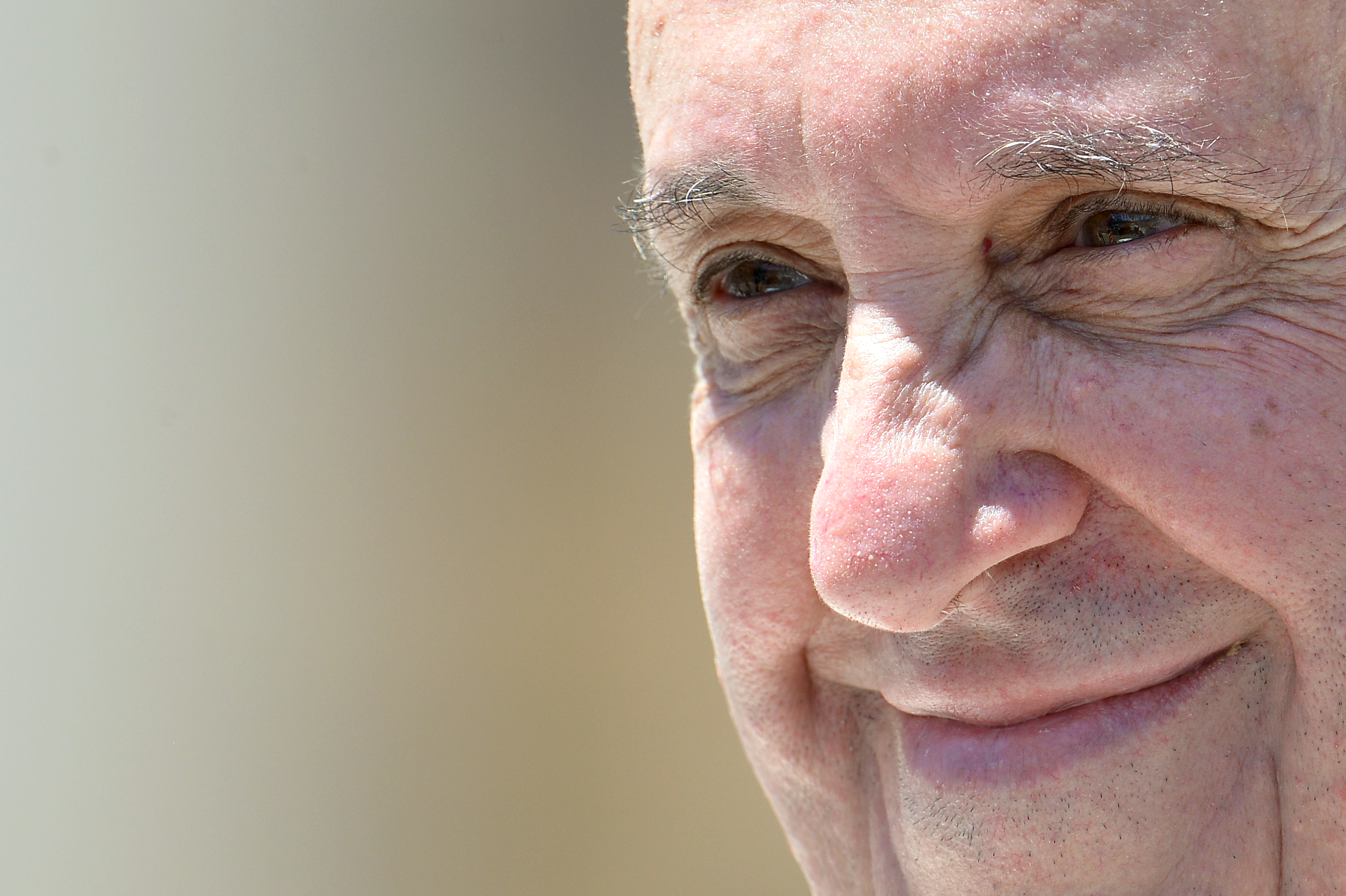
Here’s a quote for the day from Pope Francis:

When we read about Creation in Genesis, we run the risk of imagining God was a magician, with a magic wand able to do everything. But that is not so. He created human beings and let them develop according to the internal laws that he gave to each one so they would reach their fulfilment. The Big Bang, which today we hold to be the origin of the world, does not contradict the intervention of the divine creator but, rather, requires it. Evolution in nature is not inconsistent with the notion of creation, because evolution requires the creation of beings that evolve.

None of this is new, of course. Catholics in general do not buy the irrational and anti-intellectual delusions of evangelical Protestants with respect to Creation and the origins of the universe. But what it does is reinforce a very American dimension to the Francis effect in the Catholic church: the church has effectively switched sides on several key issues in the American culture war.

Damon Linker has a typically insightful piece on this question with respect to the core cultural battles over sex, marriage and family that have divided Americans for several decades now. And this helps explain Ross’s adoption of resistance to Francis’ pastoral revolution: a key, legitimizing rampart of the social right in America – the Vatican – has been partly kicked away. If the Pope sees value in some aspects of gay relationships, for example, how does a Catholic remain committed to the party of Rick Santorum and Gary Bauer?

On the question of evolution, the value of gay relationships, the validity of climate change, and the utter impermissibility of torture, Francis has made the life of the conservative Catholic Republican a lot more complicated. The GOP, for example, is dominated by white evangelical Protestants. On evolution, they are regressing, not reforming:

Americans entered 2013 more opposed to evolution than they have been for years, with an amazing 46 percent embracing the notion that “God created humans pretty much in their present form at one time in the last 10,000 years or so.” This number was up a full 6 percent from the prior poll taken in 2010. According to a December 2013 Pew poll, among white evangelical Protestants, a demographic that includes many Republican members of Congress and governors, almost 64 percent reject the idea that humans have evolved. Among Democrats, acceptance of evolution increased by 3 percent, to 67 percent, while among Republicans it decreased from 54 percent to 43 percent.

On climate change, the Pope has been emphatic (and in a way that has commanded far more attention than Benedict’s identical musings) on about our moral responsibility for conserving the earth:

Creation is not a property, which we can rule over at will; or, even less, is the property of only a few: Creation is a gift, it is a wonderful gift that God has given us, so that we care for it and we use it for the benefit of all, always with great respect and gratitude. Safeguard Creation. Because if we destroy Creation, Creation will destroy us! Never forget this!

Compare that with the Fox News view that climate change is a massive hoax. On torture, rendition and indefinite detention without trial in Gitmo, the Pope was recently unequivocal:

Francis took aim at practices that have been hotly debated in the U.S, such as the so-called “extraordinary rendition” of terror suspects to other countries, which the pope described as the practice of “illegal transportation to detention centers in which torture is practiced.” The pope called out both the nations that use such practices and those who allow it to happen on their territory or allow the use of their air space for other countries to transport detainees.

Notice that the Pope, unlike his predecessor, doesn’t duck the core question of American torture at Gitmo and other black sites. On the death penalty and life imprisonment, he is just as clear:

“All Christians and people of good will are called today to struggle not only for abolition of the death penalty, whether legal or illegal, and in all its forms, but also to improve prison conditions, out of respect for the human dignity of persons deprived of their liberty,” the pope told delegates from the International Association of Penal Law. “And this I connect with life imprisonment,” he continued. “Life imprisonment is a hidden death penalty.”

On prison reform, Francis has, happily, some Republican pols on his side. But when you observe the rhetoric from a man like Senator Pat Roberts on Gitmo and super-max prisons in general, you can see the huge gulf between the Pope and the id of the American right.

Let me be clear here. I’m not now invoking a religious authority to determine a view of secular politics in the US. Francis’s arguments, like anyone else’s, should succeed or fail on purely secular terms. And to claim Francis for the Democrats or the American left would be deeply misleading and pernicious. He remains, to take one obvious example, opposed to the taking of human life at any stage of development; and he does not believe that gay relationships can be described as marriages. All I’m saying is that the social right and Republican base has long counted on the papacy as a natural ally in the vortex of the American culture war. They can count on it no more. Which means that the evangelical-Catholic alliance, entrenched under Benedict XVI, and a key component of the American right’s fixation on abortion, gays and religious freedom as primary public issues, is teetering.

May it soon collapse entirely. It would be good for the right; and good for Catholicism.

(Photo: Alberto Pizzoli/AFP/Getty)

How Do We End Child Labor?

BANGLADESH-SOCIETY-ECONOMY

Laws against it can do more harm than good:

The complex economics of family finances show why simply passing laws against child labor can backfire. The impact of India’s 1986 landmark legislation against child labor in factories is one example. Economists Prashant Bharadwaj and Leah Lakdawala studied child labor rates and payments before and after the ban was implemented across different industries. They found the result of the law was to drive wages for children down and the number of hours they worked up.

Paying families who send their children to school has had more success:

A number of countries have introduced cash transfer schemes that pay families with kids in school. Mexico’s Opportunidades program gives mothers as much for keeping the girl in the ninth grade as two-thirds the amount a girl would earn in the labor force. The program has reduced child labor rates by as much as a quarter. And because sending kids to work is a choice of desperation for most parents, even unconditional cash transfers—simply giving poor people money with no strings attached—has reduced child labor rates in Malawi and South Africa. Providing free school meals is another approach (pdf) to increase enrollment and improve learning.

(Photo: Bangladeshi child labourers wash their hands before lunch at an aluminium pot factory in Dhaka on October 21, 2014. More than 6.3 million children under the age of 14 are working in Bangladesh, according to a UNICEF report on child labour. By Munir Uz Zaman/AFP/Getty Images)

Hillary Clinton’s Unforced Error

She is taking some heat for this comment:

Don’t let anybody tell you that, you know, it’s corporations and businesses that create jobs.

It’s a useful indicator of what may well happen in a future presidential campaign: the gaffe-prone politicking, the Republican noise machine, the re-calibration of position, the charge of being fake … oh God, please stop it now! Philip Klein characterizes the remark as feeling pressure from Warren:

She had made the statement campaigning on Friday for Martha Coakley, who is seeking a Senate seat in the state of liberal populist Elizabeth Warren, D-Mass. But Clinton now claims she meant to make a point about corporations that outsource their jobs overseas and just “short-handed” the point.

Just to put things in perspective, the latest ABC News/Washington Post poll gives Clinton a 53-point lead over Warren nationally in a hypothetical Democratic nomination battle. A University of New Hampshire poll has Clinton ahead by 40 points in Warren’s backyard. The 2014 midterms aren’t even over yet and there’s no indication Warren intends to run. And yet merely hearing the footsteps was enough for Clinton to attempt co-opt Warren’s populist message in an embarrassingly clumsy way.

Tobin chalks up the gaffe to Hillary’s inauthenticity problem:

Clinton understands that although Warren has wisely decided to decline to attempt to challenge her for her party’s presidential nomination, her left-wing populism makes her the darling of Democrats. Though she can’t be too worried about a gadfly like Senator Bernie Sanders providing competition in the 2016 primaries, Clinton needs the enthusiasm as well as the support of her party’s liberal core. So when placed alongside Warren, her instincts tell her to not merely echo the Massachusetts senator’s attack on the market economy but to go even further down the ideological road to a place that must surely baffle the Clinton enterprise’s big money Wall Street donors. …

Democrats are laboring under the delusion that Clinton is a political colossus who will follow in Barack Obama’s footsteps and sweep aside any GOP opposition in another historic campaign. But this misstep is a reminder that she has never (as Obama knows all too well) beaten a tough opponent in an election and is capable of blowing elections that seem impossible to lose. Even if this doesn’t tempt Warren to try and steal the party out from under Clinton’s nose, it should encourage Republicans who may believe that changing demographics and other problems doom their party to inevitable defeat. Americans can smell a phony from a mile away and this week Hillary proved again that this is her glaring and perhaps fatal weakness.

Ezra, for one, continues to dream of a Warren run:

If Warren were, say, the chair of the Senate Banking Committee, and if Democrats controlled the House and the Senate and the presidency, then there would be a good argument that Warren could do more as a legislator than as a candidate. But Warren is, in real life, the second-most junior senator on the Banking Committee. And she’s likely to be serving in a Senate controlled by Republicans, at a time when the White House is controlled by a Democrat, and absolutely nothing is getting done.

So it’s not just that running for president could do an enormous amount to push Warren’s issues forward. It’s that hanging around the Senate isn’t going to do anything for Warren’s issues at all. It’s hard to imagine two better years to spend away from the Senate than 2015 and 2016.

Weigel says it’s not gonna happen. Back to the gaffe at hand, Chait wryly remarks that “now we know that all the players are fully prepared to reprise their assigned roles as the 2016 campaign begins following next week’s election”:

The context of her remarks, in which she proceeded to denounce the Republican plan to reduce taxes and regulations for business, made it fairly clear that Clinton actually meant to disagree with the idea that its policies designed to benefit corporation and businesses that create jobs, not that jobs are actually formed mostly by private businesses.

Nonetheless, it was good enough to crank up the gaffe machine. Conservatives used the gaffe as a hook for unhinged paranoid claims that Clinton has revealed her secret hate for capitalism. (Forbes argues that Clinton has exposed herself as one of “certain deeply committed progressives do not support large-scale private free enterprise and do want the government to manage, control and oversee sector after sector of the economy.”) Likewise, the mainstream media dutifully conveyed the controversy. (Bloomberg reported that Clinton has “flip-flopped on whether companies create jobs,” citing three passages in her recent book that assume companies and businesses can create jobs. Almost as Clinton somehow … believes that companies create jobs.)

Beutler expects attempts to politicize the remarks to backfire:

Republicans are no less obsessed with gaffes today than they were in October 2012. Just last week, Republicans were riding high on President Obama’s gaffetastic observation that Democrats in the Senate vote with him most of the time, and before that, his admission that the policies he supports are on the ballot in November. But what makes their obsession with this gaffe particularly revealing is that it’s substantively identical to a gaffe they seized upon two years ago, weeks before they went on to lose the electionto their great astonishmentby a pretty wide margin.

In 2012, Republicans made “you didn’t build that”a decontextualized comment Obama made about the fact that the wealthy depend on and must contribute to the public spacethe unifying theme of their party convention in Tampa, Florida. They were certain that it would cause, or at least contribute, to Obama’s demise. But in hindsight, many conservatives acknowledged that the GOP’s obsession with that gaffe revealed more damaging truths about the Republican Party than the gaffe itself revealed about Obama.