The Beneficiaries Of Our Climate Response

David Roberts contrasts preventing climate change with adapting to it. He focuses on the altruism of global warming prevention:

Remember the famous carbon time lag: Carbon emitted today affects temperatures 30 (or so) years from now. So mitigation today doesn’t actually benefit humanity today; it benefits humanity 30 years in the future, when the carbon that would have been emitted would have wrought its effects. It benefits people who are both spatially and temporally distant. That’s almost pure altruism.

Roberts sees climate adaption as “nearly the opposite” of that:

It is action taken to protect oneself, one’s own city, tribe, or nation, from the effects of unchecked climate change. An adaptation dollar does not benefit all of humanity like a mitigation dollar does. It benefits only those proximate to the spender. A New Yorker who spends a dollar on mitigation is disproportionately preventing suffering among future Bangladeshis. A New Yorker who spends a dollar on a sea wallis preventing suffering only among present and future New Yorkers. The benefits of adaptation, as an iterative process that will continue as long as the climate keeps changing, are both spatially and temporally local.

One obvious implication of this difference is that, to the extent spending favors adaptation over mitigation, it will replicate and reinforce existing inequalities of wealth and power. The benefits will accrue to those with the money to pay for them.

Americans Support Strategy They Know Won’t Work, Ctd

Aaron Blake highlights a Pew poll that shows Americans are united in their support for military action against ISIS:

9-15-2014_01But that unity is only a few inches deep. That’s because it’s becoming clear that Republicans are angling for a more active role in combating the Islamic State, while Democrats are very much concerned about so-called “mission creep” — i.e. getting too involved and not being able to go back. Pew asked people whether they were more concerned about going too far in Iraq and Syria or not going far enough. Republicans and conservatives both say overwhelmingly that they worry about not going far enough; Democrats and liberals worry more about doing too much. It’s basically Iraq 2004 — 10 years later.

And who was right then? Waldman entertains the possibility that the public isn’t being hysterical after all:

Only 18 percent of Americans overall — 23 percent of Republicans and 15 percent of Democrats — think the new military campaign will decrease the chances of a terrorist attack here at home. You can slice these data a couple of ways, of course, but around two-thirds to three-quarters of every group believes that the campaign will either increase the odds of a terrorist attack or not make much difference. Yet a majority supports it anyway.

I don’t think there’s necessarily anything confused about that; in fact, it might be a mature, sober judgment. People may believe that ISIS is primarily focused on what it’s doing in the Middle East, and going after them could, in the short run, lead them to try to retaliate against us with a terrorist attack here. But the public might also believe that despite that risk it’s the right thing to do. If that’s so, it would indicate a public reluctantly going along with a limited military action, not one driven by fear and chanting for blood.

So the public wants to launch a war on terrorism that it doesn’t think will decrease terrorism. That leaves those who believe it is “the right thing to do.” Does that mean right as in ISIS is “identical” to the Nazis, as O’Reilly has it? Or as in: it’s so despicable we should attack it even though it won’t work? That does not encourage me about the future of American foreign policy. Drum picks up on the same theme:

Only 18 percent of Americans think that fighting ISIS will reduce the odds of a terrorist attack on US soil. And there’s not a big difference between the parties. Even among Republicans, only 23 percent think a military campaign against ISIS will make us safer at home. That’s a refreshingly realistic appraisal.

But why? Is it because the Republican fear campaign is so transparently unhinged? Or is it because of President Obama’s unusually low-key approach to the ISIS campaign? I’d like to think it’s at least partly the latter. I’m not very excited about any kind of campaign against ISIS at the moment, but as a second-best alternative, it’s at least nice to see it being sold to the public as a case of having to eat our vegetables rather than as yet another exciting bomb-dropping adventure in defense of our national honor. It’s a step in the right direction, anyway.

James Lindsay flags another new poll from the Chicago Council on Global Affairs that illustrates Americans’ contradictory foreign policy tendencies in general:

At first blush the Chicago Council’s poll numbers reaffirm the current conventional wisdom that Americans are more skeptical toward foreign engagements. While a majority of Americans (58 percent) say the United States should take an “active part” in world affairs, the percentage who favor “staying out” (41 percent) is the highest since pollsters first began asking the question back in 1947. (The Chicago Council has been conducting its periodic foreign policy surveys since 1974.) As a result the gap between Americans favoring “active part” over “staying out” has shrunk to its smallest ever, just 17 percentage points.

But the public’s response to other questions in the poll suggest that an increased wariness about foreign policy is not the same as a sharp turn inward. More than eight in ten Americans say that strong U.S. leadership in world affairs is desirable, in line with previous responses to the question. Just as important, even those who want the United States to “stay out” of world affairs think that strong US leadership is either “very desirable” (19 percent) or “somewhat desirable” (50 percent).

But that’s such a vague question it’s had to know what to make of the answer. I mean: who would want the US not to exercise strong leadership? The question is: to what ends? And is it prudent? And can it be controlled?

The Other NFL Abuse Scandal

Vikings running back Adrian Peterson has been accused of beating his kid. Amy Davidson runs through what appears to have happened:

This preschooler wasn’t paddled or, as Peterson put it to police, “swatted”; he was whipped with a stick and left with open wounds on his body. It’s also not obvious that Peterson has been at all straightforward. (This is something a jury or judge will work out.) In his statement, Peterson said, “I have to live with the fact that when I disciplined my son the way I was disciplined as a child, I caused an injury that I never intended or thought would happen.” This is apparently a reference to the specific wound to the child’s scrotum and a particularly ugly one to the leg. (In another text message, he told the boy’s mother the same thing, adding, “Got him in nuts once I noticed. But I felt so bad, n I’m all tearing that butt up when needed!” He also wrote that she would probably get “mad at me about his leg. I got kinda good wit the tail end of the switch.”) Peterson claimed to the police that he hadn’t noticed that the “tip of the switch and the ridges of the switch were wrapping around” the boy’s thigh.

Amanda Hess, who strongly disapproves of such punishments, notes:

Reactions from around the NFL imply that “love” is a valid reason for beating a child. “I got a ass whippn at 5 with a switch that’s lasted about 40mins and couldn’t sit for 2days. It’s was all love though,” Arizona Cardinals defensive end Darnell Dockett tweeted in Peterson’s defense. Added New Orleans Saints running back Mark Ingram Jr.: “When I was kid I got so many whoopins I can’t even count! I love both my parents they just wanted me to be the best human possible!”

Khadijah Costley White asks for less emphasis on race:

[I]f you think the media coverage of men like Ray Rice or Adrian Peterson make black people look bad, then just think what it looks like when you defend and justify their abuse. …

More than 1,500 children died from abuse and neglect in 2012 alone, most of them younger than four. So, all of those folks upholding Peterson as a symbol of black male oppression or denigration need to take a step back. The bruises on that little boy’s body are not symbolic. His fear and trauma are not due to some grand media conspiracy. And hiding and rationalizing violence against weak and helpless people represents the very worst of humankind.

Louis CK says that better than anyone:

Jazz Shaw defends Peterson, with some limits:

Assuming that Peterson is sincere in his recognition of having taken the punishment with the switch too far and has learned from the experience, perhaps he and his son can move forward with the understanding that improper behavior will still bring a punishment, but it will be scaled to a reasonable degree. Absent more evidence, it doesn’t seem to be our place – at least in my opinion – to deem him an unfit parent or to lock him up and throw away the key. (Though some reasonable degree of punishment for the father may still be in order. That’s for a court to decide.)

We should note, however, that another report has surfaced at Deadspin claiming that he causes a facial scar on a different son. You may assign whatever level of credibility to Deadspin that you wish, but some other sources are picking it up as well. If this turns out to be a recurring situation, the picture changes.

Regardless, Jonathan Cohn thinks the NFL is going to have to pay. He suggests “setting up a foundation whose mission was to fund domestic violence research and services”:

League owners could pay into the fund, at first with a one-time endowment gift and subsequently with ongoing contributions. In the future, when players commit acts of domestic violence and serve suspensions, the wages they relinquish could supplement the funds.

Will Saletan was hit by teachers as a kid:

Corporal punishment teaches itself. Peterson thought he was teaching the opposite. According to reports, he was punishing his son for pushing and scratching another child. He says he explained this to the boy. “Anytime I spank my kids, I talk to them before, let them know what they did, and of course after,” he told investigators.

But when you hit a child for hitting another child, the hitting does all the talking. That’s the upshot of a recent study of more than 100 children and their parents. Every parent who approved of spanking a child for hitting a sibling passed this belief on to their kids. And 79 percent of kids who came from homes with lots of spanking said they’d hit a sibling for trying to watch a different TV show—almost the same scenario that led to Peterson’s beating of his son. According to the researchers, “Not one child from a no-spanking home chose to resolve these conflicts by hitting.” The kids absorbed the model, not the lecture.

Zooming out, Freddie questions the left’s response to abuse cases:

The recent scandals involving NFL players Ray Rice and Adrian Peterson, for me, have revealed again this central contradiction in contemporary left-of-center thought. We have broad consensus on the left wing that we imprison too many people in America and that our police forces, in general, are overly aggressive and overly protected from punishment when they are guilty of abuse or corruption. And yet there’s also a constant impatience with any advocacy of due process, the presumption of innocence, or rights of the accused. I encounter this personally most when I am looking at Facebook or comments on websites like Gawker. People that I know to be self-identified as left-wing, or online groups that tend to be left-wing like the commenters at Gawker, are nonetheless convinced that every celebrity defendant is guilty, before the process has been given the chance to play out. Yet that due process is one of the only checks we have against the aggressive policing that, after Ferguson, we are trying to fix.

Update from a reader:

Whatever the merits of Freddie’s comments in other contexts, it’s hard to see why the presumption of innocence, due process, and “innocent until proven guilty” have much application to Rice and Peterson. For one thing, Rice has apparently escaped prosecution through the diversion program; for another, the existence of the tape, coupled with his admissions, leaves very little doubt indeed about what actually happened.

Peterson hasn’t escaped prosecution yet, but there’s still not much reason to withhold judgment as to the facts of what happened: between his own statements, the text messages, and the photos (the authenticity of which has not, as far as I know, been challenged).

So aside from a reflexive need to attack the “left,” it’s not clear that these two situations have any relevance at all to his professed concern about “aggressive policing,” or Ferguson either. If Freddie wants to complain about the left’s supposed tendency to assume that every celebrity is guilty “before the process has been given the chance to play out,” perhaps he should find better examples?

Searching For A Defense Of Obama’s “Strategy”

US-POLITICS-CLINTON

Yishai Schwartz offers up one, arguing that the president’s approach to ISIS has been perfectly coherent, and not just a reaction to the beheading videos or polls:

Obama began ramping up interventions in Iraq well before these murders, and he did so in response to substantive strategic realities. It was in mid-June that Islamic State militants routed the far larger and better-equipped units of the Iraqi army. Only days later, reports began to surface that President Obama had offered air strikes in support of the Iraqi military, but made them conditional on Prime Minister Nouri al Maliki’s resignation. On August 7, IS militants seized the crucial Mosul Dam.

The same day, profound humanitarian and strategic considerations forced President Obama to compromise somewhat on pressuring Maliki, as he authorized his first air strikes to protect the besieged Yezidi population and to bolster buckling Kurdish forces. Around the same time, the U.S. began to build the international coalition against IS that would emerge weeks later. On August 15, Maliki finally caved to international and internal pressure and stepped aside, and on August 17, American forces helped the Kurds retake the Mosul dam. All of this occurred well before the video of Foley’s murder went online.

This chain of events does not look like a sudden reversal after pressure from post-beheading opinion polls. It looks like a roadmap to war …

I guess you can take this to be reassuring – if you believe in a sustained, perpetual US war in Iraq (currently a war that has lasted from 1990 – 2014). Schwartz’s reading of the chronology is also problematic:

a steadily deteriorating strategic situation, an expressed American willingness to strike predicated on the meeting of a condition, the fulfilment of the condition …

But a clear-eyed assessment of the actual situation does not lead many to believe that IS was about to take over all of Iraq. If it were, do you think Turkey would be hanging back? In fact, its capture of Mosul may well have been its high watermark – unless Americanizing the war  gives IS a new lease on life. Then “the meeting of a condition”. I think that refers to getting rid of Maliki. But that was not the condition. The condition was a unified, multi-sectarian government in Iraq – which was the point of the “surge” as well. It never happened under the surge – which is why it failed; and it hasn’t happened even as these loons have come close to Baghdad.

Today, the Iraqi parliament could not confirm the new prime minister’s nominations for the defense and interior ministries – the two that really count, and the two that are still a function of Iraq’s permanent sectarian divides. So as the US president commits this country to war in defense of “Iraq”, the same “Iraq” is so divided it cannot form the government that Obama explicitly said was a prerequisite. Which means it was not a prerequisite. It was more bullshit for an open-ended war with no Plan B that had already been decided upon.

To me, that does not seem something that we elected Obama to do. Au contraire. I will add a couple more points: General Dempsey today filled in the blanks for what happens after the current “strategy” fails:

“My view at this point is that this coalition is the appropriate way forward. I believe that will prove true,” he said. “But if it fails to be true, and if there are threats to the United States, then I of course would go back to the president and make a recommendation that may include the use of U.S. military ground forces.”

You heard that right. And the neocon chorus will continue to fight for another invasion of Iraq – and why not Syria? – as you can see from this classic disingenuous editorial from the Washington Post. Or check out John Boehner, who wants to relive 2003 – 20011 all over again:

“I just think that if our goal here is to destroy ISIL, we’ve got to do more than train a few folks in Syria and train a few folks in Iraq and drop some bombs,” Boehner told reporters Tuesday morning in the Capitol. “I just don’t know that it’s enough to achieve the objective the president announced.”

Neither John Boehner nor the neocons at the Washington Post actually call for ground troops – Obama has allowed them to cavil and complain from the sidelines, without getting them to vote for a new war – but you can see the general drift. The Beltway never truly believed it had screwed up in Iraq – bloviators like McCain actually believe the Iraq war was a success! – and so the notion that a new Iraq War would be obviously a terrible thing does not truly occur to them. This is the price we pay for there being no accountability in Washington – the very war criminals and ideologues that gave us that catastrophe now want to repeat the entire thing, by fanning the flames of panic and hysteria.

Steven Cook gets it right:

[Last Wednesday’s] speech, which was clearly intended to alter the perception of helpless incompetence, merely reiterated the ad hoc approach to Iraq that his administration has pursued since early June. There may be good reasons to go to war against ISIS, but no one has actually articulated them.  Are we protecting Erbil and American personnel? Undertaking a humanitarian mission? Fighting evil? Helping the Free Syrian Army? Assisting Washington’s regional allies against the ISIS threat? No one knows, but we are nevertheless turning the aircraft carriers into the wind.  This is no way to go to war.

The disheartening aspect of this episode is that the White House’s instincts were initially correct: Foley’s beheading, that of Steven Sotloff, and most recently the murder of David Haines may be horrible, but they are not very good reasons to commit the United States to the conflict in Iraq and inevitably, Syria—two countries that are likely to be at war with themselves for decades. That may be unavoidable, but before the United States leaps in, policymakers should actually develop a strategy.  In other words, identify realistic national goals and determine what resources are necessary to achieve those aims.  I am not sure anyone has articulated those goals yet, which means that we are still at step one.

I know many of you disagree. But I fear this is Obama repealing a core pillar of his candidacy and presidency. And there is nothing we can do about it. The Congress has effectively abdicated its democratic responsibility – and Obama is happy about that. So sit back, get some popcorn, and watch successive emperors extend that AUMF into perpetuity. And if you think the Iraq Wars from 1990 – 2014 have been a great success, what’s not to love about that?

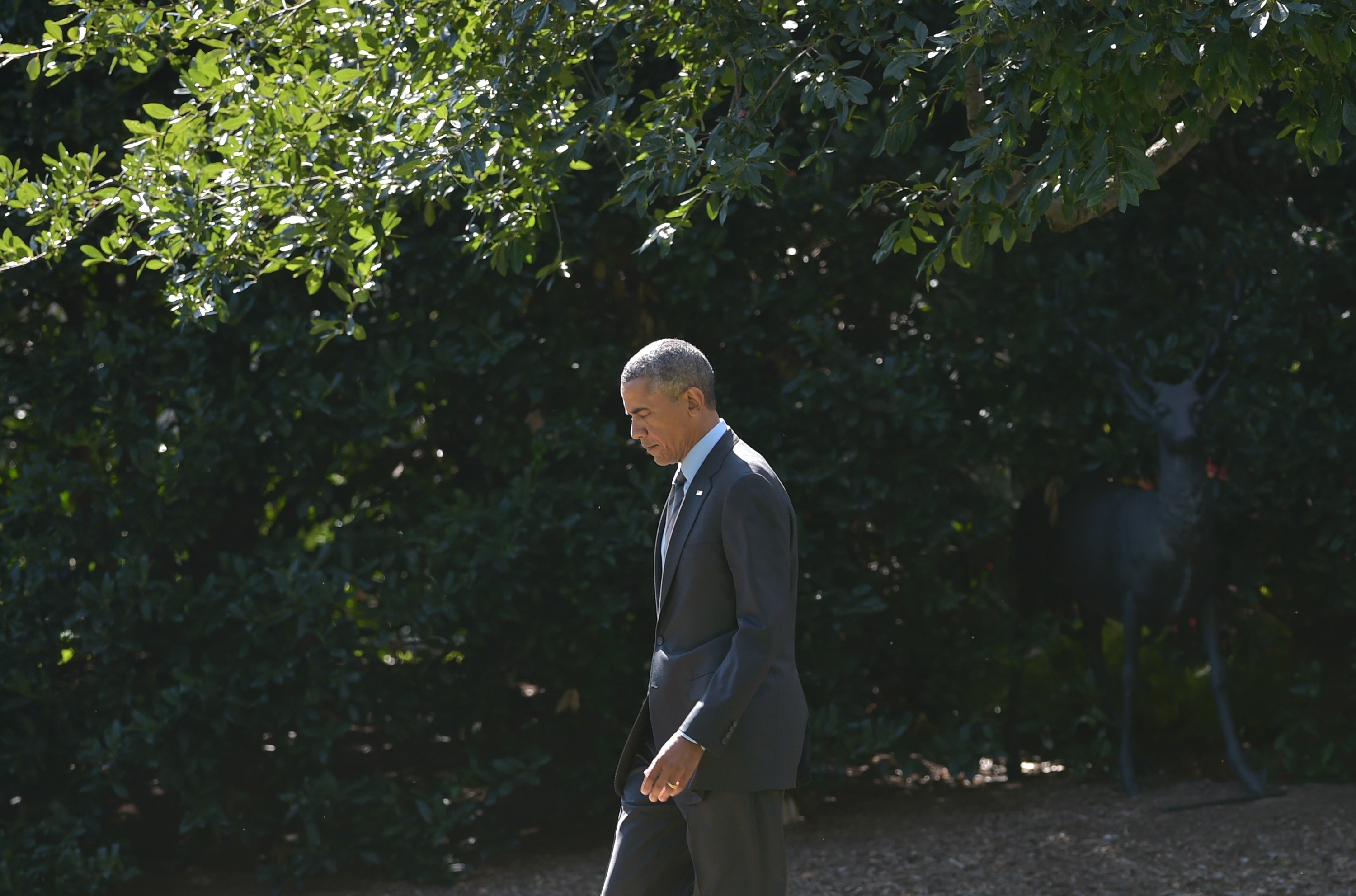
(Photo: US President Barack Obama makes his way to board Marine One on the South Lawn of the White House on September 12, 2014, in Washington, DC. Obama is heading to Baltimore, Maryland to visit Fort McHenry and to attend a fundraiser. By Mandel Ngan AFP/Getty Images.)

Desperately Seeking Moderates, Ctd

The House is working on an authorization to arm the “moderate” Syrian rebels:

The House Armed Services Committee has drafted an amendment to grant authorization to the President to arm and train Syrian rebels opposed to the Islamic State of Iraq and Greater Syria (ISIS). There are some strings attached, including requiring that the Pentagon report to Congress 15 days before it plans to train and equip the rebels, and provide subsequent updates to relevant committees every 90 days. The language will be included as an amendment to a government funding bill that needs to pass Congress by the end of the month to avert a partial government shut down. Rep. Patrick McHenry (R-N.C.), a key member of the House GOP whip team, said the amendment will pass this week.

But these “moderates” we’re supposed to be counting on seem to be on their last legs, to the point that a major American support group for them disbanded last month:

On August 19, the Syrian Support Group, which had previously arranged a few shipments of nonlethal aid to the Free Syrian Army, sent a letter to donors explaining why the group was shutting its doors. “Over the last year, the political winds have changed,” the letter read. “The rise of ISIS and Jabhat al-Nusra [an Al Qaeda-affiliated opposition force in Syria] and the internal divisions among rebel forces on the ground have complicated our efforts to provide direct support.”

The letter noted that “more significant support” was heading to the FSA from Saudi Arabia, Qatar, the United States, and other governments. But rivalries and rifts within the opposition had impeded the overall effort. “It was difficult to keep things going with the changes in the FSA and its Supreme Military Council and the advent of ISIS,” says Majd Abbar, who was a member of the Syrian Support Group’s board of directors. “It made our operations extremely difficult.”

Then there’s this:

Syrian rebels and jihadists from the Islamic State have agreed a non-aggression pact for the first time in a suburb of the capital Damascus, a monitoring group said on Friday. The Syrian Observatory for Human Rights said the ceasefire deal was agreed between IS and moderate and Islamist rebels in Hajar al-Aswad, south of the capital. Under the deal, “the two parties will respect a truce until a final solution is found and they promise not to attack each other because they consider the principal enemy to be the Nussayri regime.” Nussayri is a pejorative term for the Alawite sect, an offshoot of Shiite Islam to which President Bashar al-Assad belongs.

To which Ed Kilgore, who flagged it, remarks:

Perhaps this was all anticipated by the Obama administration and others—indeed, it does help explain the apparent desire of John McCain and Lindsay Graham to go to war with the entire region. But it doesn’t speak well for the idea that anyone who encounters IS understands immediately the organization must be destroyed at any cost lest or the world will come to an abrupt end.

And Allahpundit predicts that our de facto role as Assad’s air force will bring ISIS and Syrian rebel militias closer together, not drive them apart:

If ISIS’s grip begins to loosen in Sunni areas of Syria as the U.S. pounds them from the air, what are “moderates” more likely to do? Join with their hated enemy, the Shiite Assad, in stamping out ISIS, at which point Assad might turn around and attack the “moderates”? Or join with ISIS and fend off Assad in the name of keeping Iran’s Shiite death squads from cleansing those Sunni areas? Arguably, the more effective we are in damaging ISIS, the greater the risk that our “moderate” partner will turn on us and join the battle against the de facto U.S./Assad alliance. [Richard] Engel sees it coming. Does the White House?

It would appear not. Even though it’s bleeding obvious.

Ukraine Splits The Difference

The Ukrainian parliament had two big items on its agenda today:

In a vote synchronized with the European Parliament in Strasbourg, Ukrainian lawmakers unanimously approved the association pact over objections from Russia, which fears the loss of a market for its goods and damage to its economy from an influx of European products through Ukraine. … Earlier Tuesday, legislators voted behind closed doors to approve two bills granting amnesty to rebels and greater autonomy for eastern regions as part of an effort to consolidate a tenuous Sept. 5 cease-fire and end the fighting in eastern Ukraine. The decision on Tuesday to enshrine in law an amnesty and a framework for self-rule in the east represented a major concession to Russia that in many ways gave the Kremlin what it had been seeking since early in the conflict, long before the violence broadened and thousands died.

Bershidsky doubts Ukrainians will thank Poroshenko for this:

That, in effect, is Ukraine’s signature under the creation of a frozen conflict area.

For Russia, that kind of buffer is the best: It’s not an unrecognized state with a murky status, but an officially recognized enclave within Ukraine. Kiev takes responsibility for it, but has little or no influence on what happens there. The law will probably stand for now, as long as Poroshenko and Putin manage to make the shaky cease-fire in eastern Ukraine stick.

This is a bitter pill for Ukrainians to swallow. “I wouldn’t have voted for this bill if I had been a legislator,” journalist Mustafa Nayyem, who is running for a parliament seat as part of Poroshenko’s electoral bloc,wrote on Facebook. “I see no value in compromises that can lead to another political split in Kiev, mutual accusations of treachery and a show-off patriotism contest.”

Linda Kinstler is despondent:

A frozen conflict, when the Kremlin is involved, is what happens when, as the BBC put it, “a bloody, territorial conflict with no obvious solution is put on hold, with Russia stepping in to keep the peace on its own terms.” On Tuesday, the self-declared Donetsk and Luhansk People’s Republicsannounced they are merging their militias into a single force, the United Army of Novorossiya, which will liberate Ukraine from “Nazi scum.” These are the people who will be ruling the populations of Donetsk and Luhansk for the next three years. It’s hard to look at all this and not get the feeling that those who died fighting for Ukraine gave their lives for naught.

Walter Russell Mead is aghast:

Make no mistake about this. The settlement is a deeply damaging blow to our values, to our prestige and to our geopolitical interests. The foolish and distracted Western policies that encouraged Ukraine into a confrontation with Russia in which the West was unwilling to back it; the shameful and feckless mix of triumphalist rhetoric and minimalist action; the cluelessness in the face of Putin’s skillful mastery of Western psychology and divisions; the miserable consequences of all this for the Ukrainian state: every country, every leader in the world has been paying close attention. Historians, by the way, will also pay attention; the Obama legacy has been permanently tarnished. Unless some real changes take place, neither this President nor his close associates will cut an impressive figure when the accounts are drawn up.

And Jan Techau is skeptical that the EU will be able to act as “the de facto guarantee power for another entity’s political success against the declared intentions of a regional rival”:

There is already a sense creeping into the foreign policy crowd that Europeans may have bitten off more than they can chew. Unity among 28 member states is extremely fragile. The remodeling of the European Neighborhood Policy—the instrument that guides EU relations with Ukraine and other Eastern neighbors—will be tedious and fraught with institutional infighting in Brussels. And money is scarce. More significantly, there are severe doubts that the EU has the political will and the diplomatic toughness to insist on conditionality, the core piece of the neighborhood policy. But without a swift, watertight, and potentially brutal sanctions mechanism for neighbors that do not adhere to an agreed reform process, the transformative power of any new policy will be exactly what it was under the old one: close to zero.

On the other hand, the recent US-EU sanctions on Russia really do seem to be biting, with the Russian ruble falling and state-owned industries like Rosneft asking the government for aid:

Economist Alexei Kudrin, who served as finance minister under President Vladimir Putin for 11 years until 2011, said Tuesday that the sanctions could send Russia into a long recession. “The sanctions that have been imposed are going to have an effect (on the economy) for the next one or two years because they have limited opportunities for investment in this uncertain environment,” Russian news agency Interfax quoted him as saying. … The rouble is this year’s biggest-declining major emerging currency, having lost more than 15 percent in value to hit a new low against the US dollar on Tuesday.

Zenon Evans sees signs that tensions are de-escalating:

Russian state-owned media has made a “drastic change” lately by softening its anti-Ukrainian rhetoric, according to the independent Moscow Times. This may be a positive sign of Russia winding down its war. For its part, the U.S. is also speaking somewhat more softly about Russia. President Barack Obama admitted that Crimea “is gone,” and Secretary of State John Kerry last week called upon Moscow to help America fight the Islamic State, which has personally threatened Putin.

But Katie Zavadski catches a Russian official talking about Russians in the Baltics in a manner eerily reminiscent of the lead-up to the Crimea invasion:

Konstantin Dolgov — Russia’s foreign minister on issues of human rights, democracy, and rule of law — voiced concern Saturday over the treatment of Russian citizens in the Baltic states. Consider that a warning. According to the text of a speech published on the Russian foreign ministry’s website (and evidently given at the Regional Conference of Russian Compatriots of Latvia, Lithuania, and Estonia in Riga), the “protection of the rights and lawful interests of our compatriots abroad is one of the prioritized actions” of the foreign ministry. The speech’s inflammatory language echoed the precursors of Russia’s annexation of Crimea, citing concerns for the well-being and rights of Russians in the territory.

NATO is hip to this threat, Eli Lake reports, and is warning the Kremlin against trying to pull off a stealth invasion of a Baltic state:

[NATO Commander Gen. Philip] Breedlove, speaking at the Atlantic Council on Monday, said if the Kremlin tried that in one of the NATO allies that border Russia—like the former Soviet republics in the Batlics, for example—it would risk triggering Article Five of NATO’s charter which is the section that calls on the alliance to come to the defense of a member state being attacked. … Breedlove added that the issue was discussed this month at Wales at the head of state summit. “We had great acceptance among the NATO allies though that if you attribute this ‘little green men’ issue to an aggressor nation, it is an Article Five action and then all of the assets of NATO come to bear.”

Boots On The Ground … For Ebola

Today, president Obama is announcing a major effort to help stem the spread of the outbreak in West Africa, relying primarily on our African military command:

The unprecedented response will include the deployment of 3,000 U.S. military forces and more than $500 million in defense spending drawn from funding normally used for efforts like the war in Afghanistan, senior administration officials outlined Monday. Obama has called America’s response to the disease a “national-security priority,” with top foreign policy and defense officials leading the government’s efforts.

The officials said Obama believes that in order to best contain the disease, the U.S. must “lead” the global response effort. In the CDC’s largest deployment in response to an epidemic, more than 100 officials from the agency are currently on the ground and $175 million has been allocated to West Africa to help combat the spread of Ebola. Those efforts will be expanded with the assistance of U.S. Africa Command, which will deploy logistics, command and control, medical, and engineering resources to affected countries.

Peter Grier explains why the Pentagon is leading this mission:

The short answer is because it is the largest and most capable US organization available for emergency action, and has money to pay for the effort. The military’s extensive airlift and health-care infrastructure can quickly plug holes in the current international fight to try and contain the Ebola outbreak. US personnel should be flowing into the area in force in about two weeks, according to the White House. … Plus, the administration has now decided it’s time to move fast. If anything, it is past time. Cases are increasing at an exponential case. UN officials on Tuesday estimated that the world will need to commit upward of $1 billion to contain the crisis.

But Hayes Brown notes that other government agencies are involved as well:

Though the main takeaway from the White House’s announcement is the AFRICOM deployment, it won’t just be the military responding to the crisis. The U.S. government will also continue its quest to find doctors willing to travel to West Africa to help tackle the crisis. The U.S. Agency for International Development has for several weeks now had on its website an appeal “to the medical community in the United States for assistance with the West Africa Ebola Outbreak,” imploring qualified medical professionals to contact organizations working in the region through the Center for International Disaster Information (CIDI).

A sizable amount of funding is also being redirected to facilitate the new initiatives being launched in not just the Pentagon and USAID, but also the State Department, Centers for Disease Control, Department of Health and Human Services and other government agencies. The administration is asking Congress to provide another $30 million to send CDC workers and equipment to the region and $58 million to help develop an effective Ebola vaccine.

Adam Taylor provides a wrap-up of what other countries are doing to help fight the epidemic. Meanwhile, Rachael Rettner pushes back on Michael Osterholm’s fears that the virus could mutate and become airborne, which would raise infection rates catastrophically:

Although it’s theoretically possible that Ebola could become airborne, “it’s pretty unlikely,” said Dr. Amesh Adalja, an infectious-disease physician at the University of Pittsburgh. “Airborne transmission may be what we fear the most, but evolutionarily speaking, it may not be the best path for the virus to take,” Adalja said. The Ebola virus does mutate, or change its genetic material,, fairly frequently, but this does not necessarily mean it can become airborne, Adalja said. The HIV virus has a high rate of mutation as well, but it has not acquired the ability to spread through the air, Adalja said. In fact, none of the 23 viruses that cause serious disease in humans have been known to mutate in a way that changed their mode of infection, according to Dr. Scott Gottlieb, former deputy commissioner at the Food and Drug Administration, who recently wrote about the topic in Forbes.

Francis On Tying and Untying The Knots

Pope Francis Celebrates Weddings During Sunday Mass

This fall, we’ll begin to see the impact of the new bishop of Rome on the church with the opening of the October Extraordinary General Assembly of the Synod of Bishops, focusing on the family and evangelizing in the modern world. There isn’t much chance of a change in doctrine on many of these issues – the ban on divorced Catholics re-marrying in church and receiving communion, the disapproval of cohabitation before marriage, the ban on contraception, and certainly the aversion to same-sex commitment and love. But Francis has already shown that he is prepared to take a non-linear approach to these questions – and he keeps surprising.

What Francis seems to be saying is that in all these questions, while the doctrine will not change, the call to mercy should be paramount. In other words, in individual cases, the decision to marry a couple who have been living together or have experienced one or more divorces should be left to a merciful pastor, not a rigid and distant dogma. How to get this point across? As so often, Francis uses his own actions, rather than words:

The Holy Father presided over the wedding of 20 couples Sunday in St. Peter’s Basilica. From a distance, the group seemed fairly typical: the couples ranged from ages 25 to 56 and were all from the Diocese of Rome. But the underlying storyline is far more telling: one bride was already a mother, some of the couples had already been living together, and others had previously been married.

This is what our beloved Joe Biden would call a BFD. Priests who might have married similar couples in the past could be subject to discipline from Rome. Now, the bishop of Rome himself is presiding over them. Elizabeth Dias explains why this matters:

Since local churches currently tend to make their own decisions about serving communion to divorced and remarried, or cohabitating Catholics, any overarching guidance from the Holy Father this October could mean significant change. Cohabiting couples cannot be denied marriage by policy in the Catholic Church, but a priest is not obliged to marry a couple, and so Pope Francis’ example of presiding over a wedding for couples who had lived together will likely encourage other priests to follow suit.

Is the Holy Father subverting formerly rigid teachings? I don’t really think so. His restatement of the core Catholic understanding of the sacrament of marriage – that its core is the uniting of a man and a woman – is pretty substantive and full-throated:

“This is what marriage is all about: man and woman walking together, wherein the husband helps his wife to become ever more a woman, and wherein the woman has the task of helping her husband to become ever more a man. Here we see the reciprocity of differences.”

Well, that should finally alienate America’s blank slate progressives. What I think is going on here is simple sensitivity to the individual person and a particular situation – think of Jesus and the woman about to be stoned for adultery  – and Francis regards mercy and forgiveness as the core Christian virtue. To show no mercy in today’s world is to consign countless people to a life outside the church altogether, when they may sincerely be attempting to live out the Gospels in an imperfect world with flawed human nature. If that is the case, then you can almost hear Francis’ response: “Who am I to judge?”

Know hope.

(Photo: Brides attend the Sunday Mass held by Pope Francis at the St. Peter’s Basilica on September 14, 2014 in Vatican City, Vatican. During the Mass Pontiff celebrated the marriage of twenty couples. By Giulio Origlia/Getty Images)

Dissents Of The Day II

The in-tray has been brimming with backlash over my criticism of the president on Iraq. I’m glad to air it – and it’s made me think hard about it again. And this email stung a little – but made me laugh:

[The above] commercial popped into my head after reading you on Obama, and I thought to myself, “I swear it’s Andrew, bless his hysterical heart.”

First big round of dissent here. Another:

I share every one of your concerns regarding Obama‘s initiative against ISIS, and yet there is a word in my thoughts that you, as far as I am aware, haven’t mentioned and that president Obama mentioned only once in his speech and in a passing way: genocide.

By both word and deed, ISIS has unequivocally declared its intent to exterminate any and all non-Sunni (and eventually non-Salafist) persons that it can.  ISIS has clearly shown itself committed to a level of atrocity far above any usual sectarian blood-letting.  They may well have the capacity to kill in numbers that rival Rwanda, perhaps even the Nazis.  This thought disrupts my inclination to stand back.  Don’t we suffer remorse over past genocides we failed to act against?  Can we do much to stop this one?  Probably not.  Does that take away the moral burden to try?  Probably not.

Another quotes me:

That simple lesson is as follows: American military force to pummel Jihadists from the skies can create as much terror as it foils. Our intervention can actually backfire and make us all less safe. How many Jihadists, for example, did the Iraq War create? Our intervention gave al Qaeda a foothold in Iraq and then, by creating a majority Shi’a state for the first time, helped spawn Sunni support for the Caliphate.

It’s not fair to compare an invasion, followed by nearly a decade of occupation and so-called “nation-building,” to the air campaign and soldier training that Obama is waging against ISIS. For one thing, there’s a great deal of support from Arab nations in the region and moderate Muslims around the world. Yes, we’re doing their dirty work, to some extent. But because that work doesn’t entail our soldiers traipsing through their streets – and since they’ve asked for our help, it’s a totally different dynamic.

In short, we’re the good guys to moderate Muslims who are repulsed by ISIS. As for the extremists who like ISIS, well … we’re never going to win them over anyway, and maybe a show of force will have a deterrent effect on their enthusiasm for ISIS propaganda.

This issue is much too serious to play the strawman game where you ridicule the notion of this kind of intervention eradicating extremism. However strong the president’s language was last week, no one actually thinks this is the cure for Sunni-based violent extremism. It’s merely a way to prevent genocide, empower moderates in the region, and, over the long-term, advance the idea that we aren’t driven entirely by oil interests and imperialism.

And you’re right that it probably won’t be an unqualified success, but one thing I respect about this administration, which I thought you respected as well, is that it takes on issues where the likelihood of complete victory is remote, because they know that any progress is better than doing nothing. It was true with the stimulus. It was true with health care reform. It was true with gay marriage. And it’s true in Iraq.

I take our reader’s point. I would cavil with the idea that “we’re the good guys to moderate Muslims who are repulsed by ISIS”. We have no evidence of that. We have a hell of a lot of evidence that our interventions – especially bombing Sunni areas from the skies – can backfire and alienate the very people we are trying to support. And the idea that, at this point, Iraqis view the US as anything other than a blight on what was once their country seems too naive for me. Another reader:

Were you opposed to Obama‘s campaign to degrade and defeat al-Qaeda’s leadership? No; you kind of liked it. Although Islamic State is apparently not actively targeting the U.S. at this very moment, I see no difference between IS and al-Qaeda in terms of their long-term threat to the Homeland.  I think we would be negligent to let them grow in strength unchallenged. The job to degrade them is incredibly difficult and we may fail. We may make it worse if we kill too many civilians again.  But I don’t believe ISIS will go away or change their plans if we ignore them. I don’t believe that they will be grateful if we leave them alone to commit genocide or enslavement. Obama could have punted on ISIS, but he didn’t. He is taking seriously and doing the best he can.

Obama is not stupid or craven or cynical or excessively politically motivated. I think he is sad and tired. His vision of humanity and historical progress has taken a beating. The Arab Spring turned out to be pretty disappointing. There are tens of thousands of young Muslim men in ISIS that are objectively evil and inhumanly cruel to innocent and helpless fellow human beings. It is hard not to get depressed about human nature. He is being forced to cough up his legacy of disengagement in Iraq.

magazine_theatlantic-dec-071The Ferguson incident has revealed that race relations remain fraught in this country despite his attempts to transcend the prejudice and hatred. Both blacks and whites blame him for not doing the right thing (whatever that is). Hispanics think that he is a traitor for delaying on immigration reform. Meanwhile, his approval rating is in the toilet, the Senate is likely to fall to the Republicans, and his last two years may be completely stymied.  His supporters have fled. This is the reward he gets for being cool-headed, thoughtful, rational, measured, and brave. Almost everything going wrong is not his fault. Of course he makes a few mistakes now and then, like getting photographed golfing at the wrong time or wearing the wrong suit or saying he isn’t done yet making a strategy. If I were him I would feel mighty, mighty unappreciated.

Andrew, you were the one who could envision the potential of Obama and explain it to the world. That is how I became a reader of your blog in December 2007. You need to try to get back into his head and appreciate what he is up against and why Obama still matters. I still trust him more than anybody I can think of to be leading our country.

One more:

I am an Obama voter, a Dish subscriber, and generally find your take on national and world events well reasoned, thoughtful, and principled.  But when it comes to your position on US military action against ISIS, you seem to be over-compensating for your past mistake in supporting the Iraq war.

I am certainly no psychologist (I am an attorney), but I think it is fair to say that you carry tremendous guilt for supporting the Iraq war (I mean, you dedicated an entire Deep Dish e-book to how wrong you were and how awful you feel about it).  Certainly, much of America is andrew-sullivan-i-was-wrong-coverwar weary – rightfully so – but your skepticism and doom-and-gloom take in particular seems to carry more guilt than your typical rational and reasoned analysis.

For what it’s worth, I was against the Iraq war before it become the mainstream popular opinion.  I have a pretty good BS-meter, and I knew the pretense for a war in Iraq was a farce from the get-go. It was, and remains, an utter catastrophe.  The untold human, financial, and political cost will not truly be known for decades.  But you know what?  I support this latest fight against ISIS.

Imagine being the President of the United States, Andrew.  Even though you campaigned on ending “dumb” wars, and drew down the wars in Afghanistan and Iraq, your absolute, number one constitutional priority as president and commander-in-chief remains: the safety and security of the American people.  A large group of well-funded and trained terrorists have taken over swaths of land in the Middle East, brutally maiming and killing innocent civilians along the way.  They have publicly declared their intention to attack the US.  In essence, they have declared war on America.  While they are not large enough, nor capable enough, to actually carry out such an attack at this time, they are only growing, receiving more money, and training more fighters.

As president of the most powerful nation on earth, you have quite a number of options, but they basically boil down to two:  You can either take military action or not.  I am sorry to be the one to break this to you, Andrew, but there is no president, current, past, or future, that would ever sit back and let such a threat grow to the point of carrying out an attack on America.  Certainly not in the post-9/11 world we live in.  And you know what?  That’s how someone in charge of our security should act.  It is the responsible thing to do.

You want to be a violent terrorist organization and declare war on America?  Well, now your going to have deal with those consequences.  You’re going to be extinguished.  And if ISIS is systematically degraded and destroyed, particularly with support from allies and Middle East partners, that will be the right message.  The United States, and the world, will have zero-tolerance for this.  Zero. Fucking. Tolerance.

The President did not try and BS us by hyping the immediate threat to the homeland; he told us a reality that a war-weary America did not want to hear: that this is the approach you have take with violent fanatics.  It is an unfortunate reality that we have to respond to violence with violence, but this is the world we live in.  Perhaps there will be a paradigm shift someday when I’m old and grey, and that won’t be the case anymore, but in the meantime, I support this president to uphold his constitutional duty – dealing with these violent fanatics who will never be part of the civilized world the only way they should be dealt with: extermination.

Update from a reader, who notes something that can’t be reiterated enough:

Your reader who wrote this is completely wrong:

Imagine being the President of the United States, Andrew. Even though you campaigned on ending “dumb” wars, and drew down the wars in Afghanistan and Iraq, your absolute, number one constitutional priority as president and commander-in-chief remains: the safety and security of the American people.

The presidential oath states:

I do solemnly swear (or affirm) that I will faithfully execute the Office of President of the United States, and will to the best of my Ability, preserve, protect and defend the Constitution of the United States.

His number one priority is not the safety of Americans; it’s to uphold the Constitution. And the last time I checked, that means letting Congress declare war.

The View From Your Window Contest: Winner #222

VFYWC_222

A reader writes:

Camden Yards, Baltimore, MD. If I’m right, my self-esteem will be temporarily bolstered.

Camden Yards actually wasn’t too far off. Another reader:

Looks like Harbor Yard, home of the Bridgeport Bluefish in Bridgeport, CT.  It’s a great place to watch a ball game.  Even if it’s wrong, it’s good to support the ‘fish.

Bridgeport was the most popular incorrect guess this week. Another reader rightly gets us to the Midwest:

I’m gonna say this is the Akron Aeros’ ballpark in Akron, Ohio, from a skybox in the left field area. I’ve been to a couple of Aeros games, which is a big deal because 1) I live 9 hours’ drive away; 2) the first time I went, a visiting player gave me his bat after the game; and 3) the second time I went, there was an earthquake in Akron. Yes, in Akron. The next night, in Toledo, Ohio, a tornado zipped through the parking lot of my hotel. (I think Ohio was trying to tell me something.)

Another throws up his hands:

I give up! I have spent far too much time on your addictive contest. Thought it might be Scottsdale Stadium in Scottsdale, AZ. People can sit on the grass and watch there. Logo might be from Seattle team. Might also be Ameritrade Stadium in Omaha where College World Series is held. Or old Rosenblatt Stadium there. What stymies me is that long covered structure through which something is transported to top of the building like a grain elevator. That might make it in Minneapolis or St Paul. Found one picture of a tobacco transporter in the south but wasn’t quite right landscape.

Another was less discouraged:

I didn’t think it was possible for me to guess two windows in a row correctly. Okay, technically I’m not sure if last week’s window was the exact window, but I got the right building and that’s a win. But two easy windows in a row?  Do you want all your readers to get out and enjoy the fall weather instead of hacking away for hours, yelling at the computer, sweating it because they can’t find anything in the picture??  Well, I for one, thank you.

With more than 500 entries, this contest was even more popular than last week’s. Another reader savors the correct city:

I love the smell of napalm in the morning – it smells like … Victory Field in Indianapolis!

An expert is even more excited:

I was sooo excited when I saw the contest photo. A minor league baseball stadium?? That’s my niche! I’ve visited dozens of stadiums at all professional levels. I take trips every summer to see new cities and new teams, taking extensive notes about the games I see: the food, the architecture, the people, the uniforms. It is a great way to see the country, as it gives me excuses to go to places I wouldn’t otherwise have reason to visit. I’ve seen baseball in Buffalo, Chattanooga, Rancho Cucamonga, and everywhere in between. I saw this photo and thought this week will be tailor made for me. I’ll pick up on some nuance of the shape of the tier, or the location of the lawn, and I’ll be so proud of my baseball detective skills. I will be the only winner!

That feeling lasted a few seconds, until I saw the flag. Oh. Indianapolis. Everyone is going to get this one. Fuck. You’re a tease.

Another explains:

th2014 has been a year of highs and lows for me on the VFYW contest.  So close on some, even joining the scrum on a few correct windows; and so far on others (identifying the location by yellow lichen?  Seriously?) So imagine my happiness at seeing this VFYW contest.  A baseball stadium!  I’m a baseball fan, I’ve been to lots of stadiums, including minor league stadiums, which this clearly is.  How hard can this be?  Wait a minute … I’ve never been to this stadium …

After plenty of searches for urban baseball stadiums near power plants and finding nothing, I switched tactics.  Not quite as obscure as yellow lichen, I found the flag.  The flag of the city of Indianapolis.

Based on the level of the field and the position of the side walk pillar in the contest photo, I’d say the photo was taken at the JW Marriott Indianapolis.  The photo is from the second floor convention area, from the prefunction area (so-called by the hotel’s website):

vfywc_4

Indeed, it was the pre-function area. Another notes:

So is “Pre-function” the charming Midwestern attempt at classing up “Reception” or something? Speaking of those wholesome Indianans, in this particular VFYW search I came across this little gem of a TripAdvisor review: “Hospitality service & staff were alarmingly friendly and troublingly attentive. Or maybe as a Bostonian I’m just not used to people being nice.”

Another reader reconstructed the Indianapolis city flag in an image editor, then reverse-image searched his way to success. Here’s somebody looking to make up for last week:

After misreading “Zane’s” as “Zone’s” and thus becoming an ignominious member of the 2.1% who didn’t get the window last week, I was determined not to miss what at first glance looks to be a slam dunk: somewhere in a decent sized US city with a minor league (most likely AAA) baseball park. There’s even a flag RIGHT THERE that should be a pretty big clue as to location. And it is: the blue field with a white cross, overlaid with a white star in a red circle at the center is the flag of the city of Indianapolis, Indiana. That was surprisingly difficult to discover (I took a few detours through the county and municipal flags of Texas first, many of which feature a “lone” star) but I imagine you have no shortage of people from Indy that will recognize it on sight, in addition to the legions of highly competent Google sleuths that regularly populate these contests.

The view is from a building just off left-center field at Victory Field, home of the Indianapolis Indians, which claims to be “The Best Minor League Ballpark in America” (a claim with which, as a proud resident of Durham, NC, I am inclined to disagree.) Specifically, somewhere in the JW Marriott across Maryland Street, among the floor-to-ceiling windows (you can see the American flag from the ballpark reflected in the attached screen grab.) Based on the interactive floor plan on the hotel’s website, this window appears to be in the “Prefunction” area of the third floor, just outside the JW Grand Ballroom.

In another entry, we learn that “the Indianapolis Indians are a Pittsburgh Pirates AAA affiliate that somehow manages not to use a racist cartoon Indian on their hats (Cleveland take note).” For more on that subject, check out the Dish thread “Do Mascots Need Modernizing?” Another entry:

The contest photograph is packed with clues. I relied on minor league baseball stadiums (too small for major league, too big for little league or most universities) and a handy website listing all minor league stadiums. I started with those in Northern industrial states and it did not take long. Google Street views on the north side of Victory Field immediately included all the foreground clues in the contest photograph (red Indian teepee, street light post with no parking sign, brick perimeter fence column, trees, flag poles, memorial plague, etc.). The contest window had to be one of those directly across Maryland Street on the south face of the Marriott complex:

vfyw_Indy_9-13-2014

Many readers focused on another key element:

This started with a Google search for “minor league baseball stadium near coal power plant”, which found a nearly identical view:
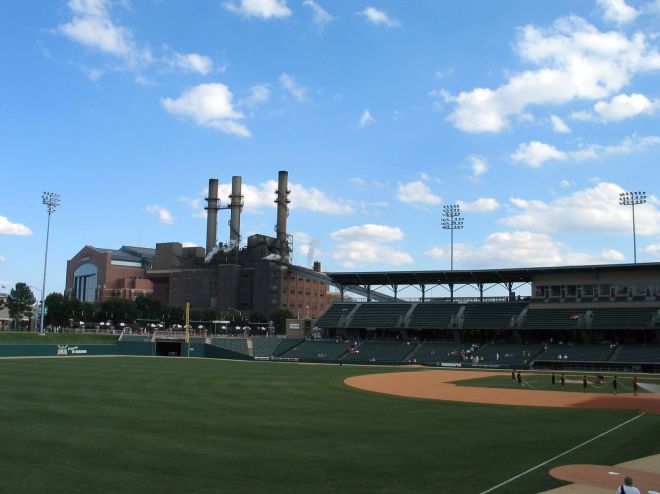
midwest-minor-league-trip-037

A native weighs in:

View From Your Window Contest # 2014-09-14 at 10.32.37 PM

I knew this picture instantly (even faster than the view from Monticello earlier this year). In the background is the former Indianapolis Power and Light (now Citizens Thermal Energy) power plant. Interestingly, the long diagonal structure used to haul coal to the boilers, but this facility was switched to natural gas a few years ago so the conveyer system is now obsolete. If you look at a map, you’ll notice a lot of railroad tracks behind Victory Field. I grew up just south of Indianapolis, and I spent a lot of time trainspotting at that location. I live in Berkeley, CA now; thanks for bringing back some really fond memories. I was in Indianapolis at exactly this time last year for the Monon Railroad Historical-Technical Society convention, and stayed a couple of blocks away at the hotel in Union Station. That was the first time I’d seen the new blue Marriott tower from which this picture was taken. The blue glass accounts for the blue hue of the picture.

Another has a recommendation:

No useful trivia about the team or stadium, but I will say that the Indy 500 is a cultural event worth attending at least once before you die. Not for the race but for all the stuff that is associated with it. You have no idea how noisy a race is unless you are in the stands…

You have to appreciate the concision of this entry:

Logic?

1. U.S. ballpark.
2. Industrial city.
3. The flag is not a state flag.
4. It is not a major league ballpark (Google elimination of each one).
5. Aha! Maybe it’s a city flag.
6. Indianapolis.
7. Victory Field.
8. Marriott.

Another native:

I grew up in Indianapolis, and spent a number of cheap dates in high school and college going to see the Indianapolis Indians, a pretty good  AAA baseball team. Back then, the Indians played in Bush Stadium, a charming old park built in 1931 and used to film the underrated Eight Men Out, where a couple of my buddies appear as extras in some crowd scenes.

A Pink Floyd connection:

Pink Floyd - AnimalsFunny Story: I took my 3 daughters to a game there earlier this year. When my oldest (4 years old) saw the power plant to the south (which you can see in the picture) she asked if that’s where the animals live. If you remember Pink Floyd’s Animals album, the resemblance is striking.

As a serious Pink Floyd fan (my second daughter is named Vera), I almost fell over when she said it and it still makes me wonder why the hell she did.

Another former resident provides some context:

That is most certainly Indianapolis, IN, taken from the back side of the JW Marriott, looking over Maryland Street at Victory field.  Without doing too much research, I’d bet it was taken out of one of the hallway windows that line the outside of the meeting rooms. I recognized this immediately.  The old coal fired steam plant right behind victory field is a dead give away to anyone who has lived in the city, as is the Indianapolis city flag flying to the left of the stars and stripes.

Fun personal story here.  I originally moved to Indianapolis 18 years ago.  We moved here because my father had received a job at the Courtyard by Marriott that used to inhabit this same site, which was Howard Johnson’s before that. They renovated it to create more rooms and meeting space for the Super Bowl that was held in Indianapolis a few years back, adding a large curved blue tower that sits alone on the west edge of the downtown skyline (the JW Marriott hotel), and using the former tower of the Courtyard as a split unit between a Courtyard and a Spring Hill Suites.

Victory Field is one of the best Triple A parks in the country, and was designed by the same people who designed Camden Yards in Baltimore, MD.  The design of Camden is responsible as the influence on many “throwback” modern ballparks across all levels of baseball.

This reader worries there are hard times ahead:

IMG_0280Let’s see, two weeks in a row now we’ve had views so easy they almost reach out of the screen, grab your lapels, and scream their addresses in your face.  So I’m betting you’ll go the other direction next week and give us one that’s correspondingly hard.  Something like this? 

Even so, Chini will get it somehow.

And he can’t wait:

VFYW Indianapolis Bird's Eye Marked - Copy

Man, you should have heard the stream of full on, raised-in-Staten Island-so-I-can-curse-in-seventeen-languages invectivery (yeah, invectivery) that came pouring forth after I loaded up this week’s image.  At least I get the satisfaction of knowing that the Dish team might have spent their weekend wading through an even bigger pile of responses than those for last week’s Malibu Barbie of a view. And these easy shots are needed, I suppose, to bring new folks on-board.

This week’s winner is yet another long-winless veteran:

Perhaps to reward us for a long summer, but a bit of an easy one this week, especially with the flag and the Wikipedia entry on USA municipal flags.  But perhaps most interesting was the obvious minor league ballpark with a teepee in it.  (I wonder if Dan Snyder has thought of trying to put traditional Indian housing in FedEx field …)  So a couple of Google searches brought me to the Indianapolis Indians and their Victory Field.

Here’s the reader who submitted the view:

I was elated to see my photo in the contest! After shouting over to my wife that this week’s contest had my photo, I suggested to her that it would probably not be fair for her to enter the contest. I should add that I’m a former winner from a couple of years ago, and that one of my views is actually in the book. In any case, this completely made my day.

The view shows a game in progress of the Indianapolis Indians at Victory Field. The photo was taken from the third floor of the JW Marriott hotel in Indianapolis. I’ve attached a street view showing the window from which I think I took the picture:

unnamed

There really isn’t any room number, as the photo was taken from a lobby area in the hotel’s convention center. There’s a whole wall of windows overlooking the stadium, and in the street-view picture I gave my best estimate of the window from which the photo was taken. I can add that the flag on the left is that of the City of Indianapolis, of which Wikipedia helpfully points out that “A 2004 survey of flag design quality by the North American Vexillological Association ranked Indianapolis’s flag 8th best of 150 American city flags.

Next week will definitely be a lot harder, so if you’re up for the challenge, see you Saturday. In the meantime, here is this week’s guess collage – see if you can find your entry:

VFYWC-223-GUESS-COLLAGE

(Archive: Text|Gallery)