The Pope Isn’t A Pacifist

by Dish Staff

In light of Pope Francis’ comments about ISIS this week, Christopher J. Hale explains why:

[F]or those who know the intricacies of Catholic moral teaching, Francis’s openness to military intervention in Iraq makes perfect sense. For 1500 years, the Church has promoted the teaching of St. Augustine: that there can be no true peace without justice. This ancient teaching has crystallized into the Church’s modern day just war principle, which holds that nations only ought to enter into military campaigns against unjust aggressors as a last resort and only in limited scope and circumstances.

Under that paradigm, does the current situation in Iraq merit such a military response? Pope Francis isn’t ruling it out. Now contrary to the absurd claim by Vox’s Max Fisher, Pope Francis isn’t calling for the tenth crusade against the Middle Eastern people. Instead, he’s proposing a clear-eyed response to a critical crisis.

Ed Morrissey also has a column detailing Catholic just war doctrine and how it applies to the situation in Iraq. In a follow-up, he summarizes why he’s almost, but not quite, a pacifist either:

I’m not arguing that Jesus would applaud a military intervention anyway. Pacifism is, and should be, the first impulse of the Christian, and the second and third impulse as well.We are called to prayer and to make peace — when peace is possible.

What Pope Francis and the Catholic Church in its Catechism argue is that war should be a last resort, and that it should be fought with “as much humility and restraint as possible.” My column points out what Francis meant, and why a fight to stop ISIS fits within the paradigm presented in Catholic teaching.

That’s why the Just War doctrine exists at all — to distinguish between wars of necessity and wars of choice. War is a result of a fallen world, which Christ offered salvation to those who accept it of their own free will. But the fallen world remains, and with it difficult moral choices as to the proper use of power for the good of humanity. Most wars are fought over petty concerns over territory, power, or even ideology, but some of those in the latter category involve such intrinsic evil with which it is impossible to negotiate or allow to continue unabated. Leaving victims to die at the hands of evil sadists and standing on the sidelines while entire populations get erased or sent into slavery is a choice, yes, but it’s not one compatible with Christian teaching either.

Brandon Ambrosino adds:

After Francis affirmed the Church’s doctrine of just war, he quickly noted how that doctrine has been abused many times in the past and can be abused again. “How many times under this excuse of stopping an unjust aggressor the powers [that intervened] have taken control of peoples, and have made a true war of conquest?”

Francis recognizes the necessity of stopping an unjust aggressor, but he also recognizes that this same sort of logic has at times been abused as a justification for domination. (For instance, yes, the Crusades.) To prevent the principles of Catholic just war doctrine from being abused, Francis thinks the decision for when and how to engage in war must not be left up to one isolated power: “One nation alone cannot judge how to stop an unjust aggressor.”

Running The Numbers On Relationships

by Dish Staff

Daniel A. Medina presents new findings on how race relates to success at online dating:

The breakthrough came when the researchers found that three multiracial groups were favored more than anyone else, something they referred to as the “bonus effect.” These three groups were Asian-white women, who were viewed more favorably than all other groups by white and Asian men, and Asian-white and Hispanic-white men, who were given “bonus” status by Asian and Hispanic women. … This “bonus effect,” which the researchers said was “truly unheard of in the existing sociological literature,” goes against the long established “one drop rule” amongst American sociologists. Usually applied to people with partial African descent, the rule essentially states that multiracial people even who are even a small part non-white are viewed simply as part of the lower-status (non-white) group.

Of course, even those who’ve parlayed their most desirable qualities (including, apparently, multiracial-ness) into coupledom aren’t guaranteed relationship success. Luckily, Emily Esfahani Smith and Galena Rhoades discuss research (pdf) on how healthy relationships progress:

The freedom to choose any relationship sequence has benefits, but it may also come at a cost long-term. Couples today seem less likely to move through major relationship milestones in a deliberate, thoughtful way. Rather, the new data show that they tend to slide through those milestones. Think of the college couple whose relationship began as a random hookup, the couple who moved in together so that they could pay less rent, or the couple who chose to elope on a whim rather than have a formal wedding. These are couples who, often without realizing it, slid through relationship transitions that could have been planned out, discussed, and debated.

The data show that couples who slid through their relationship transitions ultimately had poorer marital quality than those who made intentional decisions about major milestones. How couples make choices matters.

And how those relationships start also matters. Tom Jacobs flags a study that casts doubt on the longevity of relationships that begin when one partner swoops in and “poaches” the other from an existing relationship:

In three studies, “individuals who were poached by their current romantic partners were less committed, less satisfied, and less invested in their relationships,” reports a research team led by psychologistJoshua Foster of the University of South Alabama.

“They also paid more attention to romantic alternatives, perceived their alternatives to be of higher quality, and engaged in higher rates of infidelity.”

Being poached by your current partner, the researchers conclude, is both fairly common (10 to 30 percent of study participants reported their relationship began that way), and “a reliable predictor of poor relationship functioning.”

The Internet is Neither Open Nor Free

by Freddie deBoer

There’s been lots of talk, going around, about the demise of the comments section. This has been spurred in long part by some truly noxious trolling and the seemingly intractable problem of online harassment. Given those realities, I’m amenable to major changes, although I doubt you can really solve this kind of problem. These aren’t platform problems or technology problems. They’re human problems. Humanity exists online, and this is the way humanity is. But if we can avoid even a little of the terrible abuse that people receive online, women especially, it might be time to consider letting comments go, at least in many places. And I say that as someone with an obvious affection for how good comments can occasionally be.

I do think, though, that this is a good opportunity to finally let some of our old myths about the internet die. It’s still common to hear people talk about the internet as this open space where only talent matters and where everyone has a chance to impact the discussion. And it’s time we put those myths to bed.

It’s not like people are totally unaware of all this. Certainly, the way in which major bloggers were largely absorbed into legacy media companies and think tanks is part of the story. One of the things I’ve always liked about Matt Yglesias and Ezra Klein is that they’ve both always been upfront about the fact that their success depends in part on having been in the right place at the right time, and that building a career now is a lot harder than it used to be. Hierarchies harden, alliances form, and given the brutal economic realities of the online writing profession, the game of musical chairs gets more and more brutally competitive. The end result is, inevitably, that people feel more and more pressure to find a niche and to be liked. It’s a word of mouth business. And while the world of commenters may seem far from that of the pros, I think that many of us envisioned a future where commenters could, at their best, provide a kind of counterweight when professional and social pressures influence what the pros think and say. Well, I’m not sure it ever worked that way, but it was nice to dream.

The only people who can really watch the watchers is each other, and like all human beings, they have human concerns which make that job impossible. Is Politico’s clumsy hack job on Vox a clumsy hack job? Yes. Are people defending Vox out of purely principled motives? Um, I doubt it! I’m not impressed by it. But I guess I understand. I mean, you can’t ask people to act as impartial arbiters of their own institutions. In the original telling, naive though it may have been, commenters helped to play that role.

I dunno. Maybe I’ve grown soft in my old age. Or maybe I’m just sensitive to broken labor markets, given that I’m in one myself. (Lord knows, the professional-social dynamics of academia can be as unhealthy and pernicious as you can possibly imagine.) But as I tried to say in the first piece I wrote this week: I don’t know that there’s such a thing as political and intellectual independence when there’s so little economic and labor security. The unemployment rate is down, but I don’t know many people who really feel secure. The terrible condition of the American worker spreads out into everything and hurts people in all industries– even those who would prefer to say, for political reasons, that everything is alright.

I don’t know if there was ever a time when the internet in general, and the world of blogging and online journalism specifically, were these open cultures where anyone truly had a chance to get ahead. And there’s a simple rejoinder to all of this: commenters never were some sort of principled check on bloggers and writers. They brought the rape gifs and the misogyny and the racism and none of the checks and balances. I get that, too. I just think that it’s time for us all to reckon with the fact that the mythology is well and truly dead. The internet is a social system, which means it’s defined by inequalities in power, and those inequalities determine what gets heard and by whom. I will never stop criticizing those writers who decide that they are a very big deal, or stop pointing out the social and professional hierarchies that they care about deeply while pretending they don’t. And as much as criticisms of comment sections are accurate, they are also self-serving, a way for the various Big Deals online to lord it over the proles. But I do hope that I always keep in mind the fact that structural, economic factors are ultimately to blame for our hierarchical, unequal media, not individuals. And that my own pretensions and self-aggrandizement are no kind of alternative.

The whole thing is so… human.

The Economics Of Creative Writing

by Dish Staff

Nick Ripatrazone urges more pragmatism in creative-writing education:

Creative writing should be taught as an art, and as a business. A creative writing program that only includes the former can unwittingly reinforce romantic stereotypes of writing. A young student might major in creative writing. She could become a wonderful poet, and a well-read critic. But she needs to know that poetry doesn’t pay the bills. This is the inside joke of creative writing programs in America. We know creative writing doesn’t make money, and yet we continue to graduate talented writers with no business acumen. At best, it is misguided. At worst, it is fraudulent.

He thinks it “reasonable to expect that graduates of a discipline understand the economic realities of that discipline”:

[I]f we don’t talk about the business of creative writing, we perpetuate the myth that money always stains art. Does it often? Of course. Yet pretensions toward artistic purity hurt students. Writing can become a perpetual unpaid internship. Doing something “for the love of it” has made countless people–not the least of whom are teachers–see their generosity and good nature be rewarded with mediocre pay and respect. I owe it to my students to get them ready for the professional world of writing. If they ignore my advice, that is their problem. We should talk about money with creative writing students because, even though we wish it were different, money equals value in our culture. If you doubt that, try buying your next dinner with a well-recited poem.

MFA-holder Erika Dreifus reflects on her own unrealistic expectations going into her graduate program:

[I]f you had asked me back then how I dreamed I might be introduced a decade and a half later—maybe as a speaker at a big writers conference such as the one I attended recently in Boston—I might have come up with the following. Let’s call it my “aspirational” biography. Or, perhaps, a fantasy:

Erika Dreifus is the author of the novel The Haguenauer Line [published by Little Brown, Random House, or any other “big” publisher]. The same year The Haguenauer Line was published, Erika was honored as one of the National Book Foundation’s “5 Under 35” and one of the New Yorker’s “Best Young Novelists.” She is a tenured professor of creative writing in the Boston area [although New York or Washington would also be acceptable locations] who spends her summers alternating between residencies at the MacDowell and Yaddo colonies. She is currently completing revisions on her second novel, which will be released in the fall, and for which she will embark on a multi-city tour while she is on paid sabbatical.

Now the reality:

Erika Dreifus is the author of an unpublished novel manuscript, The Haguenauer Line, which, though agented, never sold. 

Reading Your Way Through Life: Even More Readers Respond

by Matthew Sitman

The popular thread continues, beginning with reader-love for one particular John Cheever short story:

I have returned to the work of John Cheever—especially “The Death of Justina”—more than that of any other author in my reading life. He is so alert to the spiritual potentialities of life and yet so understanding of our failure to fulfill them. The world he writes about John Cheeveris decidedly fallen yet can be  illuminated by sudden flashes of grace—as real and rare as lightning strikes.

I guess you’d call “The Death of Justina” a serious comedy about death that touches on chaos, commercialism, nasty bosses, zoning, the necessity and challenges of loving America, and, last but not least, morticians: “The priest was a friend and a cheerful sight, but the undertaker and his helpers, hiding behind their limousines, were not; and aren’t they at the root of most of our troubles, with their claim that death is a violet-flavored kiss? How can a people who do not mean to understand death hope to understand love, and who will sound the alarm?”

Of course, with this story, it is Cheever who sounds that alarm.

He can be heard reading it (rapidly, with his faux Brahmin accent) here.

A second reader on the same Cheever story:

For me, it keeps coming back to Cheever.  (And, Thorton Wilder, but perhaps that will be another entry.)

There are better Cheever passages than this, but I’ve been obsessing about this story for a while now, so here it is – from “The Death of Justina,” in the Collected Stories.

“We buried Justina in the rain the next afternoon.  The dead are not, God knows, a minority, but in Proxmire Manor their unexalted kingdom is on the outskirts, rather like a dump, where they lie in an atmosphere of perfect neglect.  Justina’s life had been exemplary, but by ending it she seemed to have disgraced us all.  The priest was a friend and a cheerful sight, but the undertaker and his helpers, hiding behind their limousines, were not; and aren’t they at the root of most of our troubles, with their claim that death is a violet-flavored kiss?  How can a people who do not mean to understand death hope to understand love, and who will sound the alarm?”

How can a people who do not mean to understand death hope to understand love, and who will sound the alarm?  Indeed.

The story continues – an advertising executive keeps writing a commercial for “Elixircol, the true juice of youth.”

“I went from the cemetery back to my office.  The commercial was on my desk and MacPherson had written across it in grease pencil:  Very funny, you broken-down bore.  Do again.  I was tired but unrepentant and didn’t seem able to force myself into a practical posture of usefulness and obedience.  I did another commercial.  Don’t lose your loved ones, I wrote, because of excessive radioactivity.  Don’t be a wallflower at the dance because of strontium 90 in your bones.  Don’t be a victim of fallout.  When the tart on Thirty-sixth Street gives you the big eye does your body stride off in one direction and your imagination in another?  Does your mind follow her up the stairs and taste her wares in revolting detail while your flesh goes off to Brooks Brothers or the foreign exchange desk of the Chase Manhattan Bank?  Haven’t you noticed the size of the ferns, the lushness of the grass, the bitterness of the string beans, and the brilliant markings on the new breeds of butterflies?  You have been inhaling lethal atomic waste for the last twenty-five years and only Elixircol can save you.

Another reader offers more praise for Joyce’s “The Dead”:

I first read “The Dead” in high school after my grandfather gave me a weathered book of selected James Joyce works. Gabriel Conroy’s no good, very bad Christmastime party has the feel of nearly every one I’ve attended. You can feel winter’s draft against buttoned coats through the pages, and it takes little effort on my part to understand the awkward dance of Gabriel’s anxiety and confidence. The final passage where Gabriel is looking over his sleeping wife has to rank among the most beautiful in the English language. I pick a cold night to read it around Christmas every year. It reminds me of my grandpa and all the past Christmases that have turned into shades.

This reader also points to a favorite short story:

A short story by Jorge Luis Borges, which he referred to as perhaps his best work, has stayed with me for almost 4 decades. In my opinion, “The South” is not only the most perfectly crafted short story ever written, it is an amazing examination of the complete relativity in which we live every moment of our lives. A relativity which is only realized at certain rare points when events and thoughts crystalize in unexpected ways.

The arc of the story is relatively simple. Dahlmann, a proud Argentine of German descent, obtains a copy of the Thousand and One Nights. In his eagerness to read it, he rushes up the stairs to his apartment gashing his head on an open door. He develops a fever which requires an extended and awful stay at a sanitarium where he is subjected to horrible procedures. When finally better, he leaves Buenos Aires for a convalescence at his ranch in the South.

When Dahlmann finally arrives by train at a small town near his ranch, he goes to the local general store to arrange for transport to the ranch and have a bite to eat. Some local farm workers are drinking and begin to toss small spit balls of bread at him while he reads. He ignores them, but when he gets up to leave the shopkeeper addresses him by name and tells him to ignore the drunks. Since he has been identified, Dahlmann feels compelled to confront the drunks – one of whom hurls insults at him and draws a large knife. The shopkeeper protests that Dahlmann is unarmed. An old peasant suddenly sends a knife across the floor which Dahlmann instinctively picks up. He prepares to leave the store even though he knows nothing about knife fighting.

The last lines of the story cannot be summarized. They are as powerful a statement of the basic relativity of our perception of our lives and the human condition as I have ever read.

“They went out and if Dahlmann was without hope, he was also without fear. As he crossed the threshold, he felt that to die in a knife fight, under the open sky, and going forward to the attack, would have been a liberation, a joy, and a festive occasion, on the first night in the sanitarium, when they stuck him with the needle. He felt that if he had been able to choose, then, or to dream his death, this would have been the death he would have chosen or dreamt. Firmly clutching his knife, which he perhaps would not know how to wield, Dahlmann went out into the plain.”

Another reader writers:

I studied literature, philosophy & comparative religions in college, yet the passage I turn to again and again is by an astrophysicist, of all people: Carl Sagan’s Pale Blue Dot. It is a humanist statement, one of both hope and sadness. He uses our scientific knowledge to inspire a better, more compassionate understanding of each other, showing how the two great disciplines of science and humanities can inform each other. Being reminded of the tininess of earth is like a Total Perspective Vortex – thoroughly humbling. I’ve had the chance to hear Neil deGrasse Tyson recite it live, and it was just as moving. Thankfully, Sagan read it for the audiobook.

Another recommends Anne Morrow Lindbergh’s Gift from the Sea, which the reader first read at age 20, and keeps returning to:

As I grow older, it resonates differently. But it always feels meditative.

“With a new awareness, both painful and humorous, I begin to understand why the saints were rarely married women. I am Gift From The Seaconvinced it has nothing inherently to do, as I once supposed, with chastity or children. It has to do primarily with distractions. The bearing, rearing, feeding and educating of children; the running of a house with its thousand details; human relationships with their myriad pulls–woman’s normal occupations in general run counter to creative life, or contemplative life, or saintly life. The problem is not merely one of Woman and Career, Woman and the Home, Woman and Independence. It is more basically: how to remain whole in the midst of the distractions of life; how to remain balanced, no matter what centrifugal forces tend to pull one off center; how to remain strong, no matter what shocks come in at the periphery and tend to crack the hub of the wheel.”
This love story, inextricably connected to a favorite novel, is pretty wonderful to read:

One text that I have returned to many times is Wuthering Heights by Emily Brontë. As a young, closeted gay man growing up in a small coastal New England town in the late 70s–early 80s, I was often stricken with a terrible fear that I would never know true love. Or even love of any kind. Wuthering Heights is a rather depressing book where things end badly for just about every character in it, but the all-consuming, haunting love that Catherine Earnshaw had for Heathcliff took my breath away and gave me hope that maybe someday, I too would feel a love like that.

I must have read my tattered paperback copy a dozen times in the course of a few years. And then one day, I met Peter. At 23 years ofWuthering Heights age, I now knew exactly the kind of love that Emily Brontë had painted in words. Hard, crushing, devastating love that made it difficult to breathe at times. And Peter returned that love. As young romances often go, it only lasted around two years with Peter moving to the West Coast for a job he couldn’t turn down. In the aftermath, I was a shell of myself for a long time. But I had felt it. I had experienced what Catherine Earnshaw had experienced, and I figured that even if that kind of love was only a once-in-a-lifetime phenomena, it was worth every hot, bitter tear I shed missing him. To this day, Peter and I are still friends. I don’t believe anyone can ever forget that a love of that intensity and we find ways to hold on to it, even long after it’s gone and there are thousands of miles between us.

And as it does, life went on. A few more relationships — the longest at 14 years — was tremendously comfortable and we’re still best friends after amicably going our separate ways. But suddenly finding one’s self single at the age of 48 years is a bit disconcerting, to say the least. However, it did give me a lot of time to reflect, remember and to eventually revisit an old friend named Catherine Earnshaw. After about a year of being a suddenly single middle-aged man, I found my old tattered, yellowed, paperback copy of Wuthering Heights up in the attic and immersed myself back in a time when I thought love was something ethereal and entirely unattainable. This time around it had a completely different effect. The wishing, the longing, the intense wanting that I felt at 23 had been replaced at 48 with a quiet, dull ache of loss — and gratitude. Gratitude that I had not only experienced an all-consuming love once many years ago, but also a warm, supportive, comfortable love that helped me become the man I am today.

I hadn’t read that book in 25 years and returning to it was like running into an old friend. What I did not expect was that like having read Wuthering Heights at 23, suddenly, there was Patrick. He had already been right in front of me for four years as a friend. Frankly, I thought he had absolutely no interest in me, especially because I had been in a long-term relationship for the first three years of our friendship and because well, he’s ridiculously adorable and I thought I simply didn’t have a chance with him. Then one Sunday afternoon over beers, he blurted out something that I could not get out of my head. So I asked him what he had meant by that comment the next time I saw him, and he just said it plainly, sweetly, and with a smile that could melt an iceberg.

That was a year and a half ago and I am crazy, madly in love with him. It is the same hard, crushing, devastating love that makes it difficult to breathe that I felt at 23. And Patrick returns that love. I had truly resigned myself to the belief that a love like that could only happen once in a lifetime but Patrick has taught me that it can, and does, happen more than once. With marriage equality spreading across the country, it’s just a matter of time until we can be legally married in our state of residence. Not long after that day comes, I plan on doing what Catherine was never able to do; marry him and make that love last for the rest of their lives.

Thanks for bringing back such memories by asking what novels, poems or stories have been our companions along life’s way. It’s been a hell of a journey so far and with Patrick as my companion, the future looks pretty darn bright.

Another reader writes:

Michael Chabon has a way with words, but this quote from The Yiddish Policeman’s Union is the one I like best. It reflects one of the Yiddish Policemens Unionbest Jewish traditions, in which we thank God for daily miracles, things like the sun coming up, the earth being beneath our feet, being able to move, and reflects the miracles we need, the basic human kindness, the realization that we each of us have divinity in us. In the context of the novel though, it also reflects how as humans, we quash that divinity through violence driven by greed and ideology:

“There was something in Mendele. There was fire. This is a cold dark place Detectives. A grey, wet place. Mendele gave off light and warmth. You wanted to stand close to him. To warm your hands, to melt the ice on your beard. To banish the darkness for a minute or two. But then when you left Mendele, you stayed warm, and it seemed like there was a little more light, maybe one candle’s worth, in the world. And that was when you realized the fire was inside you all the time. And that was the miracle. Just that.”

Here’s another poetry selection:

I completely agree that literature is therapeutic. The poem I always go back to in difficult times is “The Laughing Heart” by Charles Bukowski:

your life is your life
don’t let it be clubbed into dank submission.
be on the watch.
there are ways out.
there is a light somewhere.
it may not be much light but
it beats the darkness.
be on the watch.
the gods will offer you chances.
know them.
take them.
you can’t beat death but
you can beat death in life, sometimes.
and the more often you learn to do it,
the more light there will be.
your life is your life.
know it while you have it.
you are marvelous
the gods wait to delight
in you.

After a particularly bad breakup, when I had just moved to a new country, away from all of my family and friends, I remember repeating to myself there are ways out/ there is a light somewhere to get through the day. Works pretty well.

Another reader writes:

A Prayer for Owen Meany by John Irving is a perennial re-read for me.  This passage well summarizes my own anxiety each year during Lent (and Irving gets away with four semicolons in one paragraph):

“I find that Holy Week is draining; no matter how many times I have lived through his crucifixion, my anxiety about his resurrection is undiminished – I am terrified that, this year, it won’t happen; that, that year, it didn’t. Anyone can be sentimental about the Nativity; any fool can feel like a Christian at Christmas. But Easter is the main event; if you don’t believe in the resurrection, you’re not a believer.”

Here’s a heartfelt note from a Tolkien fan:

My go-to book is The Lord of the Rings. It’s been a lifeline when I needed it most.

I first read it at age 12. I was a fat, awkward, unfeminine girl transplanted in mid-semester from a small, urban parochial grade school to a concrete block suburban middle school. It felt like being sent to prison. I desperately wanted to escape. So I read, voraciously, everything I could possibly get my hands on. And then I found my dad’s paperback copy of The Lord of the Rings. I devoured it in one Tolkinsitting, plowed through all of the appendices (including the ones on runes, Tengwar script and calendars), then immediately started again at the beginning.

I didn’t want to leave Middle-earth.

I loved the book’s sense of adventure. I imagined the rural charm of the Shire, the vastness of the empty kingdoms of the North, the cosiness of the Last Homely House, the grandeur of the forests. I already was familiar with the tortured ugliness of Mordor and the Dead Marshes. They were the industrial landscape of the Rust Belt (where I live) and served as a bleak point of contact between my world and Tolkien’s. The One Ring became my metaphor for the suffocating social conformity that kids specialize in creating. Orcs were far more straightforward opponents than catty, clique-y middle school girls.

Life got much better after I hit high school. I made friends, slimmed down, went to college, started a career, got married, had children. But I kept returning to The Lord of the Rings, re-reading it and listening to the BBC’s wonderful radio adaptation every few years.  And my understanding of it changed.

What strikes me now is the novel’s sadness.  Loss underpins the entire story.  The old order ends in war and flame; although the good guys win, much is lost and the world is forever diminished.   Death haunts the story, climaxing in the departure of the Last Ship into the West.  This understanding of loss helps me deal with death and loss in my own life, most recently that of my dad — the one who introduced me to The Lord of the Rings in the first place.  It has been a touchstone for how to handle grief — “I will not say, do not weep, for not all tears are evil.”  I can’t help crying every time I read Frodo’s word to Sam at the very end: “I tried to save the Shire, and it has been saved, but not for me. It must often be so, Sam, when things are in danger: some one has to give them up, lose them, so that others may keep them.”

Beyond that, the Lord of the Rings has led me to sympathize with the underdogs and value the little people, the unlikeliest ones. It’s made me extremely wary of those who seek power at the expense of others.  It’s showed me the importance of friendship and the small pleasures of life.  And it’s taught me the value of mercy and kindness. I’ve tried my best to pass these values on to my children.  There are far worse ways to live your life than following the advice of wizards and Hobbits.

Another reader joins the Marilynne Robinson fan club:

I love this topic. As a literature professor, the number of texts that I’ve lived with for years and through major life changes is considerable. Often something will happen and I’ll find a sentence or a fragment of a description rattling around in my head that Housekeepingseems a fitting commentary–but I’ll have no immediate recollection of where it came from. I’m in my 30s and so didn’t grow up memorizing poems and speeches from Shakespeare and that kind of thing, as people once did, but at this point I might as well have. Sometimes I think what a loss it is that our culture no longer has that kind of shared textual intimacy.
If I had to pick one work outside my own area of scholarly expertise that both haunts and consoles me, it would be Marilynne Robinson’s Housekeeping. Here’s one passage:

“Cain murdered Abel, and blood cried out from the earth; the house fell on Job’s children, and a voice was induced or provoked into speaking from a whirlwind; and Rachel mourned for her children; and King David for Absalom. The force behind the movement of time is a mourning that will not be comforted. That is why the first event is known to have been an expulsion, and the last is hoped to be a reconciliation and return. So memory pulls us forward, so prophecy is only brilliant memory–there will be a garden where all of us as one child will sleep in our mother Eve, hooped in her ribs and staved by her spine.

Keep up the good work! I always have mixed feelings when Andrew goes on vacation, but I’m loving all four of the Dish’s guest editors this time around.

Another read writes:

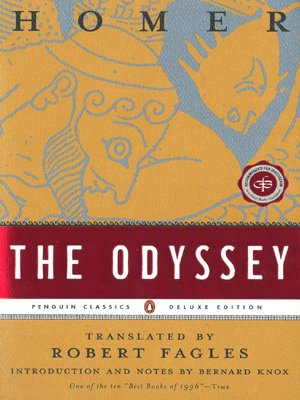
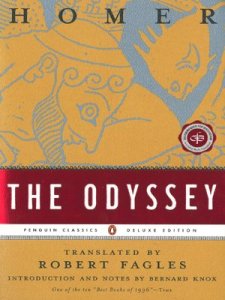
Reading has been a crucial part of the way I understand the world since before  I can remember. I honestly don’t remember learning to read. I’ve always read.  Trollope’s Barchester Towers, Bronte’s Shirley, and all the Austens are no surprise, perhaps, for a middle class white baby boomer woman. They help me understand who I am. But I reread Orhan Pamuk’s My Name is Red because it helps me understand a completely different way of imagining perfection and the sacred. But to choose just one, I will always come back to the Odyssey, and the Robert Fagles translation for preference.

I read it first as a child, in love with the Greek gods. It’s a fabulous adventure story.  Now I read it in amazement for the characters.Odyssey  It was conceived before almost everything in our culture that has shaped us, before Christianity, before reading and writing, before democracy. It is on the very far edge of who we are, and yet, I intimately recognize those characters, relationships, hopes and fears. The main characters are wonderful but even the minor ones reach out to me across the millennia. Who hasn’t met Nestor, the garrulous boring old geezer repeating all his favorite stories, surrounded by his loving family and embarrassing the hell out of them in front of the guests at the family gathering?  Menelaus and Helen are the original celebrity couple, tied to each other by self-interest and despising the other, snarking and sniping in their luxurious hall, amid a fug of bitterness and misery. Competing for attention from the assembly, they create their hell together. The swineherd is another one. Tied to memory and grief but with a very pragmatic foot in the moment, he slips easily between the past and the present, the memory of the dead king, and the need to get a pig down to the hall in good time.
I can’t even really express why the recognition of those characters as the people I meet and know every day gives me such comfort. But it does.  To recognize them from across the far side of human culture, I feel anchored to some baseline of humanity, in spite of all the tumult in between us.

And this seems like a good note to end on, at least for today:

Thanks for this thread. I love and often recommend A Prayer for Owen Meany by John Irving as a great meditation on faith, reasonA Prayer For Owen Meany and doubt. I re-read it this summer and it brims with sly good humor, jeremiads on the corrosive effect of war on US culture, and odd yet essential set pieces, such as an armadillo without its front paws. It also juxtaposes Frederick Buechner’s graceful theology with conversations by 10 year-olds about rating the breasts of the mothers in their small New England town. The opening lines draw one in:

“I am doomed to remember a boy with a wrecked voice. Not because of his voice, or because he was the smallest person I ever knew, or even because he was the instrument of my mother’s death, but because he is the reason I believe in God. I am a Christian because of Owen Meany.”

I also love it because it speaks to the Christian I’d like to be but am not. Or better put in a quote from Leon Bloy in the foreword: “Any Christian who is not a hero is a pig.”

Read the entire thread here.

Parental Disappointment On Display

by Phoebe Maltz Bovy

Parental overshare essays can subdivided into various subgenres. One of those is the very successful parent of an academically-mediocre child. The essay may be about the parent coming to terms with the fact that Junior will not get into to a college William Deresiewicz has strong feelings about. The author inevitably becomes a better person, and parent, in the process, and should be congratulated.

Another subgenre is the child with a difficulty of some kind. Not a problem so severe as to prevent the child from ever having the capacity to read the article. (Those parents suffer enough, and should feel free to share as they see fit. As should parents of adult children who are merely responding to the children’s complaints about them.) But something that’s either medical or just highly personal, that taps into whichever cultural concerns, and where the parent-writer can tell him or herself that they’re really doing a service, as if awareness-raising somehow cancels out the potential destruction of their child’s reputation. While the parents who write such pieces surely do so in part out of concern for their children and others in the same situation – it’s not just professional aspiration and a desire to write what the market plainly demands – these pieces make it so that a child will grow up with his or her identity already being associated with some biographical detail he or she might have preferred not to share, or at least not to lead with.

Rachel Simmons merged these two subgenres into a personal essay about being an academic superstar with an underachieving child. Except that the underachieving has a medical component – her child, she explains, is developmentally delayed, if still quite young. It’s ambiguous from the article whether this is a condition that will long affect her kid, or whether the tragedy is that her daughter may turn out to be of average intelligence. But one almost has to guess it’s the latter, given how much of the piece is devoted to the author’s own brilliance:

I was a classic “amazing girl”—driven, social, and relentlessly well-rounded—reveling in the fruits of post-Title IX America: an all-metro athlete in high school, Rhodes Scholar at 24, best-selling author by 27. My anonymous sperm donor is an (allegedly) gifted musician.

And:

I’ve spent years in therapy excavating my endless, often fruitless drive to overachieve. I have learned that being successful hasn’t made me happy. It’s just made me successful. I even call myself a recovering overachiever.

There’s more, but there’s also the title (and subtitle) that presumably someone at Slate chose to frame the piece: “The Achievement Gap: I excel at everything I do. I assumed my daughter would too.” This is being presented more as a story about a parent who fears a kid’s mediocrity than of one struggling with a child’s disability. Nothing in the piece suggests the daughter in question won’t one day read her mother’s article. And it’s that, and not the humblebragging, that I find objectionable.

It seems cruel to write, of your own kid, “It never occurred to me that my newborn daughter would be anything but extraordinary.” It’s saying that you think your child is ordinary. So not only will this kid have to grow up knowing that her late acquisition of verbal skills is public knowledge, but she’ll also have to contend with a public account of exactly how disappointed that made her mother.

What Is Christianity For?

by Matthew Sitman

Caravaggio_-_Cena_in_Emmaus

That’s the question Rod Dreher asks in a searching reply to my thoughts earlier this week on Christianity and modern life. Some of Rod’s response is a gentle correction to my characterization of the “Benedict Option,” which, in his original essay, he summarizes as “communal withdrawal from the mainstream, for the sake of sheltering one’s faith and family from corrosive modernity and cultivating a more traditional way of life.” To take one example, I described Eagle River, Alaska, as a remote village, while it’s actually in suburban Anchorage – I regret getting that wrong. More importantly, Rod argues that I created something of a straw man, portraying those who pursue the Benedict Option as running for the hills while the world burns. My rhetoric did slip in that direction, and there are nuances to the ways the Benedict Option can be pursued I didn’t capture in my original post. Not all who favor it, and certainly not Rod, argue for “strict separatism” as a response to modern life.

The deeper issue Rod raises, however, goes beyond haggling over this or that detail of the Benedict Option and its various instantiations. Really, arguments about the Benedict Option amount to arguments over the place of, and prospects for, Christianity in the modern world – how Christians should try to live faithfully in our day and age. Here’s the gauntlet Rod throws down:

The way a Christian thinks about sex and sexuality is a very, very good indication of what he thinks about living out the faith in modernity. The reason it is so central is because it reveals, more than any other question now, how a Christian relates to authority and moral order. Matt is a kind and honest interlocutor, and I sincerely appreciate his attention, so please don’t take this in any way snarky or hostile towards him or Christians who share his viewpoint … but the questions have to be put strongly: Where is the evidence for being hopeful about Christianity’s place in modern life? Why should anyone think that the message of Jesus will retain its power in modernity if a Christian experiences little conflict between his faith and the world as it is?

To get to the heart of it: What is Christianity for? 

Those obviously are very big questions, but at least a few points can be made to clarify how I approach these matters.

One reason I reacted the way I did to Rod’s essay is because it’s premised on assumptions about modern life I don’t share. It’s not hard to misconstrue those living out the Benedict Option, taking them to perhaps be more separatist than they are, when descriptions of what they are trying to do are prefaced with references to Alistair MacIntyre and suggestions that we are “living through a Fall of Rome-like catastrophe” or worries about “signs of a possible Dark Age ahead.” I’ve never quite bought this line of thinking, never understood modernity as being a rupture or break from a virtuous past. Instead, the formulation I use is that things are getting better and worse at the same time, all the time. The dazzling achievements of modern life are real but also can have a dark underbelly, which means it’s not always possible to clearly separate out what is “good” from what is “bad.” I resist narratives of decline because they seem to miss this, which means the task of discerning the signs of the times, thinking through them as a Christian, is a complex and difficult task. I reject both optimism and despair about modern life.

It’s worth mentioning here that I never argued for full assimilation into modern life, for Christians to be uncritical of what they see around them. I do experience conflict between my faith and the world as it is. But that tends to take the form of deep sadness at the loneliness so many feel in our society, our callous indifference to suffering, and the rampant materialism and worship of power and wealth characteristic of our times, to name just a few examples. And yet this incomplete list betrays the tension I noted above – were there not real problems with more traditional forms of community that, while largely free of the individualism and mobility that contribute to loneliness and neglect, sometimes were repressive and too averse to change or difference? Isn’t our materialism at least partly a function of an economic system that has pressing problems, but also lifted many out of a life of mere subsistence? I don’t mean for these examples to seem trite or too easy, but they get at why, even when I feel conflicted about modern life, it doesn’t take the form of viewing it as a catastrophe or a new Dark Ages.

I admit, too, that I differ with Rod on the question of homosexuality – I hope that even conservative churches come to bless gay relationships. But as the preceding shows, I don’t think that accounts in full for my attitude toward living as a Christian in the modern world. I see it as one more issue that’s of a piece with the complexity of the world around us. The increasing visibility of gay people is a fact that must be dealt with by the Church, and even many traditionalist Christians, like Rod, would be happy to concede that they are glad gay people face better prospects, in society at large, than they would have decades ago. Sexual modernity has made many people, even traditional Christians, more attentive to the ways in which gay people and women, to take the two most prominent examples, suffered in previous eras. Traditional Christians themselves, even when holding the doctrinal line, often understand these matters in ways quite different than they did just a few decades ago, showing more sympathy and humaneness than in the past. I would go so far as to say that Christians have been taught, through the changes brought by modern life, how to be more genuinely loving and decent in these areas than they have been in the past. That is not to dismiss the deep challenges modern life poses, for traditionalists like Rod, to a conservative sexual ethic – I understand, even if I do not fully share, his concerns. I just can’t view the coming of sexual modernity simply as the triumph of hedonism, if for no other reason than that it has led to grappling with real injustices.

The word that I used to describe my approach to these matters is hopeful, and Rod wonders at my use of that term, at least with regard to Christianity’s place in the modern world. I’ve gone on at length – perhaps too long – explaining how I think about modern life because I believe it goes some way toward suggesting an answer. Living hopefully, in light of this, amounts to patiently, humbly sifting through the complexity I described. It means trying to see the truths revealed by modern life as well as working to restrain it’s excesses and problems. And I’m not sure Christians can best do this by withdrawing from the mainstream, rather than critically engaging it.

When we do engage the modern world, joyfully and without rancor or fear, I still believe Jesus’ message of grace and mercy will resonate. To see the good in modern life is not to deny the need for real, costly love in the world, a love that reaches out to the poor and the lonely and the marginalized, a love that looks with compassion on all who suffer and struggle. What is Christianity for? To teach us how to do that, which sounds awfully pious, I know. And that’s certainly not all that can be said about the Christian faith. But when I look around me, I can’t help but see both the remarkable achievements of modern life and, despite those achievements, a world still fraught with injustice and pain. My hope is that we can sustain and extend the former while struggling to embody Christ’s love in the midst of the latter.

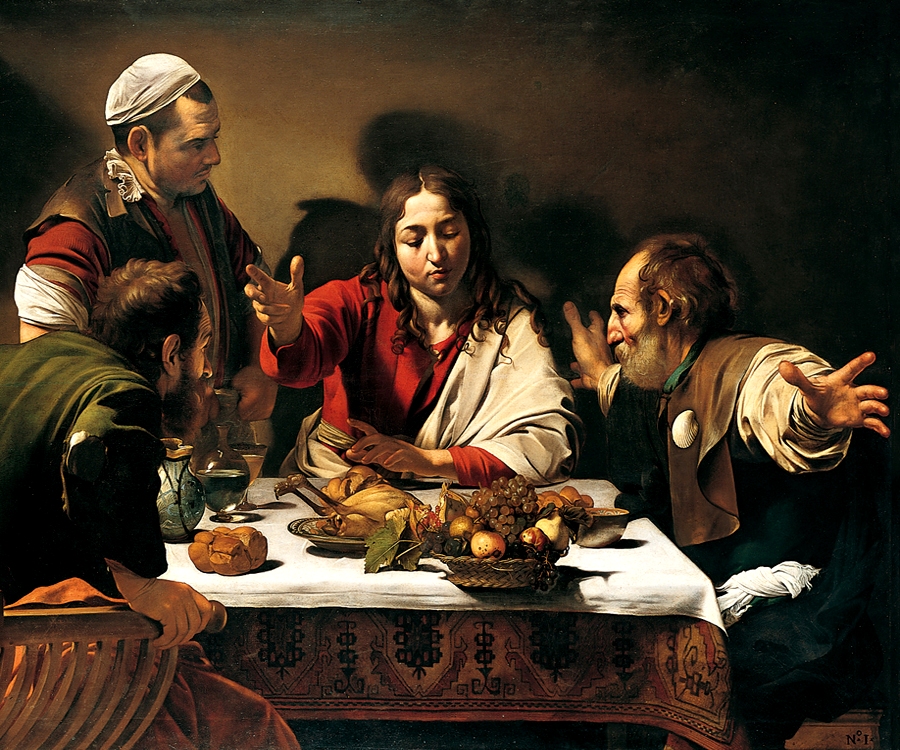
(Caravaggio’s Supper at Emmaus, 1601, via Wikimedia Commons)

The Ebola Outbreak Grows Worse

by Dish Staff

Julia Belluz flags an eye-opening chart on the growing severity of the Ebola crisis:

Ebola Chart

The situation is dire in West Point, a Liberian slum:

Tens of thousands of people are trapped in a slum in Liberia’s capital, Monrovia, after officials put the neighborhood under strict quarantine to prevent the spread of Ebola. Clashes broke out on Wednesday, as riot police and soldiers attempted to barricade angry residents. Days earlier, locals had raided a holding center for suspected Ebola patients, pulling out mattresses covered in blood, which could spread the disease.

Per Liljas provides more details:

On Saturday, a health center was looted and Ebola patients sent running, after a rumor spread that infected people were being brought in from other parts of the country. Others refused to believe the disease existed. “There is no Ebola,” some protesters attacking the clinic shouted. “There is a high level of disbelief in the government in West Point,” Sanj Srikanthan, the International Rescue Committee’s emergency response director in Liberia, tells TIME. “The government has made a concerted effort to reach out to community leaders, youth groups and churches with the message that the only way to contain the disease is to understand it. But some people still believe Ebola is a conspiracy, and those people we need to reach.”

Raphael Frankfurter is unsurprised “that aggressive, opaque public health measures are met with suspicion, resistance, and anger”:

In public health, the emphasis on “harmful behaviors” arising from ignorance fails to acknowledge the complex socioeconomic factors and structural conditions that can lead to poor health.

In the wake of the first Ebola cases in Guinea, the Guinean government and later the Sierra Leonean government launched a massive campaign to persuade people not to hunt and consume bushmeat, which is thought to carry Ebola. Though well-intentioned, these campaigns did not adequately consider that malnutrition is widespread in rural West Africa, and villages in which the population heavily relies on bushmeat are often healthier—in our experience, they even have significantly lower rates of malnourishment. It wasn’t just an issue of people “not knowing” not to eat fruit bats and gorillas—bushmeat was their only source of protein. Continuing to eat it can be understood as a rational decision based on a risk assessment—malnutrition will likely always lead to more deaths in West Africa than an Ebola outbreak.

But I’ve also observed through four years of fieldwork in Sierra Leone that public health interventions that rely on the passive reception of “medical facts” by target communities and that hinge on getting “them” to think like “us,” are simply ineffective. To health workers, taking patients home to die in surrounded by their families, to be collectively buried and remembered in their villages might be considered “irrational” or “contributing to the spread of the disease.” But these practices also allow for a kind of solidarity and resilience in the face of capricious, cruel disease.

Liljas emphasizes the desperation of aid workers as they continue to battle the ebola outbreak in West Africa with limited support from overstretched international organizations:

[T]he biggest unmet need is for additional well-trained health workers. Professionals on the ground are exhausted, and several hundred have died in part because of a lack of training. MSF and other organizations are stretched to breaking point, some of them because of their involvement in other crises. USAID, for example, is responding to four humanitarian crises at the same time: South Sudan, Syria, Iraq and the Ebola outbreak. It must also weigh up whether to put people at risk.

David Francis details how the virus is also endangering the region’s fragile economy:

The outbreak comes at an inopportune time for the region. Prior to the outbreak, the Nigerian economy was being celebrated as the largest in Africa, with a GDP of $510 billion, compared with second-place South Africa, with a GDP of $353 billion. Sierra Leone is attempting to draw foreign investment to its diamond industry and saw its GDP grow 20.1 percent from 2012 to 2013. In 2013, Guinea’s GDP grew a modest 2 percent.

All of these positives are now overshadowed by the bleak prediction of Ebola’s ramifications in the region. The World Bank estimates that Guinea’s GDP will shrink between 3.5 and 4.5 percent this year as Ebola roils the agricultural sector and discourages regional trade. Liberia’s finance minister, Amara Konneh, lowered the country’s GDP estimates by 5.9 percent because of the outbreak. Bismarck Rewane, CEO of the Financial Derivatives Company, a Lagos-based financial advisory and research firm that manages $18 million in assets, told CNBC Africa on Monday, Aug. 18, that Nigeria could lose at least $3.5 billion of its $510 billion GDP. Moody’s has already warned that the virus could hinder the region’s energy sector.

Should ISIS Be Censored? Ctd

by Dish Staff

https://twitter.com/dickc/statuses/502005459067625473

Glenn Greenwald is upset at Twitter for censoring the video of James Foley’s beheading:

Given the savagery of the Foley video, it’s easy in isolation to cheer for its banning on Twitter. But that’s always how censorship functions: it invariably starts with the suppression of viewpoints which are so widely hated that the emotional response they produce drowns out any consideration of the principle being endorsed. It’s tempting to support criminalization of, say, racist views as long as one focuses on one’s contempt for those views and ignores the serious dangers of vesting the state with the general power to create lists of prohibited ideas. That’s why free speech defenders such as the ACLU so often represent and defend racists and others with heinous views in free speech cases: because that’s where free speech erosions become legitimized in the first instance when endorsed or acquiesced to.

The question posed by Twitter’s announcement is not whether you think it’s a good idea for people to see the Foley video. Instead, the relevant question is whether you want Twitter, Facebook and Google executives exercising vast power over what can be seen and read.

Jay Caspian Kang joins the debate, coming down on the same side as Greenwald:

Twitter is not an editorial outfit; it’s odd to think that a company that allows thousands of other gruesome videos, including other ISIS beheadings, would suddenly step in. Twitter, for example, allows creepshot accounts, in which men secretly take photos of women in public. (The sharing of creepshot photos has been banned on Reddit because it tended to target underage girls.) Where, exactly, is the enforcement line? …

Facebook, Twitter, and YouTube have taken an outsize share of the information market, mostly by acting as facilitators. As presently constructed, the policies at each company about what do in these extraordinary situations are still in flux and under-formed. Having families fill out a form on a Web site about a beheading and chalking up the removal of the video to ill-defined company policy does not accurately reflect the power of the image, nor the power of social media. If Facebook, Twitter, and YouTube want to imagine their networks as something of a public square that can, at times, inspire revolutionary movements, they should come up with a more transparent and thoughtful way to deal with the extraordinary footage that is sure to come through their servers.

On the other hand, Emerson Brooking notes, ISIS’s social media propaganda ops are a key element of its war effort:

Social media has proven a powerful tool in the Islamic State’s military offensives. When IS advanced on Mosul beginning June 10, the Iraqi army collapsed immediately. An estimated 60,000 officers and soldiers fled in the first day of fighting. As IS has pushed both south and eastward, threatening to both encircle Baghdad and crush the semiautonomous Kurds, the rout has accelerated. More than 200,000 Iraqi minorities escaped ahead of IS’ early August offensive, abandoning their towns en masse. In total, some 500,000 civilians are thought to have sought refuge in Kurdish-controlled lands. While it is doubtful that more than a fraction of Iraq’s fleeing soldiers and civilians have seen the Islamic State’s postings, it only takes a small handful for the rumors to take hold.

Either way, though, Ben Makuch stresses how futile it is to try and banish ISIS from social media entirely:

I reached out to a Canadian fighter by the nom de guerre Abu Turaab al-Kanadi (“the Canadian”) on Monday, to see what the reaction was among online IS fighters. He’d been booted from Twitter, which I asked him about on Kik messenger. He was very blunt as to what solicited the hand of Twitter officials. “Probably the severed heads,” al-Kanadi said, adding that he was not offered any warning emails or an explanation from Twitter as to why his account was suspended. But al-Kanadi didn’t seem bothered: “It’s whatever. I made a new one.”  … Banning Jihadists from Twitter already seems like an impossible feat, especially when at any moment there’s nothing stopping a banned fighter simply from recreating an account outside the auspices of Twitter officials. Unless you could somehow impose an internet black out on targeted regions of Iraq—even then, the Iraqi government did that with mixed results—it’s a near impossible task.

Is ISIS A Threat To Us?

by Dish Staff

Chuck Hagel thinks so:

The group “is as sophisticated and well-funded as any group that we have seen. They’re beyond just a terrorist group,” Hagel said in response to a question about whether the Islamic State posed a similar threat to the United States as al Qaeda did before Sept. 11, 2001. “They marry ideology, a sophistication of strategic and tactical military prowess. They’re tremendously well-funded. This is beyond anything that we’ve seen,” Hagel said, adding that “the sophistication of terrorism and ideology married with resources now poses a whole new dynamic and a new paradigm of threats to this country.”

Hagel’s comments added to the mismatch between the Obama administration’s increasingly aggressive rhetoric and its current game plan for how to take on the group in Iraq and Syria, which so far involves limited airstrikes and some military assistance to the Kurdish and Iraqi forces fighting the militants. It has also requested from Congress $500 million to arm moderate rebel factions in Syria. But for now, the United States is not interested in an Iraqi offer to let U.S. fighter jets operate out of Iraqi air bases.

Retired Gen. John Allen seconds Hagel’s assessment, arguing that the US has the means to destroy ISIS and a moral and security-based obligation to do so:

IS must be destroyed and we must move quickly to pressure its entire “nervous system,” break it up, and destroy its pieces. As I said, the president was absolutely right to strike IS, to send advisors to Iraq, to arm the Kurds, to relieve the suffering of the poor benighted people of the region, to seek to rebuild functional and non-sectarian Iraqi Security Forces and to call for profound change in the political equation and relationships in Baghdad.

The whole questionable debate on American war weariness aside, the U.S. military is not war weary and is fully capable of attacking and reducing IS throughout the depth of its holdings, and we should do it now, but supported substantially by our traditional allies and partners, especially by those in the region who have the most to give – and the most to lose – if the Islamic State’s march continues. It’s their fight as much as ours, for the effects of IS terror will certainly spread in the region with IS seeking soft spots for exploitation.

Observing how the official rhetoric on ISIS has escalated, Eli Lake picks up on a choice of phrasing by Obama that he interprets as revealing:

In the aftermath of the 2012 attack on the U.S. diplomatic compound in Benghazi, Obama vowed to bring the attackers to justice. This week Obama struck a different tone, saying: “When people harm Americans, anywhere, we do what’s necessary to see that justice is done.” The difference between bringing suspects to justice and seeing that justice is done is roughly the same as the difference between treating terrorism as a crime and as an act of war.

Even though special operations teams were dispatched to Libya after Benghazi to target the jihadists suspected of carrying it out, Obama chose to treat the attack, which cost the lives of four Americans, as a crime. It took until June of this year for the FBI in conjunction with U.S. special operations teams to capture one of the ringleaders of the attack and bring him to the United States to face trial. A different fate likely awaits the leaders of ISIS.

Larison is steaming, of course:

The good news so far is that the administration doesn’t appear to be taking its own rhetoric all that seriously, but the obvious danger is that it will trap itself into taking far more aggressive measures by grossly exaggerating the nature of the threat from ISIS in this way. The truth is that ISIS doesn’t pose an imminent threat to the U.S. and its allies, unless one empties the word imminent of all meaning. Hagel made the preposterous statement today that the group poses an “imminent threat to every interest we have.” That is simply a lie, and a remarkably stupid one at that, and it is the worst kind of fear-mongering. Administration officials are engaged in the most blatant threat inflation with these recent remarks, which is all the more strange since they claim not to favor the aggressive kind of policy that their irresponsible rhetoric supports.

If the group can be contained, as Gen. Dempsey states, then it can be contained indefinitely. If that is the case, then the threat that it poses is a much more manageable one than the other ridiculous claims from administration officials would suggest.

Allahpundit figures it’s only a matter of time before ISIS attempts an attack on American soil:

ISIS has every incentive to do it, too. Nothing would lift their prestige in the jihadiverse more than an attack on American soil. They have nothing to lose at this point by holding off either; quite rightly, we’re going to bomb them whether they do it or not. They have the motive and they most certainly have the means, flush with cash to pay traffickers handsomely for smuggling them across and well supplied with men who can melt into the U.S. population more easily than the average ISIS neckbeard. If you want to knock Perry for something, knock him for understating the threat: Why would ISIS send a jihadi to cross the border, where he might be caught, when they could put one with a British passport on a plane and have him waltz into the United States instead?

By engaging the jihadists in battle, Keating points out, the US creates that incentive:

ISIS and its predecessor organization, al-Qaida in Iraq, have long held hostile views toward the United States and its presence in the Middle East. It has issued threats against the U.S. before, including a promise to “raise the flag of Allah in the White House.” U.S. and European governments have also warned for some time that the large numbers of international fighters who have traveled to Syria to fight with ISIS could return with the means and know-how to carry out attacks in their home countries. So far there hasn’t been much evidence of this actually taking place. … This has arguably been to ISIS’s strategic benefit. It’s hard to believe the U.S. would have taken quite this long to send in the drones had there been evidence that ISIS was actively plotting attacks against the U.S. homeland or even U.S. facilities in the Middle East. Now, that’s obviously changed. With the U.S. bombing its forces in Iraq, there’s no benefit for ISIS in refraining from attacks against Americans.