There Goes The Neighborhood School

by Dish Staff

Former New Schools For New Orleans chief executive Neerav Kingsland applauds DC’s proposal to move away from traditional school zoning:

Historically, having neighborhood schools kept black students from learning alongside white students; poor students from attending school with wealthy students; immigrant students from studying with native-born students – and the list goes on. A city of neighborhood schools is a city that says where you live determines which schools you can attend. The implications are clear: Poor families will not have access to the schools of the wealthy. In this sense, predictability is code for “I want school choice based on my ability to buy a house rather than school choice based on an equitable process.”

Adam Ozimek seconds him:

As Kingsland argues, neighborhood schools are “bastions of exclusion, not inclusion.” This is ironic, given that the motivation of universal and free K-12 is that it should be a force for equalizing educational opportunity.

There is no other institution in the country where equality of access is more broadly supported, even if this agreement is limited to the abstract. While liberals want to turn more institutions and markets into forces for equality, we are currently failing to do so in K-12 education despite the near total government control and significant amount of agreement on the principle of equality. It’s surprising then that there isn’t more movement to make public schools truly public, and not just another housing amenity sold to the highest bidder.

Meanwhile, Linda Lutton notes that Chicago’s neighborhood schools are struggling with declining enrollment:

In 2000, 74 percent of Chicago’s elementary kids went to their assigned neighborhood grammar school. Today, just 62 percent do– and that number is falling. The figures show how much the system shifted over the decade that included Renaissance 2010, a program that gained national attention by opening dozens of new grammar schools and closing dozens of neighborhood schools deemed low-performing or under-enrolled. …

“Neighborhood schools in the traditional and historical sense are under pressure, and more in some places than others,” says Jeffrey Henig, who studies the politics of education reform at Teachers College in New York City. While the neighborhood school is still a strong concept in suburban America, it’s taken a “body blow” in cities like Chicago that are trying to improve their school systems through school choice, Henig says.
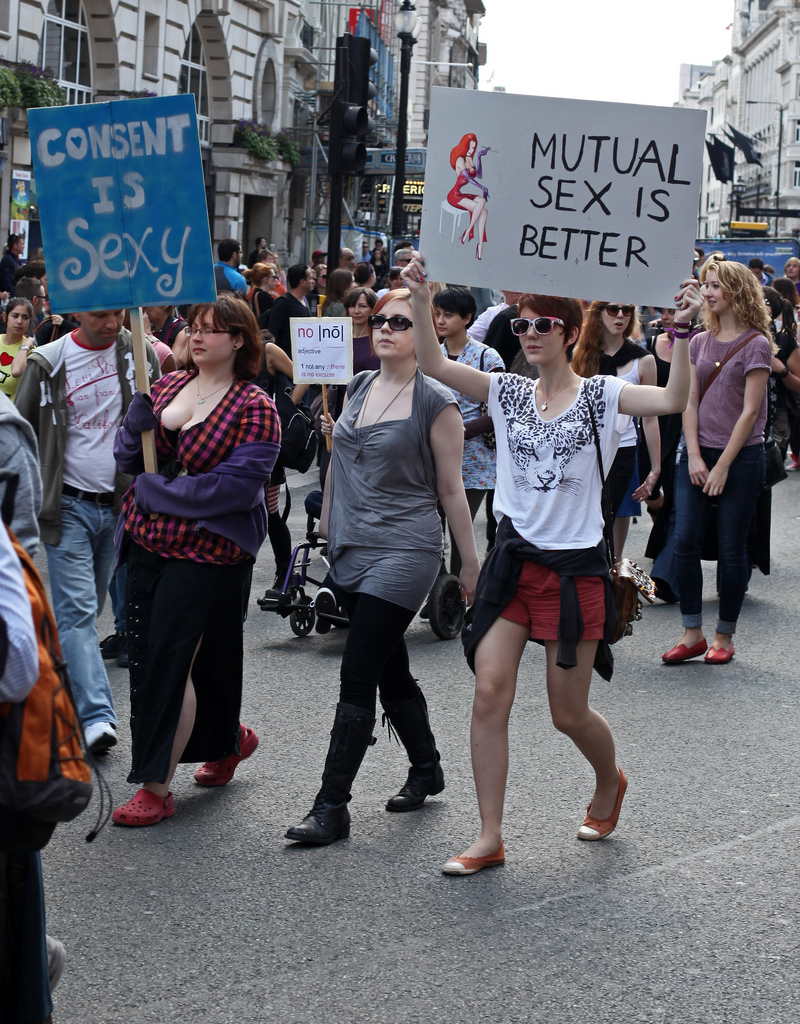
Consent, California Style

by Elizabeth Nolan Brown

5822104430_411775c541_bLawmakers can get it wrong in the most staid of circumstances, but throw a little sexual activity into the mix and things just get really bizarre. And leading the pack on bizarro sexual paternalism lately has been California. This summer, the state legislature has been trying to force condoms on porn performers and redefine rape for college students. The latter effort coincides with a nationwide push to address sexual assault at schools, one focal point of which has been consent.

In some ways this is great – feminists have long been stressing the need to teach young men not to rape over teaching young women how to avoid rape. A central tenet of this is cutting through the bullshit that leads to genuine confusion over consent (myths like women say no in bed because they want to be talked into it or that pursuing a love interest despite her repeated rejections is romantic and not annoying/scary). And the fact that lawmakers and mainstream media outlets are even discussing consent is a testament to how well this push has worked. I’m not sure I ever heard the term consent (in a sexual context) in college; now it’s a buzzword.

Of course, consent has always played a central role in our legal definitions of sexual assault and rape – though not necessarily as central a role as you might think. In many states, criminal code defines rape as sexual penetration using force or the threat of force, according to George Washington University law professor John F. Banzhaf III. If force isn’t an element, “the act would not be rape even if the woman had not consented, or, indeed, even if she had in fact said ‘no.’ Moreover, even if her judgment were significantly impaired by alcohol, the action would not constitute rape if she were able to move or speak at the time.”

California is not one of these states – it already employs a pretty broad and comprehensive definition of rape. The proposed consent law currently under debate in the Assembly (it passed the Senate in May) seeks to impose affirmative consent as a requirement – not for all sexual activity, but for sex between college students at universities that accept state funding.

An affirmative consent standard, also supported by the Department of Education, says that any sexual act counts as rape or assault unless the other person affirmatively consents – that is, specifically gives a yes, not merely refrains from saying no. Under the California consent bill, consent requires “an affirmative, unambiguous and conscious decision” by each party; this consent must be “ongoing” and “can be revoked at any time.”

Unless we presume that rape only occurs between men and women, and only with men as the perpetrator, this standard is on its face a little bit nuts.

In a world where any party – male or female, gay or straight – is capable of committing rape, hookups would have to involve a constant stream of back-and-forth consent (“do you consent to me doing this?” “yes – do you consent to me doing this?”). In reality, affirmative consent proponents tend to talk about it as matter of men getting women’s permission to proceed.

But my main objection to California’s consent bill is that it creates one definition of consent and rape for some college students and one for everyone else in the state. This seems a strange proposition, and one likely to create confusion for the folks of California as well as the courts. It merely muddies up the waters of consent.

“California needs to provide our students with education, resources, consistent policies and justice so that the system is not stacked against survivors,” said state Sen. Kevin de Leon (D-Los Angeles) in promoting the bill. But a consistent system wouldn’t set one standard of sexual consent for college students and one for everyone else.

If college rape is real rape – and, uh, obviously it is – we should stick to one legal definition of consent for all adults and then try those accused of violating it in the same judicial system. No means no, and rape means the same thing regardless of whether you’re enrolled in school – and comes with the same legal penalties.

(The Dish’s extensive coverage of sexual assault on college campuses is here. The above photo is by Chris Brown.)

Just Another Ceasefire, Or Something More?

by Dish Staff

Another three-day ceasefire went into effect in Gaza at midnight last night and appears to be holding for now, as negotiations resume in Cairo:

A senior Israeli government official had said on Sunday Israeli negotiators, who had left Cairo on Friday hours before a previous three-day ceasefire expired, would return to Egypt to resume the talks only if the new truce held. Hamas is demanding an end to Israeli and Egyptian blockades of the Gaza Strip and the opening of a seaport in the enclave – a project Israel says should be dealt with only in any future talks on a permanent peace deal with the Palestinians.

Ed Morrissey likes former Shin Bet chief Yaakov Perry’s proposal to turn the Gaza ceasefire negotiations into regional talks on a permanent peace deal:

Israel has to find a way to push Hamas aside without opening up a vacuum that will allow a worse alternative to take its place. Voila: the Arab League. The neighboring Arab nations hate Hamas too, and would love to see it expelled or at least marginalized in the region. A comprehensive regional peace plan would lock Iran out of Palestinian politics entirely and allow for a greater focus on the threat coming from Tehran rather than the constant irritation of Palestinian uprisings. They’ll never get the “right of return,” but the Arabs could gain some other concessions, especially on the West Bank wall and some of the settlements in exchange for purging Hamas from Gaza and getting the Palestinian Authority to take over its governance.

At least, that’ll be the theory.

And even if the talks can’t pull off the improbable, at least the effort will be a little more productive than listening to Hamas demand that Israel commit national suicide by reopening the border crossings under Hamas leadership.

Gershon Baskin thinks this might actually work, if the Arab states and Israel play their parts:

If King Abdallah of Saudi Arabia would issue an invitation to Netanyahu, Abbas, President El-Sisi of Egypt, and King Abdullah of Jordan to come immediately to Riyadh with Gaza on the table, it could very easily lead to the acceptance of the Arab Peace Initiative.  The current war is a dead end; we need a brave initiative and a courageous Arab leader (and Israeli one) to get beyond the current lose-lose scenario in progress.

There is more Israel can do to move things in the right direction, without giving an inch to Hamas. Netanyahu’s government should reach out to the Palestinian population in Gaza with messages that move from the current language of threats to the language of promise and hope. Israel needs to articulate to Gazans what a peaceful Gaza could look like with an airport, economic development, and jobs. Gazans desperately want to hear concrete plans for how their basic needs for a normal life could be met, and Israeli officials should be the ones to tell them.

But Omar Robert Hamilton considers the trope that Hamas can’t be negotiated with preposterous:

Of course, a central tenet of Israeli spin is to always refer to “Hamas” and not  to “Palestinians” (Americans are sympathetic to Palestinians, but not to Hamas), to hit the word “terrorist” as often as possible and to stress that Hamas is “committed to the destruction of Israel.” It is never mentioned that in their 2006 election manifesto, Hamas dropped their call for the destruction of Israel and simply reaffirmed their right to armed resistance. Hamas is a political player that, like all others, is primarily interested in the acquisition of power and influence – they are very far removed from the theocratic death cult that Israel strains to see in its dark mirror. In 2006, as Hamas was engaging in the democratic process, it announced it would stop using suicide bombers. There has not been a bomb since. Israel claimed that the (still-incomplete) Wall was to thank. Again and again, Hamas have tried to play by the rules of the game as they are set by Israel, America and the International Community. Democracy is embraced and brings with it a siege. Israel’s existence is recognized but this goes unmentioned. Military resistance is halted and the siege deepens. Truces are agreed to and Israel violates them.

Whichever way this tentative new peace effort goes, Judis observes that the US isn’t leading it. That’s because, he asserts, it’s no longer in our interests to do so:

The pressure from surrounding Arab states to resolve the conflict has eased, particularly in the wake of the failure of the Arab Spring. Lebanon, Syria, and Iraq are preoccupied with their own internal problems. Egypt’s el-Sisi is more sympathetic to Netanyahu than to Hamas’s Khalid Mishal. The Saudis are still committed to their own initiative for resolving the conflict, but like el-Sisi, have no affection for Hamas. And the threat of terrorism in the regiontypified by Islamic State in Iraq and Syriais no longer so clearly tied to the continuation of the Israeli-Palestinian conflict. So while the surrounding Arab states are always under public pressure to end Israeli attacks against Palestinians, Arab leaders have not displayed the same urgency.

The pressure that existed in 1975 or even 2005 doesn’t exist. As a result, Obama and Kerry do not feel the same urgency to act.

The Nanny State Shouldn’t Baby Working Parents

by Elizabeth Nolan Brown

“Can family leave policies be too generous?” asked Claire Cain Miller in The New York Times yesterday. Cue the eye-rolling from a certain sort of feminist – expanding America’s paid parental-leave policies has long been on many gender-progress wish lists. European countries such as the U.K., with its generous 39 weeks paid time off for new mothers (plus an additional 13 weeks unpaid leave available), are often cited as the holy grail of family- and women-friendly policies.

Last month, the White House Council of Economic Advisers blamed slow economic recovery on women’s declining labor force participation, suggesting that expanding mandatory maternity-leave policies could help rivet all these women back into the job market. But Miller points to evidence that longer leave mandates aren’t the panacea they might seem. In countries with extensive maternity-leave guarantees, women’s total labor force participation is higher, but their professional status relative to men is lower.

In one study, published last year in the American Economic Review (an earlier copy is available here), two Cornell University economists looked at family-leave policies in 22 countries. The researchers, Francie D. Blau and Lawrence M. Kahn, were attempting to understand why U.S. women’s workforce participation – one of the highest among Western countries in 1990 – had become one of the lowest in this cohort by 2010:

We find that the expansion of “family-friendly” policies including parental leave and part-time work entitlements in other OECD countries explains about 29% of the decrease in US women’s labor force participation relative to these other countries. However, these policies also appear to encourage part-time work and employment in lower level positions: US women are more likely than women in other countries to have full time jobs and to work as managers or professionals.

Knowing that younger female workers could legally take up to a year off work and require a part-time schedule thereafter could lead to “statistical discrimination against women as a group,” Blau and Kahn concluded. “Thus, while the (labor force participation rates) of women in other countries have risen relative to the United States, such increases may have come at the expense of advancement once they are in the labor force.”

Is this a tradeoff we want to make? I don’t think so. But that doesn’t mean we’re resigned to the status quo on family leave, either. Miller notes that “pulling levers in both policy and culture” could make a difference, and I would argue that the latter is the place to start. Even a small change in daddy-leave norms could benefit families, reduce the career penalty on mothers, and lead to a positive shift in our gendered view of caregiving. But if the U.S. government simply stepped in and mandated that men be allowed paid parental leave too, few would probably take it. Employer expectations and bullshit masculinity codes aren’t going to shift just because the state says they can.

As with maternal leave policies, there is only so much you can accomplish by legislative fiat here. Without getting women, men, and employers on board with expanding or shifting family leave policies, laws mandating such will only limit women’s wages and advancement potential in the workforce. And low wages and dead-end careers are the very things that make women more likely to drop out of the labor force when they become moms.

(Lots of recent Dish on paternity leave here)

The Diseases We Neglect

by Dish Staff

Ebola

Charles Kenny remarks that new Ebola treatments are in the works only because “the Department of Defense had taken interest in the disease as a bioterror threat and was financing development of the drug ZMapp as a potential response”:

Ebola is the exception: Only a little more than 1 percent of new drugs approved between 1975 and 2004 were designed to address tropical diseases that account for more than 10 percent of the years lost to premature death and disability worldwide. Research and trials for tropical diseases focusing on cheap prophylactics, such as vaccines, and easily administered treatments for sufferers should be a priority for global support.

Funding is only part of the problem.

A lot of resources at the country level are wasted on doctors who don’t bother to diagnosehealth-care workers who don’t turn up, and expensive hospitals catering only to the elite. While the WHO has some significant accomplishments in global health—not least negotiating the International Health Regulations themselves and leading the fight to eradicate smallpox and polio—it is far from a paragon of effectiveness. The WHO has undertaken some reforms since then, but a 2011 U.K. government review of the organization suggested it was “weak” in some areas, from financial resource management through transparency to its focus on poor countries.

Jeremy Youde points his finger at thrifty governments rather than the WHO:

For an international organization tasked with overseeing global responses to health emergencies, WHO is woefully under-resourced. Over the past two years, the organization has seen its budget decrease by 12 percent and cut more than 300 jobs. The current budget saw cuts to WHO’s outbreak and crisis response of more than 50 percent from the previous budget, from $469 million in 2012-13 to $228 million for 2014-15. This is the very budget line that the organization needs to rely upon in order to respond to Ebola. After it announced it needed $71 million to implement its Ebola response plan, WHO now has to hope member-states or private organizations agree to contribute.

(Chart from Quartz.)

The Whitening Of Southern Politics

by Dish Staff

Jazon Zengerle’s TNR cover-story examines the state of racial politics in the South:

Because of increasingly racially polarized voting patterns in the South, party has become a stand-in for race. As University of California at Irvine law professor Rick Hasen recently wrote in the Harvard Law Review, “The realignment of the parties in the South following the Civil Rights movement of the 1960s has created a reality in which today most African American voters are Democrats and most white conservative voters are Republicans.” That means that, as Democrats have lost ground in statehouses in Alabama and elsewhere across the South, so have African Americans. According to research by David Bositis, in 1994, 99.5 percent of black state legislators in the South served in the majority. By 2010, the percentage had fallen to 50.5. Today, it’s a mere 4.8 percent.

Political scientists distinguish between descriptive representation and substantive representation. The former focuses on the number of, say, African Americans who are elected to a legislative body, while the latter focuses on the effect of those African American representatives on the legislation passed by that body. It was easy to see, by the early ’80s, that the Voting Rights Act had successfully achieved descriptive representation for African Americans in the Southern state legislatures. But, as time went on, it began to achieve substantive representation, as well. “There was a thirty-year period in the South, from about 1980 to 2010, where there really was biracial collaboration and cooperation in politics,” says Bositis. “And it was a genuine biracial politicsmore genuine than in some northern states.”

But nowadays, according to Zengerle, “the GOP-controlled governments of Southern states are behaving in ways that are at times as hostile to the interests of their African American citizens as Jim Crow Democrats were half a century ago”:

As David Bositis told me, “Black people in the South have less political power now than at any time since the start of the civil rights movement.”

Of course, that flies in the face of the newly popular notion that Southern blacks have never enjoyed more political clout. Whether it was black Mississippians helping Senator Thad Cochran win the Republican run-off in Mississippi in June or the potential for African American voters in North Carolina, Georgia, and Louisiana to carry Democratic Senate candidates in those states to victory this November, “black voters,” Nate Cohn recently wrote in The New York Times, “are poised to play a pivotal role in this year’s midterm elections.” But these will likely be pyrrhic victories. At the state level, Republicans can continue to win by catering exclusively to white voters, pushing the parties even further apart and making state laws ever more extreme. The fact that black people in the South still have the right to vote, and they’re still able to elect black politicians at the state and local levels, is what makes the end of the Second Reconstruction so much more insidious than the end of the First. Lacking white politicians to build coalitions with, those black politicians are rendered powerless. As Kareem Crayton, a University of North Carolina law professor, told me, “The situation today has the semblance of what representation looks like without very much ability to actually exercise it.”

How Sexually Fluid Are Women Really?

by Phoebe Maltz Bovy

I’ve long had my doubts on the question. What I doubt, to be clear, isn’t that some women are bisexual. Just that all women are, which is essentially what one is saying if one declares female sexuality fluid. I doubt this in part for personal-thus-anecdotal reasons (I’m female, and my orientation hasn’t budged since it first encountered photos of a then-young Keanu Reeves close to 20 years ago), but also because there are other explanations, not related to wiring, that could account for the appearance of fluidity one witnesses.

What it comes down to is, it remains much more controversial for men than women to have same-sex relationships or encounters. But at the same time, it’s much more taboo for women than men to be without a partner of the opposite sex.

This sounds contradictory, I realize, but let me explain: There’s a stigma, for women, on being boyfriend-less, husband-less. But the stigma isn’t based on fears that the woman might be a lesbian, but rather, that she might be unable to get a man. Being found desirable by men continues to be important to women’s power in the world in a way that’s independent of how attractive that woman may or not find these – or indeed any – men. There are also financial advantages to pairing off with someone of the gender that tends to earn more.

How does any of this relate to women’s alleged sexual fluidity? Men are under greater pressure than women to seem not-gay, so there’s less same-sex fooling around among the merely curious, or it’s less openly discussed, making male sexuality seem less fluid than might be the case. But men are under less pressure than women to pair off (and what pressure there is starts so much later in life), so there may be fewer gay men than lesbians in opposite-sex relationships.

I came up with this grand (and thus far mostly unsubstantiated) theory while listening to a recent Savage Lovecast. (Update: listen to the relevant clip below, sent to us by the tech-savvy at-risk youth:


A 25-year-old woman called the show (starts at 8:13) to say that she’s a serial monogamist who’s only ever dated men. But! She can’t stop thinking about women. She’s openly bisexual, has known this since she was 14, which her current boyfriend knows, but he doesn’t want an open relationship. And so on, but what jumped out at me was the part where she mentioned that “90% of the time” when she’s having sex with her boyfriend, she’s fantasizing about women. 90%!

Imagine, if you will, ladies, if you learned that your boyfriend or husband fantasized about men 90% of the time he was with you. You’d probably come to the conclusion that your guy was gay. Not because male bisexuality doesn’t exist, but because of how close 90% is to 100%.

Presumably Dan Savage would make this same assumption if the genders were reversed. He doesn’t. This is ostensibly because the caller identifies as bisexual, but may also have just a bit to do with the fact that she’s a woman, and women, so fluid! Savage, in his response, likens her persistent desire to be with women to kinks and fetishes people try to repress over the years (he mentions foot fetishes), and it’s like, gah, this woman is a lesbian! That’s not a kink, it’s a sexual orientation! This isn’t about monogamy being constraining (as much as Savage tried to fit it into that box), but about being with someone of the wrong gender posing certain fairly obvious obstacles to happiness. What this woman needs to do isn’t – as Savage advises – renegotiate her heterosexual relationship to allow for some women on the side. She needs to lose the boyfriend and get herself a girlfriend.

Why, then, is a lesbian dating dude after dude after dude? What comes through in her call isn’t the slightest glimmer of desire for her boyfriend (“I love him a lot” and “I really care about him” – sweet, but sort of tepid for “25” and “boyfriend”) or indeed any of the other men on the planet. She’s afraid of not being in a relationship with a man: “The thought of losing that someone I have thought about spending the rest of my life with is devastating.” She’s afraid of giving up the possibility of Husband. Which is… a totally legitimate fear in our society, but hardly evidence that she’s straight or bi.

If Savage’s alarm bells don’t go off at this call, perhaps it’s because he has been socialized to believe that female heterosexuality is this softer, more reactive version of its male counterpart. That it’s basically about wanting stability, a husband, a man who’ll find you attractive. No one expects women – even heterosexual women – to lust after men. (Many of us do. But we’re socialized to be discreet about it.) So it doesn’t immediately read as “lesbian” when a woman expresses intense interest in other women, but sounds sort of lukewarm about men.

Update: Phoebe responds to some criticism of her piece here.

Arming The Kurds

by Jonah Shepp

The US has begun providing weapons directly to Kurdish forces in northern Iraq, in a break with our longstanding policy of only selling arms to the government in Baghdad:

The officials wouldn’t say which U.S. agency is providing the arms or what weapons are being sent, but one official said it isn’t the Pentagon. The CIA has historically done similar quiet arming operations. The officials spoke on condition of anonymity because they were not authorized to discuss the operation publicly. The move to directly aid the Kurds underscores the level of U.S. concern about the Islamic State militants’ gains in the north, and reflects the persistent administration view that the Iraqis must take the necessary steps to solve their own security problems. A senior State Department official would only say that the Kurds are “getting arms from various sources. They are being rearmed.”

This move is typical of Obama’s decisions in Iraq so far: sensible, realist, but a bit late. Imagine if we had decided to arm the Kurds months ago, when ISIS was merely threatening to completely destabilize Iraq, as opposed to today when it has already done so. On the other hand, of course, these decisions are not made in a vacuum, and it may have been politically impossible to do so at the time, even if Obama had wanted to. Now, with Iraq’s government in a state of total chaos, dealing with Kurdistan as an effectively independent entity makes even more sense, and it doesn’t really matter anymore if we upset Maliki. And if this really is Kurdistan’s moment, why stand in the way of the inevitable? So three cheers to the peshmerga, and let’s hope this works. Cale Salih also thinks it’s about time we threw our full weight behind the Kurds:

Obama needs the Kurds, and he knows it. They are largely secular and pro-Western, but also maintain dynamic ties to both Iran and Turkey. They offer a potential base from which the US can stage counterterrorism operations against Isis. Iraqi Kurdish parties have links to Kurdish groups in Syria, and Kurdistan Worker’s Party-affiliated Syrian Kurds have been one of the only militias able to effectively fight Isis there. Kurdistan is a much-needed safe haven for refugees from Syria, and internally displaced people from other parts of Iraq. It offers a stable, economically prosperous buffer zone right at the intersection of several regional conflicts. A weak, unstable Kurdistan would allow Isis and other militants to more easily move between Iraq and Syria.

Spencer Ackerman saw this coming days ago, when he called the claim that the US intervention was intended to protect American personnel in Erbil “a convenient elision”, allowing us “to avoid, or at least defer, explicit preferential treatment for the Kurds”:

Conspicuously, the US has yet to attack the Isis positions threatening Iraqi Yazidis at Mount Sinjar, whose dire conditions ostensibly prompted Obama’s first step toward making the Iraq crisis an American one. On the ground by Irbil, these distinctions are less meaningful. The F/A-18s might not have explicitly provided close air support for the Peshmerga – that would require coordination between the Peshmerga and the US Navy pilots – but the strikes nevertheless provide the Peshmerga with a measure of air cover, an advantage over the better-armored Isis fighters. It rhymes with close air support, at least: the Kurds get a chance to fortify the defense of Irbil.

Judis, meanwhile, suspects that our interest in Kurdistan has a lot to do with its oil:

If the Islamic State were to take over Erbil, they would endanger Iraq’s oil production and, by extension, global access to oil. Prices would surge at a time when Europe, which buys oil from Iraq, has still not escaped the global recession. Oil prices have already risen in response to the Islamic State’s threat to Erbil, and on Thursday, American oil companies Chevron and Exxon Mobile began evacuating their personnel from Kurdistan. … The United States should worry about the global oil supply. It is important for global economic and political stability. And having a significant chunk of it fall into the hands of a group like the Islamic State should certainly be a concern. But if Obama is worried about the world’s oil supply, then he should say so forthrightly and not leave himself in a position where he will be unable to justify or explain further intervention after the airdrops to the Yazidis are completed.

Well, an intervention can be both humanitarian and strategic, and I don’t think anyone really doubts that this is both. Judis is right to warn Obama against underselling the strategic angle of what he’s doing in Iraq (others have made the same point), and it would be lovely if an American president would acknowledge the degree to which petro-politics really influences our foreign policy, but my fear is that if the anti-war left ends up spinning this intervention as another sacrifice of blood and treasure to Big Oil, that would obscure much more than it would illuminate. Judis compares the situation to Libya:

If the Obama administration wanted to prevent the world’s peoples from brutal dictators and repressive regimes or from takeovers by terrorist groups, there are other countries besides Libya and Iraq where it could intervene. What distinguishes these two countries is that they are major oil producers.

It’s not the only thing that distinguishes them, though.

What The Hell Is Maliki Doing?

by Dish Staff

Baghdad’s political crisis appears to have gone off a cliff, with the embattled prime minister in the driver’s seat. Mary Casey sums up the news since yesterday:

Maliki has accused the country’s new president, Fouad Massoum, of staging a “coup against the constitution and the political process” for refusing to designate him prime minister. On Monday, Massoum asked Deputy Speaker Haider al-Abadi to form a government. U.S. Secretary of State John Kerry said the United States supports Massoum and warned Maliki not to interfere with the constitutional process and the formation of a new government. However, an Iraqi court ruled that Maliki’s State of Law coalition is the largest bloc in parliament and should be given the first opportunity to form a new government. Meanwhile, the United States has begun to directly provide arms to the Kurdish pesh merga forces who are battling Islamic State fighters in northern Iraq. The U.S. administration had previously sold weapons only to the Iraqi government in Baghdad. U.S. airstrikes over the weekend have helped the pesh merga to retake the towns of Gwer and Mahmour.

Maliki has not only threatened to sue Massoum for neglecting his constitutional duties, but has also deployed security forces loyal to him throughout Baghdad, ostensibly to forestall a coup against him but more likely, some fear, to be ready to carry one out on his behalf (NYT):

As he spoke in the middle of the night, extra security forces, including special forces units loyal to Mr. Maliki, as well as tanks, locked down the Green Zone and took up positions around the city, heightening the sense of drama. There were no immediate signs Monday afternoon that Mr. Maliki had taken further steps to use military force to guarantee his survival. And Mr. Maliki was scheduled to make a public statement on television, along with other members of his Dawa Party who remain loyal to him. Mr. Maliki’s television appearance, in which he appeared to be trying to intimidate Mr. Massoum by mentioning the army in the context of protecting the constitution, alarmed American officials, and left Baghdad wondering if a coup was underway.

To Zack Beauchamp, this kind of strongman behavior perfectly illustrates the point Obama made in his Saturday press conference that the only permanent solution to the crisis is an Iraqi political solution. After all, Maliki’s heavy-handed dealings with Iraq’s Sunni minority played a major part in enabling the rise of ISIS:

“The Sunnis have lots of different grievances,” Kirk Sowell, a political risk analyst and expert on Iraqi politics, says. Some of these are the current government’s fault. Prime minister Maliki has treated the Sunnis badly, including forcibly breaking up a peaceful protest movement in 2013. His seemingly authoritarian turn on Sunday shows just how far Maliki remains from moving towards a more inclusive style of governance. …

While these grievances of course don’t transform Iraqi Sunnis into ISIS-style theocrats, it does make Sunni communities more open to at least seeing if ISIS will be better for them than Baghdad. And so long as ISIS has at least passive support from the Sunni population, it will be almost impossible for the Iraqi government to dislodge them from the mostly Sunni territory they hold.

This behavior has even invited comparisons to Bashar al-Assad:

“The Assad approach” is how Maliki’s detractors, both rival politicians in Baghdad and civilians caught up in the government’s fight against Sunni militants, describe the Iraqi leader’s military strategy, comparing the men’s use of military force to address internal social and political problems. In Syria, Assad’s use of military force in response to popular protests, some argue, was partially to blame for how the originally peaceful protests morphed into an armed uprising that eventually created a security vacuum in which al Qaeda-inspired militants flourished. Some Iraqis say the same is true of Maliki’s decision to clear the Ramadi protest [in January]. Some Syrians say so, too. “Sometimes I laugh when I see this Iraqi dictator following Assad’s footsteps,” said Omar Abu Leila, a spokesman for the Free Syrian Army’s Eastern Front.

Ed Morrissey throws up his hands:

Kerry’s bluster aside, the US has no real influence in Baghdad any longer, which the White House made clear with its earlier unmet demands for political reform as a prerequisite for intervention. Maliki made it official last night. The only option left to the US is to arm the Kurds to get an effective fight against ISIS, and apparently leave Baghdad to Iran. If Masum can wrest power away from Maliki and get a Shi’a PM who can work with Kurds and Sunnis, that would be terrific — but he might have to fight through Maliki’s elite forces and Moqtada al-Sadr’s irregulars to have a chance now, and the US endorsement will hardly be a boon to that cause.

And Josh Marshall takes this moment to revisit the question of whether the unitary Iraqi state is worth trying to preserve:

Many of you will rightly say, this is hardly our decision. And I agree with that. But our policy inevitably looks toward and tries to shape what we see as the preferred outcome. The US and Europe tried to keep Yugoslavia together until it obviously couldn’t be kept and then we gave up trying. At the moment we’ve kept our closest friends, the Iraqi Kurds, on a tight leash and actually have a tanker of their oil held off the coast of Texas, all to help along the move toward unity in Baghdad, which Maliki seems set on preventing.

We’re told that Maliki missed the opportunity he was given with the Sunni Awakening in 2007-08 and went back to a Shia sectarian approach to governance, in essence triggering another uprising on the order of the one from the last decade, just now in a different guise and turbocharged by the immolation of Syria. This is no defense of Maliki. But what if he’s just the symptom – the symptom of a state that can’t be held together without the tyrannical grip we liberated it from more than a decade ago?

Erdogan Pulls A Putin

by Dish Staff

In yesterday’s vote, current Turkish Prime Minister Recep Tayyip Erdogan decisively won his election for Turkey’s presidency, a position which is which normally is “largely ceremonial.” Alexander Christie-Miller explains the situation:

Erdogan has insisted on the campaign trail that he will not overstep the role’s constitutional powers, but members of his Justice and Development Party have fallen over themselves to make clear that he will remain, in effect, the leader. … A loyal placeholder will occupy the role of prime minister, allowing Erdogan to remain in effective control, in a manner similar to Dmitry Medvedev’s one-term puppet presidency for Vladimir Putin in Russia, according to Sinan Ulgen, chairman of the Istanbul-based Center for Economics and Foreign Policy Studies.

“For all practical purposes, he will be trying to be both president and prime minister,” says Ulgen.

Cenk Sidar casts doubt on whether Erdogan’s scheme will go as planned:

By far the biggest roadblock on Erdogan’s path toward the accumulation of greater power, however, is the parliamentary election next summer. In order to give the new presidential office the broad powers he wants, Erdogan will need to change the constitution — and that requires a clear majority for his coalition in parliament. The governing coalition will be able to amend the constitution outright if it has two-thirds of the seats in parliament (367); a three-fifths majority (330) will be enough to pass amendments that must then be approved in a national referendum. In Turkey’s last parliamentary election in 2011, the AKP fell just short of the two-thirds threshold. But this time, post-Gezi Park, Erdogan and his allies will be facing the legacy of an unprecedented year-long wave of national discontent. Turkish civil society has been galvanized by Erdogan’s power grab, and the effects are likely to have a discernible effect on the elections.

But, according to Piotr Zalewski, changing the constitution might not be necessary:

The current document, say some legal experts, already gives him enough power to do so. Enacted in the aftermath of an army coup, Turkey’s constitution allows the President to chair Cabinet meetings, veto laws, issue governmental decrees and decide on the internal rules of the national parliament, says Riza Turmen, an opposition lawmaker and a former judge of the European Court of Human Rights. “He can decide to call early elections, he appoints the head of the general staff, the members of the board of higher education, rectors of state universities, members of the Constitutional Court, and [some] members of the Supreme Board of Judges and Prosecutors,” says Turmen.

Turkish Presidents, including Abdullah Gul, Erdogan’s predecessor, have heretofore refrained from using the full range of these powers. “But Mr. Erdogan is a different case,” says Turmen. “One difference is that he will be the first directly elected President of Turkey. The other is character. He wants to control everything.”


Halil Karaveli contends that Turkey’s business community won’t tolerate Erdogan’s growing authoritarianism:

In Turkey, the relationship between the state — the military and the bureaucracy — and the business community has been symbiotic. Business interests have been paramount; the state has looked after them since the founding of the republic. Moreover, Turkey’s integration in the global economy since the 1980s has made the state even more sensitive to the dynamics of capitalism. Over time, however, the relationship between economic political freedoms has changed. In 1980, business interests were served by an authoritarian regime. Two decades later, however, business had come to have a vested interest in democratization. Economic necessities forced the Turkish government to introduce political liberalization, in order to gain the confidence and support of the European Union.

Meanwhile, Michael Koplow and Steven Cook look at the role of religion in Turkish politics. They argue that “the secular old guard has lost the battle with the political forces that represent piety and religious conservatism”:

The AKP’s success has been built on many factors besides for an appeal to religion, including nationalism, economic growth, and regional political power. Even if a majority of AKP voters—in the last parliamentary elections AKP voters represented a majority of the country—do not vote for AKP primarily because of its religious appeal, they are nevertheless made comfortable by the religious sensibility that the party conveys. The CHP and MHP have finally bowed to the demands of the electorate and through Ihsanoglu have communicated that they understand this message. The dividing lines in the presidential race have nothing to do with religion, but rather revolve around the role of the state, Turkey’s place in the West, its treatment of minorities, and economic inequalities. Those looking for staunch defenders and guardians of a secular tradition that never really existed to begin with are fated to be eternally disappointed.