“We Are Of The World, After All”

Reviewing John Williams’ recently reissued novel, Augustus – which tells the story of the famed Roman Emperor whose rise to power began when he was adopted by Julius Caesar – Daniel Mendelsohn ponders what connects it to Williams’ other two novels – Stoner, about an English professor, and Butcher’s Crossing, a Western:

The main theme at play in all three of Williams’s mature novels is in fact rather larger: it’s the discovery that, as Stoner puts it to the mistress he must abandon for the sake of his family and his job, “we are of the world, after all.” All of Williams’s work is preoccupied by the way in which, whatever our characters or desires may be, the lives we end up with are the often unexpected products of the friction between us and the world itself—whether that world is nature or culture, the deceptively Edenic expanses of the Colorado Territory or the narrow halls of a state university, the carnage of a buffalo hunt or the proscriptions of the Roman Senate. At one point in Augustus a visitor to Rome asks Octavian’s boyhood tutor what the young leader is like, and the elderly Greek sage replies, “He will become what he will become, out of the force of his person and the accident of his fate.”

An inescapable and sober conclusion of all three novels is that the friction between “force of person” and “accident of fate” becomes, more often than not, erosion: a process that can blur the image we had of who we are, revealing in its place a stranger.

Perceiving The Kindness Of Strangers

dish_faces

A new study investigated how facial features play into our initial social judgments:

Each subject rated the faces on most-to-least scales for 16 traits, such as attractiveness and trustworthiness. The social traits were then evaluated in terms of three measures: approachability, youthful attractiveness and dominance.

For approachability, facial features concerning the mouth, such as mouth shape, were the most important. As seen in the image of model-generated faces (above), the corners of the mouth point slightly downward in the less approachable faces and turn upward in the visages that were scored as more approachable. …

In terms of youthfulness and attractiveness, characteristics of the eye and eyebrows were most strongly linked with the measure. For example, in the illustration above, the face farthest to the right features larger eyes and eyebrows with a more dramatic arch. As for dominance, that measure was most associated with facial features that may be construed as stereotypically masculine.

The study’s lead researcher, Dr. Tom Harley, is cautious about the results:

“Lots of the features of the face tend to vary together,” he explained. “So it’s very difficult for us to pin down with certainty that a given feature of the face is contributing to a certain social impression.”

There are some obvious trends however – including the tendency for masculine faces to be perceived as dominant, or for a broadly smiling face to seem more approachable and trustworthy. This points to a potentially worrying implication: brief facial expressions can make a big difference to how we are received by strangers.

“It might be problematic if we’re forming these kind of judgements based on these rather fleeting impressions,” Dr Hartley said, “particularly in today’s world where we only might see one picture of a face, on social media, and have to form our impression based on that.”

It’s So Hard Playing Famous

Alex Pappademas, whose “tolerance for Kardashian-related bullshit is pretty much limitless,” describes playing the mobile game Kim Kardashian: Hollywood. “If this game were a person it would be a horrible sociopath,” he concludes, explaining that gameplay led him to question notions of work ethic:

Although she recorded voice-overs for her avatar (“Bible — I love that on you!”), it’s unclear how involved Kim Kardashian was with the conceptualization of this game. But the gameplay itself is an extension of the compensatory mythology of hard work that the Ks have created around their body of industrious nonwork. About once per Keeping Up With the Kardashians episode, you will hear one of the Ks use the word “work” to describe activities (having their photograph taken, drinking iced coffee while walking around a potential retail space, looking at pictures of bathing suits and saying “super cute”) that no one who actually works at a job, even an easy job, would refer to as such. I love the Kardashians and I believe they’ve sustained themselves as famous people through resourcefulness and even personal sacrifice, but them saying the word “work” is always, always funny to me. They need to come up with another word to describe what they do, like “gork.” A hypothetical Khloe quote from a world where this is the case: “I’ve just really been trying to focus on gork.”

So the Kardashian game isn’t just about providing you and me with the opportunity to vicariously live the life of a professional celebrity.

It’s propaganda designed to remind us at every turn that the life of a professional celebrity isn’t easy. That it takes gork. The most important resource in the Kardashian game isn’t fake money or the sparkly “K” stars you accumulate for successfully completing a mission; it’s “energy,” represented by little Gatorade-blue lightning bolts. Every task you do in a professional context in the game takes energy, even “Grab a drink,” which, strictly speaking, isn’t even a task.

Jessica Winter is on board:

That is the genius of Kim Kardashian: Hollywood: It perfectly captures the hollow-eyed compliant monotony of the very lifestyle it’s espousing. You absorb its value system into your bloodstream on contact.

The first big dilemma my avatar faced was deciding whether or not to spend precious Adderall-bolts of energy flirting with a D-list social worker at an overlit and underpopulated party (I didn’t, and shall therefore never know if he was the nephew of a TV executive). Her first major regret was leaving a big tip for a bartender on the hunch that he had “information” (he did not, because he was just a lowly bartender). After a few hours of play, you start to understand how, if you’d been forged in this crucible like Kim and her sisters, you, too, might have turned out just like these sad, tiny people inside your phone. In miniaturizing and cartoon-izing Kim Kardashian and her brethren, KK:H renders them as less cartoonish and more empathetic than they seem in real life. Making millions to stand around doing nothing, saying nothing, thinking nothing—it’s harder than it looks.

Mission Creep, 1914 Style

Preparations For Remembrance Sunday And Armistice Day

The centennial of the July Crisis that led Europe down the perilous path to World War I has given many historians and scholars of war an occasion to revisit the question of how the European powers managed to blunder into such a bloody fiasco. Stephen Walt asks an equally interesting question: Why on did it take more than four years to correct what was obviously a huge mistake?

Ending the war was difficult because each side’s territorial ambitions and other war aims kept increasing, which made it harder for them to even consider some sort of negotiated settlement. War aims continued to expand in part because each side kept recruiting new allies by promising them territorial gains after the war, which both increased the total number of combatants and widened the geographical scope of the war. Germany promised the Ottoman Empire slices of Russian territory to get it to join the Dual Alliance; in response, London promised several Arab leaders independent kingdoms if they revolted against the Ottomans. The British also bribed Italy to realign by offering it territory along the Adriatic Sea. But all these war-time promises required each side to try to win an even bigger victory, which in turn just spurred their enemies to fight even harder to prevent it.

Each side’s ambitions also grew because politicians had to justify the enormous sacrifices their countrymen were making. The tyranny of “sunk costs” quickly sank in: the more each side lost, the more it had to promise to deliver once victory was achieved. By 1916, therefore, German war aims included annexing Luxemburg, substantial portions of France, making Belgium a vassal state, gaining new colonies in Africa, and carving out a vast new empire in Eastern Europe. For their part, allied war aims included a complete German withdrawal from the territory it had conquered, plus “national self-determination” and the establishment of democratic rule, which implied the dismemberment of the Austrian empire and the reshaping of Germany’s political order, something neither country would agree to until it was totally defeated.

(Photo: A memorial cross and poppy lays on the floor on a blanket of fallen pine needles at the National Memorial Arboretum on November 5, 2013 in Alrewas, Staffordshire. The National Memorial Arboretum is observed a two minute moment silence on the eleventh hour of the eleventh day of the eleventh month of the year, marking the exact time when guns fell silent at the end of World War I in 1918. By Christopher Furlong/Getty Images)

The Neocons Double Down On Gaza

As the brutality and slaughter in Gaza shocks the global conscience, there are a couple of options for the current American right. One might be to reconsider their lockstep support for anything Israel does, including its settlements, and perhaps observe that occupying Arab land and attempting to wipe out an insurgency tends not to go well for a Western power (see Iraq, etc.).  The other is to double down on everything, blame Hamas solely for the staggering suffering in Gaza – and call for yet more bombs, yet more shelling and yet more mass killing. Call the latter the Cheney option. As to the possibility that a campaign that would kill thousands more Gazans might spawn even deeper resistance, and ever more radical successors to Hamas, Continetti dismisses it:

Say Islamic Jihad replaced Hamas tomorrow. Would we be able to tell the difference? How would its rhetoric be more genocidal, its propaganda more manipulative, its aims more maximalist, its tactics more barbaric than what Israel experiences now? Would Islamic Jihad have two Palestinian Mickey Mouses exhorting schoolchildren to kill Jews, rather than one? …

Yes, there would be costs to regime change in the Gaza Strip. But the choice is not between a costly policy and a cost-free one. The choice is between the costs of removing a terrorist group from power and the costs of leaving it injured but able to fight another day. To prevent a fourth war, to bolster ties with the Sunni powers, to improve the chances of a two-state solution, to help the Palestinians, above all to secure Israel, the decision is clear. Destroy Hamas. End the war. Free Gaza.

Free Gaza from its own population? Because do you really think that, after what Israel has done to them, Gazans will choose the IDF over Hamas? It’s as brilliant an idea as re-invading Iraq (which many neocons also support). And it’s staggering to me that in order “to improve the chances of a two-state solution”, countless Gazan children have to die but not a single brick should be removed from the settlements in the West Bank. But the classic neocon view that in all fights, the only option is to up the ammo, seems sadly resurgent. Jonathan Tobin piles on:

Those who claim there is only a political solution to the problem fail to understand that in the absence of a military solution it won’t be possible.

Until something happens that will eliminate the Palestinian force that is determined to keep the conflict red-hot and is prepared to sacrifice their own people in order to advance that objective, there is no point to those who criticize Israel for not creating a Palestinian state. Though it has been blockaded by Israel, Egypt, and the international community since the 2007 coup that brought Hamas to power there, Gaza has functioned as an independent state for all intents and purposes since then. Its government’s sole objective has been to fight Israel, pouring its scarce resources into rockets, tunnels, and other military expenses while—despite Hamas’s reputation as a “social welfare organization”—doing virtually nothing to better the lives of its people. So long as it is allowed to stay in power that won’t change and, no matter how many cease-fires or negotiations John Kerry sponsors, peace will never happen.

Let’s note that the level of rocket fire from Hamas was at an all-time low in 2103 and 2014, and came back in force when Netanyahu launched a sweep of all Hamas sympathizers on the West Bank as revenge for a rogue unit that had killed three Israeli teens. The people who are just as responsible for keeping this conflict “red-hot” as Hamas are the Likudniks stealing more Palestinian land on the West Bank every day. In fact, they have a mutual interest in exactly this kind of extremism. Responding to Joe Scarborough’s change of heart, Allahpundit makes the same point:

I can understand being indifferent about which jihadi group runs Gaza or mildly preferring Hamas just because Israel has already collected so much intelligence on them. Better the devil you know than the devil you don’t. (Netanyahu himself apparently favors that approach.) If you take the “whatever comes next will be worse” logic to its ultimate conclusion, though, you’re forever left defending whichever bunch of degenerates is in charge at the time. Israel can’t oust Hamas because then Al Qaeda might take over; if Al Qaeda takes over, Israel can’t oust them or else ISIS might move in. If ISIS moves in, Israel can’t oust them or else a portal to hell will open in the ground and Hitler and Bin Laden will emerge from the earth to rule Gaza together. And so on.

Maybe, just maybe, Allahpundit will recall that al Qaeda did not exist in Iraq till the US invaded; and that ISIS has a direct line in its existence from that moment of chaos. We helped create Jihadism in Iraq by occupying it. Why one earth would Israel manage to suppress Jihadism in Gaza by the same tactics – except this time, by a permanent occupation?

The costs of never reviewing history is that you make the same mistakes again and again.

Trophy Children, Ctd

A reader sends the above video:

I’m firmly with those who feel that “trophies for everyone” devalues achievement. It also lessens the drive that comes from a “Just Wait ‘Til Next Year” mentality. But don’t take my word. Tanner and Timmy Lupus can demonstrate.

Another argues that the evidence supports the opposite approach:

We probably should be awarding trophies based on effort, not performance. The well-established psychological research of Carol Dweck and others says that kids will continue to work hard if they believe that hard work pays off, but they will give up easily if they have a fixed theory of ability, meaning they think they are either innately good or bad at something. Kids with an fixed theory of ability give up when they encounter obstacles because they assume that they are just innately bad at that particular task. These mentalities persist into adulthood. This is why we should reward kids for their efforts and praise them for trying hard: it will encourage them and helps build resilience.

That doesn’t mean that showing up is trying and therefore trophy-worthy. But it’s unclear to me why the anti-trophy crowd wants to reinforce awards in a manner that we know is bad for kids’ development.

More readers continue the popular discussion:

I find it odd that many of the parents writing in want to celebrate their kids success by taking away the other kids’ trophies.

My kid is introverted and isn’t super talented, so just getting him to participate is a struggle sometimes. Having some of his teammates get trophies and leaving him out will just discourage him even more. And for what, some life lesson? Give me a break. He’ll learn soon enough that life is hard and unfair. I didn’t sign him up for that purpose; I signed him up so he could get some exercise and develop his social skills. So please leave him and his trophy alone. Taking it away won’t somehow make it easier for your kid to be an Olympian.

Another makes an important point:

There’s a huge difference between giving trophies to everyone on a high-school team and on a team of six-year-olds. For younger children, athletic prowess is difficult to measure. Dribbling a few feet down the soccer field is beyond most of the kids. Most of the goals I’ve seen have been scored by fluke. For very young children, showing up to every practice, participating in the drills and not running off the field crying truly is something that deserves a trophy. There’s plenty of time to introduce them to the Darwinian world of sports when they’re older.

Another sighs, “The whining about giving participation trophies drives me nuts”:

I generally hear it from people who have never coached kids – and sometimes from those who don’t even have kids. I’d like to add a few points to the discussion. First, in my experience, participation trophies are only given out at a very young age. By the time my kids were nine, they had stopped receiving participation trophies for swimming and soccer (their two primary sports). They’ve got plenty of time left to figure out – as if they haven’t already – that most rewards are earned.

Second, as someone who has (briefly) coached youth sports, I can tell you that “thanks for showing up” is a sincere sentiment. In the context of team sports, you need all the kids you can get. No one can field a team of only the superstar eight-year-olds, let alone a whole league. There aren’t that many of them. You need the mediocre (and worse) kids to show up, or little Jimmy superstar is going to be sitting around without a league to play in. In that sense, every kid on the team is valuable. And you want as many of these kids to stick with these sports for as long as you can. The kid who looked like a future superstar at six may have stopped improving (or growing) by 10. Or he’s lost interest. And the kid who sucked at six may be a superstar at 12 or 14 or 16. Trying to weed these kids out early is a terrible idea.

Third, in an age when childhood obesity is an increasing problem, showing up and playing, even if not particularly well, should be encouraged in any way possible. Very young kids frequently need motivation. Parenting young children is all about motivating beneficial behavior. What’s wrong with using a cheap trophy to (ideally) spark an interest in sports? If a trophy (or a ball personalized by the coaching staff, which is an excellent idea some of my kids coaches have also used) keeps these kids coming out to play, it’s well worth it.

Many readers jumped on the last one in the previous post. One of the kinder emails:

What this dad doesn’t get is that a talent show is a show, not a competition, despite what years of American Idol may make people believe.  While the applause is the extrinsic reward for the young artists’ performance (hopefully on top of the intrinsic reward of art for art’s sake), it is your applause that matters, not who got applause louder than yours at curtain call.  Any real performer would feel revulsion at the very suggestion.

And since this is about young people, remember that the teacher had students on stage AND in the audience.  Just artists need to learn how to be good artists, young audience members need to learn how to be good audience members, so I have no qualms about the teacher instructing the kids on applause.

Finally, a dad who is upset not even that his daughter’s applause wasn’t sufficient, but that applause for other acts was too generous and devaluing his daughter’s performance?  And who is teaching his daughter that lesson? Well, I’ve got a trophy for him, and I know exactly where he can put it.  To thunderous applause.

The Danger Of Ebola

Michael Specter puts the latest outbreak in perspective:

Ebola is truly deadly, but the many lurid headlines predicting a global pandemic miss a central point. In its epidemic reach, Ebola is often compared with H.I.V. But they are nothing alike. H.I.V. has killed at least thirty million people, mostly by spreading quietly, burrowing into the cells it infects, and then, at times, lurking for years before destroying the immune system of its host. Ebola’s incubation period is between two and twenty-one days long. The virus kills rapidly. There is nothing insidious about it.

Ebola won’t kill us all, but something else might. Like everything living on Earth, viruses must evolve to survive. That is why avian influenza has provoked so much anxiety; it has not yet mutated into an infection that can spread easily. Maybe it never will, but it could happen tomorrow. A pandemic is like an earthquake that we expect but cannot quite predict. As [Spillover author David] Quammen puts it, every emerging virus “is like a sweepstakes ticket, bought by the pathogen, for the prize of a new and more grandiose existence. It’s a long-shot chance to transcend the dead end. To go where it hasn’t gone and be what it hasn’t been. Sometimes the bettor wins big.”

He’s right, of course, and it is long past time to develop a system that can easily monitor that process. If we don’t, the next pandemic could make Ebola look weak.

Three experts in disease control combat bad reporting on Ebola:

The desire of the international media to attract viewers has led some careless journalists to focus almost exclusively on the fear-invoking mode of death from the disease. While it may increase their ratings, it lets the real culprits off the hook. Limited health infrastructure, insufficient numbers of trained health workers, too few fully equipped labs, and not enough education and preventative epidemiology are the sad realities that push this scourge on. The image of a victim coughing up blood creates stigma instead of engaging international viewers with the true and preventable human tragedy in these communities. It also distracts from one of the more disturbing facts associated with this outbreak, which is how wealthy communities feel content to live in a world where society spends more on eliminating wrinkles than with basic health infrastructure that could, among many other things, help quench an outbreak like the one we’re currently experience in West Africa.

Kliff covers attempts to create a vaccine:

[Professor Daniel] Bausch says that the obstacle to developing an Ebola vaccine isn’t the science; researchers have actually made really great strides in figuring out how to fight back against Ebola and the Marburg virus, a similar disease.

“We now have a couple of different vaccine platforms that have shown to be protective with non-human primates,” says Bausch, who has received awards for his work containing disease outbreaks in Uganda. He is currently stationed in Lima, Peru, as the director of the emerging infections department of Naval Medical Research Unit 6.

The problem, instead, is the economics of drug development. Pharmaceutical companies have little incentive to pour research and development dollars into curing a disease that surfaces sporadically in low-income, African countries. They aren’t likely to see a large pay-off at the end — and could stand to lose money.

Where Are They Supposed To Go? Ctd

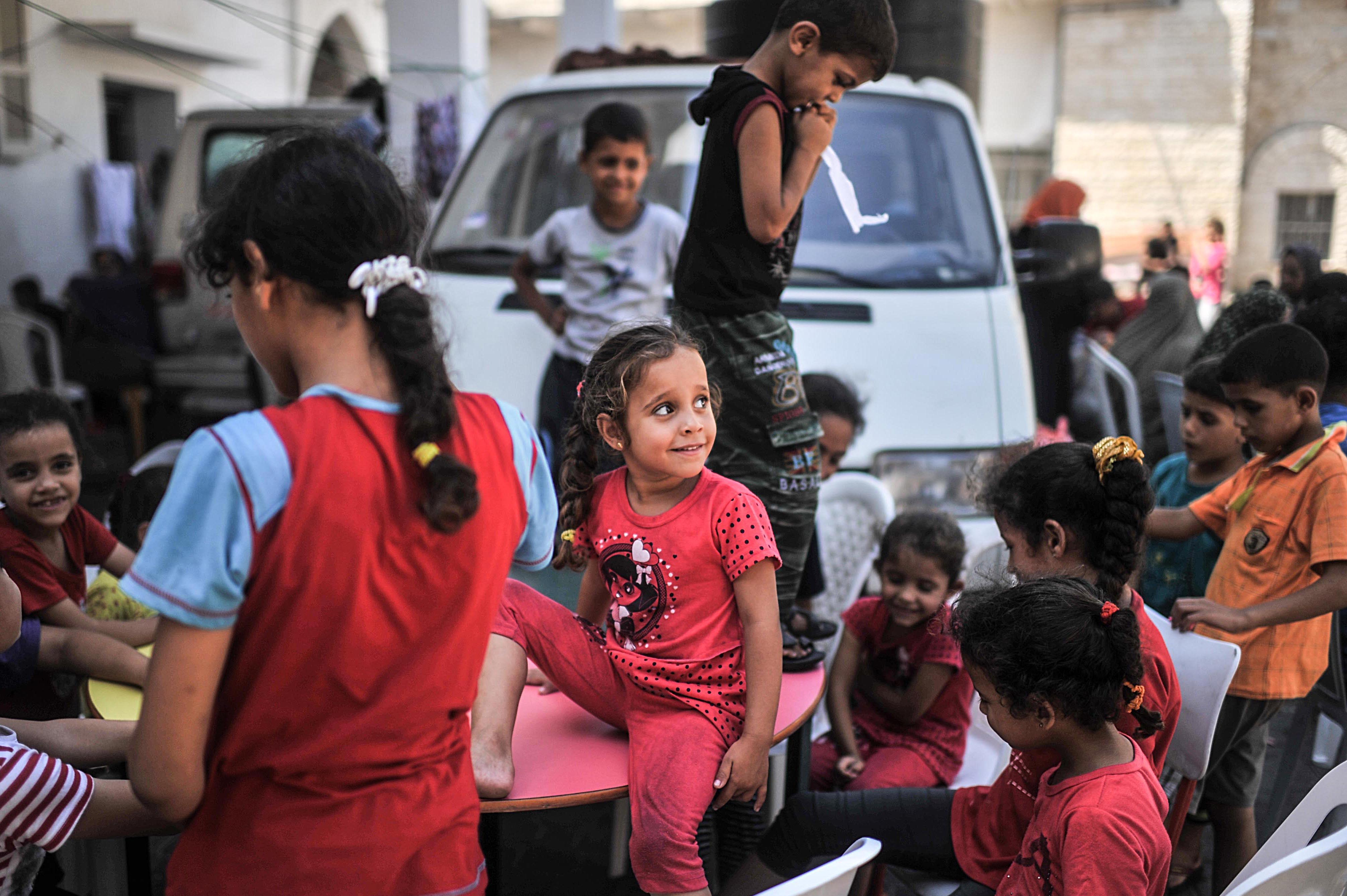
Palestinians taking shelter in an UN school in Gaza

Amy Davidson finds Netanyahu’s answer to that question deeply unsatisfying:

It would be a simple thing, Netanyahu suggests, for Palestinians to listen to the I.D.F.’s warnings—which come in the form of text messages and announcements and admonitions not to let someone Israel might target live in one’s home—and go. Civilians die, according to this logic, because they didn’t listen to Israel; they listened to Hamas. But there are not “plenty of places” that are safe; there may not be any.

There is, one would think, a special obligation for Israel to take care about the people in the shelters, because those children had gone where it sent them. What sort of calculus is involved in leaving one’s own home for a shelter that might still be hit, or maybe for one of the multigenerational homes in Gaza—where, perhaps, there’s also a second cousin who has something to do with Hamas? Does knowing that you are in danger put all of the burden on you? Does it make you the culpable one if you can’t, or don’t, get away? It may be practical to become a refugee—even to leave Gaza, if one can—but it’s not a gift or, necessarily, a credit to the one who warned you to go. And if Hamas is “making sure that they don’t go anywhere,” what use—practically or morally—are the warnings, not only to the Palestinians but to the Israelis who look to them for reassurance?

The warnings are a form of absolute self-absolution for the slaughter of children that will follow – let alone the unimaginable trauma that so many have experienced that will haunt and cripple them for life. Nothing Israelis are experiencing even comes close to this trauma. It defies any human being who sees it not to feel utter bewilderment at a country that carries on this bombardment from the vantage point of utter moral superiority. Do they not see the cruelty? The utter imbalance of power? Have they lost any human bearings?

Needless to say, the UN is furious at Israel for Wednesday’s shelling of an UNRWA school where 3,000 Gazans had sought shelter:

[U.N. Secretary-General Ban Ki-moon] said that the United Nations had provided Israeli military authorities with the precise location and coordinates of the shelter 17 times during the conflict, including a few hours before the attack. Ban’s deputy secretary-general, Jan Eliasson, said that the United Nations found mortar fragments from Israeli shells at the scene of the strike that pointed to Israeli responsibility. “They were aware of the coordinates and exact locations where these people are being sheltered,” Ban said. “I condemn this attack in the strongest possible terms. It is outrageous. It is unjustifiable. And it demands accountability and justice.”

The remarks were uncharacteristically harsh for the U.N. chief, who has been working closely with Israel, the Palestinians, the United States, and other foreign leaders to hammer out a cease-fire plan that would guarantee Israel’s security while relieving the plight of Gazan civilians, who have borne the brunt of suffering in the conflict.

Washington, meanwhile, somehow managed to condemn the shelling without blaming Israel for it:

“The United States condemns the shelling of a UNRWA school in Gaza, which reportedly killed and injured innocent Palestinians – including children – and UN humanitarian workers,” the White House said. “We are extremely concerned that thousands of internally displaced Palestinians who have been called on by the Israeli military to evacuate their homes are not safe in UN designated shelters in Gaza. We also condemn those responsible for hiding weapons in United Nations facilities in Gaza. All of these actions, and similar ones earlier in the conflict, are inconsistent with the UN’s neutrality. This violence underscores the need to achieve a cease-fire as soon as possible.”

Beauchamp tallies the mass displacement that has resulted from the conflict:

About a quarter of the population of the Gaza Strip may have been displaced during the ongoing fighting between Israel and Hamas, according to a United Nations Office for the Coordination of Humanitarian Affairs (OCHA) tally. That is very, very bad — both in humanitarian and political terms. ….

This matters even beyond the immediate dangers and pains of displacement; after the fighting stops, it’s not just a matter of putting displaced persons back in their homes. For one thing, their homes might be destroyed. But even for those whose homes are intact, returning may not be so simple. Patricia Weiss Fagen, a former senior fellow at Georgetown’s Institute for the Study of International Migration, writes that displaced persons “lacked safety, economic opportunities, and essential services” and “may continue to live as strangers and second-class citizens even when they return to their original homes.” The upshot, according to Fagen, is that long-term relief efforts, and not just short-term humanitarian aid, are necessary to help refugees.

(Photo: Palestinian children taking shelter in Salahaddin school in Gaza City are seen on July 31, 2014. Nearly 1900 Palestinians, who escaped from cities of Shujaya and Beit Hanoun under heavy Israeli shelling, live in Salahaddin school. By Onur Coban/Anadolu Agency/Getty Images)


A Bill Argentina Won’t Pay

Yesterday, the South American country went into default for the second time in 13 years:

The country’s previous default, when it reneged on $81 billion in debt in 2001, is the source of its latest one. Most of its creditors exchanged their defaulted debt for new securities in two restructurings that took place in 2005 and 2010. But a few creditors took a different path. They scooped up the cheap defaulted debt in order to chase payment of full principal plus interest in the New York courts, under whose law the original bonds were written.

Led by NML Capital, a hedge fund, a group of these hold-outs – [Argentine minister Axel] Kicillof and his boss, President Cristina Fernández de Kirchner, prefer the term “vulture” funds – won an order barring Argentina from paying its exchange bondholders unless it also coughed up the $1.3 billion plus interest they wanted. That meant Argentina either had to deal with the hold-outs or stop paying the exchange bondholders, and thereby tip into default again. The Argentine government refused even to meet the hold-outs in person until July 29th, the day before a grace period on a payment to exchange bondholders expired.

Tim Fernholz finds plenty of blame to go around:

If the vulture funds had exchanged their bonds earlier, they would have made a decent profit and saved us all this mess—but there’s no law saying they had to do that. If global finance hadn’t integrated the world’s economies, Argentina wouldn’t have suffered from capital flight – but it wouldn’t have had access to capital to begin with absent that system. If Judge [Thomas] Griesa hadn’t issued his controversial order, the holdouts contracts would be unenforceable – but it will be harder for any sovereign to borrow money if lenders fear they can’t collect. And if Argentina’s various regimes hadn’t made economic policy mistakes or had simply been more pragmatic, this whole situation might never have arisen – but it’s their citizens, and likely not the leaders themselves, who will pay the stiffest price.

But Salmon isn’t too sure about that:

[A]s for the ordinary Argentine citizen, well, there’s a lot of inflation and unemployment and black-market foreign-exchange trading going on, but that’s been true for years, and it’s far from clear how much – or even whether – the default is going to exacerbate such things. Indeed, Argentina is in pretty good financial shape right now. Both the country and its corporations have relatively little debt, which means relatively little problem rolling it over. Bank deposits are stable. The exchange rate doesn’t seem any more fragile than it has been for months. Foreign reserves have actually been going up in recent weeks. In terms of day-to-day financial life in Argentina, today looks almost identical to yesterday. Nothing much has really changed.

Meanwhile, Robert Kahn looks forward:

Negotiations will continue, and there will continue to be talk of a possible deal that would end the default, including a plan where local banks buy the debt and sell it to the government. I’m deeply skeptical. Over the last 10 years, Argentina essentially has not budged from the position that holdouts would get no better deal than those that restructured. As the court cases went against them, that offer became less and less attractive to the creditors, the courts became more resistant to stays and other rulings to protect Argentina, and the gap between the parties became so vast that it is hard to imagine any side caving now. Indeed, the political cost within Argentina of the government now paying off the holdouts seems extraordinarily high, suggesting that we may need a new government before a negotiated solution is possible.

Another Call For Genocide In The Times Of Israel

It seems to be a pattern:

G-d might be meant to illustrate that voice of the people-the vox populi. In this case, G-d had demanded that Saul (or the “prime minister”)  enter into battle with the Amalekites (Hamas and its savage partners) and destroy them utterly even if that means to the last child, cow and goat. As cruel as this appears, it is a lesson that teaches a nation in terrible danger that it has a legitimate obligation to put a definite end to a substantial threat. The end of such a conflict must make it impossible for that enemy to rebuild and continue to vex one’s nation forever.