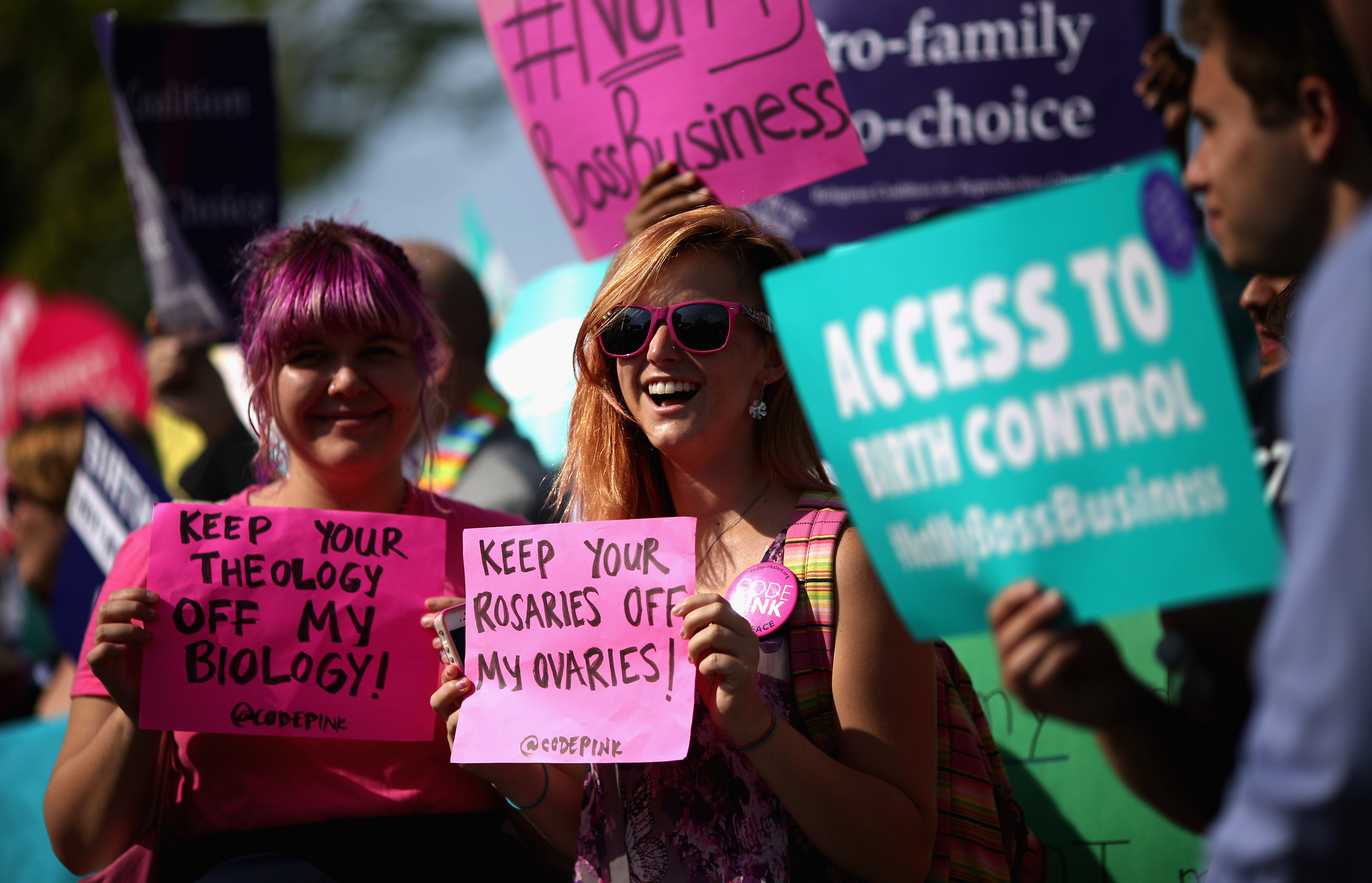
Responding to Damon Linker’s “Why liberals should cheer the Hobby Lobby decision,” Scott Lemieux writes, “This mode of argument — ‘this case presents a clash between potentially legitimate interests, so in conclusion, I win’ — is, to put it mildly, unsatisfying.” His take on what liberalism has to say about a case like Hobby Lobby:
Would this alleviate or reinforce domination? Democratic values should seek to increase individual liberty by attenuating power relations, private as well as public. In this case (since state power is implicated either way) this would compel siding with the  workers, not the employers who wish to deny them something they have a right to based on religious values they don’t share. Linker, conversely, seems to side with Alito’s illiberal “kiss up, kick down” assumption.
Who would bear the greatest burden of the accommodation? This is both possibly the most important question and where the case for Hobby Lobby really collapses. I agree that liberals should in some cases accommodate religious belief where doing so doesn’t burden third parties. If there are two people working in pharmacy and one opposes Plan B on religious grounds, having the employee who doesn’t object fill the prescription makes sense. If this creates a de minimis burden on a third party — say, waiting an extra five minutes — that’s fine. If this means a substantial burden for the customer — say, waiting until tomorrow — then the employee should fulfill the prescription irrespective of her religious conscience.
In the case of the contraceptive requirement, the burden on third parties is clear, direct, and material. Employees will be denied a something they worked for and are entitled to under federal law without being compensated for the denial. The burden on employers, conversely, is so abstract and attenuated it’s hard to even explain what it is.
PM Carpenter hears intonations of the Civil Rights Movement both in the Court ruling and in my sanguine view of it. He doesn’t like that:
Many of these Goldwater conservatives were genuine in their beliefs. They weren’t bigoted. They did extol freedom and limited government above all other principles. What they ignored was that others had to pay for their “free society.” And when social “justness” has evaded the afflicted long enough, a friendly, powerful central government begins to look pretty damn good. In short, Goldwater conservatism’s overzealous pursuit of limited government only hastened its ill health.
Still, what more easily counters Sullivan’s argument, it seems, is that the Hobby Lobby decision was grounded in statutory law–not First Amendment principles–for a rather good reason gone bad. The Affordable Care Act was not, is not, and never will be an act designed to interfere with the sanctity of religious freedom. Period.
On the other hand we are governed–by constitutional design–by principles of a secular, not theocratic, society. Accordingly, the evangelical Green family’s corporate empire should be no more exempt from the statutory law of the land than Sears or Starbucks is.
Meanwhile, Kilgore fears that Linker and I (and some Dish readers) underestimate how much power the Christian right still wields:
Damon’s obviously right that on the marriage equality issue the Christian Right is losing the battle (unless the Supreme Court provides it with a temporary comeback with a decision reversing all the lower-court rulings invalidating state same-sex marriage bans) and quite possibly the war. I suspect they will soon retreat to a posture of separating religious from civil marriages and treating only the latter as “real,” and it’s not entirely clear they’re going to lose the fight for protecting their “right” to discriminate against LGBT folk.
But if you want a real test of whether Damon’s right and I’m wrong, look at the Republican Party. Until such time as it separates its policy views from slavish obedience to Christian Right doctrine—which has in no way happened yet other than some vague and occasional talk about “downplaying social issues”—then the idea the Christian Right is losing real political power, much less “dying,” strikes me as completely unsubstantiated. We’re still one Republican-controlled presidential election cycle from the Christian Right being in a strong position to dictate to the rest of us on a significant range of subjects.
Responding to the hyperventilation on the left, Ezra argues that Hobby Lobby was “a blow to Obamacare’s effort to expand women’s access to reproductive care — but, in truth, a minor one.” He reassures pro-choice liberals that “the Supreme Court’s decision doesn’t touch most of Obamacare’s reproductive health gains”:
Almost all insurance plans now have to cover a broad range of reproductive health services. This is the backdrop to the Hobby Lobby fight. Obamacare didn’t simply mandate that Medicaid and exchange-based insurance would cover reproductive health services. It decreed that virtually all insurance had to cover reproductive health services. … That’s why there was a Hobby Lobby case in the first place: because Obamacare forced millions of employers to expand their coverage to include reproductive health services with no copays. (There are temporary exceptions for some plans that predate Obamacare, but in the long-run, these changes will apply to virtually all insurance plans.)
Critics of Obamacare argue, accurately, that these rules raise premiums and reduce the flexibility employers have to manager their insurance options. At the same time, they inarguably increase access to, and reduce patients’ costs for, reproductive health services. According to data from the IMS Institute for Health Informatics, the number of women who filled prescriptions for oral contraceptives with no copay shot from 1.2 million in 2012 to 5.1 million in 2013. “The numbers we saw for the first year the benefit was in effect showed that women in America saved more than $400 million,” says Richards. Those numbers will be much higher in 2014.
My takes on the Hobby Lobby ruling here and here. Reader reax here, here, and here.




 The Dish