There Were Red Flags

The alleged Kansas shooter made no effort to conceal his hatred of Jews:

In a 2010 radio interview, Frazier Glenn Miller, the man suspected of killing three people Sunday at a Jewish community center and a Jewish retirement center in Kansas, said he was interested in the tea party, voiced support for then-Iranian President Mahmoud Ahmadinejad, and spoke approvingly of Ron Paul, the Texas Republican congressman and presidential candidate. In late April 2010, Miller, a former Ku Klux Klan Grand Dragon, was a guest on The David Pakman Show, a nationally syndicated left-of-center radio and television program. At the time, Miller was running for US Senate as an independent in his home state of Missouri with the slogan “It’s the Jews, Stupid,” and Pakman pressed Miller on his extreme views.

During the interview, Miller was unabashed about his anti-Semitic positions. When asked whether he thought the United States would be better off if Hitler had succeeded, Miller responded, “Absolutely, the whole world would…Hitler would have created a paradise on Earth, particularly for white people. But he would have been fair to other people as well.” He added, “Germans are blamed collectively because of the alleged so-called Holocaust.”

His views on gays were equally charming:

Miller regularly railed against the LGBT community. He told one interviewer that he sought “the creation of an all-white nation within the one million square miles of mother Dixie. We have no hope for Jew York City or San Fran-sissy-co and other areas that are dominated by Jews, perverts, and communists and non-white minorities and rectum-loving queers.”

In another interview, Miller was asked if he was “gay-friendly.” Wrong question, he told the interviewer. “If you think about what homosexuals do, if that doesn’t make you sick, you’re just as sick as they are,” Miller replied.

Mark Guarino notes that anti-Semitic violence has been on the decline in the US for some time:

The shooting comes at a time when incidents against Jews in the United States are dropping significantly. In a study released earlier this month, the Anti-Defamation League (ADL) reported a 19 percent decline in 2013 compared with the year before. This continues “a decade-long downward slide and [marks] one of the lowest levels of incidents reported by the Anti-Defamation League since it started keeping records in 1979,” the report says.

“The falling number of incidents targeting Jews is another indication of just how far we have come in finding full acceptance in society, and it is a reflection of how much progress our country has made in shunning bigotry and hatred,” added ADL National Director Abraham Foxman in the report.

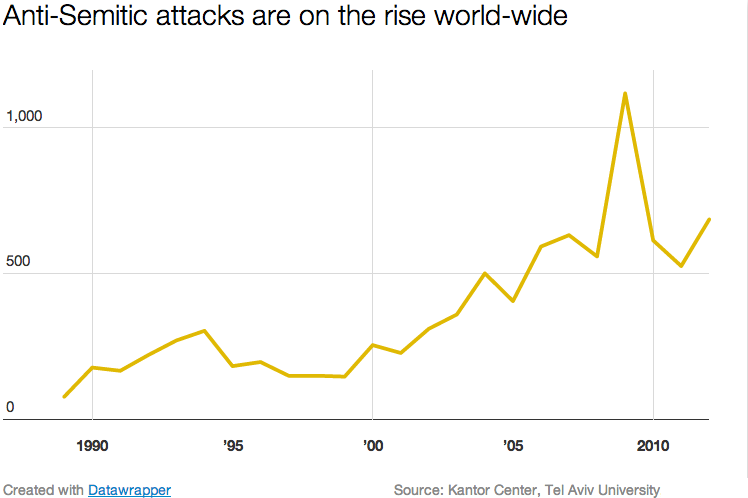
But Zack Beauchamp examines the global data, which paints a very different picture:

Screen_Shot_2014-04-14_at_11.42.56_AMThe most comprehensive data on worldwide anti-Semitism comes from Tel Aviv University. Its Kantor Center for the Study of Modern European Jewry annually tallies official reports of anti-Semitic violence, death threats, and vandalism, which it publishes in an annual report. From 1989 to 2012, when the last report was published, the data shows a clear and consistent rise in anti-Semitic violence.

Most of the violence was, unsurprisingly, recorded in places with high Jewish populations. Thirty percent of the attacks Kantor recorded in 2012 took place in France, which houses the world’s third-largest Jewish population after Israel and the United States. Europe also has large Muslim immigrant populations, many of whom are poor and socially isolated. This “globalization of populations,” according to Ohio State sociologist William Brustein, explains the recent upsurge in European anti-Semitic violence.

Why Aren’t Gay Men On The Pill? Ctd

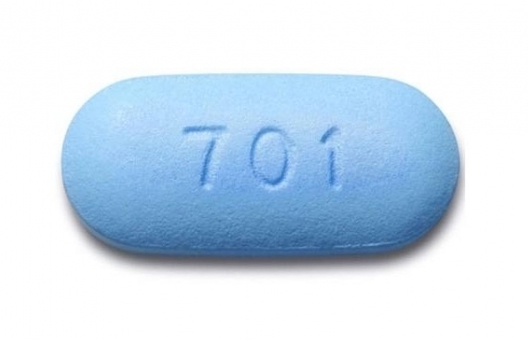
When asked about the risks of Truvada, Dave Cullen answered in three quick parts: healthcare costs (discussed by readers here), side effects, and people not taking the drug consistently:

A New Yorker piece backs up Cullen on the side effects:

Taking Truvada to prevent H.I.V. comes with very few risks. In the N.I.H. study, one in two hundred people had to temporarily go off the pill owing to kidney issues, but even those people were able to resume treatment after a couple of weeks. While bone-density loss occasionally occurs in Truvada takers who are already infected with the virus, no significant bone issues have emerged in the PrEP studies. And though about one in ten PrEP takers suffer from nausea at the onset of treatment, it usually dissipates after a couple of weeks. According to the U.N. panel’s Karim, Truvada’s side-effects profile is “terrific,” and Grant said that common daily medications like aspirin and birth control, as well as drugs to control blood pressure and cholesterol, are all arguably more toxic than Truvada.

A reader is still worried about the indirect risks of PrEP:

I’m sympathetic to your position; I will probably take Truvada when I’m at Bear Pride in Chicago. I truvadaplan on using condoms anyway, but … you know. Alcohol and all that. Sometimes you don’t pay attention.

But for the record, I do think the points that those concerned about Truvada raise regarding substituting it for a general sexual health strategy are reasonable in some ways. Case-in-point: gonorrhea. I can tell you right now, I am much, much more afraid of drug-resistant gonorrhea than I am of HIV.

Another asks:

One criticism I’ve read of Truvada is that if lots of gay men start taking it, but even a small subset of them do not take it as directed, i.e. once a day, that it could lead to different resistant strains and a strengthening of the virus? Is that at all true?

Not really, as Rich Juzwiak recently reported:

[Jim Pickett, the director of advocacy for the AIDS Foundation of Chicago] told me he believes drug resistance is “something to be watchful for,” but not a huge concern of his for a few reasons.

One is that resistance is common in the world of HIV medications. He said he’s HIV positive himself, and has been on various meds since 1997, building up resistance to “a whole bunch of drugs over the years.” And because maintaining a Truvada prescription requires a comprehensive HIV test every three months, Pickett suggested that there would be opportunity to keep a mutant strain of the virus contained:

And if you were going in for your refill and it was found out that you were actually positive, they could immediately determine what kind of strain of HIV you have. If it has any kind of genetic alterations due to it being exposed to a certain drug, suboptimal levels of drug, that could be determined. It could also be determined that you don’t have any drug in your system. And if you don’t have drug in your system, you can’t be resistant.

You also can’t be resistant if you don’t become HIV positive. People get confused about that a little bit, like the drug itself can create resistance. Well, the drug has to be at suboptimal levels and come into contact with HIV. If you don’t come into contact with HIV, no resistance. If you come into contact with HIV and you don’t have any drug in your system, no resistance. It’s just that suboptimal part. But it’s a harder thing to happen than I think people think about.

Another reader notes an obvious way to lower such risks:

I wish the discussion would remember that many gay guys – I think I once heard Dan Savage say as many as 30 percent – spend their entire lives without having anal sex, and that a lot are also in situations where they’re already at extremely low risk of contracting HIV, such as men who aren’t as active sexually or prefer practices that don’t involve intercourse. While the current safe sex rhetoric is obsessed around condoms, it is so because it is also obsessed around equating male homosexuality with anal intercourse, and sexual expression shouldn’t just be about one act.

Another risk-averse reader wrings his hands:

I’m a 38-year-old gay man, young enough that none of my friends died of AIDS but old enough that I have spent virtually my entire conscious life worrying that I would die from it. I’m a rarity: a fully condom-compliant gay man. I’ve never had difficulty using them and have never had sex without them, except with my husband.

Plus, I’ve always tried to avoid having sex with guys who don’t use condoms regularly for casual sex. Avoiding barebackers is a rule that has served me well; I’ve never had an STD, despite a huge number of partners.

PrEP – while undeniably a good thing – is very disorienting. Do I avoid barebackers who use PrEP? Just continue using condoms with them? Start taking PreP myself and forgo condoms altogether? What a wonderful, frightening thought that is.

I know I should be celebrating. Instead I’m still worrying … about a new set of issues.

Those two adjectives – “wonderful” and “frightening” – say it all. Fear is a terribly difficult thing to leave behind, especially when you have lived your entire life in its shadow.

The View From Your Window Contest: Winner #200

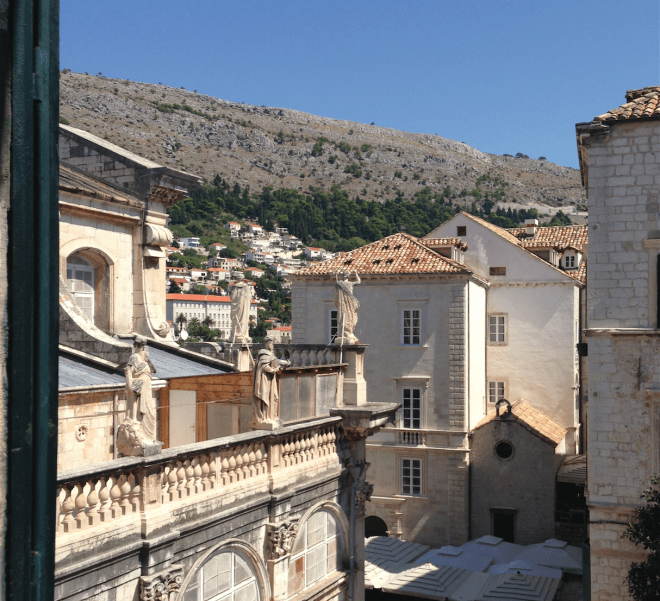
vfyw_4-12

A reader writes:

I knew immediately upon seeing this image that it was not Seattle … that is all I know.

Another:

Reminds me of Taxco, Mexico – a great town with real Old World atmosphere, in the mountains southwest of Mexico City.

Another gets the right continent:

Eleusina, Greece. Shot in the dark, based on the Mediterranean look and Greek letters in the bottom of the picture, but no sleuthing beyond that.

Another:

Ruling out Modica, Sicily because you’ve already done that for the contest (I sent it in), so going with Scicli – but it could be Ragusa, or almost any town in the Val di Noto region.

Another:

The landscape and architecture in the photo looks Sicilian to me, but I can’t nail down the exact combination of mountains, palm trees and buildings in the photo. I hope Palermo, Italy is close.

Another:

This week I’m going with my first reaction, which was “Antonioni, L’Avventura.” Which means Sicily. It reminds me of the town in that movie, Troina. As for the window, I’m going to guess some window in the churchy complex at the Piazza at the end of Via Conte Ruggero, looking at another part of the churchy complex. Somewhere in here maybe:
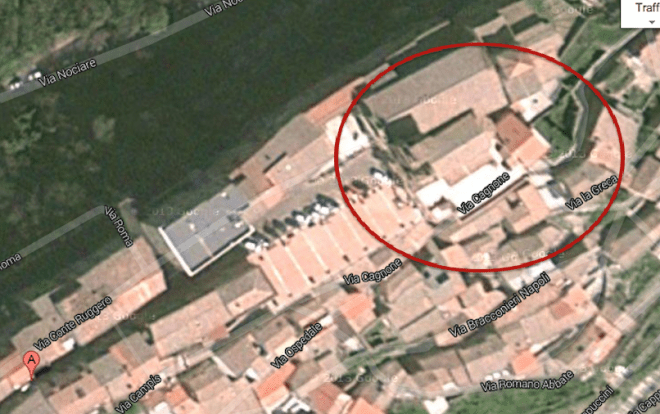
sicily

Another thought Noto, and another the Piazza Spadaro. Another reader:

Wow, this was a toughie and I’m sure I am not even close, but I’d gather that the building are Italian, as is the church (I recognize St. John, Mark (?)) but there’s no other identification other than the granite hillside. I spent some time looking around various places – Cinque Terra, Piemonte, etc. but to no avail. It’s tax-time crunch and I’m close to finishing mine up but instead took a mental health break instead. Did I get close?

Italy is close, but other readers got closer:

This looks a whole hell of a lot like Montenegro. I can’t pinpoint where it is, but I’ll go with Petrovac, based upon nothing more than a hunch.

Another inches north:

OK, it might not be Budva, Montenegro, but I visited Budva & Cotor in 2001 and the architecture and the dry steep hills of this week’s contest really do remind me of the Dalmatian coast. So since Budva is bigger than Cotor, I’m going with Budva.

Another nails the right country:

Looks like somewhere in the Mediterranean. Our SWAG [scientific wild-ass guess] is Split, Croatia.

Another:

I honeymooned through the islands of Croatia (absolutely beautiful). This looks vaguely familiar. I’m going with the island of Hvar.

Almost. The very first entry we received on Saturday got the right city:

The honey colored tiles give it away: Dubrovnik, Croatia.

More than 80 readers correctly guessed Dubrovnik. To put those in context, here is a map – from OpenHeatMap, developed by Dishhead Pete Warden – plotting all of the entries this week (zoom in by double-clicking an area of interest, or drag your cursor up and down the slide):

This embed is invalid

One reader’s quest for a VFYWC victory:

GODDAMN YOU GOOGLE MAPS FOR PICKING TODAY TO DO SOME ASSHOLE UPGRADE!!

It’s a building facing the St. Blasius Church in Dubrovnik, Croatia. If Google Maps wasn’t being SUCH A DICK I’d have an exact address for you. Please stand by.

@($*&^!%%## GOOGLE MAPS!!

9 minutes later:

Ul. od Pustijerne, second floor with the long shutters, facing Dubrovnik Cathedral, Dubrovnik, Croatia. Google hates this place.  That’s as close as I can get.

17 minutes later, the right building:

Based on the reciprocal street view, I think this is the window:
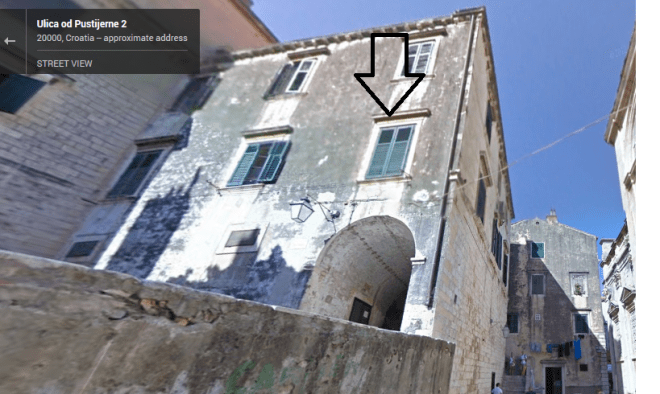
VFYW

Or maybe the one above it. But I think it’s the one with the blue shutters, based on the photo itself with the edge of blue shutter and the height relative to the building across the street.

Google Maps doesn’t want to give this place an exact street number (thought it best-guesstimates “Ulica od Pustijerne 2,” where there’s apparently a bed-and-breakfasty sort of place called “Bedroom in the Centre of Old Town,” but I don’t think that’s this room. It’s close, but not it. But that’s as close as I can get right now: East-facing window on Ulica od Pustijerne 2, just across the street from Dubrovnik Cathedral.

VFYW2

Oh. And I found it by Googling the ass out of St. Jerome Statues. Because Catholic Saint Fetish. Zing!

Six hours and 46 minutes later, the right address:

Okay, well, I had to actually go outside and breathe some fresh air and not obsess about this any more, but having finally ducked back inside to avoid a calamitous thunderstorm I was able to finally put a name on this place. Old Palace Apartments, Ulica Ilije Sarake 2 20000, Dubrovnik. Here’s a Google Image I’m assuming was taken from the apartment just south of the one the VFYW was taken from. I’m sure I’m way, way too late, but this is the exact spot, huzzah!

Missed the window though. Another had less difficulty:

I just put “european roof statues” in Google and it came up pretty quickly.

A different detail proved important for this reader:

While Dubrovnik is a striking city, what really clued me in was the hills in the background.  Nothing else looks quite like them anywhere else I’ve been, and they tower over the town.

Nearly every contestant who’s been to Dubrovnik made note of how much they enjoyed it, including several who honeymooned there. This one savors a memory:

We went last year, after a stressful season when we needed to flee the country and chill out. Amazing place. I’m 99% sure that this was taken inside the Old City near the gate where we entered every day to wander and stare and eventually end up at Cafe Buza. We would prop up our feet on the rails and drink over priced bottles of beer while staring at the Adriatic. That place baked a lot of the anxiety out of both of us. Sadly I could not find any photos from this angle, but here’s a pic (I think) of the building in the left foreground, from another angle:

old_town_at_night

Thank you for making me review my pics from the trip! It was never a place on my “to do” list, but I left part of my heart there. The people are lovely, the landscape is amazing. Nerdy points of interest: Game of Thrones is partly shot here, as was some Dr Who (11th Dr).

Many readers noted the Game Of Thrones connection:

Ohh, I know this one: King’s Landing, Westeros, the new top destination for weddings! Or maybe just the location that stands for it in filming. The distinctive statues on top the Cathedral, marked in the contest picture as well as in the Dubrovnik panorama attached, give it away.
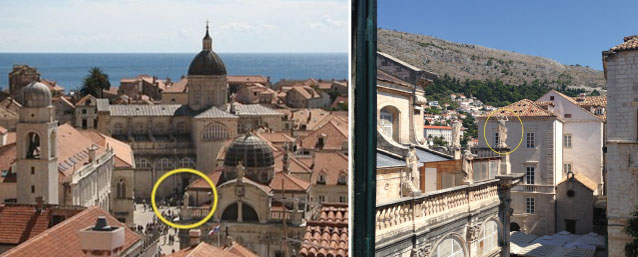
22079-dubrovnik-cathedral

I do not have the patience to look for the exact window, so I will doubtlessly lose to the hundreds of other Game of Thrones fans who take the trouble to identify it.

Here’s Dubrovnik in its Thrones CGI disguise:
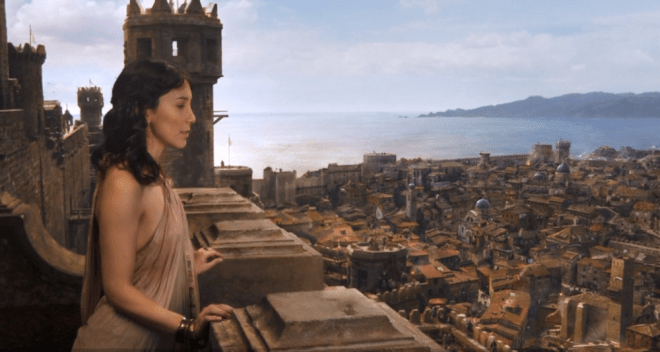
kings-landing

The city has seen real conflict as well:

I have never been Croatia but my parents were there many years ago, just after the war and things had settled down. They have many photos of bombed-out hotels along the waterfront. Thankfully both sides involved in the war were smart enough to spare Dubrovnik. My parents proclaimed it the most beautiful place they had ever visited. Hopefully I will have the opportunity to visit some day myself. Thanks for another great contest.

Another reader, like many this week, nails the right window:
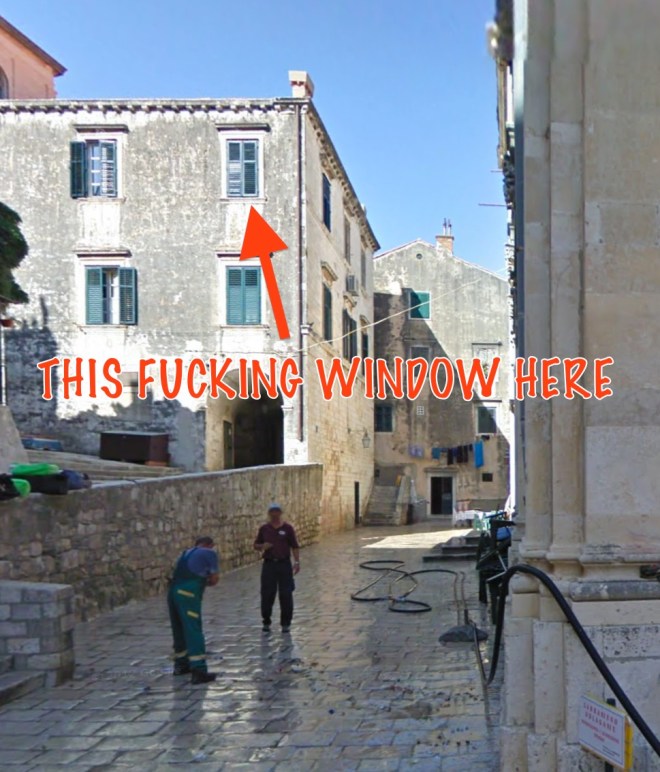
DubrovnikVFYW

It took me six hours to get this, using old-fashioned cyber elbow grease and shoe leather, and it is only now, as I primp my entry for the judges’ eyes, that I notice the “Konoba Amoret” written on those umbrellas. This means that you’ll again be deluged by typo-ridden winning entries from casual viffywers, and that the most I can reasonably expect to gain from my efforts is to see another bean slide across on The Great Abacus Of Whose Turn It Is To Win.

The Great Doug Chini chimes in:
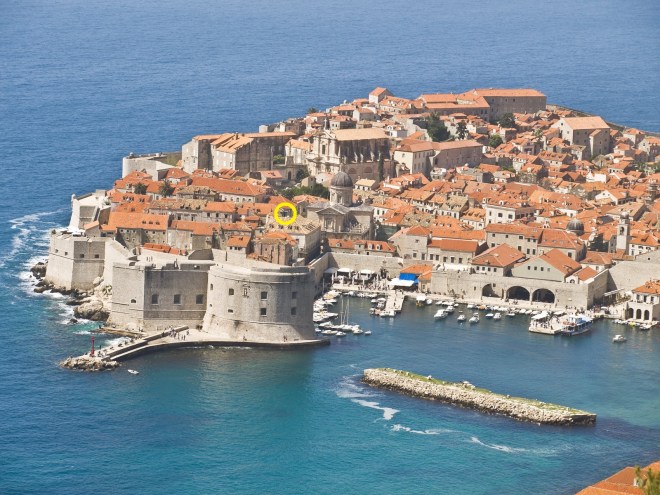
VFYW Dubrovnik Actual Window Aerial Marked - Copy

This 200th view may not be the hardest, but it sure is a pretty one. Based on the Mediterranean architecture and tight field of view I thought that it might produce only a handful of winning entries. But when I found the location I realized that, as with VFYW #170, the town’s fame means that there will be a ton of readers who got there far faster than I did. Serves me right, I suppose, for never hopping across the Adriatic when I lived in Italy.

This week’s view was shot inside the walls of the old city of Dubrovnik, Croatia. More precisely, it was shot from inside a room on the top floor of the Old Palace Apartments adjacent to the Cathedral of the Assumption and looks east, northeast along a heading of 58.60 degrees.

VFYW-Dubrovnik-Actual-Window-Close-Marked---Copy

Many first-time contestants guessed the same window, including:

I did it! IdiditIdiditIdidit!

Another first-timer:

I am 100% sure this is from the old city of Dubrovnik, Croatia. The jewel of the Adriatic. My wife and I spent some of our honeymoon to this lovely city, and even named our son after it’s patron saint (Saint Blaise, patron saint of throat maladies and wild animals). Here’s a VFYW from our honeymoon:

CIMG0583

The view is looking east, with the Cathedral on the left. I don’t know the name of the building, or what it’s purpose is. I assume it is a sobe, which is a room in a private residence rented out to tourists (this is a far better experience than hotels). My wife and I ate octopus salad under the tents in the square at the bottom center of your picture.

I’m pretty excited.  This is the first time I have even guessed the correct area of the world, let alone gotten close.  And this is the first time sending anything to you.  I have been a reader and subscriber for a couple of months now. Thank you for bringing back some lovely memories.

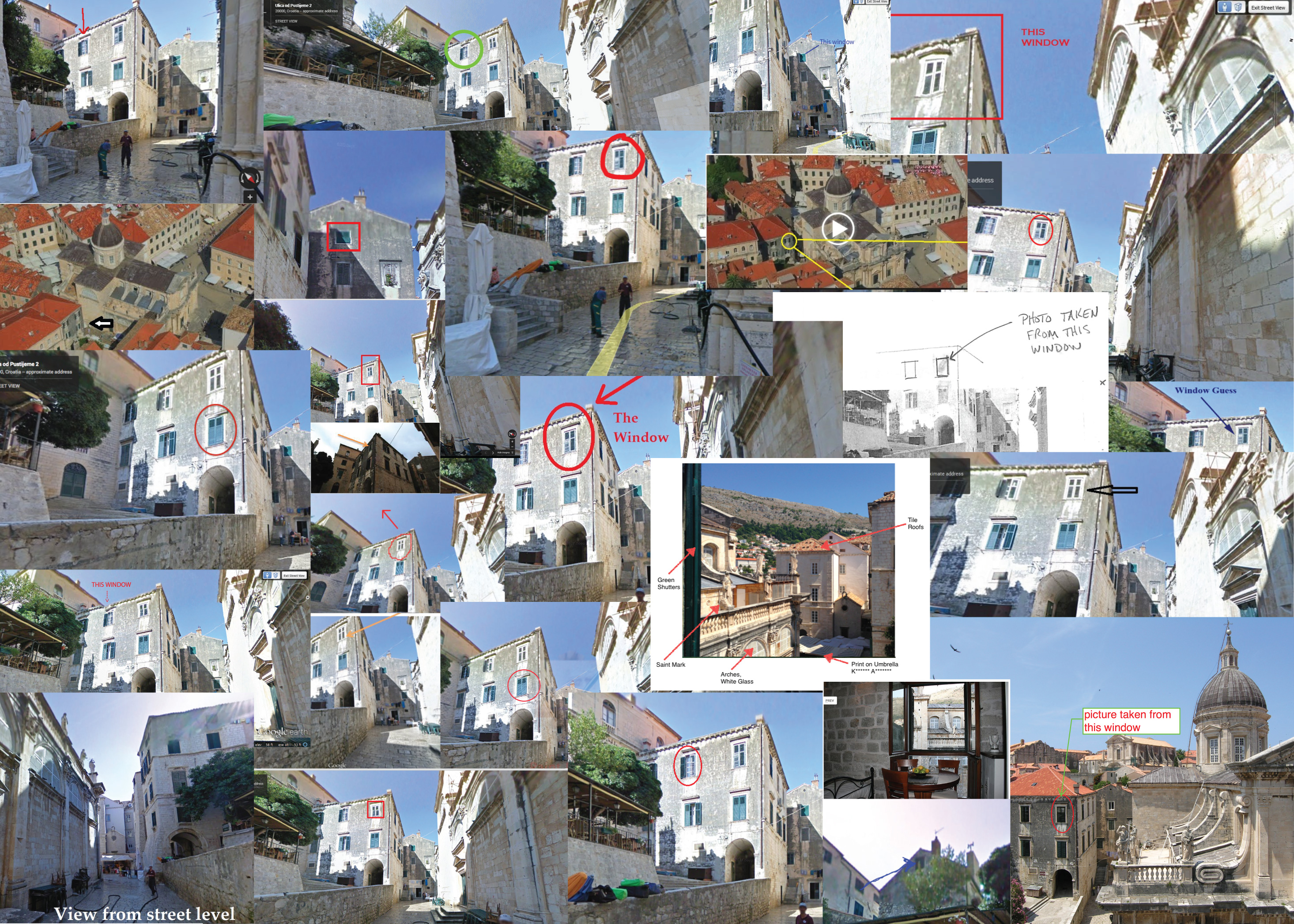
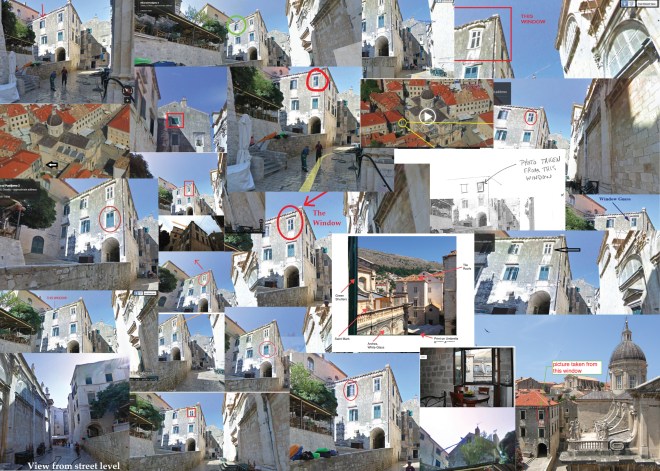
That reader, along with the many readers represented in this composite image, got the right window:
VFYWC-200-Guess-Collage

But how to determine the winner? One contestant stood out this week: a veteran of 17 contests who has correctly guessed multiple times, including some difficult views, without yet winning:

This week’s contest is brought to you by Dubrovnik Croatia. Starting with the satellite dish, we narrowed it down by the Mediterranean setting and the church and eventually ended up with Dubrovnik.  From there a quick Google Map search led to the Dubrovnik Cathedral and the correct building:

dubrovnik1

Thanks for sticking with the contest and congrats! From the photo’s owner, for the record:

Wow that’s so cool, what an honor to be chosen for the contest! I’m a long-time Dishhead, quit my job and moved to Europe last spring. Croatia is beautiful, Dubrovnik especially so. This is from the window of the apartment we were living in at the time in old town Dubrovnik behind the old cathedral. The address is: Ilije Sarake 2, 20000 Dubrovnik, Croatia. It was taken on Sunday, September 1st at 12:27 pm.

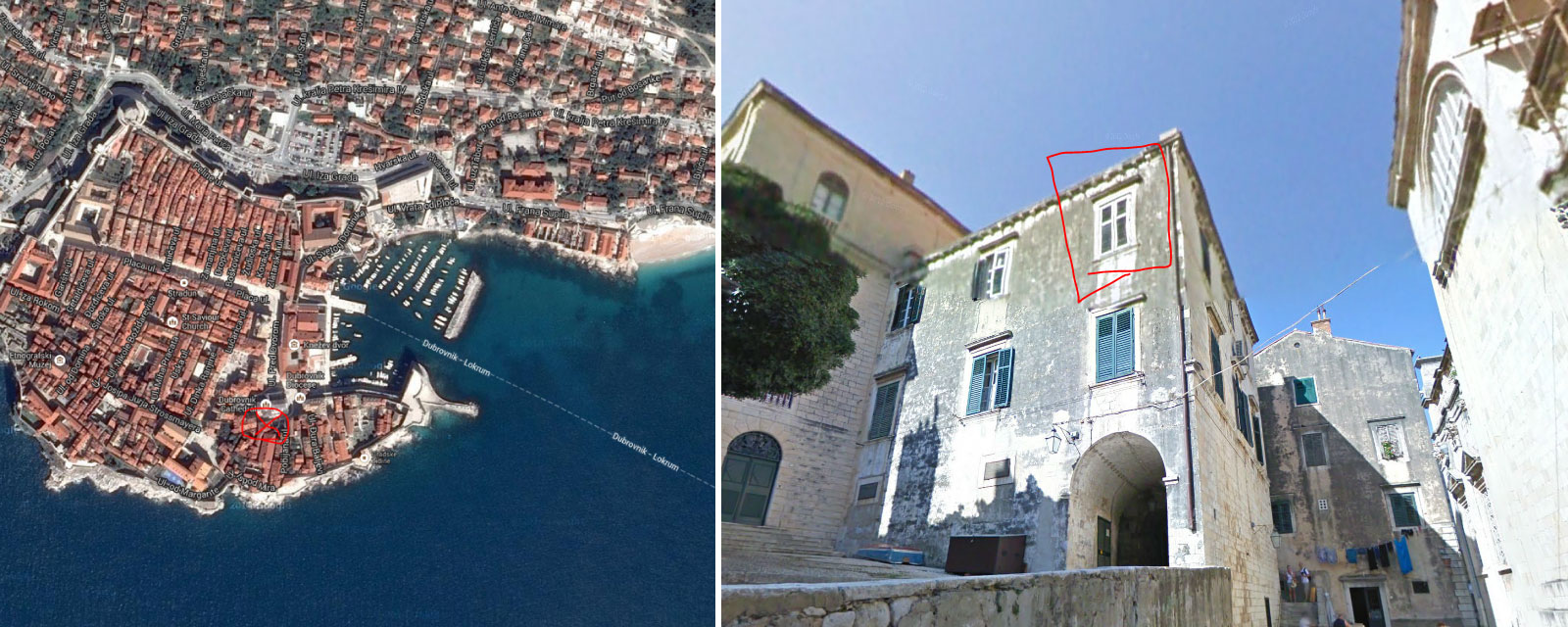
The apartment is on the second (top) floor of the building, just behind the Old Cathedral which is a big landmark in Dubrovnik. The window faces out toward the East, and the direction of the photo is pointing sort of North East, toward the harbor (which you can’t see in my photo since there’s a building in the way), with the hills in the background. Here’s a marked up screen shot of the Google Maps satellite view:

Dubrovnik_Zabriskie

(Archive: Text|Gallery)

Is A Russian Annexation Now Inevitable?

Well: it doesn’t take a genius to observe the ballet now being orchestrated by the Kremlin to justify an invasion in Eastern Ukraine, does it? The parallels with Crimea are almost perfect. Along with the cynicism behind them. Bershidsky observes the brazenness with which the Russian government is now openly meddling in the region, with sinister masked men strutting around with impunity. In this war of nerves, Putin is obviously winning, and Kiev is badly behind the ball:

The anti-Kiev forces include heavily armed paramilitaries. Their unmarked uniforms are different from those worn by Russian occupying troops in Crimea last month, but the forces appear well-organized, and in numerous videos of the attacks they do not sound Ukrainian. In fact, they often freely admit that they are Russian. In one video, the man assuming command of local policemen in Gorlovka says he is a lieutenant colonel in the Russian army, and in Slavyansk, the commander of the group that seized the mayor’s office told a reporter for Echo Moskvy radio that he was an entrepreneur from a Moscow suburb.

Although Moscow has not openly admitted that Russians are taking part in inciting the eastern Ukraine protests, they clearly are, whether in an official capacity or as volunteers. And they haven’t been ordered to keep their mouths shut, or have been lax about following their orders.

Putin is huffing his own chauvinism, and you don’t unleash that force in Russia and maintain control over it for long. David Patrikarakos is on the scene in Sloviansk:

These people were entirely different to those I had met in Donetsk and Luhansk, the other Ukranian cities that have recently become sites of pro-Russian violence.

The armed men that form the “self-defense” units here are not just militia carrying bats; they are undoubtedly professionally trained, and though they wear no military insignias, they are clearly soldiers. They carry automatic weapons and wear full army fatigues. They are professional, organized, and ready to fight. …

We are now in a new, and dangerous, phase in this crisis. The previous trouble spots of Luhansk and Donetesk are major cities in Eastern Ukraine, with more organized pro-Russia factions. That the conflict is spreading to small, unimportant towns like Sloviansk is indicative that pro-Russia activism has taken root in the heartlands of the region.

Maria Snegovaya looks at polling contradicting the claim that these uprisings enjoy significant popular support:

According to a survey by the Kyiv International Institute of Sociology, a majority of Ukrainians—in all regions—condemn the deployment of Russian troops in Ukraine (93 percent of people in the west and center held this opinion, 73 percent in the South, and 68 percent in the East). A study by the International Republican Institute (IRI) found that Russian-speaking Ukrainians in all regions do not experience significant infringement of their rights and actively oppose Russia sending troops to Ukraine to protect them (67 percent in the south and 61 percent in east of Ukraine). Similarly, the majority of respondents in all regions believe the Crimean referendum was a threat to Ukraine’s integrity, support Ukraine’s independence, and the autonomous status of Crimea within Ukrainian borders; 64 percent of Ukrainians support a unitary Ukrainian state, and only 14 percent prefer federalization—a plan to give greater authority to the regions of Ukraine. (Russian media presents a very different picture.) …

Moreover, Putin has fostered pro-European sentiment across all of Ukraine. As a result of Russian aggression, the support for European integration rose by 10 percent to 52 percent from February to March 2014. (It remained constant at 40 percent throughout all of 2013.) Likewise, the number of people supporting participation in Russia’s Custom Union dramatically decreased.

Finally, Motyl points out that Russia’s meddling in Ukraine makes it a state sponsor of terrorism according to US law:

There is overwhelming evidence of Russia’s direct and indirect involvement in the violence that rocked several eastern Ukrainian cities on April 12–13. Russian intelligence agents and spetsnaz special forces are directly involved; the weapons and uniforms worn by the terrorists are of Russian origin (a point made by the US ambassador to Kyiv, Geoffrey Pyatt); and the assaults on government buildings in Slavyansk, Mariupol, Makiivka, Kharkiv, Yenakievo, Druzhkivka, Horlivka, Krasny Lyman, and Kramatorsk were clearly coordinated by Russian intelligence. …

Does the behavior of the pro-Russian forces in eastern Ukraine involve “premeditated, politically motivated violence perpetrated against non-combatant targets”? Obviously. Does this violence involve “citizens or the territory of more than one country”? Yes, it does. The violence therefore qualifies as international terrorism, and its perpetrators are obviously “terrorist groups.” QED.

The latest Dish on eastern Ukraine here.

The Sticker-Price On Obamacare Goes Down

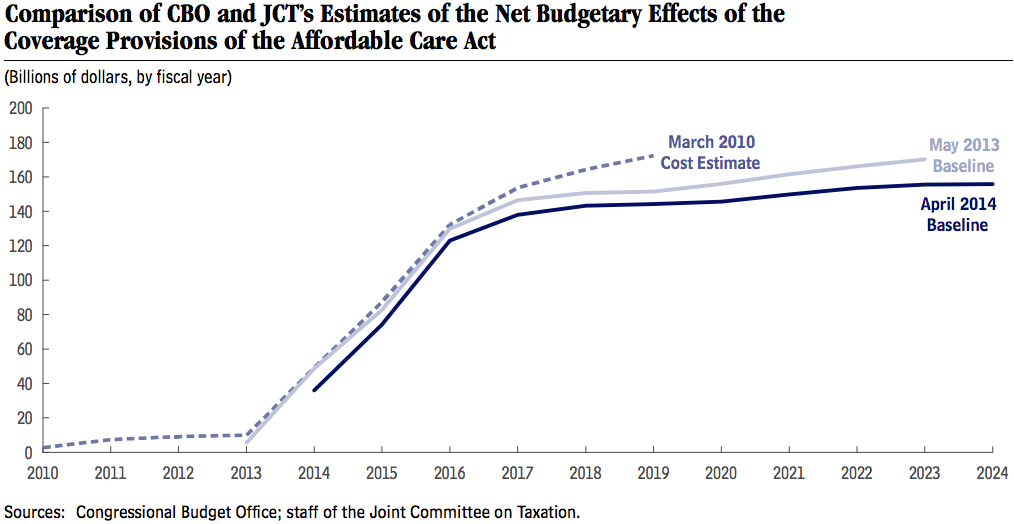
Yesterday, the CBO estimated (pdf) that the ACA will be cheaper than originally projected:

Obamacare Cost

Cohn explains why costs have decreased:

The higher the premiums, the more expensive the subsidies. And that’s where the law has, so far, outperformed expectations. Insurers are offering plans with lower premiums than CBO and other experts had predicted. As a result, the federal government is on the hook for less financial assistance.

Better still, the CBO says that it doesn’t expect across-the-board premium spikes next year, as the law’s critics and even some insurance company officials have speculated would happen. Of course, the CBO could be totally wrong about that. And even if it’s not wrong about what’s likely to happen to premiums overall, it’s possible—I’d say likely—that prices in some parts of the country will go up significantly next year. But CBO’s new projections would put such rate increases into better, more favorable perspective. Premiums are already lower than expected. The law is already reducing the deficit by more than expected. So even if premiums rise next year or beyond, the law could still end up calling for lower spending—and more deficit reduction—than the original projections suggested.

Drum makes an important counterpoint:

The bad news: the lower cost of premiums is primarily because the quality of the plans coming from insurers is lower than CBO originally estimated: “The plans being offered through exchanges in 2014 appear to have, in general, lower payment rates for providers, narrower networks of providers, and tighter management of their subscribers’ use of health care than employment-based plans do. Those features allow insurers that offer plans through the exchanges to charge lower premiums (although they also make plans somewhat less attractive to potential enrollees).”

McArdle weighs in:

The good news is that [shrinking provider networks] keeps premiums low. The bad news is that, over time, the CBO doesn’t think this will be sustainable. As more people exit the employer-based market for the exchanges, insurers will have to broaden their networks; they just can’t serve that number of customers with the networks they have, and if they try to keep the networks small, regulators will probably have something to say.

It’s worth noting, as I always do, that the CBO is required to assume that the current law will go into effect: that the employer mandate and the individual mandate are enforced, all the delayed provisions are allowed to take effect, the grandfathering ends. It’s also worth noting, as I always do, that the CBO does not have a crystal ball: We’ve never done anything like this before, so it is necessarily trying to reason from situations that aren’t necessarily great analogies for what we’re doing now. This is no slam on the office; it’s doing the best it can. But its projections may differ significantly from what actually happens.

Late Show Nation, Ctd

This embed is invalid


A reader has an inspired idea about who could replace Colbert:

My heart just jumped at your “Samantha!” comment. I’ve been telling my friends for a couple of years that my dream Colbert replacement, or replacement for Stewart if he ever left Daily Show for that matter, would be: The husband and wife co-anchor team of Samantha Bee and Jason Jones.

The Daily Show is a fake news show. The Colbert Report is a fake pundit show. The Bee-Jones Factor Cycle or something like that could be the co-anchor news show send-up, sort of satirizing co-anchor news classics like Barbara Walters/Hugh Downs on 20/20. Maybe make the show Samantha Bee’s with Jason Jones as her chief field correspondent. But they are both so good in the studio and in the field that I think co-anchor would be the best set-up.

If you like this idea, spread this shit: The Bee-Jones Factor Cycle!

Or Jamantha Bones:

Another reader has a very different take on the news:

I enjoyed reading your post on Stephen Colbert just now. I, too, have mixed emotions about this news. Mostly, I’m really happy for him and really excited to see how the whole thing unfolds.  I can’t watch Colbert all the time, but I frequently do, and I am in constant awe of how he can be so creative and innovative, and at the same time be so damned funny.

Beyond appreciating his performance, I admire the man.  He is courageous (the White House Correspondents Dinner) and honorable (his congressional testimony when he came out of character was profoundly memorable).  And yes, as someone in your post said, he is authentic (in some weird way). I have no idea what he will do with his new show, but I believe the man is so talented that whatever it is will be brilliant.

But I will miss the character he has created.  Things change.  I think Colbert will leave that character behind and we’ll never see him again.  And that makes me a little sad.

But there’s a little more to it than that.  I first started watching The Daily Show right before The Colbert Report got started, and I remember Colbert appearing as a contributor on The Daily Show.  I started watching the show because my then late-teenager son would mention it.  Jeffrey was struggling with depression, and it could difficult to find topics to connect with him on … but these two late night shows were a topic we could discuss and enjoy together.  When my wife heard that John Oliver was coming to a club in Boston to perform, she suggested that Jeff and I go to see him.  And we did.  Another connection.

It was about a year after that Oliver show that Jeffrey died by suicide.  Recovering from our grief, my wife and I found that our sleep patterns changed: I sleep much less than I did (and Jeff died 4 1/2 years ago) and my wife, who used to be asleep between 9:00 and 10:00, is now frequently still awake at 11:00.  And so she started watching The Daily Show and The Colbert Report.  We don’t always watch it live – but we record each show, and sometimes we’ll watch 2 or 3 nights in a single sitting.

My wife considers these shows a connection to our son, especially Colbert, because it’s not really her type of humor, but it was Jeff’s type of humor.  She feels that when she enjoys Colbert, she is getting a little piece of Jeff.

Surviving the loss of a loved one is a journey.  Over time, the intensity of the pain decreases, but the memory fades too.  (I don’t believe one leads to the other, however.)  At first, we could smell Jeffrey’s scent in his clothing, but that goes away in time.  We re-arranged his room.  Things change and his memory becomes more distant. When The Colbert Report ends its fabulous run, we will feel that we’ve lost another connection with Jeff.

Update from a reader:

Earlier this year a friend’s daughter came down with a mysterious nerve affliction that caused her such pain when moving her limbs that she willed herself into near-paralysis. She’s largely better now, but she spent a lengthy time in hospital, bedridden.

Though only 11 years old, she is seriously precocious, and already a committed progressive. The Colbert Show was and is her favorite program. While she was in hospital, her mom got the idea that a call from Colbert might cheer her. This being New York, everyone knows someone, so friends got to work and within 48 hours the request was on his desk. Without hesitation he called and spent half an hour on the phone, just chatting and encouraging her. And it did cheer her, tremendously.

Again, she’s on the mend; the crisis is thankfully mostly a memory now. She’s delighted for Colbert, the man and mensch, regarding Late Night. But she’s sad that her favorite character is saying goodbye.

Walmart Goes Granola?

The big-box behemoth plans to start selling a line of organic foods:

The world’s largest retailer announced Thursday that it would be partnering with Wild Oats, a prominent health food label, to expand the organic offerings in its grocery section and drive down the price of organic foods across the country. … Starting later this month, the Wild Oats label will begin to appear in the retailer’s grocery sections on approximately 100 USDA certified-organic products, including canned goods, salsa, and spices, among others. On average, those offerings will be 25 percent cheaper than organics sold by competitors, according to the company. Prices on Walmart’s existing organic offerings apart from the Wild Oats products, including produce and milk, will not be reduced.

In light of this news and a similar announcement by Target, Jenny Hopkinson wonders how the country’s organic farmers will cope with the demand shock:

The expansion of organic offerings by both companies are “a validation of what we know, which is that organic foods are attractive to consumers and they are attractive to young consumers and consumers from all walks of life,” said Laura Batcha, CEO and executive director of the Organic Trade Association, the industry’s leading lobbying organization.

However, “there are issues with supply currently in the U.S. — we see it particularly in the livestock and dairy production” side, though there also are problems in other commodities as well, she said. “The growth in the demand is outpacing the acreage.”

If that’s a problem now, the recent announced moves by Wal-Mart and Target look to make matters worse.

And Eve Andrews relays concerns that Walmart can’t turn a profit on organic food without damaging the industry:

[Coach Mark Smallwood, executive director of The Rodale Institute,] explains that the concept of a “premium” associated with organic food is misleading, because the price of an organic good reflects the true cost of its production.

“The issue is that there aren’t the subsidies available to organic farmers that there are [for conventional farmers.] So there’s a question in my mind about how Walmart is going to pull this off and be able to make profit,” Smallwood said. “And for them to even come out and make that statement before they’ve started is a huge question mark. Somebody’s going to have to pay, and my hope is that it’s not the organic farmer.”

Smallwood also shared his concern that if Walmart were to incentivize large-scale organic production, industrial organic practices would become more widespread. In this model, farmers adhere to just the bare minimum of organic standards and ultimately end up depleting soil health on a piece of land, abandoning it, and moving on to another.

A Hairbrained Regulation, Ctd

A reader quotes Elizabeth Nolan Brown on the controversy over the Army’s new hairstyle guidelines, which critics say are biased against black women:

“Why not start from a place of allowing women and their immediate supervisors to make those determinations?” Yeah, because if there are two things a military is about, they are decentralized management and individual decision-making. And there will absolutely be no possibility of problems arising when soldiers whose immediate “supervisors”- what is this, WalMart? – have vastly different concepts for what is appropriate hair, or if one of them just doesn’t like African-American hair. What a great idea. And whose says libertarian publications are out of touch with reality?

Another is less sarcastic:

You have to start with the value that the military, both for practical reasons and from tradition, places on “uniform.”

The practical reasons involve both ease of figuring out who is part of your side and promotion of group identity, especially when members come from very different economic situations and cultural backgrounds.

But in some cases, the military makes adjustments.  Physical reality means that you can’t put women into blouses (yes, the military term means the jackets worn by both men and women) without darts.  So the military allows that much variation.  The color, material, and cut of the uniform is still mandated, but that much difference in cut is allowed.  (And you might be amazed at the detail with which the uniform regulations specify how darts must be configured, in order to deal with “underarm fullness”.)

And with hair, the military admits that the broader culture expects women to wear their hair longer than men and allows that.  Women, at least while on duty, have to wear their hair in a style that is tightly constrained, but they can wear it far longer than any man would be allowed.  Similarly, women’s uniforms include the option of wearing a skirt – don’t try that if you are a guy!

So the issue here, and one the military is apparently only belatedly addressing, is how to deal with a situation where they have already made a cultural allowance but have not addressed a physical reality (that black people’s hair is simply not mechanically identical to white or East Asian people’s hair).  I expect that, eventually, they will get it right. But it will be messy.

Another:

This is an ancient story.  During my time in the Air Force, in the early 1970s, when dissent against the Vietnam war was at its maximum and the draft was a burning issue, the hairstyle controversy raged with regard to men’s hair.  It took the form of an eternal conflict between draft-motivated volunteers who wanted to look like rock stars and lifers who wanted to wage war on hippies.  The regulations were ridiculously complicated.  At times, the conflict became racial when the bigots became outraged at big Afros.

Elizabeth Nolan Brown’s proposal would create trouble.  Commanding officers and supervising sergeants would act capriciously.  Bigotry would ooze out of the slime.

The rules for men and women are still ridiculously complicated and absolutely without practical utility.  A simple solution would be a one-sentence regulation: Hair on the head will be styled to avoid a clearly observable physical impediment to the performance of military duties, to the wearing of military headgear, or to health and safety.

Update from a reader:

I’m glad this topic is getting some traction. It’s getting a lot of talk in Army circles, more over the tattoo policy changes, but the general resentment is there all the same. If you talk to soldiers about the revisions to AR 670-1 (the service-wide uniform and appearance regulations) you’ll probably get an eye roll with a “here we go again” from the older NCOs who remember what it was like in the pre-Iraq Army. The move is perceived as an institutional move from the Army at war we’ve had for over a decade, and in which almost all of our leadership is derived from, to a garrison Army that focuses on stupid shit like shining boots and ironing uniforms.

Just as an aside, the last major uniform revision we had in 2007, when the Army introduced the Army Combat Uniform, got rid of leather boots specifically, though of course unofficially, because soldiers were wasting too much time in garrison being made to shine boots – we’ve worn suede boots since, pretty much only to avoid Sergeants Major with too much time on their hands going around bothering privates about the proper amount of shine.

Of course, people forget that the ACU itself is still a hotly contentious issue in the military. It suffers from an acute problem of blending in to absolutely nothing except light grey gravel pits, and it actually makes soldiers stand out more against natural backdrops. This has been known since at least 2006 when the Army began introducing the “Universal Camouflage Pattern” as a kind of jealous response to the effective MARPAT digital camouflage uniform worn by the Marine Corps since 2003. That’s why when we send soldiers on a deployment to Afghanistan, we send them in special uniforms designed for Afghanistan which are essentially ACUs, but the camouflage pattern is the more sensible MultiCam pattern. Congress is actually ticked at the military for not addressing the camouflage problem, but because of interservice rivalry (the Marine Corps fiercely protects its camouflage pattern and doesn’t want other services adopting it, lest they feel less special) the Army is stuck with the gray gravel camouflage that literally blends into nothing.  (Here’s an Economist article from this month that gives background on the whole camouflage debacle.)

But instead of fixing the nearly eight year-old camouflage problem, a real uniform issue, we have a transitioning peacetime Army that is focussing on making black females’ hair impossible to comply with regulations, making males cut their hair once every 3-4 days in order to comply with asinine length requirements, and chaptering out experienced soldiers because of their sleeve tattoos. Priorities, right?

The Mafia Mind

A recent study out of Sicily suggests that, contrary to popular perception, mafia members may be less psychopathic than other criminals:

To measure psychopathic traits, the researchers administered the Italian version of the Hare Psychopathy Checklist Revised (PCL-R). This is an interview in which the assessor rates whether the subject displays each of 20 specific features characteristic of psychopathy, such as pathological lying; impulsivity; and callous lack of empathy. The scores are added up to give a total, with 30+ being the conventional cutoff for being ‘a psychopath’.

It turned that none of the Mafia scored above cutoff on the PCL-R, while 10% of the comparison group did. Overall, scores were significantly lower among mob members than in the ‘other’ criminals. The difference was quite pronounced.

Neuroskeptic has doubts about the study:

[I]t’s hard to know whether these Mafia members are a representative sample of their kind. They were all in prison: it might be that the ones on the outside are a different breed. The authors also noted that they could only interview low-ranking mafiosi, since Italian law forbids any contact with jailed Mafia bosses, even for research.

But a bigger problem, in my view is with the control group. These non-Mafia criminals are not a representative sample of all Italian criminals because most criminals don’t go to jail. Jail is reserved for serious and persistent cases. … In other words, maybe ‘ordinary’ criminals need to be especially horrible to end up in the same jail as the Mafia – and in the comparison group of this study. In which case, the Mafia might be just as psychopathic as those who commit similar crimes outside of the organization.

(Video: Michael and Kay discuss family business in The Godfather)

Hyperactive Prescribing? Ctd

Another round of emails, which get more and more nuanced:

Thank you so much for featuring this discussion about ADHD. It has been wonderful reading the experiences of others in similar circumstances and I’ve taken away a real sense of solidarity from your other readers who have written in.

I was diagnosed with ADHD inattentive type last year. I had never been diagnosed before, because I did well in school and went to an elite university (although, tellingly, I was a mediocre standardized test taker). Upon graduating from school and entering the workforce, I collapsed. I didn’t have the structure of academics to keep me in check and I flubbed it. For several years I was stuck in the entry level, totally flummoxed at the apparently effortless advancement of my peers while I was spinning my wheels. I became depressed and indifferent, and I withdrew from any hope of a real and meaningful career. For several years I was treated with antidepressants and anti-anxiety medication, which did eventually help the depression and enabled me to do enough to get a foot in the door at my dream job.

The efficacy of the antidepressants promptly waned; I was mortified at the prospect of blowing what I felt was my last real chance to start a proper career.

In one session with my psychiatrist, I related the power this profound fear of failure had over my internal monologue and how I couldn’t tune it out (amplified by the persistent presence of very talented and pedigreed professionals several years my junior). It was suggested that the depressive issues were caused by attention problems, and I was prescribed an amphetamine-based psychostimulant regime.

It was like turning on a light switch. I feel good about myself for the first time in a long time, and I feel like I can finally get on with my life instead of gazing at my navel and wondering why I can’t make it work. I’ve been promoted, twice, in the time since my diagnosis. To this day, I’m still drunk on the sensation of possibility.

Despite this, every time I go to the pharmacy I’m given looks like I’m a faker who’s chomping pills to get ahead. Persistent over-diagnosis for troublemakers in middle school and casual pill-sharing in college has undermined the notion that ADHD is a legitimate problem. I’m infuriated when I see authors asserting that it’s not a thing, and that if I were only diligent enough to eat well, exercise, and sleep properly that all of my problems would be solved.

Another argues that “drugs are helpful, but even just the knowledge that you have an ADHD brain can be empowering”:

I’m in the under-diagnosed population of non-hyper girls who did phenomenally on tests. I did well in school even though I would procrastinate and lose my homework before I could turn it in. My struggles really began after law school when I was unable to perform the many administrative tasks and planning duties necessary to be a good junior attorney. I could understand complicated legal issues, but I’d forget to book a court reporter for a deposition or even forget the deadline to file a motion. I wasn’t even learning from my mistakes, forgetting once again to book a court reporter on the same case.

My diagnosis of ADHD was a breakthrough. The knowledge that I just wasn’t good at certain things, like organization, planning ahead, time management, and other things that some people take for granted, was a great relief. I read Delivered From Distraction and learned strategies to help me function better. Knowing how my brain works, along with methylphenidate, has helped me compensate for my tendencies.

Another blurs the line between needing and wanting:

The issue of under- and over-prescription of stimulant drugs has two main problems which cause the controversy. First, ADHD, like most psychiatric illnesses, falls along a continuum. Second, the stimulant drugs are effective for increasing focus in everyone. The result is you have a large number of people who are right along the line between really needing the treatment and being able to get by without it, and a huge number of other people who would like to use it anyway.

My personal perspective is as a final-year medical student who has gotten through without using these drugs. I am also one of those people who falls along the borderline. Could I have gotten a prescription? Absolutely! My parents even mentioned that a few teachers brought up the possibility while I was in grade school, though my physician father disagreed and no action was ever taken. I have actually been driving one of the medical tutors at school a little crazy this year because I have difficulty sitting still when nothing is happening, and he seems to think I have ADHD.

However, I function pretty well, and it hasn’t caused any problems which I couldn’t overcome. Would being diagnosed and getting a prescription make work easier? Yeah, almost undoubtedly. Am I going to get one? No, I don’t think the side effects are worth it. Of course, if their use became incredibly widespread and I found I was at a significant competitive disadvantage by not using them … well … that might be a discussion for another day.

Another wants it now:

I think that all this discussion about how many people really have ADD or ADHD misses the point. The real question is: How many people could benefit from regular or occasional use of ADD meds? If I’m an adult who doesn’t have ADD, but I’m 40-percent more productive on a day when I take Adderall, why shouldn’t I be allowed to make that choice when I’m behind on work?