Where Will Putin Stop?

Pavel Felgenhauer claims that Putin must move fast if he’s going to grab Eastern and Southern Ukraine:

If Putin decides to send in his troops, he has a narrow window in which to act. The winter of 2014 in Russia and Ukraine was relatively mild with little snow, while the spring is early and warm. The soil is drying rapidly, meaning that it will soon be possible to move heavy vehicles off of highways and into fields in southern areas of Ukraine close to the Black and Azov Seas. A key date is April 1, which marks the beginning of the Russia’s spring conscript call-up, when some 130,000 troops drafted a year earlier will have to be mustered out as replacements arrive. This would leave the Russian airborne troops, marines, and army brigades with many conscripts that have served half a year or not at all, drastically reducing battle readiness. The better-trained one-year conscripts can be kept in the ranks for a couple of months but no longer. Otherwise they’ll start demanding to be sent home, and morale will slip. As a result, Russia’s conventional military will regain reasonable battle-readiness only around August or September 2014, giving the Ukrainians ample time to get their act together.

But Masha Gessen, who sees the annexation of Crimea as payback for the West’s intervention in Kosovo, believes that Putin is playing a very long game:

Once Putin held power in Russia, he never planned to cede it, so he had all the time in the world. Two of Putin’s key character traits are vengefulness and opportunism. He relishes his grudges and finds motivation in them: He has enjoyed holding the bombing of Yugoslavia against the United States all these years—and knowing he would strike back some day. He is anything but a strategic planner, so this knowledge was abstract until it wasn’t, when the opportunity to grab Crimea presented itself. Revenge has been sweet, but when other opportunities present themselves—and this will happen more often now, at least from Putin’s point of view—he will deploy Russian military force or the threat of Russian military force in other neighboring countries. He will take his revenge not only cold but plentifully.

Kim R. Holmes argues that one of “the most important lessons of the Cold War is that drawing lines in the sand actually works”:

We often think of how the containment strategy held the Soviet Union in check, but the real tests of strength actually occurred before that strategy was fully in place. Truman “lost” Poland (mainly because he never had it in the first place), but he drew the line with Turkey and Greece. Both countries ended up as NATO allies, not members of the Warsaw Pact. We should be drawing similarly clear lines in the sand today, particularly with respect to the Baltic members of NATO, making it absolutely clear that the United States will honor its NATO Article Five commitment to defend those countries.

The challenge for U.S. policy is not to let Russia’s fait accompli in Crimea signal a complete abandonment of Ukraine. It’s one thing to say we will not go to war to defend Ukraine’s independence, and another one altogether to consign Ukraine forever to Russia’s sphere of influence. Not everything in foreign policy comes down to threatening war. Most Ukrainians want to be part of the West, as the Poles did some 70 years ago, and this matters more in the long run than the strength of Russia’s armored brigades.

The Gay Affluence Myth

Nathan McDermott debunks it:

In reality, gay Americans face disproportionately greater economic challenges than their straight counterparts. A new report released by UCLA’s Williams Institute [pdf] found that 29 percent of LGBT adults, approximately 2.4 million people, experienced food insecurity – a time when they did not have enough money to feed themselves or their family – in the past year. In contrast, 16 percent of Americans nationwide reported being food insecure in 2012. One in five gays and lesbians aged 18-44 received food stamps in the last year, compared with just over 1 in 4 same-sex couples raising children. The LGBT community has made huge political strides over the past decade, but in economic matters they still lag far behind the rest of the country.

Yes, that seems counter-intuitive to me. But that’s a function of my confirmation bias. And it’s one more reason why marriage matters. It consolidates wealth, and protects it. Interestingly, the data from UCLA show that bisexuals are worse off financially than gays and lesbians. Not sure what that means.

Paying For A Faster Stream?

70717869_countries_with_high_speed_broadband

As Comcast and Apple consider teaming up for a new streaming video service, Gautham Nagesh reports that any potential deal “would likely draw close regulatory scrutiny and spark a new debate over whether [a cable company] can carve out a part of its pipe for content providers.” Matthew C. Klein absorbs the news:

According to the Wall Street Journal, Apple is trying to persuade Comcast Corp. to separate its data “from public Internet traffic” by treating it like Comcast’s own video-on-demand service. Consumers would be guaranteed superior picture quality and none of the buffering hiccups found in many streaming services. If the two sides can work out terms, it would be fundamentally different from the recent agreement between Comcast and Netflix Inc. and also different from what Apple had been discussing with Time Warner Cable Inc. before Comcast agreed to acquire the second-biggest cable company. Technically, Apple isn’t asking to have its traffic actively prioritized over that of rival video services, although that is probably what would occur in practice. That means the arrangement may be able to slip past rules meant to prevent residential broadband companies from giving preference to one service over another.

He doesn’t see much of value in the deal for Comcast, noting that they would be drawing a regulatory target on their back and don’t seem to need what Apple could offer them. Derek Thompson is also skeptical:

It’s fairly clear why this deal would be great for Apple – it would officially transform its TV “hobby” into a TV business. People once thought that Apple would build an actual TV, but actual TVs are a terrible, zero-profit product with a high-turnover rate. Others thought it would partner with media companies to offer a fresh take on the cable bundle, but media companies don’t want to partner with the folks who destroyed the record industry by selling songs for $0.99. Therefore Apple’s TV strategy must revolve around its hockey puck. Horace Dediu estimates that Apple has sold about 25 million of these guys. A deal with Comcast/TWC could easily double that figure.

But what exactly is in this for Comcast?

The cable company would have to invest in new network equipment to make this partnership work. It would tempt net-neutrality restrictions by giving Apple preferential treatment along its pipes just as its Time Warner Cable acquisition faces accusations of a law-breaking monopoly. Plus, Comcast would have to give Apple a share of its pay-TV profits in exchange for popularizing a device that’s partially seen as a replacement for pay-TV. Henry Blodget says there is no way this deal is going down. I say he’s right.

Meanwhile, Jordan Weissmann argues that Apple shouldn’t have to negotiate with Comcast to provide better service:

In an ideal world, where the US had a respectably fast broadband infrastructure, these discussions wouldn’t have to happen at all. As you may recall, Netflix announced its own deal with Comcast last month to improve delivery of its streaming video – after which Netflix CEO Reed Hastings published a screed about the need for stronger net neutrality protections. But every time you see one of these agreements, keep in mind that the fundamental issue isn’t so much net neutrality – the idea that Internet service providers should treat all data equally, no matter where it originates—as it is the crippling lack of broadband competition in this country. Americans pay some of the highest prices for Internet access in the developed world; in return, they get some of the most mediocre service. That’s largely because consumers only have two or three providers in their geographic area, which doesn’t give Comcast or its peers a great deal of incentive to beef up their networks (or to lower prices).

(Chart from the BBC)

The Software Will See You Now

David Blumenthal argued that electronic medical records haven’t been widely adopted because they mostly benefit patients, not doctors. Fallows passes along some pointed criticism of that view. Here’s Creed Wait, “a family-practice doctor in Nebraska”:

The saying is, “Build a better mousetrap and the world will beat a path to your door.” The saying is not, “Build a different mousetrap, pay out nineteen billion dollars in incentives to use the mousetrap, mandate its use by law and punish those who fail to adopt it.  Then shove the world kicking and screaming against their will through your door.”

So far, doctors have been paid $19B in incentives to buy [Electronic Medical Record systems].  No one had to incentivize the cotton gin.  It was simply a better product. The current EMR system is a mess because the current EMR systems in use by the majority of physicians were written in the Rube Goldberg School of Software Design and work poorly.  There is no ‘asymmetry of benefits’ as proposed by Dr. Blumenthal.  Unless, of course, what he means by this is that only the software companies are benefitting from these federal mandates.

Wait offers a personal example:

One year ago in private practice I could see eighteen patients per day.  A transcriptionist typewrote my notes. These were typically three pages long, concise, complete and extremely useful.  Then our group bought an EMR.

After one year I was seeing fourteen patients a day, my notes were twelve pages long, the vital signs alone required a half page and the notes bordered on being useless.

My reimbursement per visit had increased, my face-to-face time with the patient was shorter, I was doing a poorer job, patients were less satisfied, and I was completely frustrated by trying to build each note out of dozens of pages of drop down menus.

Before implementing an EMR I had approached each patient encounter with an attitude of, “What can we do today to improve your health, happiness and overall satisfaction with life?”  The patient and I would have a meaningful conversation about the pertinent issues.  Once an EMR was implemented, a subtle change began.  It was so gradual that at first I did not even recognize the poison.  But after a few months I realized that the visit had slowly evolved into, “Just a minute, we need to be sure that we have checked off every box on every screen and we need to be sure that a narrative of some sort has been entered into every required field.”  Then there were realizations like, “Oh, look.  If we add one more point to the Review of Systems then we can raise the billing code one notch.  Hold that thought while I click, ‘wears glasses’ under the ROS field!”

Well, time’s up!  The fields are all now completed and all goals have been met!  Next!

The EMR had become the primary influence in the interview.  The dynamic had changed.  The patient and I were now both in the room to feed the hunger of the software.

Ebola Is Back

Fruzsina Eördögh relays the bad news:

Ebola, which may well be the most terrifying virus on the planet, has killed 59 people in Guinea in a month in the first outbreak of the virus seen in West Africa. There are 80 confirmed cases so far and officials are concerned the virus has spread to neighboring countries Sierra Leone and Liberia, as a 14-year-old Sierra Leone boy who attended the funeral for one of the earlier victims is now showing signs of infection.

Other West African countries are on high alert:

Mali’s government yesterday warned against unnecessary travel to the contaminated area, after the health ministry held a crisis meeting and called on citizens to be “vigilant.” Liberia’s New Democrat newspaper ran an editorial in which it said there was an immediate need for increased surveillance on all border posts with Guinea. Many of the goods sold in Monrovia, Liberia’s capital, come from Guinea. Ivory Coast set up a coordinating post in Man on the border with Guinea and will increase surveillance and run awareness campaigns, the country’s health ministry said. Gambia, an enclave in Senegal, is monitoring the situation, its health ministry said.

But Kent Sepkowtiz urges Americans not to worry:

While this sort of thing makes for frightening headlines and occasional dud movies (here and here for starters), Ebola and its related group of devastating infections will never become a threat to the US. The disease simply sickens and kills too quickly, plus anyone in the US with an odd febrile illness and rapid progression to prostration is placed into gown and glove isolation at just about every hospital in the country.

Pre-K Prejudice? Ctd

Several readers are skeptical over the conclusions drawn here:

We know that by preschool differences in math and reading skills emerge between white and African-American students, so why shouldn’t we expect the same for behavioral issues? How does this research address the possibility that differences in home experience may create authentic differences in school behavior? Does this research tell us that two kids who commit the same offense will receive different punishments based on race? By immediately labeling this as “prejudice” we are imposing a set of assumptions. Don’t we owe these students a more rigorous approach to the problem?

Another is more direct:

I can’t be the only one who realizes that the widely-reported statistics from the DOE’s Civil Rights Data Collection are not, in fact, persuasive evidence of prejudice or discrimination. A glaringly obvious yet unexplored possibility is that the minority students in the data are simply engaging in more actions requiring punishment than their white counterparts. Full stop.

Why would this be so?

The possibilities are numerous, but I suspect socio-economic status and family environment are the main culprits. The federal studies in question don’t adjust for those factors.

Just to be clear: I’m well aware of white privilege and the many economic, social, and legal barriers that prevent full equality in modern society, but simply saying “unequal outcome = racism” is bogus. And I think in this context it is particularly absurd coming from the Department of Education. There are plenty of areas where statistics have uncovered racially biased enforcement of rules. I’m thinking particularly about marijuana arrests, where it’s clear that rates of use are pretty much the same everywhere but minorities – and black people in particular – are being singled out for punishment. Those are the kinds of statistics that would, for me, evidence racially-motivated punishment in the school context.

So we need to compare apples to apples. How often are the different ethnic groups engaging in behavior for which suspension is a possible punishment? If white students were getting into on-campus fights at the same rate as minority students but being suspended only one-third as often, that would be clear evidence of discrimination. Perhaps an enterprising Dish reader can find a study showing disparate punishment outcomes despite identical behavior. Until then, your readers need to recognize the crummy and possibly misleading nature of these statistics.

Another gets very anecdotal, with a second-hand source:

When my daughter was in a small suburban elementary school, every black male in her grade of 120 students was in trouble to one extent or another. Her principal told me, and I’m paraphrasing, “Every black male student in this school is under some form of corrective counseling. Every student currently under escalated counseling in this school is a black male.”

One called his teacher a bitch. Expelled. Another refused to take his seat and stop talking, ever. Removed from regular schooling. All of them, every single one – so I was told, anyway – used foul language openly. Most were removed to remedial facilities on the second or third foul language offense. There were only one or two black male students left in regular classes and they were on thin ice, I was told.

The school principal told me that the fathers – and here we’re talking degreed professionals, for the most part, including executives and at least one lawyer as recall – were responsible for the behavior. During counseling sessions, some of the mothers expressed outrage, one screaming at the father “I hope you’re satisfied; you’re ruining his life and he’s only in first grade!” One of the mothers told her, “It’s not the school. It’s a black-male thing nowadays, with black fathers encouraging sons to be black and aggressively stand their ground in school.”

I found it interesting that the principal told me that “this is all new, in recent years”. And that there was little or no pushback or denial from the parents about the behavior. No lawsuits or protests. Also no similar behavior at all from black female students, who seemed as normal and well-adjusted as their white and Hispanic counterparts.

Map Of The Day

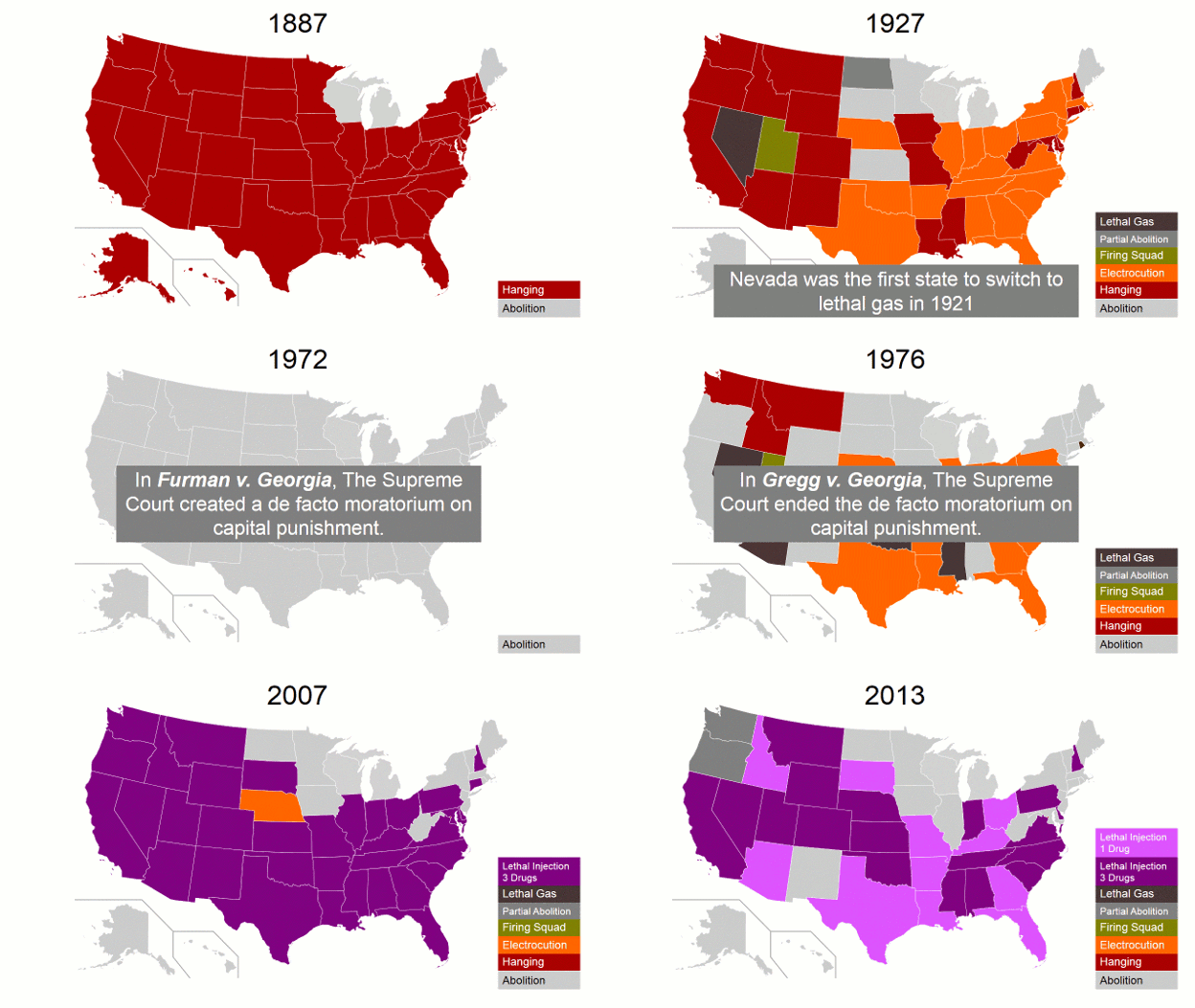
death_penalty_map_v3f

Lane Florsheim details the evolution of executions in the US:

In 1790, Thomas Bird became the first person to be executed under the United States Constitution. Bird was convicted of murder and piracy, and the total cost of his hanging was five dollars and fifty cents (for the construction of a gallows and a coffin). Since then, the U.S. state and federal governments have executed thousands of people by hanging, firing squad, electric chair, lethal gas, and lethal injection. The map [seen above] illustrates the progression of death penalty execution methods by state since the beginning in the late nineteenth century.

The Supreme Court effectively put executions on hiatus in its 1972 Furman v. Georgia decision, but states immediately began working around the ruling and the Court reinstated the death penalty in 1976’s Gregg v. Georgia decision. By 2009, all death-penalty states had made lethal injection the sole or primary execution method for death row inmates, despite problems with the method that have been evident since the 1950s. Now, the death penalty is transforming once again, due to a shortage in the drug used in the three-drug protocol to paralyze the inmate during his execution. As a result, states have resorted to hunting for a replacement in unusual places, such as domestic compounding pharmacies. Some have changed their protocols to use just one drug, or tried to replace the missing drug with new drugs. Others have put executions on hold. In states such as Louisiana, Tennessee, and Wyoming, there’s even been talk of reintroducing the electric chair. This has led to a spate of ethical problems and legal challenges.

Previous Dish on the shortage of lethal-injection drugs here.

Cold Reading

In an interview with Prospero, Olga Sobolev explains how global military conflicts shaped the literature of the US and the Soviet Union:

The response to the first world war was great literature like T.S. Eliot and Ezra Pound, but after the second world war the response was mostly pulp fiction, thrillers and spy novels. The novel is very much based on an individual view of the world, but, because there was such strong propaganda against Communism, there was a group-consciousness response based on stereotypes that fitted into this genre of formula fiction of spy novels and thrillers.

She goes on to provide context for the birth of James Bond:

So readers on both sides of the Iron Curtain were consuming these ideological patterns and stereotypes?

Yes, but in slightly different ways.

In the Soviet Union it came from the top down, but in the West the propaganda was regulated by economic means. Left-wing writers were removed from the shelves (Howard Fast, Dalton Trumbo and even Frank Baum, author of “The Wizard of Oz”) though never actually censored. They were not in demand because of media propaganda, so what was in demand was the thrillers and spy fiction. Interestingly, apart from Richard Condon’s “The Manchurian Candidate” (1953), which was American, the novels were mostly British. There was Ian Fleming’s Bond, of course, and then, later, John Le Carré, a more literary writer than Fleming. [Le Carré’s character George] Smiley is human where Bond is not. “The Spy Who Came in From the Cold” (1963) was a huge success because Kim Philby defected in 1963, and 1961 had seen the Maclean and Burgess defections, so Le Carré was on the wave of these huge political incidents. Then there was “Tinker, Tailor, Soldier, Spy” (1974), and “Smiley’s People” (1979) when the Anthony Blunt affair was in the headlines.

What Is Kindness Like?

Casey Cep shares a story about her father, who, having a heart attack early one morning, requested the ambulance not use its siren so as not to wake his three sleeping daughters. What it taught her about kindness:

I have called it an act of kindness, which I think it was. It was considerate in a way I cannot begin to understand; generous in a way no one would expect, much less demand. Years later I still do not comprehend how in what very well might have been the final moments of his life, my father thought to ask for quiet so that his daughters might continue sleeping.

Kindness is like an ice cube in your hands. It stings, but then the cold dissolves; what at first you could barely hold becomes something you cannot let go. My father’s request for a quiet ambulance came from a man so familiar with kindness that the sting was completely gone: the ice was no longer cold, but one with the flesh.

She goes on to riff on being kind in the Internet age:

[K]indness is not always as heavy as action: it can be as light as speech or as invisible as inaction. Sometimes the kindest thing we can do is to exercise self-restraint: not posting a nasty comment on an article, leaving a mean-spirited tweet in the draft folder, keeping quiet to listen to whatever unfamiliar or opposing opinion is being offered.

The Internet has offered us many facile ways of expressing approval (like, favorite, share) but few ways of being kind. It might be that the greatest act of kindness on the Internet is to be quiet. Not to be forever silent, but at least listen and learn before expressing outrage or anger, and to realize that kindness will not always take the form of approval. My father’s quiet ambulance was one act of kindness, but so too was rebuking me not long after when I fought with one of his hospital nurses about visiting hours.

Read the Dish round-ups on George Saunders’s commencement speech about kindness here and here.

Vino In Vodka Country

As Crimean winemakers consider new options, Joy Neumeyer traces “Russia’s rocky history with wine”:

[It] started with Francophile Tsar Alexander II, who established the alcjcountry’s first vineyard in the late 19th century. Considered a drink for aristocrats, wine was a distant second to the everyman’s constant companion, vodka. A famous Russian saying goes, “There cannot be too much vodka. There can only be not enough vodka.”

After World War II, Stalin sought to make wine available to the masses, and charged scientists with developing hardy new types of grapes that could survive the winter and be produced in bulk. For decades, Soviet vineyards churned out sickly sweet swill, with grape sugar and concentrate added to disguise bad quality. While enjoyed by Russians on holidays, it would have made the average Frenchman faint.

But in the post-Soviet era, a flood of imports from Europe and South America made dry wine widely accessible, and it’s catching on with the growing urban middle class. Russia has seen the highest growth in wine consumption in the world, more than doubling, from around 3 to almost 8 liters per capita since 2000 (compared to a 67 percent growth in China, another emerging market). Meanwhile, production of Russian wine has also boomed, from 238.5 million liters of still wine produced in 2000 compared to 478 million in 2011.

Update from a reader:

Your post on Crimean wines reminded me that, a few years ago, I visited the famous “Valley of Death” from Tennyson’s poem “The Charge of the Light Brigade” and was surprised to find that it’s now one big vineyard:

Valley-of-Death-Panorama

Very likely there are still cannonballs and other debris of battle still buried under the vines, but it goes to show that despite wars and transient political dramas, wine springs eternal.

Another from a history professor in California wine country:

Joy Neumeyer’s piece on Crimean wine contains a significant factual error.

The first Russian wine vineyard was planted at least two hundred years earlier than Neumeyer indicates, when German merchants, on their way to and from Persia, cultivated Vitis vinifera in the vicinity of present-day Astrakhan (which was incorporated into the Russian Empire in 1556). Moreover, at the time of its annexation by Russia in the 1780s, viticulture in Crimea, where Greeks, Tatars, and Jews had long lived, was at least two millennia old. Similarly long pedigrees characterize viticulture and winemaking in Georgia and Bessarabia (Moldova), which were incorporated into the Russian Empire at roughly the same moment as Crimea.

Russian elites were not unaware that Tsarist imperialism along the Black Sea brought them into contact with deeply entrenched wine cultures and economies. At a nationwide viticultural congress in Moscow in 1902, Russia’s most celebrated vintner, Prince Lev Sergeevich Golitsyn, stretched the truth only a little when he claimed that Russia’s first winemaker was Noah, who reputedly planted grapes on the slopes of Mt. Ararat.

(Image of Russian wines via RealUSSR; “Valley of Death” shot via Wiki)