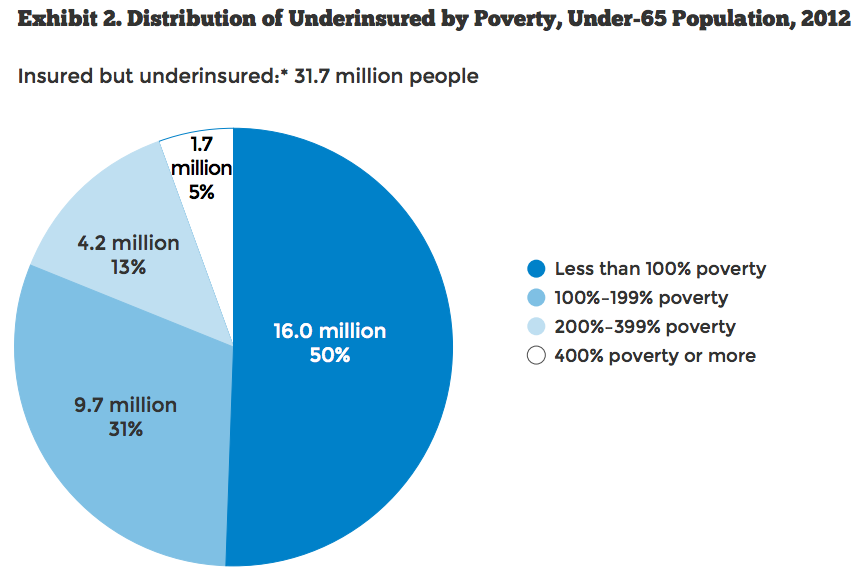
Cohn points to a new report (pdf) by the Commonwealth Fund indicating that Obamacare will help the underinsured:
According to the report, which became public early Tuesday morning, some 32 million non-elderly Americans were in households that spent a “high share of income on medical care” during 2012. That’s a little more than one in ten non-elderly Americans. The majority, though by no means all, are poor or near-poor. …
“The Affordable Care Act will significantly reduce underinsurance since it sets a national floor for benefits, requires that plans cover a minimum level of costs, bans pre-existing condition exclusions as well as lifetime and annual benefit limits, and increases cost-sharing protections for people with low and moderate incomes,” says Sara Collins, who is the Fund’s vice president for Health Care Coverage and Access and a co-author of the paper. “The problem of underinsurance is most pronounced among low and moderate income families and the provisions of the law are well-targeted at significantly improving coverage for people who have in the past spent large shares of their income on health care.”
Meanwhile, Khazan emphasizes that the uninsured are still massively confused about Obamacare:
Perversely, insured people and richer people had more knowledge about the ACA, and about how health insurance works in general, than did the uninsured. Knowledge about both the law and concepts such as premiums and deductibles increased with income. People who would qualify for the Obamacare subsidies were only able to answer an average of four of 11 questions about the law. Women were more ignorant than men were about healthcare reform, even though they arguably stand to benefit more.
Our forecasts could be wrong in November. In fact, they probably will be wrong — it’s unlikely that Republicans will win exactly six seats. But we think it’s equally likely that our forecast will be biased in either direction. If Democrats retain just one more seat, they’ll hold the Senate. Or Republican gains could grow to seven seats, or quite a bit more.
And here’s the least surprising news: Political campaigns are hypocritical. At the same time the DSCC is criticizing our forecasts publicly, it’s sending out email pitches that cite Nate Silver’s “shocking, scary” forecasts to compel Democrats into donating.
You’d do well to shut out the noise the next time the DSCC writes a polling memo.
Weigel believes that “the Silver backlash was inevitable”:
Silver’s cachet on the left, which was high after 2008, became incomparable after 2012. That was the year FiveThirtyEight became a digital security blanket for liberals, a site they could refresh and refresh and refresh some more when their other news sources warned them that Mitt Romney might actually win.
Cillizza offers a few reasons why Democrats are so worried about Nate Silver’s latest predictions:
Know who REALLY listens to what Nate says? Major Democratic donors. They follow his projections extremely closely and, if he says the Senate majority won’t be held, they take it as the gospel truth. That, of course, is a major problem for the DSCC and other Democrats focused on keeping control of the Senate — particularly given that major outside conservative groups led by Americans for Prosperity are already spending heavily on ads bashing vulnerable Democratic incumbents. If the major donor community concludes that spending on the Senate isn’t a worthy investment, [Guy] Cecil and his Democratic colleagues know that their chances of holding the majority get very, very slim. Nate’s predictions move money in Democratic circles. Cecil knows that. Hence the memo.
Comparing 538’s forecast to its most credible rival, the Cook Political Report, is instructive. Cook’s Jennifer Duffy lists Arkansas as a toss-up race; Nate shows a 70/30 probability that Mark Pryor will lose. Similarly Cook shows the two vulnerable Republican seats, Kentucky and Georgia, as toss-ups. Nate gives Democrats a 25% chance of winning Kentucky and a 30% chance of winning Georgia. But his numbers would change rapidly with a few more likely-voter surveys in any of these states showing Democrats running even or ahead; Duffy tends to project races as very close until evidence emerges that they are not so close.
But there’s not a great deal of divergence in the factors used by 538 and Cook—polls, electoral history, money, national trends—and it’s very likely their forecasts will converge as we get closer to November.
What’s truly striking and amazing about Dick Cheney and Donald Rumsfeld is their persistent refusal/inability to reflect in any serious way on the immense moral, fiscal, and human costs of their failed wars. They are post-modern creatures – Rumsfeld never tackled an insurgency, he just “redefined” the word, just as he re-named torture – and you see this most graphically in Errol Morris’s small masterpiece, The Unknown Known. And so the very concept of personal accountability and responsibility is utterly absent. There was one flash of it: when Rumsfeld offered his resignation after the torture program’s reach and migration was revealed in the photos from Abu Ghraib. But even then, Rumsfeld was resigning because of the exposure – not because of the war crimes which he directly authorized.
And so it is fitting, perhaps, that after the massive misjudgment of the Iraq invasion and occupation, and after neglect in Afghanistan made that country even less safe from the Taliban, that Rumsfeld has the gall to attack the sitting president in a clear case of dealing with a foreign leader. Here is Rumsfeld, unable (unlike McNamara) to find a conscience within his massive, brittle ego, lashing out at the president yet again:
This administration, the White House and the State Department, have failed to get a status of forces agreement. A trained ape could get a status of forces agreement. It does not take a genius.
Here is the man who derided half of Europe and told the Brits they weren’t even needed on the eve of warfare talking about diplomacy:
United States diplomacy has been so bad, so embarrassingly bad, that I’m not the least bit surprised that he felt cornered and is feeling he has to defend himself in some way or he’s not president of that country. We have so mismanaged that relationship … I personally sympathize with him to some extent. Nobody likes to hear a foreign leader side with Putin on the Crimea the way he has. But I really think it’s understandable, given the terrible, terrible diplomacy that the United States has conducted with Afghanistan over the last several years.
So having described the first black president as inferior to a trained monkey, he actually sides with a current adversary of this country against his own commander-in-chief. There was a time when I would have been shocked by this. But Rumsfeld and Cheney can permanently reduce one’s ability to feel shock at anything.
A reader adds:
Rumsfeld fails to give his audience any hint of the fact that this is a problem that he made. America used to have no problem concluding SOFAs with its allies. Those agreements addressed Americans in uniform and provided that owing to the need for military discipline and control, the soldiers, sailors and airmen (and women) would be subject to military justice rather than the criminal justice system of the host government. However, under Rumsfeld, the footprint of the American military changed dramatically, and contractors came to constitute a majority of the force the US deployed. At the same time, American military and civilian justice failed utterly to deal with the contractors (think of the Blackwater contractors who massacred 14 Iraqis and wounded 20 more at Nissour Square in Baghdad in September 2008, for instance). These circumstances led both the Iraqis and the Afghans to refuse to sign a SOFA in the form the US sought, because the US’s terrible record (Rumsfeld’s record) of non enforcement. Thus, Rumsfeld created the problem and has made it increasingly difficult for the US to get these agreements.
The key problems, Iraq and Afghanistan, were problems under Bush as well as Obama, and were handled by the same professional team at the Pentagon. They really have next to nothing to do with the White House, under either Bush or Obama. But they have an awful lot to do with Rumsfeld and his scandalous mismanagement of the Pentagon.
In the latest video from Shane, he discusses some of the prisoners, including a member of al-Qaeda, he came to know while behind bars in Iran’s notorious Evin Prison:
In a followup, he offers his take on the meaning of Rouhani’s election last year:
Shane Bauer is an investigative journalist and photographer who was one of the three American hikers imprisoned in Iran after being captured on the Iraqi border in 2009. He was held for 26 months, four of them in solitary confinement. He subsequently wrote a special report for Mother Jones about solitary confinement in America, and is also currently running a Kickstarter-like campaign to enable him to spend a full year investigating America’s prison system. Shane and his fellow former hostages, Sarah Shourd (now his wife) and Josh Fattal, have co-written the memoir A Sliver of Lightbased on their experiences. Except here. Shane’s previous videos are here.
Joseph Pierre tackles claims of over-diagnosis in his profession:
The diagnostic creep of psychiatry becomes more understandable by conceptualising mental illness, like most things in nature, on a continuum. Many forms of psychiatric disorder, such as schizophrenia or severe dementia, are so severe – that is to say, divergent from normality – that whether they represent illness is rarely debated. Other syndromes, such as generalised anxiety disorder, might more closely resemble what seems, to some, like normal worry. And patients might even complain of isolated symptoms such as insomnia or lack of energy that arise in the absence of any fully formed disorder. In this way, a continuous view of mental illness extends into areas that might actually be normal, but still detract from optimal, day-to-day function. …
The truth is that while psychiatric diagnosis is helpful in understanding what ails a patient and formulating a treatment plan, psychiatrists don’t waste a lot of time fretting over whether a patient can be neatly categorised in DSM, or even whether or not that patient truly has a mental disorder at all. A patient comes in with a complaint of suffering, and the clinician tries to relieve that suffering independent of such exacting distinctions. If anything, such details become most important for insurance billing, where clinicians might err on the side of making a diagnosis to obtain reimbursement for a patient who might not otherwise be able to receive care.
Vaughan Bell praises Pierre’s piece as a “surprisingly good snapshot” of the field, but he has reservations:
Probably the most important thing it underlines is that most psychiatrists are less obsessed with diagnosis than people who are are obsessed about the fact that psychiatrists make diagnoses. Most psychiatrists typically don’t think that ‘every diagnosis is a disease’ and recognise the fuzziness of the boundaries – as indeed, do most medical professionals. …
I would also say that the piece reflects mainstream psychiatric thinking by what it leaves out: a sufficient discussion of the psychiatric deprivation of liberty and autonomy – and its emotional impact on individuals. Considering that this is the thing most likely to be experienced as traumatic, it is still greatly under-emphasised in internal debates and it remains conspicuous by its absence.
We get stuff about how Helen Keller was “a hero to millions, a symbol of the triumph of the human spirit over adversity” and how “Marcel Proust became famous for writing good books,” which is one of those facts so incontrovertibly true that stating it sounds a mysteriously false note. And a data-mining examination of the history of fame, whereby we learn that Adolf Hitler is the most famous person born in the past two centuries (i.e., mentioned in the most books), leads to the insight that “darkness, too, lurks among the n-grams, and no secret darker than this: Nothing creates fame more efficiently than acts of extreme evil. We live in a world in which the surest route to fame is killing people, and we owe it to one another to think about what that means.”
After a while, you begin to suspect that this sort of wan reflection might be compensating for the fact that the data itself reveal little that is new.
The book is mostly entertaining, and its authors [Erez Lieberman Aiden and Jean-Baptiste Michel] are an amiable presence. But the claims that they make about the impact of their work—and the larger impact of big data on the humanities—are imposingly serious. “At its core,” they write, “this big data revolution is about how humans create and preserve a historical record of their activities. Its consequences will transform how we look at ourselves. It will enable the creation of new scopes that make it possible for our society to more effectively probe its own nature. Big data is going to change the humanities, transform the social sciences, and renegotiate the relationship between the world of commerce and the ivory tower.”
We are, in other words, deep in TED territory here, where no innovation can ever be merely useful or profitable, and must always mark something like a turning point in human history.
But Quentin Hardy spots a new and highly practical trend:
What if big data, that much-proclaimed multibillion-dollar hope of the enterprise software industry, is just a feature of something else?
On Wednesday, a company called New Relic announced that its product, used by information technology professionals to monitor the performance of software applications, would also carry real-time analytics about customer usage. That is the kind of thing that is useful to marketing departments, which are now spending money on custom big data systems. “We monitor how fast an application is, why it might be taking so long to load, why a line of code’s database query took so long,” said Lew Cirne, New Relic’s founder and chief executive. But the company can also tell “not just how long it took Airbnb to load an app, but what the best price point was in New York for completing a deal, or what products on Disney are getting the most customer hits.” …
The change in the product signifies [the] tendency for software developers to work in different parts of the company — the marketing department, for example — and not just in information technology. “The big trend we’re riding is that software will be in everything, and you’ll interact with it everywhere,” said Mr. Cirne.
A reader revives the thread with an upsetting story:
My daughter was falsely accuse of raping her girlfriend in October of this year. I know she was falsely accused because the girl who accused her said things happened in my home while I was supervising the girls. The girl who accused my daughter has an active fantasy life and had published a story online about being raped in exactly the way she claimed my daughter had raped her almost a year before they met. When the police asked me about what happened, I explained that it could not possibly have happened because my wife and I were supervising the girls the entire time my daughter’s friend visited.
Our exculpatory testimony was ignored. My daughter’s denials were ignored.
She was pulled out of school without the opportunity to talk to her parents and processed at the district court. She was not placed at an alternative school until almost two months had passed. She was placed on electronic monitoring prior to trial. During that monitoring period (October 24 – January 22), she was not permitted to leave the house, even to exercise.
I was ordered to pay for a court-appointed attorney or find one for my daughter. We ended up paying almost $10,000 in attorney fees to defend my daughter. We intended to contest the matter in court but eventually had to take a plea deal because we ran out of money. My daughter’s guilt or innocence wasn’t really important because our justice system decides guilt or innocence based on your ability to pay.
I don’t doubt that rape happens far more often than false rape accusations. To believe that rape is so uniquely damaging that it is always worse than a false rape accusation is to place an inordinate amount of faith in our legal system. Considering how many innocent men have been sent to death row enjoying far greater legal protections than common defendants, it’s hard to understand how anyone could have that much faith in our legal system. Justice may be blind, but she is somehow able to tell how much you’ve got in your pockets.
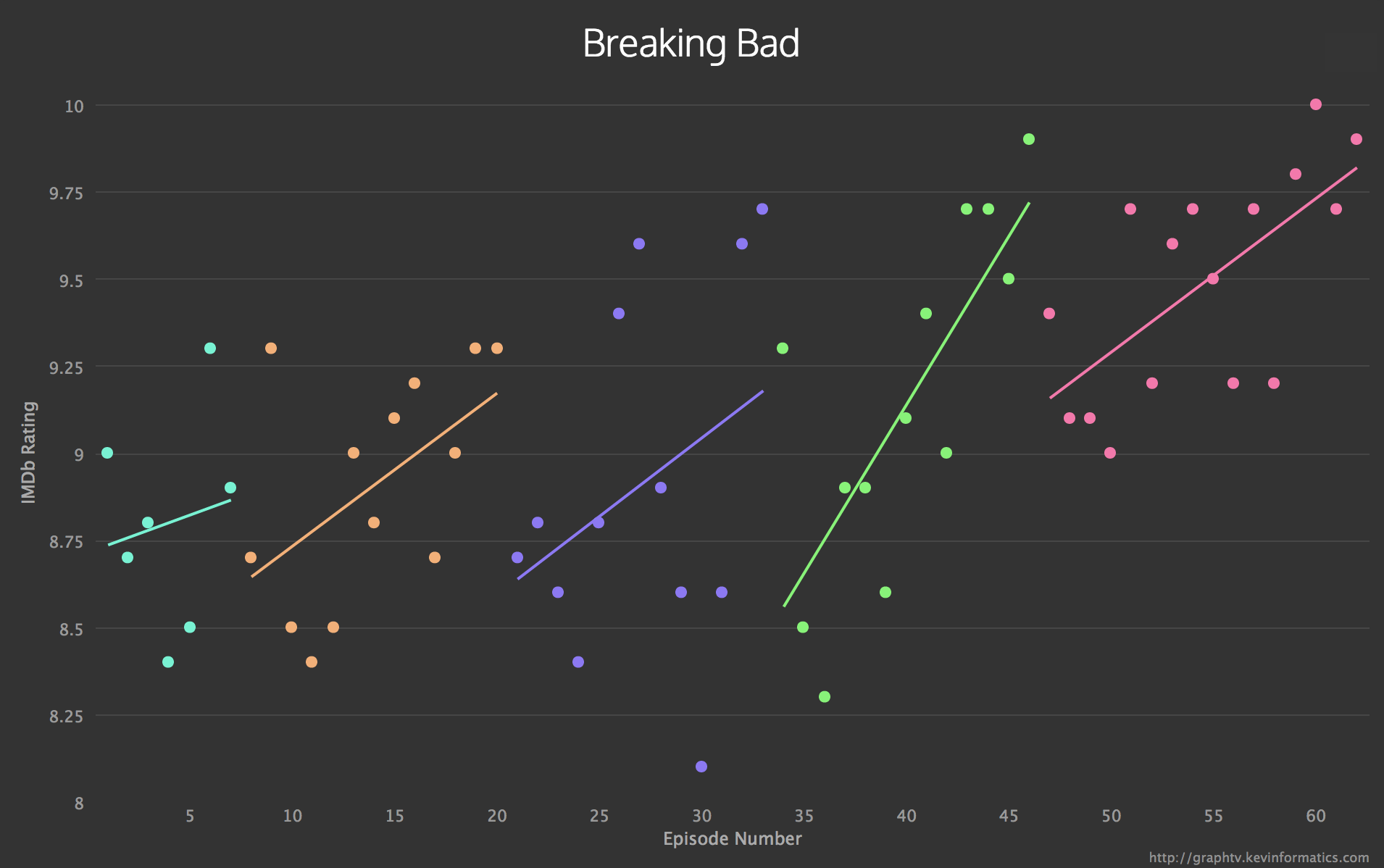
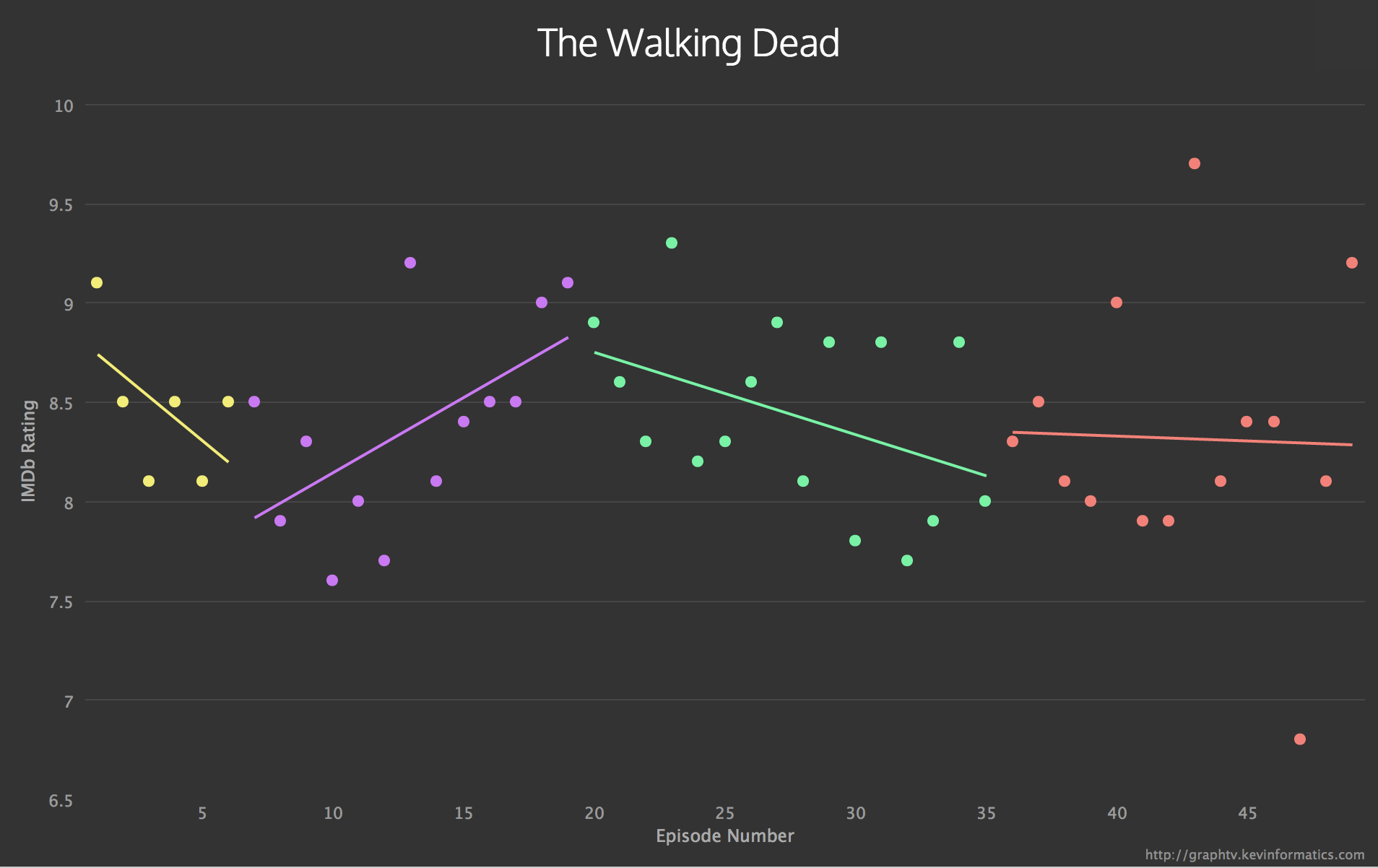
Arguing the merits and demerits of a favorite TV show is an exercise plagued with uncertainty. What some viewers see as a well-developed, three-dimensional character, others may see as a grating waste of space, and one person’s daring plot twist is another person’s nonsensical cop-out.
With Graph TV, this is no longer a problem. The website, created by software engineer Kevin Wu, looks up the IMDB user ratings for every episode of a given TV show and turns them into points on simple graphs that show the ebb and flow of public opinion over the course of a series. Each season of the show is coded with a different color, so users can see, for example, which seasons of Dexterreceived more praise as they went on and which ones tumbled down the Y-axis faster than an Olympic bobsled team with nothing left to lose.
Mark Movsesian describes a disturbing move by the Islamic State in Iraq and the Levant (ISIL), an al-Qaeda offshoot:
ISIL has taken the eastern [Syrian] town of Raqqa and reinstated the centuries-old dhimma, the notional contract that governs relations with Christians in classical Islamic law. According to the dhimma, Christians may live in an Islamic society as long as they pay a poll tax called the jizya, accept restrictions on their activities—for example, they may not engage in public religious displays, affect equality with Muslims, or carry weapons—and refrain from cooperating with Islam’s enemies. If they break the terms of the contract, Christians forfeit the protection of Islamic society and become subject to retaliation. ISIL has updated the dhimma for Raqqa’s several thousand Christians. For example, Haaretz reports,
According to the 12 clauses in the accord, the Christians will commit to pay a twice-yearly poll tax of “four gold dinars”—which at today’s rate, comes to about $500 per person—with the exception that members of the middle class will pay half this amount, and the poor will pay a quarter of it, on condition they do not conceal their true financial situation.
Rashid Najm talked to an Egyptian scholar who calls the tax “theft”:
The imposition of “jizya” on Christians in Syria is nothing but “a new fad, one of many launched by terrorist groups stemming from al-Qaeda, which have no legal authority to issue such edicts and rulings,” said Sheikh Abdul Zahir Shehata, a lecturer at Egypt’s Al-Azhar faculty of sharia and law. This imposition is “a form of theft that uses religion as a cover,” Shehata told Al-Shorfa. “Jizya” is not a pillar of Islamic law, he said: It emerged during the Islamic expansion era and was paid by non-Muslims who were capable of fighting in return for protection, while zakat was collected from Muslims, with proceeds going to the Muslim treasury where public funds were held.
“ISIL contradicts itself,” Shehata said. “On the one hand they say they are implementing the provisions of Islamic sharia, including the ‘jizya’, however the Islamic state must be a full-fledged state and recognised by its citizens and subjects, which is not the case in the areas where ISIL is imposing its control by force and bloodshed.”
But Mark Cohen argues that premodern dhimmi status meant Jews were better off in the Mideast than in parts of Europe:
In the premodern Muslim world Jews, like all non-Muslims, were second-class subjects, but they enjoyed a considerable amount of toleration, if we understand toleration in the context of the times. They were a “protected people,” in Arabic, dhimmis, a status that guaranteed free practice of religion, untrammeled pursuit of livelihood, protection for houses of worship and schools, and recognition of communal institutions—provided that able, adult males paid an annual head-tax, accepted the hegemony of Islam, remained loyal to the regime, and acknowledged the superiority of the Muslims. …
On the plus side, Islamic society was a pluralistic mosaic of different religions and ethnic groups and Jews were not the only marginal group. Moreover, as the smallest of the minority groups, Jews were rarely singled out for special attention. In Latin Europe, by contrast, Jews constituted the only non-conforming religion (heretics were considered bad Christians), and accordingly suffered more frequent and severe persecutions.
Harsher punishments for African-American students start in preschool, according to a new Department of Education analysis:
Black children constitute 18 percent of all kids attending preschool but account for 48 percent of all students suspended more than once, the new data show. Across K-12 schools, black students represented 16 percent of the student population but 42 percent suspended more than once in the 2011-12 school year.
Earlier studies have found that these high suspension rates for black students – males in particular – exist among older students as well, Yale associate professor Walter Gilliam said. The race gap “was bad then, and it’s bad now,” Gilliam said. “You don’t have to be able to split hairs to see how disproportionate it is.” Gilliam’s own research has found high expulsion rates among black preschoolers, but there has been little prior research on suspension.
Bouie notes that the disparities aren’t limited to suspensions:
Compared to their white counterparts, black boys are three times more likely to be placed in remedial or “problem” classes, as opposed to receiving counseling or a diagnosis. School-related arrests are depressingly common, and in 70 percent of cases, they involve black or Latino students. The same goes for referrals to law enforcement – in one Mississippi school district, for example, 33 out of every 1,000 students have been arrested or referred to a juvenile detention center, the vast majority of whom were black. This has far-reaching consequences. Suspensions lead to more absences, as students become disconnected from the school. In one study of 180,000 Florida students, researchers found that just one suspension in ninth grade can drastically reduce a student’s chance of graduating in four years.
Social-justice activists have been raising the alarm for years now about the “school-to-prison pipeline,” which the ACLU describes “as a disturbing national trend wherein children are funneled out of public schools and into the juvenile and criminal justice systems.” It works like this: Students, especially students of color, are hit with outrageous and disproportionate disciplinary measures in the school system. At best, that causes them to fall behind in their classes, but it can also result in students being suspended or shuffled off to separate classes for troublemakers, causing higher dropout rates and the subsequent higher unemployment and imprisonment rates. Sometimes schools turn to the police, who then arresting kids for minor infractions, treating them as criminals instead of young students who need support.