Restoring Pleasure

by Katie Zavadski

About a decade ago, members of the Raëlian religion began raising funds for a so-called Pleasure Hospital in Burkina Faso, which would restore the clitorises of women who had undergone female genital mutilation. The hospital had been slated to open in early March, but it was blocked by the local government. Sue Lloyd-Roberts reports that the American surgeons, led by gender-confirmation surgery expert Marci Bowers, moved their operating room to a local doctor’s clinic:

Bebe, a 24-year-old, is among the first. Is she scared? “No, I am not scared,” she says. “I am just angry. They cut me when I was four and it still hurts. Whenever my husband approaches, I just don’t want him.”

Bebe is given a local anaesthetic for the procedure which is a surprisingly simple one. Bowers investigates to see how badly Bebe has been mutilated. “No matter how severe it is,” Bowers explains, “we can always find the clitoris.” Although the visible part of the clitoris is cut off during FGM, it remains below the surface. “Voilà,” Bowers says as she finds it and pulls it up. “The clitoris now looks amazingly normal, part of an unaltered female anatomy.”

By the end of the first day, the team have “restored” eight women. The word is getting out, beyond the borders of Burkina Faso. By day three, women from Senegal, Mali and even Kenya come to the clinic to ask for the operation.

But the government swiftly canceled the licenses of the foreign doctors:

An official at the Health Ministry tells me that the opening was cancelled because Clitoraid [the organization behind the Pleasure Hospital] had not provided essential documents. All of which sounds reasonable until the Health Minister tells another journalist that “medical organisations should be focused on saving lives and not advertising their religion in an attempt to convert vulnerable people.”

Wendy Syfret talks to Clitoraid spokeswoman Nadine Gary:

How central is orgasm to Raëlian philosophy?

Pleasure is the most important part of the Raëlian philosophy, but the central part is simply explaining that life on planet Earth was created scientifically by people like us. Ladies like us and men who were created in their image. When you enjoy your clitoris, you can think that women creators have a clitoris just like you and have created you in their image, so you can enjoy yourself like they enjoy themselves. So is orgasm central to the Raëlian philosophy? Yes. You know we don’t masturbate every second of the day, but we don’t shy from it.

Previous Dish coverage of FGM here.

Farm-Fresh Photojournalism

by Tracy R. Walsh

Andrew Cohen applauds the coalition of animal rights groups, civil liberties organizations, and media groups challenging Idaho’s three-week-old “ag-gag” bill:

The statute creates the crime of “interference with agricultural production” by punishing anyone who makes an unauthorized “audio or video recordings” of what transpires inside food processing facilities in Idaho with up to one year in prison. It is designed, as its lengthy legislative record suggests, to help Big Ag prevent the public dissemination of images of animal abuse or unsafe conditions. Images like those posted in April 2011 as part of an award-winning investigation into the state’s dairy industry by the Boise Weekly. Or the video of farm workers in Idaho kicking and stomping on cows that the Boise Weekly posted in October 2012. It was this investigative work that caused one concerned lawmaker to lament recently not the cruelty, or unclean food, but the injustice of these farm operators being “tried and convicted in the press or on YouTube.”

Ken Paulson of the First Amendment Center weighs in:

There is a certain redundancy to all the ag-gag bills. They invariably try to limit investigative work by criminalizing things that already are criminal. …  You violate the law if you enter a farm by “force, threat, misrepresentation or trespass.” Each and every one of those is already prohibited by multiple statutes. If you were trying to eliminate coercion and fraud and trespass, you would not need to pass this bill. If you were trying to limit the scrutiny of the agriculture industry, you would need to pass this bill.

It is not only constitutionally suspect, it’s terrible public policy on the part of the legislature. Give me the very best argument for why this needs to be in place and then tell me why you wouldn’t then pass similar legislation for day-care centers. Would anyone suggest that you would send someone to prison for documenting child abuse? Is there anyone who is going to run on that platform?

Katie Valentine argues such laws have already had a chilling effect elsewhere:

In the six other states that have ag gag laws on the books, activists and journalists have said they’ve stopped attempting to document abuse on farm operations for fear of prosecution. This chilling effect means that the public in these states has little chance of seeing footage that can expose cruel and dangerous practices on agricultural operations and lead to major change in the agriculture industry. In 2008, for instance, an undercover video exposed “downer” cows, which can’t stand on their own and are sometimes diseased, being used for beef. The video led to the largest meat recall in US history and prompted the US to ban the use of downer cows for meat.

A Faster FAFSA? Ctd

by Chris Bodenner

An expert weighs in:

As you can see from my email signature, I do financial aid for a living and have done so for 20 years.  There are two issues I want to touch on with regard to that post, and I’ll take them one at a time.

First, the new FAFSA is the greatest innovation in student aid in the last 20 years. Hands down. There is nothing at all complicated about it and the Time article is full of shit. I give a FAFSA completion workshop for parents and students every year, so I know of what I speak. The current FAFSA takes the average low- or middle-income student/parent about 15 minutes to complete, especially if they use the wonderful DRT (data retrieval tool) from the IRS. The questions in Section I that were highlighted in that article only need explained once and the vast majority of parents and students will answer $0 to almost all of them. If they go to a similar workshop the first year, they will never need help again. In fact, attendance at my workshops have decreased over the last 2-3 years since the DRT was implemented because the form has become so easy to complete.

For the critics who think there is anything “complicated” about the current FAFSA, they should direct their ire at Congress.  It is because of their rules for federal student aid that those questions are there and they cannot be gathered through IRS documentation.  Instead of criticizing what the Department of Education cannot change, they should yell at the people who created the situation or, at the very least, provide the DoE with solutions.  Good luck with that.

Second, I have no sympathy whatsoever for the reader who wrote in whining about having to try to hide or sell assets in order to pay for college.  He or she is very, very, very lucky to have enough assets to play games with regarding a child’s education.  Isn’t this why parents make investments and build savings?  So a rich parent has to move some of his/her vast piles of money around and has a vacation home that is counted among the parent assets?  Big freakin’ deal.  Try being a single parent living on minimum wage or a two-parent family making less than $50,000 a year with two kids in college.  Try being one of the foster kids who come to my campus.  Or try being one of the five kids on our campus who had a primary earning parent who died this past year.

A Horse On The Force Leads To Buyer’s Remorse

by Tracy R. Walsh

3291351844_2904b76089_b

In some cities, at least:

When you factor in all the expenses for training, feeding, stabling, and outfitting, funding a single police horse is decidedly expensive. And horse units, usually deployed at large public events, perform poorly on typical accountability metrics like arrest rates. With so many more cost effective alternatives, mounted police have been forced to make the case that their units still belong.

Last month, Portland, Oregon, became the latest city to consider dropping its horse program. City Commissioner Steve Novick, hoping to redirect the $860,000 the city chips in annually to other budget concerns, had some harsh words for the department’s fleet:

“The mounted patrol is largely ornamental.” He explained to his fellow commissioners, “The primary justification for the unit, as I understand it, is ‘crowd control.’ But marauding crowds have not seemed to be a major source of crime in Portland for quite some time.” In Waterloo, Ontario, budgetary concerns similarly led to the disbanding of its program. And in New York City, there are signs Mayor Bill de Blasio’s high-profile campaign against the city’s “inhumane” horse-drawn carriages could extend to the NYPD’s mounted unit.

Blake Zeff thinks de Blasio would be foolish to push the carriage issue so soon after winning a battle over pre-K funding:

Like President Obama, the mayor expended a tremendous amount of chits early in his first term on an enormous new social program that looks likely to pass by a hair, with alterations to the initial design. … If you’re the City Hall senior staff right now, you could sure use a steady, stable few months of quiet, if you can control it. It’s not the time for more fights.

(Photo by Flickr user Campra)

Your Cell Phone Knows Everything About You

by Jonah Shepp

Mystic aside, the NSA claims that collecting your phone metadata doesn’t violate your privacy because it doesn’t tell them much about you. Well, researchers at Stanford have been studying that claim since November, and even they were surprised at how staggeringly false it turned out to be:

We did not anticipate finding much evidence one way or the other, however, since the MetaPhone participant population is small and participants only provide a few months of phone activity on average. We were wrong. … The degree of sensitivity among contacts took us aback. Participants had calls with Alcoholics Anonymous, gun stores, NARAL Pro-Choice, labor unions, divorce lawyers, sexually transmitted disease clinics, a Canadian import pharmacy, strip clubs, and much more. This was not a hypothetical parade of horribles. These were simple inferences, about real phone users, that could trivially be made on a large scale.

The study’s implications are pretty major:

“This is striking,” Fred Cate, a law professor at Indiana University, told Ars by e-mail. “It highlights three key points.

First, that the key part of the NSA’s argument—we weren’t collecting sensitive information so what is the bother?—is factually wrong. Second, that the NSA and the FISA Court failed to think this through; after all, it only takes a little common sense to realize that sweeping up all numbers called will inevitably reveal sensitive information. Of course the record of every call made and received is going to implicate privacy. And third, it lays bare the fallacy of the Supreme Court’s mind-numbingly broad wording of the third-party doctrine in an age of big data: just because I reveal data for one purpose—to make a phone call—does not mean that I have no legitimate interest in that information, especially when combined with other data points about me.”

Derek Mead adds:

Remember, these inferences are solely based on phone metadata, which includes phone numbers and call time. Phone metadata is an extremely powerful tool—the NSA wouldn’t be so dedicated to collecting it if it wasn’t—and it’s absolutely, unequivocally isn’t anonymous. As the researchers write, it’s “unambiguously sensitive, even in a small population and over a short time window.” I asked [Stanford’s Jonathan] Mayer if there was anything he’s seen that people could do to limit the usability of their metadata. The answer was pretty simple: Unless you stop making calls, there’s nothing you can do.

Shared Cinema

by Jessie Roberts

Casey N. Cep views moviegoing as “a collective escape: something we do with others, something we experience together”:

Just as we go looking for the lives of others on the screen, we get to look at them around us in the theater. In the age of bowling alone, when so many community organizations and spaces are in decline, the movie theater remains a place where the many become one: various ages and varied professions all watch the talkies together.

That mix is what I miss most when I watch a movie at home:

The chatty teenagers near the concession stand, the gossiping couples who are always first in their seats; the collective sighs and gasps and enthused whispers of commentary during the film; even the hokey clapping at the movie’s end. I suppose we have comment sections and message boards as digital surrogates, but I live for the unexpected conversations that follow movie screenings; even if I’m only eavesdropping, those conversations are as memorable to me as the movies themselves.

But as technology shifts us away from the cinema, Cep worries that “cinemas are well on their way to making moviegoing a luxury experience”:

It might be that in a few years only a limited number of movies debut in theaters and the rest of what’s on offer will have already proven itself in the direct-to-video market, or that everything on cinema screens is a few years or even decades old, screened not as a test, but as a celebration of popularity. Our cinemas will become something like museums, displaying what has already proven popular or earned acclaim, instead of galleries, where new art appears first for assessment. The picture shows won’t end, but they’ll become the last rather than the first stop for Hollywood.

An Obamacare Price Hike?

by Patrick Appel

Elise Viebeck warns of one:

Health industry officials say ObamaCare-related premiums will double in some parts of the country, countering claims recently made by the administration….” … I think everybody knows that the way the exchange has rolled out … is going to lead to higher costs,” said one senior insurance executive who requested anonymity. The insurance official, who hails from a populous swing state, said his company expects to triple its rates next year on the ObamaCare exchange.

Cohn throws cold water:

As usual, the real news here is more complicated and ambiguous.

The possibility of higher-than-normal rate increases in some parts of the country is real enough, for several reasons. Chief among them: Insurance companies may have expected a better mix of beneficiaries—in other words, more healthy people and fewer sicker ones. If so, the companies could discover that the premiums they set for this year are too low to cover the medical bills they must pay to doctors, hospitals, pharmacies, and the like. If that happens, the insurers could respond by raising premiums next year, perhaps substantially. Serious, honest people are worried about this scenario unfolding, based in part on rumblings they are picking up from within the insurance industry. “There is extensive concern about rate increases next year,” Caroline Pearson, vice president of Avalere Health, told the Fiscal Times. “Particularly since exchange enrollment is skewed toward older enrollees, some are concerned that plans will need to raise prices in 2015.”

But as Pearson also pointed out—and as all the “could”s and “if”s in the above paragraph imply—nobody really knows what’s going to happen.

Mcardle is somewhat skeptical of Viebeck’s report:

Insurance executives have every incentive to be as alarmist as possible. The administration and the insurers are now engaged in a lengthy negotiation about what you might call “The Obamacare Exchange Rescue Package of 2014.” In response to public outcry, the administration has made a bunch of changes to the rules — allowing people with “grandfathered” plans, for instance, to keep their policies. Those rule changes are going to cost the insurers a considerable sum. So the administration is proposing more rule changes, this time to funnel money to the insurers.

The insurance industry would like the funnel to be as big as possible. One way to encourage this is to tell reporters that you’re planning to triple policy premiums in “a populous swing state” — during an election year.

Obama Lowers The Boom On Russia

by Patrick Appel

https://twitter.com/b_judah/status/446684476807340032

https://twitter.com/Max_Fisher/status/446669982127366144

Today Obama announced new sanctions:

President Obama took new steps Thursday to intensify the economic isolation of Russia following its “illegal” annexation of Crimea, which could have a “significant impact on the Russian economy,” the president said. Speaking from the White House on Thursday, Obama said the U.S. will move “to impose sanctions not just on individuals but on key sectors of the Russian economy.” Senior White House officials say the sanctions will apply to 20 senior members of the Russian government and other “cronies.” They will also apply to St. Petersburg-based Rossiya Bank, which will be “frozen out of the dollar,” making it difficult for the institution to operate internationally.

The sanctions will target Russia’s financial services, energy, mining, and engineering sectors, officials said Thursday.

Miriam Elder thinks the sanctions have teeth:

The first round of sanctions announced by Obama on Monday was symbolic but ultimately toothless, targeting people with big mystiques but little power in today’s Kremlin … These sanctions are different. They hit as close to Putin without targeting the man himself. There are a couple notable absences from the list — Alexei Miller, the CEO of Gazprom, and, more importantly, Igor Sechin, the CEO of the state oil company Rosneft and one of Putin’s hardline advisors. But by reaching to his favorite oligarchs, the U.S. has hit Putin where it hurts. There’s a reason most outside Russia have never heard of these people — in Russia those with the real power stay in the shadows.

Drum expects “we’ll quickly get a pro forma response about how weak and vacillating this is from Bill Kristol, John McCain, and Charles Krauthammer.” Prior to the sanctions announcement, Fred Kaplan put America’s spat with Russia in perspective:

What’s going on now is not Cold War II.

The Cold War split the entire world in two factions. Scads of civil wars, regional wars, and wars of national liberation were, in some sense, “proxy wars” in the titanic struggle between the United States and the Soviet Union. China was used as a lever for playing one side off the other—and China played off both. Nothing like that is going on now. Nothing like it could possibly go on now. Neither side has the leverage to do it. Russia has no global reach whatsoever. Russia has no support for its actions in Ukraine; China has evinced no interest in it.

Right now, then, this is at most a regional conflict, not a global one, and the best thing that Obama can do—in both his threats and his inducements—is to keep it that way. Certain Republicans on Capitol Hill could help. Senators like John McCain and Lindsey Graham, who used to know better, could lay off their absurd yelping about Obama’s “weakness” and “feckless leadership.” For one thing, it’s not true; at least when it comes to this crisis, they’ve recommended very few steps that Obama hasn’t already taken. If they’re really worried about Putin’s perceptions of America, instead of merely clamoring to make political points with GOP extremists, they should stand by the president and make sure Putin understands that, on this issue, there are no domestic fissures for him to exploit.

Russia also sanctioned US officials today:

The Russian response has been received as less potent than the new U.S. sanctions. The United States announced a round of sanctions targeting officials and oligarchs with close ties to Putin as well as Bank Rossiya — individuals and entities that many Russia watchers never expected to be hit with sanctions.

A Search Engine With A Bug

by Patrick Appel

Google Flue Trends

According to a recent report, Google Flu Trends has major problems:

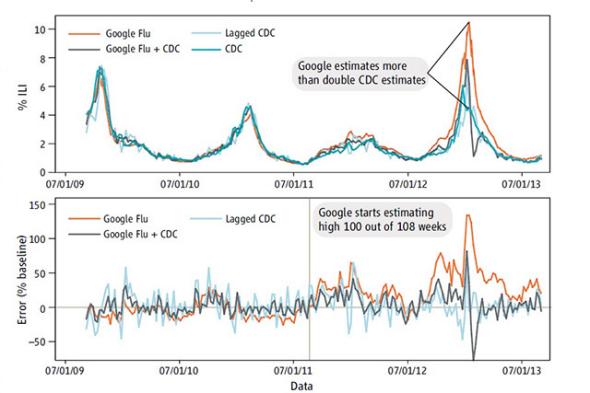
Flu Trends has gotten it badly wrong in at least two cases. The reason for these errors is remarkably simple: the flu was in the news, and people were therefore more interested and/or concerned about its symptoms. Use of the key search terms rose, and, at some points, Google Flu Trends predicted double the number of infected people than were later revealed to exist by the Centers for Disease Control data. (One of these cases was the global pandemic of 2009; the second an early and virulent start to the season in 2013.)

On its own, this isn’t especially damning. But the authors note that flu trends have consistently overestimated actual cases, estimating high in 93 percent of the weeks in one two-year period. You can do just as well by taking the lagging CDC data and putting it into a model that contains information about past flu dynamics. And, unlike the Flu Trends algorithm, they point out that this sort of model can be improved.

David Auerbach takes Google to task:

One of the main problems is that Google’s data is private—very private. Google does not release its raw data or the details of its analyses or even the set of keywords it uses for a particular result. This makes the studies impossible to replicate or check . . . Even if Google’s methodology is perfect—and there’s reason to believe it’s not—there needs to be validation. Here Google’s corporate and research agendas come into conflict: If it wants credit for scientific research, it needs to show its work, even at the cost of compromising competitive advantage.

But the project can be salvaged:

As a test, the researchers created a model that combined Google Flu Trends data (which is essentially real-time, but potentially inaccurate) with two-week old CDC data (which is dated, because it takes time to collect, but could still be somewhat indicative of current flu rates). Their hybrid matched the actual and current flu data much more closely than Google Flu Trends alone, and presented a way of getting this information much faster than waiting two weeks for the conventional data.

“Our analysis of Google Flu demonstrates that the best results come from combining information and techniques from both sources,” Ryan Kennedy, a University of Houston political science professor and co-author, said in a press statement. “Instead of talking about a ‘big data revolution,’ we should be discussing an ‘all data revolution.'”

Cool Ad Watch

by Katie Zavadski

Ahead of World Down Syndrome Day tomorrow, an Italian advocacy group releases this PSA:

Through 15 people with Down syndrome from around Europe, the video, titled “Dear Future Mom,” outlines that mothers can expect the same things all mothers expect: a child who hugs, runs, helps, works and faces challenges. “Sometimes it will be difficult. Very difficult. Almost impossible,” the people say. “But isn’t it like that for all mothers?”

Gregory Jaquet appreciates the approach:

No lies, nothing hidden, they give parents a objective and touching perspective.

Erin Gloria Ryan can somewhat relate to the struggles that mothers face:

The sad subtext of that message is that in the western world, women who find out they are pregnant with a child with Down Syndrome choose abortion around 90% of the time, often because they fear their child won’t live a “good life.” I’ve written at length about how the 9-out-of-10 statistic is tough for me, a vocally pro-choice woman who grew up with a very close relative with Down Syndrome, to swallow. And I’d never tell other women how they must or must not form their families. But, as a pro-choice woman, I’d want prospective mothers to base their decisions around whether or not to abort a pregnancy to rely on facts rather than fear, and ads like this one help shine light on the reality of living with or raising a child with Down Syndrome.