What’s Wrong With Ukraine’s Economy?

ukraine economy

A lot:

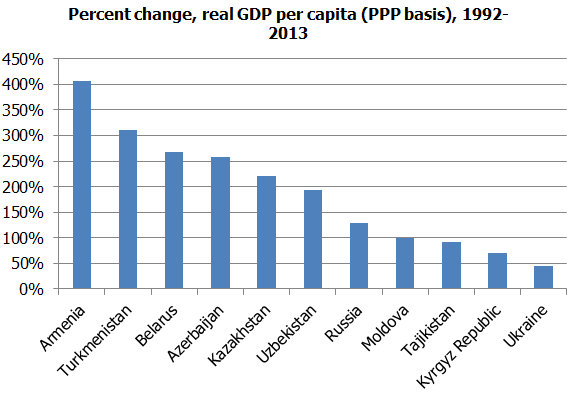
Ukraine was badly hit by the financial crisis and plummeting steel prices. GDP fell by 15% in 2009. That made it a prime candidate for economic streamlining. In 2010 the IMF agreed to loan Ukraine $15 billion—with conditions attached. A major target for reform were Ukraine’s cushy energy subsidies. The state gas company, Naftogaz, only charges consumers a quarter of the cost of importing the gas. Cheap gas discourages investment: Ukraine is one of the most energy-intensive economies in the world and domestic production has slumped by two-thirds since the 1970s. The IMF ended up freezing the deal in 2011 after Kiev failed to touch the costly subsidies.

Daniel Berman’s explains the EU’s new $15 billion aid offer:

This is not quite as generous as it seems – the aid is tied to the implementation of an IMF restructuring campaign that is sure to be almost as destabilizing in the short-run as the aid is intended to be stabilizing. If the goal was simply to strengthen the Ukrainian state in the near future, the aid should have been offered with fewer if any strings.

Nonetheless a major aid package is an excellent idea, and is precisely what should have been [done] 20 years ago. The 15 Billion Dollar package would have done infinitely more to strengthen Ukraine and to guarantee the nation’s territorial integrity than the near-worthless promises entailed within the Budapest Memorandum, or a decision to risk both American and Russian ostracism by retaining control of Nuclear weapons Kiev could not fire. Kiev’s greatest weakness through the last two decades and even today has been less its lack of military force, and more its lack of political unity. History teaches us that money does not solve those divisions on its own, but it sure damn helps. In times of crisis economic weakness is, as was demonstrated in 1930s France and Germany, a political, not an economic problem.

But he also wonders if it’s just a payoff:

The package can be just as easily seen as a bribe to console Ukraine for the loss of the Crimea as it can be as an effort to retake it. With Crimea seemingly preparing to increase the tension by petitioning to join Russia, that is suddenly a more important issue than anything else. Right now the package represents the overlap between the German and American positions because it can either console Ukraine for accepting Russia’s terms, or strengthen the Ukrainian state in its resistance, the respective goals of those two countries.

Giving The SAT A Low Score, Ctd

Yesterday the College Board introduced an overhaul of the SAT, with a return to the 1,600-point scoring system, a revamped and now-optional- essay section, and a new emphasis on American “founding documents” as source material. Todd Balf offers a “simplistic example” of a new SAT prompt:

Students would read an excerpt from a 1974 speech by Representative Barbara Jordan of Texas, in which she said the impeachment of Nixon would divide people into two parties. Students would then answer a question like: “What does Jordan mean by the word ‘party’?” and would select from several possible choices. This sort of vocabulary question would replace the more esoteric version on the current SAT. The idea is that the test will emphasize words students should be encountering, like “synthesis,” which can have several meanings depending on their context. Instead of encouraging students to memorize flashcards, the test should promote the idea that they must read widely throughout their high-school years.

Elizabeth Kolbert, who last week panned the current version of the exam, thinks the timing is interesting:

The Board’s announcement was months – perhaps years – in the making. Suggestively, though, it came just two weeks after the release of a new study that questioned the SAT’s utility. Commissioned by the National Association for College Admissions Counseling, the study analyzed the college experiences of students at so-called test-optional schools. It found only “trivial” differences in grades and graduation rates between the students who had presented SAT scores and those who had not.

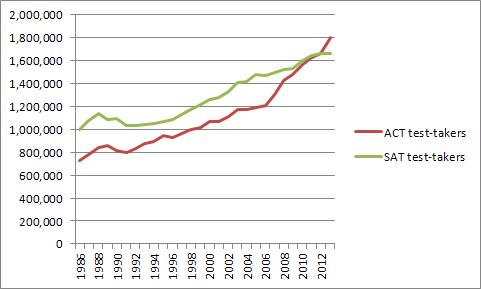
Jia Lynn Yang suggests that competition from the ACT is behind the redesign:

testtakers

According to these numbers, the ACT passed the SAT in 2012. But by some measures, the lead may have changed earlier in 2010. That year, when it became clear that the ACT was gaining on the iconic SAT, FairTest says the College Board revised its number upward to include more exam administrations. “This is Coke versus Pepsi trying to hold onto, or in this case try to regain, market share,” said Bob Schaeffer, director of public education at FairTest. Schaeffer says the new SAT in 2005 was like “the New Coke of tests; a total failure in the marketplace. “

Meanwhile, it appears college administrators are cautiously optimistic about the redesign:

Michael Sexton, vice president for enrollment management at Santa Clara University, said that his institution has never looked at scores on the existing essay on the SAT, “so we won’t miss it.” He said that, generally, the changes announced Wednesday made sense. And he said he values the SAT as helping admissions officers make decisions, especially in science fields.

A number of other admissions leaders agreed, although frequently with caveats about one or more changes. Seth Allen, vice president and dean of admissions and financial aid at Pomona College, said via email that “there appears to be more of an emphasis on measuring critical thinking skills in this new version of the test. There also appears to be more emphasis on connecting the material to actual learning rather than memorization and test preparation. Both are steps in the right direction.” But Allen said he was “less keen on the idea of including American-centric passages in every exam. This creates a potential issue for non-US applicants.”

Readers recently debated the merits of the SAT here.

The Texas GOP Has Two Right Feet

Abby Rapoport thinks political reporters are inventing a GOP establishment-Tea Party divide after Texas’s Tuesday primaries, in which Senator John Cornyn and other establishment figures fought off challenges from the right:

Texas is complicated because there’s no binary opposition between “establishment” candidates and those affiliated with the Tea Party. Should we define “establishment” as Speaker of the House Joe Straus, who has himself a relatively moderate record but has presided over one of the state’s most conservative legislatures? Outside Tea Party groups have tried to topple Straus, yet he also commands support from Tea Party-backed state representatives. Or is the “establishment” closer to Governor Rick Perry, the state’s longest-serving governor, who gave one of the first major speeches at a Tea Party rally in 2009? Or is it David Dewhurst, who hung tight to Perry’s message, passed extreme measures, but then watched his political dreams crumble as Cruz rose to power by accusing Dewhurst of being a moderate?

Benen agrees that the primaries are a contest between the far right and the farther right:

If the top-line takeaway is that the GOP Establishment won and the Tea Party faltered, some might get the impression that more moderate conservatives prevailed over voices of extremism. That impression would be mistaken. Federal lawmakers like Cornyn and [Rep. Pete] Sessions became some of the most conservative members of Congress in recent years as Republican politics in Texas became more radicalized.

Cillizza points out that the Tea Party didn’t much care for Cornyn’s challenger:

Yes, [Steve] Stockman ran as the conservative alternative to Cornyn who he attacked as part of the problem due, at least in part, to the fact that the incumbent is the second ranking Republican in the Senate. And, yes, some of Stockman’s views on the problems with the Republican party in Washington align with the tea party. But, the idea that Stockman was a tea party darling is simply not true. In fact, it’s hard to find a single major tea party group that endorsed Stockman’s campaign. Several leaders of the tea party even denounced it.

John Fund looks at the down-ballot races in which Tea Partiers fared much better. Sean Sullivan provides highlights from the other primaries, which included a familiar name:

George P. Bush easily won the GOP primary for land commissioner, a powerful post in Texas. He has the inside track in the November general election given the state’s conservative tilt. Bush is the nephew of former president George W. Bush and the son of former Florida governor Jeb Bush. While the former president has largely avoided the spotlight since leaving office, the Bush name is bound to get more attention in the coming months with George P. Bush’s campaign and speculation over whether Jeb Bush will run for president ramps up as 2016 draws near.

Apathetic Atheism vs New Atheism, Ctd

Readers continue the thread with many wonderful emails:

I also relate to the brother-in-law who wanted to support his wife but did not stand in church because he doesn’t believe in God. I also attend church with my family during holidays, or Mass when I’m visiting my boyfriend’s family. But I don’t take communion or say anything that indicates I am a believer. Why? It’s not to be contrary; it’s out of respect. These are very real beliefs for these people, and participating to the point of lying is disrespectful to their traditions and faith (not to mention confusing for my family, who have been told and must continue to be told that I do not share their beliefs). Isn’t Revelations 3:15-16 applicable here? “‘I know your deeds, that you are neither cold nor hot; I wish that you were cold or hot. So because you are lukewarm, and neither hot nor cold, I will spit you out of My mouth.”

Another broadens the discussion:

I think there’s something missing in these posts: an accurate label. Personal atheism is an apathetic stance, since it only describes one’s absence of beliefs compared to others’. But what is always referred to as New Atheism can better be described as anti-theism. It’s not just a statement of personal beliefs, but a political stance against religion as the basis for legal or political policy. Of course, being “anti” something carries a stigma (so that anti-abortion becomes pro-life, or anti-gay becomes pro-“religious freedom”). So perhaps New Atheists – or in my term, anti-theists – can call ourselves pro-secular. But somehow, that doesn’t have the same ring. My main point is that it’s a branding issue. How do you oppose conflating religion and politics without denigrating others’ beliefs?

Another notes, “Regarding Thomas Wells’ article, there’s already this term: Apatheism.” Another reader, less concerned about labeling, sees the value in being a gadfly:

I’m probably one of the “New Atheists” Thomas Wells dislikes or one of the dickheads your reader described. The reason why I’m a dickhead atheist relates to when I realized I was an atheist.

Recently my brother entered into the seminary to become a Catholic priest. After a year, he decided he wanted to have a family and kids, quit the seminary, and got a degree in theology. After he graduated, we began to have discussions about religion and politics. We would get into heated debates while discussing topics like gay marriage and the contraception mandate (I support both; he is against). Every one of his arguments boiled down to “because the Bible says so.” As the arguments continued, I would attempt to use logic, facts, and scientific studies to argue my point. He just became condescending and argued I couldn’t understand his argument because I never studied religion and philosophy. To counter that “argument”, I began to study religion from both points of view (from Aquinas to Dawkins). After doing so, I realized two things:

1) I don’t buy into religion at all
2) I’ll never convince my brother his views are wrong.

I realize I’ll never be able to convince people like my brother there is no God, but I might be able to convince people who were like me. I think it’s important to express my point of view to make others think about their beliefs. Hopefully this can stem the tide of religion forcing its way into public policy.

Another:

When I was a New Atheist I was so angry at believers for needing God to explain the Universe and say what is right. And it’s easy to see the worst in religious people to confirm my views (See Westboro Baptist). Then one day, and I don’t exactly know why, I realized a lot of very good people found meaning in life from the Bible, the Torah, and the Koran. They pray to God and find warmth in their hearts. Who am I to tell them that is wrong? From then on it was just as easy to find the good believers as the bad ones. It only depended on what I was looking for. This Onion article is probably the best way to explain it: “Local Church Full Of Brainwashed Idiots Feeds Town’s Poor Every Week“.

Now, I think it’s best to be a silent voice in support of atheism. The believers that made me feel OK with other believers just did small, good, kind acts each and every day. So I can only do the same. The best way to convert a mad believer into an accepting one is to show that an atheist’s moral code is no different for how we open doors, care for the sick, or extend a hand to those in need. Maybe this is what Francis was talking about for how the believers and atheists can meet on common ground.

On that note, another reader:

Recently a young fellow who openly identified as atheist began attending the same church I do, and by attending I mean fully participating: small group meetings, community service projects, Sunday School – the whole nine yards. It turns out, he is there for much the same reason I am, because he needs friends and community and a church can be a good place to find it.  He is welcomed with open arms and loved by everyone.

Fast forward to a recent Sunday meal with a young couple who also turned up at our church.  When the question was asked how they found out about our church, the answer was through our young atheist friend.  “We thought if you accepted him, then we’d have a place too.” As it turns out, our atheist has been the best recruiter our little church has ever had.  I count at least eight regular attendees he brought with him. Some of them were already people of faith, some were searching, and others were just lonely.

I love that kid and the way he has opened up space in our midst. The church should be a place of refuge for everyone and when it truly is people just might start coming.

Anchor Away!

Liz Wahl, the RT America host who resigned on air yesterday in protest against the network’s biased coverage of Ukraine, gives Jamie Kirchick an inside look at the network’s editorial agenda:

Wahl, for her part, says that while the Kremlin influence over RT isn’t always overt, that journalists there understand what they have to do to succeed and fall into line accordingly. “I think management is able to manipulate the very young and naïve employees,” she says. “They will find ways to punish you covertly and reward those that do go along with their narrative.” …

Wahl recalls a story she attempted to report about last year’s French intervention in Mali, aimed at repelling an al-Qaeda takeover of the country.

She interviewed a Malian man who “talked about what it was like to live under sharia law, people getting limbs amputated…And I thought it was probably one of the best interviews that I’ve ever done. I was touched by what he said as a first hand source, but he also talked about how the French were well-received there and how they were waving French flags and how they should have come sooner, how grateful a large part of the population was, having seen people being literally tortured and having their limbs cut off.”

That story, however, didn’t fit the RT narrative, which portrays every Western military intervention as an act of imperialism while depicting Russian ones as mere humanitarian attempts at “protecting” local populations, as the network constantly describes Moscow’s role in Crimea. Needless to say, Wahl’s interview with the thankful Malian never aired. “I was told after that it was a ‘weak’ interview,” Wahl said.

Allahpundit asks the obvious question:

Good for her, although I wonder what she expected when she went to work for RT. Her boss invaded Georgia a few years ago; his feelings about Ukraine being a de facto Russian province aren’t a secret. What did she think was going to happen? If he had laid off on invading but sought to crush Ukraine economically and politically to stop the phantom Nazi menace in Kiev, would that have been more acceptable?

Dan Wright is even less understanding:

After one of her colleagues Abby Martin got great press when she condemned the Russian invasion of Ukraine, Wahl decided she had had enough (of not being famous). So she went into a monologue about how her family had some mixed background where parts were from Hungary and other parts were not and that one her parents was a veteran and her partner works for the US military (it was less than perfectly coherent) then finished with an on air resignation.

Wahl was shocked (shocked!) to be working for a media organization that promoted a pro-Russian perspective despite it being owned and operated by the Russian government to provide a pro-Russian perspective.

Meanwhile, Ravi Somaiya notes that Wahl was not the first RT-er to quit over Russian whitewashing:

William Dunbar, a British journalist … started working for RT in 2008, when he was 23. He knew he would struggle to overcome the channel’s editorial line, he said, but “I was confident at the time that I would be able to fight my corner.”

That moment arrived, he said, when he was in Georgia as Russian bombs began to fall in the summer of 2008. He mentioned reports of the bombs in a phone interview with the studio, he said, and was quietly told that those mentions were responsible for his being kept off the air. He had previously seen reporting critical of Russia held off the air, and studio commentary that ran counter to his reporting. He recalls that Georgian staff members, who were likely to find such edicts hard to stick by, were given paid leave.

After seeing footage of destroyed apartment blocks in Georgia and photos of the dead, Mr. Dunbar said, he found he “was not allowed to report it,” but was instead asked to divert to stories that served Moscow. He resigned.

If You Like Your Can, You Can Kick It

Cohn translates the latest Obamacare tweak, which allows people to keep insurance plans that don’t meet the law’s minimum coverage standards through the end of 2016:

Administration officials argue that this announcement merely changes the duration of the transitionary period, without altering the end result. They make a good case. From the get-go, the law had a “grandfather clause,” allowing people with insurance as of March, 2010, when the Affordable Care Act became law, to hold onto their policies. This decision is similar to expanding that protection—and not to a very large group of people. One estimate, from the Rand Corporation, suggests only a half million people still have the old plans. And as Greg Sargent pointed out on Wednesday, that number will dwindle over time, because the non-group market is so volatile, with people moving in and out as they obtain or drop coverage from employers.

Allahpundit calls the delay nakedly political:

Quite simply, Obama was forced to choose between doing something that would help his party at the ballot box but hurt his signature health-care law and doing something that would help stabilize the law financially at the risk of generating a nasty backlash to his party from consumers with cancellations. He made the political choice. Which is exactly what O’s critics feared would happen as government insinuated itself further into the health-care industry via O-Care. Decisions on health-care policy are now a species of politics. You’re welcome, America.

Drum concedes that point:

It would hardly be the first time that a particular provision of a complex law got delayed a bit, after all. On the other hand, most delays are due to agencies flatly being unable to meet statutory deadlines, something that’s just part of the real world. The Obamacare delays, conversely, are pretty clearly being announced for calculated political purposes. What’s more, to the best of my knowledge the administration has never provided a definitive legal justification for these actions, which suggests that they don’t really have one they aren’t embarrassed to defend.

Bob Laszewski warns that this endangers the law’s long-term sustainability:

As a person whose policy is scheduled to be cancelled at year-end, I am happy to be able to keep my policy with a better network, lower deductibles, and at a rate 66% less than the best Obamacare compliant policy I could get. But for the sake of Obamacare’s long-term sustainability, this is not a good decision. The fundamental problem here is that the administration is just not signing up enough people to make anyone confident this program is sustainable. Yes, the law’s $20 billion “3Rs” health insurance company reinsurance program will prop up the program through 2016––and even be enhanced because of these changes. But then the “training wheels” come off and the program has to stand on its own. As I have said on this blog before, I don’t expect the insurance industry to be patient past 2015 before it has to begin charging the real cost of the program to consumers.

But Adrianna McIntyre doubts the delay will have a major impact:

There’s a fear that individuals who cling to old, less generous plans are healthier than those who already jumped to the exchanges. That might be true, but it also probably doesn’t matter much. CBO estimates that the exchange population will swell to 22 million by 2016 as people become more aware of coverage options and the penalty becomes more severe. The specter of adverse selection fades pretty fast when you set 1.5 million—a number that will erode over the life of the administrative fix—in that context.

“Looking at the issue more broadly,” Philip Klein argues, “the change undermines a central rationale for Obama’s health care law”:

Obama and his allies long-defended the outlawing of certain health care plans, arguing that they were substandard. And they argued that depriving people of the ability to purchase such plans was essential to making the health care law work. If young and healthy people can purchase cheap health insurance with fewer benefits, they argue, it would make coverage more expensive for older and sicker Americans.

Now, not only is Obama saying that these legacy plans can remain, but he’s saying they can stay alive for three years longer than intended. If they can be extended for three years, the new rules may never fully go into effect (unless Obama will allow a wave of cancellations in October 2016, just before the presidential election). And maintaining these plans will further drive up the cost of insurance on the exchanges.

Central Interference Agency

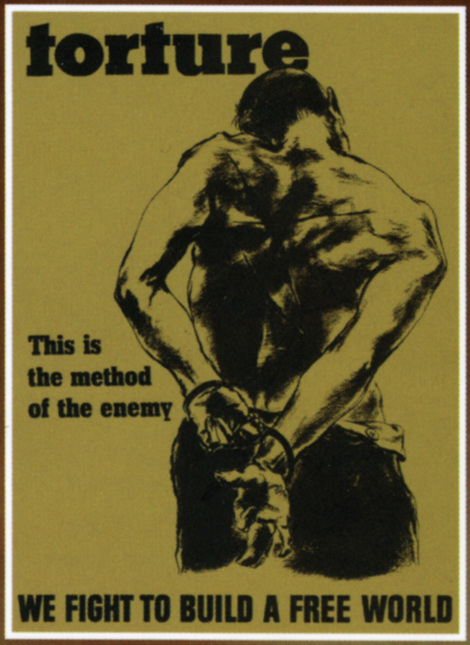
oldantitortureposter.jpg

Yesterday, we learned that the CIA spied on Congress’ investigation of the agency’s torture program. Dan Froomkin puts the revelation in context:

The resistance to oversight about torture mirrors similar problems legislators have experienced when it comes to trying to monitor surveillance programs and other secret activities, with one huge exception: The torture report was championed and endorsed by Senate intelligence committee Chairman Dianne Feinstein (D-Calif.) and other senior members of that committee. By contrast, Feinstein and House Intelligence Committee Chairman Mike Rogers (R-Mich.) have emerged as the strongest defenders of surveillance activity, leaving the so-far-losing battle for disclosure to be fought by more rebellious legislators.

Alex Ruthrauff makes the obvious point that the agency must have something to hide:

Agencies that operate in good faith and within the law have no need to obstruct investigations. If you’re doing that, you’re admitting guilt.

That might actually be the worst part of all of this — beyond the torture and the law breaking, the CIA is actually incompetent enough 1) to let Congress discover the CIA was spying on them, and 2) not to realize that their best chance of making this go away is to cooperate, say “sorry,” re-arrange the deck chairs, and move on. A lawless CIA is one thing, but a lawless CIA run by people who apparently can’t even manage a simple PR crisis is pretty fucking scary.

Drum quotes yours truly saying the same:

It’s enough to make you think that the CIA committed crimes so damning and lied so aggressively during the torture regime that it is now doing what all criminals do when confronted with the evidence: stonewall, attack the prosecution, try to remove or suppress evidence, police its employees’ testimony, and generally throw up as much dust as possible.

Actually, the funny thing is that this might not be true. It’s possible that spying is simply so ingrained in the CIA’s culture that they do it anytime they can, even if there’s no good reason for it. Alternatively it’s possible that the CIA committed crimes so damning and lied so aggressively during the torture regime that it’s now terrified of a full accounting of what it did. I could believe either possibility.

I fear the second. The zeal and passion with which the CIA has tried to justify the unjustifiable strongly suggests to me that the Senate Report, along with the CIA’s internal report, is correct: the US practised horrifying torture on a large scale and did so under cover of darkness, lying to the Congress, lying to itself, destroying tapes of its own atrocities and covering up all the way. They must be exposed and returned to democratic civilian control.

(Illustration: an anti-torture poster, from the days when the US opposed the use of torture in warfare.)

Paul Ryan Can See Russia From His Pet Political Issue

This is ridiculous:

[CNN host Kate] Bolduan pressed Ryan on what Congress could do in response to international crisis.

“Well, I think we should move forward on natural gas exports very quickly,” the former GOP vice presidential nominee insisted. “I think we should approve an LNG terminal in the east coast to go to Europe. I think we should approve the Keystone Pipeline. And I think we should show that the U.S. is going to be moving forward on becoming energy independent.”

“Moving forward with the Keystone pipeline!” Bolduan exclaimed. “That development would take years, though, to actually make that happen.”

Ryan argued that the controversial pipeline would be a “signal” to Russia.

Erik Loomis quips:

There’s no question that the one thing that will cower Putin is if Obama decides to pipe some Canadian fossil fuels through Nebraska to Gulf Coast posts.

Ben Adler explains why Keystone would have little effect on Russia:

After conflict between Russia and Ukraine led to supply disruptions in 2006 and 2009, Europe took measures to make itself less vulnerable. Meanwhile, as U.S. natural gas production has soared in recent years, U.S. demand for gas from the international market has shrunk, so even without exporting gas, we’ve been freeing up more of it for Europe. “The U.S. energy boom has already changed the balance of power in Europe away from Russia and to a more balanced posture, even without sending a single molecule of American natural gas over, because it has freed up supplies from places like Qatar and Norway to compete with Gazprom,” says Andrew Holland, senior fellow for energy and climate at the American Security Project, referring to Russia’s state-owned oil and gas company. …

All of this aside, there is still no evidence that Russia would be more respectful of Ukrainian sovereignty if it faced more competition for European gas markets. The main beneficiaries of allowing more exportation of fossil fuels would be the companies that produce those fossil fuels.

Francis On Civil Unions, Ctd

Tyler Lopez doubts that the Pope was really endorsing same-sex partnerships in the interview published yesterday:

The pope’s statement could easily be interpreted to mean the extension of legal rights to a caregiver living with a terminally ill loved mary-knots-SD-thumbone. Some civil unions also allow widows who wish to form a new romantic partnership to keep Social Security survivor’s benefits. To give you an idea of how slow things are moving here, this represents progress: Church leaders previously suggested that widows should “have consecrated to God their remaining years in the unmarried state.”

Being exceedingly careful not to issue any errant endorsements of a loving commitment between same-sex partners, the pope only suggests that the Vatican should examine and evaluate the circumstances of governmentally recognized relationships.

Yes, but it’s clear that gay couples could be included in such arrangements … and did you expect an American secular liberal to run the Catholic church anyway? I sure didn’t and wouldn’t want one to. Elizabeth Dias is on a shrewder path. She interprets the statement as another step in Francis’ tone-shifting project:

He also, once again, reminded the world that his papacy seeks to welcome gays, not to judge. It pointed to his desire to see a church of pastors, not of doctrinaires. It was a loud echo of the five most famous words of his papacy so far: “Who am I to judge?” He uttered them in reply to a reporter’s question on gays in an impromptu press conference last July. Even that brief gesture of increased compassion from the Holy See sent shockwaves through global Catholic communities, and it signified the shift in tone that put Francis on the cover of LGBT magazine The Advocate’s as their 2013 Man of the Year.

Allahpundit weighs in:

A Christian friend who supports gay marriage has always insisted to me that there’s no real contradiction between her faith and her views on SSM.

Religion has its sphere and civil society has its sphere; so long as the Church gets to set the rules in its own house, i.e. by not having to recognize or perform same-sex marriages, it can be agnostic about which sorts of relationships the government chooses to legally recognize. I don’t know if Francis would go that far, although there are credible reports that he privately endorsed civil unions for gays in Argentina as a potential compromise position while the country was debating legalizing gay marriage. Either way, the bit above about taking care not to vaccinate people against faith is consistent with his pronouncements on family/sexual matters so far: He seems reluctant to get caught up in these disputes for fear that they’ll sidetrack his bigger-picture vision for the Church, which has more to do with charity for the poor and less with culture-war flashpoints that risk alienating more socially liberal believers. It’s not quite a “truce” a la Mitch Daniels but more a matter of emphasis. Or so it seems to a humble atheist.

Look: Pope Francis is the first Pope to come from a country that already has marriage equality. He has long understood the distinction between a religious truth and a civil law. And the church in Argentina hasn’t shriveled up and died since marriage equality arrived. In my view, the church can easily assent to civil unions as it easily consents to civil divorce: as long as it’s a civil matter and not a religious one, this is simply a consequence of living in a pluralistic society, and since the Second Vatican Council, the church has come to terms with that.

John Gallagher sees other reasons to be hopeful that things are getting better in the Church:

This isn’t the only recent sign that the Vatican may be softening its antigay stand. Cardinal Peter Turkson of Ghana, president of the Pontifical Council for Justice and Peace at the Vatican condemned Uganda’s antigay laws, saying that “homosexuals are not criminals” and shouldn’t be sentenced for up to life in prison. In most corners, this would be met with a “duh,” but in the Vatican this is actually bold.

One more hint that change might be afoot: the Jesuit magazine America recently ran an editorial echoing Turkson’s condemnation. Perhaps more interesting, the magazine also ran a cover story that concluded that Pope Francis does seem to be shifting the Church’s stance on LGBT issues, though not its doctrines, with a greater emphasis on dealing with people where they are instead of judging them in advance.

America is not taking a different stance than it has in the past; it’s a pretty progressive Jesuit publication. Heck, it even had me on the cover in the 1990s making the case for gay inclusion in the church. So I wouldn’t read too much into that. FOD Dan Savage argues that if Francis really is endorsing civil unions, he’s 30 years too late:

If Christians had looked at the suffering of gay men in AIDS wards in 1985 said, “The lives, loves, and rights of these couples must be protected,” and if conservative Christians had proposed civil unions then and gotten a civil unions statute signed into law by the conservative Christian president they helped elect, that might’ve halted the push for marriage equality before it could even get off the ground.

But now that we’re winning marriage—now that victory is assured—the pope is willing to maybe think about supporting some type of civil union scheme. I’ll say to the pope what I said to my evangelical Christian pal: that fucking ship has fucking sailed. What the pope is saying to gay people in 2014 is this: “Okay, now that you’re winning marriage, here’s an idea: give marriage back and we will give you civil unions… which we once opposed with the same intensity and in the same apocalyptic terms that we oppose marriage today. Is it a deal?”

No deal, Francis.

Of course that’s right, but Francis is really talking about this topic within a Catholic context. He’s talking about how the church can understand these matters, not the state. That’s a start, at least. It’s a return to the spirit of humility and inquiry that led to the 1975 document that insisted that homosexual orientation was no sin. Unlike civil society, moreover, Catholicism has a long and deep theology wrapped up in a Thomist understanding of gender, sex and love. That cannot and should not be junked overnight to meet Western secular standards. It requires a difficult discussion about how the church’s teachings on homosexuality impact its teachings on love and family and sexuality as a whole. It requires a process of deliberation, prayer and thought. I see Francis as doing one thing: allowing a real debate about these matters for the first time since Ratzinger shut it down two decades ago. And we will only see its fruit in a few decades’ time. But the challenge now for gay Catholics, it seems to me, is engaging in this conversation, telling our truths to our fellow believers, and seeking a way for the church to reconcile its teachings of the equal dignity of all human persons with its demand that gay people lead lives without intimacy or close family at all. Francis has invited us in; we should take him up on the offer.
Russia’s Loss Isn’t Our Gain

Scott McConnell makes an important point:

The dream of chaos inside Russia still animates half the people inside the Beltway. Paula Dobriansky, a big deal ambassador during the Bush administration tells an audience that Putin’s real fear is that the Maidan revolutionary spirit will spread to Moscow. That is obviously what she wants—though why anyone would seek regime disintegration in a state that possesses hundreds of nuclear missiles in not obvious.

Adam Kirsch thinks seeing Russia through a Cold War lens is “making it hard for us to assess the real dimensions of the threat—to take Putin and what he represents entirely seriously”:

What we are seeing is a weird kind of negative feedback loop: The more dangerous Russia is, the more untimely it seems, so the less dangerous it appears. The problem is that, while Putin’s government and his ideology have little to do with the Soviet Union, the Soviet Union remains our reflexive frame of reference for anything having to do with Russian geopolitics; and the Soviet Union is no longer frightening to us. Partly this is a generational issue. No one under 30 today remembers the Cold War at all; no one under 60 played any major role in waging it. What remains is the defunct iconography of Cold War pop culture: Russian villains from the Bond movies to Rocky to Boris and Natasha, which could not seem less threatening today.