Sentenced To A Violent Death

by Dish Staff

Daniel Genis, a former inmate, gets real about how going to prison raises your risk of getting murdered, and how little anyone will care if you do:

Obviously, incarceration increases one’s odds of a violent death. Living in a society openly governed by force with those who have demonstrated their familiarity with it increases the danger. There are steps to lower the risk: Don’t join a gang, don’t get high, don’t gamble or owe anyone—all fairly obvious. Also important: don’t join the dating pool or compete for the attention of homosexuals. If the most common reason for jailhouse murder is money, the second is jealousy.

I did 10 years without being scarred; I fought infrequently, only when I had no other option, and mostly in the beginning. Nevertheless, I saw a man die 10 feet from me in my first year.

I knew both killer and victim but not the reason. I knew only that the hit was commissioned; the man who took the contract was a specialist. He had come to prison with a parole date two decades away, but by the time I met him he would have to be Methuselah to ever see a board. With few other options, he became a hitman and killed many times. The victim was himself dangerous, and also the strongest man in the yard. He could lift a concrete table. But he couldn’t stop the shank to his heart. …

I was shown how much the value of my life had shrunk on my very first day in the state system. A notorious sex offender got off the bus with us. After processing in everyone else, the cops took him somewhere for a reminder of their thoughts on “rapos.” He was old, frail and handcuffed; 20 minutes later they had a crime to cover up. Something had gone wrong in that room and the guy was dead. His corpse was quickly re-shackled and returned to the bus. The paperwork was spotless: he had died in transit, the conjunction of a weak heart and long trip. I had nine years ahead of me and plenty of transit. Therefore I decided not to remember anything if anyone came investigating. But no one ever did.

The Pessimist’s View of Facts

by Michelle Dean

It hasn’t been a good fall for firm believers in stable capital-T Truth, has it?

The courtroom, which Americans often seem to venerate as a kind of church, hit a lot of speedbumps. Here’s just two: A significant swath of the country was obsessed with Serial, the podcast which deconstructed a fifteen-year-old murder prosecution in Baltimore and found more than a few factual holes in the case. But unless some big reveal is waiting for us in the Thursday finale, the podcasters didn’t find exonerating evidence, either, for the man convicted of the offense. Similarly, in spite of the theatrics of a three-month grand jury, the “truth” about what happened to Mike Brown in Ferguson, Missouri on August 5 remains subject to considerable dispute. (The very latest from The Smoking Gun has it that one of the key witnesses in the case had a history of racism and fabrication.)

And it’s obviously not just the court system that seems to be failing at truth-telling. The debacle of Rolling Stone‘s article about rape at the University of Virginia rages on. It’s exposed what a lot of journalists already knew: even the fanciest magazine pieces can have shadowy bits and rely on unconfirmed accounts. As though to prove that point, just yesterday New York magazine found itself thrown onto a similar fire when the New York Observer revealed that a high-schooler had entirely fabricated his account of being a multi-millionaireNew York is fact-checked, but that wasn’t a failsafe here.

For some people this is very depressing. They’ll write you long op-ed pieces decrying the work of lazy judges, craven lawyers, and shoddy reporters. There’s often a sense of betrayal driving those pieces, anger at professionals for not doing their jobs. I don’t excuse any malfeasance of course, and my opinion of Bob McCulloch is extremely low. But I’m rather more ambivalent about whether it’s a bad thing that we all recognize that the Truth isn’t one, and it’s often hard to uncover.

Obviously I’d like not to have to second-guess every piece of big journalism I read. Obviously I’d like to think that the courts are doing the best they can. But I was once a lawyer. Seeing how courtroom sausage got made undermined any faith I’d had in the relationship between litigation and the truth. I’ll spare you my full Eeyore on this subject, but suffice to say that the rules of evidence, and the winner-takes-all attitude of the judicial system, don’t have much to do with finding out what really happened.

When I first became a journalist I thought that things in this field would be better. But then I learned to report by being someone’s fact-checker. It was intellectually transformative. Trying to nail down the simplest things, like dates, turned into hours of discussion, phone calls, cross-checking documents and interview transcripts and more than once, the weather report. There were few outright lies involved, but lots of half-memories, mix-ups, and forgetfulness. The truth could get to be a bit of a black hole.

Recognizing that doesn’t, to my mind, excuse laziness. If anything it makes you more vigilant than you might otherwise be. It makes you want to ask about the work behind the story. Call me a glum Canadian if you like, but I think self-doubt can actually be positive. I don’t think the blind self-confidence we encourage in prosecutors and sometimes journalists is always that great for them. The latter half of 2014 has been clear enough testament of that.

Dick Cheney’s Moral Standard, Ctd

by Dish Staff

Damon Linker is perturbed at what Cheney – “along with a distressingly large number of Americans – understands by patriotism: a willingness to do just about anything to advance the interests of the United States and decimate its enemies”:

Cheney’s hardly the first person to defend such a position. Machiavelli advocated a version of it in The Prince. It’s been favored by some of the most ruthless nationalists and totalitarians in modern history. And it’s expressed in Book 1 of Plato’s Republic by the character Polemarchus (the name means “leader in battle”), who defines justice as helping friends (fellow citizens) and harming enemies (anyone who poses a threat to the political community). This is what patriotism looks like when it’s cut off from any notion of a higher morality that could limit or rein it in. All that counts is whether an action benefits the political community. Other considerations, moral and otherwise, are irrelevant.

The problem with this view, which Socrates soon gets Polemarchus to see, is that amoral patriotism is indistinguishable from collective selfishness. It turns the political community into a gang of robbers, a crime syndicate like the mafia, that seeks to advance its own interests while screwing over everyone else. If such behavior is wrong for an individual criminal, then it must also be wrong for a collective.

Chait helpfully dismantles Cheney’s defense of torture. And Waldman focuses on his refusal to define the term:

[E]ven after this repeated questioning, we still don’t know how Dick Cheney or any other torture advocate defines it. Why not? It seems pretty clear. There is simply no definition that anyone could devise that wouldn’t apply to things like stress positions or waterboarding. Try to imagine one. Torture is the infliction of severe physical or mental suffering to obtain information or a confession — but only if it leaves a mark? Or only if it’s done by non-Americans? Any such definition would be absurd on its face.

So when people like Cheney are asked what the definition of torture is, they say, “September 11!” When asked what definition of torture wouldn’t apply to the particular techniques the CIA employed, they just repeat, “We didn’t torture” over and over. They not only defend torture as a means of obtaining intelligence, they sing its praises and insist that it was spectacularly successful, all without having the courage to call the thing by its true and only name.

Froomkin is concerned that, for Cheney, his Meet The Press appearance “was still a win – at least in the short term, until history passes a more considered verdict”:

Because our elite political media is unwilling to call out the morally abhorrent self-interested ravings of a torturer, Cheney’s statements effectively push the envelope for what is treated as legitimate debate. So while we finally have this long-awaited Senate Intelligence Committee report, full of achingly detailed descriptions of abuse and lies even more depraved and duplicitous than any of us had imagined, the media just sees the “revisiting of a debate” about torture.

Previous Dish on Cheney’s MTP appearance here. Andrew’s take here.

Ruble Trouble, Ctd

by Dish Staff

Screen Shot 2014-12-16 at 11.56.43 AM

Matt O’Brien highlights the latest piece of bad news for the Russian currency:

Russia’s central bank raised interest rates from 10.5 to 17 percent at an emergency 1 a.m. meeting in an attempt to stop the ruble, which is down 50 percent on the year against the dollar, from falling any further. It’s a desperate move to save Russia’s currency that comes at the cost of sacrificing Russia’s economy.

But even that wasn’t enough. After a brief rally, the ruble resumed its cliff-diving ways on Tuesday, falling another 14 percent to a low of 80 rubles per dollar. It was 60 rubles per dollar just the day before. The problem is simple. Oil is still falling, and ordinary Russians don’t want to hold their money in rubles even if they get paid 17 percent interest to do so. In other words, there’s a well-justified panic. So now Russia is left with the double whammy of a collapsing currency and exorbitant interest rates. Checkmate.

Neil Irwin elaborates, pointing out that even the central bank’s attempt to stanch the bleeding is a big risk:

Perhaps the higher interest rates will make those moving money out of Russia think twice, and a resulting reversal in currency markets will lead speculators to conclude that betting against the ruble is no longer a sure thing. But the move shows how Russian policy makers are stuck with no good options. Already the central bank has reportedly been intervening to try to short-circuit the sell-off, buying rubles to try to arrest the declines.

The problem is that if you try to defend your currency and lose, you are essentially throwing your money at currency traders for nothing. As Russia has deployed its reserves to (so far unsuccessfully) stop the currency collapse, it has made traders betting against the ruble richer while leaving the Russian government poorer. Poorer by $80 billion, to be precise.

“Putin’s policy choices in this matter,” Yglesias adds, “have important implications for the distribution of wealth in Russia”:

The collapse in the value of the ruble is a disaster for Russians who have debts denominated in foreign currencies, but it’s not necessarily the worst thing in the world for those who don’t. Indeed, Russians working in tourism (which, admittedly, isn’t that many people since Russia is mostly cold and empty) or in the country’s handful of export industries that aren’t oil and gas actually benefit from a cheap currency. Conversely, much higher interest rates will be devastating to the fortunes of Russians who need to roll over ruble-denominated loans or who depend on rate-sensitive sectors like construction for their employment.

Bershidsky suggests that Moscow’s next step might be to impose capital controls like Malaysia did in 1997. But the really troubling question is what the political implications are. Noah Millman wonders whether a currency crash will be Putin’s downfall, and if so, what happens next:

If an economic meltdown leads to widespread popular discontent, the regime will have to respond in some way. The most appealing way – because the least risky for the regime – would be to stage-manage a change in leadership that promises change while changing very little. But who is Putin’s Putin? Once upon a time, the obvious answer would have been Dmitri Medvedev. But in the wake of his administration, and his agreement to hand the Presidency back to Putin after one term, I’d argue Medvedev is too closely-identified with Putin to be a plausible replacement for the regime in the event of any real discontent. …

If the regime cannot stage a satisfactory bit of theater, then the remaining options are uglier. Putin could deliberately try to provoke the West in the hopes of blaming Russia’s economic troubles on foreigners. Or he could turn force inward against internal “enemies” of Russia. Or the regime could hand Putin’s head to the mob without a clear plan for succession, leading to a period without clear leadership at the top until someone emerges from the internal struggle for power. Least likely of all would be a genuinely revolutionary situation such as obtained in 1991. None of Russia’s organs of power are willing to take that kind of risk again.

Keating fears that the crisis will inspire even more belligerent behavior from the Kremlin:

Putin can’t do much of anything about oil prices and any steps to cooperate with NATO to secure sanctions relief will make him look weak. There’s a fair chance, then, that he may actually escalate tensions to get back the rally-round-the-flag effect that has sustained his popularity through the Ukraine crisis. Russian jets continue to buzz the airspace of NATO countries, and the military recently carried out snap drills in Russia’s westernmost region, Kaliningrad. This doesn’t look like a leader on the verge of de-escalating.

Slow Down, You Move Too Fast

by Will Wilkinson

0627110720

The “Intellectual Situation” column in the latest edition of N+1 contains a stimulating meditation on the sense that the pace of life is perpetually quickening, leaving us with ever less unharried time.

The centrality of this feeling to our age, and to the ages that preceded it, has received its most comprehensive treatment in the recent work of German theorist Hartmut Rosa and his concept of an “acceleration society.” For Rosa, the sense of speedup created by labor-saving is one of the major paradoxes of modernity, and one of the exemplary versions of this paradox is that “the dramatic rise in feelings of stress and lack of time” in our epoch has been “accompanied by an equally significant increase in free time.”

The paradox, in a nutshell, is that economic growth and technological progress actually does free up time, but also produces a profusion of diversions clamoring for limited attention. “The feeling comes about because the variety of social experiences available is ceaselessly proliferating: the number of things you might be able to do becomes impossibly large, and expands every day with implacable speed,” say the N+1 editors.

I certainly know the feeling. But I would suggest that this doesn’t really amount to real problem for people who have no aspiration to live on the bleeding edge, or to, to say the same thing, to live in reaction against the bleeding edge. The N+1 editors may not encounter many placidly unhurried folks in Brooklyn, where “artisanal” slow-living presents itself as one among many enticing lifestyle choices, attractive precisely due to the sort of depletion they describe.

Here in Chattanooga, though, I cannot say that I see people breathless from the proliferating options of modern life.

Chattanoogans do have smart phones, but are oddly disinclined to make use of their mapping functions. When, new to town, we purchased a patio furniture set at the Home Depot, the clerk responsible for setting up delivery asked us for detailed directions to our house, which she wrote down on a pad of paper. “Don’t the drivers have GPS?” I asked. The question was met with a quizzical look, perhaps because, unbeknownst to me at the time, GPS in Chattanooga refers to Girls Preparatory School. “Can’t they just get directions on their phone?” She conceded that this might be possible, but would not let the matter rest until she had affirmed, by means of an exceedingly drawn-out exchange, that we indeed lived off the “S-curve” on Hixson Pike, as she had suspected. We may have been a little annoyed by the imposition on our very precious time, but that’s because we were the odd ones, the outsiders, the people who live, for no good reason, in a hurry.

Since moving to the South, I have had I don’t know how many leisurely conversations about the breed of my dog or the age and weight of my baby, as if I had appeared in the supermarket parking lot, or headed up my street in unsociable headphones, specifically to burn my minutes in vacuous neighborly chit chat. I try not to look like I’m itching to get away because, really, what’s the hurry? Anyway, people here go to work, where they do not hurry, go home to their kids and maybe watch a little TV, maybe “like” a few baby pictures on Facebook, on Sundays go to a lot of church, and it’s all slower than it was when I was a kid up in Iowa, sedate Iowa. (The Chamber of Commerce would have you know, however, that Chattanooga has the fastest broadband in the United States.) I may make myself frantic trawling the infinite internet, reading “year’s best” lists full of things I will never ever have time to get around to. I may sit in front of my Roku’s menu screen feeling stymied by the profusion of choices. But I could just relax and live like a regular person.

I’d meant to comment on the N+1 editors’ extraordinary ability to connect the putative problem of feeling like we have no time, like all putative problems, to “neoliberalism.”  (“An era of social acceleration has its political consequences too, in which neoliberalism, the pensée unique, monopolizes the language of inevitability, obligation, fidelity to the one best way.”) But, really, who has the time? Pensée unique? I’ll say. Get another idea.

(Photo from a reader: “Walden, TN overlooking Chattanooga, 7.20 am”)

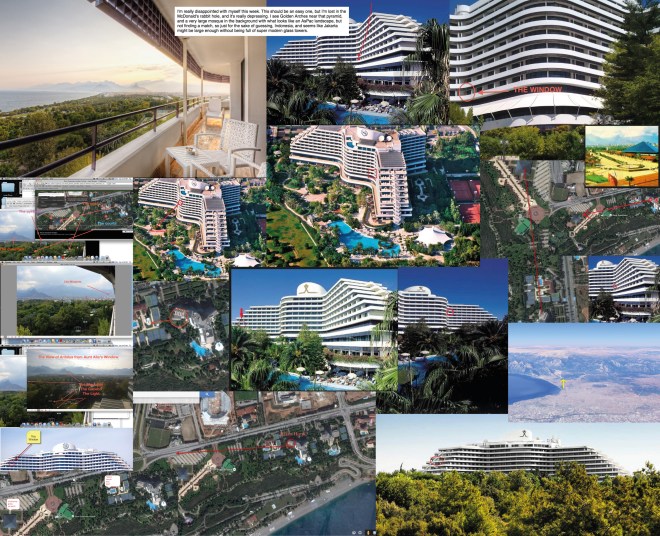
The View From Your Window Contest: Winner #235

by Chas Danner

VFYW-Contest-235

A reader is thinking Central America:

Only a guess, but I went to Guatemala years ago and it was one of the most beautiful places I’d ever been. This has the same feel.

Another argues that “palm trees and high mountains suggest an equatorial highland location such as Bogotá, Colombia, where the McDonald’s (near right edge) would not be out of place”. Then again, maybe it’s Bosnia:

Some of the architecture looks like old Soviet-style buildings … there are some fir trees … city has a vague Eastern European feel to it … and there is a mosque on the far right of the picture …the multi-variate correlation that fits is Sarajevo. Here’s to hoping I’m right.  BTW, these contests alone are worth the $20 subscription.

Another shares a vivid memory:

I remember standing on the parapet of Chapultepec Castle on a remarkably clear day in Mexico, DF and seeing the spectacular view of the mountains Iztaccihuatl (Sleeping Woman) image005and Popocatepetl (Smoking Man). This was in the ’90s and the air was rarely clear enough to afford such an opportunity.  I asked a gentlemen in my poor Spanish how often you could see the mountains and he replied maybe two days a year.  It’s a much more frequent sight now, but only the Mexican calendar artists can give you this [seen above].

The most popular incorrect guess ended up being Rio, with other readers throwing their darts at Tehran, Lima, Scottsdale, Bogota, Taipei, Barcelona, Jakarta and Yavin IV (again). And this reader has hobbits on the brain:

This is clearly taken from the Galadriel Suite (Room 407) of the Sheraton Minas Ithil and Suites (formerly the Trump Morgul). That modernist geometrical building is the Osgiliath Convention Centre, designed by Daniel Liebeskind. The post-war (of the Ring) Gondor official plan called for low density housing and parkland in much of the Anduin Valley lands, but a succession of Wardens of the White Tower allowed for the condominium developments that now dominate the view of most Minas Tirith residents (small mountain at rear on left).

Either that or Santiago, Chile.

Another explains:

At first I thought this might be an untypical view of Rio – that iconic mountain from some other angle. But with my limited ability to manipulate Google Earth, I couldn’t make it work. And what really bothered me were what appeared to be Italian cypress trees. They grow in a Mediterranean climate, of which there are several outside the Mediterranean itself. (I went down the Sicily path for a while, but to no avail.) I know from my environmental scientist sister that Brazil does not have a Mediterranean climate, but Chile does. AND it has the Andes! So on that flimsy evidence, I’m going with Santiago de Chile. With my luck, this is really in Southeast Asia …

Southwest Asia, actually, where this reader arrives, nailing the right country:

There is no useful Street View in Ankara, Turkey but I’m pretty convinced that’s where we’re looking. I’d love to spend more time on it, but I’m at a conference with terrible WiFi. Hope I’m not a hemisphere off!

Another sets the city straight:

I see you threw in some Rio-esque mountains in the background just to trick us. I started my search with pyramid buildings in Rio  there actually is one! But it’s nothing like this one. So I moved on to searching for pyramid buildings around the world, and spent about 5 minutes before finding one that looked a hell of a lot like this one. Antalya, Turkey! A beautiful place I’d never heard of … I’ll put it on my “places to go some day” list. Then I just lined up the view with objects from Google Maps satellite view.. the pool… the green structure … the gazebo. It’s gotta be the Falez Hotel. But I can’t find any matching balcony photos or anything like that  the railing and the overhang don’t seem to look like anything I can find. So I’m just saying the 6th floor to say something.

I wouldn’t recommend staying in this hotel. All the pics submitted to TripAdvisor are of broken things, dirty things, and a Russian woman with her hands on her hips.

The pyramid was of course the key breadcrumb for most correct guessers this week:

Pretty easy one after last week’s stumper.  I’m sure the ratio of mud brick houses to glass pyramids (not in Paris or Las Vegas) is a million to one or better.

Capture

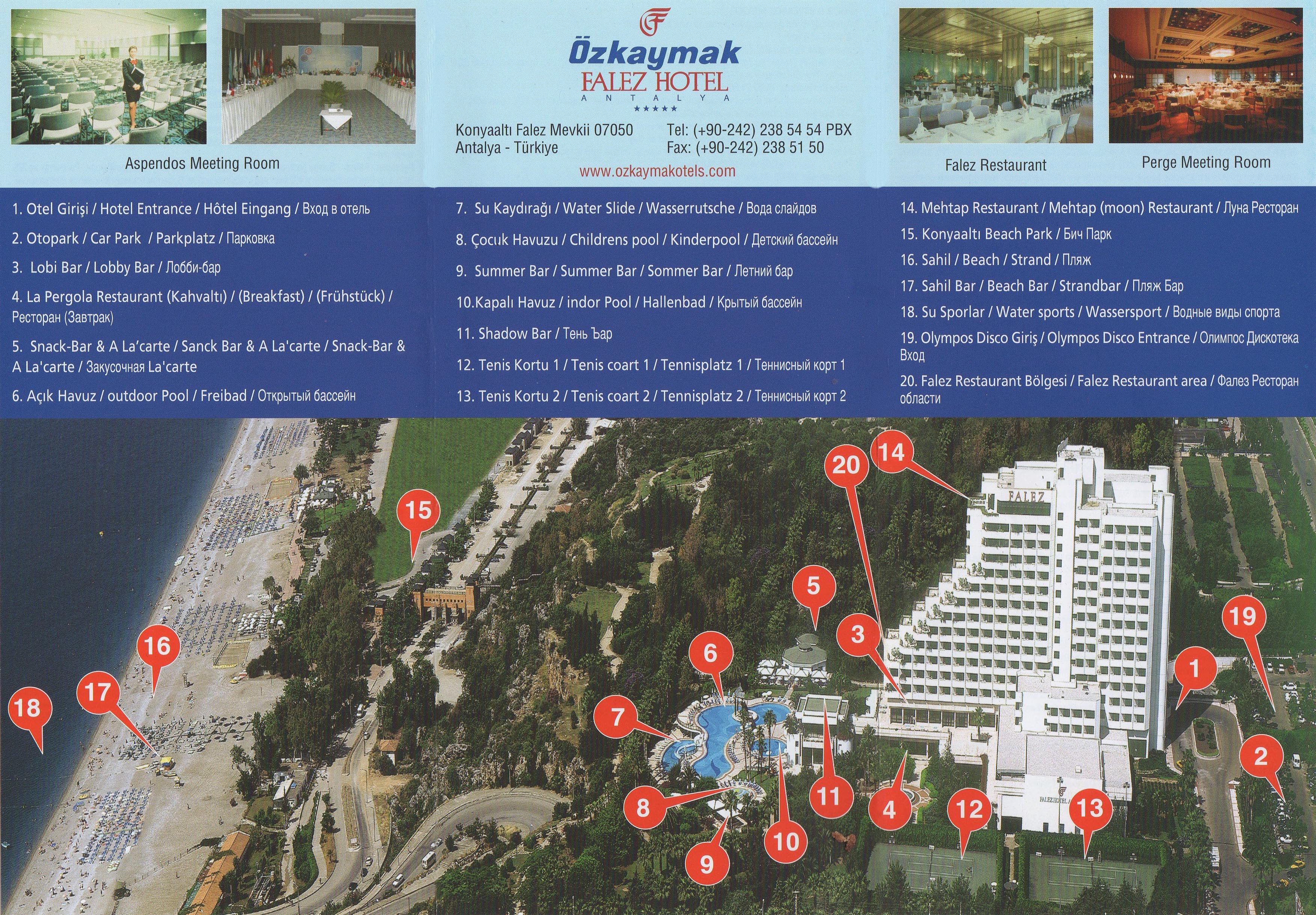
Lots of readers flagged the right building but named the wrong hotel (the Ozkaymak Falez), and this former winner explains why:

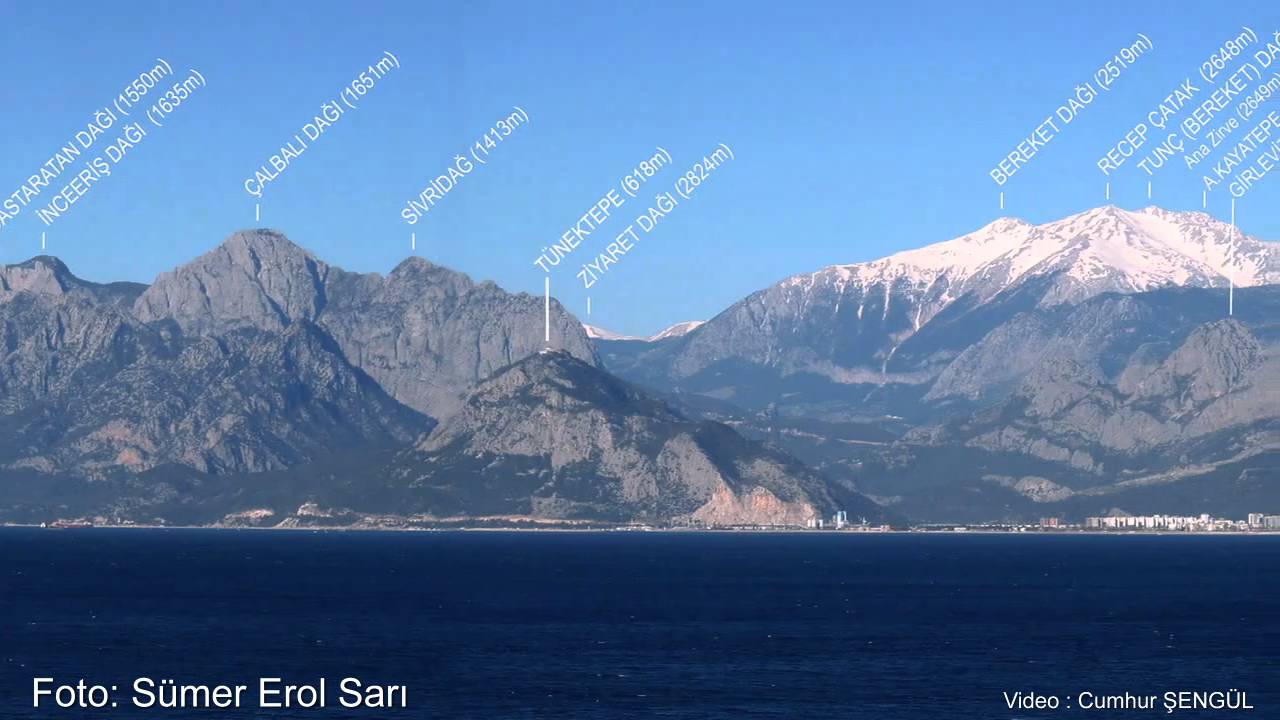
Much easier this week.  The contest picture contained so many clues that Turkey’s southern coast became the only place to search.  Antalya, Turkey popped up right away with this beautiful image.  Once in Antalya, the position of the beach, the McDonald’s and the hills of the Beydağları Coastal National Park to Antalya’s west led to a particular hotel.  Google Maps incorrectly identifies the hotel as the Ozkaymak Falez Hotel, a rundown establishment popular with both male and female Russian tourists and garners scathing reviews on TripAdvisor.  Luckily for the person that submitted the contest picture, he or she stated next door to the Falez Hotel at the Rixos Downtown Antalya (a former Sheraton).

As for the window, massive hotels are always difficult.  The window is on the hotel’s west side on a fairly low floor.  Because the tennis court lights are visible but the trees block us from seeing the courts’ surface, I’ll guess the 5th floor.  The hotel contains a few curves on its west side.  Because the hanging lattice shows the building curves right where the contest window is positioned and because the balcony railing goes only a short distance before curving away to the north, I’m guessing that the contest window is in a room right at the southernmost curve on the hotel’s west side.  My window guess is highlighted:
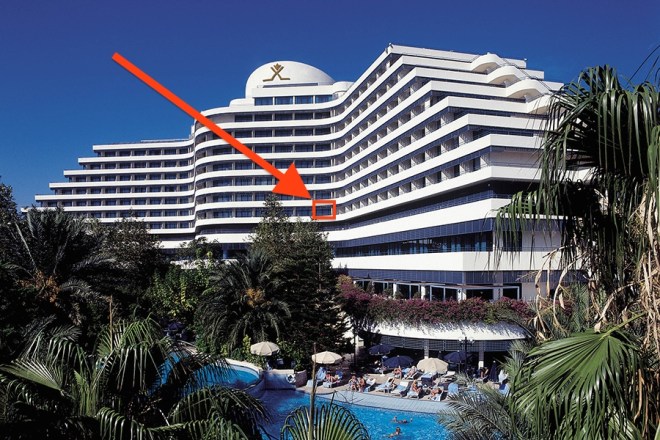
hotel view with label

Another veteran took a different route:

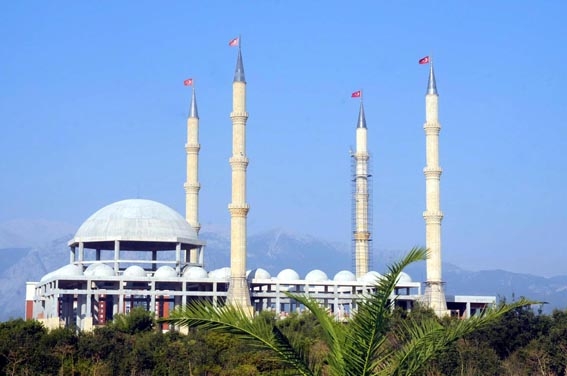
A tricky contest. The clue that eventually gives the country away could also get you bogged down. The mosque at the right end of the picture tells you that this is (probably) an Islamic country; but another photo of that same mosque is nowhere to be found. After a fruitless (and very boring) search, you give up and begin simply looking for a city at the foot of a mountain range; since those minarets have their closest counterparts in Turkey, this is the country to start with (well, actually I started with Indonesia and Malaysia: all those palms got me a little off track). And in fact, this week’s picture was taken from the Rixos Downtown Hotel (Sakıp Sabancı Boulevard, Konyaaltı Beach) in Antalya, Turkey. As for the mysterious mosque, it belongs to the Faculty of Theology of the nearby Akdeniz University. There are not many photos of the mosque because it isn’t there yet  at least not entirely  it’s still in construction:

mosque

For you new players out there, this is how it’s done:

Good thing there was a McDonalds in the picture.  That was the big giveaway.

 image003

My first thought was “Great. Deciduous, conifer AND palm trees.”  But the tall, dark, narrow conifers appeared to be Mediterranean Cypress, so that narrowed the search area. Then there was the mosque in the far right background.  That narrowed it further. Of course, it was the “Cam Piramit”, that determined the correct city. This picture shows another view of the Can Pirimit with that uniquely shaped hill behind it:
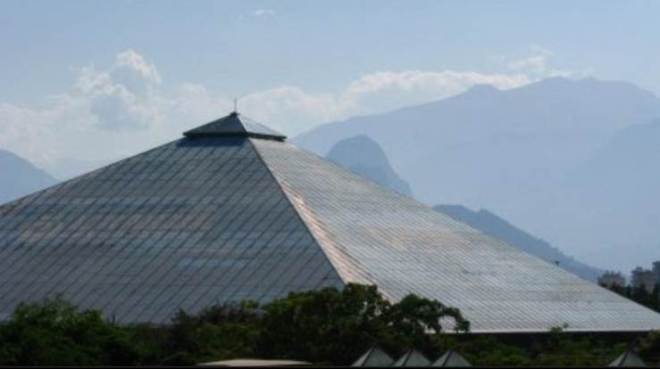
image002

Flying video tour of the Cam Piramit here, complete with resounding music:

[youtube https://www.youtube.com/watch?v=ZPRXvg1rRsU]

The picture you posted was taken from what is now the Rixos Downtown Antalya but used to be the Sheraton Voyager Hotel. Here is another picture from that hotel, but one taken from before the trees grew up to mask the tennis courts of the “Antalya Tenis İhtisas ve Spor Kulübü” next door. The picture also clearly shows the yellow ball topped sculpture:
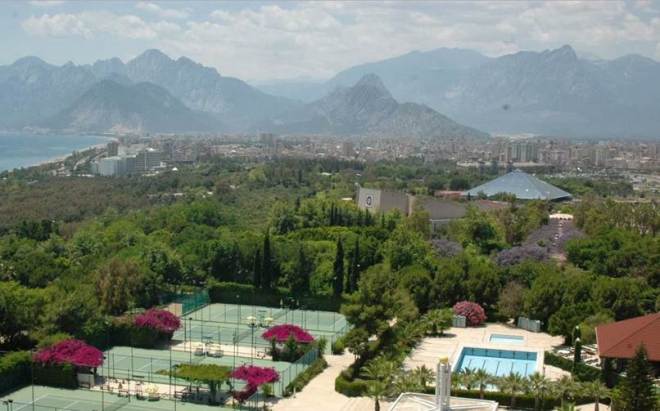
image005

OK.  So correct building.  What about the window? It is on an inside curve, so my best guess as to which window is this one.  At least I’m closer that I was last week in Morocco:
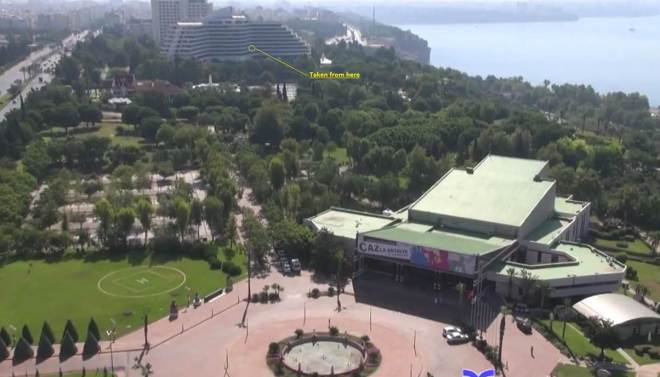
image008

Another reader laments the changes the city has undergone:

I am not going to look for the exact hotel room, because this gets depressing. Many of your readers share wonderful memories of those hotels from where the picture comes. I have not been to the hotel, but the contest does bring up memories of the location. Growing up as an expat in Istanbul, I have been on vacation on those beaches west of Antalya in the late seventies. There was a little country road running parallel to the beach, towards Kemer, and there were a few primitive campgrounds tucked away under the pine trees, where you’d set up the tent in the sand (or you didn’t, because it wouldn’t rain anyway), and a crazy guy called Arap Mustafa would cook wonderful village food for dinner, on a gas stove set up on a concrete slab under a makeshift roof. Sandy beach, crystal-clear clean water, pine trees. Nothing else.

Seeing how today the entire stretch of beach between old Antalya and the mountains, a good 10 km, is occupied by urban sprawl, unregulated industry, freeways, ugly cheap hotels, and ugly expensive hotels, I want to cry. Or puke. There are many places in Turkey I want to go back to. But Antalya I am not going to visit before the next massive earthquake or tsunami.

It is one of the most egregious instances, where one of the most beautiful regions of one of the most beautiful countries in the world has been mindlessly sacrificed to global tourism. And, of course, the push to open the next pristine beaches or nature preserves for tourism development continues full throttle, so that the buddies of the Erdoğan administration can make more money.

Apologies to the reader who is probably enjoying their vacation there. I hope you had a great time. But to me, it was a reminder how deeply ambivalent modern tourism is in third- and second-world countries.

Another master class:

I was pleased to see minarets on the left side of the photograph as they are among my favorite architectural elements. The style was reminiscent of those in Istanbul and other major cities of Turkey and the vegetation was also consistent with landscaped sections of these cities. None, however, had the distinct and dramatic mountains of the contest photograph. Eventually I found them in a photograph of Antalya. Once there, the hotel, its ample grounds, the tennis courts, swimming pool, and the glass pyramid in the contest view were fairly obvious.

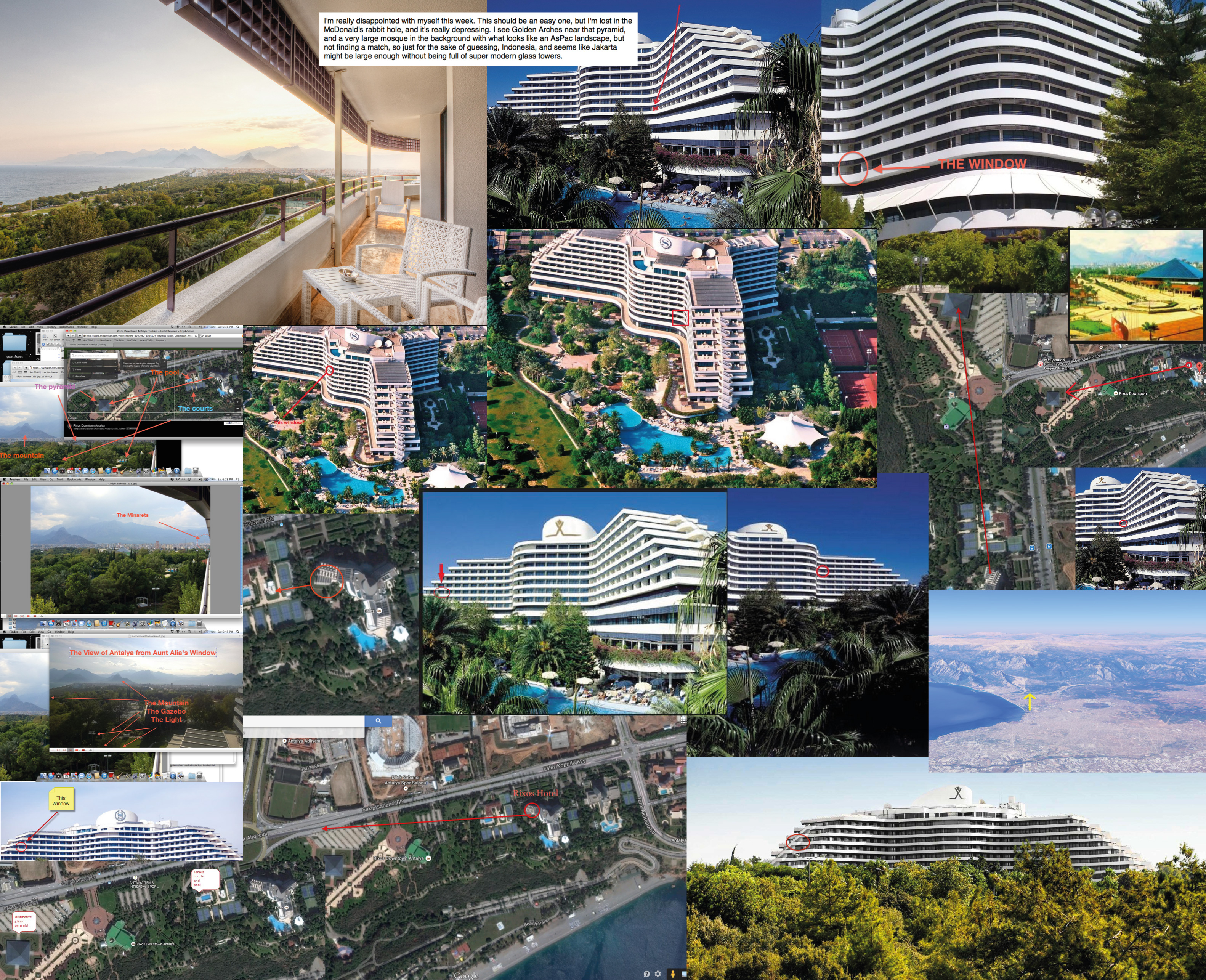
vfyw_HMcollage_12-13-2014 copy

The photograph was taken from a balcony where a major turn occurs in the hotel’s curving exterior. This change in angle is clear in the railing and sun shade alignments in the foreground of the contest photograph. The line-of-sight along the balcony railing appears to extend along this entire section of the hotel’s façade, including railings for five or six rooms, until the railing turns out-of-sight around the next bend. This is the only location I could find that explains these bends while also avoiding views of other sections of the hotel’s façade (see illustration). The floor chosen was based roughly on the height of the trees seen in the contest photograph and their relative heights in photographs of the grounds.

Chini reminds us:

It’s been two years since we last visited this country in VFYWC #126, a contest which I remember only because it was the same weekend Hurricane Sandy arrived. This one takes place under far less hellish circumstances and, given the wealth of clues, I suspect someone is gonna have to nail the right room number to win their VFYW book.

VFYW Antalya Bird's Eye Reverse Marked - Copy

This week’s view comes from the Rixos Downtown Hotel in Antalya, Turkey. The picture was taken on roughly the fourth floor (room #443, perhaps?) and looks west-south-west along a heading of 257.85 degrees.

Wow that’s a close guess, as this week’s photographer explains:

It is from the Rixos Hotel, Room 445, Sakip Sabanci Bulvari, Konyaalti Sahili, in Antalya,  Turkey.  We had a great time there.  There was a film festival happening when we were there at the pyramid-shaped building seen in the photo.

This week’s winner got pretty close too:

I must say, I thought this week’s contest was going to be hard, but all the clues, as Chini says are right there: Mountains, palm trees, sports (tennis anyone or swimming?), minarets in the background, etc all point to Turkey. The pyramid building was the big fat clue and that place, the Sabanci Congress and Exhibition Center just puts everything into place.

The shot was from the Sheraton Voyager Otel hotel. Now the room, without a map, and a good photo, I’m going to guess that it’s on the 4th floor, and room 455.

In perusing the various websites (Tripadvisor, Hotels, etc.) I can’t believe how cheap the resort hotels are in Antalya are. I also found out that Antalya is ranked third behind London and Paris for international arrivals. There’s Greek, Ottoman, Byzantine and Turkish history all over this town with ruins, clock towers, etc. As of the 2010 census there are over a million people living there. Another interesting place in the world!

Well, I know I’ll lose to a better room finder than I, but just in case this week’s contest is too damn hard and I won’t enter – I want to wish everyone at the Dish a Happy Holidays – you guys often make my day. Here’s to a great 2015!

Same to you, though be advised our final contest for 2014 arrives this Saturday. Until then, here are some more of the images you submitted this week:
VFYWC-235-Guess_Collage

(Archive: Text|Gallery)

No, Elizabeth Warren Still Isn’t Running

by Dish Staff

Fed Chair Nominee Janet Yellen Testifies At Senate Confirmation Hearing

James Antle III quips that “Elizabeth Warren may be the last liberal in America who doesn’t want Elizabeth Warren to run for president”:

Warren was interviewed by National Public Radio Monday and was asked the standard question several times. “I’m not running for president,” she said. What is she telling liberal independent groups? “I told them, ‘I’m not running for president.’” Never ever? “I am not running for president,” she replied. “You want me to put an exclamation point at the end?”

Sounds pretty definitive, right? Except the Washington Post responded to the interview with a piece titled, “Why Elizabeth Warren is smart to not totally rule out running for president.” The political press clearly wants Warren to run.

Sargent doesn’t believe Warren “has any intention to run.” So why are progressive groups still talking her up?

Anything that boosts Warren’s visibility might also boost the potential power and influence that Warren may be able to exert within Congress — and over the Democratic Party in general — as their chosen vehicle for progressive policy ideas. That might boost the groups’ own influence over the debate.

Tomasky calls Warren the most powerful Democrat in the country:

But she does have this problem:

The media will always peg her as “left,” a word that in modern American media usage is clearly a pejorative. And if she just gets stuck there, her influence, however great among the Democratic base, will never grow outside of it. More centrist Democrats will make a few gestures in the Warren direction, but nothing more.

So Warren’s great challenge is to counter that dismissal by showing that her ideas do indeed have appeal outside the hard-shell Democratic Party base. They do, potentially—a number of polls have shown that Americans, including many in the center and even some on the right, have negative views of Wall Street and would back tighter regulation. She can speak to goo-goo eyed crowds in Boston and New York and San Francisco and Los Angeles, and while she’ll wow the already converted and rake in the money, she won’t be changing anything. But if she can take her message to Des Moines and Louisville and Columbus and Jacksonville and demonstrate that audiences are receptive there, then she’ll break out of the box the media wants to assign her. And if she can do that, she’ll become a figure of un-ignorable influence, and she’ll start making the likes of Clinton really pay attention.

Beinart rejects a comparison bandied about:

The better analogy is not between Elizabeth Warren and Ted Cruz. It’s been Warren and Rand Paul. Warren’s crusade against Wall Street may appeal to young blue collar Republicans in the same way Paul’s crusade against the national-security state appeals to young liberal Democrats. Both Warren and Paul are exploiting a divide in the other party. Democratic elites are more hawkish on foreign policy than their party’s rank and file; Republicans elites are more pro-Wall Street than theirs.

But Ed Kilgore is unsure how popular her politics would be:

To most Democrats most of the time, Warren is raising important and legitimate concerns about Wall Street that must be addressed, not just dismissed as “class warfare.” To some Democrats some of the time, she represents a decisive break with the Clinton and Obama traditions that is morally necessary.

But let’s don’t pretend there’s a slam-dunk “electability” case for this kind of politics. Yes, the “median voter theorem” of politics that dictates a perpetual “move to the center” by general election candidates has lost a lot of its power just in the last few years. But the countervailing “hidden majority” argument for more ideological politicians of the left and the right is hardly self-evident, and has in the past often been fool’s gold.

Sarah Mimms hears from Republicans who “see Warren as a way to paint the Democratic Party as increasingly beholden to its liberal wing and removed from moderates”:

Warren is hardly the only Dodd-Frank champion among congressional Democrats. And she’s far from alone in opposing the changes pushed by Republicans this week. …

But other members of the Democratic Conference in the Senate aren’t seen as rising stars the way Warren is. Few are considered potential presidential candidates. And none serves as well in the role of liberal specter over the next two years as Warren will, particularly now that she is a member of leadership. “The more exposure she gets, the better for us,” [RNC spokesman Sean] Spicer said. Warren could easily become a poster-woman for the Democratic Party over the next two years, he argued, serving the same purpose as Pelosi and Reid have in Republican advertising and strategy.

Dreher, for one, hopes Warren “will run for president in 2016 to force a national conversation on the Washington-Wall Street power nexus”:

A populist who talks like Elizabeth Warren and really means it is a Democrat a conservative like me would consider voting for, despite her social liberalism. As Phyllis Schlafly said back in 1964, in defending Goldwater against the Establishment Republican Nelson Rockefeller, a contest between Warren and Clinton, and a contest between Warren and just about any Republican would give the country a choice, not an echo. She almost certainly couldn’t beat Hillary for the 2016 nomination, but a Warren candidacy would get her name and her issues out there.

Andrew Prokop doubts it will happen:

[I]f Hillary doesn’t run, or her standing in the polls begins to plummet — it seems conceivable that Warren could heed the calls of various activists and jump into the race. But if Warren thought a presidential bid looked like a promising and appealing prospect under current conditions, she’d be floating the possibility of a run now, like Jeb Bush is. For the moment, it’s best to take her at her word that she’s focused on the Senate.

Larison thinks “it would probably be a better use of Warren’s time to concentrate on her role in the Senate”:

Warren hasn’t even finished her first term in office, and she is just now starting to have some real influence. That role may not be entirely incompatible with running a presidential campaign over the next year or so, but challenging Clinton will inevitably take her away from the job she was elected to do. It is there that she might stand a chance of achieving something. Running around Iowa and New Hampshire might provide the occasion for some interesting primary debates, but it isn’t going to have much of an effect.

(Photo by Alex Wong/Getty Images)

Why Didn’t Amy Pascal Just Pick Up The Phone? Ctd

by Michelle Dean

A reader compares the Sony hacking to this year’s sexting hacks:

I was a Sony Pictures employee up until two months ago. I worked as a television producer on the Sony lot for the previous two years. On a daily basis, I passed by Amy Pascal and Michael Lynton and the others whose private emails have now been leaked (contrary to Michelle Dean’s disdain that they’re just “big fancy business people,” they’re actually very cool, approachable people), and I have been warned that my private information has very likely been leaked as well – as have any present and former Sony Pictures employees going as far back as 1995. (!)

Let’s first remember what this hack is about: Private documents and emails were illegally stolen and leaked to the public, with more leaks threatened, in order to blackmail Sony out of releasing a film – they have specifically demanded that Sony not release “The Interview.” Put another way, foreign hackers are blackmailing Americans out of exercising their First Amendment rights. And now the media outlets that continue to print the salacious details revealed in these stolen documents are complicit in that blackmail scheme, having given the leaked information the damaging attention that the hackers wanted. The media crossed the line when the reporting shifted from the story of the hack itself and the criminal investigation, to printing every salacious email they could find.

This is not a Snowden leak where it can be argued that this is information about our government that is vital to American citizens. As Sorkin pointed out, these hacks reveal no laws broken by Sony. So this is nothing more than sleazy tabloid journalism using documents stolen by criminals. It is the complete lack of ethics of The Fappening all over again. It doesn’t matter how we got the information, there’s page-views to get! Is this the norm now?

And the worst part is, in the few stories that I’ve read on this, I have seen nothing that would shock anyone in the entertainment industry: Film executives and producers talk bluntly about scripts and actors and personalities because that is the business that they are in. They have to be both passionate and direct, or they aren’t doing their jobs.

Let’s flip the script, so to speak: All of your personal information, emails, your employees’ medical records, payrolls, etc. are leaked by foreign hackers, who threaten to release more if you publish a controversial story. The FBI is investigating. How would you feel about all of your fellow bloggers printing every salacious, taken-out-of-context detail of every email you’ve sent for the past 20 years, making it front page news every day for three straight weeks, and counting? Would you really blame YOURSELF?

To answer the reader’s last question first: I would, at least a tiny bit. But then I’m the self-lacerating sort. And I also tend to see things in questions of degrees.

Of course I would be unhappy to see journalists publish people’s unredacted medical records and social security numbers, which I would agree are analogous to the sext leaks of early September. And I completely sympathize with the panic employees caught up in this mess might feel about that. As far as I know, no one has yet printed things like that but it’s not much comfort.

My point was more limited than this reader imagines. I was simply pointing out that business executives do not have a clear-cut expectation of complete privacy in emails that related to business negotiations and transactions. That goes for the “cool, approachable” executives, too. Business people are regularly called onto the carpet by their lawyers and shareholders to account for their actions in managing the company. It’s just part of the deal along with the rich severance payout.

Is that an abridgement of their First Amendment rights? I’m not so sure. I think it’s just about being a responsible executive.

These emails may not show “illegal” activity per se, in that nothing in them hints at criminality. But they do have the potential to incur big costs for the company in later disputes and litigation. And shareholders do, by the way, have some interest in knowing how the company’s management behaves. The public interest here may not be as clear-cut as in the Snowden matter but these aren’t simply “private” matters. And as an experienced big fancy business person (I think she can survive a tongue-in-cheek remark), I’m sure Pascal knows that intimately.

Update from a reader:

Michelle Dean was right to feel sorry for the in-house counsel at Sony who has tried to prevent everyone there from sending sensitive e-mails – clearly, the message hasn’t gotten through there based on that note from a former Sony employee. News flash to everyone in the US: your company, not you, owns your e-mails! When you hit “delete” on an e-mail, it means “saved forever on a server and/or hard drive somewhere”. Anyone in this day and age who thinks they have any expectation of privacy in any e-mail exchange is sorely mistaken.

When you communicate by e-mail, it feels like a conversation, but it’s like etching something into stone. I tell everyone at my company that for any e-mail you write, imagine seeing it blown up on a giant screen in courtroom somewhere, and you having to explain what you meant by it. I’ve sat through that exact scenario hundreds of times, and have seen offhand e-mails written in the middle of the night create hundreds of millions of dollars in liability for a company, and countless deposition and trial time being spent talking about one or two sentence e-mails. I’ve also seen sexually explicit e-mails (and photos/videos) that would make anyone blush, and these have been viewed and discussed in open court.

I also don’t understand the reference to “First Amendment Rights” by the former Sony employee. Where is the US government involved in stopping anyone at Sony from saying anything? The authorities should go after whoever hacked into the system, and convict them of a crime if they can be caught, but the people who wrote these e-mails assumed the risk when they decided to write an e-mail instead of picking up the phone (or walking down the hall). With everything that’s happened the last few years, including Snapchat hacks etc., it’s amazing to me that people are still surprised when their e-mails get exposed for the world to see.

Forward thinking companies are automatically deleting all e-mails after a short period of time (i.e., 90 days), both to save storage money and to avoid situations like this. Microsoft was at the forefront of this, and has been extremely pleased with the results. Sony (and all of the other studios) may want to consider a similar policy, which would have avoided most of the most embarrassing leaks.

Bigger, But Better?

by Chris Bodenner

Looking back at 2014, Felix Salmon runs through all the high revenue and venture capital numbers of new media companies like Buzzfeed, Vice, and Vox:

The small but self-sustaining bloggy site is a thing of the past: if you’re not getting 20-30 million unique visitors every month, and don’t aspire to such heights, then you’re basically an economic irrelevance. Advertisers won’t touch you, you won’t make any money, and your remaining visitors will inexorably leach away as they move from their desktops to their phones.

But if you’re like the Dish and rely on subscribers rather than advertisers, you don’t need to be so dependent on huge traffic numbers. And even if you can get those numbers and their corresponding ad dollars, advertisers are fickle, as Gawker recently saw when it lost “seven figures” in ad revenue from their controversial coverage of Gamergate. (Can you imagine the ad backlash over Dish controversies like Scrotumgate or all the graphic photos of dead children in war zones?) Speaking of Gawker, Michael Wolff absorbs a recent staff memo from founder Nick Denton, who outlined a big management shakeup and a refocus on generating scoops over Facebook-friendly fodder. Here’s Wolff:

Gawker, or the Gawker identity, Denton seemed to acknowledge in his memo, is a casualty in the race for traffic: Gawker succeeded because it was a carefully molded product (a small band of young people overseen by Denton — with Denton constantly hiring and firing his editors). But then it morphed into a business with a much larger number of ever-younger people having to produce more and more, and working with less and less editorial vision or leadership. Gawker began to focus on an open area of parallel writing (i.e. free writing) designed to enhance its traffic base — but, too, with the natural effect of diluting quality and confusing purpose. … [A]t somewhat cross purposes to his desire to better compete with BuzzFeed (or admitting that this is impossible), Denton urged his company back to its blogging roots.

In Denton’s words:

[Blogging is] the only truly new media in the age of the web.

It is ours. Blogging is the essential act of journalism in an interactive and conversational age. Our bloggers surface buried information, whether it’s in an orphaned paragraph in a newspaper article, or in the government archives. And we can give the story further energy by tapping readers for information, for the next instalment of the story, and the next round of debate. The natural form of online media is the exchange, not the blast. [New executive editor Tommy Cragg’s] ethos gives us the best chance of recapturing the honesty of blogs, before their spirit was sapped by the tastes of the Facebook masses.

Denton is even jumping back into the blog saddle himself, something he hasn’t done regularly since 2008. Responding to Wolff and Salmon, Mathew Ingram pushes back on the perception that bigger is better when it comes to new media:

[They both] seem to see media success as being composed of just one thing: namely, huge amounts of traffic gained by reaching a massive audience of millennials and then selling them to advertisers for tens of millions of dollars. That’s what Salmon seems to mean by talking about how the “table stakes” for starting a digital media company have never been higher, and small sites are a thing of the past.

But this is demonstrably not true. The cost of starting a digital-media entity, even a potentially successful one, has never been lower. Ask Jessica Lessin, who left the Wall Street Journal to start The Information, or Lara Setrakian of News Deeply, or Andrew Sullivan of The Daily Dish, who is now making close to $1 million a year from his readers — or blogger Ben Thompson, who went from being a relative unknown to running his own self-financed blog company. As Thompson put it in a recent post on his site Stratechery:

“The thing about Internet scale is it doesn’t just have to mean you strive to serve the most possible people at the lowest possible price; individuals and focused publications or companies can go the other way and charge relatively high prices but with far better products or services than were possible previously.”

… It may not make you a billionaire, but that doesn’t mean it isn’t possible. The New Republic’s problem isn’t that it somehow needs to transform itself into a massive mega-media entity like BuzzFeed, it just needs to do a better job of identifying a market need or an audience that is passionate about its content, and then giving them a way of helping to support that mission.

That’s precisely the insight that venture capitalist Roger McNamee shared when discussing the Dish to Charlie Rose shortly after we went independent two years ago, and it’s an insight even more relevant today as sponsored content and click-bait are consuming the new media landscape.

What The Hell Just Happened In Pakistan?

by Dish Staff

Pakistan

Nine Taliban gunmen disguised as soldiers attacked an army-run school in Peshawar this morning, killing at least 145 people, mostly children, and holding hundreds more hostage before dying in an eight-hour gun battle with security forces:

The militants’ assault on the school started at about 10 a.m., when the gunmen entered the Army Public School and Degree College in Peshawar, the capital of Khyber Pakhtunkhwa Province. Local news reports said the gunmen were disguised as paramilitary Frontier Corps soldiers and gained entry by scaling a wall at the rear of the main building. The attackers then opened fire on students with guns and grenades and, in a chilling echo of the Beslan school siege in Russia in 2004, took dozens of people hostage in the school’s main auditorium, according to news reports. … By late afternoon, the army said it had cleared three sections of the school compound and that troops were pushing through the remaining sections. After the last of the militants was killed, officials said, soldiers were sweeping the compound for explosives.

In taking credit for the attack, the Pakistani Taliban (TTP) said it was in retaliation for a recent military offensive against the group in the lawless region of North Waziristan. Sami Yousafzai rang up a TTP commander to ask why exactly his comrades believed that the mass murder of children was an appropriate act of revenge:

[Jihad] Yar Wazir justified the killings as fitting retribution. “The parents of the army school are army soldiers and they are behind the massive killing of our kids and indiscriminate bombing in North and South Waziristan,” which are the TTP strongholds. “To hurt them at their safe haven and homes—such an attack is perfect revenge.” But the children are innocents, I said. What about them, I asked?

“What about our kids and children,” he said. “These are the kids of the U.S.-backed Pakistani army and they should stop their parents from bombing our families and children.” Yar Wazir went on: “Those kids are innocent because they are wearing a suit and tie and western shirts? But our kids wearing Islamic shalwar kamiz do not come before the eyes of the media and the west.”

To Juan Cole, the attack is indicative of the TTP’s desperation:

North Waziristan had always been protected by military intelligence and so had become a haven for al-Qaeda offshoots. But in the past 6 months Pakistani army troops have killed nearly 2000 fighters and deeply disrupted what is left of the Pakistani Taliban. The group that took over the school complains of the perfidy of the government’s bombing. So this school attack was the Pakistani Taliban taking revenge for the government’s disruption of their terrorist activities. This is not a sign of strength but of weakness, and they lashed out at a soft target. They are facing a major defeat. That is its significance.

And Samira Shackle expects that “the sheer brutality of the event will answer some of the internal political debates about how best to tackle the terrorist threat”:

As recently as spring, the Pakistani government was pursuing talks with the Taliban, even as violent attacks across the country surged. Many in the mainstream political right wing still agitate for appeasement and negotiations rather than a military operation. And amongst the wider population, there is a fault-line of people who explicitly or tacitly support the actions of the TTP and associated groups, even as they suffer the effects of this campaign of terror. Some commentators have suggested that the sheer brutality of this assault will undermine the arguments of those who would like to see negotiations with the TTP, and will perhaps reduce that element of support amongst the wider populace. The group is seeking the destruction of the Pakistani state as its minimum, and speaks only the language of violence. That is no starting point for a meaningful settlement.

(Photo: A view of the coffins at Lady Reading Hospital where the casualties of a Taliban attack on a school were carried in the northwestern city of Peshawar, Pakistan, on December 16, 2014. By Metin Aktas/Anadolu Agency/Getty Images)