A Forgotten Firebombing, Ctd

Several readers recommend the 1988 anime film Grave of the Fireflies for some insight into Japan’s wartime experience:

The movie opens, very memorably, with the firebombing of Kobe and the intense panic, horror, and death of those bombings. Roger Ebert called it “an emotional experience so powerful that it forces a rethinking of animation,” and I can only agree. Viewing the movie is the only reason I became aware of the firebombings of Japan, and I imagine it played a similar role for many other people outside of Japan.

Another suggests re-watching Errol Morris’ The Fog Of War:

Morris interviews Bob McNamara, an architect of the war in Vietnam, about his participation in the planning and execution of the firebombing campaign in WWII. It wasn’t just Tokyo. Start at 2:43 or so in this clip (though the whole thing is a valuable viewing).

Meanwhile, another reader found herself confronting America’s wartime past on a trip to Japan:

In 1995, I visited Tokyo on business. A couple of us went to the recently opened Edo-Tokyo Museum, which focuses on the history of the city. Browsing the exhibits, we came upon a television that was set to run footage of the firebombing of Tokyo. A group of fellow museum-goers was watching the footage in silence. We did as well. We were the only Caucasians in the museum that day – Easter Sunday, as it happens – and it was probably obvious we were Americans. I can think of few occasions on which I have felt more uncomfortable.
Deathbed Prayers, Finally Deciphered

prayercode

Last week, MetaFilter member Janna Holm posted a request for help to the online community:

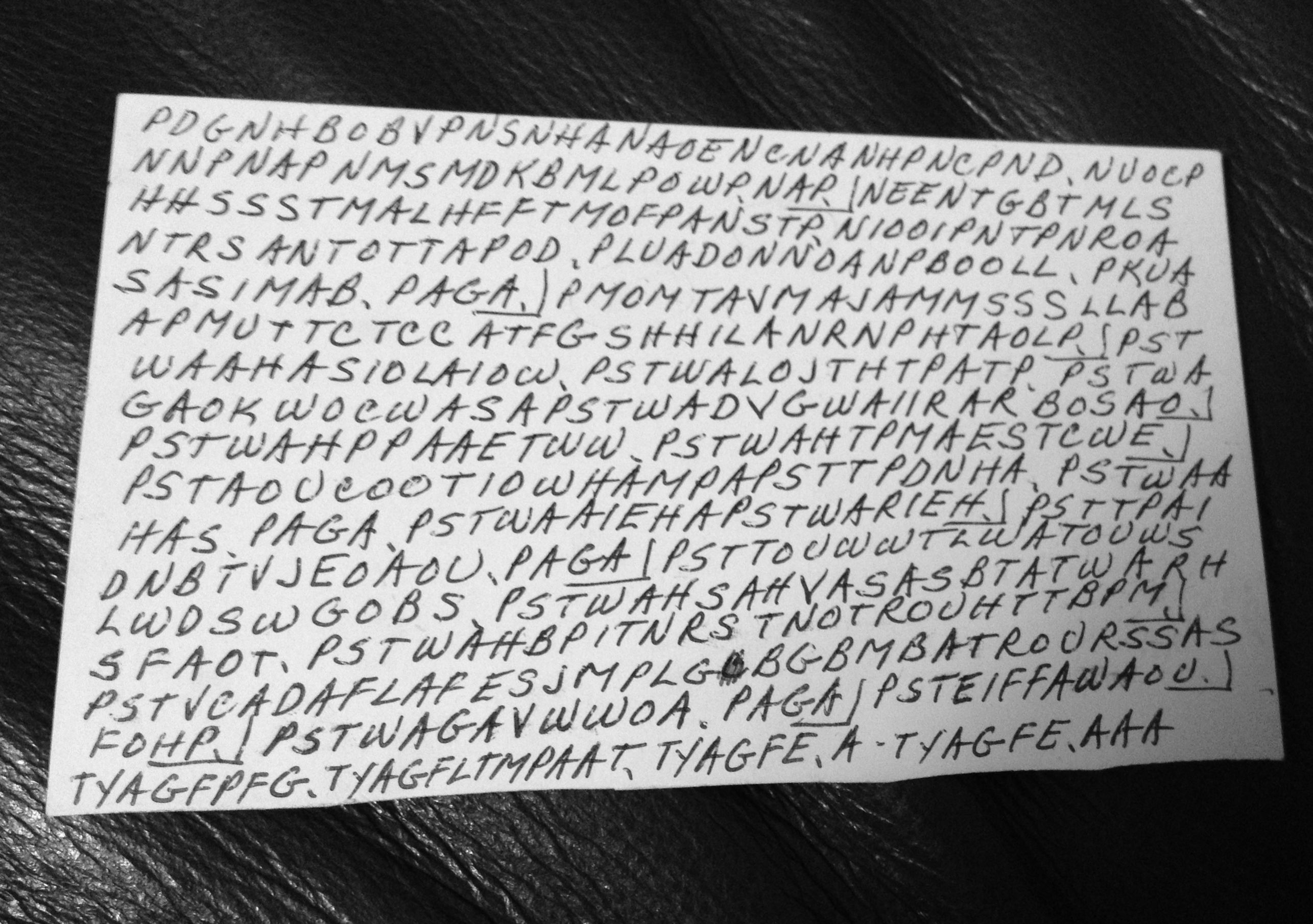
My grandmother passed away in 1996 of a fast-spreading cancer. She was non-communicative her last two weeks, but in that time, she left at least 20 index cards with scribbled letters on them. My cousins and I were between 8-10 years old at the time, and believed she was leaving us a code. We puzzled over them for a few months trying substitution ciphers, and didn’t get anywhere. My father found one of the cards the other day and I love puzzles and want to tackle the mystery again.

Mario Aguilar summarizes what happened next:

Holy moly, wouldn’t you know it? The code turned out to be last prayers of a dying woman. Each letter stood for the first letter of the word in a prayer or message to God. The back of the card [here] was the easiest to decypher, revealing the pattern. As harperpitt noted, this is almost certainly the Lord’s Prayer:

Our Father who art in Heaven, hallowed be thy name… etc etc etc

Having recognized the pattern and the prayer-like sentiment, community members started piecing together the front side of the card bit by bit. It all appears to be a series of thank yous and requests to god; things like “Please see that we are all happy and safe in our lives and work” and “thank you Almighty God for listening to my prayers and answering them.”

Casey Cep comments:

Janna Holm, in one of her final posts on the thread, said that her father suspects her grandmother had not only lost the ability to speak but was losing her memory when she wrote out the cards. Perhaps, then, the code was not to disguise her prayers but a device by which she preserved and protected them. Realizing that, Holm wrote on Tuesday, “At this point, I don’t think much more can or should be deciphered …. I’m O.K. leaving a little mystery with this one.” Would that we all could live with such mystery, and not only in prayer.

(Photo via MetaFilter user JannaK)

Being There During Bad Times

Catherine Woodiwiss offers guidance for those who want to help a friend or loved one going through trauma or suffering. Among her suggestions? “Do not offer platitudes or comparisons. Do not, do not, do not”:

“I’m so sorry you lost your son, we lost our dog last year … ” “At least it’s not as bad as … ” “You’ll be stronger when this is over.” “God works in all things for good!”

When a loved one is suffering, we want to comfort them. We offer assurances like the ones above when we don’t know what else to say. But from the inside, these often sting as clueless, careless, or just plain false. Trauma is terrible. What we need in the aftermath is a friend who can swallow her own discomfort and fear, sit beside us, and just let it be terrible for a while.

David Brooks distills (NYT) her advice to one phrase – “the art of presence” – and puts it in context:

We have a tendency, especially in an achievement-oriented culture, to want to solve problems and repair brokenness — to propose, plan, fix, interpret, explain and solve. But what seems to be needed here is the art of presence — to perform tasks without trying to control or alter the elemental situation. Allow nature to take its course. Grant the sufferers the dignity of their own process. Let them define meaning. Sit simply through moments of pain and uncomfortable darkness. Be practical, mundane, simple and direct.

Todd Brewer appreciates the advice:

Woodiwess speaks repeatedly of the “presence” of those around her – how much it helped that people were simply there. But what Brooks aptly notes is that this presence is rarely, if ever, one that is aided by the speech of the console-er. When the world goes to hell, the last thing one needs is “a word” from the pastor. A cup of soup? Absolutely! A book on “why bad things happen…’? Not so much.

For many people – especially for pastors highly trained in preaching and teaching – this is incredibly disarming. It feels like resignation or irresponsibility not to say anything to the person in the midst of trauma. At best, we want to help. But so often “help” is just another word for “control” and a defense mechanism for feeling uncomfortable with another’s grief. Perhaps some might even think that a failure to talk about Jesus is un-Christian. And so we assault the grieving with misguided theological platitudes, congratulating ourselves that we’ve done our job.

Religion’s Degree Of Difficulty

Earlier this month, Tom Ehrich, an Episcopal priest, wrote about a realization he’d had – “religion shouldn’t be this hard”:

Church should be a safe place — safe to be oneself, safe to make one’s confession, safe to love whoever one feels called to love, safe to imagine more, safe to fail. Instead, church often is a dangerous place, where people feel guarded, self-protective, hemmed in by tradition and expectation, required to obey rules. Church should be different from society. Instead, it plays by the same rules: get mine, be first, be right, punish the weak, exclude the different, reward the wealthy.

Dreher suspects that behind such rhetoric is “a standard liberal Protestant agenda.” He goes on to defend the idea that the religious life should be hard:

[A]ny authentic religion will, at times, be hard. Dying to oneself is hard, but in a Christian sense, if you’re not dying, you’re not living. The saying goes, “The Church is not a museum of saints, but a hospital for sinners.” True! But a hospital treats the sick, and helps restore them to health. It doesn’t confirm the sick in their sickness. If a man comes to church with racism in his heart, he is not helped by a church that refuses to help him confront it. If a businesswoman comes to church, feeling guilty for having cheated her clients by cutting corners, the church doesn’t make her healthy by confirming her in her okayness. Church does you no good if it confirms you in your liberal 21st century American prejudices, or your conservative 21st century American prejudices. Even though Pope Francis sometimes drives me crazy, I am grateful for how some of his pronouncements challenge even non-Catholic Christians like me to rethink my approach to life. Lust, greed, anger, lying — we are all guilty, more [or] less, of these and other sins. Every person who comes through the doors of the church — men, women, old, young, rich, poor, gay, straight, every single person — is a sinner who needs to change, to become more like God. If we are comfortable in our faith, we are doing something wrong. If it’s not hard, we’re missing the point.

If The Net Had A Saint

The Internet’s Own Boy, a documentary about Aaron Swartz, premiered at Sundance this week. Tim Wu reviews the film:

Swartz grew up in an age of total capture, meaning that there is video footage from most of his life—as a young boy climbing trees, as a precocious teen-ager sprouting facial hair, and as a scruffy young man speaking at political rallies. It is an intimate film, and by the end you feel that you know Swartz. The awareness that he will eventually take his own life makes it especially hard to watch him as a happy little boy, laughing and playing. The death is less a Hollywood drama than it is a slow-moving descent into despair, after Swartz is caught and charged, as Cory Doctorow puts it in the film, for “taking too many books out of the library.” A felony is a weighty thing for anyone, but Swartz, serious to a fault, saw conviction as a mark that would stain his life indelibly.

There is some commonality between Aaron Swartz and Christopher McCandless, who died in the Alaskan outback, the subject of Jon Krakauer’s book “Into the Wild.” Neither man could really accept the world, and both of them died young. But, unlike in McCandless’s case, the but-for cause of Swartz’s death was clear: a relentless federal prosecutor who piled on the felony charges and refused to drop them, despite the fact that the crime did no real damage, and that the database owner, JSTOR, had asked that the charges be dropped. Yes, Swartz took his own life, and he bears responsibility for that act. But, as the film shows, his prosecution was a cruel and unnecessary episode that is unworthy of a country that calls itself free.

DJ Pangburn interviewed filmmaker Brian Knappenberger about his movie:

I find it fascinating that a year after Aaron’s death, I’m still finding out about the various projects and endeavors in which he was involved. Was there one thing you learned about Aaron in the making of the film that blew you away?

There is one part in the film where we list the organizations of which he was founder or to which he contributed, and that list is crazy. It’s an enormous list. Last night at the screening, there was a woman in attendance named Taryn Simon—who I recognized from film footage—who’d done project with Aaron called Image Atlas. They decided to do key words in Google searches in countries all over the world in different languages all on one page.

You could type “beauty” and it would list all of the images that came up in Iran, China, or America, and compared the notion of beauty between different countries and cultures around the world. You can still use it by the way. There were a million things like that which Aaron was doing that pop up out of nowhere.

Datamining For Dates

When Chris McKinlay, a 35-year-old PhD student, had little luck using OKCupid, he coded a script that mined profiles of potential love interests and helped him optimize his own profile for visibility:

[H]e created two profiles, one with a photo of him rock climbing and the other of him playing guitar at a music gig. “Regardless of future plans, what’s more interesting to you right now? Sex or love?” went one question. Answer: Love, obviously. But for the younger A cluster, he followed his computer’s direction and rated the question “very important.” For the B cluster, it was “mandatory.”

When the last question was answered and ranked, he ran a search on OkCupid for women in Los Angeles sorted by match percentage. At the top: a page of women matched at 99 percent. He scrolled down … and down … and down. Ten thousand women scrolled by, from all over Los Angeles, and he was still in the 90s.

He needed one more step to get noticed. OkCupid members are notified when some­one views their pages, so he wrote a new program to visit the pages of his top-rated matches, cycling by age: a thousand 41-year-old women on Monday, another thousand 40-year-old women on Tuesday, looping back through when he reached 27-year-olds two weeks later. Women reciprocated by visiting his profiles, some 400 a day. And messages began to roll in.

Adam L. Penenberg wonders if McKinlay might have violated federal law:

After I tweeted the story one of my followers who works in computer security reminded me that McKinlay may have run afoul of one of the shabbiest laws in existence: The Computer Fraud and Abuse Act (CFAA) — the same law that Federal prosecutors used to pressure Aaron Swartz.

CFAA makes it a crime to access a computer without authorization, a catchall chunk of poorly conceived legislation that has been ripe for abuse. For example, there’s the case of Andrew “weev” Auernheimer, who, as a member of a hacker group called “Goatse Security” in June 2010, scraped AT&T’s website for the email addresses of iPad users then shared the file with Gawker to show the porousness of the telecommunication company’s security. No money changed hands. He didn’t break into AT&T’s computer network or cause any damage. He simply created an automated script to vacuum up information off a publicly available webpage. After being found guilty Auernheimer was sentenced to three and a half years in prison and forced to pay $73,000 in restitution to AT&T, which had to plug the security hole.

How Bar Brawls Begin

Burt Likko, a lawyer who did work for an insurance company “which wrote liability policies to a whole bunch of seedy bars,” relays what he learned about the topic:

You might think that a bar fight is most commonly started between two guys fighting over a woman. That’s not so, at least not in my experience. Ejection seems to be a more precipitating event. More than half the bar fights I had to sort out started when a too-drunk patron was asked to leave and refused to do so. When the bar back or the bouncer attempts to escort the drunk out of the building, the drunk refuses to cooperate, and if the escorting turns in to physical handling, the drunk will wrestle away and attempt to run back in the bar. It is during this struggle that harmful physical contact between the drunk and someone else is initiated. By whom is not always clear — does the drunk punch the bouncer; does the drunk flail at the bouncer and hit a bystander; does the bouncer hit the drunk? These are the burning questions that must be sorted out in a bar-fight lawsuit.

He also shares his thoughts on the link between bar violence and sexual frustration:

[B]ased on what I heard from dozens of witnesses, those bar fighters who initiate confrontations with other patrons (as opposed to reacting badly to being 86′ed by the staff) do so as a substitute for obtaining sexual release. Dozens of witnesses over multiple cases reported to me that the person they identified as the assailant had either recently suffered a romantic reversal or had recently stuck out when trying to hit on a member of the opposite sex.

This suggests at least some substance to the trope of a link between propensity to violence and sexual frustration — the woman (or man) with whom the drunk was flirting is already spoken for and uninterested in extra-monogamous play, typically. “I’m not very likely to get laid today, so instead I’ll fight with someone,” seems to be roughly the thought pattern here. I speculate that this means on a neuro-biological level that engaging in aggression and violent behavior produces a feeling of satisfaction, which in turn triggers a release of endorphins or other similar hormones that the fighter’s brain craves.

You Know What They Say About A Book With Big Feet …

Tracy Clark-Flory interviews Virginia Wade, whose Cum For Bigfoot e-book series has taken off:

Why do you think the “Cum for Bigfoot” series has been such a wild success?

The longer I’m in this business and reading other people’s work, I’m beginning to realize dish_bigfootporn that it’s this capture fantasy, where you kind of have this thrill about being kidnapped and ravished, but of course you would never want that to happen to you in real life. The danger of it, the dark quality to it and the taboo nature of it, I think that all appeals — and actually to mostly female readers. When I started writing erotica I thought I was writing for men.

Also, it’s campy and funny and I didn’t take it too seriously. Actually, I don’t know why any readers would read my book [laughs]. I think it’s just that it’s so out there, so out of the realm of possibility. That’s why these dinosaur erotica books are so popular and these tentacle books are so popular. The chances of you getting tempted by a tentacle are, you know, pretty slim. Why do we read books? So that we can go somewhere else for a while and experience something that will never happen to us.

Do you find your books arousing?

When I write them they do kind of arouse me. They’re so filthy, oh my god. I’ve gotten some emails and messages from people telling me that, uh, yeah, they’re enjoying my books and thanking me for a good time. …

So, what kind of a lover is Bigfoot, exactly? Tender or rough? Giving or selfish?

He’s surprisingly gentle. The women really, really enjoy everything he does to them. It starts out — I can’t call it rape because then I’ll get in trouble — it’s one of those forced seductions. It’s not really any worse than a bodice-ripper romance — although my stuff’s pretty detailed. I’d forgotten how raunchy it was until someone quoted back something I’d written and it was something to the effect of “semen dripping from eyelashes” [laughs].

Last week, Lizzie Crocker zoomed out on the trend:

[R]eally, how strange is this so-called “literary phenomenon”? Take Bram Stoker’s Dracula: through observing the Count’s gradual seduction of Lucy Westenra (and her resulting metamorphosis), we come to see that she desired him from the beginning. The lines are slightly blurrier in the original King Kong, but bold enough for critics to extrapolate a sexual subtext, so that an ape holding a blonde woman hostage atop the Empire State Building in Manhattan is an ape holding a blonde woman atop a giant phallus in Manhattan. The difference between the woman-falls-for-demon-beast storyline in fiction then and now is a matter of the implicit versus the explicit. Today, there are no limits when it comes to explicit language and content in self-published erotica.

(Image of cover of Cum For Bigfoot via Amazon)

A Novel Take On The Mind

E.L. Doctorow’s new novel Andrew’s Brain is structured as a dialogue between the main character and a man called “Doc.” Jane Smiley assesses the protagonist’s primary conflict:

Andrew’s burden is that he cannot get close to anyone, not because he is incapable, but because he seems to carry disaster with him wherever he goes. This may be simply thoughtlessness – he relates an incident from his childhood in which he was sledging at dusk down a driveway into the street; when a car stopped suddenly to avoid hitting him and hit another car parked at the kerb, the driver died, impaled on the steering wheel. More tragedies follow. Accidents? Fate? Failure of intelligence? Andrew can’t decide. Doctorow’s larger theme is one that fascinates: what is the source of evil, and, perhaps, how do evildoers experience their own actions, explain them, go on living?

Edmund Gordon offers a mixed review:

[I]n spite of its neat dimensions, Andrew’s Brain is a bit of a mess. Part rambling philosophical essay, part kittenish satire, part exuberant Nabokovian game, it ends up wholly congested and confusing. But Doctorow’s balmy prose makes it the kind of mess that it’s a genuine pleasure to wallow in for a while. He has an easy, lyrical way with scene-setting and characterization (the first time we encounter Andrew’s ex-wife Martha: “It happened to have been snowing that night, and Martha was transfixed by the soft creature-like snowflakes alighting on Andrew’s NY Yankees hat brim. Martha was like that, enrapt by peripheral things as if setting them to music”.)

He is a brilliant, careful observer of natural phenomena (of the mountains surrounding Andrew’s college town: “They took in the light, they’d bounce it down or suck it up as was their wont. It was a kind of mountain bureaucracy, and nobody could do anything about it, least of all the sun”.) And he has a poet’s flair for lovely-sounding nonsense (“There is nothing you can think of except yourself thinking. You are in the depthless dingledom of your own soul”).

In a recent interview about the book, Doctorow elaborates on his interest in the workings of the human brain:

The novel revolves around questions about the nature of the mind and consciousness. How did your study of philosophy inform your writing?

From my undergraduate days, I’ve always been interested in the major philosophical questions that don’t seem to have an answer that everyone agrees on. The idea of cognition – what it is and how it works – has preoccupied me in previous novels, as it does here. Currently the neuroscientists who accept the materiality of the mind – who regard the soul as fiction – don’t know yet how the brain becomes the mind, how it’s responsible for all our thoughts and feelings, our subjective life. How this three-pound “knitting ball”, as Andrew calls it, produces our subjective life. If we do ever figure it out, that could be a glorious intellectual achievement. At the same time, it carries grave dangers, because if we understand how the brain works in all its detail, then a computer could be built that emulates the brain and creates consciousness. This is not just Hollywood movie stuff. If that ever happens, it’s the end of the mythic world that we’ve lived in since the bronze age, with all the stories we’ve told ourselves about what human life is. That could be as much of a disaster as an asteroid hitting the planet.

Democrats For War With Iran, Ctd

President Obama Departs The White House

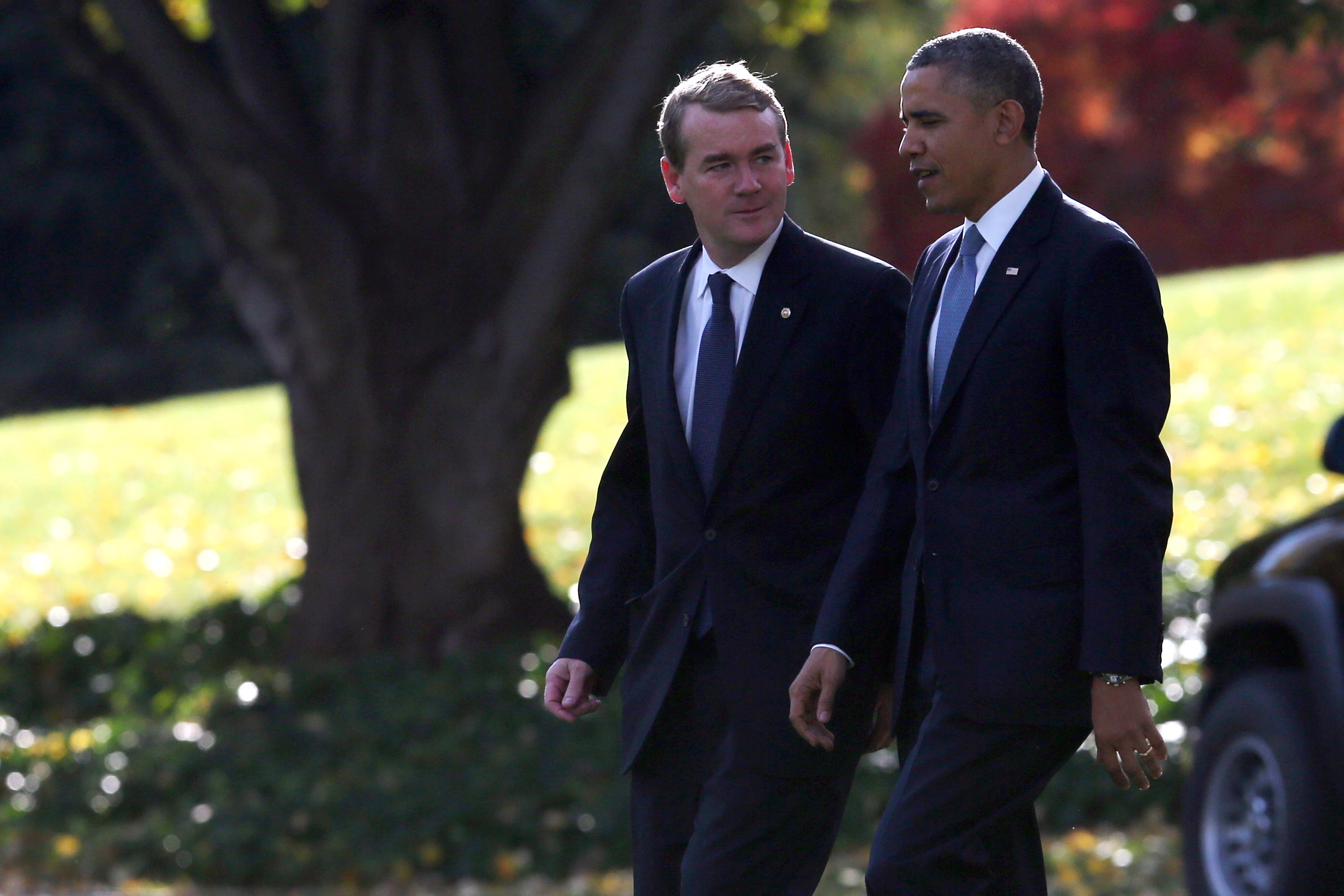
A Colorado reader emailed Senator Michael Bennet’s office to ask why he was co-sponsoring the AIPAC bill that drastically moves the goalposts on the Iran negotiations whose terms have already been set, adds a whole range of non-nuclear issues into the bargaining, includes demands that both the president of the United States and Iran have already ruled out, and commits the US in advance to joining a pre-emptive war on Iran, led by Israel. Here’s the money quote from the letter he received from Bennet’s office:

I support the ongoing negotiations and the President’s efforts to engage Iran and its people through direct diplomacy; I am also cognizant of the security risks Iran poses to our allies in the region and the international community at large. That is why I am a co-sponsor of the Nuclear Weapon Free Iran Act of 2013 (S. 1881). The bill would impose economic sanctions against Iran only if it violates any interim or final agreement that is reached with respect to its nuclear program.

S.1881 has been placed on the Legislative Calendar but is not currently under consideration on the Senate floor. I will continue to follow the negotiations closely and will keep your thoughts in mind should this legislation be brought before the full Senate.

There are three possible conclusions to be drawn from this:

a) Bennet hasn’t read the full bill he is co-sponsoring, which includes several AIPAC-inserted poison pills for any realistic negotiation with Iran; b) Bennet has read the bill, knows it’s a poison pill that could only, if passed, end all negotiations and commit the US to an Israeli war, and believes war with Iran is the right course of action; or c) is deliberately misrepresenting the scope of the bill to his constituents, privately opposes it, won’t vote to bring it to the Senate floor, and is doing all this because he is shit-scared of AIPAC, and what crossing them might do to his political future.

At best that’s cowardly; at worst, it’s craven; in its entirety, it’s pure Washington – the kind of politicking that Bennet once promised he would oppose. In other words, Bennet is just another calculating Washington pol, prepared to sabotage his own president’s negotiations and provoke another Middle East war for his own careerist reasons.

Readers are encouraged to write their Senators, especially Democratic ones undermining their own president, to ask why they support the AIPAC bill. The Dish will publish the responses. It’s one way to get some accountability on this. And to get the Democrats who favor war with Iran on the record now. Let’s give the night-flower some sunlight, shall we?

(Photo: Senator Bennet with the president whose negotiations he is threatening to sabotage. By Mark Wilson/Getty.)