Vollmann’s cross-dressing—unlike, say, the comedian and actor Eddie Izzard’s cross-dressing, or mine—is not an expression of deep identity (it is not something he has always done, nor something he always wanted to do) but something he seems to have done on a dare; having explored the mountains of Afghanistan, the red-light districts of Phnom Penh, and the polluted croplands of Calexico, Vollmann finds a new adventure in dresses and wigs. He cannot, he writes, “know what it is like to be a woman,” but he can “perform femininity for myself.” And why not? Like me, he won’t be fired, or even stigmatized, let alone physically harmed, for cross-dressing (though every year—as he must know—many people still are); like me, Vollmann works in a field where you can embarrass yourself without much professional penalty, as long as your audience still likes the language you use. There is nothing morally wrong—though nothing morally praiseworthy—in drag per se; when a man so invested in straight male desire as Vollmann tries it on, and describes how he feels with prolix honesty, the results may be creepy or charming, or both.
What’s sad here is how much he seems to have done it alone, without even trying to figure out how other cross-dressers or trans people, or their communities or their literary precursors, might help:
sometimes he talks without listening. When Vollmann is not explaining the processes by which he made Dolores into visual art, or explaining how “The Book of Dolores” interacts with the Mexican novel, he is explaining, or mansplaining, life in general: “People often get crushed to pieces between the grindstones of conflicting realities, as did the Poles during the Nazi-Soviet Pact.” Vollman has a thing for autodidacts and big thinkers: his prose here refers to Herbert Marcuse and to Gandhi, to Thoreau, to Dostoyevsky, to photographers from Man Ray to Steven Livick, but not (unless I missed it) to anybody before him who has spent any time thinking about what it means to reject the gender in which you grew up.
If you were to describe the Israel lobby as a secretive group that enforces the policies of the Israeli government on American politicians in private gatherings, you would be called an anti-Semite. The idea that the Israel lobby is secretive and underhand plays into ancient anti-Semitic tropes. If you were to say about AIPAC that “a lobby is a night flower, it thrives in the dark and dies in the sun,” you would be regarded as an anti-Semite for the same reasons. If you were to note that an AIPAC official once responded to the idea that the lobby had been weakened by pushing a napkin across a table and said “You see this napkin? In twenty-four hours, we could have the signatures of seventy senators on this napkin,” you would be called an anti-Semite. If you were to claim that AIPAC was “the most effective general interest group … across the entire planet,” you would be suspected of anti-Semitic tendencies. (The source for these varied quotes is here.)
And if you were to say that AIPAC was so powerful it could get a left-liberal mayor of New York to give a speech so fulsome in its cravenness and excess it adds whole universes of meaning to the word “pander” and also insist that it be kept secret, even to the extent of hauling a reporter out of the hall, then all bets would be off. Why, after all, should AIPAC be in any way secretive about its completely legitimate, even civic-minded, lobbying of American public officials on behalf of the interests of a foreign government? The very idea is anti-Semitic, is it not? Why should any defender of Israel want to keep his remarks private? Even if you found nothing in the speech faintly controversial, why on earth the secrecy?
And yet here we are, with the lofty, pizza-challenged mayor of New York City, right after a landslide election, caught keeping a speech to AIPAC off his public itinerary and barring any press coverage of it. Weird, innit? What would he have to hide? Well here’s an audio of the speech that AIPAC, according to De Blasio, asked him to keep top-secret:
I’m not sure if that is the entirety of the speech, but let’s just note a few things. First up:
There is a philosophical grounding to my belief in Israel and it is my belief, it is our obligation, to defend Israel, but it is also something that is elemental to being an American because there is no greater ally on earth, and that’s something we can say proudly.
“No greater ally on earth”.
Just ponder that remark for a bit. How many troops did Israel send to fight with Americans in Iraq? None. Forty other countries did, led by the UK, Australia, and Poland. How many troops did Israel send to fight with Americans in Afghanistan? None. Fifty-nine other countries helped, also led by the UK. In both cases, this “greatest ally on earth” would have been extraordinarily counter-productive if it had been involved. That’s how useful an ally the country is in confronting our common enemies. Which allied defense minister recently publicly said of an internal security plan for the West Bank, shared confidentially among allies, that it was “not worth the paper it was written on” and that “the only thing that can ‘save us’ is for John Kerry to win a Nobel Prize and leave us in peace.” Israel’s. Which allied prime minister in recent years took the extraordinary step of lecturing the American president in front of the world press in the White House itself? Israel’s. I cannot think of any allied prime minister ever thinking about doing the same.
But this preposterous bullshit is what a left-liberal mayor felt obliged to serve up. Then this:
There is no deeper connection across boundaries than this connection we share.
Not with France, the oldest ally of the US? Not with Britain, the mother-country of the US? Not with any of the other countries whose sons have spilt blood on the same battlefields as Americans? Not with those who fought and died alongside Americans on D-Day? Then the astonishing statement that “part of my job description is to be a defender of Israel.” Really? And there I was thinking he was mayor of New York City! Would someone critical, say, of Israel’s continued settlements on the West Bank be barred as unqualified to be mayor of New York City? De Blasio is not taking any chances:
City Hall will always be open to AIPAC. When you need me to stand by you in Washington or anywhere, I will answer the call and I’ll answer it happily ’cause that’s my job.
The Nation, which indulges towards another an habitual hatred, or an habitual fondness, is in some degree a slave. It is a slave to its animosity or to its affection, either of which is sufficient to lead it astray from its duty and its interest …
A passionate attachment of one Nation for another produces a variety of evils. Sympathy for the favorite Nation, facilitating the illusion of an imaginary common interest, in cases where no real common interest exists, and infusing into one the enmities of the other, betrays the former into a participation in the quarrels and wars of the latter, without adequate inducement or justification.
It leads also to concessions to the favorite Nation of privileges denied to others, which is apt doubly to injure the Nation making the concessions; by unnecessarily parting with what ought to have been retained; and by exciting jealousy, ill-will, and a disposition to retaliate, in the parties from whom equal privileges are withheld. And it gives to ambitious, corrupted, or deluded citizens, (who devote themselves to the favorite nation,) facility to betray or sacrifice the interests of their own country, without odium, sometimes even with popularity; gilding, with the appearances of a virtuous sense of obligation, a commendable deference for public opinion, or a laudable zeal for public good, the base or foolish compliances of ambition, corruption, or infatuation.”
Pulitzer prize-winning photographer Narciso Contreras has confessed to doctoring one of the photos he took in Syria for the Associated Press:
When it comes to major Photoshop alterations, serious news organizations have a zero-tolerance policy, as AP freelance photographer Narciso Contreras recently discovered. After admitting that he had cloned out a piece of a Syrian conflict image, the news agency was forced to ‘sever ties’ with the Pulitzer Prize winner. The photo in question was taken in September of last year, and shows a Syrian opposition fighter taking cover during a firefight with government forces. In the original, a colleague’s camera can be seen in the bottom left corner of the image, a camera that Contreras decided to clone out before sending the picture in.
The AP flipped its shit; not only did the agency fire Contreras, it removed the entire library of his work from its public record. Yannick LeJacq questions whether that was the right call:
This final point about removing Contreras’s work from the visible archive of the AP’s history is particularly compelling. The AP, it seems, acted so swiftly and harshly because it has a reputation to uphold. It’s not only “the definitive source,” by its own description, but also “the world’s most trusted news organization.” And to its credit, the AP acted with commendable transparency by openly reporting on its own snafu.
But still: did it have to strike all of his work from the public record?
Roger Tooth, the Guardian’s head of photography, explains why the zero-tolerance policy matters:
Sacking someone, albeit a freelance, seems very draconian. It was a first offence after all – AP has carefully checked all Contreras’s 494 other photographs on their archive. A warning would have been more suitable, surely? Except that the major wire agencies and their clients rely on their images being totally authentic; that’s why news organisations like the Guardian spend many thousand of pounds each year on their contracts. In a news environment it’s all about a chain of trust: from the photographers through to the agencies, newspapers and websites, and then to the readers. If that chain is broken, any picture could be suspect, and that can’t be allowed to happen.
Adam Weinstein points out that other forms of manipulation, sometimes more egregious, are just fine with the AP and other news agencies:
Most news agencies have no interest in a photograph whose truth is messier, whose truth doesn’t hit a special emotional chord in our cockles. Crop it? Sure. Lighten it? Yeah, just a bit. Use this mid-action frame, and not the dozen before or after it? Yep. Add a caption to tell viewers exactly what they should get out of the image? Of course.
But good God, don’t Photoshop anything out! It’s laudable that the AP’s standard pays lip service to “truth and accuracy.” By its standards, Contreras absolutely made an unpardonable sin. But the “objective” news industry’s pretense to sinlessness is just as unpardonable.
James Estrin notes that this “type of ethical lapse happens with alarming frequency despite the clarity of the rules and the severe consequences that have befallen transgressors”:
In one of the most notorious cases, Brian Walski of The Los Angeles Timeswas fired in 2003 for combining elements of two images into one composite. Adnan Hajj, a freelance photographer working for Reuters was let go in 2006 after doctoring smoke in an image of an Israeli airstrike in Beirut. But unlike previous occurrences in which the violation was discovered by readers, bloggers or other photographers, this week’s case had a twist: Mr. Contreras — facing a moral dilemma and knowing the consequences — turned himself in.
I saw the study you highlighted pop up across the Internet (including on Facebook, how meta!) a few days ago and I’m glad you brought some of the criticism to light. One that I have not seen pertains to a critical assumption. The model seems to fit the data pretty well, which is “Facebook” searches on Google. But then the authors make the assumption that searches on Google are a proxy for usage of the actual Facebook website. I’m no expert, but that seems like a strong assumption to make without knowing for sure if there is a good correlation. How many people actually access Facebook by typing it into Google instead of directly putting in the web address? Seems to me that Google searches are a better proxy for interest in news about Facebook the company. I’m no fan of Facebook and quite honestly I’d like to believe the predictions, but I’d like to know more from people who are in the field (any readers out there?) before believing the hype.
Another is on the same page:
I use Facebook daily. I haven’t googled it in years.
Another goes deeper:
To answer the question succinctly, “No” – and the reason is because of something that most people predicting its demise tend to miss: that being on Facebook is an interconnected experience; since it’s where your friends are, there are huge disincentives to leaving. Sure, I can go decide I’m going to “switch” to Google+, but if my friends aren’t there, what kind of experience am I going to have? This is not like trading in your AOL email account for Gmail, or switching Web browsers.
True, Facebook’s precursor, Myspace, did die, but keep in mind that at its peak, Myspace had 125 million users; Facebook is over one billion. That creates exponentially more interconnectedness.
Yes, some young people seem to be leaving the platform. They are the ones with the time and the inclination to make the switch, and don’t have the deep layers of friendship that an adult does, from childhood friends to college roommates to former co-workers. The real struggle for Facebook going forward is that it – and its stockholders – may have to get used to skewing older, because most of us probably aren’t going to leave.
One more:
Facebook itself has published a refutation to the study. They also show that using the same methodology as the Princeton researchers, that Princeton University is on the way out.
Reacting to the news that Bill Cosby is developing a new family sitcom for NBC, Poniewozik invokes Michael J. Fox, another former star the network recently tried to revive:
NBC’s reasons for wanting Cosby back are evident. The question will be: why does Cosby want to go back to NBC? The problem with The Michael J. Fox Show wasn’t Fox, who was and remains a gifted performer. It’s that he was in a tepid, generic show that seemed to have no idea behind it but, “Michael J. Fox, back on your TV again!” Despite a lot of talent, The Michael J. Fox Show almost seemed to go out of its way to be as unmemorable as possible, leaving it little selling point beyond the audience’s memories of Family Ties.
Likewise, Cosby was a famous name even when he brought The Cosby Show to primetime (with the same producers he’ll be working with now). But that wasn’t what made it great TV. It was that he had distinctive ideas about how to shake up the way families in general, and African American families in particular, were portrayed on TV, and he created memorable characters to express those ideas.
Willa Paskin is glad Cosby is coming back to TV, noting the decline of the black family sitcom since the ’90s:
Twenty-two years after he left television, Bill Cosby remains one of the few people who can get a black family show on a network again.
This is particularly mind-boggling given that the influence of The Cosby Show is all over television. Cliff and Clair Huxtable were exemplars of the now nearly ubiquitous TV-parenting technique that combines equal parts love and aggravation, and, when practiced at the high-level of Cliff and Clair, consists of very responsibly and reliably laughing at your children in instructive ways. No parent on any show from Modern Family to Mom does anything without Cliff and Clair hovering in the background, doing it a little better.
And Cosby’s recent stand-up material suggests that he is now positioned to be just as funny as a grandfather as he was as a dad. He seems to have been buffing the character of the slightly-doddering, cutting-in-flashes, exasperating and exasperated husband and grandpa for quite some time.
Alyssa wonders why Cosby has to star in the show himself:
He’s 76, so is he going to play a grandfather whose primary role in the show, as Cosby’s has been in the real world of late, to tell parents who are in the process of raising their own children either that they’re doing it wrong, or how to do it better? Maybe that will work. And maybe Cosby will give a huge lift to the younger African-American actors who end up in his orbit, which I think would be the most important potential outcome of Cosby’s return to television.
But why is putting Cosby at the center of a show, rather even than having him create a show that stars other actors, the best option? … Because the number of black male characters on television are so limited, and even more so black men who have families, bringing Cosby underscores a depressing self-fulfilling assumption in Hollywood: that there are only a very small number of black actors that audiences will resonate to.
Since we’re on to the topic of “marijuana as a gateway drug”, I’d like to bring up an argument I almost never hear, and have no idea why: Isn’t it possible that marijuana acts as a gateway drug for some people because they buy those other drugs from the same guy? I’m sure a lot of people have gotten the Amazon-sales pitch from their pot dealer (“If you like marijuana, you might also enjoy … “). I have never been tempted, but if I wanted to try cocaine or mushrooms, etc., I would probably just ask the guy I buy pot from. My guess is that legalizing marijuana and putting it in pharmacies would limit people’s access to harder drugs for this very reason.
Another opens up about his addiction:
The main reason I would give for being “ashamed” about 20 years of smoking marijuana almost daily and eventually entering rehab is not what you might think.
It’s not that it destroyed my marriage, curtailed my career, and repeatedly saw me leave my small children at home sleeping alone while I was out replenishing my supply. Even though my habit had me do all of these things, plus steal amounts from friends, withdraw socially and thankfully only almost cause several car wrecks, by far the most embarrassing thing about being a marijuana addict has been having to tell people that my addiction was “only” marijuana.
Despite a growing acceptance in Alcoholics Anonymous of those whose substance abuse was not primarily alcohol, I would get pushback from some members when I’d tell them I only used to get drunk when I ran out of pot. I tried meetings at Narcotics Anonymous, and the junkies and meth heads literally laughed when I’d introduce myself as a drug addict and later reveal my details. Unlike the “tragedy” of other addictions, mine was received more like a story about locking my keys in the car.
I am in favor of legalization. I only hope that as marijuana’s acceptance grows, the truth becomes more well-known that while it may be less harmful than many other intoxicants, it is far from harmless, its aura of benign innocence is misleading, and its damage can be as deep as its more sinister siblings.
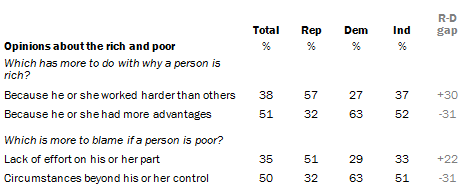
A Pew poll found that it’s popular to raise taxes on the rich to expand the safety net. Sargent takes a closer look:
The key here is that the question does not ask whether we should raise taxes on the rich to pay down the deficit, as many other polls do. Respondents are asked if we should raise taxes on the rich to expand the safety net as a way to reduce poverty, and a majority says Yes — far more than saying the best way to help the poor is by cutting taxes on the job creators. Independents agree with this by 51-36. Only Republicans favor lowering taxes on the job creators over taxing the rich to expand programs for the poor, by 59-29.
The danger for liberals to keep in mind is that voters are less persuaded that the government can do something useful to reduce inequality than they are that the government should do something useful.
People are accustomed to the idea of a mass public that’s “ideologically conservative and operationally liberal”; in other words one that hates “big government” but loves programs such as Medicare and Social Security. On inequality you could see the reverse happen, where people favor bold action to tackle inequality but are skeptical that specific programmatic ideas are workable or will be implemented correctly.
Emily Badger focuses on what the poll had to say about the causes of wealth and poverty:
The belief that people are poor more through their own lack of effort than their circumstances is widely held by large segments of the population, including 51 percent of Republicans, and 46 percent of people in the highest income group (which is not that high). If you fall into this category, then it clearly doesn’t make sense for society to try to solve a problem that it had little hand in creating.
This difference is important, although the survey question itself feels unsatisfying. I’d love to see a survey that gets much more specific about what those circumstances might be: If a child born into poverty remains poor as an adult, how much do you believe failing schools, neighborhood crime, and poor job access contributed to that outcome? I wonder if the answer would change for some people if the concept of “circumstances” weren’t quite so abstract, if it weren’t posed simply as the alternative to personal responsibility. Surely Obama is choosing his words very carefully right now.
Referring to the toll of the Syrian refugee crisis, Kori Schake argues that “the ally of America in the greatest need at the moment is Jordan”:
The United States is the largest international donor to Syrian refugee efforts. But a much larger and more diversified inflow of aid to Jordan is urgently needed and long overdue. The United Nations provisionally estimates that the cost to Jordan of hosting Syrian refugees will be $3.2 billion in 2014. The United States needn’t be the provider of that aid, but drumming it up from others is something it can and should do.
And here is where the Obama administration could perhaps make a virtue out of the catastrophe that is its Middle East policy, harnessing the newfound willingness of unlikely partners in the region to productive effect. The U.S. government should develop a strategy for raising not just that $3.2 billion but also providing political, economic, and other assistance to the government of Jordan, webbing it into regional cooperation made possible by allies worried about U.S. policies. The approach should expand from the refugees themselves to also having lines of operations for affecting Jordan’s own people and also supporting the government of Jordan.
It should increase trilateral U.S.-Israeli-Jordanian efforts on water sharing and security, folding other regional allies in to fund and share Jordan’s burdens. Jordan should also be given a starring role in Palestinian peace talks, both to reward its support for Israel but also to help in managing its domestic Palestinian population — if a peace deal is reached, Jordan will be a major beneficiary.
(Photo: An aerial view shows the Zaatari refugee camp near the Jordanian city of Mafraq, some 8 kilometers from the Jordanian-Syrian border, on July 18, 2013. The northern Jordanian Zaatari refugee camp is home to 115,000 Syrians. By Manel Ngan/AFP)
Jonathan Bernstein listens to what Republican candidates for governor in states that expanded Medicaid are saying about it:
Nada. Zip. Nothing. None of these Republicans is pledging to repeal the Medicaid expansion put in place by a Democratic governor. Indeed, most of them don’t mention Obamacare at all, and only one even mentioned health care. I’m sure that most — if they want to win a Republican nomination! — would support Obamacare repeal, if asked. But that’s different from making repeal an actual priority.
He thinks this supports the view that “where it’s in place, Medicaid expansion is here to stay.” Sargent believes the expansion could benefit Democrats in red states:
The Medicaid expansion, as an issue, is kind of taking on a life of its own, independent of Big Bad Obamacare. In Louisiana, Senator Mary Landrieu has aggressively criticized the rollout of the law, but has also attacked Republicans for refusing to implement the Medicaid expansion. In Georgia, Dem Senate candidate Michelle Nunn has called for fixes to the law while also saying the state should expand Medicaid, which 57 percent of Georgia voters support, according to a recent poll. Democrats are attacking GOP governors over it, too, particularly in the bid to oust Florida Governor Rick Scott.
Pushing for Medicaid expansion in the holdout states could turn out to be a solid populist issue for Democrats this year. The argument is simple: It’s free medical care and it doesn’t cost the state anything. Who’s against that? We’ll find out later this how well that argument works.
“According to the medical records we have been provided, the fetus is distinctly abnormal,” the attorneys [for the Munoz’s husband] said. “Even at this early stage, the lower extremities are deformed to the extent that the gender cannot be determined.” The attorneys said the fetus also has fluid building up inside the skull and possibly has a heart problem.
Emily Bazelon pleads for the state of Texas to respect her and her husband’s wishes:
“The uncertainties about the pregnancy—damaged fetus, almost no cases of trying to bring a 14-week-old to term in this circumstance, what he the dad is able to cope with, his dead wife’s wishes about wanting to have a child if she cannot parent, the massive costs involved and the impact of a tragic outcome on his other child—they point clearly in the direction of who should be making the decisions and who should have been making them all along. Not the hospital, not the legislature, not pro-life or pro-choicers—the husband.”
Toobin takes a look at how anti-abortion ideology feeds into this tragedy and that of brain-dead California teenager Jahi McMath:
McMath’s family has no apparent politics; they are simply grieving. But their cause has been taken up by the anti-abortion movement, especially those members of Terri Schiavo’s family who sought to keep feeding her years after her brain activity ceased. As in the Schiavo case, the effort is to expand, or at least confuse, the definition of “life.” Brain death, though defined slightly differently throughout the country, has been accepted as actual and legal death for decades. There is no controversy about McMath’s status; the doctors and the coroner agree. Dr. Heidi Flori, a critical-care physician at the hospital, said in a declaration, “Mechanical support and other measures taken to maintain an illusion of life where none exists cannot maintain that illusion indefinitely.”


 The Dish