
America’s Recovery Is In Full Swing

0d1805c459724f83b12bdb956c441036_623x512

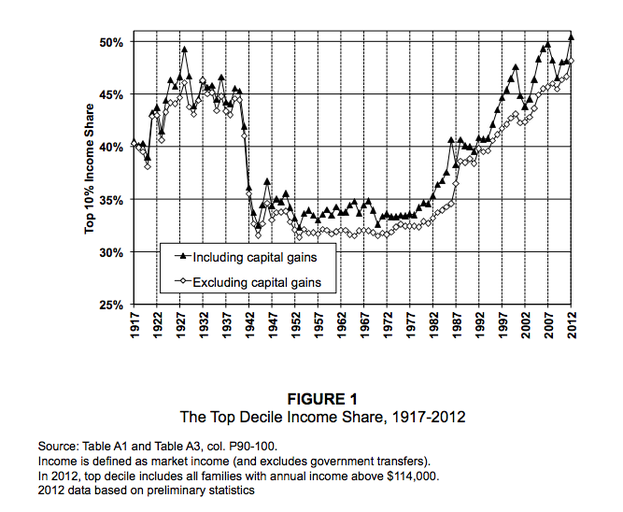
If you’re rich. According to a new annual report, the top 10 percent of earners took in over half of the nation’s total income in 2012, while the top 1 percent collected one-fifth of all income:

The income share of the top 1 percent of earners in 2012 returned to the same level as before both the Great Recession and the Great Depression: just above 20 percent, jumping to about 22.5 percent in 2012 from 19.7 percent in 2011. That increase is probably in part due to one-time factors. Congress made a last-minute deal to avoid the expiration of all of the Bush-era tax cuts in January. That deal included a number of tax increases on wealthy Americans, including bumping up levies on investment income. Seeing the tax changes coming, many companies gave large dividends and investors cashed out. …

Allie Jones points out that this is a record gain for the upper income bracket, edging out the Roaring Twenties:

You can see that in 2012, top 10 percent income share creeps above 50 percent for the first time … Senior Brookings Institution fellow Justin Wolfers notes from the study that in the years since the crash (2009-2012), the average income of the top one percent has risen 31.4 percent, while the average income of the other 99 percent has risen only 0.4 percent.

Drum anticipates a counterpoint:

Now, I imagine that apologists for the rich are going to point out that their recent winnings still don’t make up for their losses during the Great Recession. And that’s true. … [S]ince the 2007 peak the rich have suffered an average income loss of 16.3 percent. The rest of us have done better: our incomes are down only 11.2 percent.

But this is meaningless. For starters, an 11.2 percent drop for someone making 15 bucks an hour is a helluva lot more painful than a 16.3 percent drop for a millionaire.

The Difficulty Of Destroying Chemical Weapons

Keating underscores it:

Both Russia and the United States have more than 20 years of technical experience in chemical weapons destruction, but as I noted yesterday, both countries’ efforts to destroy their Cold War-era stockpiles have been years behind schedule. Sometimes these delays are political—public protests in the United States prompted a shift from incineration to chemical treatments at several U.S. facilities—but often they’re due to the understandable technical challenges of disassembling some of the deadliest weapons ever created.

Mark Thompson goes into detail on US efforts to dispose of its own CW stockpiles:

It has taken the Pentagon far longer (the original completion date was 1994), and cost far more money (the original estimate was between $1 billion and $3 billion), to destroy its chemical weapons.

To date, the U.S. has destroyed, primarily by burning, 89.75% of the arsenal at seven of those nine [chemical weapons] sites: Johnston Island in the Pacific; Anniston, Ala.; Pine Bluff, Ark.; Aberdeen, Md.; Umatilla, Ore.; Newport, Tenn.; and Tooele, Utah. The remaining 10% is slated to be neutralized using new techniques. Current plans call for the 8% of the original stockpile remaining at Pueblo, Colo., to be rendered safe using a biotechnological process by 2019, while the 2% at the Blue Grass, Ky., is scheduled to be to be neutralized using what the Pentagon calls “super-critical water oxidation” by 2023.

Yochi Dreazen looks at how hard destroying CWs has been in Libya:

[Cheryl Rofer, who supervised a team responsible for destroying chemical warfare agents at the Los Alamos National Laboratory,] noted that Syria has far more chemical weapons than Libya, so getting rid of them could take even longer. “I wouldn’t be surprised to see this last as long as ten years,” she said.

If the U.S. and Syria came to a deal — a very, very big if — there would still be one major wrinkle. Rofer said that the only two organizations who really know how to get rid of chemical weapons are the Russia and American militaries. Given the amount of time it would take to build and then operate the disposal facilities, those specially-trained troops would need to stay in Syria for years. In a war-weary U.S., keeping that many boots on the ground for that long would be an extremely hard sell.

Larison agrees:

When we consider how adamant most Americans and even most members of Congress have been that the U.S. avoid sending ground forces into Syria, it is obviously a non-starter in Congress and with the public to suggest that American soldiers be sent into Syria for years as part of a weapons disposal effort. Such a scenario disturbingly echoes the mistakes of the Lebanon and Somalia missions. Then again, why would the Syrian government accept American soldiers on its territory for any reason? Considering how ineptly the administration has justified its proposed attack on Syria, I don’t see how they could possibly persuade Congress or the public to support what would prove to be a much longer, more significant commitment than the “unbelievably small” attack they had been advocating earlier.

Sentenced To Live In A Shipping Container

Screen Shot 2013-09-10 at 2.27.52 PM

Feargus O’Sullivan shares some unsettling urban-planning news from the Netherlands:

Following a long period of trouble with the police and neighbors, the city recently evicted the Dimitrov family from Amsterdam’s Noord district and sent them to basic accommodation on Zeeburger Island, a predominantly ex-industrial port zone in the area where the city meets the Ijmeer Lake. Housed in converted shipping containers monitored by a heavy police presence, the idea behind the move is that the family will bother their neighbors less if they don’t have any neighbors to bother.

The plan is part of a controversial, long-threatened scheme to create far-flung, socially isolated communities for the “antisocial,” approvingly dubbed “scum villages” by rightist politician Geert Wilders, who suggested the best way to deal with disruptive citizens would be for the authorities to “put all the trash together.” … It’s a policy that has some previous form in the Netherlands, where in the 19th century officially designated problem families were resettled in what were then considered distant, sandy wastes near the German border.

The family, which is of Roma descent, is not pleased:

The eight members of the Gipsy family have compared their container homes, numbers 48a and 48b, to a concentration camp and accused Amsterdam council of “pure racism.” Francois Lonis, ex-partner of one of the Dimitrov daughters who still lives with the family, criticized [Amsterdam mayor Eberhard] van der Laan for commemorating the Holocaust while “discriminating” against Roma. “The mayor talks a lot about Auschwitz but sends us to this place. Where is my mother-in-law supposed to do the shopping?” Mr Lonis told Parool.

(Image: The family moving into the shipping-container house, taken from a Dutch news report seen here)

What Does The Russian Solution Solve?

Keating pushes back on the idea that the Russian solution is actually a solution. He claims that “the United States will almost certainly be drawn in again”:

Putting aside the potential difficulty of verifying Syrian compliance with the plan and rounding up dangerous chemicals in the middle of a war zone, how is the credibility of the United States, its allies, and the United Nations—considered so important to maintain in the run-up to a possible airstrike—going to be tested if we’re actively turning a blind eye to atrocities committed with conventional weapons while an ongoing international effort, which would presumably require some international “boots on the ground,” is underway to take away the weapons responsible for fewer than 1 percent of the casualties in this war?

Ambers was unimpressed with how the Russian deal came about:

Recognizing the perceived and actual limits of U.S. power, hard and soft, Obama has always wanted regional powers to take more responsibility for moral calamities in their area of influence. With Syria, I think he made a mistake. It is in many ways the perfect test case for this new form of interest-balancing. Instead, Obama fell back upon old arguments. … It’s kind of embarrassing, and politically, probably terribly damaging, for the Obama administration to have fallen back and blundered into the solution its actual foreign policy would have recommended, but it may hasten the discussions that lead to the beginning of the end of the Syrian crisis. The U.S. will have to lead not from behind, but from somewhere way outside of the negotiating room.

And Juan Cole argues that the Russian proposal makes a political solution in Syria more likely:

Without a US or Western bombing campaign, the Syrian regime is likely just strong enough to hold on for years. The rebels’ advance of last spring has stalled and in some places been reversed. Some sort of negotiation now seems likely. While in my view the two sides are not yet desperate or exhausted enough to make that sort of agreement the Lebanese acquiesced in at Taif in 1989, they may be able to take small steps toward that eventual outcome, which increasingly seems the most plausible one.

Reexamining The Murder Of Matthew Shepard

Stephen Jimenez’s upcoming book, The Book Of Matt: Hidden Truths About the Murder of Matthew Shepard, is the result of more than a decade of research into the truth behind Shepard’s brutal 1998 murder in Laramie, Wyoming. We recently had the opportunity to sit down with Steve and discuss his book. In our first video, he explains how he first became involved with the story and why he thinks it’s taken so long for the truth to come out:

This embed is invalid


Here’s what Kirkus had to say about The Book Of Matt, which comes out September 24 (pre-order here):

An award-winning journalist uncovers the suppressed story behind the death of Matthew Shepard, the gay University of Wyoming student whose 1998 murder rocked the nation. Jimenez was a media “Johnny-come-lately” when he arrived in Laramie in 2000 to begin work on the Shepard story. His fascination with the intricate web of secrets surrounding Shepard’s murder and eventual elevation to the status of homosexual martyr developed into a 13-year investigative obsession. The tragedy was “enshrined…as passion play and folktale, but hardly ever for the truth of what it was”: the story of a troubled young man who had died because he had been involved with Laramie’s drug underworld rather than because he was gay.

Drawing on both in-depth research and exhaustive interviews with more than 100 individuals around the United States, Jimenez meticulously re-examines both old and new information about the murder and those involved with it. Everyone had something to hide. For Aaron McKinney, one of the two men convicted of Shepard’s murder, it was the fact that he was Shepard’s part-time bisexual lover and fellow drug dealer. For Shepard, it was that he was an HIV-positive substance abuser with a fondness for crystal meth and history of sexual trauma. Even the city of Laramie had its share of dark secrets that included murky entanglements involving law enforcement officials and the Laramie drug world.

So when McKinney and his accomplices claimed that it had been unwanted sexual advances that had driven him to brutalize Shepard, investigators, journalists and even lawyers involved in the murder trial seized upon the story as an example of hate crime at its most heinous. As Jimenez deconstructs an event that has since passed into the realm of mythology, he humanizes it. The result is a book that is fearless, frank and compelling. Investigative journalism at its relentless and compassionate best.

Our full Ask Anything archive is here.

Another Meep-Meep Moment?

Screen Shot 2013-09-11 at 4.47.16 AM

A reader writes:

You and Charles Pierce both seem to have done a 180 on the Syria question, and neither of you seems to have explicitly admitted it.  You’ve gone from slamming Obama for being imperial, idealistic, bloodthirsty, foolhardy – and God knows what else – to praising him for his subtlety, nuance, willingness to listen, and so on. Which, fine. But maybe somewhere along the way, you could just throw in a bit of an acknowledgment along the lines of: “Oops, I jumped the gun on this one; I overreacted, got hysterical, and now I see the President doing his characteristic thing – seeing the big picture when others did not.”

I don’t think I’ve done a 180. I remain opposed to any military intervention that could be seen as a way to alter the outcome of the Syrian civil war. I remain of the belief that the Congress should have the final say on any war, large or unbelievably small. Where I have shifted – and this may be a function of being off-grid when this atrocity occurred – is a greater awareness of and concern about the breach of the international norm with respect to chemical weapons. I have acknowledged this shift – here. Money quote:

I have to say I found myself shifting a little – not a lot, but a little – after reading the transcript of the president’s press conference at the end of the G20 Summit.

A better grasp and appreciation of the entire history in this area also affected me. And as this has all shaken out, I see a way to reconcile all these apparently conflicting goals in Russia’s and Syria’s public acknowledgment of the chemical weapons stash and apparent willingness to sign up to the Chemical Weapon Convention. This may turn out to be illusory, or too difficult to accomplish, or some kind of ruse to keep Assad in power for a while longer, but no president would turn such an offer down. If only such an offer had been possible in Iraq in 2003. Another reader wonders if we are “finally hearing the meep meep”:

I’m so glad you have calmed down about Obama on Syria. He is on the verge of accomplishing, without firing a shot, what Bush launched an invasion to do.  Congress is going to get him out of bombing Syria, and yet Obama is going to be able to point to the Republicans and call them the ones who blinked as a dictator massacred his people.  He is re-establishing the precedent that going to war requires congressional approval. He will have enhanced internationalism.

Republicans are loving this right now because they think Obama looks incompetent. They are blindly stumbling into an outcome that gives Obama everything he has ever said he wants, ever. And they’re not going to realize it until it’s too late. It’s such a perfect outcome, how could this have not been planned? Is Obama on the verge of pulling off the greatest rope-a-dope in the history of US politics?

Another isn’t buying it:

Your reaction to Obama’s address last night sounds suspiciously like you’re getting ready to declare another “meep, meep!” victory for Obama’s long-view, chess playing strategy:

Will Assad be more likely to surrender his chemical weapons if the US attacks or if Russia insists on their destruction? Please. It isn’t close.

As if Obama planned on this all along!  Putin may very well have just pulled Obama’s chestnuts out of the fire, while saving Assad and further ensconcing Russia as Syria’s and Iran’s protector (assuming, of course, that Syria indeed does hand over those weapons and this transfer can be verified). So Russia might have just saved Obama from himself. His policy and performance in regard to Syria has been jaw-droppingly amateurish, beginning with his drawing of “red lines” a year ago that he had no will to enforce, and the absurdly thin arguments he has advanced for military action, contradictory goals, general incoherence and flailing of these past weeks.

Even if this all works out in the end, this has not been Obama’s finest hour. Even admirers of Obama like myself must admit this. He was more than willing to get us into another stupid fucking war until the American people rejected it and the Russians intervened.

Has it occurred to my reader that it was necessary to actually risk another war to get the diplomatic solution we now have? Obama had to make that proposal credible and serious for it to work. Yes, it was a huge risk. Yes, it places a premium on restricting WMDs that may be too ambitious. But it may have paid off. And in the end, a president needs to be judged on results, not news cycles. And those alleging incoherence have not acknowledged that diplomacy – always Obama’s first preference with respect to Syria – sometimes requires a deadly serious intent to do something you don’t really want to do. It requires some level of nerve-wracking bluff. Bluff is not incoherence, although it sure can be risky. And a president who can live with that risk is a president with some cast-iron balls. And that’s why the view that this has revealed weakness in Obama seems completely wrong to me. It has revealed steel.

And you don’t have to argue that Obama is some kind of Jedi warrior who saw all this from the start (a silly idea) to see that he was able to pivot, shift, test, improvise and flush out new options in a horrible situation as the crisis careened from one moment to another. This is what leadership can be – and you saw a very similar set of patterns in Eisenhower’s administration, and even, as Michael Dobbs noted today, in John F Kennedy’s haphazard, contradictory, and risky maneuvers in the Cuba missile crisis. Eisenhower was ridiculed, and regarded as an idiot from day to day in Washington. Can you imagine what the neocons today would say if a president cut off a war as Eisenhower did in Korea? He’d be Carterized immediately. And Eisenhower was indeed regarded as out of his depth by the hard right, if not an active Communist appeaser. But he endures as one of the greatest foreign policy presidents of the last century.

Another reader ladles on the scorn:

Assad and the Russians have no intention of agreeing in a meaningful and substantive way to giving up all these weapons and allowing a verifiable implementation of any agreement.  They are going to make us a laughing stock by delay, denial, and obfuscation.  On the other hand, it does give President Obama a little face-saving in the short run from the big mess he let himself get into. There are no good alternatives in this morass, but I think this might be the least worst alternative.

But again: why is the US on the hook for this? Russia has said this is what it wants; so, staggeringly, has Syria. They are the ones now on the hook. And the key objective is to stop future chemical attacks by Assad and to minimize the dangers of those weapons being dispersed or in the hands of Sunni Jihadist terrorists. Isn’t that far more likely now than, say, a week ago? Mission advanced. Another pivots back to domestic politics:

I hope that Assad can be made to back down. But in a way, the best thing that could happen at home would be for the Republicans to vote down the use of power.

It would inoculate Democrats for a generation against going to war: “The Republicans voted against punishing Syria, which was a threat to Israel, why should we support this next war?” Who would have predicted that in a long interview on NPR, Republican Tom Cole would have said that Assad’s use of chemical weapons did not result in any direct security threat to America or its allies.  Democrats will be able to play back that interview for years: “Syria, Israel’s most hostile neighbor, deployed chemical weapons and the Republicans voted against any use of force.” Meep meep?

Another adds:

Seems to me that AIPAC and the Israeli government are still pushing for a strike, latest developments be damned. If, as it appears likely, the US Congress either votes down the authorization to strike, or doesn’t bring it to a vote, it’d be the first Congressional rebuke of AIPAC that I can remember. Does your crack staff know the last time that happened?

Another awesome development. Another reader references Kerry’s historic gaffe:

Just a funny thought: remember another time that an Obama surrogate went out in public and accidentally blurted out a major shift in policy that immediately set in motion a process no one expected would start, and is at this point now a reality? Marriage equality?

Another points to another major achievement that many, including me, thought would never come:

I’m with you on Syria. I don’t think Obama gives two shits how he gets there; he’s just concerned with the final destination.  Does anyone remember all the ups and downs and sausage-making over the ACA? Nope. They just know it’s Obamacare.

The way I see it, we have a president confident enough and secure enough in his authority to let others take the credit, to let the Russians lead.  Because in the end, who cares how we get there? What matters is that the weapons are gone.

But of course the Washington class will frame this as a huge loss for the president, because.  Can you imagine George W. Bush or Dick Cheney taking this route?  Not a chance.  They would’ve bombed the shit out of Syria just to show they could.

The current solution doesn’t have the drama of dropping bombs or sending sorties over Damascus, so Obama comes off as a bit of a dull president.  And in this case, that’s fantastic, because he’s getting shit done.  He always does.

Meep meep.
The Rise Of The Tech Villain?

Noreen Malone wonders if Silicon Valley is inheriting Wall Street’s image of flagrant wealth:

Tech world conspicuous consumption isn’t quite the same as Wall Street conspicuous consumption. A Silicon Valley executive isn’t likely to spend his cash on bottle service and a Porsche; a trip up Kilimanjaro and a Tesla is far more the norm. Slate’s Farhad Manjoo, who lives in San Francisco and is hardly a kneejerk critic of wealth, told me he plays a little game with himself where he counts the number of Teslas he sees in any given day. It used to be one a day, now it’s up to five or ten. That kind of lifestyle is certainly expensive (Teslas start at $62,000 or so, without any of the add-ons), but there’s also an element of virtuousness to it—which to some can be more grating than the unapologetic materialism of a stereotypical banker: I spend a lot of money, but it’s to save the earth, not to burnish my own image. And then there’s Google Glass: an unsettling-to-the-rest-of-us status symbol that only a tech-head could love.

Alexis Tsotsis recently sized up the reason for the increasingly hostile perception of the tech industry:

Many argue that our corporate shuttles, inflated housing prices, social bubble, iPhones for day and for night, and enthusiasm in replacing labor with capital, are worthy targets of mass resentment. The creation of a “resentocracy.” In 2010, The Social Network topped the box office. In 2013, The Internship barely cracks the top four because of general Silicon Valley weariness and fatigue. And then there’s that whole “aiding-the-government-in-aggregating-the-world’s-private-data-without-our-knowledge” thing. “Trust us.” Remember Enron? That’s now us.

The fallacy of the tech industry is that we think our “change the world/connect the world” intentions are enough, or at least that they should shield us from reproach, much like our gated communities of Ubers, Airbnbs, and TaskRabbits. We revel in our massive concentration of wealth, private-public transportation, private tech-heavy schools, and the underlying ideology that the government is stupid. We are exempt.

The Great White Outdoors, Ctd

A reader writes:

There might be something interesting about the ethnic makeup of outdoors participants, but it’s certainly not, as Ryan Kearney puts it, that “White people love hiking. Minorities don’t.” The first chart in his article does show that outdoor participants are 70% white and 11% black. But the US as a whole is 72.4% white and 12.6% black, so all this shows is that, by and large, whites and blacks are equally likely to be outdoor participants.

One potentially interesting story is that while 16.3% of Americans identify as Hispanic, only 7% of outdoor participants do (though there might be some ambiguity depending on how the Outdoor Foundation calculated the Other category). But most interesting to me is that, while Asians/Pacific Islanders are 5% of the population, they are 7% of outdoors participants. In other words, they are 40% more likely than whites to be outdoors participants! The article should really be titled, “Why do Asians love the outdoors so much?”

A few readers assess the costs of camping:

The New York Times article isn’t about the aversion of non-whites to camping; it’s about visiting national parks. Thus, Kearney’s talk about the expense involved in camping makes little sense.

I’ve been to a number of national parks but have never camped in any of them. Furthermore, someone in either Denver or Washington DC – cities both mentioned in Kearney’s piece – could rent a car (assuming they don’t own one) and drive to Shenandoah or Rocky Mountain National Parks, go hike, and then return home. Total cost would be car rental (I have rented cars in both places within the last 12 months for under $30/day) plus gas and and any park entrance fees. If you want to spend the night nearby, a Red Roof Inn or Days Inn typically runs around $50/night (I know this because I stayed in both over the last two weeks). While obviously there are some people who cannot afford this, this is no way constitutes a huge economic barrier.

Another agrees:

I’ve got a serious beef with Kearney’s suggestion that “a backpack, tent, and the necessary gear will run you $1,000.”  If he’s looking at doing some serious multi-day backpacking treks, then that’s entirely possible (although still excessive).  But if you’re talking about a weekend trip to a state park, all you really need is a tent and some sleeping bags.  Just looking at Wal-Mart and Target, you can find a decent tent for $40 and sleeping bags for $20 or less each.  A family of four could be set up with brand new gear for well under $150.  Look around at garage sales or inherit some hand-me-downs from friends and you can get set up for substantially cheaper than that.

Sure, a camping stove, lantern, camping chairs, etc. would be nice, but that’s stuff you can always add later, and there’s no need to get any of the high-end ultralight backpacking gear for the vast majority of campers.  I understand that $150 is still pretty high for a lot of families, but if the alternative is staying at a cushy hotel, you’re probably already ahead.

Where Are All The Female Philosophers?

Katy Waldman puzzles over the absence of women in philosophy, where “fewer women are earning doctorates in Plato’s (and Mary Wollstonecraft’s) discipline than in the notoriously male fields of math, economics, and chemistry”:

According to one estimate, only 21.9 percent of the tenure-track faculty in 51 philosophy graduate programs were women in 2011 (and the percentage of black woman professors was vanishingly small). Then Linda Martín Alcoff, from Hunter College, zeroed in on one explanation for the gender gap: that female would-be philosophers are deterred by the academy’s combative, “rough-and-tumble” style of debate. (She refuses to smear these women as too fragile; instead, she argues, prominent members of the community have a duty to “check in” with those who wield less power, especially after eviscerating them in discussion section.) Next, Cambridge University’s Rae Langton held the emblematic image of the philosopher up to the light. That stern, gray-bearded man—a “serious, high-minded Dumbledore”—creates a stereotype threat for any thinker who looks less white or male, she claims, meaning that women and blacks may underperform because they don’t feel like “proper” philosophers.

She points to a 2005 article by Camille Paglia, who figured contemporary women are simply uninterested in joining a dying field:

Now that women have at last gained access to higher education, we are waiting to see what they can achieve in the fields where men have distinguished themselves, above all in philosophy. At the moment, however, the genre of philosophy is not flourishing; systematic reasoning no longer has the prestige or cultural value that it once had. The entire way we approach the world has changed. Philosophy once claimed to provide a rigorous method to search for the meaning of life, and it was a precious substitute for dogmatic religion. But in modern times, religion among the educated classes in Europe and North America has lost ground, and intellectuals are neglecting the basic human need to find answers. Philosophers are now at the margin. Philosophy has shrunk in reputation and stature – it’s an academic exercise.

The Wrong Way To Adopt

Megan Twohey has published a harrowing five-part report on the practice of “private rehoming,” in which adoptive parents use social media to give away their troublesome kids to strangers:

Reuters analyzed 5,029 posts from a five-year period on one Internet message board, a Yahoo group. On average, a child was advertised for re-homing there once a week. Most of the children ranged in age from 6 to 14 and had been adopted from abroad – from countries such as Russia and China, Ethiopia and Ukraine. The youngest was 10 months old.

Many of them were physically or sexually abused by their new parents, and at least one child was placed with a pornographer. Aja Romano is aghast:

The term “rehoming” is a term that’s typically used to weed out pet owners by requiring them to pay a “rehoming fee.” But as Reuters points out, to “rehome” a small child, sometimes all you need is an Internet connection and a transfer of guardianship – the human equivalent of a bill of sale. “We have a 13-month-old adopted son who has special medical needs,” reads a typical notice on the now-defunct Yahoo Group Adoptions From Disruption. “We are very overwhelmed and feel this little guy would do better in a family who had the time and emotional resources to offer him.” Another adoptive family sought a way out of their adoption after having had the child for only 5 days.

But one foster mother and member of the infamous Yahoo group defends rehoming:

Most [adoptive parents] were seeking a formal adoption through the courts and not a cavalier transfer of guardianship. The under- and over-current was always shame. Parents listed dozens and dozens of professional counseling routes and treatments they had exhausted while simultaneously begging not to be judged for their decision.

Now, that one safe place parents could go and talk about the decision to re-home is gone. The problem, however, is not. Adoptive parents in crisis are pushed even further into secrecy and back-alley swaps. Instead, post-adoption services need to be more intensive and widely available. Finding new adoptive parents for children should not be a routine practice but it should be an option and supported by the agencies who facilitated the first.

Katie J.M. Baker underscores the weak oversight:

The government isn’t great at relocating kids; no authority tracks what happens after a child is brought to America, so no one knows how often international adoptions fail, and many states say they don’t track cases in which they take custody of children from failed international adoptions, even though they are required to do so by law. But at least they don’t deliver them instantaneously, Amazon-Prime style, into the arms of abusers.

Meanwhile, philosopher Tom Douglas mulls over the ethics of rehoming:

Reflecting on this sort of case leads me to think that we (or at least I) intuitively hold adoptive parents to higher moral standards than natural parents. When adoptive parents realize that they are not up to parenting, we are more inclined to think ‘you should have thought harder about that earlier’ than in cases where non adoptive parents realize that they are not up to parenting. In other words, we think that parents who adopt must be more confident in their future parenting abilities and commitment than other parents. This, I think, at least partially explains our negative intuitive reactions to ‘re-homing’.

Of course, even if this succeeds in explaining our intuitive reactions, it may fail to justify them. Perhaps there are good arguments for holding adoptive parents to higher standards than others. For example, perhaps the fact that adoptive parents have generally had to ‘outcompete’ other candidate parents in order to complete the adoption places them under a special obligation to make good on the adoption. But I’m not at all sure about this.

Previous Dish on adoption herehere and here.