The President Makes The Case: Reax

Fred Kaplan analyzes Obama’s speech:

The upshot is this: If Russia backs away from a real deal, after exciting so many players to its possibilities, Obama could emerge with his air strikes gaining greater support—at home and abroad. To this end, Obama and his aides have crafted a narrative that makes everything they’ve done in recent days—the slips and slides, as well as the shrewd moves—seem smart and bold: namely, that Putin proposed this plan (and Assad subsequently announced that Syria would join the other 189 nations that have signed an international treaty prohibiting the use of chemical weapons) only because the United States had threatened to use force.

This narrative may even be true.

John Judis argues along the same lines:

Obama attributed the Russian initiative partly to “the credible threat of U.S. military action.” That’s certainly the case. The Russians and Syrians would not have budged without the threat of American force. And even if the protracted negotiations over the next months don’t result in a clear and firm proposal. Assad will have acknowledged his use of chemical weapons and be far less likely to use them again, as will other dictators who find themselves facing popular rebellions. And if by any chance he does use them, Obama should have less trouble in building an international coalition to punish him. That’s all to the good, and is the result—even with all the bungling diplomacy—of Obama’s initial threat of force.

Ezra Klein points out that “Obama needs the country’s backing to strike Syria so he can strike a diplomatic bargain to get rid of Assad’s chemical arsenal, thus ending America’s interest in striking Syria”:

At this point, the White House has a surprisingly good plan to avoid war while achieving the limited goal of disarming Assad’s nuclear arsenal. But it relies on them making a very bad argument for a much larger war with much broader, more humanitarian, objectives.

George Packer doubts that disarmament will work:

There’s a brutal and chaotic war going on.

The United Nations would evacuate its advisers from Syria if a single one of them were killed, something that Assad or his extremist enemies could easily arrange. Armed factions will be trying to grab control of the weapons the whole time. Assad will have every incentive to withhold some part of his arsenal in case of ultimate need, and he’ll have a friend on the Security Council to help him delay and deceive.

Chait is puzzled by pundits’ opposition to a non-military path:

The sudden onset of diplomacy has produced a widespread skepticism that I find baffling. Remember, the purpose of air strikes is not to topple Assad. It can’t prevent the attack that has already happened. All it can do is prevent him – and, to a lesser extent, future dictators — from using chemical weapons. The skeptical reactions I’ve seen, from the likes of Jeff GoldbergJulia Ioffe, and Max Fisher all seem to lose sight of this, judging diplomacy against a standard of success higher than the air strikes could possibly have achieved.

David Graham felt that Obama’s speech left several paradoxes unresolved:

If Assad can’t hurt Americans, why is it a national-security concern? If American attacks will be so limited, will they even really make much difference, either to stop the slaughter or as a future deterrent? And if it’s so important to prevent gas attacks that “brazenly violate international law,” why is Obama so willing to conduct a punitive strike that seems to most experts to violate international law? With the nation watching, Obama had a chance to resolve these contradictions, and he didn’t do it — he didn’t even try.

Douthat thinks the speech should not have taken place:

A prime time presidential address should either announce a policy course or make a specific appeal to Congress; it should not be wasted on a situation where the course is so unclear and the appeal so vague and undirected. Yes, it’s been on the schedule since last week, but there is no rule saying that a president must speak when he’s announced that he will speak if significant events intervene. And after the Russian gambit and the Congressional vote’s postponement, it would have been the better part of valor to simply postpone this speech as well.

Larison agrees that the speech was unnecessary:

It’s impossible to take seriously Obama’s claim that he doesn’t think “world’s policeman” is the proper U.S. role when he is delivering a speech defending the necessity of enforcing an international norm with military action. He recycled several of his officials’ worst fear-mongering arguments about proliferation, Iran, and terrorism, but these have not improved through repeated assertion. All in all, this was a speech that Obama didn’t need to give, and he said nothing that would persuade anyone not already supportive of his policy.

And Dreher is skeptical that the speech made a difference:

Was anybody’s mind changed by that speech? I can’t imagine it. It wasn’t terrible, but it wasn’t convincing either. It’s about the best attempt one could imagine to sell an incoherent, bad policy.
The President Makes The Case

That was one of the clearest, simplest and most moving presidential speeches to the nation I can imagine. It explained and it argued, point after point. Everything the president said extemporaneously at the post-G20 presser was touched on, made terser, more elegant and more persuasive.

The key points: it is an abdication of America’s exceptional role in the world to look away from the horrific use of poison gas to wipe out civilian populations and kill rebels in a civil war. Given that the world would have ignored August 21 or engaged in meaningless blather about it, Obama took the decision to say he would strike. Since such a strike was not in response to an imminent threat to our national security, Obama felt he should go to the Congress, and reverse some of the strong currents toward the imperial presidency that took hold under Dick Cheney.

As that moment of truth loomed, the Russians gave way on defending or denying Assad’s use and possession of chemical weapons. Putin only did so if it could be seen as his initiative and if he could take the credit for it. Kerry’s gaffe provided the opening. And we now have a diplomatic process that could avert war if it succeeds. And of course, Obama is prepared to give such a proposal a chance. Any president would be deeply foolish not to. There is no urgency as long as Assad has formally agreed to give the weapons up, doesn’t use them again, and the process can be practically managed as well as verified at every stage.

I’m tired of the eye-rolling and the easy nit-picking of the president’s leadership on this over the last few weeks. The truth is: his threat of war galvanized the world and America, raised the profile of the issue of chemical weapons more powerfully than ever before, ensured that this atrocity would not be easily ignored and fostered a diplomatic initiative to resolve the issue without use of arms. All the objectives he has said he wanted from the get-go are now within reach, and the threat of military force – even if implicit – remains.

Yes, it’s been messy. A more cautious president would have ducked it. Knowing full well it could scramble his presidency, Obama nonetheless believed that stopping chemical weapons use is worth it – for the long run, and for Americans as well as Syrians. Putin understands this as well. Those chemical weapons, if uncontrolled, could easily slip into the hands of rebels whose second target, after Assad and the Alawites and the Christians, would be Russia.

This emphatically does not solve the Syria implosion. But Obama has never promised to.

What it does offer is a nonviolent way toward taking the chemical weapons issue off the table. Just because we cannot solve everything does not mean we cannot solve something. And the core truth is that without Obama’s willingness to go out on a precarious limb, we would not have that opportunity.

The money quote for me, apart from the deeply moving passage about poison gas use at the end, was his description of a letter from a service-member who told him, “We should not be the world’s policeman.” President Obama said, quite simply: “I agree.” And those on the far right who are accusing him of ceding the Middle East to Russia are half-right and yet completely wrong. What this remarkable breakthrough has brought about is a possible end to the dynamic in which America is both blamed for all the evils in the world and then also blamed for not stopping all of them. We desperately need to rebuild international cooperation to relieve us of that impossible burden in a cycle that can only hurt us and the West again and again.

If the Russians can more effectively enforce what the US wants, it is a huge step forward to give them that global responsibility, and credit. That inclination – deep in Obama’s bones in domestic and foreign policy – is at the root of his community organizing background. Stake your ground, flush out your partner’s cards, take a step back and see what would make a desired result more likely without you, and seize it if it emerges. The result is one less dependent on US might or presidential power, and thereby more easily entrenched in the habits and institutions of the world.

Yes, he’s still a community organizer. It’s just that now, the community he is so effectively organizing is the world.

The Return Of The Novella

Novelist Julian Gough lauds e-readers for freeing authors to write as much as they want, not as much as their publishers demand:

Writers can seldom express ideas “at their natural length,” because in the world of traditional print only a few lengths are commercially viable. Write too long, and you’ll be told to cut it (as Stephen King was when The Stand came in too long to be bound in paperback). Worse, write too short, and you won’t get published at all. Your perfect story is 50 pages long – or 70, or 100? Good luck getting that printed anywhere.

The high fixed overheads of book production – printing, binding, warehousing and distributing a labor-intensive physical object – have tended to make books of fewer than 100 pages too expensive for the customer. (And print magazines and newspapers can take works of only 10, maybe 15 pages, max.) But although commercial print publishers have never liked novellas or novelettes, authors always have.  Indeed, many writers have done their best work at that length, despite the difficulty of finding publication (Melville’s Bartleby, the Scrivener; Kafka’s The Metamorphosis).

Zach Schonfeld adds:

Journalists have even more reason to celebrate: Here, finally, is an outlet for essays and long-form investigations too lengthy for a magazine slot but not quite weighty enough for a book deal. Writers could always share such pieces on their own blogs and the like, but isn’t it nice to get paid? Hence the advent of sites like The Atavist and, more recently, Epic.

Novel Critiques

Zoë Heller encourages novelists to take on their own kind in criticism:

If nonfiction writers are, by and large, less squeamish [than fiction writers] about criticizing one another’s work, this is not, one suspects, because they are a bolder or less compassionate bunch, but rather because the criticism of nonfiction tends to be a more impersonal business than that of assessing novels. The critic of nonfiction contests matters of fact, of interpretation, of ideological stance. The critic of fiction, by contrast, has only aesthetic criteria to work with. You may respectfully take issue with another writer’s analysis of the Weimar Republic without impugning his skill and dignity as a historian. But when you argue that a novelist’s characters are implausible or that his sentences are inelegant, there’s no disguising the rebuke to his artistry.

Given these powerful deterrents to candor, why urge novelists to write criticism at all?

Certainly not because the world needs more “hatchet jobs” or literary “feuds.” (The fact that literary argument is so often spoken of in these debased terms can only act as a further disincentive for the review-shy novelist.) No, the real reason for encouraging novelists to overcome their critical inhibitions is that their contributions help maintain the rigor and vitality of the public conversation about books. Practical experience in an art form is not an essential qualification for writing about that art form. (As Samuel Johnson pointed out, “you may scold a carpenter who has made you a bad table, though you cannot make a table.”) Yet an artist’s perspective is clearly useful to the critical debate. (The thoughts of a master carpenter on what went wrong with your wonky table will always be of some interest.)

Funny Business

Manjoo isn’t laughing at The Onion as much as he used to. He blames the newspaper’s “new Internet-focused publishing process”:

I ran my criticisms by some former Onion staffers, and a few agreed with my take. (Though none for the record: “I lived in fear of articles just like this one pointing out that the Onion wasn’t funny anymore,” one former editor told me.) But they also suggested something I hadn’t considered—that with the CNN piece and many others, the Onion’s writers might be making fun of themselves as much as they’re taking on the rest of the media.

“If you look through the Onion over the last half-year, there’s a ton of stories about how horrible it is to work for the Onion,” one former staffer told me. Among them:

Executive Creative Too,” about the CEO of a media company who claims “his sensibilities are very refined and even edgy, and that he thinks of himself as ‘at heart, more of a writer and idea guy than a businessman.’ ” In January, after the Atlantic ran a “sponsored” story by the Church of Scientology, the Onion shot back with, “SPONSORED: The Taliban Is A Vibrant And Thriving Political Movement.” But that joke (and “Sponsored Content Pretty Fucking Awesome,” from May) was likely aimed at the paper’s bosses, too, who’ve been warring with the editorial side over whether the paper should run sponsored stuff.

In other words, now, more than ever, the Onion is in the same boat with the rest of the media. Writers and editors at the Onion face the same pressures as their straight-news brethren—a mandate to be faster, to do more with less, to have insta-opinions on everything even if it means sometimes being wrong.

Weigel seconds Manjoo’s complaints. Noreen Malone, on the other hand, calls the publication “the country’s best op-ed page”:

The Onion isn’t Democratic or Republican. It’s clearly got a left-leaning outlook, but the editorial position is more properly characterized as against bullshit. This can include everything from the highhanded way Barack Obama deals with the press (“Dear The Onion,” reads a letter to the editor “from” him, “Just a polite reminder that you have to print whatever I send you”) or the appalling things campaigns make politicians do (“Romney Murdered JonBenet Ramsey, New Obama Campaign Ad Alleges”) or CNN’s unseemly pageview-trolling (“Let Me Explain Why Miley Cyrus’ VMA Performance Was Our Top Story This Morning.”) Bullshit also includes the way people go through the motions of “dialogue” (as in this faux opinion column titled “America Needs To Have a Superficial Conversation on Race”) or fake-apologize (“The Onion isn’t sure exactly what it did wrong but it’ll apologize if that’s what you need to hear to move on”). Bullshit is even the way people deal with veterans, and what war does to people. (“Town Nervously Welcomes Veteran Back Home.”)

Should We Treat E-Cigs Like Cigs?

Since e-cigarettes remain unregulated by the FDA, some health officials worry that more young people are getting hooked on nicotine:

Dr. Thomas Frieden, director of the CDC [Centers for Disease Control and Prevention], believes that e-cigs could become a gateway into cigarette addiction. In an interview with the Times, Frieden argued that “the adolescent brain is more susceptible to nicotine, and that the trend of rising use could hook young people who might then move into more harmful products like conventional cigarettes.”

Kleiman puts the dangers in perspective. He writes that “the risks of nicotine are a tiny fraction – almost certainly less than 10%, arguably even lower than that – of the total health risks of smoking”:

If e-cigarettes substitute for smoking, the health benefits are likely to be very large. Even if they substitute for not smoking or for quitting, the damage is likely to be limited. … The FDA’s desire to have enough authority to require e-cigarette sellers to manufacture them properly and label them accurately, to limit marketing aimed at minors, and to be able to force the removal of unsafe product from the market, seems quite reasonable. What’s not reasonable, and what is likely to be bad, on balance, for health, is the idea that anything that delivers nicotine vapor should have the same rules applied to it as an actual cigarette.

Previous Dish on e-cigs, health risks and branding here, here and here.

The Limits Of The Military Machine

In the fooferaw over Obama’s allegedly chaotic foreign policy over the last few weeks, it seems important to me to note that what is now on the table is what Obama has long explicitly said he wanted on the table. He isn’t being presented with a defeat; he is being offered the thing he said he was looking for all along. Read the presser after the G20 – before yesterday’s transformation. Here’s the money quote:

My goal is to maintain the international norm on banning chemical weapons.  I want that enforcement to be real.  I want it to be serious.  I want people to understand that gassing innocent people, delivering chemical weapons against children is not something we do.  It’s prohibited in active wars between countries.  We certainly don’t do it against kids.  And we’ve got to stand up for that principle.

If there are tools that we can use to ensure that, obviously my preference would be, again, to act internationally in a serious way and to make sure that Mr. Assad gets the message.

Hasn’t this now been accomplished? And this time, the means and the end are better matched than if America’s use of military force had somehow smacked Assad into compliance (an unlikely outcome in any case). What we’ve learned most acutely this past decade is that overwhelming military force is not the sole criterion for power or for achieving international goals. It is even becoming anachronistic and self-defeating in some respects. Charles Kenny gets it:

[L]ong gone are the days when being the top nation militarily meant you could invade half-continents, get countries to adopt your national sports, and set up global economic institutions to your preferred design.

There’s an irony that a U.S. military system that has the power to wipe civilization off the face of the planet through thermonuclear Armageddon is considerably less capable of actually imposing its political leaders’ will on the world than were the British armed forces of 150 years ago that gave pride of place to a cavalry using lances.

Our world has changed. And the old neo-imperial model – categorically proved wanting in Iraq – has to cede to a new form of global interaction. A mixture of great power maneuvering and effective use of the norms of the United Nations system is what will likely be the result, if we are lucky. It’s always better to use the institutions you’ve got. And the core point is that it would be the best means of advancing our interests. Will Assad be more likely to surrender his chemical weapons if the US attacks or if Russia insists on their destruction? Please. It isn’t close.

And if “power” is to mean anything, it must surely mean the ability successfully to advance and defend our national interests. By surrendering some obvious power, we gain much more beneath the surface. Of course, the underlying capacity for massive force makes this work – and there is no obvious or preferable alternative to the US providing that. I’m not arguing for some kind of peacenik abandonment of military strength. I’m simply arguing that the military machine itself is not power. It is, in some frustrating ways, a constraint upon it.

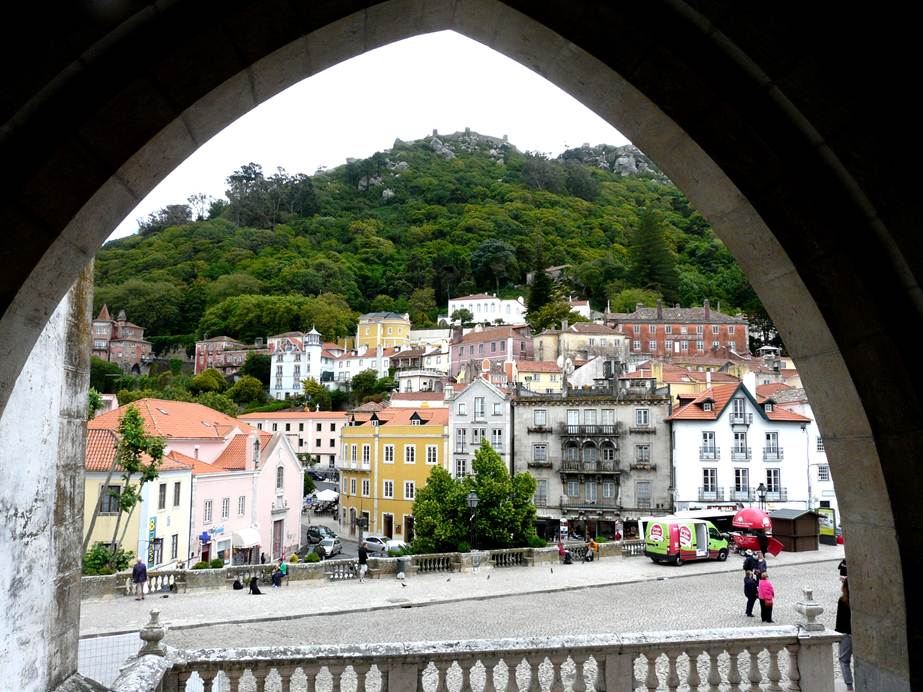
The View From Your Window Contest: Winner #170

image001

A reader writes:

Surely this week’s charming view has delighted and engaged many people. Who would not want to spend time in a place where the sun is shining, people are enjoying themselves, and even the dogs know they’re in the right place! This is one of the most beguiling scenes you have ever shown.

I think this is a picture from Portofino, Italy. The blue cross is typical of certain pharmacies in Europe. The mixture of old and new in the architecture of the buildings, the stone terrace wall, the cobblestone streets, and the delightful color schemes, led me to think Italy would be a reasonable choice. How I narrowed it down to Portofino: Sheer dumb luck. Elsewhere on the net this weekend was a feature showing wonderful hotel getaways. Among them was a picture of Portofino that was so reminiscent, in so many respects, of your contest photo this week that I could not resist sending in an entry.

Another:

Probably wrong, but I’m going with Prague, Czech Republic. That’s what it reminds me of, but I was there long ago, and pretty drunk most of the time.

Another:

Looks like Karst formations to me. Minor googling got me to somewhere between Trieste and eastern Slovenia. I’ll go for Trieste and leave the exact location to those with better google skills or more local knowledge.

Another:

Split, Croatia. End of guess.

Another:

This is my very first entry. The view is suspiciously evocative of Heidelberg, Germany, with the photo having likely been taken from one of the arches at the Old Bridge Gate over the Neckar River. I returned to the city earlier this summer, having first spent a few short hours there several years ago, and confirmed my belief that Old Town Heidelberg is one of the most beautifully lush, quaint, and dare I say dreamy locations I have personally visited. The view from atop the hill at the end of Philosophers’ Way is especially spectacular. Even if my answer is wrong – which I hope it isn’t – the thrill of recognition when I first saw the photo on your blog has already made my morning.

Another is less delighted:

OK, this is infuriating. I was initially positive that this was Petřin Hill, Prague, Czech Republic. What else could it be? I reasoned. The Habsburg yellow building in the foreground. The tourists blocking the street in standard clueless fashion. (Mostly kidding, tourists! Don’t stop going to Prague! The economy needs you and the Praguers would be left with nothing to complain about!) the Malá Strana cobblestones. Had to be.

But that wall, dammit. It’s not the Hunger Wall, and i don’t remember other walls up on Petřin. Could be a shot of the Dripping Garden wall in the Valdštejnský palac, but from where, I have no idea. And I don’t think that tram stop sign is the right shape, either. I suspect this is going to keep me awake at night and I may need to write you again to dispel the angst.

Another gets on the right track:

This image reminds me a lot of the Offshore Portugal areas of Madeira and Azores. I am going to go ahead and guess that this picture was taken in Funchal in Madeira.

Another nails the right location – but with some real effort:

This one was brutal.

At first sight, there wasn’t anything to give it away. The mixed architecture didn’t offer any obvious clues and pointed in all sorts of directions. All that was certain was that this is Europe. But then what?

The somewhat weathered state of some walls and roofs suggested a warmer, more humid climate – but apparently not warm enough for people to shed their coats. Altitude, perhaps? I spent a good amount of time looking at obscure medieval towns nestled on hillsides in Slovenia, Northern Italy and Hungary. To no avail. It also didn’t help that what looked like a blue cross in the photo is actually a green one – either way, pharmacies are a dime a dozen.

Looking up added to the confusion. Half of Europe sits at the foot of some form of castle, fortress or palace. This was getting more difficult by the minute. And then there was that van. That flashy green-red van. Red-green. Red-green? RED-GREEN! Exactly. But I didn’t get it either.

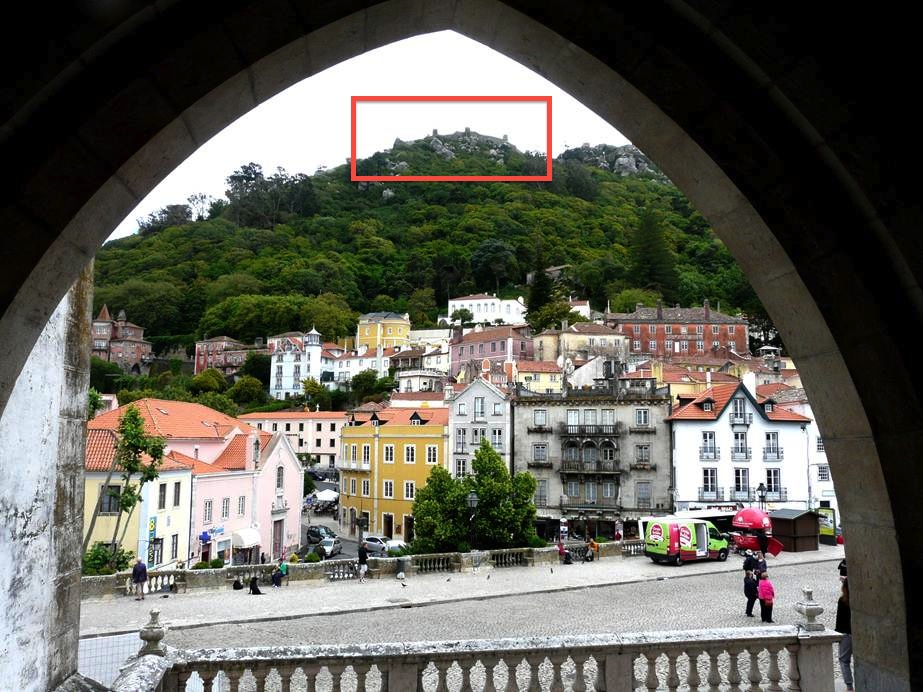
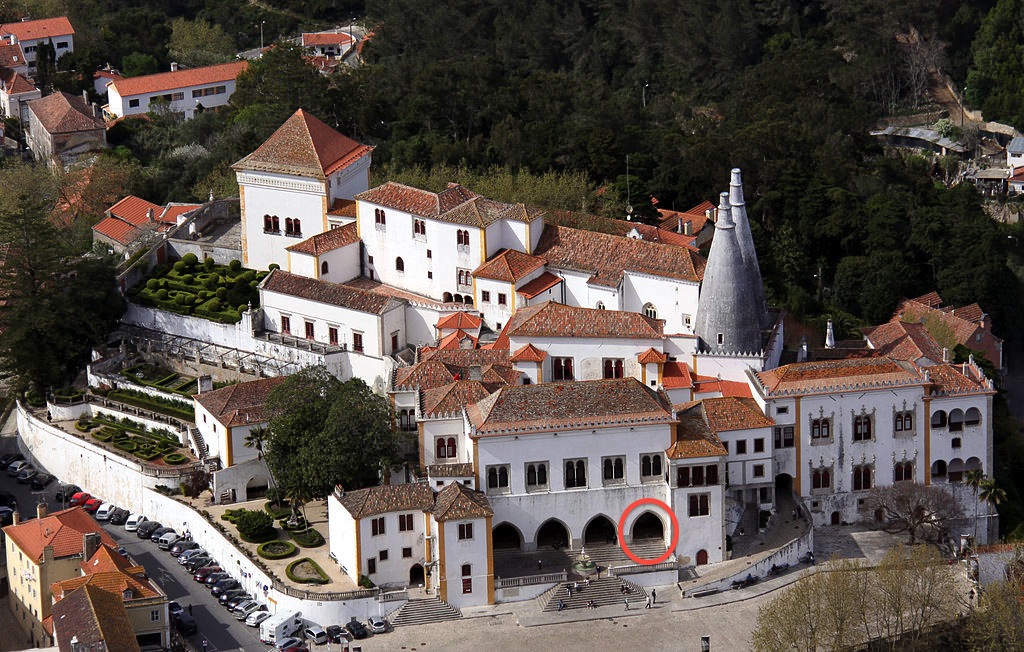
What set me on the right path was good old Google (in German). Old town. Hillside. Merlons. In that order. Three pages into results, I found nearly the same view. This photo shows part of the old town of Sintra, Portugal. The picture was taken from inside the eastern end of the entrance arcade to the Palácio Nacional de Sintra, which served as one of Portugal’s royal palaces from the 15th through the 19th century. Here’s a Wikipedia picture with the photographer’s location in the red circle:

sintra

The whole town is a UNESCO World Heritage Site. Situated less then 20 miles west of Lisbon, this looks like a lovely place to visit.

Another agrees:

If you’ve never been to Sintra, it is well worth a visit. Once you get away from the crowded, narrow streets in the town itself, the Pena Park is incredibly peaceful.  My only tip is that you avoid the humidity of late August – trekking up the hills to the Pena National Palace, which nestles in the mountains overlooking the town, becomes pretty unpleasant in 100 degree weather!

Another points to another palace:

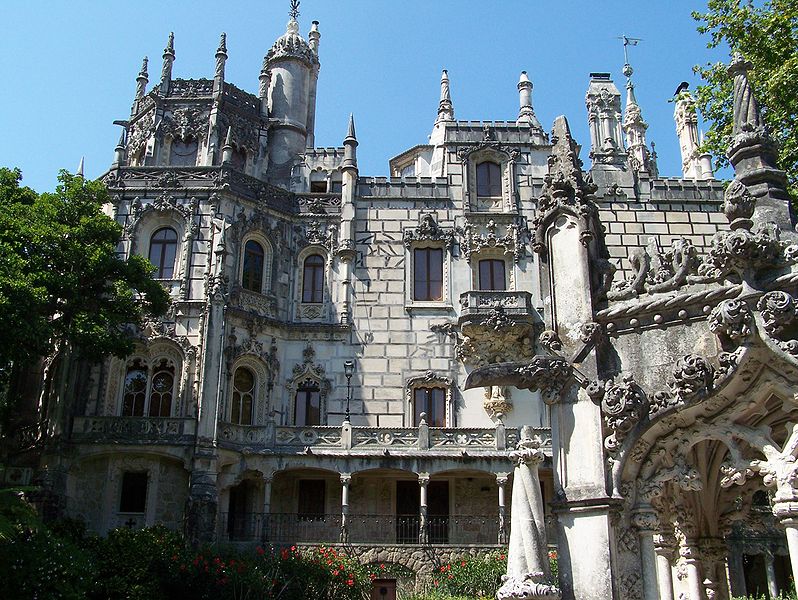
I think this is the first VFYW where I’ve actually been to, so I recognized it immediately.  The view is taken from the Palacio Nacional de Sintra in Portugal. To be honest, where this photo was taken was pretty much as far as I got into the palace; we ended up skipping past the bus tours of people and heading up the hill to the other castles and palaces in the area.  The most memorable was the Quinta da Regaleira, with its gothic architecture and network of tunnels extending below the property:

798px-Palacio-da-Regaleira1_Sintra_Set-07

It’s hard to overstate the excess.

Another reader:

I grew up not too far and went to visit the town and its palaces many times with my parents, but I still find new things when I go visit. If anyone goes there, go see the toy museum around the corner from where the photo was taken, go have a travesseiro (a particular pastry) at the Periquita café, go up the mountain to the Disney-like Palácio da Pena or go explore the terraces and caves of the Quinta da Regaleira, full of Romantic symbolisms. Or just wander around through the town and the mountain and enjoy the splendid views.

A word of warning, though: the area between the town of Sintra and Lisbon is heavily overbuilt, so if you take the train directly from Lisbon, close your eyes until you get to the last stop.

Another:

The closest we have ever come to death was walking along the side walls of nearby Castelo dos Mouros (blasting wind, thick fog, no guardrails). I went there in 2006 with my best friend.  I can guarantee you will have at least 30 winning entries with this one (too easy).

Actually closer to 100 readers correctly answered Sintra. Five of them have correctly guessed difficult views in the past without yet winning, but one of them clearly stands out as having participated in a whopping 55 contests over the years, so he breaks the tie this week:

This week’s contest only took a few minutes to solve once I noticed a tiny detail:

9-7-1

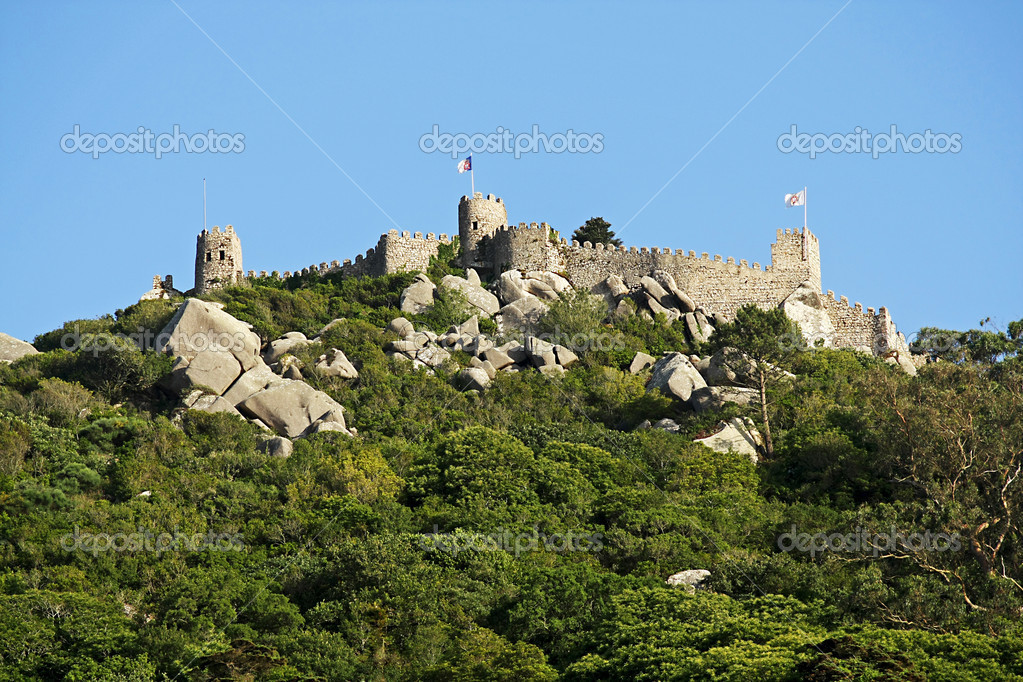
That’s no moon, it’s a spa … I mean, that’s no mountaintop, it’s a castle. Crank up the trusty search engines, and after a handful of misfires, “mountain top castle” did it. The title of one photo I found is “Moorish Castle-Sintra”:

Moorish castle-Sintra

So we’re looking at a castle above Sintra, Portugal, meaning we are IN Sintra. Given the layout of the foreground of the contest photo, there’s only one option for the location, and that’s the Sintra National Palace. There are four large arches on the front of the palace, but given the location of the little fence in front, we are looking out of the left-most arch, or the right-most if you’re facing the building.

That was a particularly fun one. See you next week.

(Archive)

Dead Children As Talking Points

Former Obama speechwriter Jon Favreau makes an emotionally-charged case for military action:

I don’t like war, or the risks that accompany even the most limited conflicts. But I cannot un-see the images played on CNN over the weekend of little children gasping for their last breath while an invisible poison destroys their nervous system. The world is a messy, complicated place, and I know we don’t always have the ability, or frankly the will, to stop bad things from happening everywhere, all the time.

But years from now, when the history is written about the time a madman gassed hundreds of children while the whole world watched in horror, I want to be able to tell my own kids that I was part of a country that did something about it; that we acted to save more innocents from this special kind of horror, in Syria and in other places where such evil is contemplated.

Obama has also cited the deaths of children on countless occasions – and I don’t doubt it’s informed by a father’s instinctual anguish and recoil. I do not doubt the sincerity of this feeling, or the rightness of it. We just have a duty not to let our frontal cortexes be flooded with that kind of non-negotiable. It was exactly these kinds of absolutes – the torture of children under Saddam, for example – that replaced calm thinking in 2003.

And in the end, far, far more children died because of the US invasion than would have happened in most feasible alternative scenarios. Garance sees the same emotionally blackmailing rhetoric in speeches by Susan Rice (see above) and Samantha Powers:

Either U.S. Ambassador to the UN Samantha Power and National Security Adviser Susan Rice have been working from a script or the two foreign-policy pros, both mothers, share a remarkable affinity for making similar points in the same way, as evidenced by their vivid descriptions of gassed Syrian children during recent speeches making the administration’s case for congressional authorization to use force against the regime of Bashar al-Assad.

As the administration finds that its other messages are, to be kind, not breaking through, its top female national security officials have been making the case that it’s about the kids. They know that it is impossible to look at the pictures of fat babies and adorable toddlers wrapped for burial in late August and not be horrified — not if you have an ounce of humanity. But the question has never been that there was an atrocity committed; the debate has been what to do in response to it.

Pynchon In Profile, Ctd

Penguin has released a trailer for Thomas Pynchon’s forthcoming novel, Bleeding Edge:

This embed is invalid


Margaret Eby captions the video, calling it “bizarre” and “entertaining”:

On Tuesday, The Penguin Press released a five minute video clip that features a young, schlubby dude sporting novelty sunglasses and a t-shirt that reads “Hi, I’m Tom Pynchon” explaining the mores and manners of the Upper West Side. “Listen, I mean, they call me the king of the Upper West Side,” the Pynchonian figure says, surveying the Manhattan skyline. “I mean, I kind of see myself more as an all-seeing eye. A power player from the margins. Kind of like Karl Rove, if Karl Rove were liberal and Jewish. Just ask my doorman.”

Alexander Nazaryan adds:

Penguin Press has released a trailer as strange and intriguing as the book it purportedly promotes, with an actor traipsing around the same “Yupper” West Side where Pynchon lives and his latest fiction is set. In fact, Bleeding Edge isn’t even mentioned until the actor on screen calls Maxine “a grade A MILF.”

Biblioklept’s take:

I don’t know, I’m guessing this is intentionally awful. I mean, book trailers are supposed to be awful, right?

Recent Dish on the elusive novelist here.