Heroism 101

Phillip Zimbardo – originator of the Stanford Prison experiment – now focuses his research on ways to “train” people to avoid unethical conformity:

According to a principle known as the bystander effect, for instance, we’re less apt to help someone in need if there are others standing around; we may not feel as compelled to act if we think another person will step in. The hero project’s curriculum teaches students to use a mental “pause button” so that they can avoid falling prey to automatic assumptions (“Someone else will take care of it”) and choose a more thoughtful response instead.

Similarly, instructors warn students how easy it is to slide into conforming with what others are doing—even if it’s something unethical like bullying a fellow student—and emphasize the importance of standing alone when necessary. In addition to learning how to overcome tendencies that may hold them back from helping, heroes-in-training get to flex their selflessness muscles by brainstorming social change strategies (helping fellow students struggling with math, say) and testing them out in the real world.

It’s still too soon for a long-term verdict on the curriculum, but early assessments indicate hero project’s approach is one to watch. In pilot programs at high schools in California’s Bay Area, kids who’d taken a hero course showed an enhanced understanding of concepts like the bystander effect and the ways people defer to authority, and they reported being more reflective and compassionate after taking the course.

Why Won’t Vegetarians Eat Fake Meat? Ctd

A reminder of where real meat comes from:

This embed is invalid


A reader answers the above question:

But they do! Have you ever wandered into a vegan health food store and seen tofu cut and colored to look like grilled chicken, or veggie patties made to look (and taste) like hamburgers?

Another quotes the previous post:

“In a poll run on the website of the Vegetarian Society, nearly four in five said they would not eat IVM [in vitro meat], while fewer than 7 per cent said they would.” In a related story, nearly 999 out of a 1000 vegetarians never heard of the Vegetarian Society.  Seriously, polling the holy rollers of vegetarians says nothing about what the vast majority of vegetarians (myself included) would do.  Most of the vegetarians I know (including myself) have “fallen off the wagon” one or more times for various reasons.  I had a couple of female former vegetarians tell me they weren’t feeling all that well and their bodies just “told” them to eat meat.  Assuming IVM has the taste and nutrition of “real” meat, I would imagine first, the ranks of vegetarians would significantly increase, and second, that while a majority of current vegetarians may not use the IVM option, I’m betting a lot more than 7% will.

A few who won’t:

I’m 45 and I’ve been a vegetarian for almost 20 years. Although I like animals and believe they should be treated with dignity, that’s not my primary motivation for being vegetarian. I just don’t like to eat meat. There’s something about it that I find repulsive.

I’m regularly confronted by people who hear that I’m vegetarian and project all sorts of political significance on it. The most belligerent ones want to believe that I’m in PETA and spend my time throwing paint on women in fur coats. It really seems to get their goat that I don’t want to eat a steak, even if it’s “free range,” “grass-feed,” 100% organic, locavore’s delight. Oh, and then the inevitable question: “Don’t you crave it? What about bacon?”  It’s like I’m being chased around by that character in “Green Eggs and Ham.” Do you like it in a house?

For the majority of vegetarians whom I have met (and we’re NOT in a club or anything), the answer is no, I don’t crave bacon. That’s like asking a person who doesn’t like olives, “Don’t you just want one?” Or someone who doesn’t smoke: “How can you restrain yourself? Everyone loves the taste of a Marlboro.”

And really – synthetic meat? Are you serious? That sounds even worse than real meat. I almost barfed just thinking about it!

Another:

I’ve been a vegetarian for about 15 years now, and am mostly vegan. I can say with 99% certainty that my vegetarianism has to do with animal welfare and suffering and environmental concerns.

I shit you not, this is what I wrote to my wife a few hours ago, in an email planning our family’s dinners for the upcoming week: “I also think we should try to make some sort of fish thing once a week [for the wife and kids]… I wish I could make myself eat fish, but I just don’t really think I can.” I think fish is good and healthy. It’s great (aside from environmental concerns). But I don’t want it bad enough to say “ha ha, sucker, I want to taste your flesh so badly that you have to die!”

So would I be first in line to eat some IVM-produced fried chicken? Probably not. Why? It’s not because my actions don’t align with my professed values; it’s just that I haven’t eaten it in so long, the desire for it is just long gone. But just because I’m not all that interested in buying it, doesn’t mean I don’t think IVM is not an awesome development.

Another:

I’ve been a vegetarian since 1979. I became a vegetarian solely for ethical reasons. If fake meat were being marketed today, I would probably force myself to use it, to insure that the producers found it profitable to produce, but I wouldn’t really want to. For the first few years of being vegetarian I still lusted after meat, but after five years or so I no longer perceived meat as food and didn’t find it attractive. A friend of mine, who is 25 years sober through AA, has told me that he went through the same process with alcohol.

One more vegetarian:

If it is clear to me that my eating lab-grown meat would reduce animal suffering, then I would absolutely do it – I’m sure I’d get used to it fast enough. But I think the money I would spend on the product would do less to support and grow that market than if I spent that money on programs that educate people about the horrors of factory farming. Even a small contribution to Vegan Outreach, for example, would get many more booklets like this one in the hands of college students: “Even If You Like Meat“.
Why We’re Creeped Out By The Uncanny

Rose Eveleth outlines the reasons:

One is that not being able to tell whether something is human or not can be a deeply unsettling feeling in itself. Artists and directors take advantage of this all the time for dramatic effect. The dread that viewers feel while trying to figure out who is a zombie, or Cylon, or alien might be the very same dread they feel when faced with a very realistic robot.

Another explanation focuses on the disconnect between how realistic something looks, and how well it moves.

There’s always been a lag time between how quickly designers can make things look like people, and how quickly engineers can make them move like us. If a figure that you thought was human started to move jerkily, you would recoil. Similarly, if you were to shake a robot’s hand while expecting a human touch, but instead felt cold rubber, you would be caught of guard. An unexpected break in humanness can be an unpleasant shock, one that sets off fearful and distrustful instincts. “Whenever we see something move, and we’re not familiar with the mechanism of movement, it grabs our attention,” says Andrew Olney, a psychologist at the University of Memphis who works on designing intelligent robots. “If your coffee cup started slowly moving across the table, that would kind of freak you out a bit.”

Finally, a third theory turns to evolution. It suggests that if a robot looks like a human, but moves unnaturally, our brains subconsciously classify what we’re seeing as someone with a disease. This is the same explanation proposed for most feelings of disgust. When we stand near something like faeces, rotting flesh, or a jerking robot, we experience a sudden urge to get away from it so as to avoid catching the infections it may harbour.

Previous Dish on the “uncanny valley” here, here and here.

Therapy For Losers

Robert L. Strauss provides a glimpse into the training methods of psychiatrist David Burns, a leader in cognitive behavioral therapy and the author of Feeling Good.  “Theo” is a fellow therapist who is frustrated that a patient dropped out of his practice:

Although Theo is obviously upset, this is a training session, not a therapy session, and so Burns asks what the two of them should do next. Theo suggests the “externalization of voices” technique, in which the therapist (or friend or spouse) hurls the patient’s negative thoughts right back at him. It’s the patient’s job to defeat those thoughts.

“People will think I’m a loser,” Burns says, as Theo’s inner voice.

“And they’d be right,” Theo answers, disheartened. “I am a loser.” (Theo has an advanced degree from Stanford.)

Burns reminds Theo that in this exercise he needs to find positive thoughts he “believes in 100 percent” that will crush his negative thoughts completely.

Round Two.

“You have to accept that you’re not going to have a successful practice,” Burns jabs.

“It’s silly to jump to conclusions,” Theo answers.

“Well, you failed the patient who dropped out,” Burns says.

“We don’t know that,” Theo answers. “That’s black or white. That’s not how the world works.”

“Still, you don’t know what you are doing.”

“I’m learning every week. I’m having some remarkable success,” Theo says more assertively. “Openings just mean that people’s schedules change. The reality is that therapists have openings.”

“The reality is that you are a loser.”

“That’s just not true!” Theo retorts with a conviction that was entirely missing moments before.

Burns asks who won the exchange.

“I did,” Theo says.

When Theo quantifies his “after” feelings, anxiety has dropped from 75 to 40 percent, inferiority from 75 to 30. He reminds himself that therapy is a science and an art.

Taking The Me Out Of Memoir

Beth Kephart praises memoirs that move beyond self-absorption:

[W]hat does memoir offer? What can it yield? Why am I, after all these years, still reading it, teaching it, shaping it, seeking it? The answers are many, but here I offer just one: Because memoir at its very best is the start of a conversation. It makes its interest in readers explicit, offering not just a series of life events, but a deliberate suggestion of what it is to be a human being – to experience confusion, despair, hope, joy, and all that happens in between. True memoir is a singular life transformed into a signifying life. True memoir is a writer acknowledging that he or she is not the only one in the room.

One memoir she claims gets it right:

Consider, for example, Jean-Dominique Bauby’s international bestseller The Diving Bell and the Butterfly, which later became a major motion picture. It’s a slender book – a mere 132 pages. It’s a terrifying book, written by a man who, in December 1995, suffers a massive stroke that leaves him permanently paralyzed. Bauby is “locked in,” unable to move or speak. It’s his left eye that saves him – his left eye, which he relies on to blink at the slate of letters an assistant shares. Blink by blink, letter by letter, Bauby communicates his story. He was a famous magazine editor, we learn. He is trapped, we learn. But he is still alive – and still, miraculously, hopeful. And even though each word comes slowly, even though he has no words to spare, Bauby makes the explicit effort to tell us about ourselves. He looks up from where he is and acknowledges our presence.

Don’t Rush Off To Homs Just Yet

Ann Friedman worries that freelance reporters are entering war zones without proper preparation or support:

I confess that I’ve been watching all the coverage of Amanda Lindhout’s book [profiled above] with a bit of chagrin. Lindhout, who traveled to Somalia as an aspiring journalist in 2008, was kidnapped along with her photographer companion and their guides. She spent 15 months in captivity before her family finally hired a private security firm and raised the ransom money. Later she collaborated with established journalist Sara Corbett – “we rented a really remote house in the Bahamas together and spent seven straight days in conversation” – to write a book about her ordeal. On Twitter she describes herself as an “adventurer,” but in much of the coverage, including a recent Today show appearance, she’s identified as a journalist.

“Why her and not me?” asks veteran journalist Robert Draper, who met Lindhout in a Mogadishu hotel before she was kidnapped, in an essay in ELLE. The answer seems pretty clear. She had traveled widely as a tourist but had zero institutional support and very little experience as a reporter.

As young journalists survey the professional landscape—the layoffs, the closure of foreign bureaus—just packing up and buying a plane ticket starts to seem like a viable option. As one guy wrote to me recently, “I am interested in getting to the Middle East as some sort of war correspondant [sic] or novice freelance frontline reporter. I believe I could find the connections with publishers to make the journey successful. What are some steps I could take to set up a trip and get a sponsorship loan on equipment in order to begin preparing for a deployment?” Every single hard-bitten war correspondent has had to start somewhere. It’s just that more and more of them are trying to get that start without the support or backing of an established news organization and without the mentorship of an experienced international reporter.

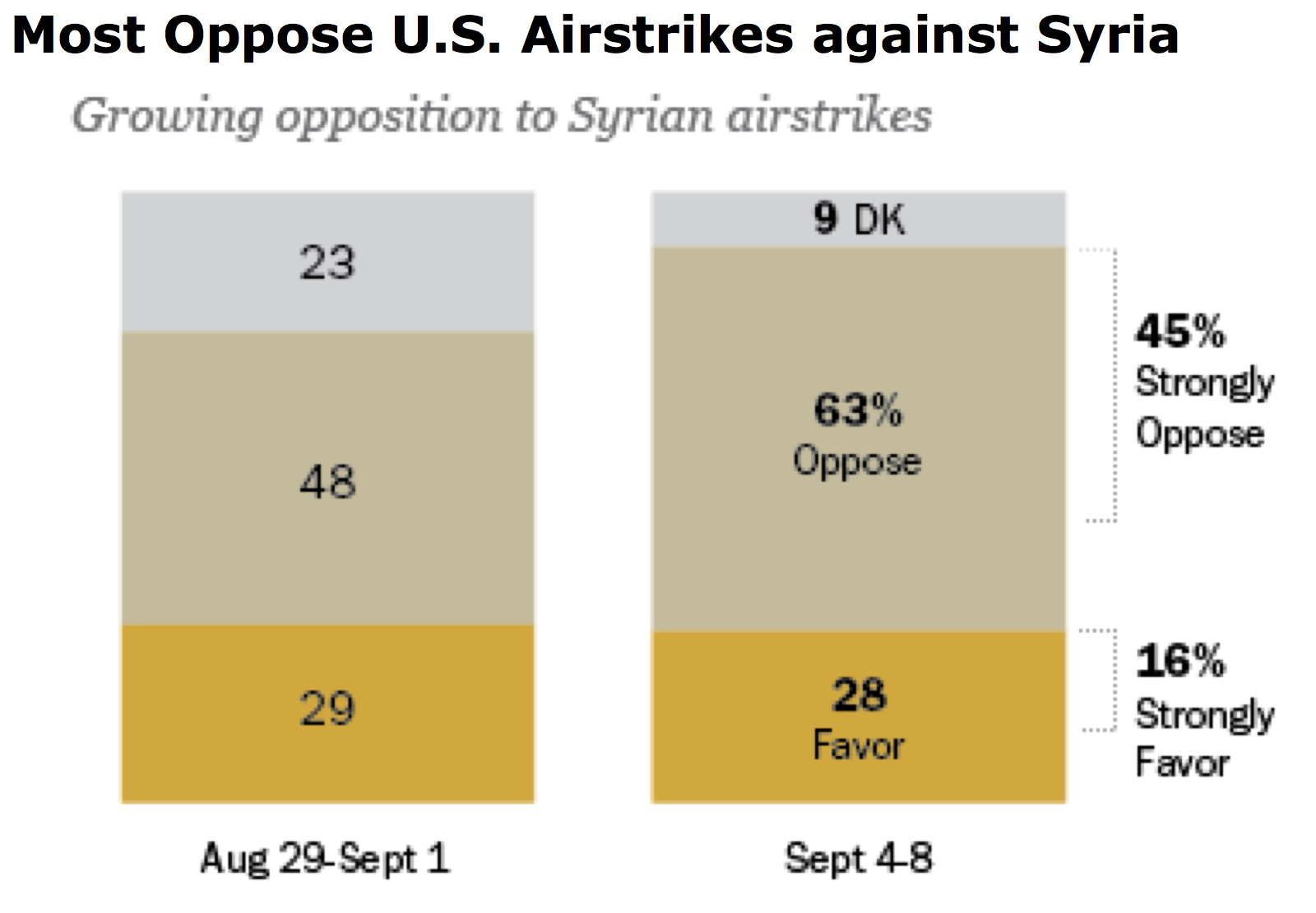
The Growing Opposition To War

Syria Pew Poll

The latest from Pew:

Over just the past week, the share of Americans who oppose U.S. airstrikes in Syria has surged 15 points, from 48% to 63%, as many who were undecided about the issue have turned against military action. By contrast, the share of Americans who support airstrikes remains virtually unchanged: Just 28% favor U.S. military airstrikes against Syria in response to reports that its government used chemical weapons.

Nate Cohn notes “the total collapse in Republican support”:

Back in April, when Pew asked voters whether they would support strikes if Syria used chemical weapons, Republicans were pretty supportive; 56 percent were on board, compared to just 24 percent opposed. By last week’s Pew Research survey–now simply asking voters whether they would support strikes now that Syria had used chemical weapons–Republicans were basically divided. But today, Republicans are overwhelmingly opposed by a 49 point margin, with just 21 percent in support and 70 percent opposed. There hasn’t been similar movement among Democrats.

Ed Morrissey parses a CNN/ORC International poll:

The only good news for Obama in this poll is that a majority of respondents say that their votes in the midterms won’t be impacted by the vote on the authorization (57%).  However, among those who will take that into account fourteen months from now, sentiment runs nearly 3:1 against at 11/31.  It’s 4:1 among independents at 9/36, and 5:1 in the West (7/38), where Democrats hoped to make gains against Republicans with social-libertarian policies.

Quote For The Day

“Christian realism requires the disavowal of war. Christians do not disavow war because it is often so horrible, but because war, in spite of its horror – or perhaps because it is so horrible – can be so morally compelling. That is why the church does not have an alternative to war. The church is the alternative to war. When Christians lose that reality – that is, the reality of the church as an alternative to the world’s reality – we abandon the world to the unreality of war,” – Stanley Hauerwas.

Previous Dish on the Christian pacifism of Hauerwas herehere and here.

Pulling Out All The Stops, Ctd

Readers respond to that great piece from Ann Friedman on “the pullout generation”:

Your post on pullout method is lacking. For many couples, pulling out simply works. A 2009 study found that when practiced correctly, withdrawal only failed 4% of the time. Condoms, by contrast, had a failure rate of 2%. All things considered (health, risk, and pleasure), this risk differential is acceptable for disciplined, stable couples.

Another agrees:

I think Marcotte misses big on this point: she talks about “decisiveness” versus “ambivalence”, and choosing “in the heat of the moment” (basically, “you should really be more responsible”) but neglects to think that some families simply choose not to make it a decision. Young couples who want children eventually don’t have to be “trying” or “not trying” – they can simply be married, have sex, and maybe conceive a child.

Another reader:

The biggest pregnancy scare I’ve ever had was actually with a condom.

On my birthday several years ago, in the heat of having sex with my girlfriend, I suddenly came when things felt especially good – because the condom had just broken, something I didn’t think to check in that moment of blinding pleasure. She wasn’t on the pill, since it clashed with her medications, so we both started to freak out. We immediately checked an online fertility calendar and discovered she was at peak fertility – so we freaked out some more. First thing in the morning she got Plan B from the pharmacy and no baby ever came of the incident, but it did make me realize how much condoms can give you a false sense of security. Nowadays I pull out even I am wearing a condom, paranoid it might be broken.

In a subsequent relationship, which lasted almost two years, she also wasn’t on hormonal birth control. We stopped using condoms after several months and switched to the pullout method -every single time we had sex, without any slip-ups.  Maybe I just have Zen-like self-control, but we never had any pregnancy scares or actual pregnancies (and she had accidentally gotten pregnant twice in her life, both on the pill, so she was plenty fertile … though I guess it’s possible I’m not).  At times I still felt irresponsible for only relying on the pullout method, and maybe we just got really lucky, but that long relationship left me convinced that coitus interruptus isn’t the horribly risky method that we were all warned about in sex-ed class.

“Unbelievably Small”

That’s how Kerry described the proposed military strikes against Syria:

Waldman comments:

This was an off-the-cuff remark that he’d obviously like to take back, but it was just an unfortunately exaggerated version of what the administration has been saying all along. It’s going to be limited in duration and scope! It’s hard to convince people that only a minimal effort is required at the same time you’re trying to convince them that this is so very critical.

Fallows focuses on the same disconnect:

The concern all along about the administration’s plans has been the gap between the problem it describes — moral outrage, gassing of children, overall carnage — and the response it is proposing. You can talk about that disconnection: Will an attack make a difference? Might it make things worse? I’ve tried to look into such questions in the posts gathered here. Or you could run back-to-back clips of the same Cabinet secretary saying “this is Munich” and “unbelievably small.” It’s unfair to the admirable and usually eloquent Kerry, but in a moment’s slip-up he crystallized a counter-argument.

Joshua Keating’s two cents:

I may not have much experience with brinksmanship, but it seems to me that threatening to hit someone becomes a lot less effective when at the same time you’re telling your friends,Don’t worry, I’m not going to hit him that hard. And convincing the public that this situation is analogous to the buildup to the largest war in human history is difficult when you’re also saying that an “unbelievably small” effort will be sufficient to deal with it. Given the blows the Assad regime has already absorbed over the last two years, it’s hard to imagine statements like these changing his thinking.