Gary Becker highlights the economic advantages of population growth:
To be sure, if higher birth rates lead to lesser education and other human capital investments in each child, they may result in lower, not higher, per capita incomes. Malthus fear of lower per capita incomes explains his strong opposition to high birth rates. However, the rapid growth in world population during past 250 years has been accompanied by unprecedented high per capita incomes all over the world. Whatever the Malthusian negative effects of greater population, they have been dominated by factors that raised per capita incomes, including the benefits of increasing returns and other advantages from having a larger population.
There is no necessary connection between population and economic growth. The sharp decline of Europe’s population because of the Black Death is thought to have increased per capita incomes significantly by reducing the ratio of people to arable land, resulting in improved nutrition. A larger population can, as Becker points out, increase the rate of technological progress by increasing the number of geniuses and other very creative people. But so can assortative mating, which has become much more common in the advanced countries as a result of falling discrimination and Internet dating search. At some point there may be diminishing returns to the increasing number of computer engineers.
Laura Bennett declares her antihero fatigue, arguing the word has lost all meaning in the recent surge of bad boy TV dramas:
Somehow “antihero” has come to represent an impossibly broad characterological range: from psychopathic drug lords to well-meaning serial killers to wayward Dominican kids who sometimes mistreat women because of culturally-ingrained misogyny. …
In Hollywood, the concept has been around at least since films of the ’40s and ’50s began exploring the new post-war cynicism, and an action film actually titled “Anti-hero” appeared in 1999. [Encyclopedia] Britannica cites as some early antiheroes Satan in Paradise Lost, Heathcliffe in Wuthering Heights, and Don Quijote, none of whom are particularly useful analogues for the wretched, morally bankrupt leading men of cable drama. And the men of HBO and AMC are not as similar in their sinfulness as they have been made out to be. Walter White is by now less an antihero than a straightforward villain, a macho foil for Hank. “Antihero” implies that a character encourages a conflicted sympathy; Walt forfeited our sympathy long ago.
Walter White can only claim antihero status for a precious few seasons until the series becomes the confessions of a thug. The show’s genius, as Heather Havrilesky recently pointed out, is how effectively it alienates the audience from its protagonist without losing any dramatic momentum. Conscious of how cheap the American bad boy trope has become, the show’s writers keep pushing their main character further into villainy until we’re all forced to drop concern for Walter and redirect our sympathy and compassion toward basically everybody else. That’s when you know it’s no longer an antihero’s story, but a subversion of the trend.
Bennett goes on to strip Tony Soprano and Carrie Bradshaw of their antihero credentials as well:
Even Emily Nussbaum—who it should be said, is singularly skilled at inventing her own critical archetypes, a la the “Hummingbird theory”—wrote a piece on “Sex and the City” that identified Carrie as the “first female antihero,” the one frustrating bit of an otherwise lovely essay. Carrie could be irksome as a character, but “Sex and the City” was defensive of its protagonist in a way that “Breaking Bad” and “The Sopranos” never were, permitting Carrie to be abrasive and vain only to rein her in at the last minute with a pat, chastened ending; the other shows pushed us to see just what it would take to sever our emotional attachment to their protagonists, while Carrie’s reprehensibility was always a learning experience.
This might be overkill. If Carrie was too innocent, and Tony too depraved, one wonders what recent drama got it just right.
To me, the above scene from The Sopranos is a great example of the genuine antihero Bennett is after: disgusted with his (usually maniacal) sister’s progress in anger management, Tony methodically dismantles her gains from therapy and drags her back down to his level of misery and self-loathing. With a grin. Like Walter, Tony’s infection of everyone around him becomes a horrible spectacle, be it through physical brutality or sick emotional manipulation. He knows he’s a “toxic person,” as he laments later on in the series, and his attempt to correct himself forms the tragic arc of the show’s final season.
Still, contra Bennett, we never abandon him like we do Walter – in fact, we follow Tony into therapy, into purgatory, into death (that’s right) and, in the above clip, out of his sister’s house and into the street. Because there’s no way we’re staying behind with Janice. He’s not simply an antihero because he cares for his family or wields personal charm, but because in the moral universe he inhabits, Tony is capable of more insight and growth than the rest of his family, friends and enemies. And unlike Walter’s evolution into Dark Lord in Breaking Bad, Tony never replaces the true villain of the piece – his mother Livia, who carries on poisoning everyone’s lives long after her own has sputtered out.
So while it’s true The Sopranos spawned a wave of second-rate libertine heroes, of all shapes and sizes, if it gave us the perfect modern antihero in Tony and paved the way for the anti-antihero in Walter, that seems like a price worth paying.
More readers respond to Andrew’s post on Eddy’s mourning of Dusty:
We have been so very sorry to read your recentposts about the life and death of Dusty. We are both sorry for your loss and with it, the remembrance of our Van’s death last year. I admit to starting a note to you twice last week, each time ending with “What is happening with your other dog?”, but I didn’t have the heart to send them. They just seemed like piling on, and my own memories of Van’s death were overwhelming. So I was interested to read the stories from readers on grieving pets. I thought it was time to share my thoughts from last week.
Our beloved dog Van died last year in late May after years of decline, followed in the end by seizures. He got to the day when he wasn’t really Van anymore. Like Dusty, his last day was full of love and hamburgers. The vet came to our apartment and we said our goodbyes. When I started to close the French doors separating our living room from the kitchen, so that our other dog Bettina wouldn’t be in the room, the vet said gently that we should allow her to be with us at the end of Van’s life. Bettina sniffed around him and said her goodbyes.
We were concerned about her, so we increased her walks with our dog walker from two days a week to five, thinking that at least she would enjoy the company of her canine friends. Like Eddy, she ate and seemed to enjoy her new solo life. But then, also like Eddy, she stopped eating and started burying her food in our couch and chairs. She started living under the dining room table. She stopped hanging out with us. We began to realize that the only reason Bettina ever hung with us was because Van did. We understood that he was her captain and without his leadership, she didn’t know what to do with herself.
The week after Christmas, we adopted for Bettina a 6-month-old fur brother. At first she wasn’t very enthusiastic. He is a giant puppy with no impulse control. But she did start eating again. Our dog walker insisted that Bettina was hating to love him, and that turned out to be true. Eight months in, they are now firm friends. And she is herself again.
Our reader also attaches the above photo of “Van and Bee watching the world go by.” Another reader:
I just finished reading the story about Molly and Custard. My family had a very similar experience when our 14-year old golden retriever Auggie died.
Nine years ago now, we adopted a one-year-old cat named Nemo, an absolute rascal that had been left at our vet’s office when his owner could no longer keep him. Auggie and Nemo were never the best of friends. Despite being a 75-80 lb dog, Auggie was pretty much afraid of her own shadow and Nemo took full advantage. He always seem to know how to drive the ol’ girl crazy, particularly in later years when she had hip dysplasia and Nemo could get to parts of the house that Auggie no longer could.
When the day finally came to put Auggie down – and we were so fortunate that she was really only truly suffering the last two weeks of her life – we didn’t think Nemo would miss her much. After all, he’d be king of the castle! But something funny happened: Nemo started sleeping in spots where Auggie used to sleep. He was gentler and more affectionate, staying near my mom for hours (who thought of Auggie as her long-lost daughter) when she was feeling sad. He got lonely more frequently, often meowing or trying to grab our attention in the middle of the night. It was as if he had experienced a bit of a personality transplant – he was the same ornery cat, but softer and more vulnerable.
I dunno, maybe I’m projecting my family’s feelings onto a cat that couldn’t give a damn. Still, I couldn’t help but feel we were helping him as much as he was helping us grieve.
Another emphasizes a point illustrated by the first reader:
I feel like one very important thing we can all try to do is to let our companion animals be with their companions in death. Personally, I’ve told my partner that if I should die before he and my dog, I want my dog to have some time to be with my body, to know me in death, since that physical proximity is her only way of really knowing I am gone. Animals know by scent (and perhaps other means) that other animals in their presence have died. I think the same should ideally occur with other animals in the “pack” – they are, after all, not only companions of us, but companions of each other. If one dog dies, another dog in the same family should be given time with that dog to know and experience its death. There is no other way for them to really know what has happened to the one that is gone.
Thank you, as always, for the opportunities you provide for these conversations.
For the entire Dish discussion this summer of deceased pets and the impact on their owners, go here.
Ed Yong reports on a study that may help explain the phenomenon of near-death experiences:
[Neuroscientist Jimo] Borjigin discovered that rats show an unexpected pattern of brain activity immediately after cardiac arrest. With neither breath nor heartbeats, these rodents were clinically dead but for at least 30 seconds, their brains showed several signals of conscious thought, and strong signals to boot. This suggests that our final journey into permanent unconsciousness may actually involve a brief state of heightened consciousness.
Although the experiments were done in rats, Borjigin thinks they have implications for the near-death experiences (NDEs) reported by one in five people who are resuscitated after their hearts stop. Although they were unconscious, unresponsive and clinically dead at the time, they come back with stories of bright lights, “realer than real” memories, and meetings with people they knew. Some scientists have dismissed these accounts outright. Others have taken NDEs as proof of a religious afterlife or a consciousness that lives on outside the body, as popularised in a recent bestseller of dubious provenance.
But Borjigin’s research suggests that these experiences could just be a natural product of a dying brain. That doesn’t make them any less real, but it does root them in the natural world, without the need for a “super-” prefix.
Chris Cillizza tries to compare Christie to past presidential candidates and comes up short:
The truth of the matter is that Christie is surprisingly hard to pin down in terms of who he most resembles from the past of the Republican party. He is a northeastern Republican but not nearly the moderate (or liberal) that Giuliani is. He is a pragmatist but not in the vein of a former Utah Gov. Jon Huntsman who wanted the party to overhaul itself in the midst of the 2012 race. He’s a real populist, not someone trying to act like regular people ala Mitt Romney in 2012. Here’s how one Christie ally described the governor: “Christie’s a conservative, but he’s not angry about it.”
The struggle to create a Christie analog worries Democrats since there’s no blueprint for how to run against him if he does wind up as the Republican nominee in 2016.
Friday night, Egyptian security forces laid siege to Cairo’s al-Fath mosque, where pro-Morsi protesters had been holding up after Wednesday’s massacre and Friday’s violence, which killed at least 173 people. Once the mosque complex was cleared, as many as 1,000 protesters were arrested. Yesterday, another 38 Morsi supporters were killed while in police custody, apparently suffocated by tear-gas inhalation under circumstances which remain unclear. Then today, 25 off-duty police officers were found executed on the side of a road in Sinai, as is purported to be seen in the tweet above. Sharif Abdel Kouddous is certain the chaos will continue:
As Egypt plunges headfirst into a deadly downward spiral with no end in sight, many of its citizens are baying for still more blood. Both sides leading the conflict, the military and the Muslim Brotherhood, are playing a zero-sum game, based on a false binary demanding that Egyptians choose one or the other. Both are defined by hierarchy, patriarchy, secrecy, mendacity and a blinding sense of their own superiority. Both are juggernauts in the Egyptian body politic that have heedlessly clawed away at Egypt’s social fabric in their struggle for power, proving time and again that their own political and economic interests trump all. …
Today, many of the revolutionaries who fought the country’s successive authoritarian regimes—first Mubarak, then the Supreme Council of Armed Forces, then the Muslim Brotherhood—now find themselves sitting on the sidelines, pushed out of the discourse and forced to watch as the bloodletting continues. The transformative revolutionary moment that exploded on January 25, 2011, has become a faint glimmer, in danger of being extinguished completely. “Despair is betrayal” is the mantra that has echoed throughout Egypt during the many tough times over the past two and half years. Today, it is very hard not to feel like a traitor.
Adding to the craziness, there are even reports that Mubarak will soon be released, while Morsi will face yet more charges. Elsewhere, Kristen Chick reports on the anti-Christian violence:
The Coptic Orthodox church had just opened in April after 13 years of construction, in a country where the government strictly curtails building permits for churches. Now, its elaborate dome stands above a ruined, charred interior. The walls are blackened and rubble litters the floor. A picture of Jesus is half burned, the charred edges curling where they were licked by flames.
“The religion of God is Islam,” reads graffiti sprayed in yellow on a wall of the church. Three burned out cars, one of them upside down, rest in the courtyard. Next to the gate, sprayed in black, is another phrase: “Victory or martyrdom.”
The Saint Virgin Mary church in Al Nazla is one of 47 churches and monasteries that have been burned, robbed, or attacked since Aug. 14 in a wave of violence against Christians since the brutal police crackdown on the former president’s supporters, according to Ishak Ibrahim of the Egyptian Initiative for Personal Rights. He adds that dozens of Christian schools, other religious buildings, homes and shops have also been attacked and burned, and seven Christians killed. Police have done little to stop the attacks.
And lest anyone forget Egypt’s economy, which is still a complete mess and getting worse due to the near total cessation of tourism as well as widespread cancellation of foreign investments. Nonetheless, H.A. Hellyer thinks the country can still right itself:
The future of politics in Egypt, along with the regional and international repercussions that accompany it, directly depends on how this crisis is resolved. The same path that was open before this terrible turn of events is still open. The basic outlines of a political accommodation are still there for everyone to grasp. An interim government is unsustainable, and means for little or no accountability of anyone — and the reinstatement of Morsi is also a bad move. Fresh presidential elections under the watch of international observers are needed as soon as possible, but that is only a starting point. Consensus is key to unlocking Egypt’s deadlock — and that demands an alternative vote system for the presidency. Whoever becomes Egypt’s next civilian president must have the largest possible mandate and be best positioned within a vote system in which the winner is the first or second choice out of many candidates.
That consensus cannot be established without the full participation of all political forces in the country — and that means the Muslim Brotherhood, popular or not, must be permitted to have political representation as a group.
One piece of good news: amazingly, the unarmed man who was gunned down by security forces in the brutal video we featured on Friday, survived.
Bassem Sabry outlines the treacherous path that lies ahead for the organization:
On one hand, the Brotherhood is faced with the combined power of an antagonistic administration, the media, the judiciary and a substantial number of people who seem to be confronting the Brotherhood in the streets out of their own volition. The Brotherhood is even facing the leaderships of the country’s top two religious institutions, the Coptic church and Al-Azhar. Most remarkably, a senior Al-Azhar leader and scholar, Dr. Ahmed Kreima, had reportedly declared that Al-Azhar’s council of Sharia scholars has deemed the Brotherhood apostates.
On the other hand, as the Brotherhood seemingly continues to lose control over its base, and and as supporters resort to open violence, their cause and any sympathies garnered are damaged, and the position of the government strengthened. The prevailing narrative in Egyptian media of an “Egypt Fighting terrorism” becomes more palatable for some than it previously seemed.
Eric Trager adds that, while the Egyptian military has been very successful in targeting the Brotherhood’s leadership, the consequences of that success may prove dire:
[The generals have] demonstrated that they understand the Brotherhood’s vulnerabilities, since the Brotherhood cannot function effectively once its top leaders have been apprehended. After all, the Brotherhood is at its core a hierarchical vanguard, in which legions of fully indoctrinated cadres are organized under a nationwide, pyramidal chain-of-command. …
Still, the military’s decapitation of the Brotherhood is a double-edged sword.
By removing the top layers of the organization, the military has made it impossible for the Brotherhood to execute a change in strategy. The military thus has no way of compelling the Brotherhood to abandon its disruptive protests and instead re-enter the political process, as the military says is its goal, because all of the top and provincial leaders who could command their cadres to change course are being removed from the scene.
Even worse, by disorganizing Egypt’s most cohesive Islamist group, the generals have turned hundreds of thousands of deeply ideological Muslim Brothers into free radicals, who will no longer listen to their typically cautious leaders.
Lynch surveys the response of other prominent Islamists across the Arab world, noting that the crackdown in Egypt may result in greater polarization between Islamist organizations and Gulf nation governments, most of whom have loudly offered their political and financial support to Egypt’s military-backed government. And then there’s the Syria angle:
These Islamist networks and personalities have been instrumental in building support and raising money for the various factions of the Syrian opposition. Now, they are prominently equating Egypt’s General Abdel Fattah al-Sissi with Syria’s President Bashar al-Assad. Suwaidan, for instance, proclaims that “the right is clearly with the revolutionaries in Syria and with those who adhere to legitimacy and reject the coup in Egypt.” What will happen if the Islamist networks which have been working to support the Syrian opposition begin to turn their fundraising and mobilizational efforts to Egypt?
Sports journalist Martin Manley, who left the Kansas City Star in early 2012, killed himself in front of a police station on Thursday on his 60th birthday. He left a website that explains his decision making. The gist: he didn’t want a slow lingering death in nursing homes or heroic battle with cancer that he would ultimately lose. He wanted to control his death – every detail.
And that’s one thing I haven’t seen discussed on your great thread about suicide – the need for control. I think about suicide all the time; I have for years. That troubled me until I realized it gave me a sense of control. I, like Manley, am single, in my 60s and have no desire to deal with a lengthy illness or long-term care. Unlike Manley, I’m also broke. And for me, the idea of ending my life is a great comfort. But, of course, it has to be my little secret.
It’s called rational suicide, and I think it will be part of the legacy of the Boomers. We’ve got to get a national conversation going about the need to let people who are at the end of life, have some control about ending their life. Thanks for helping make that happen.
Another reader:
Now that Yahoo! has taken down his site and his sister is battling them to put it back up, I think it’s appropriate for you to add this to your suicide thread: I wish he’d been able to choose some other sure method that would have been less dramatic.
This would require a major shift in how we think about death. We’d have to accept that there are some people who can cooly, dispassionately decide that it’s their time to go, while others will fight to survive for as long as they can – and that both are valid choices. A system that accommodated that, and treated the person choosing suicide with respect rather than as a danger to himself who must be stopped by any means possible, could include counseling to ensure that the choice wasn’t being driven by depression or influence from third parties. The longer we force people to be furtive about it and shame surviving families into silence or into condemning the loved ones they have lost, the worse it is for everyone.
I hope the sister wins her battle. I still have not read his entire website, but what I’ve read presents an interesting and complex picture – neither a hero nor a coward. He had concerns that are not unlike the concerns of others at his age. But to me, his choice doesn’t seem radically different from that of my aunt when she decided not to undergo radiation for breast cancer for a third time. She died within days of the date the doctor said she would upon making that choice, and, of course, it was unclear whether what finally did her in was the cancer itself or the increasing doses of morphine she was taking to counteract the pain.
I respect her decision, as I do Manley’s. I just wish he hadn’t been in a situation where he felt his best option was a police parking lot.
A meta-analysis of 63 scientific studies conducted between 1928 and 2012 has found that 53 of the studies showed “a negative correlation between intelligence and religiosity, while 10 showed a positive one.” Frank Furedi criticizes the claims:
It’s not that researchers are dishonest but that they like anyone else suffer from a tendency to discover what they already suspect. In the current era where religion is increasingly associated with out-dated beliefs, dubious traditions, dogma and prejudice it is inevitable that the authority of science will be harnessed to prove the religious stupid. Is it any surprise that in a smug tweet Richard Dawkins refers to this meta-analysis with feigned surprise as to why the cleverness of atheists should even be questioned?
The polemical use of science – called scientism- has nothing to with real science, which is the disinterested pursuit of the truth. It uses the authority of science to invalidate the moral status of groups and individuals and their practices on the ground of their natural inferiority. It is the 21st century equivalent of 19th century craniology.
Regrettably the mantra “research shows” has become a substitute for a critical engagement of views. Devaluing the intelligence of your opponents is what children do when they call one another stupid. It absolves its practitioners from taking the arguments of their opponents seriously.
Jack Vance at Atheist Revolution is also skeptical of the study, as is Deacon Nick Donnelly:
‘[R]eligiosity’ is defined as ‘involvement in some (or all) facets of religion’. ‘Religiosity’ is restricted to a very stark, undefined ‘functionality’ with no attempt to examine the role of reason, or insight, the apprehension of truth and meaning, the intelligence of the heart, the perception of values, let alone the activity of grace, the response to revelation, the presence of God.
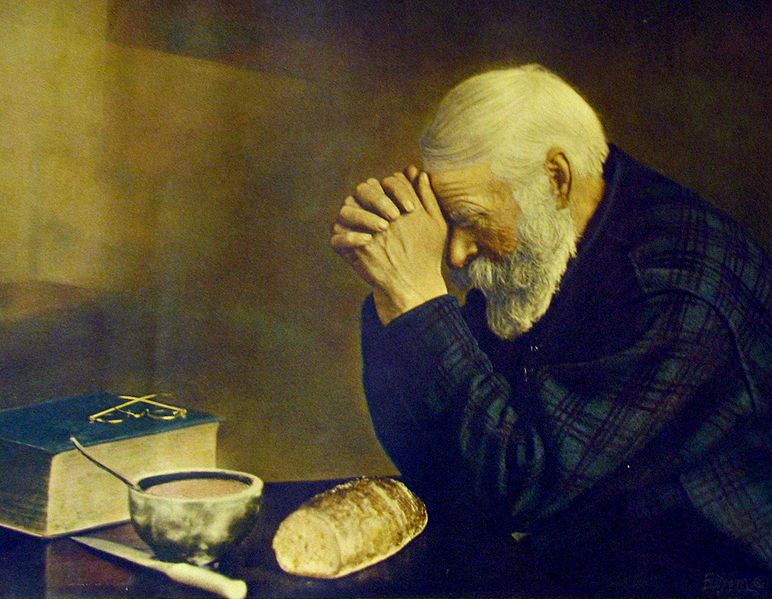
Recent Dish on scientism here and here. On the above image:
Grace is a 1918 photograph by Eric Enstrom. It depicts an elderly man, Charles Wilden, with hands folded, saying a prayer over a table with a simple meal. It was taken in Bovey, Minnesota. Originally black-and-white, the photo was colorized by hand by Enstrom’s daughter, Rhoda Nyberg. It was this colorized version that attained widespread distribution. In 2002, an act of the Minnesota State Legislature established it as the state photograph.
Sarah Carr worries about the Egyptian state controlling the press:
It looks like we are heading towards media oppression that will be worse than under 2011. There is a public appetite for it, and the security bodies have apparently been given a green light to do as they please. Wars on terrorism rely on crude binaries: You are either with us or against us, and this is the constant message being relayed to us ([presidential advisor Mostafa] Hegazy even said during the presser yesterday that Egypt is “taking note of who is with it and who is against it”).
Laura Dean connects Egypt’s polarized media to the country’s deepening divisions:
When the army took power they shut down several Islamist channels, and since then the state and independent outlets have shown unwavering support for the army and the military-backed government. When 51 Morsi supporters were killed by security forces outside the Republican Guard, the army said they were provoked and did little toattempt to justify what was, at the very least, a disproportionate use of force. Despite the overwhelming number of dead Morsi supporters, no one in the mainstream media questioned the military’s line. …
Meanwhile, the Muslim Brotherhood is not innocent of biased and faulty coverage. Following the Republican Guard killings, they used images of dead Syrian children, claiming they were Egyptians that had been killed in the shooting.
David Kenner takes note of the military’s intimidation of foreign journalists:
The official criticism of the foreign press corps has coincided with an increase in attacks on journalists as they cover events in Cairo. The Guardian’s Patrick Kingsley, the Washington Post‘s Abigail Hauslohner, the Independent‘s Alastair Beach, the Wall Street Journal‘s Matt Bradley, and McClatchy‘s Nancy Youssef were all threatened by Egyptian security forces or civilians in the past several days. Brazilian journalist Hugo Bachega was also detained while covering the protests on Friday, as was Canadian filmmaker John Greyson and physician Tarek Loubani, whose current location remains unknown.