Pogonophiliacs Unite! Ctd

by Chris Bodenner

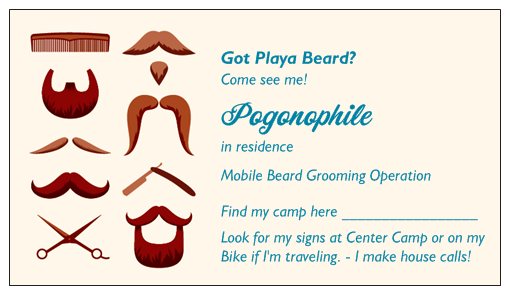
Pogonophile In Residence Card

A reader sends the above image:

In anticipation of Burning Man’s philosophy of gifting, I’m combining my pogonophilia with a free service to all the bearded Burners.  I’m sure your beard will be well cared for, but if you or anyone you know is suffering from “Playa Beard”, feel free to pass along the attached card. I’ll be setting up a part-time operation at Center camp, opening my own camp to beards of all types and even operating a mobile service while passing out cards and performing “house” calls.

Another counters Andrew’s call for letting your facial hair grow:

Why do you get haircuts? Why not just let it grow?  Maybe folks shave the same reasons some people get haircuts. To them, it looks more presentable.

And along those lines, why trim a beard? Another reader:

Oh, the horror of a guy shaving everything – including the pubic area. Do those same male hair lovers (the hetero kind) like women hairy as well? Or do they pride the “hairiness” for males, but females need to shave? Could you delve into that some more? I don’t know – I’m just a curious hairy lesbian …

She should check out the long-running Dish thread, “Why Should Women Shave?” Meanwhile, many readers sound off on a shorter thread of late:

There’s another possible reason why Gillette’s Mach-3 sales are falling. It may well be that the shaving public is getting tired of paying a premium price for their product.

I’m going to be buying razor blades whether I grow a beard or not, since I also shave my head. For years, I was a loyal Gillette customer. The design of the Mach-3 and its follow-on, Fusion, is brilliant. The placement of the hinge is key. It allows you to follow the contours of your face, head, whatever with minimal applied force to the skin.

But that comes at a cost. The cartridges are damned expensive. While they were the only game in town, we paid up. But …

What’s happening now is that the down-market manufacturers are beginning to catch up. Recently, I’ve switched to Wilkinson razors. They’re about as good and the blades are half as expensive. For me that’s an easy choice, beard or no beard.

Another reader:

Some have succumbed to the lure of the old, aided by Reddit. My 22-year-old son bought an old-fashioned razor off the internets, followed the reddited instructions for sanitizing it, and now he shaves with Italian tube shaving cream and a brush. While he has nothing against beards, his would still be a bit scraggly and sparse. But he’s also not supporting the mainstream razor market.

Another Redditor:

Eighteen months ago I bought a Merkur safety razor, a badger hair brush, shave soap, an alum block, and 100 blades, all for around $80. I’ve replaced the soap only, and only once, in that time. The razor and the brush will last indefinitely. At my current rate of shaving (roughly twice a week), it costs me maybe $15 a year to shave. Once one learns how to properly use them, the blades are as comfortable as any multi-bladed contraption. They’re easy to clean and worth several reuses. A straight razor is even more economical, though I found in my own experiment with a straight that I don’t have the patience to learn it.

Reddit has a community of 40,000 dedicated to old-school shaving. It’s just slightly smaller than the one committed to beards.

One more reader:

I pray every day that we have yet to reach peak beard.  This video from a few years back featuring Gavin McInnes (of Vice fame) perfectly captures my predicament (NSFW):

My dear friend and I both suffer from the tragedy of the weak chin.  The era of stubble and bears being acceptable in the workplace was a godsend.  Finally, we could conduct business in the office without looking like Kenneth the Page.  I have not bought a razor in years and I hope society never compels me to do so again.

How To Get More Egyptian Blood On Our Hands

by Patrick Appel

A National Review editorial urges America to “back Egypt’s military.” It claims that the “military’s horrific violence … does not alter the U.S.’s calculus”:

The Muslim Brotherhood and the military government are now at war, and the latter remains the best hope for securing American interests and, ultimately, a free Egypt. We should therefore continue our financial and matériel support for the Egyptian military and maintain as close a relationship as possible to push the government toward our objectives.

In Commentary, Michael Rubin is more unhinged:

So long as the Muslim Brotherhood seeks to turn back the clock, impose its hateful and intolerant ideology upon Egyptians of all religiosities and religions, and refuses to abide by the pathway to transitional elections, and so long as it continues to fight in the streets, then it should suffer the consequences of its actions. And if those consequences result in exponentially higher Brotherhood casualties than army casualties, then so be it. That is the truest path to peace.

Ali Gharib pushes back:

The Muslim Brotherhood is a retrograde, conservative religious movement. In their ham-handed year-long reign over Egypt, they exposed themselves as lacking a serious commitment to democratic principles, such as inclusion and protection of minority rights. But it’s also the largest and best organized political force in Egypt. Rubin’s notion that the Brotherhood should be bloodied into submission represents exactly the same foundational flaw seen in the Brotherhood’s brief rule. Rubin demands, in fashion of old, hard-nosed Republican realists, that the U.S. continue its partnership with the Egyptian military, even amid its massacre of its own citizens. He’s their perfect, and willing, partner.

Larison counters National Review:

The NR editors find the violence earlier this week to be “horrific,” but their preferred policy ensures not only that there will be more of it, but that the U.S. will be actively supporting the most heavily-armed side as it commits new outrages. Instead of distancing the U.S. from the crackdown in Egypt, they would like Washington to be a full partner in it. That means having “as close a relationship as possible” with the government that just committed what is by some accounts the worst one-day massacre of civilian protesters by government forces since Tiananmen.

When Animals Grieve

by Chris Bodenner

A reader responds to Andrew’s latest post about his dogs:

First, thanks for sharing the story about Eddy’s delayed grief for losing her friend Dusty. I thought I’d share a story about when I lost one of my two cats many years ago. Molly was really the first cat I owned (my mom didn’t like cats, so we grew up with dogs). I was renting a small house and took in the stray who stayed there; it was easier to give Custard a home rather than cleaning up the mess he made of the trash cans. While Molly and Custard generally got along, they never seemed particularly close.

Then one day, I was going out of town to visit some friends in New Orleans for a week, so I made arrangements for a co-worker to feed Molly and Custard while I was gone. On my first day in New Orleans, I got a call from Steve – he had gone to feed the cats and found Custard dead. I never learned what happened, but Custard sometimes had the habit of his former stray self and would stuff himself when he had a really large bowl of food and would later vomit. I had a feeling that is what happened, and he probably choked on the extra food he had consumed. Steve very generously offered to bury Custard.

When I got home, I emotionally prepared myself for the loss of one cat but I suspected no emotional response from Molly. After all, cats never gave you any sympathy when you needed it. When I got home, I found a house with no cats and a note from Steve. He said that Molly had gotten away from him and escaped from the house. She then watched him bury Custard from a distance.

He returned a couple of times and left food on the porch but didn’t see Molly. I also didn’t see anything of her the night I got back, but she was at the door early the next morning. The first thing I noticed were that her front claws were completely worn down, and there were marks on the ground where Steve had buried Custard.

She had spent some time digging at the spot where her friend had been buried. My idea of having a cat who paid no attention to Custard’s death was completely wrong. Molly was clearly upset, and my formerly tough, independent cat kept very close to me the next few days. While she eventually calmed down, this represented a permanent change; she spent the rest of her life being much more dependent on me because of the loss of Custard. There clearly had been some deep bond between them I had never perceived.

I’m old enough now to have experienced the death of several pets – dogs in childhood, cats since I’ve been on my own. Dogs and cats can bring a tremendous richness to our lives – it’s just unfortunate we have to experience the pain of their deaths. I hope that you and your husband will take care of each other, along with Eddy, and perhaps consider adopting another dog when your hearts tell you it is the right time.

Another reader remarks on the unparalleled company that pets often keep:

I care for two dogs, brothers/littermates, now just over 10. They have literally never spent a night apart (although at times have slept in different rooms). It is almost unheard of them to not both go on walks at the same time. The only time they are separated for any time is when one or the other goes to the vet.

I live in dread of the impact of the loss of one on the other. They have different personalities, and I can see them reacting differently, but I know the survivor will show grief and possibly worse (if already aged, I think it could speed the process). As much grief as I’ll be feeling, the most important thing I can do at that point is to be there for the surviving brother.

The post that sparked this thread – a reflection on Barbara King’s recent book, How Animals Grieve – can be read here. The long and emotional thread “The Last Lesson We Learn From Our Pets” can be found here.

Jean Bethke Elshtain, RIP

by Matt Sitman

Last week, the prominent political theorist, Christian ethicist, and public intellectual passed away at the age of 72. Elshtain was perhaps best known for making the ethical case for American intervention in Afghanistan and Iraq after 9-11, outlined in her book Just War Against Terror. The NYT obituary describes her impact this way:

In the weeks after the attacks of Sept. 11, 2001, Dr. Elshtain was among a handful of scholars and religious leaders, including Franklin Graham and Cardinal Bernard Law of Boston, invited to meet with President George W. Bush to discuss the response he was considering. Dr. Elshtain had expertise in one particular area of interest to the president, her husband recalled: she had written extensively on the fourth-century Christian bishop later known as St. Augustine and his doctrine of the Just War. That doctrine held that while Christians could not justify killing to protect themselves, they could engage in war to protect the lives of others. The notion became central to the Bush administration’s justification of the war in Iraq as in large part a humanitarian project to free the Iraqi people from a tyrant.

Despite her arguments on behalf of war, many remembrances are emphasizing the difficulty in applying labels to her thinking. Carl Scott summarizes her this way:

[S]he was something of a difference feminist, something of an Augustinian, something of a Jane Addams-ite battler for social justice, something of a communitarian, and something of a foreign-policy neo-conservative.

Her most lasting legacy might be that, unlike many academic political theorists, she sought to engage religious thought in her work, long before it was trendy:

“Her joint appointment in political science and the divinity school at [the University of] Chicago was truly unusual,” said Erik Owens, a professor at Boston College who worked with Elshtain when she was his dissertation adviser. “Religion was not taken seriously enough as a proper subject of study by political scientists through most of her career, and political science was equally suspect in most divinity schools. She helped to bring these two disciplinary guilds into conversation with one another. This may be one of her greatest legacies as a professional academic.”

Biographically, her concern for ordinary people, and the weak and disabled among us, came from her own experiences – especially with illness, as Robbie George, who served with her on President Bush’s Council on Bioethics, points out:

She was a daughter of the west—born and bred in Colorado. She did not enter the world with a silver spoon in her mouth, nor was she given a gilt-edged education. She was among the last cohort of Americans to be struck by polio. She limped throughout her life, but never complained of her affliction or let it slow her down.

Marc Livecche, a former student of Elshtain’s, recalls her refusal “to change anything she thought or to attempt to change anything you thought simply in order to reach an agreeable reconciliation”:

Believing instead that falsehood is the opposite of dialogue, and that real disagreement is a hard won victory accessible only through an honest meeting of minds, she gave it to you straight and demonstrated the refreshing value of frankness-with-charity and invective-against-twaddle. This led to her belief that what the world most needed from Christians was, in Camus’ terms, “Christians who remain Christians.” For Elshtain this meant that Christians have to speak out loudly and clearly, in witness to their normative grounding, against evil in the world, never leaving the world in doubt that we stand against those bloodstained regimes that put the innocent to torture. She bore none of the utopian sentimentalism that believed we could end evil in history but neither did she give in to cynicism by refusing to believe we might end some evils and diminish others.

In addition to her work on just war theory noted above, Elshtain wrote on women and public life, St. Augustine and politics, the moral dimension of democratic life, and more. One of her last major projects was her 2005-2006 Gifford Lectures, which resulted in her book Sovereignty: God, State, and Self. From its final pages:

One of my persistent worries about our own time is that we may be squandering a good bit of rich heritage through processes of organized ‘forgetting,’ a climate of opinion that encourages presentism rather than a historical perspective that reminds us that we are always boats moving against the current, ‘borne back ceaselessly into the past,’ in F. Scott Fitzgerald’s memorable words from The Great Gatsby. This historic recognition should not occasion resentment or dour heaviness; rather, it should instill gratitude. As this book drew to a close, I realized that it was no culminating magnum opus — few books are — but, rather, a contribution to the shared memory of our time and place. And that is enough.

For more, especially if interested in her work in political theory, read Russell Arben Fox’s richly detailed thoughts on Elshtain here. For a critical take on her writings, on torture in particular, see Corey Robin here.

Don’t Lose Sleep Over Sleepovers, Ctd

by Chris Bodenner

A reader writes:

Marcotte’s Dutch example of more progressive attitudes toward teen sex is not unique to the Netherlands. When I was living abroad, a German friend explained to me that when she and every other girl she knew growing up turned 16, their mothers would take them to get birth control pills. It was entirely permissible for her to have a boyfriend spend the night and have sex with him in her parents’ home. In fact, she said, her parents would probably be concerned if she had a boy over and they DIDN’T hear them doing it. It’s worth noting that this young woman was not the daughter of freethinking hippies, but rather straight, conservative Bavarian Catholics; her dad is a cop and her mother is a theologian (yes, really). She always said she couldn’t understand why American parents were so afraid of their teenage children having sex. As a matter of simple logic, it just didn’t make any sense to her, given how many of them end up pregnant, with STIs, or in unhealthy relationships as a result of having no guidance on the subject.

Ferrett Steinmet focuses on the father-daughter dynamic:

There’s a piece of twaddle going around the internet called 10 Rules For Dating My Daughter, which is packed with “funny” threats like this:

“Rule Four: I’m sure you’ve been told that in today’s world, sex without utilising some kind of ‘barrier method’ can kill you. Let me elaborate: when it comes to sex, I am the barrier, and I will kill you.” All of which boil down to the tedious, “Boys are threatening louts, sex is awful when other people do it, and my daughter is a plastic doll whose destiny I control.”

Look, I love sex. It’s fun. And because I love my daughter, I want her to have all of the same delights in life that I do, and hopefully more. I don’t want to hear about the fine details because, heck, I don’t want those visuals any more than my daughter wants mine. But in the abstract, darling, go out and play.

Another reader:

Slightly off topic: A gay couple I know has an elementary school-age son and daughter who have lots of friends and who adore their parents. The couple is also popular with neighbors and fellow school parents.  The daughter has girlfriends on sleepovers as often as the other girls – meaning all the time. But an awkward and sad problem: The fathers of the boy’s friends, as much as they get along with the two gay fathers, refuse to allow their boys on a sleepover at the gay men’s home. So the boy gets no sleepover parties like his sister and friends get.

Throatlump.

Greatness Isn’t Graded On A Curve

by Patrick Appel

Gregory Djerejian is disappointed with Obama’s foreign policy:

[T]he President does have one thing going in his favor. The opposition party would have mounted an even more disastrous foreign policy, I suspect, proactively blundering about saber-rattling with the usual recycled neo-con nostrums, bogging us down in even more theaters than at present. Obama at least has spared us these indignities, ‘leading from behind’ adventures like Libya (and its ugly hangovers) apart. But it is not a particularly proud legacy to say ‘at least I was better than the other guy would have been’. This is not the stuff of a great Presidency, at least when it comes to foreign policy.

Of course, there has been and is much work to accomplish at home, and while not the topic here, whether jobs, infrastructure, Wall Street reform, and more; we should not conclude the Administration necessarily covered itself in glory there either, beyond the easy myths that ‘but for’ pork-infested stimulus, QE-infinity and serial bailouts Great Depression II beckoned (this is not to take away from the gravity of the economic situation we faced in late ’08 and early ’09, nor some of the Administration’s crisis management at the time, or indeed, the prior Administration’s). But while I understand a great power can only remain so from a base of strongly rooted strength at home, and Obama’s apparent focus on domestic politics therefore is not ill-advised, it is another thing to look alternatively peeved, bored, listless and simply largely adrift on foreign policy. Leaders, whether Sisi or Putin, have noticed. We simply must do better, and please, this does not mean better, or more, speeches. It means strategic execution of statecraft in a turbulent, unsettled age of great geopolitical transition, one of the Presidency’s most solemn responsibilities, or at least one might hope, a solemn aspiration. And its manifest absence represents a season of disappointments the international community can ill afford at this juncture.

Joking About Suicide, Ctd

by Chris Bodenner

A reader writes:

I actually think the premise of Amy Schumer’s joke is pretty funny, but it might be funnier if the guy arrives at work Monday and gets called on the carpet for not finishing his work. Of course he didn’t expect to be there, but it turns out this is hardly a new issue of his; he apparently never finishes anything he starts. “You need to develop some stick-to-itiveness, son! You need to follow through to the end!”

Another presumes that Comedy Central killed the joke because it was too skittish about the subject:

There’s no place left for black comedy, I guess, in our timid times. Both MASH and Harold and Maude mined suicide to terrific comedic effect, the latter making suicide both the driver and climax of the movie. Within a year or so of those two movies, Ruth Gordon (Maude) also starred in the hilarious and pitch-black Where’s Poppa? We are poorer for our earnestness.

Below are several more cultural references and links from readers:

Another sterling example of suicide played for laughs is the sequence in Groundhog Day, in which Bill Murray, in a fruitless attempt to escape his endlessly repeating day in Punxsutawney, tries over and over to kill himself. In this particular context, suicide is funny indeed. It’s only one of the many elements that makes Groundhog Day a classic film comedy and one of very few movies that succeeds in using suicide in a humorous way (and yet with a poignant touch).

Another:

I’m probably not the first to email the “Bruce’s Cry For Help” skit from Kids In The Hall, but in case you haven’t seen it, it’s a chuckle (2:00 is the one laugh-out-loud moment for me):

Another:

Oh my gosh, you can’t consider suicide humor with Joan Rivers, who began making jokes about her husband Edgar almost immediately after he took his own life. She has continued to so, and it was a theme of her roast.  Not too long ago, she made Terry Gross almost speechless with her comic references to it.

Update from a reader:

How can any discussion of joking about suicide not include “The End?” Burt Reynolds was at the height of his powers, and bearded:

What Breaking Bad Gets Wrong

by Brendan James

Dylan Matthews fact-checks the show’s portrayal of the meth game:

One of the most convincing critiques of the show I’ve read came from The New Inquiry’s Malcolm Harris, who argued that the show’s obsession with highly pure method — supposedly Walt’s calling card, and the thing that got Gus interested in buying his wares — doesn’t square with the real world, in which meth is almost always “stepped on,” or diluted. There isn’t a market for pure meth, not because it’s not better, but because of who’s buying meth. “It’s a textbook case of what freshman economics students call inelastic demand,” Harris writes. “As Stringer Bell told D’Angelo Barksdale in another show about drugs, in direct contrast to what Walter claims, ‘When it’s good, they buy. When it’s bad, they buy twice as much. The worse we do, the more money we make.’”

Even if that logic holds, there may still be reasons for Walt to make his meth as pure as possible. “When Walt measures the purity in the lab, he’s figuring out how much of the expensive and tightly controlled precursor chemicals became saleable product and how much went to waste,” Lindsay Beyerstein at In These Times has argued. “The purer Walt’s product, the more [distributors] can dilute it.” But that doesn’t explain why Walt’s meth on the street, when found by his DEA agent brother-in-law Hank and analyzed by the agency’s experts, is so much purer than other meth out there. Walt’s product would only make it to the street like that if there really was demand for purer meth.

Update from a reader:

Wasn’t this addressed in last night’s episode, albeit indirectly?

Local scrub dealer Declan is fine with substandard product, as he’s much closer to the end-user, both geographically and in terms of where he falls on the supply chain.  International meth empire mastermind Lydia, on the other hand, needs a purer product.  If you’re moving tons of meth halfway across the globe, you’re going to want the purest product you can have, as it allows for easier transport and lower risk.  I figured that Lydia’s issues with Declan’s substandard product stemmed directly from the fact that the product was meant to be cut upon arrival in Europe, not because Czech junkies are any more discerning than those of Albuquerque.

Previous fact-checking of the show here.

The Game Of Life

by Jessie Roberts

The Novelist is a video game with an unconventional objective:

[T]he player is tasked with guiding an author named Dan Kaplan and deciding how he will spend his days. There are no bullets or rocket launchers here: the core conflict revolves around Dan’s ability—or inability—to balance his career, his marriage, and his relationship with his son.

You, the player, don’t directly control Dan; instead you are a ghost who inhabits his house. You can watch, observe, and manipulate at your discretion. One day, you might direct Dan to sit and work on his novel, boosting his career at the cost of neglecting his wife and son. Another day you might have help out his wife at an art show, or take his kid to the beach. Every time you go down one branch, the other two could suffer.

The idea, designer Kent Hudson says, is to make us all think about how we approach our own major life decisions. “There’s no winning or losing,” Hudson told me during a lengthy phone chat a few weeks ago. “You play through and get a story that my hope—and this sounds so pretentious—but my hope is that as you’re presented with the same fundamental question in nine different ways over the course of the game, that you start to learn about your own values.”

(Hat tip: Page-Turner)

Fighting Over The First Americans

by Matt Sitman

Michael Lemonick profiles the work of archaeology professor James Adovasio, whose excavations of the Meadowcroft Rockshelter in western Pennsylvania helped upend our ideas about the peopling of North America:

A young archaeologist at the University of Pittsburgh, he intended to use Meadowcroft to train students. But what he found here helped demolish his colleagues’ long-held ideas about the timing of humans’ first steps in the New World. Since the nineteen-thirties, the conventional wisdom had held that humans crossed over into North America from Siberia around thirteen thousand years ago, then spread over the next five hundred years through North and South America—wiping out mammoths, mastodons, and other large mammals as they went. This hypothesis became known as the “blitzkrieg model” of species extinction.

But Adovasio, now a professor at Mercyhurst University, in Erie, Pennsylvania, discovered evidence that humans had camped at Meadowcroft, under a protective rock overhang, sixteen thousand years ago—a few thousand years before the Siberian crossing.

Adovasio at least partly blames old-fashioned prejudices for the persistence of the theory he rejects:

In part, he attributes the longstanding acceptance of this implausible story to the fact that, until relatively recently, most archaeologists were men. “I mean, who but a male would think that the ancestors of modern Native Americans sprinted to South America and killed everything in their path?”

If the first immigrants did arrive much earlier, the ice-free corridor through the glaciers wouldn’t have been available. But there’s an alternate route: they could have travelled down the coast in boats. “The colonization of Australia occurred even earlier,” Adovasio said. “It’s, in my opinion, simple racism that we never recognized before that the earliest populations in the Americas were capable of building boats.”