Will Marriage Equality Come To New Jersey?

Will Baude reviews a current court case:

Last week, I had a post that was skeptical of the claim that current law requires the federal government to recognize state civil unions as marriages. Reading through this brief recently filed by the state of New Jersey, I am no longer so sure. (The brief is a defense of New Jersey’s civil union law — which allows same-sex couples to have civil unions with the same legal status as marriage, but not technically marriage itself — but the brief also argues that the federal government is required to recognize the civil unions.)

For one thing, state civil union laws sometimes contain language that defines the word “spouse” to include unioned couples in addition to married couples. (See, e.g., the Illinois civil union law I discussed here.) And some federal provisions use the word “spouse” rather than the word “marriage,” although it is not clear they intended for “spouses” to include people who are not in a “marriage.”

For another thing, it almost looks like New Jersey law already defines civil unions as a form of marriage, by stating that marriage includes civil unions.

Nathaniel Frank points out a contradiction in the state’s brief supporting the status quo:

“To reserve the name of marriage for heterosexual couples,” says the brief, makes sense because “altering the meaning of marriage” would, in the words of the 2006 ruling, “render a profound change in the public consciousness of a social institution of ancient origin.” The definition of marriage has “far-reaching social implications.”

Oops, except then it doesn’t. The brief then does an about-face, insisting that the nomenclature distinctions have no meaning at all—an effort to show that the law is not rooted in anti-gay prejudice.

A “long-standing precedent,” the brief explains, dictates “that courts look to essence, not label.” It cites a 1915 court case finding that a law’s import “lies in the essential nature of the work done rather than the names applied to those engaged in it.” The brief goes to great lengths to drive home this point, even dragging in the Bard: “Shakespeare wondered what’s in a name?; for purposes of federal criminal law, the answer is ‘nothing.’ Substance rather than nomenclature matters.” And: “A rose by any other name is still a rose.” And: “Calling a dog’s tail a leg will not give the dog five legs.”

Let’s imagine for a moment that it’s true that nomenclature doesn’t matter a whit. If that’s right, then it’s the strongest case yet for the other side. If there is nothing in the name “marriage,” then New Jersey’s Civil Union Act has no rational relationship to an important state interest. The label is the single distinction the law makes. How can that both serve a compelling governmental interest and mean absolutely nothing, at the same time?

The brief also “contends that it’s actually the feds who are now blocking gay equality by withholding benefits to civil union partners.” Timothy Kincaid suspects that Christie plans to lose the case:

Christie and his legal team have crafted an argument that, while complete legal nonsense, allows him to position himself as a champion of gay couples. He’s declared that the federal government is obligated to recognize civil unions as marriages. And, if it does not do so, plaintiffs should sue the Obama Administration instead of him.

Despite its chutzpah, it’s astoundingly smart. Christie can shift his presented stance from oppressor to advocate, merely by asserting an absurdity. It is he who wants his state’s gay couples to have federal rights, you see, and it’s the Obama Administration that is refusing equality. And it has the added benefit of positioning him to (as I suspect he will) champion the idea of federal civil unions recognition when he makes his presidential run.

Surprised By Grief

dustymontage3It’s not as if I have any excuse (you warned me plenty of times) but I’m shocked by how wrecked I am right now. Patrick, Chris and Jessie, thank God, have been holding down the fort on the Dish, because otherwise I’m not sure I could think about much else right now. How can the emotions be this strong? She was a dog, after all, not a spouse or a parent.

And yet, today, as I found myself coming undone again and again, I realized that living with another being in the same room for 15 and a half years – even if she was just a mischievous, noisy, disobedient, charming, food-obsessed beagle – adds up to a lot of life together. I will never have a child, and she was the closest I’ll likely get. And she was well into her teens when she died.

She was with me before the Dish; before my last boyfriend, Andy; before I met Aaron. She came from the same breeder as the beagle my friend Patrick got as he faced down AIDS at the end of his life. I guess she was one way to keep him in my life, so it was fitting that his ex-boyfriend drove me to the farm in Maryland to get her. I was going to get a boy and call him Orwell (poseur alert) but there were only girls left by the time we got there. I didn’t know what I was doing but this tiny little brown-faced creature ambled over to me and licked the bottom of my pants. She chose me. On the ride home, I realized I hadn’t thought for a second what to call a girl dog, and then Dusty Springfield came on the radio.

My friends couldn’t believe I’d get a dog or, frankly, be able to look after one. I was such a bachelor, a loner, a workaholic writer and gay-marriage activist with relationships that ended almost as quickly as they had begun. I thought getting a dog would help me become less self-centered. And of course it did. It has to. Suddenly you are responsible for another being that needs feeding and medicine and walking twice a day. That had to budge even me out of my narcissism and work-mania.

But I also got her as the first positive step in my life after the depression I sank into after my viral load went to zero in 1997. I know it sounds completely strange, but the knowledge of my likely survival sent me into the pit of despair. I understand now it was some kind of survivor guilt, and, after so much loss, I had to go through it. I wrote my way out of the bleakness in the end – as usual. But this irrepressible little dog also pulled me feistily out.

She was entirely herself – and gleefully untrainable. I spent a large part of our first years together chasing her around bushes and trees and under wharfs, trying to grab something out of her mouth. She’d find a disgusting rotten fish way underneath a rotting pier, wedge herself in there, eat as much as she felt like and then roll around in ecstasy as I, red-faced, bellowed from the closest vantage point I could get. There was the year that giant tuna carcass washed up on the sand and I lost her for a split second and nearly lost my mind looking for her until I realized she was inside the carcass, rendering herself so stinky it was worse than when she got skunked. But the smile on her face as she trotted right out was unforgettable. It was the same, proud, beaming face that appeared from under a bush in Meridian Hill Park covered in human diarrhea, left by a homeless person. Score!

Good times: the countless occasions she peed in the apartment, always under my blogging chair, driving me to distraction; her one giant chocolate orgasm, when she devoured two boxes of Godiva chocolates left on the floor by a visiting friend, ate every one while we were out at dinner, and then forced me to chase her around the apartment when I got home, as she puked viscous chocolate goo over everything, until I slipped in it too. Yes, she survived. The rug? Not so much.

She was also, it has to be said, always emitting noise. She had a classic howl, and when the two of us lived in a tiny box at the end of a wharf, she would bay instinctively at every person and every dog she saw come near. It’s cute at first. But after a while, she drove most of my neighbors completely potty. I tried the citronella collar, but she found a way to howl that stayed just below the volume that triggered the spray. Howling was what she did. There was no way on earth I was going to stop it.

But there was one exception to this rule. In my bachelor days, I’d stay out late in Ptown, trying to get laid, and often getting to sleep only in the early hours. I installed some floor-to-ceiling window blinds to block out the blinding sun over the water – so I could sleep late (this was before the blog). Dusty – usually so loud and restless – would wait patiently for me to wake up, and wedge herself between the bottom of the fabric of the blind and the glass in the window. That way, she kept an eye on all the various threats, while basking in the heat and light of the morning. And until the minute I stirred, despite all the coming and going around her, she uttered not a peep. In her entire life, she never woke me up. This is the deal, she seemed to tell me. You feed and walk me and house me on a beach all summer long, and I’ll let you sleep in.

It was a deal. She never broke her part of it; and I just finished mine.

(Photo montage by Aaron Tone.)

Soaring Through Our Imagination

dish_swifts

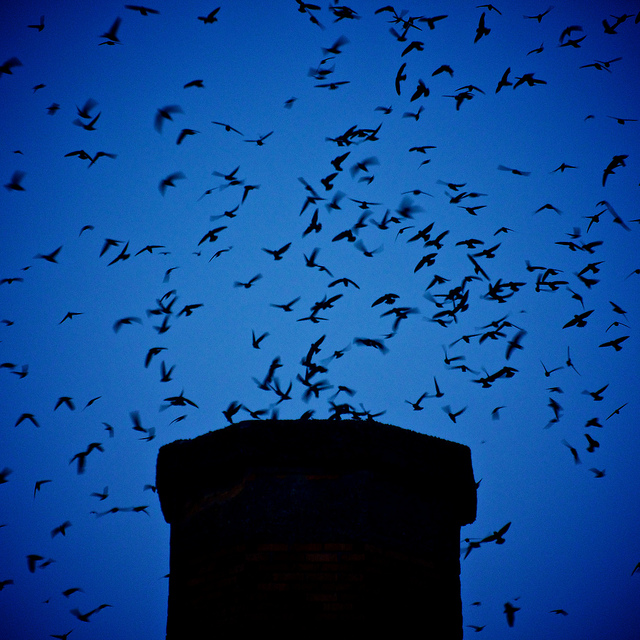
Mark Cocker contemplates the cultural cachet of birds:

The central symbolic value that birds play in language, literature, art, thought and religion is that of transformation from one state to another. The idea is ancient, visceral and undeniable. Mesolithic infants have been found buried with their heads resting on swans’ wings. The symbol for the Holy Spirit in the Christian faith is a dove. In south-east Asia cranes carried the souls of the dead to heaven. At weddings throughout the western world people release white doves as a symbol of the couple’s love. In Europe white storks bring the spring. Muslims built hospitals to house injured storks and made it an offence to harm them. Traditionally the symbol of homecoming for sailors was the swallow tattooed on their arms.

The examples are innumerable. Central to them all is the idea that birds often express our most cherished ideas and our most exalted values. Look at the spectrum of national flags and other state insignia. Birds, particularly birds of prey, are everywhere – few other creatures feature. It is surely this association with transcendence, or some tiny fragment of it, that is at work in all our encounters with birds. And it is for this reason that they are so crucial to our relationship with all nature.

Jim Crace shares his experience of swifts, “a bird neither friendly nor unfriendly”:

Here, this evening, in Grasse in the Alpes Maritimes of southern France, the noise trapped in the dilapidated, medieval, traffic-free alleyways and courtyards is deafening and eerie. At least a thousand screaming swifts have condescended to spend an hour close to me. I could almost catch one with a butterfly net if I stretched high enough and if they weren’t such whizz-kids of the wing, celebrating every duck and dive and every taken bug with their falsetto palaver. In the final shadows of the evening, these alpine swifts are closer to my head than either starlings or bats would ever dare to come. They are as close as gnats. I’m standing in the eye of the swarm. But still I cannot claim any intimacy with them. Despite this tumultuous proximity, they are not sharing any of their world with me. There is no interface, no common ground. They’re still aloof. My love for them is vain. All they know about is bugs and air, feeding, flying, moving on. They leave me gaping at an empty sky.

Previous Dish on our feathered friends here and here.

(Photo of flying swifts by Robert T. Britt)

Robbed By The Cops

Sarah Stillman spotlights the abuse of civil asset forfeiture laws:

The rise of civil forfeiture has, in some areas, proved of great value. It allows the government to extract swift penalties from white-collar criminals and offer restitution to victims of fraud; since 2012, the Department of Justice has turned over more than $1.5 billion in forfeited assets to four hundred thousand crime victims, often in cases of corporate criminality. Federal agents have also used forfeiture to go after ruthless migrant smugglers, organized-crime tycoons, and endangered-species poachers, stripping them of their illicit gains. Global Witness, the anti-corruption group, recently cheered the Justice Department’s civil-forfeiture action targeting the son of Equatorial Guinea’s dictator, which sought his Malibu mansion, Gulfstream jet, and some two million dollars’ worth of Michael Jackson memorabilia, including a bejewelled white glove.

Yet only a small portion of state and local forfeiture cases target powerful entities.

“There’s this myth that they’re cracking down on drug cartels and kingpins,” Lee McGrath, of the Institute for Justice, who recently co-wrote a paper on Georgia’s aggressive use of forfeiture, says. “In reality, it’s small amounts, where people aren’t entitled to a public defender, and can’t afford a lawyer, and the only rational response is to walk away from your property, because of the infeasibility of getting your money back.” In 2011, he reports, fifty-eight local, county, and statewide police forces in Georgia brought in $2.76 million in forfeitures; more than half the items taken were worth less than six hundred and fifty dollars. With minimal oversight, police can then spend nearly all those proceeds, often without reporting where the money has gone.

Ilya Somin believes that the “best solution is to abolish civil asset forfeiture completely”:

As a practical matter, most of the people victimized by asset forfeiture abuse are poor, lacking in political influence, and unable to bear the expense of prolonged litigation. For these reasons, there is little political pressure to prevent the sorts of abuses documented in Stillman’s article and elsewhere. And there is similarly little incentive for higher officials to monitor police and prosecutors’ use of asset forfeiture to curb this kind of behavior. A categorical ban on civil asset forfeiture would be easier to administer than piecemeal reforms, and therefore more likely to succeed.

A Second Chance For Bob Dylan’s Worst Album

In 1970, Dylan released Self Portrait, a notoriously awful album that has confounded many of his fans for decades. When Greil Marcus reviewed it in Rolling Stone, he famously began with the question, “What is this shit?” Now, as part of their “Bootleg Series” that uncovers rarities, outtakes, and unreleased tracks from Dylan’s recording sessions, Columbia Records is releasing Another Self Portrait, offering a fuller picture of what the songwriter was up to at the time. Kevin Courrier thinks we have reason to be optimistic about the album, believing it will show “a man tracing the roots of both his musical path and interests”:

Self Portrait suffers from the sense that Dylan is playing the songs to himself rather than to the listener.

But the samples I’ve heard on Another Self Portrait, from Eric Anderson’s “Thirsty Boots” and Tom Paxton’s “Annie’s Gonna Sing Her Song,” actually reach out to an audience. You hear the threads of what not only came to define the musical territory Dylan had already been mining to that point, but also what would later become the Bob Dylan Theme Time Radio Hour on satellite radio. On that program Dylan, as the host, took us on musical journeys through the history of American music – blues, jazz, show-tunes, rock and folk – using a theme like ‘the weather’ as the clothes line on which he hung the songs. On Another Self Portrait, he also extends to his listeners the country sound he was immersed in with his previous album, Nashville Skyline, by reminding us (as he had on the infamous The Basement Tapes) that his music was not narrowed by the social protests of the topical song. In his mind, the American songbook is an evolving and expanding catalogue tracing a map of the nation’s struggles and triumphs.

Another Self Portrait could very well be the album that Self Portrait wasn’t. It may compare to how Good As I Been to You (1992) and World Gone Wrong (1993) set Dylan up for his series of records (Time Out of Mind, Love and Theft) that brought his voice back to its authentic sound. In those two early Nineties records, Dylan revisited the songs of his youth, earlier versions of the America that would help him come to terms with the country he was living in now. He then set forth to mine his own path with those tracks (“World Gone Wrong,” “Black Jack Davey”) as skeleton keys for his own (“Not Dark Yet,” “High Water (for Charley Patton)”). But we already know that the history that followed those sessions led into the eventual aimlessness that Good As I Been to You got him out of. The only authentic thing about Self Portrait was its portrait of an artist in hiding. What Another Self Portrait might just reveal is more of what Dylan was actually hiding from.

Aging Along With Our Books

Jen Doll pens a love letter to the books that filled her childhood summers:

There are a great many excellent summer reads, but to me, some of the most moving books of summer are the ones we read way back when we were kids on summer vacation. These stories may be five or 10 or 20 years old, or more, yet they still manage to take us right back to that childhood sense of summer, and wonder, when the days stretched out long and full of possibility, when the sun didn’t go down until 9 p.m. and we could roam free in our neighborhoods, ruling our small worlds, until then. Anything could happen by day, but by night, I’d be tucked in bed with a good book, which I could read with impunity into the wee hours because there was no school the next day. I’m a big believer in re-reading, particularly books we experienced at some long-ago time in our lives, because the power of those stories is not just in their words. They are transportive, letting us remember, re-live, and compare who we were then with who we are now.

Along the same lines, Judith Hertog recently revisited Ivan Turgenev’s classic novel of social change in Russia, Fathers and Sons, and came away surprised by how her response to the work had changed:

On rereading, I had expected to recognize the scenes and characters that moved me years ago. But I could not even guess which passages I had underlined and annotated as a seventeen-year-old. I vaguely remembered being impressed with Bazarov – it was probably one of his speeches that I recommended to my friends – but as an adult, I found Bazarov childishly pompous and recognized him as an insecure young man who holds on to the reassurance of big ideas to avoid having to make emotional connections. He was, in fact, I now realized, the boyfriend with whom I had just broken up when I was seventeen and whom I continued to love obsessively.

On second reading, I found that my sympathy now lies with the older characters, whom Bazarov ridicules. I felt pity for Bazarov’s parents as they try to understand and please their disdainful son. I identified with Arkady’s tenderhearted father, whom Bazarov dismisses as a sentimental fool. I even found myself siding with Arkady’s conservative uncle, Pavel. When, in one of their many quarrels, Bazarov declares that he questions anything that has not been proven, Pavel replies: “We are old-fashioned people; we imagine that without principles… taken as you say on faith, there’s no taking a step, no breathing…” Now that I’m an adult, I’m inclined to agree with Pavel that there is indeed a limit to the power of rational thought. In the twenty-five years between my readings of Fathers and Sons, the elements that originally did not speak to me seem to have germinated and become a part of myself.

Leaving Europe For Jihad

Sebastian Rotella takes note of the unprecedented wave of radicalization driving Muslims in Europe to join jihadists in Syria:

“Imagine this: Between 2001 and 2010, we identified 50 jihadists who went from France to Afghanistan,” said a senior French counterterror official who also requested anonymity. “Surely there were more, but we identified 50. With Syria, in one year, we have already identified 135. It has been very fast and strong.”

The statistics are even stronger in adjoining Belgium, one-sixth the size of France. Between 100 and 300 jihadis have journeyed from Belgium’s extremist enclaves to Syria, according to a veteran Belgian counterterror official. Other significant fighting contingents represent Britain, Denmark, the Netherlands, Canada, Central Asia, Libya, Tunisia, and Saudi Arabia. The senior French official estimated the total number of Europeans to be at least 400. Others say it could be double that, but counterterror officials warn that precise numbers are difficult to establish.

Update from a reader:

While there can be no doubt that the conflict in Syria has stirred the passions of radical elements within Islamic culture, I think it’s worth casting a suspicious eye on Rotella’s statistics on the “jihadists” who have fled France and Belgium for the war in Syria, and the comparison he makes to the Afghan war. Syria was, after all, a French colony for years, and French is a commonly spoken language there.

That there are a substantially higher proportion of immigrants of Syrian descent living in both France and Belgium than those of Afghan descent. France doesn’t even make the top-10 list of countries playing host to Afghan refugees.

Rotella’s use of the indifferentiate term “jihadists,” imagining a unified front of de-nationalized, radical Muslims bent on the destruction of the West, hides the most logical cause of these departures for the battlefields of Syria: a lot of these young men are culturally connected to Syria. Do you honestly think the European police forces distinguish between “jihadists” of the Al-Qaeda sort, and other politically motivated Arabs…say those whose families were harmed by the current Baathist regime in Syria? Nuance has never been the strong suit of those characterizing the motivations for action among Arabic speaking Muslims.

Again, I don’t question that a portion of those who have joined the fight in Syria see this as step-one in a battle against the Great Satan. But to characterize this as an “unprecedented wave of radicalization” rather than a not-unsurprising response to cultural connections in that same, mundane way that the Irish Catholics of Boston were more interested in the goings-on of the IRA than the German Catholics of Missouri, is rhetorically inflammatory and sheds more heat than light.

A Pen Pal In Solitary

A reader writes:

I never imagined that I would someday be in a position where I personally know someone in solitary confinement, or that I would be able to confirm what Atul Gawande wrote in The New Yorker about solitary confinement: “Whether in Walpole or Beiruit or Hanoi, all human beings experience isolation as torture.” I have been writing to a long-term prisoner since September, 2004. In early 2009, she was placed into solitary confinement, where she remains today, four and a half years later. Our correspondence has continued throughout.

She is an outgoing, social person, and four-plus years of solitary confinement has been particularly hard on her.

For the first year or so, she was in a cell that had an inner door of bars, which remained closed all the time, and an outer solid door which she could slide open, allowing her to talk with other prisoners in nearby isolation cells. Then she was moved to a cell with a door that stays closed all the time. The lights in her cell are left on 24 hours a day. When she leaves her cell, it’s in full irons, with her ankles shackled and her wrists chained to her waist. The guards aren’t allowed to talk to her, except to give her commands. All her visits are non-contact. She loves long hugs, but hasn’t had a hug of any kind in almost five years. Even when her mom and dad visit, she only talks to them over a phone, through a glass window.

The effects of solitary confinement – especially depression and loneliness – are obvious from her letters. She spends much of her day sleeping, and only gets limited time outside her cell for exercise and a shower. Guards are not allowed to talk to her, except to issue commands. To me, the effects are obvious. She wrote regularly; she was optimistic and curious. Today she writes sporadically and fights a never-ending battle with depression. She deals with the depression with prescription drugs, prescribed by the prison psychologist.

Now that I’ve seen the effects of long-term solitary confinement on someone I know, I can say with certainty: it’s torture.

The Puritanism Of Progressive Parents, Ctd

A reader writes:

As a former resident of Portland, I’ve followed the fluoridation debate lightly without much of an opinion, but have dug into it some more with the unfurling of this thread. I tip my cap to the reader who linked to the anti-fluoride site. I, for one, have been trying to figure out what’s wrong with my teeth for some time, with no leads (even from dentists) until I saw the pictures of dental fluorosis:

teeth2

I grew up in Lawrence, KS which had fluoridated water, and my teeth look like those with mild dental fluorosis. (But I also had no cavities while growing up.)

Overall, I thought that some of the arguments made on the site were compelling, some less so. But the reflexive cries of “whack-job” by readers in the following post made me cringe. In addition to providing zero links to their claims of pseudo-science for others to evaluate, there’s a rich irony lost on the responders.

Oppenheimer’s article wasn’t about fluoridation or organic food; it was about the aggressive purification of the left betraying the fundamental values of classic liberalism and subverting its societal priorities. That those readers imagine that they’re proving Oppenheimer’s point by citing Western medicine is laughable. There is perhaps no better example of “liberal” ideological purity and certainty than mainstream Western medicine, which dismisses all forms of knowing that can’t been “proven” in a lab.

A reader with a long-term illness writes:

I couldn’t resist responding to this statement: “Ignorance of science and medicine is a luxury that is great so long as you’re basically healthy. When you’re really sick, however, you’d better toss all that alternative crap out the window.” What upsets me most is the either/or attitude the reader advocates. I think this mindset permeates our culture.  I think it’s completely unproductive and does nothing but produce self-righteous justification for one’s current beliefs.

I was raised holistically by both my parents.

On the rare occasions me or my brother did get sick my parents used homeopathy and other alternative methods and home remedies to treat us.  When we had colds, it was honey / lemon / cayenne pepper tea, and onion cough syrup.  If you look either of the home remedies up you will see that they are very old and have been used for many generations.  Neither of us ever had bronchitis, tonsillitis, strep throat or other common childhood illnesses.  We had our regular check ups and yes we got our required shots.  We were the healthiest kids in our class and of most of our friends.

However, that changed for me around 10-12 when I got bit by a tick.  I didn’t know it at the time, but I had contracted Lyme disease.  My lyme would go undiagnosed for close to 20 years until I reached 30.  In my early 20s I developed very severe endometriosis.  After much searching and many visits to various doctors and specialists over a 3.5 year period, I was properly diagnosed and had two surgeries for it.  The first was diagnostic but didn’t fix the pain.  The second was done two years after my first by a surgical specialist and I was finally on the mend – or so I thought.  I was diagnosed with chronic and untreated lyme disease two years after my second surgery.  (Before any of your skeptics chime in on my lyme diagnosis, my diagnosis was confirmed based on the CDC guidelines for diagnosing Lyme, even though my bite occurred almost 20 years prior, and I never had any of the initial symptoms of a bull’s eye rash, fever or flu like symptoms.)

I write this brief history to note that I am exactly the type of kid the reader was referring to.  But you know what ultimately got me better?  BOTH alternative therapies and Western medicine.  During the two years between my first and second surgeries, I used prescribed drugs by my gynecologist but I used acupuncture and Chinese herbs to support my system.  This kept my nausea and fatigue at bay and was very helpful in lowering my pain.  I also used a long list of other therapies, including medical marijuana. My Lyme treatment started with herbs for the first 1.5 years followed by a solid year of long-term antibiotic therapy.  During this I worked closely with a kinesiologist that my Lyme doctor (yes, a regular MD) sent me to in order to tweak my supplements and antibiotics as needed.

Without using both holistic and allopathic medicine, I don’t think I would be as healthy and thriving as I am today.  My Lyme is in remission and my endometriosis is under control.  I still have mild symptoms that are controlled with herbs and supplements in addition to progesterone therapy, and a diet focused on whole foods, fruits and veggies. I think it’s incredibly narrow minded to dismiss the “alternative crap” as “ignorance of science”.  I needed the drugs and the surgery, and I was perfectly willing to admit that and to use them as needed.  But I wasn’t about to dismiss other treatments I’ve used preventatively my entire life that helped to sustain me and move me through my medical issues in a gentler way.

Update from a reader:

“There is perhaps no better example of ‘liberal’ ideological purity and certainty than mainstream Western medicine, which dismisses all forms of knowing that can’t been ‘proven’ in a lab.” I have my issues with liberal dogma (which most certainly does exist), but if one cannot prove something in the lab, then it isn’t “known” – it is rumor. Worse yet, such logic leads to homeopathy, healing crystals, and other bunk.

True, some herbs have medicinal properties, but unless one has run a double-blind test, then you truly don’t know if the herbs do anything beyond the placebo effect. The US government has spent over a billion dollars trying to prove non-Western medical claims, and guess what? The herbs and other items very rarely do anything positive, occasionally show mild effects, and often have undocumented side effects.

Wanting things that have been proven in the lab might be something many liberals want, but that want is based on what science has done for us, while the dismissal of the scientific method by your reader in nothing short of scientific denialism that is also the father of global warming denying, anti-vaccination movements, and other kinds of crazy.

Kerry’s “Fool’s Errand”? Ctd

As 104 Palestinian prisoners are set to be released from Israeli jails with Netanyahu’s approval, Abraham Katsman still puzzles over why the PM opted for this as a precondition for peace talks:

Israel has taken a diplomatic beating lately, including the E.U. decision to ban financing and cooperation with Israeli institutions in all territory captured in 1967 (including Jerusalem’s Old City). Netanyahu may feel compelled to take some heat off Israel by entering talks even at this painful price, while being confident that the Palestinian leadership will reject any reasonable Israeli offer. If Netanyahu can widen the perception that the absence of peace is due to unreasonable Palestinian demands and intransigence, that may ease the building diplomatic pressure on Israel.

That’s not a bad bet. First, Abbas set an acrimonious tone by this week by restating that no Jewish Israeli —soldier or civilian—could live in his future Palestinian state. Love is not in the air.

Yousef Munayyer doubts Israel has any reason to worry about its image, which is part of the problem:

Israel is pleased with negotiations for negotiations’ sake.

If they can, along with the United States, impose their will on the Palestinians and get them to accept a deal that leaves them with an impractical and indefensible demi-state of Bantustans, they might come to an agreement. If they can’t force such an agreement on the Palestinians, they will likely blame the Palestinians for the failure of the talks and key pro-Israel figures in the U.S. will support this narrative as well, allowing Israel to argue that it did all it could do and to effectively buy more time for the occupation.

To break this cycle, the U.S. must do something they have never been able to do in the peace process before: credibly and resolutely pressure Israel to comply with international law to achieve a just settlement. If Washington cannot do that, then the negotiations that they have convened merely support an Israeli public relations campaign aimed at convincing the world that they are on their way out of the West Bank while they only entrench themselves deeper in it.

More Dish on the current round of talks here, here and here.