Gingrich recently admitted that the GOP should reexamine its foreign policy:
I am a neoconservative. But at some point, even if you are a neoconservative, you need to take a deep breath to ask if our strategies in the Middle East have succeeded. … It may be that our capacity to export democracy is a lot more limited than we thought.
Jacob Heilbrunn sees Newt’s reversal as “a further sign that the old consensus in the GOP is fraying”:
Gingrich has long had an astute sense for the pulse of the GOP. He may well believe—and his belief may be justified—that the party is at a turning point when it comes to examining its stands on foreign policy. The GOP has yet to undertake a real reckoning with the policies of the George W. Bush and Dick Cheney.
It’s interesting that Gingrich is saying these things at a time when most hard-liners and hawks in the party are reaffirming their support for the ideas behind failed Bush-era policies, but I’m doubtful that Gingrich’s “change of heart” is all that significant. As a sign that hard-liners continue to lose ground in the party, it could be a welcome development, but it is just as easy to see Gingrich’s remarks as an effort at damage control. It seems to me that Gingrich isn’t saying these things because he wants to abandon neoconservatives, since he still claims to be one, but because he recognizes that their dead-ender defenses of extremely unpopular wars and attacks on Rand Paul are not having the desired effect.
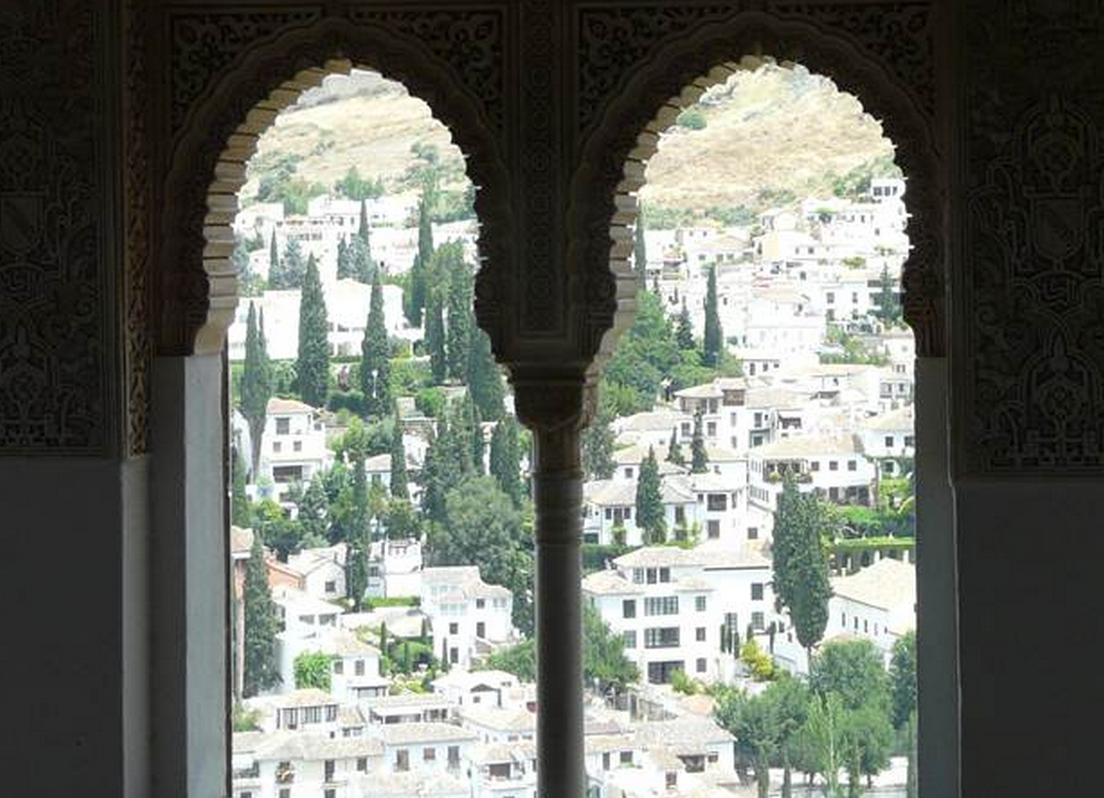
First impression of the picture gives me a distinct eastern Mediterranean vibe. The architecture and climate could fit anywhere between Egypt and Turkey. While it wouldn’t shock me if this was on the Iberian Peninsula somewhere, I’m staking my claim in Jordan. It seems a bit too sparsely vegetated for Turkey, too hilly for the Nile delta, and with conflict in Syria, I’m eliminating that country. It’s a crap shoot between Israel, Jordan, and Lebanon but I had to pick one, so here’s hoping.
Another reader:
I’ve never entered the contest before, but the decoration around the window is the first thing that struck me as so familiar. Though the coloring in the photo isn’t very sharp, the view and the pines also drew me to Villa d’Este, Tivoli, Lazio, Italy. Looking through photos I have from my last visit, so many of the buildings are similar. Though I’m not sure what exact window in the Villa it was taken, I believe it is facing north from a 3rd floor window toward the Reserva Naturale Monte Catillo. The only other problem is most windows in the villa are rectangular with only a few being arched.
But there are so many sights like this in central Italy, it could be just about anywhere. Oh, well! It did take me back to my last trip to Italy.
Another:
Is it the view from the bell tower of St. Francis of Assisi church, Umbria, Italy (and a hat-tip to the pope for his comments about gays last week?)
Another:
It looks like the hilly areas around Jerusalem, the Mount of Olives.
Another:
Tehran? Parts of it are extremely affluent and some of the architecture there is Beverly Hills-esque. That’s my guess.
Another gets in the right territory:
My guess is that this picture was taken in the southern part of Spain, Andalusia region. Specifically I think it is Cordoba. My wife and I went to Malaga for our honeymoon, so when I saw the picture, the South of Spain immediately came to my mind. It looks like the great mosque-cathedral or maybe Alcazar Palace.
Another nails the exact location:
Spain, Italy, Greece, Turkey. Right away, I narrowed this week’s contest to those four countries. Next, I eliminated Spain, since last week’s contest was in Spain, and what are the odds? Then I crossed off Italy, since those windows seemed to be plainer. Nothing really doing in Greece, so I turned to Turkey, fairly confident. The detail on the arches themselves, the Byzantine-looking designs around windows, Turkey seemed like a strong possibility.
But then I found the attached picture, and PLOT TWIST, it’s actually in Spain.
Specifically, it’s from the Alhambra, in Granada, Andalusia, Spain, facing north. Thanks for an easier one after last week. Although I did learn a lot last week, and I was the fifth or sixth best guess, which I’ll take given how hard it was.
Another provides some history:
The Alhambra was originally constructed as a fortress in 889 and later converted into a royal palace in 1333 by Yusuf I, Sultan of Granada. As Ferdinand and Isabella completed the reconquest of Spain, the last Muslim ruler Muhammad XII of Granada surrendered the Emirate of Granada in 1492, a singular year for the Spanish Empire for several reasons besides this final capitulation of Islam in the West. Legend has it that as the Moorish royal party moved south toward exile, they reached a rocky prominence which gave a last view of the city. Muhammad XII, surveying for the last time the Alhambra and the green valley that spread below, burst into tears. Whereupon his mother, clearly a an unsentimental person, reproached him bitterly mocking, “Thou dost weep like a woman for what thou couldst not defend as a man.”
Another reader:
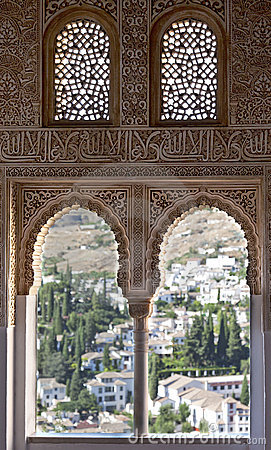
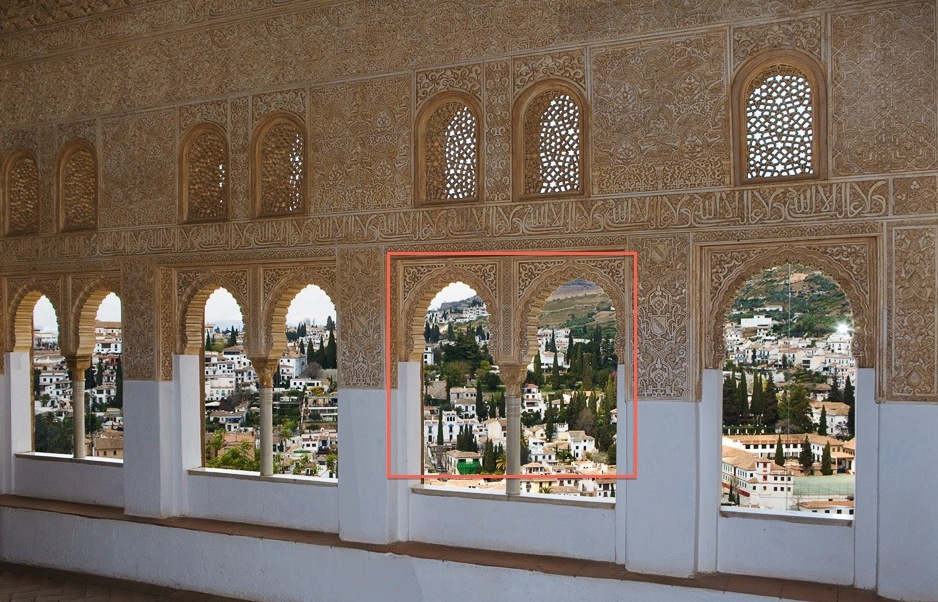
The window is one of four twin arches in the Oratory at the Alhambra, which means Red Castle in Arabic:
I’m still frustrated I didn’t get my submission in on time last week, so I looked at this week and thought: I’m not sure that I’m ready to face it. I gave it to my wife to look at, and in less than ten minutes she said: “It’s Alhambra, Spain!” If I win with this submission – when it wasn’t even me that found it – and when I might have won last week’s really hard one if I’d just got the time change right, then well, I guess c’est la vie.
Another:
I have a feeling that this week’s contest might not be too difficult. It took about 10 seconds to find a higher quality picture similar to the contest photo to confirm that we are in Granada Spain north of the Alhambra. Then it took some time searching images from inside the Queen’s Dressing Room, the Comares Tower, the Ladies Tower, and the Tower of Mihrab before finally stumbling on the Oratory:
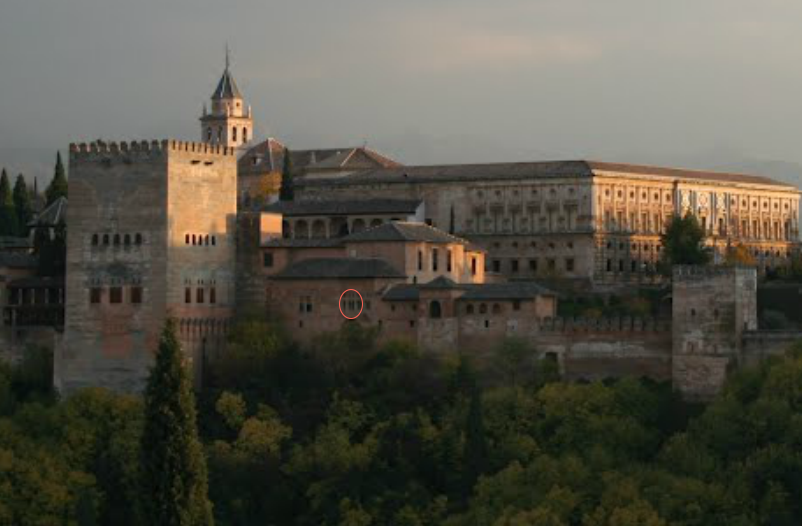
You posted my aerial view with the red lines in the answer to #156. It was one of the first contests I entered and the first time you posted anything I submitted. I assume that I will lose this one because either I was yet again one or two windows off or someone else will win the tiebreak. As always, thanks for the contest.
Another:
The palace is of course beautiful, and its reputation is well-deserved. One interesting fact is that there are some 10,000 calligraphic inscriptions in the palace, which are apparently not at all easy to read even for Arabic speakers. Amazingly, there was no effort to systematically catalog and transcribe them until recently.
Rick Steves provides an up-close tour:
Another reader:
You must be feeling charitable this week. I’ve seen so many of these views where I had not even the slightest clue. This one is obvious enough that I imagine you’ll receive a flood of emails. The Alhambra Palace – one of the most magnificent and beautiful creations of humanity, is the site of the photo. If it’s not, then you’ve really out-tricked me.
I had the opportunity to visit the Alhambra about 13 years ago, and found myself enthralled. I could’ve spent days wandering the place, examining the details and taking in the views. It’s a remarkable achievement from when the Moors ruled Spain.
We did indeed receive a flood of emails this week. Of the more than 150 readers who wrote in, about 95% answered Alhambra. About a dozen of those readers’ email addresses are marked with a “Correct Guesser” filter, which means they have gotten a difficult view (defined as one guessed by 10 or fewer readers) without having won the tie-breaker. Of those dozen, one clearly stands out for the number of contests participated in (31), so that reader breaks the tie this week. (His entry is the first visual one seen above, the one with a “PLOT TWIST”.) One more reader writes:
Didn’t you already do Granada within the last year? Regardless, this week took me all of 12 seconds, and I’ve never even been to Granada, so I’m going to assume that I have a flat zero chance at winning (especially since this is a famous window), but I’ll go ahead and submit a guess to hopefully better my chances of winning someday. Not to complain, but all of the recent contests have regularly been either some of the easiest or most difficult ever, any chance you could try to hit that middle ground a little more often?
Finding a good contest candidate – an interesting location that is not too easy, not too hard – is incredibly difficult, especially lately. Often it takes close to an hour combing through unused VFYWs just to find a decent candidate. So bear with us a little; the contest is only as good as its options.
Christie’s national security rhetoric is best understood as confirmation that he is the candidate of the people that thought Giuliani was a competitive and credible presidential candidate. Many of the people urging Christie to run in 2012 were former Giuliani backers, and Christie seems well-suited to represent the small constituency that combines hawkishness and security state authoritarianism with more moderate or liberal views on some at least some domestic issues. It is not a constituency that will propel a politician to a presidential nomination, but it could ensure a devoted club of admirers among hawkish editorial writers and columnists.
It’s surprisingly easy to envision Christie winning the nomination.
His conservative credentials are pretty good, so now all he needs to do is get Republicans to remember. That shouldn’t be hard for Christie. His charisma and brass-style will make him an excellent Obama-, union-, and liberal-basher once he wins reelection. It’s easy to envision him cleaning up the debates, like Newt Gingrich before South Carolina. It’s worth recalling that he was once a Tea Party favorite for exactly this reason. Unlike 2008, when Giuliani’s northeastern starting point was interrupted by Romney and McCain, there’s not another northeastern, maverick-y candidate to prevent Christie from doing well in a state like New Hampshire, Michigan, or Florida. If Jeb Bush doesn’t run, there isn’t another candidate better positioned to start locking down endorsements and donors. Electability will help, too.
What Bezos is doing isn’t philanthropy. He’s buying a for profit company and presumably aims to run it as a profit. But from a broader vantage point, it represents one of our Gilded Age robber barons taking his ample wealth and directing toward what is something like a public trust. I think that’s a good thing. In that sense, I think it’s similar, though not quite as altruistic and on nothing like the scale of what Bill Gates is doing with his vast fortune, investing in generally unglamorous projects that have immense impact in human terms for people around the world.
[B]illionaires don’t buy newspapers to run them as public goods, and smart billionaires don’t buy newspapers to make money. Billionaires buy newspapers for influence. That is the point.
The Post is among the most influential in the nation. Second- or third-most, depending on which party is in power. Buying the Washington Post is sort of like retaining the best-connected lobbyist in Washington, in a parallel world in which lobbyists are universally praised for their value to functioning democracies. Bezos needn’t even exercise his influence in the vulgar fashion of a Murdoch. He can merely staff the paper with people attuned to his worldview and allow the opinion page to evolve to reflect his interests naturally.
Sasha Issenberg bets that Bezos is more interested in the WaPo’s delivery infrastructure:
UPS, like its peers in the postal and shipping sectors, never aspired to offer same-day delivery. In fact, only one industry has consistently done so: newspapers. Their delivery networks — hub-and-spoke fleets trucking bundles of newsprint into warehouses and out to retailers, with individual delivery drivers bringing single products to pre-selected doorsteps in neighborhoods they know well. The Washington Post, like nearly every newspaper in the country, already offers pre-dawn same-day delivery, a service extended to subscribers for less than the cost of buying individual copies from a newsstand.
Newspapers may become obsolete, but there is no reason that their distribution networks have to die, too.
There are two roads, I think, open to the media. You can be very, very large and survive or you can be very, very small and thrive. The choice is Walmart or the boutique corner shop; everything in between seems likely to be pulverised.
“It is so wonderful not to keep this secret any more,” he said. “For a while I couldn’t even tell my daughter. Being asked to play the Doctor is an amazing privilege. Like the Doctor himself I find myself in a state of utter terror and delight. I can’t wait to get started.”
[I]f we are to have a 12th white male … could we have done any better? Working on the excellent template of angular Scottishness perfected by David Tennant, the possibilities for Peter Capaldi, an actor with such extraordinary experience and range, are fun and immense. There will be an undeniably dangerous edge: not just of Malcolm Tucker – viewers may also remember him as the Angel in Neil Gaiman’s Neverwhere, full of purity and beauty while hiding terrible secrets within; or the gentle, heartbreaking moral conflict of his John Frobisher in Torchwood’s Children of Earth, one of the most underrated pieces of television of the past 10 years.
He’s a versatile everyman who’s also utterly unique. In short, he is everything a classic Doctor should be – able to pivot from slapstick goofball to heartbreakingly tragic figure in the span of a single scene. And as one of the oldest actors to play a man who’s already nine centuries old, Capaldi also brings a worldly gravitas that will serve in contrast to the lithe physicality of his previous two predecessors.
Ted Kissell bemoans the choice, sighing, “another white male”:
[N]ot taking a bolder leap in the casting and switching up the gender and/or race of the Doctor feels like a missed opportunity. The Feminism of Doctor Who Tumblr, in anticipation of the announcement, ran a feature called The Time Lady Project, which suggested dozens of potential actresses who could play the part. Some of these were pie-in-the-sky because they were such big stars (Tilda Swinton, Helen Mirren, Emma Thompson), but many of them were in that really-good-but-not-too-big-to-commit-to Who’s-grueling-schedule range. And having a woman as the smartest, bravest person in the universe, being able to fix any problem, save the world with her wits, a magical vehicle, and boundless courage–who wouldn’t want to watch that show?
I wanted Steven Moffat to make a selection as outrageously ambitious as the show itself can be, and Peter Capaldi is more of the same. Which isn’t to say he’ll be a terrible Doctor, as Capaldi’s a fine actor and will bring to the role a gravitas it’s lacked since the end of David Tennant’s run. But as heroes go, the Doctor’s just “a madman with a box” whose power, such as it is, is the ability to bluff his way out of a war. And as powers go, “intelligence” is limitless in its potential appeal because everyone likes to think they’re smart. Having him embodied by an endless parade of white British males creates an unwholesome and unnecessary connection between intelligence, acts of extreme whiteness and penises.
Previous Dish on the expectations for the 12th Doctor here and here.
Keith Humphreys worries that high cigarette taxes encourage black markets and drug-war excesses:
In New York City, a legal, fully taxed pack of cigarettes costs $10-15; Chicago prices are only slightly less. Working class and poor addicted smokers (i.e., most smokers) thus face great temptation to enter into the black market. Columbia University Professor Shelley Cantrell documented that “the $5 man” – a street seller of untaxed black market cigarettes – is now a pervasive feature of life in low-income New York City neighborhoods.
He thinks the federal government should push states to adopt moderate cigarette taxes:
If one imagined for the sake of argument that [a tax of] $1.50-$2.50 a pack were the initial chosen range for receiving federal tax largesse, that would give the 28 states below that range an incentive to hike state taxes. Citizens in those states would smoke substantially less, improving public health and more fully reimbursing the public purse for the costs of smoking. And out-of-state gangs of tobacco smugglers would have far less incentive to maintain a presence in the state. High-tax states (e.g., Washington, New York, New Jersey) would reap little net revenue from that part of their tax which was over $2.50 a pack because of the loss of the federal tax rebate. This would give them an incentive to stop further increases or even cut back. This could have the lamentable effect of reducing the frequency of price-driven smoking cessation, but those same states would benefit in terms of shrinking black markets.
Amazon CEO Jeff Bezos has bought the Washington Post for $250 million. Fallows hopes for the best:
The money required to run a news organization is, for this era’s new wealthy, relatively modest. I haven’t stopped to do the comparisons, but I bet that the investment Jeff Bezos is making (and will need to increase, if he wants to revive the paper) is modest compared with what a previous era’s Rockefellers, Carnegies, and Fords decided to put into their universities and foundations. So let us hope that this is what the sale signifies: the beginning of a phase in which this Gilded Age’s major beneficiaries re-invest in the infrastructure of our public intelligence.
The case against Jeff Bezos — if you’re a reader of The Post — is that Bezos owns one of the largest and most influential companies in America.
Amazon’s political interests extend across everything from state sales taxes to the minimum wage to trade with China. It’s doubtful that Bezos intends to aggressively use The Post to advance Amazon’s legislative goals. But over time, who knows? The Post has had to navigate similar tensions in recent years with our Kaplan division, but this will be of a new scale.
Marc Tracy doubts Bezo’s politics will matter very much:
In the end … the combination of Bezos’ business interests and his lack of prior political commitments (he is no George Soros or Sheldon Adelson) probably militate against him doing too much. If he turns the Post into a far-left or far-right newspaper (or, more likely, an annoyingly libertarian-ish one), he risks alienating Amazon consumers who will not bother with the distinction between that company and its CEO.
Yglesias admits that “we have no real idea what he intends to do with the paper”:
Journalism-as-vanity-project-for-rich-guy has a long and storied tradition in America, but it’s a bit of an odd fit in the sense that Bezos has no personal ties to the city of Washington. His memo to Post employees confirms that he has no intention of moving to D.C. to run the paper on a day-to-day basis, and he says the Post “already has an excellent leadership team.” Beyond that, he doesn’t give much hint as to his plans.
Ariel Levy reflects on Internet vigilantism in light of the sexual assault of a high school girl in Steubenville, Ohio last year:
In trying to determine what happened in Steubenville, the police and the public began with the same information, gathered from the same online sources: ugly tweets, the Instagram photograph, and a deeply disturbing video. But while the police commandeered phones, interviewed witnesses, and collected physical evidence from the crime scene, readers online relied on collaborative deduction. The story they produced felt archetypally right. The “hacktivists” of Anonymous were modern-day Peter Parkers—computer nerds who put on a costume and were transformed into superhero vigilantes. The girl from West Virginia stood in for every one of the world’s female victims: nameless, faceless, stripped of identity or agency. And there was a satisfying villain. Teen-age boys who play football in Steubenville—among many other places—are aggrandized and often do end up with a sense of thuggish entitlement.
In versions of the story that spread online, the girl was lured to the party and then drugged. While she was delirious, she was transported in the trunk of a car, and then a gang of football players raped her over and over again and urinated on her body while her peers watched, transfixed. The town, desperate to protect its young princes, contrived to cover up the crime. If not for Goddard’s intercession, the police would have happily let everyone go. None of that is true.
“What happened to the girl is atrocious,” Jane Hanlin told me. “But what they’re putting out there about her is worse—and false.” Nobody urinated on the victim. She was not “brutally gang-raped.” At the trial in March, Mays and Richmond were accused of putting their fingers in her vagina while she was too intoxicated to give consent. There is no evidence to support the claim that the entire football team was present when the assault occurred, or that “dozens of teens witnessed the events,” as a recent Glamour article had it. “The narrative that goes through these stories is: there are dozens of onlookers; she’s taken from party to party; she’s raped at multiple locations,” Hanlin said. “Understandably, people are outraged when they read that, because it makes it look as though there is a whole group of kids here who watched and heckled and laughed and participated. That’s not true: there are five that behaved very badly. But five is less than eighty.”
The Economistworries that, in the interest of gaining leverage, the US has given a pass to Egypt’s junta for killingscores of pro-Morsi demonstrators:
After the killing, Barack Obama kept his counsel. It fell to John Kerry, the American secretary of state, to speak out—and then he merely called on Egypt’s leaders to “step back from the brink”. Likewise in Britain David Cameron, the prime minister, left it to William Hague, the foreign secretary, to rap the generals over the knuckles. America’s protest at the ousting of Mr Morsi had been to delay the supply of some F-16 fighter jets to Egypt. But that modest gesture was more than undone just before the shootings. In an unwise precedent, the administration declined to say Egypt had suffered a coup, because to do so could have triggered an automatic block on aid.
The Muslim Brothers—and other Muslims across the Middle East—will conclude from all this that the West applies one standard when secularists are under attack and another when Islamists are. Democracy, they will gather, is not a universal system of government, but a trick for bringing secularists to power. It is hard to think of a better way for the West to discourage the Brothers from re-entering Egypt’s political process.
David Rohde remembers that the US has “used the same logic in Pakistan,” to no effect:
Washington has given $11 billion in military aid to the Pakistani army in the name of maintaining American “influence” in Islamabad. From new equipment to reimbursements for Pakistani military operations, the money flowed year after year, despite complaints from American officials that the Pakistanis were misusing funds and inflating bills. … One of the lessons from the last decade in Pakistan is that money might buy American officials a seat at the table. But Pakistani generals — or Egyptian generals — will not necessarily listen.
And they will definitely blame their problems on us. For the last decade in Pakistan, military officials have used pro-military media outlets to spread a message that an all-powerful United States is behind the country’s ills. Some of the same patterns are emerging in Egypt. Pro-military Egyptian media blame the United States for the country’s problems.
General al-Sissi is already blaming the US for “turning its back on Egyptians” by not sending him fresh F-16s. He also insists that he and his generals are willing to give up power:
[Lally] Weymouth: Aren’t the Americans warning the interim government against any further civil strife or bloodshed?
Sisi: The U.S. administration has a lot leverage and influence with the Muslim Brotherhood and I’d really like the U.S. administration to use this leverage with them to resolve the conflict.
Whoever will clean these squares or resolve these sit-ins will not be the military. There is a civil police and they are assigned to these duties. On the 26th of [July], more than 30 million people went out onto the streets to give me support. These people are waiting for me to do something.
Weymouth: How can you assure the U.S. that you don’t want the military to rule Egypt—that the army wants to go back to its barracks?
Sisi: Mark my words and take me very seriously: The Egyptian military is different from other militaries around the world.
Weymouth: Do you really want to have civilian rule here?
[P]eople who “contract leukemia” will be able to buy insurance once they’re sick at the same rate they could have gotten it for when they were well. That’s the part of the Obamacare law that its defenders are usually most keen to emphasize. People who go without insurance while they’re healthy may have to pay a tax — although even at that the Internal Revenue Service will be limited in its methods of collection — and may, if they get sick, find their options for getting insurance limited for a few months.
Sure, there’s the penalty; everyone knows about that. But there’s also the limited open enrollment issue. That’s insurer-speak for “you can only sign up for exchange plans during certain months”; despite the rhetoric, people actually can’t just buy insurance whenever they fall ill.
The initial enrollment period is extended, from October 2013 through March 2014. But in subsequent years, enrollment will only last from October to December. There are special exceptions, like losing employer-based coverage during an off month, but I double-checked the regs.“I accidentally burned my Obamacare card” didn’t make the cut.
The idea of waiting until one gets sick only works if you manage to schedule said major illness for sometime in the early spring. Otherwise, opting not to enroll is a decision that sticks with you through the early fall.
Jonathan Cohn asks whether FreedomWorks will pick up the tab:
Keep in mind that just one visit to the emergency room can easily generate bills that reach into five figures. All of which brings us back to the question Kevin Drum asked a week ago: Is FreedomWorks prepared to cover the medical bills for young people who take the group’s advice, turn down insurance, and end up with crippling medical debts?
Earlier thoughts on FreedomWorks’ anti-enrollment campaign here.