It’s So Personal On The Silver Screen, Ctd

A reader writes:

As a patient of one of the doctors in After Tiller, I can, most unfortunately, assure you and the reader who doubts the scarcity of late-term care in this country: No, wealthy women don’t get to have these procedures in hospitals. Very few people do, and in those cases, it is almost always the case that the woman is in imminent danger of dying because of her pregnancy. Even then it’s a maybe, not a certainty. Because of legal restrictions or simply lack of comprehensive doctor training in this procedure, many women have to be flown ASAP to late-term abortion doctors to have their lives saved when they, say, experience organ failure from pregnancy-related illness.

When I learned of my need for a late-term abortion, the doctors at my hospital – my HUGE, important, very legitimate hospital for high-risk pregnancies in Boston, the city of medicine and liberalism – did not know whether or not I had ANY options for termination.

They turned up one clinic – only one in the entire country – and it was nowhere near here. I think that two of the doctors here might have been able to help me (not all four do the procedure as late as I needed it), but nobody in Boston could. So even if there may be a few more reputable doctors who practice late-term abortion, none materialized out of all of Boston when I needed help. Money and good insurance will not save you. Know that these few doctors serve most cases of late-term abortion in the Americas (including Canada) and even Europe.

I have heard of other doctors who practice late-term procedures coming out of the woodwork lately – unscrupulous doctors who operate illegally or in sketchy legal territory and take unacceptable risks with their patients’ well-being – doctors like the convicted Kermit Gosnell, and another operating out of New Jersey. They have terrible safety records, but they provide cheaper care.

Despite there being no hidden network of upper-class abortion providers for the latest-term procedures, money is a huge issue for access anyway. You hear “abortion clinic” and you think “cheap!”, but the doctors in this film preform a serious four-day procedure at a place that has to constantly stave off frivolous lawsuits filed constantly by political “pro life” activists, defend its right to exist in its legislature over and over and over again, and has to provide comprehensive protection from “pro life” terrorist attacks. The doctors are not getting rich off of this, but the procedure is not cheap. Mine cost $25,000. Because of the medical urgency of the situation, I had only one business day to come up with the cash or the credit – a business day I had to spend on an airplane to reach my destination. I incurred an additional $3,000 in travel expenses. My “Cadillac” insurance plan, which claims to cover this procedure, has only deemed a small fraction of it worthy of reimbursement. I can choose to sue or eat the difference. A woman without established and supportive connections (or a huge personal fortune) would have been out of luck.

I hope that this perspective is a little bit illuminating. My need for a third-trimester abortion was a deep personal tragedy. I lost a baby I loved and wanted, and she lost her shot at life – but our other options were just so much worse. To endure this situation, to travel this journey of loss … it added layers of pain and fear that I couldn’t stay home in my local care network.

My heart is full of gratitude for the doctors in this film. One of them saved my life and my baby’s life, too. But I will never get over that sense of fleeing into the night to find the care that was appropriate for my needs. It hurts me to hear the scarcity of care dismissed by those who erroneously assume that there are other doors open for care. The scary truth is this: I am an educated woman of reasonable means. When I needed my care, I could only find one door. I was lucky it was the door of one of these four capable and reputable doctors. In my desperation, I could easily have fallen into much more dangerous hands.
“Republicans Have Taken Themselves Hostage”

Ezra dubs GOP opposition to Obamacare a “campaign of self-sacrifice”:

The current crop of Republican strategies ask conservative congressmen to hurt their constituents and their political prospects, conservative governors to hurt their states, and conservative activists to hurt themselves. It’s a kamikaze mission to stop Obamacare. … Republicans have taken themselves hostage. They’re threatening to hurt themselves and their states and their voters and their most committed activists if Democrats don’t give them their way on Obamacare. It’s evidence of their extraordinary dedication to the cause, but also to their increasingly extreme view of how American politics works.

Reihan takes issue with Ezra’s thesis:

[T]he problem isn’t that Republicans aren’t being responsive to the interests of their voters.

Rather, the real political problem is that the core Republican electorate looks less and less like the country as a whole (i.e., the core Republican electorate is less dependent on transfers, more likely to be a part of married households, and more likely to be privately insured), and this makes it harder for GOP policymakers to craft policies that are responsive to the interests of swing voters. While Ezra’s charge that Republicans are harming the interests of their own voters and activists isn’t very strong, one could more plausibly claim that Republicans are neglecting the interests of people who don’t vote for them, and this tendency is both wrongheaded on normative grounds and politically self-defeating over the long-term.

The Zimmerman Verdict And My Block … And Yours

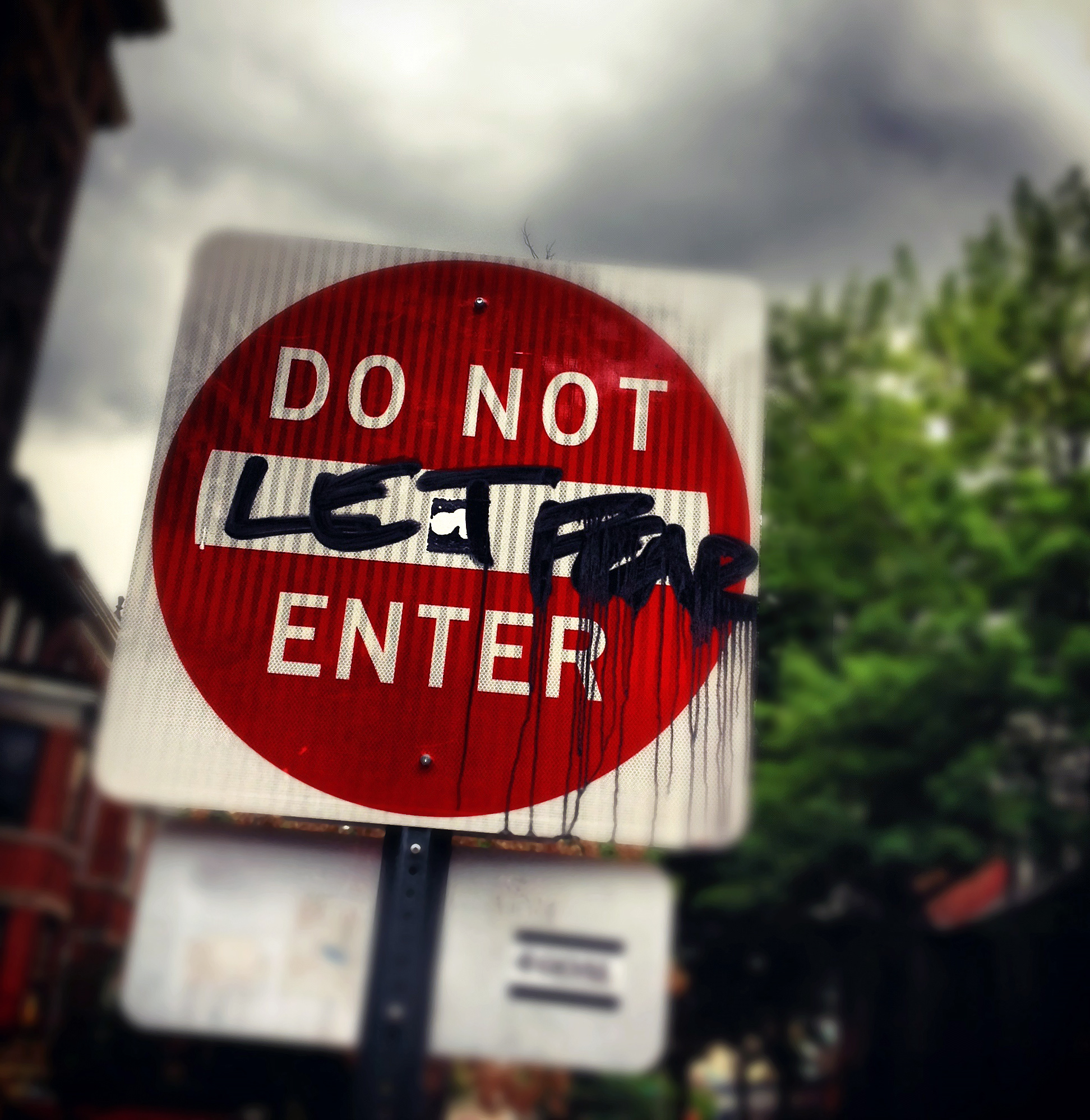
donotletfearenter

A reader shares two riveting tales of racial violence:

This quote from you about the violence on your block in DC [17th and Euclid, seen in the above photo by Alex Ogle] broke my heart:

Will that change my attitude when I manage to return from NYC? No. Does it deeply depress and anger me? Yes.

I have been living in NYC for 20 years and most of it in Brooklyn, yet I come from a very small town in Massachusetts. There was one black family in my town, where they lived in a cramped and battered shack – wait for it – outside the gate to the town dump.

I have lived in various places in the city, ranging from slightly dangerous to incredibly dangerous.  During the first five to seven years, I found the black anger at white people to be very real and rather surprising and disconcerting (as well as very understandable).  I must admit that over time I felt attacked for simply being white and began to, in my mind and heart, generalize the black population.  Until …

I lived in a decidedly tough neighborhood in 1995, when my very clearly gay roommate was beaten and mugged, where a neighbor was stabbed to death one door away and the pool of blood on the sidewalk larger than anything I have seen since. One summer evening I saw something unreal unfold before me from the beginning to the horrible end; I watched four white men, all very tough looking – dressed very preppy actually – in a red Mustang drive up and begin to taunt a group of neighborhood black men sitting (as they did every evening) on the stoop in front of my building. At first I assumed they were just Jersey guys looking for trouble. The driver was arguing with the black guys but it was difficult to make out. The guys on the stoop seemed incredulous, wary and attempted to appear tough.  However, they eventually quieted down and backed off. It seemed like it was over.

But the white guys wouldn’t let them be.

It was clear that the driver was trying to get a reaction – an excuse – to fight.  Over and over and over from the driver’s side window pointing his finger insultingly saying “Don’t you say one more word … not one more word.” And they didn’t, so he kept at them, repeating “one more word, one more f!@#in word” until one of them finally dropped an F bomb and they jumped out of the car – all of them actually undercover cops – and proceeded to beat the hell out of them and arrest them guns draw.  All the guys had were a couple of 40 ounce bottles of beer.

A slight, skinny man was pistol-whipped in the head so hard he didn’t just fall over; he crumpled into a pile unconscious.  As I watched from my window, I noticed a gallery of people from every window slowly gather and watch as I had, cheering on the one remaining (and VERY large) guy still upright, named Arturo (the name they chanted) as he managed to simultaneously fend off and speak incredibly calmly to the police, who literally circled him like a pack of dogs trying to find a way in to nail him.  All he kept repeating to them in a calm voice was “Why you trying to bust me up?  I’m just sitting on my stoop.”

Finally more cars arrived and an ambulance, so the undercover cops moved in.  They knew they had backup imminently.  Arturo managed to really hurt one of their knees inadvertently as he was being jumped by four guys. Eventually ten more uniformed cops with batons beat him mercilessly a la Rodney King while the angry gallery of onlookers begged and yelled for them to stop.  They loaded him and two more guys into the ambulances. Another one was cuffed and pressed into the hood of a car.  The man, in clear agony, simply stayed calm and repeated ad nauseum, “Will you please let me go? I was just going home.  Will you please let me go?  I was just walking by.” The cop holding him in this horrific position realized he just grabbed a random black passerby, frantically looked around for someone to tell him what to do and eventually he uncuffed the guy and let him walk away.

Now here’s the cherry on top of this S!#$@ sandwich:

One guy from the gallery of onlookers in the building directly across from my window was yelling “I got you on tape!  I got you on tape you bas!@#ds!! Why did you do that?!  I got you on tape!”.  What did the police do then?  Well about five of them got into his building, went up the six stories and arrested him and dragged him out in handcuffs put into a cruiser and driven away.

That solidified for me the incredibly disparate set of rules of engagement city cops have with white versus black people.  I have recounted that story many times to friends, but this type of profiling has come to light so many times it sadly seems to only merit a head shake, a sigh and a shrug and then everyone goes back to The Voice.

Another story:

Last year in May, I went running on the very safe outer ring of  Prospect Park in Brooklyn, in broad daylight, when I saw four black youths taunt a female jogger about 30 yards ahead of me.  They let her pass but whispered something in her ear that I couldn’t hear.  They just seemed like, well, KIDS.  I had about ten seconds to decide:  Should I give them the benefit of the doubt and run right past them or be the scared white guy and give them a wide berth?  I decided the former.

As I passed them, they parted two by two and one of them swung around and tripped me so high on my leg that I slung to the pavement and broke my eye socket. What ensued was an all-out brawl, where I was beaten, kicked, and punched, with many on-lookers doing nothing.  One good Samaritan finally tried to advise them they should leave me alone.  Well, he got three stitches in his eye for that.

We managed to find all four and they are being dealt with via the justice system, as they should be.  It dawned on me recently that in the wake of that traumatic experience, I managed to quite honestly not ever consider race in the incident.  All I kept thinking about was that they are ignorant kids, who are very stupid and make foolish choices and how fragile I have been since then.  I am angry, nervous, scared and scarred, but interestingly race has never entered into the equation for me. It was the brutality, the mindlessness of it (they didn’t even steal anything; it was just for fun).

If I were to be asked to imagine myself in this situation having happened rather than having actually gone through it, I would quite honestly bet that the opposite would have been my reaction.  We all have places within us that need to be exposed and learn from them until you can manage find a truer path, but it CAN be accomplished.

“The Emperor Palpatine Of African Politics”

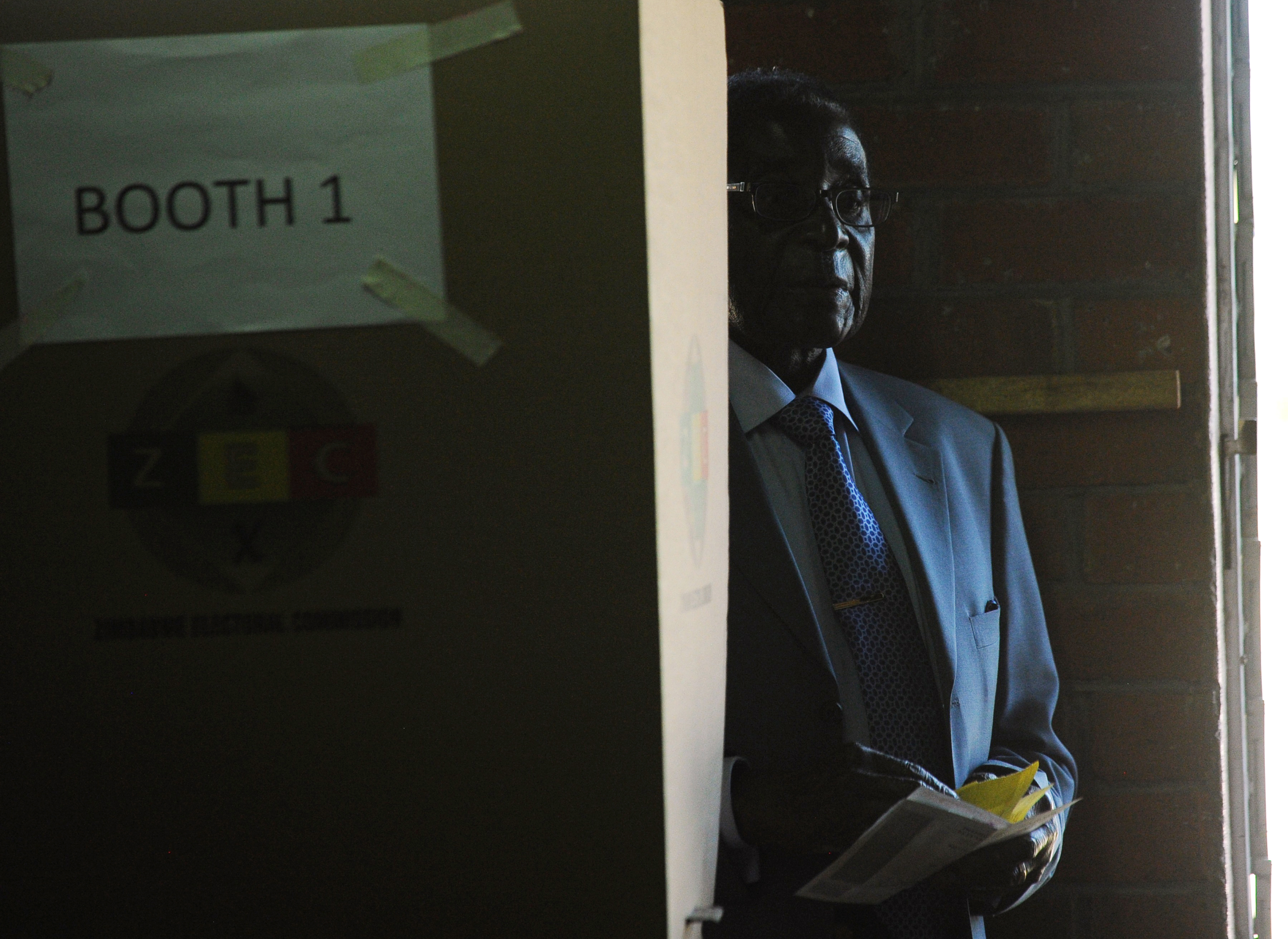
ZIMBABWE-POLITICS-VOTE

Robert Mugabe continues to cling to power:

Describing the Zimbabwean general election last week, Olusegun Obasanjo, the head of the African Union observer mission, used the word “free” readily, but the term “fair‘‘ caught in his throat. Was the voting — based on a roll that included 1.7 million voters who are missing or dead, and featuring 35 percent more ballots than people casting them – – fair? Obasanjo shrugged, turned his hands palm up, cocked his head and uttered, ‘‘fairly.’’

The AU and the Southern African Development Community nevertheless endorsed the election, allowing Robert Mugabe, 89, the world’s longest-serving ruler, to declare victory in the presidential race, with 61 percent of the vote. His party, which had held a minority of parliamentary seats, claims to have won a two-thirds majority, enough to change the constitution on its own.

Jon Lee Anderson says Mugabe “seems determined to die in office”:

Indeed, few politicians in modern times have been as willfully enduring or as spitefully determined to hang around, wraithlike, as Mugabe.

(A notable exception is Fidel Castro, though he did step down, in 2008, after forty-nine years in power.) Earlier this week, Mugabe, the Emperor Palpatine of African politics, gave a press conference in Harare, flanked by stuffed lions and cheetahs, in which he promised to “surrender” if he lost the election. But, when speaking to Lydia Polgreen, of the Times, he scoffed about his age being a political liability: “The 89 years don’t mean anything. They haven’t changed me, have they? They haven’t withered me, they haven’t made me senile yet, no. I still have idea, ideas that need to be accepted by my people.”

Fisher reviews the dire situation inside the country:

[Since 2002] Zimbabwe’s economy actually got much worse, suffering from hyperinflation so bad that the finance ministry one day announced that it would redenominate the currency by removing ten zeros from each unit, so that a $10 billion note would become worth one Zimbabwean dollar. In February 2009, the currency ballooned in value again and the finance ministry cut 12 zeros from the denominations. That April, it suspended the currency altogether. Since then, the free-fall has slowed and the economy is not in such dire shape.

Mugabe won the 2002 election against Tsvangirai but was widely accused by election monitors of vote fraud. In 2008, Tsvangirai ran against Mugabe again. Although Tsvangirai initially won more votes, the count was close enough to require a second round of voting. Between the two rounds, violence against Tsvangirai supporters and activists was widespread, with some human rights groups accusing Mugabe’s party of setting up “torture camps.” Tsvangirai withdrew but international outrage was such that Mugabe was forced to accept a power-sharing arrangement with Tsvangirai, although it’s not clear how much power the opposition leader actually holds.

Simukai Tinhu runs through five options the opposition has to fight back against Mugabe’s latest power grab.

(Photo: Zimbabwe President Robert Mugabe casts his vote at a polling booth in a school in Harare on July 31, 2013. Crisis-weary Zimbabweans were voting today in a fiercely contested election dominated b Mugabe’s bid to extend his 33-year rule and suspicions of vote rigging. By Alexander Joe/AFP/Getty Images)

The Right’s Brand Of Populism, Ctd

Chait dismisses the idea of Republican populism:

[Y]ou could eliminate every business subsidy in Washington, and you’d still have in place a massive income gulf and a wealthy elite able to pass its advantages on to the next generation (through proximity to jobs, social connections, acculturation, spending money on education) that have nothing to do with government. The egalitarian laissez-faire economy is a fantasy.

Wilkinson pushes back:

I agree that egalitarian laissez-faire is a fantasy, but I deny that rooting out all corporate welfare would do so little and that progressive transfers would do so much.

Mr Chait has set up a false alternative. To say that the “main driver of inequality today is the marketplace” is a fairly empty observation. The marketplace is a complex system of institutions itself created by legal rules, and these rules are mostly established by government. The law constitutes and codifies the corporate form. The law defines the scope of property rights, including intellectual property rights. These political artefacts specify the contours of the marketplace and have vast, systemic distributive consequences. These facts are usually trotted out to correct free-market enthusiasts in the grip of the fallacious idea that “the market” somehow exists outside politics, and that the pattern of income and wealth emerging from the operation of market exchange is therefore “natural” and not already thoroughly political. I’m sure Mr Chait has made these points himself, so it should be be easy for him to see that to say that the marketplace drives inequality is just to say that government does, because the marketplace is a creature of politics.

A World Of Sand

photo-27

Rebecca Willis considers the tiny particles:

“Sand”, [geologist Michael Welland] says, “sculpts the landscapes of our planet and reveals the history of the Earth.” Without it, there would be “no concrete, no glass, no silicon chips and a lot less jewellery”. It is hard to conceive of modern life without sand—and therein lies a problem: we are using sand faster than the planet can replenish it.

“We think of sand as something that’s just there,” he says, “but it is not a sustainable resource.” Whole islands are being wiped off the map as man develops the planet, especially by making concrete and extracting valuable minerals. Fracking—the great energy hope of the moment—devours vast quantities of sand. And most of the world’s beaches are undergoing erosion—partly from natural causes and partly because civilisation in coastal areas is “completely perturbing the natural balance of a highly complex system, by removing dunes, building breakwaters, and replacing sand that is removed … with the wrong kind of sand”.

Welland hoped his book would surprise the reader—and it does—but some of his findings surprised him, too. “The microscopic life in between the grains on the beach is truly astonishing.” Tiny invertebrates called meiofauna live there. “If you pick up a handful of wet sand at the beach, you are holding a miniature zoo. And these little critters keep the bad bacteria on the beach under control and relatively odourless for us. The diversity of life in the spaces between the grains of sand is greater than the diversity in the rainforest.” Beach sand is, literally, full of surprises.

(Photo: The dunes outside Provincetown, MA)

The Ethics Of Scientific Studies

Virginia Hughes describes a study that focused on Romanian orphans:

In 1999, [neuroscientist Charles Nelson] and several other American scientists launched the Bucharest Early Intervention Project, a now-famous study of Romanian children who were mostly ‘social orphans’, meaning that their biological parents had given them over to the state’s care. At the time, despite an international outcry over Romania’s orphan problem, many Romanian officials staunchly believed that the behavioural problems of institutionalised children were innate — the reason their parents had left them there, rather than the result of institutional life. And because of these inherent deficiencies, the children would fare better in orphanages than families.

The scientists pitched their study as a way to find out for sure. They enrolled 136 institutionalised children, placed half of them in foster care, and tracked the physical, psychological, and neurological development of both groups for many years. They found, predictably, that kids are much better off in foster care than in orphanages.

She elaborates on the logic underlying the inquiry:

Perhaps the strangest part of this project was that the fundamental scientific question it posed — Are orphanages bad for kids? — had already been answered. Definitively. Studies going back many decades had shown that orphanages are awful. Research with human subjects is normally considered unethical if it doesn’t tackle novel questions. In this case, though, Nelson’s project was ethically justified because Romanian officials had not paid any attention to those previous studies. Quite the opposite: They had a strong cultural belief that state-run orphanages would protect orphans far better than unstable and untrustworthy foster parents.

This cultural belief persists in various forms, as Hughes explores further here.

An Ode To English Majors

Mark Edmundson pens one:

Real reading is reincarnation. There is no other way to put it. It is being born again into a higher form of consciousness than we ourselves possess. When we walk the streets of Manhattan with Walt Whitman or contemplate our hopes for eternity with Emily Dickinson, we are reborn into more ample and generous minds. “Life piled on life / Were all too little,” says Tennyson’s “Ulysses,” and he is right. Given the ragged magnificence of the world, who would wish to live only once?

The English major lives many times through the astounding transportive magic of words and the welcoming power of his receptive imagination. The economics major? In all probability he lives but once. If the English major has enough energy and openness of heart, he lives not once but hundreds of times. Not all books are worth being reincarnated into, to be sure—but those that are win Keats’s sweet phrase: “a joy forever.” …

What [the English major] feels about language most of the time is wonder and gratitude. For language is a stupendous gift. It’s been bequeathed to us by all of the foregoing generations. It is the creation of great souls like Shakespeare and Chaucer to be sure. But language is also the creation of salesmen and jive talkers, quacks and mountebanks, hookers and heroic warriors. We spend our lives, knowingly or not, trying to say something impeccably. We long to put the best words in the best order. (That, Coleridge said, is all that poetry really comes down to.) And when we do, we are on the lip of adding something to the language. We’ve perhaps made a contribution, however small, to what the critic R.P. Blackmur called the stock of available reality. And when we do, we’ve lived for a moment with the immortals.

The Smiling Face Of The Church

VATICAN-POPE-AUDIENCE

Lost amidst the discussion of the Pope’s recent remarks on homosexuality was this observation from John Allen: the theme that Francis invokes the most is joy:

Every pope seems to have a signature spiritual idea. For John Paul II, it was courage: “Be not afraid!” was his catchphrase to invite the church to recapture its missionary swagger after years of introspection and self-doubt. For Benedict XVI, it was “faith and reason,” the idea that religious belief and intellectual reflection need one another to remain healthy.

For Francis, the best early candidate for his signature touch is mercy, expressed in his repeated emphasis on God’s endless capacity to forgive…

In a recent essay for the Italian newspaper Corriere della Sera, Enzo Bianchi, founder of the celebrated ecumenical monastery of Bose, offered a statistical analysis of the words used most frequently by Francis since his election. He found that the single most commonly used term was “joy,” more than 100 times, followed closely by “mercy,” which the pope has used almost 100 times.

One that note, it’s worth revisiting Francis’ remarks from a homily he delivered during a Mass celebrated in the Chapel of the Domus Sanctae Marthae at the end of May:

The Pope began by referring to the readings of the day from the book of Zephaniah (3:14-18) and the Gospel of Luke (1:39-56), saying that they “speak to us of joy and happiness: ‘rejoice, shout for joy’, says Zephaniah… ‘The Lord is in the midst of you’… He too will rejoice over us. He, too, is joyful”.

“Everything is joy. But we Christians, we are not used to talking about joy, about happiness. I think that many times we prefer complaints! What is joy? The key to understanding this joy is in the Gospel: ‘Elizabeth was filled with the Holy Spirit’. What gives us joy is the Holy Spirit.

“It is the Spirit who guides us. He is the author of joy, the creator of joy, and this joy of the Holy Spirit gives us true Christian freedom. Without joy we Christians can not become free. We become slaves to our sorrows”.

(Photo: Pope Francis smiles after his weekly general audience in St Peter’s square at the Vatican on June 12, 2013. By Alberto Pizzoli/AFP/Getty Images.)

The Light Inside

dish_turrell

“To understand Turrell’s art … it is necessary to have some familiarity with what Quakers do,” writes Morgan Meis of James Turrell, who was raised as a Quaker:

Quakers worship by getting together and having a meeting. All you need is two Quakers for a meeting, but Quakers are happy to get together in larger groups. Quakers conduct their meetings by sitting silently, usually for about an hour. Talking is allowed, but not encouraged. You talk if you are moved to talk. Otherwise, you sit quietly. It is fair to call this meditation. While Quakers are meditating, they seek what they call the Inner Light. The idea of Inner Light goes all the way back to the early 17th century and to George Fox, the very first Quaker. As a young man, George found himself displeased with religion in its contemporary form. He struggled to find the truth, as sensitive young men and women will do. These were years of darkness and tumult. And then he found peace. In 1647, George heard a voice that said to him, “There is one, even Christ Jesus, who can speak to thy condition.”

Fox remembered that Christ sometimes calls himself “the light” in the Gospels. He decided that light was the key to correct and meaningful religious practice. There is a light inside of all of us, he thought. When you connect to the light, you are also connecting to God. For this reason, Quakers aren’t all that jazzed up about specific religious doctrines. If you are wondering what to do, how to live your life, just sit quietly and try to listen to the Inner Light. That’s all the doctrine any good Quaker needs. The answers are there inside, because God is inside.

Meis particularly sees the influence of Quakerism in “Aten Reign,” Turrell’s current exhibition at the Guggenheim:

I’d like to suggest that the best way to approach and interpret Turrell’s installation at the Guggenheim is to say it is a Quaker meeting. Observe, if you will, what happens when people enter the ground floor of the museum. They stop and look up. They see that the spirals of the Guggenheim have been transformed into a glowing light installation. They roam around for a minute or so looking up. Then they find a space to lie down on the floor. Generally, they stop talking. They watch the glowing lights and the luminescent egg. This silent watching goes on for many minutes. More than ten minutes. More than fifteen minutes for many people, and more than that for others.

In other words, James Turrell has managed to get people in New York City to lie on the floor silently meditating for more than ten minutes. Most of these people have never meditated in their lives. Many of them would not sit still silently for ten minutes if you paid them to do so. But the power of the egg compels them.

(Photo of “Aten Reign” by Flickr user Nika)