Should We Judge A Book By Its Author?

Ender’s Game, a film based on a book by Orson Scott Card, is stirring considerable controversy in advance of its November 1 release because of his history of opposing gay rights. Money quote from Card in 1990:

Laws against homosexual behavior should remain on the books, not to be indiscriminately enforced against anyone who happens to be caught violating them, but to be used when necessary to send a clear message that those who flagrantly violate society’s regulation of sexual behavior cannot be permitted to remain as acceptable, equal citizens within that society.

Last week, Card issued a statement in defense of the film:

Ender’s Game is set more than a century in the future and has nothing to do with political issues that did not exist when the book was written in 1984. With the recent Supreme Court ruling, the gay marriage issue becomes moot. The Full Faith and Credit clause of the Constitution will, sooner or later, give legal force in every state to any marriage contract recognized by any other state. Now it will be interesting to see whether the victorious proponents of gay marriage will show tolerance toward those who disagreed with them when the issue was still in dispute.

Scott’s statement proved unconvincing to many opponents. Ampersand maintains that Card is a “vicious homophobe,” but believes “artists shouldn’t be boycotted for their political views.” Likewise, Alexandra Petri pleads, “Don’t punish the work for its creator”:

[G]iven the choice, I’d rather have despicable artists and great art than creators with sedate, tolerant lives who made things that were dull and ugly. If you believe art changes things, of course that’s what you want. The more good art you have, the better for humanity. It expands and deepens your understanding. It forces you into another perspective. There is a moral element in it — even if it’s not overt. As [Oscar] Wilde wrote, “They will not say ‘We will not war against France because her prose is perfect,’ but because the prose of France is perfect, they will not hate the land…. It will give us the peace that springs from understanding.” Start penalizing beautiful things for coming from an ugly place, and you wind up with a less lovely world.

A statement by Lionsgate, the film’s distributor, creates distance between the film and Card:

As proud longtime supporters of the LGBT community, champions of films ranging from GODS AND MONSTERS to THE PERKS OF BEING A WALLFLOWER and a Company that is proud to have recognized same-sex unions and domestic partnerships within its employee benefits policies for many years, we obviously do not agree with the personal views of Orson Scott Card and those of the National Organization for Marriage. However, they are completely irrelevant to a discussion of ENDER’S GAME. The simple fact is that neither the underlying book nor the film itself reflect these views in any way, shape or form.

Maggie Gallagher weighs in:

Gay marriage advocates are trying to build up a boycott of Ender’s Game because of Orson Scott Card’s personal views on marriage. It seems very strange to me that so many artists and people on the left are supporting the idea that to make art in the mainstream you have to have the right political opinions. This used to be considered the heart of McCarthyism: loyalty oaths for filmmakers as the condition for working in the film industry. (These were imposed by the industry, not the government, remember, in response to public pressure).

Jim Burroway pushes back:

It was just a little more than a year ago that the National Organization for Marriage, of which Gallagher is board chair, called for a boycott of Starbucks. I’ve grown to believe that organized boycotts are almost always futile in achieving their aims. That said, I do believe that we are all free to spend our money however we choose. I don’t purchase gasoline at Exxon on Mobil, and I don’t shop at Wal-Mart. And if the gross receipts for Ender’s Game opening night are going to be looked at as some kind of an economic referendum for Card, then I can safely say that I won’t be seeing the movie. It’s my money, and I just don’t feel like paying Card a dime of it, and I hope none of my friends or family members will either.

But if they do — if they want to see the movie because they loved the critically-aclaimed book, or because they’re interested in the star power of Asa Butterfield, Harrison Ford, Ben Kingsley, Aramis Knight, Hailee Steinfeld, Jimmy Pinchak, Viola Davis, and Abigail Breslin — then that’s no skin off of my nose either. Evil people are capable of producing great art, and it’s not axiomatic that their personal evil compromises that art, although I also think that it’s rare for that to occur. I’m not familiar with Ender’s Game to know whether it is tainted with Card’s vindictive viewpoints or not, although I am aware that it does infect other books that he wrote later.

Previous Dish on Card’s hateful rhetoric here.
Can The GOP Double Down On The White Vote? Ctd

John Sides believes that Republicans would be wise to support comprehensive immigration reform:

I’m not suggesting that the GOP won’t win larger numbers of Latino voters in individual elections than they did in 2012 because of cyclical factors like the economy or idiosyncratic factors like the particular candidates who are running. I’m just suggesting that the GOP should be asking itself, “How do we convert some of these unaffiliated Latino voters into habitual Republican voters?” And that takes more than economic growth or, say, nominating Marco Rubio. … [S]upporting comprehensive immigration reform is a necessary, though not sufficient, step for the GOP to accomplish that goal. Immigration may not be every Latino’s highest priority but, again, I see that issue as important to winning over at least some Latino voters and many Latino opinion leaders.

But Paul Waldman notes that Southern Republicans have little incentive to woo Latinos:

In many places, and in the nation as a whole, the idea that the GOP could become (or stick to being) a nearly completely white party is very bad for Republicans. Consider that nationally, John McCain got 55 percent of the white vote, and Mitt Romney did slightly better, getting 59 percent. It wasn’t enough for either of them to win. But if you’re a Republican in, say, Alabama, where nearly nine out of ten whites vote Republican, you don’t need a single vote from non-whites. An all-white party is just fine with you.

Meanwhile, Keith Humphreys warns that doubling down on the white vote risks having the national GOP follow in the California GOP’s footsteps:

The California lesson for the national GOP? Racially divisive appeals to alienated white voters can work, perhaps especially in a mid-term election. Indeed, doubling down on white voters may well work nationally in 2014. But pursuing such short-term electoral rewards is a route to long-term political oblivion in an increasingly diverse America.

Earlier Dish on the subject here, here, and here.

A Republican Sweep In 2016?

While acknowledging that she could be wrong, McArdle defends her prediction that there’s a 70% chance that the GOP will win the White House and both branches of Congress in 2016:

Since the Civil War, only two Democratic presidents have been succeeded by another Democrat. Both of them–FDR and JFK–accomplished this by dying in office. Since World War II, only four presidents have been succeeded by a member of their party. As I mentioned above, two of them accomplished this by dying in office. One of them accomplished this by resigning in disgrace ahead of his own impeachment. Only one of them, Ronald Reagan, left office at the end of his appointed term and was succeeded by a duly elected member of his own party. Mostly, the White House flips back and forth like a metronome.

Nate Cohn responds by crunching some numbers, concluding that Republicans have a 23% chance of winning both the presidency and both houses:

This is all for illustrative purposes and it isn’t close to perfect. These numbers are outright arbitrary. Some numbers are just missing: Surely the Democrats have some chance of winning the House, and surely the GOP has some shot to take back the Senate in 2016, even if they don’t win it in 2014. But the point is that the GOP doesn’t have anything close to a 75 percent chance of holding all three branches by 2017. Not even close.

Bernstein examines the history books:

First of all, look at how many times the pattern has recurred. In McArdle’s case, we’re talking about times when a president stepped aside (making a same-party succession possible). That happened in 1952, 1960, 1968, 1988, 2000, and 2008. So her pattern, to begin with, is one out of six. That’s perhaps something…but it’s not exactly an Iron Law of Politics, is it? 0 for 10, or 1 for 50, would be a lot stronger.

Then, next, we can check the qualifiers to see if they’re making the pattern look stronger. In this case, there’s one: postwar. If we put that aside and go with “20th century,” then we add 1908, 1920, and 1928 — and get two hits, with TR/Taft and Coolidge/Hoover. Is there some special reason that the postwar era should be different? Not that I can think of, and if we include those the pattern drops to three in nine — hardly something to get worked up about. Note that the more qualifiers you toss in, the more likely you are to be creating the pattern that you’re seeing, so this is an important test.

And Larison points out the danger of Republican overconfidence:

[T]he problem with expecting anti-Democratic voter fatigue in 2016 is that it could delude many Republicans into thinking that they can get away with running another ill-suited nominee with more or less the same uninspired and irrelevant agenda that Romney offered voters last year. One of the things that harmed the Republicans in the last presidential election is that they assumed that they were “supposed” to win because of economic factors. This conveyed the message they felt entitled to winning the election, and it confirmed that they were oblivious to the modest improvement in the economy. Depending on the state of the economy in 2015 and 2016, Republicans may end up setting themselves up for disappointment again if they assume that a majority will be eager to throw the other party out.

McArdle responds to critics here and here.


The Economics Of Terrible TV

Late last week the trailer for Sharknado went crazy viral on Twitter:

Thomas Vitale, SyFy’s executive vice president for programming and original movies, explains how much these films cost:

We pay $750,000 or $800,00 for these movies. They cost about a million and a half to two million. The budgets are often helped by tax grants and incentives from the locations we’re shooting in. We’ve shot all over the world, pretty much every continent except Antarctica. They’re done as coproductions with independent companies. The Asylum made “Sharknado.”

Amanda Hess profiles The Asylum:

If the Asylum’s films are naive camp, its marketing strategy is all deliberate. “It’s a parody of the studio system,” Latt says. “We’re making fun of the commerce side of this. You made your movie for $200 million? I’ll make it for 20 bucks.”

Consider the Asylum’s line of “mockbusters,” designed to ride the coattails of the zillion-dollar publicity pushes for big-studio films. When DreamWorks studios came out with Transformers in 2007, the Asylum raced out Transmorphers. When Columbia Pictures released Battle: Los Angeles in 2011, the Asylum countered with Battle of Los Angeles. When mockbusters trip legal threats from the big studios—and they usually do—the Asylum will fuss with the cover art and change the titles to pacify the lawyers, then thank the studios for throwing more publicity their way.

Amelia Schonbek points out that The Asylum is making lots of money:

The films’ success ultimately depends on the idea that, as The Asylum’s chief operating officer, Paul Bales, says, “If you are a fan of giant transforming robots, you are going to find everything you can about giant transforming robots.” By this logic, a movie doesn’t have to be good to be successful. It just has to be topical.

So far, the formula has worked: between 2011 and 2012, the studio made twelve million dollars in revenue with a fifteen-per-cent profit margin. As of last March, even after making hundreds of movies, The Asylum has not yet lost money on a single film—making the most important number for this movie zero.

And Meghan Neal looks at how these films cater to viewers’ preferences:

Netflix is one of Asylum’s regular buyers, along with Red Box, Blockbuster, Amazon, and others. And it buys the whole shebang. It scoops up every new release and has the studio’s entire catalog available. And Netflix doesn’t just stop at licensing new releases. In a sense, it’s influencing their being made in the first place. Netflix provides Asylum with data on what its users are interested in, and the studio obliges.

… The unsettling part is that the masses can be terribly off base, and even the most sophisticated algorithm can’t sniff out, you know, actual art. In the words of this Salon article, viewers are turning into puppets. “Now Netflix is using the same formula to prefabricate its own programming to fit what it thinks we will like,” wrote Salon. “Isn’t the inevitable result of this that the creative impulse gets channeled into a pre-built canal?”

Ask Michael Hanna Anything: What The West Doesn’t Get About Egypt

In our latest video from the Arab world expert, Hanna notes how frequently the West oversimplifies Islamism:

Along these lines, H.A. Hellyer points out the overly binary way that last week’s violence has been interpreted, both in and outside of the Egypt:

Pro-Morsi campaigners insist that the Muslim Brotherhood is non-violent and has no weaponry, and they focus all attention on the killings that took place at the pro-Morsi sit-in in front of the Republican Guard, at the hands of state forces. On the other side, anti-Morsi commentators argue that the Brotherhood is essentially a militia; that the sit-in was armed; and that the Brotherhood tries to redirect attention to the deaths that have taken place elsewhere at the hands of pro-Morsi activists. The media in Egypt is primarily imbued with the latter, with little nuance — the international media and pro-Morsi outlets in the region are generally concerned only with the first narrative.

Again, reality lies in between, and with elements of both.

The Muslim Brotherhood undoubtedly has weaponry — such was evident when the headquarters was attacked during the uprising. However, there is really no evidence that heavy weaponry was at the sit-in — at best, according to eye-witnesses and civil rights groups, the weaponry was mediocre and much of it homemade. Certainly, it would be difficult for anyone to justify the break up of a sit-in, resulting in dozens of casualties, with the level of firepower used by the army. One suspects that privately the state agrees, and that this was a mistake arising from a tense situation and probably Morsi-supporters resisting arrest — but we will probably never hear that line in any state broadcast. At the same time, the reality is that on top of this tragedy, many civilians have been attacked, and killed, by pro-Morsi forces around the country in the past week — and the killings are often sectarian.

Of course, recognizing the truth of both narratives, at the moment, is unthinkable. Sins of omission, as well as commission, are rife — either due to unfamiliarity with Egypt altogether, or clearly partisan agendas. Objective media is, unfortunately, rare indeed. The importance of that kind of coverage and analysis cannot be overestimated at such a crucial time — not simply because good information is rare to come by, but because so much poor disinformation is so utterly common. On Egypt, right now, truth really is the greatest victim. It is a victim worth rescuing, and right now, it seems that the best source of information is going to be direct access to eyewitnesses of particular controversies, as well as civil rights and human rights organizations.

Michael Wahid Hanna is a Senior Fellow at The Century Foundation, where he works on issues of international security, international law, and US foreign policy in the broader Middle East and South Asia. He appears regularly on NPR, BBC, and al-Jazeera. Additionally, his Twitter feed is a must-read for anyone interested in Egyptian politics. Our ongoing coverage of the current events in Egypt is here. Michael’s previous answers are here. Our full Ask Anything archive is here.

An Immigration Reform Alternative?

Jamelle Bouie says that Republicans shouldn’t give up on the Latino vote just yet:

If I were advising Republicans, I would push them to work hard to counter the perception that they’re hostile to Latinos and oppose their inclusion to political life. It doesn’t have to be comprehensive reform. Support for something like the DREAM Act–in addition to something that makes room for more high-skilled immigration–would do the trick.

House Republicans seem to be doing just that with their newly announced (and tentatively named) KIDS Act. Elise Foley reports:

[The bill] would be a Republican alternative to the Dream Act that failed in the Senate in 2010, and would allow undocumented young people to become legal residents.

Although offices for Cantor and Goodlatte would not get into details or the timetable, Cantor has said previously that undocumented immigrants who came to the U.S. as children should be allowed to become citizens. The KIDS Act would be one of several bills that the House could consider on immigration reform as part of its piecemeal approach. So far, Republicans seem far more comfortable with legalizing so-called Dreamers than they do with a path to citizenship for their parents.

Weigel sees this as remarkable turnaround:

[J]ust a month ago, Rep. Steve King added an amendment to the Homeland Security funding bill written to end a policy begun by Barack Obama in 2012–“deferred action” on deporting illegal immigrants under 30. It was seen as a pseudo-DREAM Act, and the King amendment was seen as a pseudo-repeal of psuedo-DREAM. It passed, 224-201, with all but six Republicans voting with just three red-district Democrats.

What happened? The Senate bill really did put some fear into House Republicans; the King amendment is going to have to be explained as blow against executive overreach, not as anything to do with Dreamers.

A Partial Defanging Of The Filibuster?

Molly Redden argues that Harry Reid’s filibuster reform proposal “is so modest that you could fairly construe it as a return to the status quo”:

It wouldn’t interfere with the minority’s ability to prevent a piece of legislation from coming to a vote, which members can do today without even staying on the Senate floor. And it doesn’t threaten the talking filibuster, of “Mr. Smith Goes to Washington” fame, which Senator Rand Paul used to such spectacular effect this spring. … [L]et’s not pretend that Reid’s choice to eliminate the filibuster in one narrow instance would organically, inevitably lead the Senate to eliminate the filibuster altogether. Those are separate choices in which the majority party will perceive separate stakes. As for whether the Senate could come to resemble their malfunctioning counterpart, it would be a false equivalence to make believe that that’s the rules’ fault.

When the Senate is filibustering executive branch nominees not because of their qualifications but because they don’t like what they would be legally authorized to do in office, I think a small rule change is vital. The GOP is becoming not an opposition party, but a wrecking ball, denying the ability of a duly elected president to nominate his own officials – and get them in place – within his own branch of government. Sarah Binder weighs in:

I think it’s important that Reid appears to be narrowly tailoring a rule change to apply only to executive branch nominees (and perhaps only after a nomination has been pending on the executive calendar for a set length of time).  When asked by CQ’s intrepid Senate reporter, Niels Lesniewski, about what Reid would do when contested judicial nominations came to the floor in a couple of weeks, Reid refused to expand the scope of conflict to judges: “This is focused very concisely…This is not about judges…This is about presidential executive nominees.” Why was Reid so adamant about limiting the reach of a rule change to executive branch nominees?  A narrowly tailored change might make his nuclear gambit look more like previous episodes of reform by ruling.  It might also make it easier to secure the support of 51 Democrats.

Mark Kleiman wishes Reid would be more aggressive:

It’s understandable that some Senate Democrats want to solve the current crisis with as little damage as possible to their own power and that of their successors. That’s why Reid plans to move ahead with a rules change covering executive nominations only. But the Republican threat of retaliation – the one sort of Republican utterance that is invariably sincere – makes the proposed strategy of limited rules change incoherent. Since the Republicans will retaliate against a limited rules change with a comprehensive rules change, Democrats will never again get any benefit from being able to use the filibuster. So, in a rational world, having been forced to use the nuclear option to move the current batch of blocked confirmations they’d use it on everything at once. There’s no point in getting a little bit pregnant.

Has Greenwald Crossed The Line?

A reader thinks so:

Up until now, Greenwald has been within bounds as a journalist. But Snowden’s [Saturday] message, delivered through Greenwald, is criminal extortion and not remotely anything like whistle-blowing or journalism:

“Snowden has enough information to cause more damage to the U.S. government in a minute alone than anyone else has ever had in the history of the United States,” Greenwald told the Argentinian newspaper La Nacion. Asked if he was afraid that Snowden might be killed, Greenwald said: “If something were to happen, those documents would be made public. This is your insurance policy.”

“The U.S. government should be on your knees every day praying that nothing happens to Snowden, because if something happens, all information will be revealed and that would be their worst nightmare,” Greenwald added.

Separate and apart from anything they’ve done up to know, this is despicable. I’d love to get your take on this. I fear the fame this episode has brought Greenwald has gotten to his head and he is now becoming just a criminal and a traitor.

The latest from Greenwald and Snowden is also unsettling:

“In order to take documents with him that proved that what he was saying was true he had to take ones that included very sensitive, detailed blueprints of how the NSA does what they do,” said Greenwald in an interview with the Associated Press published Sunday.  Greenwald said Snowden had “literally thousands of documents,” which he called “basically the instruction manual for how the NSA is built.”

I can understand the reasons for exposing the security state’s innards if you want to render the entire program moot. I’m not sure I understand the motive for withholding that information as a form of blackmail or “life insurance policy”. This sentence from Greenwald is troubling to me as a journalist:

Snowden has enough information to cause more damage to the U.S. government in a minute alone than anyone else has ever had in the history of the United States.

If Snowden and Greenwald want to expose what they regard as illicit programs, why not just expose them? Bragging about their capacity to blackmail or terrify their own government seems, well, at best hyperbolic, and when the threat is made in a foreign newspaper, disturbing.

Update: Glenn responds here.

The Tragedy Of Trayvon: Reax

Responding to George Zimmerman being found not guilty, Joyner writes that “the prosecution handled a weak case poorly and that an acquittal should surprise no one”:

Now, of course, juries sometimes get it wrong. Many innocent men have been found guilty and many people who plainly did what they were accused of doing are acquitted. In this particular case, there’s no doubt, reasonable or otherwise, that George Zimmerman killed Trayvon Martin, a teenage boy who did not deserve to have his life ended. But that wasn’t what the jurors were being asked to decide. Rather, they were charged with deciding whether Zimmerman committed second degree murder as defined by Florida statute. And, as contemptible as George Zimmerman is and as outrageous as Trayvon Martin’s death is, it strikes me as pretty obvious that he did not, regardless of what one believes about what happened after the events we hear on tape end.

I agree, as does TNC:

I think the jury basically got it right. The only real eyewitness to the death of Trayvon Martin was the man who killed him. At no point did I think that the state proved second degree murder. I also never thought they proved beyond a reasonable doubt that he acted recklessly. They had no ability to counter his basic narrative, because there were no other eye-witnesses.

But, in a later post, TNC puts the case in context:

The injustice inherent in the killing of Trayvon Martin by George Zimmerman was not authored by jury given a weak case. The jury’s performance may be the least disturbing aspect of this entire affair. The injustice was authored by a country which has taken as its policy, for lionshare of its history, to erect a pariah class. The killing of Trayvon Martin by George Zimmerman is not an error in programming. It is the correct result of forces we set in motion years ago and have done very little to arrest.

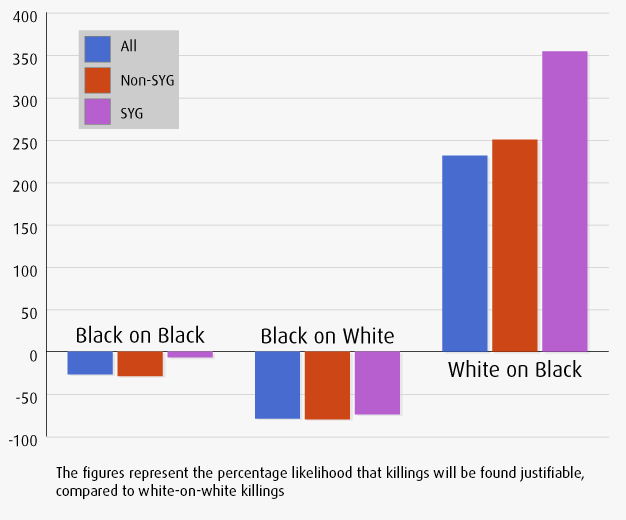
A glimpse at those forces:

11

Cord Jefferson likewise connects the shooting of Trayvon Martin to society’s racial prejudice:

It is a complicated thing to be young, black, and male in America. Not only are you well aware that many people are afraid of you—you can see them clutching their purses or stiffening in their subway seats when you sit across from them—you must also remain conscious of the fact that people expect you to be apologetic for their fear. It’s your job to be remorseful about the fact that your very nature makes them uncomfortable, like a pilot having to apologize to a fearful flyer for being in the sky.

Meanwhile, Jazz Shaw dismisses any idea that the trial was about race:

In the post-Zimmerman era, anyone who winds up in a conflict situation where there is a racial difference between the parties can now stand up and say that the villain was profiling the other party. It provides the convenient mental imagery to lump them in with rogue cops and the rest of the story. Don’t look for this to end any time soon. Profiling is the new substitute for discrimination, even if the perpetrator has nothing to do with law enforcement, and I’m betting it’s going to have a long run.

But I fail to see how profiling wasn’t obviously salient in this incident. Zimmerman convicted Martin of being a punk and a would-be burglar because he was black and wearing a hoodie in a complex where burglaries had recently taken place committed by young black men. Implicating an innocent person in that criminal group because he was a stranger, and looked like the criminals, is classic profiling. Charles P. Pierce groans:

[O]f course, this was not about race because nothing is ever about race.

The prosecutors even told us that it wasn’t about race. The defense won its case because this was not about race. The sharp guys and pundits will spend all weekend explaining how race was an element of the events that night, but that the case, ultimately, was not about race. And because this case was not about race, nothing out of our history counts, because our history, here in the land of the free, is not about race, either. Because our history is not about race, a few weeks ago, when the Supreme Court gutted the Voting Rights Act, what happened on the Edmund Pettus Bridge was not relevant. Because our history is not about race, last night, Emmett Till was not relevant, even though a few people inconveniently brought him up. But that was years ago, and the country has changed, and it is John Roberts’ Day Of Jubilee, and this trial was not about race because nothing is about race any more.

Along the same lines, Lisa Wade examines the racial effects of Stand Your Ground (SYG) laws:

[W]hite people who kill black people are far more likely to be found not-guilty even in states without SYG and black people who kill whites are less likely to be found not-guilty regardless of state law.

It’s simple: We are already biased in favor of the white defendant and against the black victim. Stand your ground laws give jurors more leeway to give defendants the benefit of the doubt.  This increases even further the chances that a white-on-black homicide will be considered justifiable because jurors will likely give that benefit of the doubt to certain kinds of defendants and not others. Stand your ground may or may not be a good law in theory but, in practice, it increases racial bias in legal outcomes.

Scott Lemiuex places more blame on our gun laws:

Carrying a deadly weapon in public should carry unique responsibilities. In most cases someone with a gun should not be able to escape culpability if he initiates a conflict with someone unarmed and the other party ends up getting shot and killed. Under the current law in many states, people threatened by armed people have few good options, because fighting back might create a license to kill. As the New Yorker‘s Amy Davidson puts it, “I still don’t understand what Trayvon was supposed to do.”

Unless the law is changed to deal with the large number of people carrying concealed guns, there will be more tragic and unnecessary deaths of innocent people like Trayvon Martin for which nobody is legally culpable.

Steven L. Taylor insists the legal system, however broken, was served:

In point of fact, the courts are supposed to produce an outcome that is commensurate with the laws as written.  As such, if one finds an outcome to be “unjust” is it quite likely that the source of the injustice is not the criminal justice system, per se, but is, rather, the fault of legislators.  Indeed, it is often the fault of the demands of the public (which are frequently contradictory*).  Regardless, the application of the law in a certain circumstance often produces a legally correct (or, at least, a legally consistent and logical) outcome even if the outcome may not be considered “just” in an abstract sense.  And, of course, the question of what is just, both in general and in the specific, is a normative one that is open to disagreement.  Such disagreements, as is often the case with normative disputes, can be quite passionate.

My initial thoughts after hearing the verdict are here.

(Chart via Frontline)

Dissents Of The Day

A reader writes:

The jury was not “all-white,” but consisted of five white women and one black woman. Also, Zimmerman isn’t white.

According to ABC News:

While the court did not release the racial and ethnic makeup of the jury, the panel appeared to reporters covering jury selection to be made up of five white women and a sixth who may be Hispanic.

I used quote marks around “white” for the reason my reader notes. Another:

For someone who “didn’t follow the trial that closely,” the truth of the Zimmerman case is surprisingly obvious to you. You state that Martin “was clearly racially profiled, followed and challenged,” and you call that a “fact”. You further state that “Zimmerman clearly made a decision that led directly to” Martin’s death. Those “facts” were disputed at trial, and a jury – who were especially chosen out of a pool of many for their impartiality, who weighed vastly more evidence and heard more testimony than you, and who spent 12 hours deliberating the case – concluded that those were doubtful claims, not facts.

We don’t know the details of the jury’s deliberations. But no-one disputed the fact that Zimmerman described Martin thus to the cops before he killed him:

Fucking punks. These assholes. They always get away.

And he was told by the cops to stop his stalking. He decided to ignore them. My reader continues:

You make other egregious errors about America’s system of justice. I’m sure many of your readers will point them out to you (such as the fact that a jury of one’s peers is a right of the defendant, not the victim). But if you feel the need to comment about “race in America” again, you first ought to examine your own heart. Why are you so quick to impute racism not only to Zimmerman, but also to a jury whose members are wholly unknown to you? Why are you so quick to assume, with so little knowledge, that systemic racism has so tainted the minds of Americans that our very system of justice is untrustworthy? Why did you feel it necessary to make a bombastic comparison between the manifest wrongs of nearly a century ago (lynchings) with a case where right and wrong is so painfully unclear?

I emphatically do not believe the jury’s verdict was racist; I think they almost certainly made the right call given the evidence and how they were instructed. It was Geraldo who said they were racist. As for the right of the defendant to a jury of his peers, technically my reader is right. But Martin was effectively put on trial as well; and an almost all-white six-person jury of women doesn’t seem to represent either Zimmerman’s or Martin’s peers.