The Tragedy Of Trayvon, Ctd

k-bigpic

A couple of points, one of which is a correction. The “Stand Your Ground” law in Florida was responsible for the delay in the trial, and, by some accounts, the difficulty in getting all the forensic evidence after so much time had passed. There’s little question that it was a law George Zimmerman was aware of. But it was not directly used by the defense in the actual trial, as I suggested, where the case became a classic one of self-defense in a very murky incident in the dark with no reliable witnesses. Josh Marshall has a good post on this nuance – but the Florida self-defense law is the same as in every state but Ohio. Eugene Volokh notes:

Who should bear the burden of proving or disproving self-defense in criminal cases, and by what quantum (preponderance of the evidence, clear and convincing evidence, or beyond a reasonable doubt), is an interesting question. But on this point, Florida law is precisely the same as in nearly all other states: In 49 of the 50 states, once the defense introduces any evidence of possible self-defense, the prosecution must disprove self-defense beyond a reasonable doubt.

This goes back as far as 1877:

“When a person, being without fault, is in a place where he has a right to be, is violently assaulted, he may, without retreating, repel by force, and if, in the reasonable exercise of his right of self defense, his assailant is killed, he is justiciable.”

The phrase “being without fault” seems problematic to me in this case. Once Zimmerman ignored the police warnings to leave Martin alone and let them handle it, it seems to me he was at fault. And that decision was the critical moment Martin’s life came under threat. With the Stand Your Ground law behind him, Zimmerman kept up his amateur policing. It’s the permissiveness of that law that can cause the emboldening of vigilantes. In the end, though, none of that mattered save Zimmerman’s contention that he had no way to retreat under alleged assault by Martin, and so was justified in killing an unarmed individual.

Still, it’s hard to read stories like this one without wondering how deeply this case may have shifted the sense of some whites that if they gun down kids in hoodies, they’ve got the law on their side. To wit:

In November, black youth Jordan Davis, a 17-year-old Jacksonville resident, was the only person murdered after Michael Dunn, 46, allegedly shot into the SUV Davis was inside several times after an argument about the volume of music playing … At the Gate Station, Rouer said Dunn told her that he hated “thug music.” Rouer then went inside the store to make purchases and heard several gunshots while she was still within the building.

Upon returning and seeing Dunn put his gun back into the glove compartment, Rouer asked why he had shot at the car playing music and Dunn claimed that he feared for his life and that “they threatened to kill me.” The couple drove back to their hotel, and claim they did not realize anyone had died until the story appeared on the news the next day.

What scares the shit out of me is the detail that the alleged murderer did not even blink as he got back in his car. His defense is that the black teens he shot at had a gun, even though no evidence has surfaced to prove that in any way, and that he shot in self-defense. But:

Without solid evidence from both sides and one surveillance video that only shows the story from the inside of the convenience store, this case has a long way to go.

What mindset allows you to shoot into a car full of teens because you hate “thug music”, and drive off as if nothing had happened? The mindset of Geraldo Rivera. I remain of the view that the best response to this case is to repeal these laws that empower vigilantes and all but encourage the murder of young black men – if you can find one alone, with few witnesses, and a semblance of a suspicion.
A Grand Debut

Steve Grand – star of the above music video, of unrequited gay love – is having a sensational month:

The 23-year-old singer-songwriter doesn’t have a label, manager, agent or publicist to back him, which makes amassing more than 1.2 million views in 10 days (he uploaded the video on July 2) an impressive feat. “This is all very grass-roots. All I did was upload the song on YouTube and share it on Facebook. It got around pretty quickly,” Grand said by phone from Chicago, apologizing for sounding tired due to lack of sleep after a whirlwind of press interviews.

While many people have dubbed Grand “the first openly gay country singer,” Zach Schonfeld isn’t so sure:

Grand’s story is indeed inspiring. Hailing from a Catholic family in the Midwest, the singer was sent to “straight therapy” for several years shortly after discovering his sexuality at 13. He self-financed his music video with $7,000, and according to a feature in the Chicago Sun-Times, his job experience “has run the gamut from modeling to supplying music for Catholic church events.” Only a week into Internet stardom, he has developed a flair for the dramatic. “I would die a happy man today,” he told the Sun-Times. “And it’s the first time in my entire life I can say that.”

But is rushing to call Grand the “first openly gay male country star” not a little, err, reductive, or even inaccurate? As is often the case with these sorts of bold media proclamations, the label brushes aside a bit of history in its eagerness. Most notably, it ignores Drake Jensen, a Canadian country singer who came out in February, 2012, and whose latest video, “Scars,” details the pain of being bullied as an LGBT teen. Of course, you could argue that Jensen isn’t exactly a star, and his video won’t likely have the same viral appeal; as Salon’s Daniel D’Addario notes, “his bearish physique isn’t winning him any fans among the BuzzFeed set.”

Grand himself questions the label:

“I actually didn’t set out to write a country song,” he said. “I’m not really concerned with labels, honestly. I was really surprised when I saw I was being labeled as a a ‘gay country star’ and people saying I was the first.” “There have been people that have done it before, and I certainly don’t want to take anything away from them. It’s not important to me whether I’m the first or not,” he continued. “I just wanted to create something really beautiful that resonated with people all over the world. The song has done all I could ask for.”

He got emotional on Good Morning America talking about how his family reacted to the music video. And coming out as a country singer hasn’t had a great track record so far:

In 2010, the industry was buzzing with the rumors that a gay singer was ready to come out.  It ended up being Chely Wright, a country singer who had a #1 country hit in 1999 with “Single White Female.” Wright capitalized on her buzz to release new music and introduce herself to a new generation of fans via pride parades and gay media, and also released a documentary called Wish Me Away that showcased her career and struggles with being gay in country music.

However, by early 2011 she was singing a different tune.  In an interview with the website Autostraddle, she was blunt and honest about the negative effects that coming out had on her career.  “It didn’t help my career,” she said. “My record sales went directly in half. If it appears from the outside in that it’s helped my career, it could be because I haven’t talked about the negative.”

But Eric Sasson wonders whether Grand should even worry about such measures of success:

Steve Grand is already finding his audience among the thousands of viewers who have seen the video and have been touched by his story. So many artists are eschewing the traditional route of labels and releasing their own music, and finding an audience on their own—look no further than Macklemore to see how record labels may not matter as much as they used to. Grand’s audience may not end up being the traditional consumers of country music, but he is further proof that many artists would prefer to do things on their own terms than compromise who they are in order to win the hearts of executives and focus groups.

Lester Brathwaite has more for Grand fans:

Before baring his soul with “All-American Boy,” Grand bared a little more as Steve Chatham and the fast/furious moniker Finn Diesel, modeling underwear for DNA magazine, photographers Tom Cullis and Wander Aguiar, among others. But hey, girl’s gotta make that dough and that viral video didn’t pay for itself. Oh, and let’s not forget his previous musical incarnation as Steve Starchild, which gave us this cover of Lady Gaga’s “Marry the Night.” Sadly that video’s no longer available, but there’s also this other Gaga cover, “You and I“– we were never really into that song to begin with anyway.

Go here to watch him cover Lil’ Wayne’s “How to Love”.

Mass Murder As Performance Art

Errol Morris sets the scene for the above trailer:

Josh Oppenheimer’s film The Act of Killing—for which I served, along with Werner Herzog, as an executive producer—is an examination of the Indonesian mass killings of 1965-66, in which between 500,000 and 1 million people died … [Oppenheimer] identified several of the killers from 1965 and convinced them to make a movie about the killings. But the film is even weirder than that. Oppenheimer convinced these killers to act in a movie about the making of a movie about the killings. There would be re-enactments of the murders by the actual perpetrators. There would be singing, and there would be dancing. A perverted hall of mirrors.

Morris poses a challenging question to Oppenheimer about a scene where the film’s central character, Anwar Congo, watches footage of himself re-enacting killings and subsequently pukes on a rooftop:

Morris: … The vomiting—whether the vomiting is one more performance for himself and for us, or if it is the result of something real. Can we ever know? … I’m left in the end with a question. I know that there is a past for people, but do they ever deal with it, or do they just try to reinvent it or just make it up out of whole cloth?

Oppenheimer: You’re raising a very, very scary thought. It’s so disturbing in some way that it would’ve been hard for me to maintain my relationship with Anwar, if this were an operating assumption. It could be right. If Anwar doesn’t have a past and also has these at the very most echoes, reverberations or stains from what he’s done that he doesn’t recognize, and if the final moment is maybe yet another moment of performance, if he then disappears into the night and we’re left in this shop of empty handbags, and there’s no connection to the past on that roof, then it’s almost too chilling for me to contemplate what the whole movie is really saying. It’s a disturbing thought.

A Composed Cup Of Joe

Andrew Webster describes the short video seen above:

There are many small pleasures that come with making a cup of coffee, from the warm mug in your hands to that first sip. But one thing you might not think about is the sound. Thankfully, composer and sound designer Diego Stocco — who has worked on the most recent Sherlock Holmes films as well as games in the Assassin’s Creed series — decided to make a video that highlights this oft-forgotten aspect of coffee making. Using some custom built waterproof microphones, along with other gear, he was able to capture everything from the shake of a sugar packet to the pouring of the brew itself — and the results sound surprisingly epic.

For an epic supercut of all the coffee (and pie) scenes from Twin Peaks, check out the video after the jump:

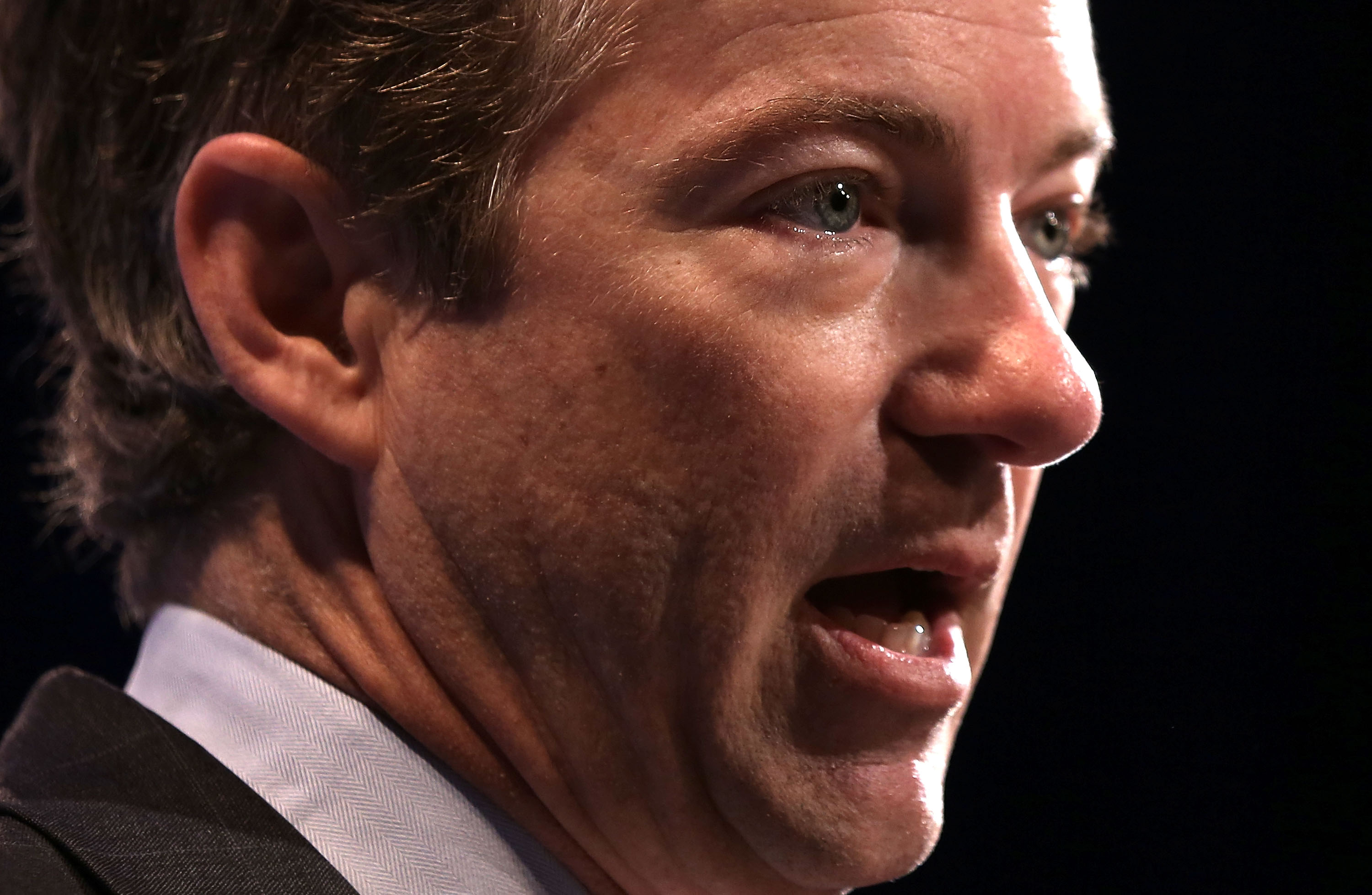
Rand Paul’s Biggest Selling Point

Stuart Reid thinks it’s Paul’s foreign policy:

After [George H.W.] Bush lost his reelection, the realists never could transcend technocracy to achieve real political influence, Sen. Rand Paul Delivers Immigration Address Hispanic Chamber Of Commerce Conferenceand never could offer a message that competed with that of the neoconservatives. Today, Republican realists face the added disadvantage of having a president from the opposite party who, generally speaking, has adopted just the type of limited foreign policy they prescribe. Agreeing with the incumbent Democrat gets you nowhere in the Republican Party.

And so the non-neoconservative Republicans are left with Paul, who, in the words of the conservative New York Times columnist Ross Douthat, “can sometimes sound like a libertarian purist, sometimes like a realist in the Brent Scowcroft mode and sometimes like—well, like a man who was an ophthalmologist in Bowling Green, Ky., just a few short years ago.” Paul’s perceived extremism has prevented the old-school realists from claiming him as their own. As one former official who identifies as a realist told me, “While some (but not all, to say the least) of what Rand Paul says makes sense, he is much too outside the mainstream on all sorts of economic, domestic, and foreign policy questions to be the heir to Bush 41, Ford, Nixon, Eisenhower, etc.”

When anyone describes anyone in Washington “outside the mainstream” without any substantive argument as to why he is wrong, my hackles rise. Those in Washington who were “out of the mainstream” in 2003 opposed the Iraq War. In 1993, “outside the mainstream” folks backed gay marriage. In 1980, “out of the mainstream” Ronald Reagan changed the country.

I have lots of qualms about both Pauls. But I can see how sincere he is in believing America’s interests would be better served by a lighter global footprint than our current one, and I agree with him. He’s too libertarian-purist for my taste or, in my view, the country’s cohesion. But knowing how tough it can be to shift Washington’s vast and connected military industrial complex away from seeking reasons to justify its expansion and expense, his rigidity, though an obvious flaw in a politician, may be necessary to get to a post-hegemonic America. And he has definitely helped change the debate:

The brashest of Paul’s positions—the immediate cutting off of aid, the major downsizing of military bases, the imposition of significant congressional authority—will likely never become U.S. foreign policy. But his effect on the rhetorical landscape could prove more lasting. Paul, George Will said, has “expanded the range of what is discussable.” The challenge he poses to advocates of military intervention is particularly potent, and particularly useful at a time when Washington is debating our intervention in Syria.

Drezner admits that “Paul is taking positions that are forcing more hawkish GOP foreign policy activists to, at a minimum, hone and defend their arguments better than they have in the past.” But he isn’t entirely sold:

[O]ne of the points I was trying to make in my Foreign Affairs essay was that the GOP needed to take the topic seriously as a substantive policy issue — not just as an opportunity to posture for domestic interests.  Based on Reid’s article, it’s not entirely clear to me that Paul is doing that.  Rather, he just seems to be playing to a different base — the Alex Jones-listening, UN-black-helicopter, the-amero-is-coming conspiracy theorists.

As often, Dan separates the Paulite wheat from its large amount of chaff.

(Photo: Getty Images.)

One More Reason To Hate Hitler

He ruined German music, according to Terry Teachout’s review of Forbidden Music: The Jewish Composers Banned by the Nazis:

The extent to which Hitler and his cultural commissars sought to control and shape European musical life has been chronicled in detail. But most of these books have dealt primarily or exclusively with German-speaking performers and those performing artists from other countries, France in particular, who collaborated with the Nazis. Yet the unswerving determination of the Nazis to rid Europe of what they called entartete musik (degenerate music) may well have had an even more far-reaching effect on postwar European musical culture. After all, many well-known Jewish classical performers—Fritz Kreisler, Artur Schnabel and Bruno Walter among them—managed to emigrate to America and other countries where they continued their careers without significant interruption. Not so the Jewish composers whose music was banned by the Nazis. Some of them were killed in the Holocaust, and none of those who survived succeeded in fully reconstituting their professional lives after the war.

One of the reasons why? It turns out the Fürhrer was a devotee of Wagner, in more than one sense of the word:

It is in no way surprising that Hitler should have paid close attention to Germany’s musical establishment, since he was an aesthete manqué with a passion for classical music. His ideas, moreover, about music and musicians had been shaped by Richard Wagner. “Whoever wants to understand National Socialist Germany must know Wagner,” he declared. Hitler read Wagner’s writings closely and took them seriously, declaring Wagner to be his favorite “political” writer and describing him as one of “the great reformers” in Mein Kampf. “Beside Frederick the Great we have such men as Martin Luther and Richard Wagner.”

Wagner’s pathological anti-Semitism was the insane root of the Third Reich’s suppression of Jewish composers. But one of the most striking aspects of this policy was the fact that even though Hitler promulgated a staunchly anti-modernist doctrine, it was not absolute in practice. Except for Hitler himself, Nazi leaders were comparatively indifferent to whether a given composer was a traditionalist or a modernist, so long as he played ball with them. What mattered to them—and to Hitler—was blood. If you were Jewish, it was irrelevant whether you were assimilated or observant, much less whether you were an atonal modernist or a Brahmsian conservative: Either way, you threatened the racial purity of German culture.

Being African In America, Ctd

In an interview, Chimamanda Ngozi Adichie, author of the novel Americanah, expands on her arguments about race that the Dish first covered here:

[R]ace is something that one has to learn. I had to learn what it meant to be black. When I first came, somebody made a joke about fried chicken, and people said ‘Oh my God!’ And I just thought, ‘Why? What’s the problem? What’s going on?’ If you’re coming from Nigeria, you have no idea what’s going on. When I came to the United States, I hadn’t stayed very long, but I already knew that to be “black” was not a good thing in America, and so I didn’t want to be “black.” I think there are many immigrants from Africa and the Caribbean who feel that way, and will say very clearly ‘I’m not black.’ There’s the overriding desire to do well, to succeed. If it means absorbing the negative stereotypes of a particular group, then that’s fine, they do it. I think also that many black immigrants don’t realize that they’re able to be here and do what they’re doing because of the sacrifices of African Americans. They don’t know the history. I didn’t when I came.

An African American man called me “sister” once, and I was like ‘No, no, no, I’m not your sister, I’m not doing that.’ It took about a year of reading, learning, watching, for me to really come around and realize that there’s a context— you know, I read African American history and I’m just amazed at how recent some of the things that happened were. I’m not talking about slavery, I’m talking about 40 years ago. But when immigrants come here they absorb stories that have no context and no history. So it’s ‘oh, black Americans are very lazy. They all live in the inner city because, you know, they don’t want to work hard.’ Sometimes you’re in a gathering of immigrants, and some of the talk can sound like you’re in Alabama in 1965.

It’s very depressing, because I’ve come to deeply, deeply admire African American history and African American people. Their story is the one I most admire, the one I’m most moved by. But then, there are different ways of being black, there are different blacks. I’ve come to very happily identify as black, and I like to joke about wanting to go back and find that man who called me sister, because I would hug him. But my experience is different. My experience of blackness is different from African Americans, and for me it’s still a learning process, because there are things that I can’t inhabit. Now I know racial subtleties, now I get it. But I don’t have the history, and it’s different.

What Would John Locke Do?

Declaring himself one of the “nones” – that is, someone without religious affiliation – George Will opines on religion’s place in the American experiment:

[T]he American founding owed much more to John Locke than to Jesus. The founders created a distinctly modern regime, one respectful of pre-existing rights — rights that exist before government and so are natural in that they are not creations of the regime that exists to secure them. In 1786, the year before the Constitutional Convention, in the preamble to the Virginia Statute for Religious Freedom, Jefferson proclaimed: “[O]ur civil rights have no dependence on our religious opinions, any more than our opinions in physics or geometry.”

In fact, religion is central to the American polity precisely because religion is not central to American politics. That is, religion plays a large role in nurturing the virtue that republican government presupposes because of the modernity of America. Our nation assigns to politics and public policy the secondary and subsidiary role of encouraging, or at least not stunting, the flourishing of the infrastructure of institutions that have the primary responsibility for nurturing the sociology of virtue. American religion therefore coexists comfortably with, but is not itself a component of, American government.

Religion’s independence of politics has been part of its strength. There is a fascinating paradox at work in our nation’s history: America, the first and most relentlessly modern nation, is — to the consternation of social scientists — also the most religious modern nation. One important reason for this is that we have disentangled religion from public institutions.

Robert Long comments on the distinctiveness of Wills’ approach:

Will travels ground seldom tread by today’s avowed unbelievers: he warmly praises American religions both for the democratic impulses they impart and for the intermediary role they play between citizen and state. And if natural rights don’t require religion, they are “especially firmly grounded when they are grounded in religious doctrine.”

The nones of America should “wish continued vigor for the rich array of religious institutions that have leavened American life,” he concludes.

Here Will differs sharply from today’s professional nonbelievers, who regard religious belief with something akin to revulsion, and who channel the old progressive view that religion must be eclipsed for humankind  to secure a long and prosperous future. The George Will model combines unbelief with a fondness for religion, not a fear of it.

“An Almighty Paradigm Shift”

Damian Thompson notices the deep convergences between Justin Welby, the new Archbishop of Canterbury, and Pope Francis:

The similarities between Archbishop Welby and Pope Francis are almost spooky — once you get past the fact that one is an Old Etonian evangelical Protestant and the other a South American Jesuit who prays in front of garlanded statues of Mary. Archbishop Welby was enthroned two days after Francis was inaugurated. That’s simple coincidence, but the other parallels tell us a lot.

Both men were plucked from senior but not prominent positions in their churches with a mandate to simplify structures of government that had suffocated their intellectual predecessors, who also resembled each other in slightly unfortunate ways. Rowan Williams and Benedict XVI seemed overwhelmed by the weight of office; both took the puzzling decision to retreat into their studies at a time of crisis in order to write books — Dr Williams on metaphor and icon-ography in Dostoevsky, Benedict on the life of Jesus. When they retired, early and of their own volition, their in-trays were stacked higher than they had been when they took office. Their fans were disappointed and the men charged with replacing them thought: we’re not going to let that happen again.

Pivoting off the essay, James Mumford grapples with what the elevation of these two Christian leaders might portend:

Emerging there, [Thompson] argues, is an extraordinary thing: a new ecumenism centred around evangelism. ‘The alliance between Catholics and evangelicals is the most important and surprising development in global Christianity for decades,’ he writes.

This is indeed remarkable – that an Archbishop of Canterbury enamoured with Catholic Social Teaching and devoted to Ignatian spirituality and a Latin American Cardinal who likes reading the bible with Protestant ministers were appointed within weeks of each other; that American evangelicals love ‘our’ Pope Francis and conservative Catholics increasingly find common ground with Protestants around hot-button moral issues.

I don’t think it’s exaggerating to see this development as the twenty-first century church’s ‘perestroika’ (‘reconstruction’) and ‘glasnost’ (‘openness’). A sea-change in attitudes. An almighty paradigm-shift. An opening out onto the ecclesiastical other, rooted in a conviction that what unites Christians of different denominations is far greater than what divides them.

Sex, Drugs, And Rolling Stones

Robert Frank’s 1972 documentary of the Rolling Stones on tour, Cocksucker Blues, portrays the band in such an unflattering light that, upon seeing the completed work, its members blocked its release. Jack Hamilton reviews the movie:

Most troubling of all are the unfamous players, the roadies and groupies and hangers-on who seem plucked from the pages of Slouching Towards Bethlehem and are now lost to history, or to worse. We meet a fan bemoaning the injustice that her LSD usage has caused her young daughter to be taken into protective custody; after all, mom protests, “she was born on acid!” We see a man and woman shooting heroin, filmed with bored detachment, the only sound the whir of a hand-held camera. Upon completion the woman looks up and asks, unnervingly and entirely validly, “Why did you want to film that?”

The film’s most disturbing scene, and the one that most lives down to its reputation, takes place on the Stones’ touring plane.

We see explicit and zipless sex. We see clothed roadies wrestling with naked women in a manner that seems dubiously consensual, as band members play tambourines and maracas in leering encouragement. At one point Keith Richards emphatically gestures at Frank to stop filming; he doesn’t. By the time the scene finally ends we feel drained, nauseated, ashamed of ourselves and everyone else in this world.

These are emotions not typically associated with rock films, and if only for this reason Cocksucker Blues is an important work. But it’s also a riveting portrayal of beauty in decay, and Cocksucker Blues’ most redemptive moments come in its musical performances. Frank has no use for the sumptuous stage sequences of later concert films like Scorsese’s The Last Waltz or Demme’s Stop Making Sense; the performance footage in Cocksucker Blues is frenetic, explosive, and almost random in composition. “Brown Sugar” is captured by a hand-held camera so hyperactive it seems to mimic Jagger’s dance moves; “All Down the Line” is shot almost entirely from behind the drum kit, Charlie Watts’ splashing hi-hat in the foreground, hypnotically obscuring, then becoming, the main event. In a particularly stunning scene Stevie Wonder joins the band onstage for a medley of “Uptight (Everything’s Alright)” and “(I Can’t Get No) Satisfaction” as the camera scrambles about, bottling a moment more intoxicating than every substance backstage combined.

The scene with Stevie Wonder is here. Two long clips from the film are here and here.