The Internet Is For Pornfunding

dish_offbeatr

Gillian Orr ponders the potential of Offbeatr, a site for crowdfunding porn:

This could potentially have a democratising effect on porn, with previously short-changed fans (namely women) being given a say as to the sorts of films that get made.  Erika Lust, a feminist writer and director of pornography, isn’t quite so sure: “I don’t think that will be the case. There is still a long way to go until women are considered significant porn consumers as it is. Also, it’s my belief that change in the industry will come from film-makers who are dedicated to creating erotica and particularly their own vision, regardless of funding and popular opinion.”

Lux Alptraum agrees that many projects seems to be faltering but names a notable exception:

Almost a year after the site’s launch, many projects are still struggling to get the votes needed to advance into the funding stage (unlike most crowdfunding sites, Offbeatr requires project creators to collect a set number of votes before they begin soliciting donations as a way of proving the viability of the project). Even some promising projects created by talented, experienced people seem to be floundering. “Come to Me When You Are Ready,” a film by the award winning adult filmmaker Erika Lust, has received a mere 17% of the votes required to move on to the fundraising stage; Mormonboyz.com’s campaign to fund a film scheduled to debut last fall is similarly stalled. …

To date, thirteen projects have been successfully funded by Offbeatr. Most had modest goals, which certainly helped their success (though it should be noted that one project managed to raise almost $200k). And many of them were created by established artists with loyal fan bases — a hallmark of quite a few crowdfunding successes, adult or not. But there is one thing that sets Offbeatr’s successful projects apart from those found on Kickstarter, Indiegogo, or Crowdrise: the majority of them have come from members of the furry community.

In other furry news, WM. Ferguson was in Pittsburgh for the Fourth of July weekend and noticed that, aside from unusually enthusiastic Pirates fans, something about the city seemed strange:

I saw another guy having a cigarette outside the convention center. He had fox ears, a matching tail and big fur boots, and I asked him what was going on. He told me he was in town for Anthrocon — a convention for fans of anthropomorphism, commonly known as furries.

It was a perfect alignment of misunderstood subcultures: Pirates fans and furries. The furries’ ascendancy seems the more assured of the two. Although the Pirates had the best record in baseball the weekend I was in Pittsburgh — which hasn’t happened this late in the summer since I can’t remember — Anthrocon was having its strongest convention ever, having grown to more than 5,000 furries since it started in Albany for a few hundred like-minded anthropomorphs in the late ’90s. This year, The Post-Gazette estimated, Anthrocon would bring an estimated $6.2 million to the city. The attendees would also try for the world record for the largest parade of people in fur suits.

Previous Dish on Offbeatr here.
The Inner Lives Of Animals, Ctd

“Do elephants have souls?” asks Caitrin Nicol, who describes how the beasts demonstrate an unusual appreciation for mortality:

For man, his sense of self, sense of history, and sense of the intemporal, however inchoate, are gestured at with his remembrance of those who have passed on. But here he is joined by the elephants, the only other known creatures that — whatever it may mean to them — purposively commemorate their dead, in a way [Coming of Age with Elephants author] Joyce Poole calls “eerie and deeply moving”: “It is their silence that is most unsettling. The only sound is the slow blowing of air out of their trunks as they investigate their dead companion. It’s as if even the birds have stopped singing.” Using their trunks and sensitive hind feet, the ones they use for waking up their babies, “they touch the body ever so gently, circling, hovering above, touching again, as if by doing so they are obtaining information that we, with our more limited senses, can never understand. Their movements are in slow motion, and then, in silence, they may cover the dead with leaves and branches.”

After burying the body in brush and dirt, family members may stay silently with it for over a day; or if a body is found unattended by elephants not related to it, they may pause and stand by for some time. They do this with any dead elephant, recently deceased or long departed with only the skeleton remaining. “It is probably the single strangest thing about them,” [Elephant Memories author] Cynthia Moss writes:

Even bare, bleached old elephant bones will stop a group if they have not seen them before. It is so predictable that filmmakers have been able to get shots of elephants inspecting skeletons by bringing the bones from one place and putting them in a new spot near an elephant pathway or a water hole. Inevitably the living elephants will feel and move the bones around, sometimes picking them up and carrying them away for quite some distance before dropping them. It is a haunting and touching sight and I have no idea why they do it.

Elephants even react to carved ivory, long divorced from the original remains and altered and handled extensively. Poole writes of a woman who came to visit Tsavo National Park wearing ivory bracelets: as an elephant approached, the park warden cautioned her to hide them behind her back; but when the elephant arrived, she reached around behind the woman and contemplatively perused the bracelets with her trunk. Poole then had a friend stage a repeat performance later, and the same thing happened.

Recent Dish on animal consciousness here and here.

From Rag To Comedy Riches

New-names-for-armed-services-e1373373069927

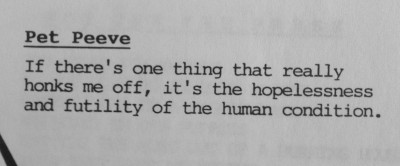
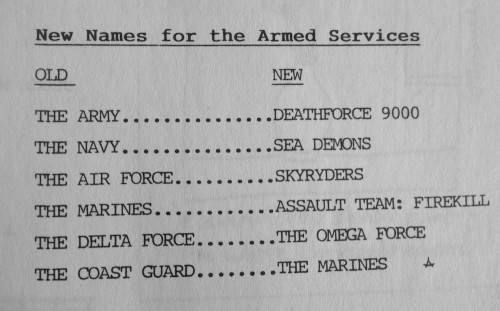
George Meyer’s late-’80s humor magazine Army Man had a staff that went on to fill the ranks of The SimpsonsSNL, and The New Yorker.  James Folta scans old copies of “America’s Only Magazine” and marvels that it isn’t more well-known:

[W]hat makes Army Man‘s humor so relatable is that many of the pieces are pointedly critical and, like much great humor, evidently reflect the writers’ frustrations. The jokes land with more honesty and truth as a result. … It’s the density of the jokes that makes them more than just a quick laugh. They are able to pull in large ideas, universal gripes, and pain. This universality and relatability is what would make the Simpsons one of the greatest shows of all time. …

In the age of Twitter, it can be tempting to compare Army Man‘s short, punchy humor to tweets. But unlike Twitter, Army Man has no chaff. This is the power of an editor with a strong vision. Meyer chose the funniest of funny. Careful attention is given to each joke but also to the unity of the absurdist, off-kilter voice. With Twitter and democratic or algorithmic organization, the steading hand of an editor is lost. Meyer’s editorial guidance makes Army Man more than what it would appear to be.

The magazine’s success would be its ultimate downfall.

One of Army Man‘s biggest fans was producer Sam Simon. When Simon needed to quickly pull together a writing staff for the first season of The Simpsons, he opened a copy of dish_AMpetpeeveAmerica’s Only Magazine and hired George Meyer, Jon Vitti, and John Swartzwelder. Later, most of the masthead of Army Man would end up writing for The Simpsons. Which was great for The Simpsons, but it doomed the magazine. Meyer didn’t want to sacrifice the quality of either by trying to juggle his attention. So after just three issues, the magazine stopped.

Army Man‘s ranks also included Jack Handey, Andy Borowitz, and Bob Odenkirk.

Creative Voices

A Radiolab podcast reviews the career of neurologist and author Oliver Sacks, who turned 80 this week. In an interview with Suzanne Koven of The Rumpus, Sacks discusses his new book Hallucinations and the connection between hallucinations and creativity:

Rumpus: You describe the hallucinations Henry James had on his death bed—vivid scenes of the Napoleonic Wars—and novelist Amy Tan’s hallucinations when she had Lyme disease. Do you think that creative people have more interesting hallucinations? Or do you think they simply describe their hallucinations in a more interesting way?

Sacks: Well that’s a very nice, contrasting pair. Amy called them “a detritus of a dream,” or something like that and had not much interest, whereas Henry James thought it was some subjacent fantasy which he’d had all his life and finally sort of took over. At one time I did read a book called The Voices of Poetry, where the thesis was very much that a “voice” is not just a metaphoric reference to the muse.

Rumpus: Have you had that experience in writing? Of hearing a voice?

Sacks: No. Yes. Although I wouldn’t call it … I’m not sure what to call it. I have it less now, but with my first book, with Migraine, there were many, many problems, including a sort of mad, internal threat in which I said to myself, in September of ’68, You have ten days to write it and if you’re not finished by ten days, you’ll commit suicide. This sounds even madder than it was. You have to know some of the background. Anyhow, under my own threat or joke, I first started writing and within hours the feeling of terror was replaced by a feeling of joy in the writing and, in particular, a feeling that I was taking the book down to dictation. It came to me absolutely fluidly by a sort of inner voice. I was excited. I didn’t want to go to bed. I slept for two or three hours a night and no more. Perhaps I was hypomanic. I’m not sure what word to use.

So that was very much like hearing a voice. I can’t say it was anyone’s voice in particular. But my verbal auditory imagery is as vivid as my visual imagery is poor. My musical imagery is somewhere in between.

Life’s Too Short In America

Christopher Flavelle reviews a new study showing that Americans have fallen behind Europe in life expectancy and considers our potential to catch up:

The inescapable context for this study is the enduring debate over whether the government should ensure that almost all Americans get access to health insurance. The portion of Americans who are uninsured, or who are insured but lack affordable access to care, is the single biggest difference between the U.S. and other developed countries. It’s also, through Obamacare, a difference that can be fixed.

Richard Gunderman dismisses the importance of the numbers:

[T]he mist of health statistics often obscures the mountain we are really trying to climb. It is true that U.S. life expectancy lags behind that of a number of other nations. It is true that if we could lower rates of smoking and obesity, we could probably bump these numbers up. But a more sober analysis reveals that life expectancy is a pretty poor indicator of health. We are attracted to it because it is straightforward to measure and makes it relatively easy to keep score. But we cannot tell from a person’s life expectancy how well they are actually living.

Suppose through some wonder of modern biomedical science we could suddenly double our life expectancy by staying in bed 20 hours per day, or giving up all solid foods, or never again reading a book. Would we do it? To say that we are willing to pay any price in order to increase the length of our lives is to say that we have forgotten what it really means to live. The Struldbruggs in Jonathan Swift’s Gulliver’s Travels are immortal specimens, but they are also miserable human beings, whose unending lives prove to be not blessing but curse.

Another Paul, Another Secessionist Smear? Ctd

Friedersdorf puzzles over Rand Paul’s connection to Confederate nostalgist Jack Hunter:

I do respect Hunter’s renunciations and rethinking, and the increased empathy that preceded this controversy. Within the world of commentary, I am disinclined to shun anyone earnestly seeking redemption from a past of talk-radio hackery — talk about getting the incentives all wrong.

That doesn’t change the fact that Hunter should resign his post immediately, because his continued presence can only undermine the effectiveness of his employer. Paul shouldn’t have ever hired him, because even if — to be overly charitable — Paul wasn’t aware of his objectionable views, or disagreed with all of them but didn’t regard them as pertinent to the job, a Senate staffer’s role is to help his boss govern, and any fool should’ve been able to see that having an avowed secessionist and Confederate nostalgist on staff would end in distraction, controversy, and many assuming (whether rightly or wrongly) an antagonism to blacks — just as many Americans assumed, during the Jeremiah Wright scandal, that Obama harbored antagonism toward America.

Bouie thinks Rand has a race problem that goes beyond the staffer:

Yes, Paul is on the right side of the war on drugs, and is one of the few Republican voices pushing for federal criminal justice reform. At the same time, as evidenced by his disastrous appearance at Howard University, he lacks any awareness of how his limited government views play to African Americans, who—as a group—have a strong memory of what could happen when you leave states to their own devices. On some level, he seems to think that his ideological purity makes it okay that he believes the 1964 Civil Rights Act was an imposition on “liberty,” despite the fact that this places him in the company of people who defend secession, and the Confederacy.

None of this is evidence that Rand Paul holds racist views, and if he did, it wouldn’t matter. Lyndon Johnson was almost certainly a racist—he also worked to usher a Second Reconstruction of far-reaching civil rights laws. But it is evidence that Paul is oblivious to the history of “limited government” ideologies in this country, which have been (and are) used to defend white supremacy.

Julia Ioffe nods:

As New York’s Jonathan Chait pointed out, racists tend to pop up in the Pauls’ circles. A lot. This has been true since the elder Paul got into politics, in Houston, in the late 1960s. Paul is going to have to explain this stuff, and explain it in a definitive way. How, for example, did he only have a “vague” notion of his co-author’s previous work? Wouldn’t his past work be an important qualifier when he was being considered for that job? How did he hire a man to direct his social media whose Twitter handle is @SouthernAvenger?

This is a different and more important question than the one his father faced over the racist, homophobic, and anti-Semitic apocalyptic drivel written under his name. Ron Paul had no chance of getting to the White House, but Rand could, and so it matters who those “lot of people” are. Rand, of all people, should know: He filibustered one of the people that was going to work for the current president (CIA Director John Brennan), and has threatened to filibuster another potential presidential employee (FBI Director James Comey).

Ask Michael Hanna Anything: The Surprise Of June 30th

Michael Hanna points out how shocking it was for the June 30th protests to not only come together as fast as they did, but grow to a size that far eclipsed the protests of 2011:

Nisral Nasr thinks the political landscape in Egypt is too foggy to tell whether the coup will be in the service of democracy:

There is no particular reason for now to believe that the Egyptian Armed Forces are the modernizers envisaged by American academics in the 1960s.  Nor is there reason to believe that the Muslim Brotherhood is the carrier of democratization through an Islamic state as envisaged in the 1990s and early 2000s.  Of course the governments after 1952, invariably led by Army officers, pursued industrialization policies for strategic reasons.  So, too, the Muslim Brotherhood leadership pursued open elections for their own strategic reasons.  Neither the Army nor the MB are or were particularly committed to the wider principles that academics like to read into these policy choices.

Sarah Carr declares that “the debate is semantic and tedious, and the nomenclature will not be decided now”:

I will not weigh in on the coup/revolution debate other than to say millions of Egyptians were on the ground demanding Morsi’s removal while military jets drew hearts in the skies above them, and then Defense Minister Abdel Fattah al-Sisi announced that Morsi had (forcibly) buggered off. Nothing has changed. The real revolution will happen when army involvement in politics is a distant relic of history.

Elsewhere, the Big Picture is up with a new gallery compiled from the past week in Egypt.

Michael Wahid Hanna is a Senior Fellow at The Century Foundation, where he works on issues of international security, international law, and US foreign policy in the broader Middle East and South Asia. He appears regularly on NPR, BBC, and al-Jazeera. Additionally, his Twitter feed is a must-read for anyone interested in Egyptian politics. Our ongoing coverage of the current events in Egypt is here. Michael’s previous answers are here. Our full Ask Anything archive is here.

Will We Cut Egypt’s Aid? Ctd

Ali Gharib sides with Elliott Abrams on aid to Egypt. He doubts the withdrawal of US money will undermine the country’s ailing economy:

[A] common objection goes like this: Egypt is in tough economic straits, and cutting off both military and economic aid could plunge the whole economy—and society—into a chaotic tailspin. (Because the military dominates the economy, controlling between 10 and 30 percent of it, the military aid factors in here too.) Along with various members of Congress, Secretary of State John Kerry made this point: ”A hold up of aid might contribute to the chaos that may ensue because of their collapsing economy,” Kerry said. “Their biggest problem is a collapsing economy.”

The U.S. gives about $1.5 billion total in aid to Egypt. Since Morsi’s ouster, Gulf Arab countries like Saudi Arabia, Qatar and the United Arab Emirates pledged $12 billion—which appears to not be directed solely at the military. In other words, the Gulf Arabs have already rushed to fill the breach, with more—and more flexible—aid. The Egyptian economy won’t be peachy keen any time soon, but U.S. aid, in the context of the Gulf Arab money, will hardly make or break it.

Max Fisher counts Hagel’s close relationship with the head of the army as another reason we haven’t called it a coup and suspended aid:

The Egyptian defense minister who officially announced on state TV that the military had removed Morsi, a general named Abdel Fatah al-Sissi, also turns out to be friendly with U.S. Defense Secretary Chuck Hagel, according to a revealing story by The Wall Street Journal. They’re not old fishing buddies, exactly, but they had lunch two months ago, the foundation of a personal relationship that was, according to a senior administration official who spoke to the Journal, “basically the only viable channel of communication during the crisis.”

For the Obama administration, then, alienating Sissi would have left the United States without a “viable channel of communication” with one of its most important allies in the Middle East. That raises the potential costs of condemning the coup significantly, and may help explain why the United States is eager to preserve the relationship.

More Dish on the debate over Egypt’s aid here, here and here.

The GOP Exposed

John Boehner Holds Weekly Press Briefing At The Capitol

The House Republicans just pushed through a farm bill with extremely generous farm subsidies while scrapping the usual corollary food stamp aid. It doesn’t get clearer than that. There’s no small government consistency here – just an embrace of subsidizing Big Ag and a contempt for the needy in a long, protracted growth recession. Are they trying to make themselves look like total douchebags? Chait is unsurprised:

It’s no longer novel that conservative Republicans have positioned themselves to Obama’s left on domestic spending that benefits their own constituencies. We have seen three years of Republicans attacking Obama for robbing Grandma’s Medicare. But at least Medicare is a justifiable program. The existence of farm subsidies is insane, and the fact that a party that hates government so much it engages in a continuous guerilla war of shutdowns, manufactured currency crises, and outright sabotage can’t eliminate it may be the most telling indicator of the GOP’s venality. They only hate necessary government spending. Totally unjustifiable spending is fine with them.

Or they are simply acting out on deeper cultural fears and biases? Even Douthat takes the GOP to task this time:

This is egregious whatever you think of the food stamp program, and it’s indicative of why the endless, often-esoteric debates about the Republican future actually matter to our politics. Practically any conception of the common good, libertarian or communitarian or anywhere in between, would produce better policy than a factionally-driven approach of further subsidizing the rich while cutting programs for the poor. The compassionate-conservative G.O.P. of George W. Bush combined various forms of corporate welfare with expanded spending on social programs, which was obviously deeply problematic in various ways … but not as absurd and self-dealing as only doing welfare for the rich.

Bernstein wonders if Boehner should have killed the bill:

What’s not clear to me is whether John Boehner is better off with this thing passing. As Ed Kilgore notes, it’s not real likely that anything can come out of conference that can pass. It’s not really clear, right now, if the separate nutrition bill can pass. It’s not clear what Boehner had to promise to conservatives about conference to get them to stick on this vote. It’s not clear what the next step is.

It seems to me that Boehner did have another choice. If the GOP-only farm-only Farm Bill fails, then maybe he can push the mainstream of his conference to support a bipartisan bill, leaving the conservative fringe out entirely. It won’t work on everything, but on the Farm Bill, it really might. Maybe. And if it works on the Farm Bill and there’s little fallout, that might strengthen Boehner’s ability to gather different coalitions on the next tough one that comes up.

Good luck with that. Plumer foresees gridlock:

The Senate and House could try to reconcile their two very different bills in conference — and the final version could well include food-stamp money. But any reconciled bill would still need to pass the House again — and conservatives there don’t want to vote for the Senate’s food-stamp formula, which would cut spending by just $3.9 billion over the next 10 years. The House could pass its own food-stamp bill later this month. Alternatively, the House could approve its own separate bill to reauthorize the food-stamp program. Indeed, Robert Greenstein of the Center for Budget and Policy Priorities thinks the GOP will eventually come up with “a still harsher SNAP bill designed to pass solely with Republican votes.”

What does he mean? Recall that the previous House farm bill would have cut food-stamp funding by $20.5 billion over 10 years. That legislation failed to pass because the cuts were too steep for many House Democrats and not steep enough for many House Republicans. If the next food-stamp bill made even sharper cuts, then Republicans might be able to pass it on their own. But, again, the final product would still have to get through the Democratic Senate. There’d still be an impasse.

(Photo: House Speaker John Boehner speaks to the media during his weekly news conference on Capitol Hill, July 11, 2013 in Washington, DC. By Mark Wilson/Getty Images.)

Why Has Immigration Reform Flatlined?

Ambers thinks the bill probably “never had a chance”:

Boehner is not willing to sacrifice himself for the sake of immigration reform. He could easily bring a bill to the floor, any bill, and get it passed, and then appoint conferees who will move towards the Senate version of the bill. But he won’t. If he did that, he’d be canned. Hence his “majority of the majority” rule, the Hastert rule, which is both a reflection of, and a contributor to, the anti-governing spirit within the Republican Party.

The louder parts of the GOP base, the talk radio hosts, are resolutely against compromise on immigration. Even Sean Hannity, who flip-flopped the day after the 2012 election because he (temporarily?) agreed with the smarties in his party that principles had to be exchanged for expediency, is now back where he was. Why? That’s where his listeners and viewers are.

Jonathan Bernstein notes that most Republican supporters of immigration reform in the House appear “more scared of their shadows than they are of a bill failing”:

It gets to something very important to know about legislating. Yes, counting votes matters. But intensity also matters. There are plenty of bills that have theoretical majorities but never go anywhere, either because of strong opposition or, even deadlier, a lack of strong support. What it comes down to is that comprehensive immigration reform probably can be saved — but only if those Republican politicians, Republican operatives and Republican-aligned interest groups who support it are willing to go all-out, and not just behind closed doors, to get it.

Klein and Soltas add:

The simplest way to explain the politics of the bill right now is that, after the election, the Republican Party was scared of the Hispanic electorate, and so they wanted to act. But Republicans are no longer that scared of Hispanic voters, and so they no longer want to act. Unless the Hispanic community can change that, there won’t be an immigration bill.