To Which States Will Today’s Decision Apply? Ctd

HRC has a primer on what the DOMA decision means for same-sex couples in various states:

Brian Beutler explores the implications of the SCOTUS’ decision to leave Section 2 of DOMA, “the section that says states don’t have to recognize marriages from other states,” intact:

Marriage equality supporters are understandably ecstatic that the Supreme Court has declared section three of DOMA unconstitutional. But for a subset of same-sex partners, the ruling won’t truly guarantee them equal treatment under the law. The nature of the court’s DOMA decision, combined with its decision to punt the California Prop 8 case about whether there’s a constitutional right to gay marriage, will ultimately create a sort of three-tiered status for same-sex partners. …

“As a general rule, a person who legally married a different-sex partner will be considered married in all states,” [Shannon] Minter [the legal director for the National Center for Lesbian Rights] said. “But that is not true for same-sex spouses. Many states have enacted constitutional amendments that prohibit the state from respecting the marriages of same-sex couples who validly married in another place. It is not yet clear whether same-sex spouses who live in states that do not respect their marriages will be eligible for federal benefits that turn on whether a marriage is valid where the couple or surviving spouse lives. At least in the short run, there are some federal benefits that same-sex couples in these states likely will not receive.”

Allan Brauer, who married his husband in California in 2008, explains what the ruling means for him:

The DOMA decision means that my spouse and I will now be able to file joint Federal income tax returns as well as state ones, my spouse will no longer pay Federal taxes on the value of my health insurance, and the tragedy of losing a spouse will no longer be exacerbated by unequal treatment of our estate and Social Security benefits. Hooray!

But… If we were to relocate to a state that does not permit SSM or recognize such marriages performed elsewhere, some of those Federal benefits may simply disappear. Poof! Current Federal regulations vary across departments in whether they look at your legal status based on where you live, or where your marriage was performed.

Linda Beale predicts more litigation in the near future:

[T]here is a huge problem looming because of the failure of many states to recognize same-sex marriages performed in other states even though they recognize all other marriages performed in those other states.  Section 2 of DOMA–which allows states to refuse to recognize sister-state marriages–in flagrant violation of the normal rules of comity between states–was not at stake here and thus its repeal remains for future cases. This means that there will be considerable uncertainty –and much bigotry and discrimination against gay couples for some time as those states that have enacted discriminatory constitutional or statutory provisions against gays continue to deny marriage rights to gay married couples when they move  into them, and perhaps prevent them from retaining custody of their children or being able to legally divorce their spouses or will estates to their spouses.

These problems will be resolved, at least for now, under each states “conflict of laws” provisions, with the overlay of the state’s constitutional prohibitions, where existing, on recognition of same-sex marriages.  This will cause harmful suffering to gay couples, so one would expect that there will be litigation on this issue soon.

The GOP’s Collective Action Problem

Chait watches Republicans put themselves in a bind over immigration reform:

Immigration reform seems to be a simple problem of Republican Party organization. The interests of the party as a whole dictate passing a bill, but the people who need to do the passing — Republicans in Congress — have an interest in voting immigration reform down.

He wonders if recent statements from Paul Ryan will prove helpful:

There are still plenty of House Republicans who want the bill to pass without having to cast a vote for it themselves. Paul Ryan is enthusiastically stepping forward to pitch immigration reform to his party. Ryan, of course, would very much like to be a Republican presidential nominee one day. And Ryan gets his way within the party more than anybody else.

Caren Bohan notes Ryan’s past efforts on immigration:

Ryan is not a new convert to immigration reform and he says politics are not driving his embrace of it. His work on it goes back to his days as an aide to Jack Kemp, the late congressman who saw immigration as part of a free-trade agenda. In April, Ryan teamed up with his friend, Democratic Congressman Luis Gutierrez, who is a staunch supporter of immigration reform, to tout the issue at an event in Chicago. He has also co-sponsored immigration reform bills in the past.

Paul Mirengoff is skeptical:

Ryan proposes that we grant illegal immigrants a “five-year probationary status” essentially immediately, before anything new and concrete is done to secure the border. If after five years, Congress isn’t satisfied that the border has been secured, the probationary status supposedly will be revoked. Otherwise, the formerly illegal immigrants can proceed towards full citizenship. …

It’s almost unimaginable that the status of former illegal immigrants would ever be revoked. Do you see Republican politicians mustering the courage to pull that trigger? I didn’t think so. At most they might add more years to the probationary period, but I don’t see that happening either. Ryan — I wish I could say this nicely — is conning us.

Civil Unions ≠ Marriage

Governor Christie, who vetoed marriage equality in New Jersey, disapproves of SCOTUS’s ruling:

Zack Ford counters Christie:

Besides the fact that a referendum continues to be a costly, offensive, and unnecessary option, Christie could not be more wrong; in fact, Wednesday’s DOMA decision probably has a bigger impact on New Jersey than on any other state. In the 2006 case Lewis v. Harris, the New Jersey Supreme Court unanimously ruled that the state’s constitution guarantees “every statutory right and benefit conferred to heterosexual couples through civil marriage.” The Court left it up to the legislature to determine how those rights are conferred, and lawmakers at the time passed a civil unions bill. An investigation that concluded in 2008 found that these “separate but equal” unions were inferior and did not meet the Supreme Court’s expectations, and a lawsuit is already pendingto challenge their unequal status.

With Wednesday’s ruling, the case against the civil unions becomes much more significant. Now, not only are civil unions inferior in how they’re respected in the state, they also deprive same-sex couples of all the federal benefits of marriage — the only union the federal government recognizes. A state judge has already scheduled a hearing for August 15 to fast-track Lambda Legal’s lawsuit in light of these new legal circumstances.

Barro looks at Christie’s past rhetoric on marriage and civil unions:

[Christie] said in a statement at the time he issued his veto: “I have been just as adamant that same-sex couples in a civil union deserve the very same rights and benefits enjoyed by married couples—as well as the strict enforcement of those rights and benefits.”

At the time, gay rights advocates disputed the notion that civil unions were equivalent to marriage. After [yesterday’s] decision, they are inarguably right. People in same-sex civil unions in New Jersey lack access to federal benefits that are available to straight New Jersey couples and will soon be available to same-sex married couples in states like New York. The only way to rectify that is to legalize gay marriage.

David Link also notes that, after yesterday’s ruling, it’s impossible to argue that civil unions are “marriage in all but name”:

The dynamics of marriage lite have now shifted. Only full marriage comes within the court’s ruling, a point made by both majority and dissenting justices. States will still have the ability to take half-measures, and I expect some will. But by doing so, they will be enacting laws they cannot expect to be fully equal to marriage. If they have any doubts, they can refer to Windsor.

So if the political argument continues to be about equality (and it should), anyone promoting civil unions as a political compromise will explicitly be compromising that.

Will We See A Republican Comeback?

Harry Enten thinks the GOP could easily win in 2016. He argues that Clinton’s general election polling numbers “won’t stand up over time” and that she is “still coming off a height of popularity since serving in the non-partisan position of Secretary of State”:

At this point, a better feel of how a Democrat might do if the election were held today is polling involving Vice President Biden. Biden is a well-known standard bearer of the Democratic label. He’s been serving in a partisan office for as long as many have been alive. His favorable rating generally matches up with President Obama’s approval rating in the polls.

Last month, Biden was either neck-and-neck or trailed leading Republicans. He was 1pt ahead of Marco Rubio and 2pt ahead of Rand Paul in an early May Public Policy Polling survey. He was behind by 4pt against Paul and 6pt behind Jeb Bush in a Quinnipiac poll.

All of them are also less well-known than Biden, yet they are polling at or ahead of him.

You could argue that Bush is more moderate than the mainstream Republican candidates, though, Rubio and Paul are almost certainly to the right of it. They incidentally are three of the top four leading contenders for the nomination right now. You wouldn’t expect mainstream Republican candidates to be polling this well if the party were too out of the mainstream to win.

Reihan objects to Enten’s claim that the “GOP might be feeling the pressure to adjust its political platforms to win national elections, but it doesn’t need to”:

The conceptual problem with Enten’s piece, in my view, is that some measure of “adjustment” is inevitable, as the issue mix changes from election cycle to election cycle. Issues that were not salient in 2012 will be salient come 2016, and the process of taking a stand on emerging issues will necessarily entail shifts of emphasis, etc. The central claim made by conservative reformers or reform conservatives (or whatever we’re called this week) is that the party still needs a compelling post-Reagan, post-crisis domestic policy agenda that resonates with middle-income voters. A related claim is that though, as Enten notes, the average voter felt that Mitt Romney was closer to them ideologically than Barack Obama, this didn’t mean that the average voter felt that Romney’s policy agenda was more responsive to her needs and concerns, which is the more salient question.

World Poverty: There Isn’t An App For That

Charles Kenny and Justin Sandefur say that Silicon Valley can’t save the world:

The tech gurus, like so many evangelists of earlier eras, are wildly overoptimistic about what their gadgets can accomplish in the world’s poorest places. In this they share a rich history of failure. No less than Marx and Engels were sure the locomotive was going to unite the proletariat into a national force for social revolution, and the world would be a worker’s paradise in short order as a result. More recently, in the midst of the Arab Spring protests, columnist Thomas Friedman and many fellow pundits gushed about the power of tools like Twitter and Facebook to overthrow dictators and promote democracy. The Internet, declared the State Department’s in-house tech guru, Alec Ross, had become “the Che Guevara of the 21st century.” (Given that Che failed in three of the four revolutions in which he participated, that might actually be about right.)

Not only that, but Joshua Keating flags a study in Africa correlating cell phone expansion with violent conflict:

[Researches] found that from 2007 to 2009, areas with 2G network coverage were 50 percent more likely to have experienced incidents of armed conflict than those without. The clearest overlaps between cell coverage and violence were observed in Algeria, the Democratic Republic of the Congo, Kenya, Nigeria, Uganda, and Zimbabwe.

The authors think that improved cell-phone coverage helps insurgent leaders overcome what’s called the “collective-action problem” — that people are reluctant to join group endeavors when there’s a high level of personal risk. But better communication helps leaders recruit reluctant followers, whether they’re demonstrating for higher wages or killing people in the next town.

Hathos Alert

A reader writes:

The comments section on Glenn Beck’s “The Blaze” website is so disturbing right now it has actually become hilarious.  Be careful, the sheer amount of facepalming this evokes might leave a permanent mark. These people are experiencing so much cognitive dissonance over what America means and represents in the modern world that you can almost hear their heads exploding trying to make sense of it all by grasping onto the most ridiculous of explanations.

Normally I’m not one to revel in victory; or rather, I try to enjoy winning but not revel in the loss of others. I mean hell, we’re all going to be on the losing side sometimes.  But sweet Jesus, it’s hard today. Here is a link to the comments section along with a few choice excerpts I’ve excerpted below (cue Cartman’s “tears of insufferable sadness“):

“It is your kind that is intolerant of our religion. You refuse to accept that we feel strongly about this.”

“We never hated gays – we just didn’t want them to use the word marriage. But your kind will never be satisfied until marriage is done away with and all churches are bankrupted and driven underground.”

“My wish for this once fine country is for it to be destroyed utterly. To be erased from the pages of history and never to be remembered by any who come after us unless it is to be compared to Sodom and Gomorrah in reference to the completeness of our depravity and moral collapse and our destruction at the hand of God.”

“For the first time in my life I despise my country.”

“The Gay president knows that homosexuals are easily controlled……Once you give up morals….You will give up guns you will give up everything……Property…..Jobs……You will be Government property…….Trade in you gun rights for a marriage certificate…….I watch gay women on TV……They are not commited and never will be…….My advice for men…….Do not be a sperm donor…..Do not…!!”

“I wouldn’t get too happy there, because once muslim laws take over here in America and before you say it won’t…maybe you should read about how CAIR and other muslim organizations are infiltrating our government. Plus, Obama is meeting with radical islamists in the WH (he just had a meeting with one, matter of fact there is a story on it here on the Blaze. Once the muslim laws take effect, homosexuals will be killed (just read the Quran)….but hey keep celebrating and think that light you see is the light at the end of the tunnel instead of the oncoming train.”

Sweet Jesus …

The Political Climate

Nate Cohn downplays the political danger that climate policy poses for Democrats:

[T]he electoral consequences of Obama’s climate policy will probably be overstated. That’s not because climate policy doesn’t have big electoral consequences, but mainly because Democrats have already incurred the huge, if localized costs of pursuing regulations on carbon emissions. The 2009-2010 era fights over Cap and Trade and EPA regulations on new power plants solidified Democrats as the party of the so-called “war on coal,” which resulted in cataclysmic Democratic losses in traditionally Democratic stretches of eastern Kentucky, West Virginia, western Pennsylvania, and western Virginia. Maybe memories of the “war on coal” would have faded without the president’s newest climate push, allowing Democrats to recover in 2014. That’s possible, but unlikely. After all, Republicans were already favored to takeover West Virginia’s open Senate seat.

Barro, meanwhile, worries that Republicans will respond to Obama’s climate policies with “maximum political and legal resistance:

[I]t’s not likely to be an effective strategy for shaping policy. Obama is acting under legal authority he already has and a Supreme Court decision that forces the EPA to regulate carbon. Republicans should instead do something they’re not used to: Work with Obama to come up with a better alternative to his plan. Obama has only taken a heavy-handed regulatory approach because that’s what he can do without congressional action; if Republicans would agree to a carbon tax or a cap-and-trade system, he’d gladly take that over the plan he laid out [yesterday].

What’s A Bisexual Anyway? Ctd

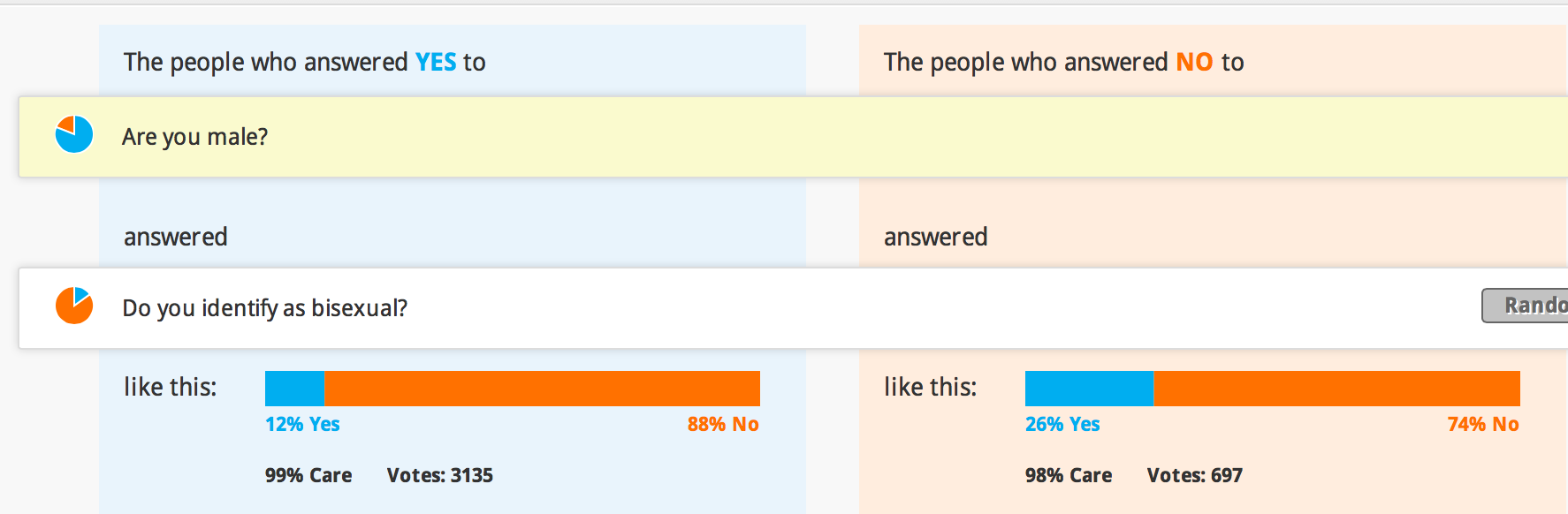
Screen Shot 2013-06-26 at 3.10.33 AM

The above screenshot from our unscientific poll shows that 12 percent of male respondents identify as bisexual while 26 percent of female respondents are bi. Of all the straight-identified respondents, 21 percent say they have had a pleasurable sexual experience with someone of the same gender. And 26 percent of respondents do not believe that bisexuality is a sexual identity of its own. Read all of the results here. Below are more stories and observations from bisexual men who bristled at the previous readers who doubted their existence:

When I was about 13 or 14, I realized I was attracted to men.  I had many deep crushes on girls as children, and no real attraction to men until I hit puberty.  I liked fantasizing about both, and I had two significant relationships in that period of bisexuality, one with a boy and another with a girl.  They were both pretty good.  Throughout this time, it was drilled into me by coming out stories and adults both gay and straight that bisexuality was a stopping point on the way to being gay.  I still had crushes on girls, but my awkwardness and general unattractiveness mostly kept them from becoming relationships.  I also had crushes on (mostly straight) boys.

At 16, as one of the few juniors at a debate camp full of seniors, there was a group of friends I really wanted to be part of – a clique led by a smart, good-looking girl with a gaggle of male followers.  At first she thought I was hitting on her; that’s when I made my move and came out as gay.  If I’m looking back and being totally honest, I think my shift from bisexual to gay at 16 was actually based on my attraction to a woman.  This is a pattern that would hold for the next four years or so: I would develop close friendships with females I was actually attracted to while having sexual and romantic relationships exclusively with men.  There was one exception: one of my female idols and I got so drunk and a hotel room that we attempted to have sex, but booze and marijuana and sexual confusion are not kind to the erection of any man.

At 20, I met the woman I would eventually marry.  She is amazing, beautiful, smart, and we are infinitely compatible.  During the early phase of our relationship, I spent a lot of time thinking about what it meant that I now had the most significant relationship of my life so far with a woman.  Mostly it was just awkward.  Coming out as gay to everyone you know was hard, and occasionally painful.  Coming out to everyone you know again as bi just confuses them.  I still am attracted to men, but I absolutely love my wife.

What I’ve concluded from all of this is that a lot of people’s confusion is based in two assumptions about bisexuality: for men it’s a phase before gay and for women it’s a phase before straight.  I think this is often true, but man is it irritating to have all of those cases used against your identity.

Or as another reader puts it:

In most of these cases, a bisexual woman is perceived as a straight woman faking it to be edgy – a poser trying to attract men with a hot fantasy – and a bisexual man is perceived as a gay man in denial. In both these instances, society seems to be saying that if you’re going to deviate from the sexual norm, the only valid choice is the cock.

Another:

In my early teen years, I periodically developed powerful crushes on other boys in my classes. I’d worry that I was gay (I’m the son of a devoutly Catholic mother and was devout at that age as well), but then I’d think “but I also have a crush on all these girls.” In fact, I’d had crushes on girls from an early age. Since I’d never heard of bisexuality and figured a person was either one or the other, I figured “well, if I like girls, I must be straight, regardless of what I feel for these other boys.” Even then, when one of those boys dropped me in favor of “cooler” friends, I moped for a whole school year.

The lightning bolt didn’t really hit until a few months later when I was out hiking with my best friend and one of our old high-school buddies.

My friend had joined the rowing team at his college and had become extraordinarily fit in just a couple of months. We were hiking back to the car and my two friends challenged each other to a race. As they ran off, I caught myself admiring my friend’s ass. And not just in a “hey, he looks good” kind of way. The things I wanted to do with that ass would have shocked him. I was so surprised that I had to sit down. Soon after, I told my other best friend from high school (an ex-girlfriend) that “I think I might be bisexual.”

Her response? “Duh.”

She told me that the way I’d been around certain men had aroused her suspicions years previously. She rattled off a list of names and at each one I felt a flutter. A litany of handsome, gorgeous, or just cute young men, any one of whom I’d have eagerly …

This was all about 25 years ago. In the intervening years, I’ve dated more women than men and I have no trouble admitting that I’m more often attracted to women. My taste in men frequently surprises me; I don’t have a single type; I’m not usually attracted to tremendously masculine men or to particularly effeminate men (for that matter, my taste in women is similarly androgynous). And in the last few years my social circumstances have moved me away from “traditional” gay culture. However, the two real passions I’ve had in my life were for a simply beautiful man and a gorgeous woman. And in neither case was it because I was “turned on by ‘dirty'”, as your reader put it. I was madly in love with both of them and was crushed when those relationships ended.

So, do we exist? Yes. Are there more of us than anyone else? Well, it’s true that we have that choice and in the prevailing social climate in this country, is it any surprise that most men who are occasionally attracted to other men chose to simply “be straight”? Some of us don’t, however, and telling us that we don’t exist is, honestly, deeply insulting.

Another:

I’m just catching up on this thread and feel the need to weigh in, particularly to your reader’s comment, “What I haven’t ever encountered was a guy claiming to be bi, but apparently exclusively interested in men.” I could be the guy your reader is looking for. I openly self-identify as a gay man primarily for the sake of simplicity, and I have only had long-term relationships with other men. My friends and family all know. However, I have had sex with women, I enjoy it, and I actively seek it out on occasion. I had several legitimate “crushes” on women in my high school/college days, though nothing became of them. My romantic interest in women largely ended when I started dating guys in college (I’m 28 now). At the same time, I don’t think many women would enter a relationship with a guy who was openly bisexual, for whatever reason – fear of being his showpiece to appear straight or to satisfy his parents, or she may find it unmasculine, etc.

Starting in college, however, I’ve had a string of female partner’s I’ve hooked up with regularly, as well as a few one-off hookups. I guess that makes me the reverse of the stereotypical bisexual guy, who will have relationships with a woman and only dabble in sex with other men.

As I said before, I quite openly self-identify as gay because it’s easy, and it’s mostly true – I am more inclined toward sex with men, and I think I’m probably more compatible with men for relationships. I could probably give up sex with women if I had to. However, if I’m with gay friends and the topic of sex with women arises, I don’t mind sharing my experience. The usual response is, “Wait, you’re bi?” as if a guy who can swing both ways is a mythical creature. I just reply, “Yeah, sort of.” Then come the follow-up questions, and all I can really say is that I occasionally like sex with women. Apparently bisexuality confuses people, and initially telling someone that I’m gay just allows me to skip having to explain myself.

Another:

I am the reader who posted that I “don’t believe” in bisexuals.  Of course I posted that to be inflammatory (like almost everything else I do).  However, the responses don’t take into consideration my experiences.  I was married to a woman for over ten years and I have two children.  I had an incredibly fulfilling sex life.  I had been flipping back and forth between men and women my whole life and I’ve had four long-term relationships; two men and two women.  I loved my wife more than words can express and I still do.

My point only was that over time EVERYONE will find that they are better off with one or the other, whether or not they are sexually attracted, emotionally attracted, etc. to varying degrees.  Unfortunately for my wife and children I didn’t realize this until it was too late to avoid causing a great deal of pain.  So yes, I don’t deny that some of your male readers might be capable of relationships with both genders and that they might be fulfilling in both directions but I truly believe that for each person there will be one that will make them whole in the way the other cannot.  I don’t think many of your readers who responded to me have reached this point in their lives yet.  I was almost 40 when I figured it out.  I wish them luck.  It’s not an easy road.
Putin’s Uninvited Guest

Julia Ioffe doubts the Russians are interested in providing Snowden with a quick exit now that he’s stuck in Moscow:

I’m going to make a prediction here: Snowden isn’t going to Ecuador. He’s staying in Russia. Why? Because that’s what “free men” with troves of valuable data—just look at how hard the White House is fighting to get him back—and even more valuable revenge potential do when they take a strange detour to South America through Moscow and, mysteriously, get stuck. …

Putin said that Russian security services—which, again, are swarming the airport—”have not and are not working” with Snowden. Feels like there’s a missing word there, like, oh, I don’t know, “yet.” I’m going to call bullshit on that one, but if you don’t believe me, listen to Ellen Barry, the Pulitzer Prize-winning Moscow Bureau Chief for the Times. “If #Snowden’s been at Sheremetyevo all this time but FSB did not approach, it’s like a hungry man looking at a hamburger and not touching it,” she tweeted. (A Russian security source told a Reuters reporter that “he is a tasty morsel for any, any, secret service, also for ours.”)

I promise you, dear reader, that that hamburger—or tasty morsel—will get eaten, if it hasn’t been devoured already.

Michael Hirsh suspects Putin is having a field day:

Whatever Putin may be saying now about not wanting to harm ”the business-like character of our relations with the U.S.,” it is evident that Russia’s foreign policy is largely shaped by its leader’s desire to meddle with America and its designs around the world. That is true whether the issue is Syria (with Putin backing Bashar al-Assad against the U.S.-aided rebels); Iran (where Moscow opposes too-stringent sanctions and is building a reactor); or missile defense (where Putin pressured President Obama to retreat from a missile-defense system, angering the Poles and the Czech Republic). Above all, Putin was incensed by the Magnitsky Act, a 2012 law named after a murdered Russian lawyer under which the U.S. government can penalize Russian human-rights abuses. And he has built his entire rise to power on the idea of resurrecting the prestige and geopolitical impact of his former employer–the USSR — if not exactly its communist system.

Fred Weir, on the other hand, interviews a Russian analyst who thinks Putin more likely views Snowden as a risk:

[Professor Andrei] Konovalov suggests there could be a reason closer to home for Russian authorities to hold Snowden at arms length. It’s one thing for the Kremlin’s English-language satellite news network Russia Today, known as RT, to lionize information leakers such as Assange and Snowden, and quite another for domestic Russian audiences to see Putin openly embracing an idealist bent on ripping the lid off government secrets.

Throwing The Kitchen Sink At Climate Change, Ctd

Jonathan Chait believes that Congress forced Obama’s hand on climate:

There is a very fortunate irony about President Obama’s second term. He has to deal with a Congress barely capable of keeping the government’s lights on, let alone crafting rational laws, and totally unable to handle any number of policy crises. Yet, on the single most urgent issue facing the country (and the world), climate change, Obama doesn’t need Congress at all. …

It is true that, in the long run, Congress will have to act. Obama can meet environmentalists’ near-term goal of reducing carbon emissions 17 percent by 2020 on his own. In the decades afterward, deeper cuts will be needed — humans have simply pumped too much carbon into the atmosphere to sustain any continuation of the old practices. Perhaps a functional Congress will one day emerge. In the meantime, the only way to understand the issue is that Congress, for all intents and purposes, does not exist.

Yglesias sees “one right response to Obama’s climate plan” for Republicans:

The right solution here is still what it was when Obama was first elected. Republicans ought to suck it up and recognize that a real legislative framework for tackling climate change is better than an ad hoc, executive-branch response. All the interests, regions, and industries harmed by a carbon tax or cap-and-trade system are going to be harmed even more by an all-regulation effort—you get the costs of reduced fossil-fuel use without the revenue that can mitigate those costs. The upside to sticking with the Clean Air Act framework is that it gives Republicans an issue: People will feel pain if electricity becomes more expensive, and they can point the finger at Obama and the Democrats. But while this sort of partisan war may have made some sense in the president’s first term, by now it’s surely time to give up the ghost.

Brad Plumer is more optimistic about the regulatory approach:

A better approach,  [economists will] typically say, would be for Congress to set a price on carbon that required polluters to pay for the damage caused by their emissions. People would then decide how best to adjust to the new price of fossil fuels on their own. That would be cheaper and more efficient. Again, that’s the conventional wisdom. But in an interesting recent paper (pdf) for Resources for the Future, Nathan Richardson and Arthur G. Fraas look at this comparison in much greater detail. Their conclusion? It actually depends how each is designed. EPA regulations might even be more effective than a carbon tax in a few cases.

McArdle, meanwhile, predicts that the costs of climate regulation will prevent any action, regulatory or legislative, without major changes in the energy landscape:

[T]his will not be painless for anyone.  Unless we get really cheap solar, it will be painful for everyone–so painful, I submit, that it probably isn’t going to happen.  Let’s return to Obama’s plan.  Final standards will be released in 2015 and phased in slowly.  (You will observe that the president has cleverly timed things so that he is out of office when the cuts begin to bite).  If they are toothy enough to really hurt–produce a measurable increase in electric bills that really changes behavior, other than causing manufacturers to shift production to Chinese facilities where energy-efficiency is lower, but so are energy prices–then I predict that President Obama’s successor will roll the rules back even more swiftly than they were unrolled.

If said successor does not, but digs in and stands on environmental principle, then Congress will step in and amend the law to remove EPA oversight over carbon emissions.  This will happen whether Democrats or Republicans control the House, for the same reason that European parliaments keep weaseling out of strengthening the EU carbon trading regime.