First they ignore you. Then they laugh at you. Then they attack you. Then you win.
I remember one of the first TV debates I had on the then-strange question of civil marriage for gay couples. It was Crossfire, as I recall, and Gary Bauer’s response to my rather earnest argument after my TNR cover-story on the matter was laughter. “This is the loopiest idea ever to come down the pike,” he joked. “Why are we even discussing it?”
Those were isolating days. A young fellow named Evan Wolfson who had written a dissertation on the subject in 1983 got in touch, and the world immediately felt less lonely. Then a breakthrough in Hawaii, where the state supreme court ruled for marriage equality on gender equality grounds. No gay group had agreed to support the case, which was regarded at best as hopeless and at worst, a recipe for a massive backlash. A local straight attorney from the ACLU, Dan Foley, took it up instead, one of many straight men and women who helped make this happen. And when we won, and got our first fact on the ground, we indeed faced exactly that backlash and all the major gay rights groups refused to spend a dime on protecting the breakthrough … and we lost.
In fact, we lost and lost and lost again. Much of the gay left was deeply suspicious of this conservative-sounding reform; two thirds of the country were opposed; the religious right saw in the issue a unique opportunity for political leverage – and over time, they put state constitutional amendments against marriage equality on the ballot in countless states, and won every time. Our allies deserted us. The Clintons embraced the Defense of Marriage Act, and their Justice Department declared that DOMA was in no way unconstitutional the morning some of us were testifying against it on Capitol Hill. For his part, president George W. Bush subsequently went even further and embraced the Federal Marriage Amendment to permanently ensure second-class citizenship for gay people in America. Those were dark, dark days.
I recall all this now simply to rebut the entire line of being “on the right side of history.” History does not have such straight lines. Movements do not move relentlessly forward; progress comes and, just as swiftly, goes. For many years, it felt like one step forward, two steps back. History is a miasma of contingency, and courage, and conviction, and chance.
But some things you know deep in your heart: that all human beings are made in the image of God; that their loves and lives are equally precious; that the pursuit of happiness promised in the Declaration of Independence has no meaning if it does not include the right to marry the person you love; and has no force if it denies that fundamental human freedom to a portion of its citizens. In the words of Hannah Arendt:
“The right to marry whoever one wishes is an elementary human right compared to which ‘the right to attend an integrated school, the right to sit where one pleases on a bus, the right to go into any hotel or recreation area or place of amusement, regardless of one’s skin or color or race’ are minor indeed. Even political rights, like the right to vote, and nearly all other rights enumerated in the Constitution, are secondary to the inalienable human rights to ‘life, liberty and the pursuit of happiness’ proclaimed in the Declaration of Independence; and to this category the right to home and marriage unquestionably belongs.”
This core truth is what Justice Kennedy affirmed today, for the majority: that gay people are human. I wrote the following in 1996:
Homosexuality, at its core, is about the emotional connection between two adult human beings. And what public institution is more central—more definitive—of that connection than marriage? The denial of marriage to gay people is therefore not a minor issue. It is the entire issue. It is the most profound statement our society can make that homosexual love is simply not as good as heterosexual love; that gay lives and commitments and hopes are simply worth less. It cuts gay people off not merely from civic respect, but from the rituals and history of their own families and friends. It erases them not merely as citizens, but as human beings.
We are not disordered or sick or defective or evil – at least no more than our fellow humans in this vale of tears. We are born into family; we love; we marry; we take care of our children; we die. No civil institution is related to these deep human experiences more than civil marriage and the exclusion of gay people from this institution was a statement of our core inferiority not just as citizens but as human beings. It took courage to embrace this fact the way the Supreme Court did today. In that 1996 essay, I analogized to the slow end to the state bans on inter-racial marriage:
The process of integration—like today’s process of “coming out”—introduced the minority to the majority, and humanized them. Slowly, white people came to look at interracial couples and see love rather than sex, stability rather than breakdown. And black people came to see interracial couples not as a threat to their identity, but as a symbol of their humanity behind the falsifying carapace of race.
It could happen again. But it is not inevitable; and it won’t happen by itself. And, maybe sooner rather than later, the people who insist upon the centrality of gay marriage to every American’s equality will come to seem less marginal, or troublemaking, or “cultural,” or bent on ghettoizing themselves. They will seem merely like people who have been allowed to see the possibility of a larger human dignity and who cannot wait to achieve it.
I think of the gay kids in the future who, when they figure out they are different, will never know the deep psychic wound my generation – and every one before mine – lived through: the pain of knowing they could never be fully part of their own family, never be fully a citizen of their own country. I think, more acutely, of the decades and centuries of human shame and darkness and waste and terror that defined gay people’s lives for so long. And I think of all those who supported this movement who never lived to see this day, who died in the ashes from which this phoenix of a movement emerged. This momentous achievement is their victory too – for marriage, as Kennedy argued, endures past death.
I never believed this would happen in my lifetime when I wrote my first several TNR essays and then my book, Virtually Normal, and then the anthology and the hundreds and hundreds of talks and lectures and talk-shows and call-ins and blog-posts and articles in the 1990s and 2000s. I thought the book, at least, would be something I would have to leave behind me – secure in the knowledge that its arguments were, in fact, logically irrefutable, and would endure past my own death, at least somewhere. I never for a millisecond thought I would live to be married myself. Or that it would be possible for everyone, everyone in America.
But it has come to pass. All of it. In one fell, final swoop.
Thirteen years ago, as I was starting to experiment with this blogging thing, I wrote the following:
[T]he speed with which an idea in your head reaches thousands of other people’s eyes has another deflating effect, this time in reverse: It ensures that you will occasionally blurt out things that are offensive, dumb, brilliant, or in tune with the way people actually think and speak in private. That means bloggers put themselves out there in far more ballsy fashion than many officially sanctioned pundits do, and they make fools of themselves more often, too. The only way to correct your mistakes or foolishness is in public, on the blog, in front of your readers. You are far more naked than when clothed in the protective garments of a media entity.
But, somehow, you’re liberated as well as nude: blogging as a media form of streaking. I notice this when I write my blog, as opposed to when I write for the old media. I take less time, worry less about polish, and care less about the consequences on my blog. That makes for more honest writing. It may not be “serious” in the way, say, a 12-page review of 14th-century Bulgarian poetry in the New Republic is serious. But it’s serious inasmuch as it conveys real ideas and feelings in as unvarnished and honest a form as possible. I think journalism could do with more of that kind of seriousness. It’s democratic in the best sense of the word. It helps expose the wizard behind the media curtain.
I stand by all those words. There are times when people take this or that post or sentence out of a blog and make it seem as if it is the definitive, fully considered position of the blogger. Or they take two sentences from different moments in time and insist that they are a contradiction. That, it seems to me, misses the essential part of blogging as a genuinely new mode of writing: its provisionality, its conversational essence, its essential errors, its ephemeral core, its nature as the mode in which writing comes as close as it can to speaking extemporaneously.
Everything is true, so long as it is not taken to be anything more than it is. And I just want to ask that future readers understand this – so they do not mistake one form of writing for another, so they do not engage in an ignoratio elenchi. What I have written here should not be regarded as interchangeable with more considered columns or essays or reviews. Blogging is a different animal. It requires letting go; it demands writing something that you may soon revise or regret or be proud of. It’s more like a performance in a broadcast than a writer in a book or newspaper or magazine (which is why, of course, it can also be so exhausting). I have therefore made mistakes along the way that I may not have made in other, more considered forms of writing; I have hurt the feelings of some people I deeply care about; I have said some things I should never have said, as well as things that gain extra force because they were true in the very moment that they happened. All this is part of life – and blogging comes as close to simply living, with all its errors and joys, misunderstandings and emotions, as writing ever will.
I tried, above all, to be honest. And you helped me. Being honest means writing things that will make you look foolish tomorrow; it means revealing yourself in ways that are not always flattering; it means occasionally saying things that prompt mass acclamation but in retrospect look like grandstanding. It means losing friends because you have a duty to criticize what they write. It means not pretending you believe something you don’t – like a tall story from a vice-presidential candidate or a war narrative that was increasingly obsolete. It means writing dangerously with the only assurance – without an editor – that readers will correct you when you’re wrong and encourage you when you are right. It is a terrifying and exhilarating way to write – and also an emotionally, psychologically depleting one. But I loved it nonetheless. I relished it every day. I wouldn’t trade these years for any others.
And I felt continually blessed to have such a readership and to be surrounded by such amazing people – Patrick and Chris (whose final genius was in creating that final Moments Of Dishness thread until 5 am this morning), Jessie, who wrote some of the first memos and went on, with Matt, to create a weekend section beyond compare, with Chas, our fixer of boundless energy and love, with Alice, our wonderful poetry editor, with Jonah, perhaps the most brilliant and ebullient natural blogger I’ve ever met, and with Zoe, our former frat-boy-girl, whose spirit never left us, and with all the interns who made this place what it became. This was their creation as well as mine, in the end. I grew to love all of them. That almost no one ever left, that Chris and Patrick and Jessie were here in 2007 and still here in 2015, says something about how close we became and how we all made something extremely hard look increasingly effortless.
But it was effort nonetheless, as the exhaustion in our minds and bodies now proves. And it was the effort to keep honest that matters to me now. I hope that this fifteen-year catalog of insights and errors, new truths and old lies, prejudices and loves, jokes and intimacy, prescience and forgetfulness, will not be taken for anything more than it was, or ever could be. I hope we can all simply look back at the journey, and the laughs we had, and the pain we lived through together and the love that sustained us as a team and as a community, as we struggled together to figure out the truth about the world.
And yes, this was a labor above all of love. Love for ideas and debate, love for America, love for my colleagues, and love, in the end, for you.
I sit here not knowing what to write next. And yet, in the end, it is quite simple.
One sub-theme of the Dish has long been my passionate, tortured relationship with the Catholic Church. This decade and a half exposed the unspeakable child abuse epidemic in the church, leaving me utterly unmoored and gutted. My faith life during all these years sputtered, lingered, and at times opened onto a dry, bleak wasteland. I quit blogging (at least) once before in 2005 – but the election of Joseph Ratzinger as Pope Benedict XVI ended my premature retirement. I knew Ratzinger’s work intimately, and had wrestled with it for years. I knew instantly that the church I loved would double down on its past, clamp down on any dissent, hide any scandal as well as it could, and risk becoming a narrower and tinier sect of purists. It pained me and enraged me as the church tried to blame its own foul abuse of children with gay priests. For a while, months at one point, I could not go to Mass. Just entering church filled me with an anger that has no place in such a refuge. I went into a spiritual wilderness. The hurt got the better of me.
The Holy Spirit nonetheless guided me back. Even in those dark days, I couldn’t abandon the legacy of Jesus’ example or an institution that had gone through the darkest times itself and yet gone on to brighter and even triumphant days. I clung to hope, which is absolutely not the same as optimism. And it turned out I was right not to let go. The emergence of Pope Francis – the sheer miraculous grace of it – suddenly eclipsed the despair.
You know what has happened since. I just wanted to add this coda to the narrative arc of the Dish years. It may not mean as much to you as to me – but Francis may well become a figure more important than merely Pope. That’s what I see and hope for, in any case. A little over a year ago, I sat down and wrote an essay about him that we ran on Deep Dish. It’s called “Untier Of Knots.” It was restricted to subscribers until last week – but it’s here if you’re interested. One quote in that essay from Francis means a lot to me. It is a lesson I learned writing this blog for so long – the letting go of arrogance, of utter certainty, and learning better the art of listening – to you, the readers, to other voices, and to the world. Here’s the passage:
I would not speak about, not even for those who believe, an “absolute” truth, in the sense that absolute is something detached, something lacking any relationship. Now, the truth is a relationship! This is so true that each of us sees the truth and expresses it, starting from oneself: from one’s history and culture, from the situation in which one lives, etc. This does not mean that the truth is variable and subjective. It means that it is given to us only as a way and a life. Was it not Jesus himself who said: “I am the way, the truth, the life”? In other words, the truth is one with love, it requires humbleness and the willingness to be sought, listened to and expressed.
The truth is a relationship. For so long, from your profound and sometimes hilarious emails about love and death, suicide and depression, eggcorns and female body hair, late-term abortion and the death of pets, bisexuality and cover songs, I learned to let go and let you guide me to the truths I had never seen or had pushed out of my line of vision or was simply too proud to acknowledge. The truth is a relationship. And we all grew in it together.
Or as Gotthold Ephraim Lessing once put it:
The true value of a man is not determined by his possession, supposed or real, of Truth, but rather by his sincere exertion to get to the Truth. It is not possession of the Truth, but rather the pursuit of Truth by which he extends his powers and in which his ever-growing perfectibility is to be found. Possession makes one passive, indifferent, proud.
If God were to hold all Truth concealed in his right hand, and in his left only the steady and diligent drive for Truth, albeit with the proviso that I would always and forever err in the process, and to offer me the choice, I would with all humility take the left hand, and say: Father, I will take this – the pure Truth is for You alone.
OK, no more begging for site to continue, EXCEPT can you please leave the site up for those of us who want to go back to read past weekend posts? These don’t have an expiration date. My weekends are so busy that I often don’t get a chance to explore all the excellent reads. I could probably spend a year going back and reading so much of what I missed. Also, how will we know where to go next if you don’t leave the site up for us to explore the “Blog Love” list? And some of the “Threads” have great significance (suicide, abortion – these have touched lives in so many ways). I insist you leave the site up for at least a year. Please, please, please, tell us you will.
Yes, we absolutely will. We’re determined to keep the site up in perpetuity for research and just memories. It’s like one huge encyclopedia of early 21st Century videos, arguments, quotes, poems, essays and so on. It will cost a little, but we will do what’s needed. The same with refunds. We’ll be in touch by email, but you can also contact us at support@andrewsullivan.com. In one last gesture of generosity, a few of you even offered to throw some money in a final tip-jar. So we set one up here, with the help of Tinypass. Drop us an email if you do; we are determined to reply to every one in due course. We’re floored and grateful.
U.S. House Speaker John Boehner (R-Ohio) declined to offer his hopes for litigation seeking marriage rights for same-sex couples before the U.S. Supreme Court, but said he doesn’t expect House Republicans will weigh in on the issue. “I don’t expect that we’re going to weigh in on this,” Boehner said. “The court will make its decision and that’s why they’re there, to be the highest court in the land.”
The core sign of the entrenchment of social change is that the opposition eventually accepts it or acquiesces to it. When I started campaigning for marriage equality in 1989, and through the 1990s and beyond, I wondered if we would ever see this in my lifetime. Most people thought it was absurd; even many gays thought it was counter-productive; many more thought it was reactionary. I’m not claiming any prescience. I just knew it was the right thing to do, and after I was told I might not live for that many more years, I figured I would spend the rest of my then-truncated life to give it my best shot. The inscription in Virtually Normal is dated to the day I found out I was positive. I wrote under the assumption that it would be the only book I would ever write.
My best friend died of AIDS the week it came out. My last words to him were “You ruined my book tour.” Even with his mouth crammed with a ventilator, and life draining from him, a small smile creaked out of the side of his face. At least I want to believe so. Today, I just want to remember him – and so many others who died never knowing that such a triumph lay ahead, who never got to see it, and who live in my mind and soul right now.
This struggle was for the future. It was for those yet born. It was for those who now take it for granted. But it was also because of what my now-absent friends taught me about endurance and love and dignity and relationships. Its victory is a sign and a proof that the deepest darkness can be turned to light. And that reason and love and argument and the truth will win … in the end.
“Send me five links a day” was the original job Andrew gave me. Now, in the more than seven years since then, I have almost certainly read more than a million blog posts. It is entirely possible, during that time, that I have read more posts than anyone else on the planet.
Andrew liked to call interns his “leaf cutter ants” because they would go out into the blogosphere, locate Dish-worthy content, and send it to him for posting. When I began working for the Dish, discovering the most intelligent voices online was an exhausting but manageable task. Those five-link memos quickly swelled into 50-link ones. In those days, you could keep on top of the major online conversations by tracking a couple hundred blogs. Within a few years, I was tracking more than a thousand.
As the velocity of the online conversation quickened, my system for digesting it had to become more sophisticated. But, no matter how efficient I got, the torrent was far too great for any one person. And, beyond reading, I needed to find time to write as many as 15 posts a day, schedule others’ drafts, manage the junior staff, edit the occasional Deep Dish piece, and run the business-side of the Dish. Given those realities, a primary project of mine these past years has been figuring out how to collectively read and curate the web.
So I ditched my personal RSS account and set up a group account for the entire staff. The number of blogs we follow grew to over three thousand. I’d send interns batches of 40 or 50 links to evaluate. They would send me memos back. I’d rip apart and recombine those memos into a master memo we dubbed the “Frankenmemo.” After Jonah joined the Dish, we began reading the internet in shifts (Jessie and Matt constructed their own process for the weekend). Later, Chas and I dreamt up and built Dish Prep, our staff-only website that has served as a clearinghouse for identifying and assigning the stories you see published on the Dish. Our unofficial motto eventually became “we read internet so you don’t have to.”
Though I’m hugely proud of the reading system we created, we never fully lived up to that slogan. The way we read, however impressive, is only a the barest outline of the vision in my head. The same is true of the Dish as a whole. We had the potential to become the place for intelligent conversation online. But Andrew, Chris, and I burned out before reaching that promised land. My exhaustion is nearly equal to Andrew’s own (reading a million blog posts will do that to you). And, to survive Andrew’s departure, the Dish would have needed years, not days, to adapt. It was too heavy a lift – for right now. But our goals live on.
And we have demonstrated beyond doubt that our economic model for online journalism is viable. What makes shutting down so difficult is we have done the nearly impossible and created an independent reader-supported media company that was deeply in the black for its two years of existence. Parts of that economic model can and should be applied elsewhere at a grander scale. The same goes for most of our editorial model. My plan going forward is to figure out how to accomplish that end. But my first order of business is to recover from seven years of sleep deprivation. After that, I’ll search for a place where I can apply all of the editorial, business, and managerial skills I’ve honed at the Dish. If you have an idea where that might be, or if you simply want to talk, you can still contact me at patrick@andrewsullivan.com.
The Dish may be dying, but the mission of the Dish will continue in the future work of this brilliant team. If you want to contact any of them, please email staff@andrewsullivan.com. It has been my great honor to have worked with them, and for you, for the better part of a decade.
Until we meet again …
(Photo: How Keely, my chihuahua-terrier mix, tells me it’s time to stop blogging for the day.)
Yesterday we made one final bleg requesting “your favorite moment of Dishness” – and you delivered in spades, as you always do. It’s hard to disagree with this reader’s pick:
Your wedding, plain and simple. The photos, the setting, the dogs, the look in your faces:
I’ve been reading you for 10+ years and you kept me looking forward and to know hope. As native Texan gays, we hope our day comes for true marriage, not just a ceremony.
Another reader:
My favorite moment of Dishness? No question: Dusty. We miss you. RIP to Dusty and the Dish.
Another looks to the future:
For me it’s “Falling In Love Again“, about bonding with Bowie after the loss of Dusty. It gets to me every time I read it – the peculiarities that define us all (pets too), the process of moving on (but not forgetting), and everything that comes with sharing your life with another being.
Another reader gets close to home:
My mind immediately jumped to the moment you got your green card. You explained exactly just what and how much the symbolic welcoming to the country meant to you. I’m proud to consider you a brother and hope you one day get your citizenship. Thanks for everything.
Another simply sends this video, which any true Dishhead will recognize by its date – June 19, 2009:
Another elaborates:
So many moments with the Dish brought me joy, tears, enlightenment and shared frustration, but what stands out the most was the Green Revolution coverage. Unlike anything I’ve ever seen elsewhere in this life, coverage aggregation / best news reporting available with such honesty and intensity. I can’t say thank you enough to the whole Dish team who made it happen.
It was the moment when Patrick and Chris and I first truly bonded as a team. Speaking of which, one of our best teammates was intern Doug, who sends a screenshot from his July 2012 interview:
(Yeah, I set up a script to take screenshots at intervals throughout the interview process. Super creepy, but I had to memorialize the event because it was a huge fucking deal to me. And honestly, I’d say it’s not a bad pic.)
The chance to work with the three of you was amazing, but this is my moment of Dishness for so many more reasons. Because this was the moment I began to fully understand that the Dish, in so many ways, was exactly what it presented itself as. It was not just Andrew; it was a fascinating and bizarre entity all of its own (by the time I joined), in which you could see the individual personalities at work, but that was simultaneously so much more than any of you individually. It was the first time I’ve ever been really excited for an interview, rather than just dreading it. And it was the beginning of one of the most interesting adventures in my life.
Likewise, to say the least. Another reader sensed the mind meld of the whole Dish staff:
That time Andrew went on vacation and I couldn’t tell for days. The padawans had supplanted their master.
This reader would probably agree:
An “esoteric” moment of Dishness? How about a YouTube video you posted showing in time-lapse a map of Bruce Springsteen’s concert appearances over 40 years, set to a Springsteen song. The video had like 200 views before being featured at the Dish.
Sure, I have loved (and hated) the Dish’s commentary, been charmed by the window views, changed my mind after reading through the eloquent responses of your readers. But the ability of you and your staff to curate these obscure bits that speak to the quirky passions of your readers – that’s true Dishness. No other site comes close in casting such a wide net for the oddities that speak to what we love in our culture.
Speaking of oddities:
My favorite moment of Dishness was the Wedding Dress Guy. To me, this is when the Dish transcended an author’s personal/political blog and moved toward something broader, quirkier, and increasingly indefinable. I mean, one minute there’s a critique of John Kerry, the next, a tattooed guy wearing his ex-fiance’s wedding dress in an eBay ad. It’s everything I love about the free-for-all that is the Internet.
My favorite moment? When you talked about paying your interns. (And when you quoted me praising you for it!) Seriously, how did working for free become OK? (I blame Reagan firing the air traffic controllers.) So thanks for paying the interns.
Thanks for your countless emails over the years – emails that were often more compelling than anything we wrote:
I’ll go with your “It’s So Personal” series on late-term abortions. I was raised Catholic, was fiercely pro-life at one point but gradually came to the pro-choice perspective. Still, there was some residue from my upbringing, and I couldn’t understand why people would opt for the procedure so late in pregnancy. When I read those searing stories of choices no parent could face, I finally understood.
Another quintessential Dish thread:
The Cannabis Closet. You’re not just my favorite political voice on the web; you’re my favorite voice on the web. And that thread goes so far beyond politics. I picked this because you were so unafraid to tackle it, and your readers followed your lead.
Another pivots to politics:
As a 14-year-long reader (I started following you when I was 22 – sigh, we’ve grown old together, Andrew), my favorite moment of Dishness was during the 2012 POTUS election. You had an absolute MELTDOWN after the first debate and outwardly lost all faith in our president.
This embed is invalid
If I’ve learned anything about the man since ’04, it’s to have faith in his abilities and talent, you clearly lost that faith for a brief period after a lackluster performance. You got spun up by the spin, overly dramatic and as you’ve been known to do over the past decade, shrill. You calmed down eventually, and as predicted, we got another four years. Take care during this next stage Andrew :)
One thing to say: I wasn’t spun by the spin. I freaked out in real time before any spin occurred. Another reader saw that debate differently:
You took a lot of flak for over-reacting, but Obama fucking up so flagrantly, with so much at stake, warranted the strongest possible reaction. You expressed my sentiments to a T, essentially saying “how dare you” to the president. At a time when many observers made a point of showing restraint, you understood (viscerally) that the situation called for something else.
Another goes back to the very early days of Dish:
Reading the Melville poem you posted on September 13th, 2001 sent a chill through my spine that day. How foreboding it seemed then, and how prescient it turned out to be. Looking back on that post now, I can’t think of anything else that more clearly foreshadows the events of the years that followed – in particular how we the weeping, blinded by grief and hungry for revenge, launched the most misguided war in our history. Perhaps it isn’t always the enemy who should be warned of those baring the iron hand. Perhaps it should be a warning to the very people baring it.
Another jumps ahead:
One moment of Dishness that makes me grin is this post from October 2004, when you linked to your endorsement of John Kerry for president:
The endorsement I once never thought I’d write… I’m now headed to an undisclosed location.
With Barack Obama having taken the mantle of the elixir to the Bush/Cheney years, I think back to that post on occasion and consider it the early draft of “Know Hope.”
Another reader:
My favorite moment was the time you finally realized and admitted how wrong you were about the Iraq War. Those of us who had been against the war from the beginning were being told, by you, and others, how wrong, stupid, etc. etc. we were. I was never prouder of you than I was at that moment. I downloaded the I Was Wrong e-book you put together that traced your thinking from the beginning and I understood how difficult it was for you to admit your error. If all of us could be so open to change.
The Iraq e-book was a huge editing job tackled masterfully by Chris and Patrick, with a ton of technical help from Chas. It’s now outside our Deep Dish paywall for anyone to read. Back to Dishness:
I have a clear favorite. I worked on the Obama campaign at this office in Virginia during the 2008 general election. Seeing our own tiny corner of the campaign documented amidst your reporting of important events from all over the country on that historic day provided a sense of validation and connection with the larger campaign that I still savor to this day.
The other side of that campaign:
This entry has to be one of my all-time favorites in Dishness:
“An image from Sarah Palin’s id.”
I read it as I was in the middle of drinking my morning caffeine. I literally spat out my drink and started choking because I was laughing so hard.
Another gets serious about the former half-term governor:
Okay. In the end, it has to be the subject that brought me here in the first place: Trig. Despite the ridicule, dismissal and disinterest, you never wavered in your insistence that the story mattered. Just as a candidate who uses his war record (McCain et al) or near death of a child (Al Gore) as a central part of his political identity and appeal, VP candidate Sarah Palin’s endlessly repeated, fantastical birth story was a valid area of inquiry. And you were the only one in the quasi mainstream who wouldn’t let it drop.
In the end, this story is not about Palin. It’s about the collapse of the press and the corrupt cynicism of a political system that foisted this farce upon us without performing any minimal due diligence.
Another reflects on the most recent election:
My favorite moment was “The American President.” In 2012, I was an Obama organizer in Seattle, where I worked 20-hour, high-stress days. On election night, I was too busy (and too drunk) to read blogs, so I read this post hung-over on November 7, going to the campaign office to pack my things. It was a beautiful winter morning, cold and clear and sunny. It read as a summation of all I’d worked for, and no moment online has since carried so much promise.
Another:
November 6, 2012: Karl Rove impotently raging against the forces of reality while trying to figure out how he could have spent so much money for so little gain.
Another had trouble picking a moment:
Oh, so many. But one I think deserves attention is the whole Obama/Road Runner thing. It’s so fitting. How many times have this guy’s political opponents been certain that they have him, right up until the second they look up and see the anvil? I honestly hope that the President has used the line. Maybe when the networks called the 2012 election he was never supposed to win. Meep, meep.
Another reader:
So I’m at a military conference, sitting in the audience, waiting for the next speaker. I pull out my phone to catch up on The Dish and start scrolling down. Without warning, before the jump, is a full-screen picture of a scrotum. A Colonel next to me barks, “Boy, what are you looking at?”
Heh. Another prefers the flip-side:
The Post-Scrotum Compromise. The debate ultimately drove the “Naughty Saturday” and “Churchy Sunday” format, right? Man, I’m gonna miss Saturdays.
The NSFW Saturday format – posts about sex, dating, booze and drugs, and other fun things typically done on a Saturday night – was already in place by then, conceived by Chris and kept prurient by weekend editors Zoe and then Jessie. Another reader looks back to the navy-blue days:
Oh the places you’ve gone …
Like here:
That time when you and Goldblog got into a pissing contest – not about settlements, not about Netanyahu, not about your marks on the Anne Frank attic test, not about Iran … but about that shitty Atlantic redesign. Then, before going on vacation, you unleashed Dish Nation on HIS inbox. It took almost a week for him to crawl out of his smoldering in-tray, white flag in hand. Though hardly anyone noticed.
A far less petty battle:
For a Moment of Dishness, I nominate your coverage when the Senate torture report came out. During those days, I remember telling people, very happily and repeating myself as I often do, that Andrew was “on a roll”. I couldn’t believe how much high-quality commentary was appearing in The Dish, often minute-by-minute.
But another reader finds that “my moment of Dishness has to be negative”:
In your reactions to Sally Ride’s choice to stand as a universal icon for women, you could only see cowardice as a lesbian. Iraq should have taught me your capacity for tunnel-vision, but it took Sally Ride to really cement it for me. But it’s quintessential “Dish”: there you are – personal, flawed, passionate, revealing – and still trying for honesty and decency even when you’re bloody wrong and nasty about it. I consider you a “good man” for trying to see past your own blind spots. Even when you fail. Maybe especially then.
More readers let me have it:
OK, you asked for “embarrassing” – now this was EMBARRASSING, from October 5, 2004:
Well, I could easily be wrong, but I have a feeling Cheney will crush Edwards tonight. The format is God’s gift to Daddy. They’ll both be seated at a table, immediately allowing Cheney to do his assured, paternal, man-of-the-world schtick that makes me roll on my back and ask to have my tummy scratched. (Yes, I do think that Cheney is way sexier than Edwards. Not that you asked or anything.)
When you referred to Scott Tenorman as “Stan Tenorman“, prompting all of us Dishhead South Park fans to go apeshit on you. I must have emailed 10 seconds after that post hit the blog, and you actually responded directly to me. I don’t remember exactly what you said though about 40% of the words were F-bombs. You knew the kind of trouble you were in.
Speaking of the Tenorman episode, Cartman should be given a chance to say goodbye as well:
Another reader gives me props for a principle I care about deeply:
Your piece defending Mozilla CEO Brendan Eich, “The Quality of Mercy“, changed me. As someone who is young, queer, liberal, and growing up in San Francisco, this piece was the first one to push me to shed my dogmatic approach to those who disagreed with me. A movement won through understanding is such a testament to human empathy and I’ve since taken on the challenge of become a more open person. Since then, I’ve been able to learn so much because I’ve made myself an active yet vulnerable participant in a conversation instead of a bully. This was such an important lesson for me to learn at the time I did (I was 17 and incredibly self centered, as 17 year olds are want to do).
Another reader has Kenny’s back:
During the clusterfuck known as gamergate, you took the time to try to understand the perspective of the nerds who felt their culture was being co-opted. You didn’t excuse the horrible things some of them had done, but you humanized them. I don’t think feminists realize how their open contempt of nerd culture is inextricably linked to the schoolyard dynamic of preying on unattractive and low status kids to advance one’s own social standing. Male nerds are afraid of women, and for good reason. Thanks for trying to understand this. I’ll miss you.
This post of dudes with beards eating cupcakes. As a product of conservative evangelicalism, it was a growing-up moment for me. “Wait. He totally posted that because he thinks it’s sexy! Hmmmmm.” Hard to explain, but my eyes were opened to orientation versus sex with cocks in a new way.
YourDish changed my life, Andrew. Or maybe I should say “Our Dish.“
Right the second time. Another reader’s moment of Dish:
It was almost a throwaway line from several years ago. But it went something like this: “The real difference is not between gays and straights but those who have children and those who are childless.”
That, more than any other post, changed my thinking. I had already begun to respect gays more – including coming around on gay marriage – thanks to you. But this was a new perspective: It completely sidestepped the issue of sexuality (or race, or religion, to be honest). And it’s so true: People who have kids lead profoundly different lives that childless adults, regardless of their sexual orientation. And vice versa.
Several readers take us to a fount of Dishness – the window contest:
I’ve been reading your blog for more than a decade. My favorite moments have been when you’ve posted links to work by people I know personally and when you posted a contest entry from my hometown of Winooski, Vermont:
Your enthusiasm for the ‘Noosk seemed sincere. I hope you’ll come up here someday to visit now that you have all of this free time! There’s a direct flight to Burlington from DC.
The sincerity in that case belonged to Chris, who made the contest what it is today with the help of Chas, who took the baton last year. Another great VFYWC moment:
Two years ago on my 40th birthday I made a list of 40 feats I wanted to accomplish that year. One of them was to guess the city correctly in a VFYW contest. That week, the same week I signed up to be a subscriber, by pure fluke, I won the contest. (I didn’t actually guess the city correctly – but no one else did either, so proximity won out.) I was so happy I screamed and jumped around the room.
And another:
I am sure for countless readers, a special moment of Dishness was when they instantly recognized a VFYW that was not their own. In my case it was because I recognized a tree I have never seen, growing in a place I have never been. I knew that tree because I dwell in the overlooked world of garden bloggers and followed the blog of the person who submitted the window view from her Airstream Land Yacht. Politics are taboo in the garden blogging world, so that view told me a fellow garden blogger was also a Dish reader.
I then whined on my own garden blog that the Dish never published my window view. Urban views tend to get favored over nature views. I submitted another one just in case. Five days later there it was. It felt good.
I got two more window views in this winter. Chris called the last one phallic:
How many phallic window views did you get? I call it Creation. From the destruction of two colliding spirals something new is born. Something new is being born right now for all of you with the end of the Dish. Thank you, Andrew and team.
One more window moment:
I was stunned that the VFYW was taken in Chetek, Wisconsin, 2.38 pm. Not my window, but my hometown. Although I no longer live there, I felt a connection to someone in Podunk Chetek that we share an even larger, virtual community. Thank you. Thank you. Thank you.
For more serendipity along those lines, go here. Another reader switches gears:
My favorite moment of the Dish was your review of the opening ceremony of the London Olympics, and your comparison to the Beijing ceremony. It perfectly encapsulated what was so great about you and the Dish: a real-time introspective review of real world events. While most media outlets worried that the smaller-in-scale London ceremony proved that the West was falling behind China, you were one of the only ones that took a contrary position, arguing that London’s ability to laugh at itself is the bedrock of a free and democratic society.
Favorite may not be the right word, but for me the most memorable moment of pure Dishness is this video takedown of Joe Solmonese (when he was the head of the Human Rights Campaign) that you did at an AIDS vigil on the National Mall at the beginning of the Obama administration. It combines everything I love about the Dish: you passionately stating what you believe without care for politics or niceties; your empathy and understanding and care for others; your abhorrence for the stuffed-shirt cravenness that too often passes for “leadership” in Washington; and the clarity with which you speak about gay rights. I remember very clearly watching the video and wondering why I wasn’t hearing more people saying publicly what you were saying, which is we’re not waiting anymore for full equal rights for all gay Americans. And now look how far we’ve come.
Another takes me down a notch:
My favorite moment of Dishness: when Andrew had his beard dyed and instead of a subtle grecian formula type of deal, it came out a deep brownish hue. His freakout made me laugh out loud. Exposing himself and poking fun of his own foibles and vanity made the Dish much more fun.
Another sets a different tone:
Favorite moment of Dishness? Probably hard to call such a sad video a favorite moment, but years later it stays with me:
It touches on many Dish themes: dogs, faith, addiction, love, redemption, city living. And it just breaks my heart. I felt a fraction of this sadness upon reading about the end of the Dish.
Something much sadder:
I’d nominate almost any moment in which you took on elements of the American Israel lobby over Israel’s conduct and America’s role in enabling it or submitting to it, but I’ll pick the time Leon Wieseltier tried to insinuate your Israel posts were anti-Semitic. I chose this because I know from my own experience how hard it is for any gentile to write about this topic truly and honestly, neither flinching from the points that need to be made forcefully, or saying something that can be construed as, or actually is, anti-Semitic. This issue is so important, so tied up to the major questions of war and peace – now of course with Iran.
Have you never fantasized about fucking a carpenter with sawdust under his fingernails just after he fixed your creaking door? (#SullyTMI: I pulled that one off in real life in 1989.)
I sure as hell did after reading that.
More TMI:
You had me falling out of my chair at work laughing as you described your time at Burning Man “in the bowels of a throbbing, mobile homosexual sheep.”
Something a bit more civilized:
Your review of the State Dinner at the White House in 2012 was a great moment of Dishness, especially the image: you and Aaron holding hands (he, in an immaculate tuxedo, you … well, less immaculately turned out). And then the symbols: you and Aaron as a married couple attending an Obama-hosted diplomatic function, guested by a prime minister (a fellow Oxonian) who was fully supportive of gay rights in the UK. You posted pictures and gave us a review of the soiree, including the decorations, because we asked and you couldn’t help yourself. A totally exclusive event that you made totally inclusive.
But the Dish has always mixed the high with the low:
[T]he founder of Popeye’s Chicken, Al Copeland, just passed away. In my humble opinion, no fried chicken comes close to Popeye’s and I have also eaten there a couple times a month for as long as I have lived in the US. May his eternal repose be both spicy and mild.
I eat fried chicken regularly, but you should know that Bojangles is way better than Popeye’s. Unfortunately Bojangles only exists in the southeast, so you Yankees have the mistaken idea that Popeye’s is the best there is.
Or this option:
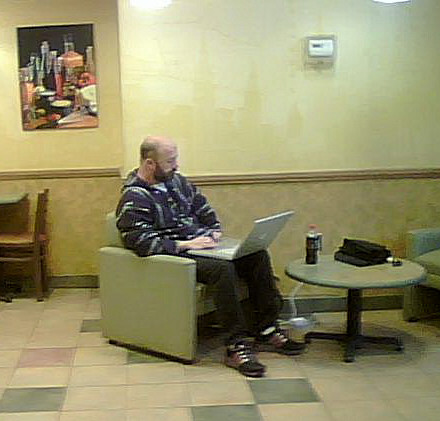
When you were snapped by a Dishhead blogging from Subway – that was a great moment of Dishness:
Not sure how this is going to make it through your spam filter, but: For my money nothing beats a “potato gun”. You know, a nice compact poop that shoots out cleanly and doesn’t even require a wipe (of course, I do a couple safety wipes anyway). Shits of this nature will often be accompanied by a mid-level whooshing sound which is the reason for the name.
Is this thread an all-time low or all-time high for The Dish? I can’t decide.
And Andrew responded:
My secret: Yerba Prima Daily Fiber Caps. Seriously changed my life. They come out like large, clean, perfectly formed rabbit poops, leaving nothing but white on your toilet paper. Heaven.
I’m dying. The Dish is the only place where I feel it’s actually ok to read about this shit.
Speaking of shitty:
As a New Yorker living in DC for a long time, I loved your posts on living in New York City for a year. One of the lesser hats you wear is defender of Washington, D.C., for which I am always grateful. You are able to pinpoint why DC is good and why NYC is overinflated.
When Sam Harris kicked your ass in the God debate. It demonstrated that even one of the great independent thinkers of our time (that would be you) can’t escape the early inculcation of religion. Thanks for that, and for everything else I learned in the many, many hours I spent reading your blog. I’ll miss you!
Kicked my ass my ass. A religious reader:
My huge and everlasting thanks for introducing me to the term “Christianist”. The proud and grateful recipient of 16 years of stellar Catholic education, I was beginning to be embarrassed to be associated – even remotely – with what was called “Christian” in this country. Using your term gave me an alternative that made conversations about politics easier and clearer, especially amongst my primarily Jewish and atheist colleagues. After I started using the term in conversation, a friend (with a similar 16-year Catholic background) offered her profound thanks to me – so I pass those along to you as well.
Another:
My favorite moment of Dishness, hands down, is from November 30, 2006 as part of your “Best ‘80s Video Contest” re: Bronski Beat’s “Smalltown Boy”:
If you were gay and young in the 1980s, the pop music was a form of emancipation and revelation. Early PSBs, Erasure and Bronski Beat captured the breakthrough. Many of us as teens lived in small towns and yearned for the big city. And no music video spoke to our lives as powerfully as “Smalltown Boy.” Even now, it chokes me up. The video is a record of the beginnings of a revolution. You can feel it coming.
Your post immediately after Christopher Hitchens died: “I cannot write anything worthy of him now.” That’s as far as I get with the Dish too – I cannot write anything worthy. Ridiculous comparison of course, but with both Dish and Hitch I felt as though I communed a little with each.
Another sends “some screen captures of Dishness that I’m pretty sure were due to my email suggestions,” which we’ve compiled:
Another reader’s moment:
Gah so many. I know that part of my love for your blog is the sense that I’m being listened to. I’ve sent you many emails and some percentage of them have actually been posted. Many of them have been very long, the kind of email that starts at 1000 words and then I whittle it back as far as I can. This one was not:
Andrew! Wake up! Wake up wake up wake up!
Another sends something surely to wake you up – in the middle of the night:
The favorite Dish moment for every Dishhead is the day you post one of their emails, like my “Dish themes in one photo”, submitted 5/6/11 and posted shortly thereafter:
Another’s Dishiest moment:
Yesterday! In a spasm of Dishness, you outdid yourselves: sex, drugs – no Rock & Roll, but you can be forgiven – historical view from your window, chart of the day … even Gitmo. Only a Sarah Palin reference is missing. Thanks for a huge fix before utter withdrawal.
One final hit of poetry:
I took great satisfaction when I took up the cause to have the Dish feature the poetry of William Stafford. 2014 was the 100th anniversary of Stafford’s birth, and I was a great admirer of the man and remain a champion of his work. I took it upon myself to implore (umm, more like pester) Alice Quinn and the Dish staff to highlight a few of Stafford’s poems on the centenary occasion. And you came through, posting several fine examples from Stafford’s canon. I was especially delighted that Andrew took a moment to write to me that one of the poems “stopped me in my tracks the way all great poems should” (“An Archival Print,” posted here).
So here’s one more from Stafford, which I find very appropriate to the occasion. It’s called “The Way It Is”:
There’s a thread you follow. It goes among
things that change. But it doesn’t change.
People wonder about what you are pursuing.
You have to explain about the thread.
But it is hard for others to see.
While you hold it you can’t get lost.
Tragedies happen; people get hurt
or die; and you suffer and get old.
Nothing you do can stop time’s unfolding.
You don’t ever let go of the thread.
Andrew, whatever lies ahead in your journey, don’t ever let go of the thread.
Another joins just in time:
As a ten-year reader (and proud subscriber), I CANNOT believe I waited this long to email you. My favorite moment of Dishness? Last night. Specifically, me realizing that an online community of which I’ve never interacted outside my own mind has meant so much to me that I spend 45 minutes having my fiance take 57 terrible pictures so I can have a photo to send in my first and only email. Wearing the shirt. Balancing the mug between my legs. Forgetting that I’m wearing PJ pants. The dogs not cooperating. Saying *Fuck It* I’ll just send some photos anyway:
You guys aren’t making this easy at all. Another verklempt moment:
I was with my mother in the hospital before her second open heart surgery in as many years and shared with her your “Prayer for Sunday,” which was amazingly appropriate. Brought tears to all of our eyes (my father and two of my three sisters, included), along with a silent and calm reflection on the world to come.
That prayer was selected by Matt, the heart of Dish Sundays. One more reader:
There are so many moments to choose from, Andrew, but you know what the best one is? This one right here. Because I’m really, really fucking sad right now – which means that I care about the Dish, and you, and your incredible staff, in a way that words really can’t describe. I cannot tell you how much your blog has meant to me. Thank you for all those moments – and thank you for this one. See you down the road.
I’m a reader. That’s how this ride started for me. Seven years ago there was, and still is, no better place on the Internet for keeping abreast of news, arguments, ideas, and the penetrating thoughts and experiences of complete strangers – the Dish’s readers. Finding the Dish was a revelation. I was hooked.
In the spring of 2009, I knew the Iranian elections were ramping up because I read the Dish, and it was a story that captured my attention like nothing else previously or since. When their election day came and went wrong, I devoured all the news I could find, living the story in real-time from afar. I started hammering the Dish inbox with scraps of news, videos, and tweets, reloading constantly to see if and when my contributions made it on the blog. I also began volunteering my efforts for HuffPo’s live-blog on the story, and started collecting those chilling videos of Iranians chanting Allah-o Akbar from their rooftops. When that project got a plug on the Dish, from “blogger Chas Danner”, I was floored. It was during those few summer months that I first caught the journalism bug, mostly because I found myself doing the job I had been watching the Dish do for years.
In 2012, when I applied for and somehow got a Dishternship, I suddenly found myself under the hood, revamping our Facebook feed, helping the Dish cover a presidential election, getting chastised by Patrick for not “feeding the beast” enough, and eating mini-cupcakes in the green room at Colbert.
When my internship ended, right as the Dish was about to go independent, I refused to stop working until they hired me back on. When they finally relented and I was asked what I wanted my new title to be, I suggested “Special Teams”, a football term for a collection of players with specific skills used for special situations. It was an apt title, as my job often required some self-taught skill the rest of the team lacked, and there ended up being virtually no part of producing the Dish, or keeping our company going, that I didn’t get to play some role in.
When we needed a new website, I designed it and managed its launch. I found our technology partners Tinypass, 10up, and WordPress VIP and managed those relationships. When we needed to shoot and edit videos, or produce podcasts, or find meeting spaces we could rent, I figured it out. When some gear inside the Dish broke, I was the one who got the call. And I edited others’ drafts, became a headline specialist, wove together contest entries, and found most of the Dish’s Mental Health Breaks and Faces Of The Day these past few years. But, for me, nothing was more exhilarating or more challenging than parachuting into some breaking news event and connecting the dots, tweets, images, and posts, staying up late and waking up early to squeeze some extra ounce of understanding out of the confusion and chaos.
Now, at the end, I’m the Dish’s Managing Editor, and so proudly so. For while I’ve loved being a jack of all trades, what I’ve loved even more is helping maintain and improve the overall system of human and technological resources that make the Dish possible. The Dish is a super-organism. Each individual part – our staff, Andrew, the readers, and the blogosphere – making up the essential whole. It is a complex and magical machine, and I for these past few years I have felt like its faithful mechanic.
For me, the ultimate special project has been the entire thing itself, making sure Andrew’s spirited campaign against sponsored content left no outrage unturned, helping Patrick try to reimagine our company’s future, or version after updated version of his brilliant RSS processing system, having passionate arguments with Chris about the nature and future of Dishness, working with Jessie to relaunch our Twitter feed so that the hundreds of other writers we depend on for our content would know we’ve featured their work, relaying tweets and posts to Jonah so he can be the best damn foreign-policy blogger on the planet, and the countless, marvelous conversations with Matt about what journalism is, should, and can be. These incredible people, these co-workers who have become my best friends, have inspired me in ways I could have never imagined. Anything I ever do, everything I ever accomplish, will be because of them.
And then there are all of you, our readers. For those of you who have written in with your votes of confidence in our staff continuing on, please know how much that has meant to us. We have read all of them. And if you saw some tall guy sobbing on the F train last Friday, that was me after reading how one Dishhead was willing to up his subscription to $5,000 to save the Dish. Please know how badly we wanted the Dish to live on somehow, and how hard we fought for that possibility. Working for all of you has been the greatest thing I have ever done in my life. I would have done it all for free, or paid to keep it alive myself, as so many of you have done. I know how important the Dish is to all of you, because I’m one of you too. And I don’t know what I’m going to read tomorrow when I wake up either.
This was real. Even more than the success of our business or editorial models, what the Dish proved is that you, our readers, exist. There are at least thirty, maybe fifty or a hundred thousand of you out there who get it. That’s enough. You have all proved that the future of media, of reading and thinking, doesn’t have to be constrained by the bullshit of clickbait, faux-inspiration, take-pieces, regurgitated Times articles, listicles, and advertising masquerading as journalism. You have proved that the homepage lives. You have proved that editors matter. The Dish existed because of you. Now we dream forward.
The Dish may be dead, but I will always be a Dishhead. I still believe, even now at the very end. And I always will.
One of the first questions I get when a person finds out I work at the Dish, and that Andrew is not just my boss but my friend, is about how we met.
Unlike most of my generation, and probably most readers of this blog, I first encountered Andrew’s writing in his books. I read Virtually Normalwith the thrill of genuine intellectual discovery when, as a young doctoral student at Georgetown University, I pulled it off the shelf during an afternoon haphazardly exploring the stacks. I turned to Love Undetectableand The Conservative Soulin quick succession, with the former, in my estimation, being Andrew’s best and most beautiful book. But perhaps most importantly, in early 2008, Andrew’s dissertation on Michael Oakeshott finally was published. During my graduate studies, Oakeshott had become an intellectual hero of mine, a thinker whose writing genuinely changed my life. So I scraped together the money to buy Intimations Pursued, read it slowly and deeply, and then sent Andrew an email asking if we could get coffee to discuss it.
I was a nobody – a poor graduate student in a city in which proximity to power or money is what gets people’s attention. I had nothing to offer Andrew in that regard. What I now realize, however, is that that was a good thing.
I wasn’t asking for anything other than an earnest conversation about a somewhat obscure English philosopher. I wasn’t seeking an internship, I wasn’t trying to secure a “connection,” I didn’t want Andrew to introduce me to anyone. I certainly never believed I’d work at the Dish. Andrew was just a writer who fascinated me, not a celebrity blogger. I wanted to ask him questions. That was all. And that’s why, I now feel certain, he wrote back to me suggesting we skip the coffee and just get dinner at the Duplex Diner.
That evening we shared what would be the first of many long meals together, with me awkwardly asking questions about his dissertation and trying not to seem as nervous as I really was. (Confession: I downed a beer on my way to dinner to help me relax.) I met Aaron that first night, too, and we all ended up going to listen to jazz at Blues Alley. We promised to do it again soon, and in short order we became friends – a title that he and I both revere.
Working together these last two years necessarily impinged on our friendship, with discussions of “business” always threatening to intervene. So while I will miss Andrew’s blogging, and now find myself considering what comes next in my own career, I am relieved that Andrew and I simply can be friends again. Because, after all, true friendship is entirely non-instrumental, and fits uneasily amidst the demands for productivity and performance. As Oakeshott puts it in “On Being Conservative” (pdf):
Friends are not concerned with what might be made of one another, but only with the enjoyment of one another; and the condition of this enjoyment is a ready acceptance of what is and the absence of any desire to change or to improve. A friend is not somebody one trusts to behave in a certain manner, who supplies certain wants, who has certain useful abilities, who possesses certain merely agreeable qualities, or who holds certain acceptable opinions…The relationship of friend to friend is dramatic, not utilitarian; the tie is one of familiarity, not usefulness; the disposition engaged is conservative, not ‘progressive.’
Andrew, to borrow Oakeshott’s phrasing, certainly does not always have acceptable opinions, nor is he always agreeable. Far from it, as readers of this blog certainly know. But Andrew, more than anyone else, has taught me that any genuine form of love, especially friendship, does not seek to change or improve the other person. Friendship is marked most of all by simple delight, by finding the world a slightly less lonely place because of another person’s proximity. It exists for no purpose beyond itself; it is “useless” in the very best sense of what that might mean. And so, it turns out, entering into an abiding friendship actually is the beginning of a more general wisdom: that striving must give way to acceptance, that present laughter should be valued over future reward, that life is not a series of “problems” to be “solved” but a mystery to enjoyed. I’m not sure I’d really understand these things, to the extent I do or in the same way, if Andrew hadn’t decided to answer my email that day.
I can’t help but feel joy that my friend is leaving blogging behind. His deepest interests are not political, as my own story of meeting and getting to know Andrew should indicate. The daily jousting on the web, however brilliantly he executed it, does not reveal the core of the Andrew I know. Instead, if asked to describe the man, what comes to mind is the time we talked about God hour after hour one sunny Spring day, or the eagerness with which he showed me Provincetown my first visit there. I look forward to the day, soon arriving, when reciting our favorite Philip Larkin poems supplants discussion of web traffic, and when, after going to Mass together, we can converse about Jesus without worrying over Monday morning’s blogging.
“But the wild things cried, “Oh please don’t go – we’ll eat you up – we love you so!”
And Max said, “No!”
The wild things roared their terrible roars and gnashed their terrible teeth and rolled their terrible eyes and showed their terrible claws but Max stepped into his private boat and waved goodbye.”








 company’s future, or version after updated version of his brilliant RSS processing system, having passionate arguments with Chris about the nature and future of Dishness, working with Jessie to relaunch our Twitter feed so that the hundreds of other writers we depend on for our content would know we’ve featured their work, relaying tweets and posts to Jonah so he can be the best damn foreign-policy blogger on the planet, and the countless, marvelous conversations with Matt about what journalism is, should, and can be. These incredible people, these co-workers who have become my best friends, have inspired me in ways I could have never imagined. Anything I ever do, everything I ever accomplish, will be because of them.
 The Dish