The Not-So-Hard Stuff

Sarah Heppola finds that quitting alcohol for the holidays isn't as difficult as it seems:

The peer pressure you think will exist if you stop drinking? It really doesn’t. What you realize is that most people don’t care. They can’t tell whether that glass of sparkling water with lime is actually a vodka tonic or whether your Diet Coke has rum in it.  People who do pay attention to what’s in your glass are generally people with alcohol issues.

Hathos Alert

Schwarzenegger treats audiences to a "DVD commentary" that's really just a play-by-play of every scene:

Gabe wonders:

How is Arnold Schwarzenegger not recording DVD commentary for all of the movies? Now that we know what a DVD commentary track can actually BE, who on Earth wants to hear what Wes Anderson has to say?

Brent Rose adds:

I've gotta say, this is something I really miss about DVDs. I'd say about 90% of the movies I watch at home these days are streamed. Streaming movies are fantastically convenient, but we lose something that was one of the first big advantages DVDs had over VHS tapes: extras. I love extras. In a streaming-only world, the commentary you hear in the video above would never exist, and that, my friends, would be a tragedy.

“Football”

The word is one of the top 25 worst passwords of 2011:

The list is somewhat predictable: Sequences of adjacent numbers or letters on the keyboard, such as “qwerty” and “123456,” and popular names, such as “ashley” and “michael,” all are common choices. Other common choices, such as “monkey” and “shadow,” are harder to explain.

Cory Doctorow thinks that online passwords are an endangered species.

Why Aren’t There Political Video Games?

In 2004, Ian Bogost predicted that every major candidate in the 2008 US presidential elections would have their own PlayStation3 game. It didn't happen, and here's why:

One of the things that games do that kind of works against politicking is that they can’t help but try to show how something works, to kind of dig underneath and give you some experience with it. And if you are a politician, what you really want to control is image and speech. You might not want to touch this interactive medium, where things can become uncertain. 

Why We Like Thanksgiving Leftovers

A scientific explanation:

Turns out, "your individual psychology plays more of a role than the actual chemicals in the turkey itself," says [Chris Loss, director of the department of menu R&D at the Culinary Institute of America]. When you grow up eating turkey sandwiches after Thanksgiving, that three-day old taste becomes what you think of as good.

Face Of The Day

133996523

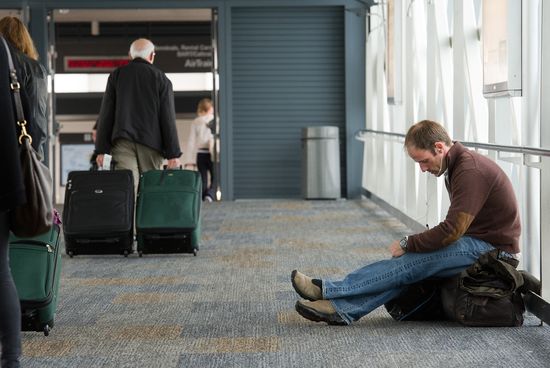
Traveler Stephen Linaweaver waits for his flight to Boise, Idaho, in the departure hall at San Francisco International Airport in San Francisco, California, U.S., on Wednesday, November 23, 2011. About 23.2 million people are expected to fly during the 12-day period surrounding the Thanksgiving holiday, a 2 percent drop from last year, according to the Air Transportation Association of America. By David Paul Morris/Bloomberg via Getty Images.

Why Amsterdamers Love Bikes More Than Londoners

One explanation for the different attitudes goes back to WWII:

Occupying Germans stole thousands of bicycles from the Dutch when they seized the Netherlands, leaving them unable to transport themselves in the manner they were used to. In Britain, however, strict petrol rationing meant bicycle use rose considerably as, for many, it was the only way to get around. The actions of war meant that the Dutch lost their bicycles, but the British were forced on to them. As soon as the Brits had the opportunity to get off their bicycles they did, with car ownership increasing rapidly in the post-war years, and continuing to remain high.

Re-Branding Baby Girls

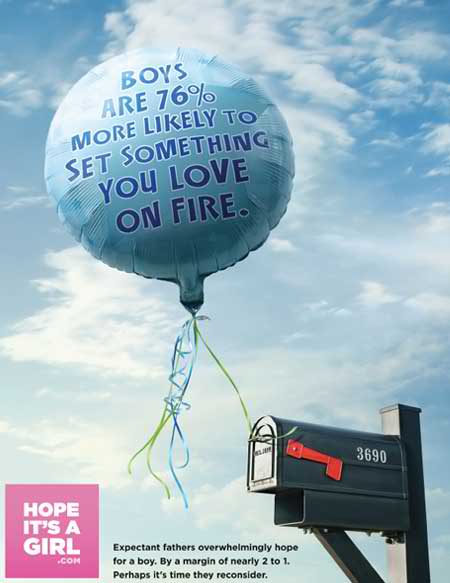
Fast Company asked ad firms to come up with ad campaigns to counter most parents' preference for baby boys. The results are here. Anya Kamenetz explains the project:

Government incentives and private-sector funding are important parts of an effort to rectify this problem. But there's also a place for branding; in countries like China, India, Girls_Ad and South Korea, pro-girl advertising has been added to the mix–mostly simplistic propaganda. If better executed, these ads could shape social attitudes in ways subtle and overt. "If handled correctly, the most sensitive issue can be dealt with," says Priscilla Natkins of the Ad Council, which brought the world Rosie the Riveter and Smokey the Bear. She points to recent successful U.S. campaigns about drunk driving ("Friends Don't Let Friends . . ."), autism, and seat-belt use. "When we took on our seat-belt campaign, usage was in the low-20 percents–now it's way up in the mid-80s. Advertising didn't do that alone, but we planted the seed with consumers that led to legislation."
Erin Gloria Ryan still isn't convinced:

I don't care that a boy is less likely to set something I own on fire than a girl, but I do care that according to the US Justice Department, 91% of rape victims are female and 99% of rapists are men. I'm excited that changing social mores might allow her to be a powerful executive someday, but I'm not prepared to know that as soon as she's old enough to drive, she, like her mother, is going to have to learn how to carry her keys between her index and middle fingers in case someone follows her to her car. … Maybe more Americans would be convinced to prefer daughters when they're convinced that the world that waits for them isn't sort of awful.