The Hippie-Hacker Revolution

Walter Isaacson sheds light on the counterculture of tech innovators in the ’60s, when computing “went from being dismissed as a tool of bureaucratic control to being embraced as a symbol of individual expression and liberation”:

The person who best embodied and most exuberantly encouraged this connection between tech geeks and the Sixties counterculture was a lanky enthusiast with a toothy smile named Stewart Brand, who popped up like a gangly sprite at the intersection of a variety of fun cultural movements over the course of many decades. “The counterculture’s scorn for centralized authority provided the philosophical foundations of the entire personal-computer revolution,” he recalled in a 1995 Time essay titled “We Owe it All to the Hippies.” As he explained:

Hippie communalism and libertarian politics formed the roots of the modern cyberrevolution…. Most of our generation scorned computers as the embodiment of centralized control. But a tiny contingent — later called “hackers” — embraced computers and set about transforming them into tools of liberation. That turned out to be the true royal road to the future… youthful computer programmers who deliberately led the rest of civilization away from centralized mainframe computers. …

Not surprisingly life on that techno/creative edge led Brand to become one of the early experimenters with LSD. After being introduced to the drug in a pseudo-clinical setting near Stanford in 1962, he became a regular at Ken Kesey’s Merry Prankster gatherings. He also became a photographer-technician-producer at a performance art commune called the US Company, which produced what became known as “happenings.” These involved psychedelic drugs, acid rock music, technological wizardry, strobe lights, multimedia shows, projected images and words, and performances that required audience participation. Occasionally they would be accompanied by talks by Marshall McLuhan or Timothy Leary. A promotional piece on the group noted that it “unites the cults of mysticism and technology as a basis for introspection and communication.” It was a credo that could have been emblazoned on the posters of the personal computer pioneers. Technology was a tool for expression. It expanded the boundaries of creativity and, like drugs and rock, could be rebellious and socially transforming.

The 2013 Dish Awards: Face Of The Year

Three pictures are vying for first place. Edie Windsor At SCOTUS has 17.92%:

Supreme Court Hears Arguments On California's Prop 8 And Defense Of Marriage Act

Trayvon and Zimmerman with their races changed is ahead by a hair with 18.69%:

tumblr_mpz9xoYIvJ1qz4e1ro1_1280

And the Pope’s selfie is in second with 18.13%:

Help break the tie! To vote for the other awards, use the links below.

Click here to vote for the 2013 Malkin Award!

Click here to vote for the 2013 Moore Award!

Click here to vote for the 2013 Dick Morris Award!

Click here to vote for the 2013 Poseur Alert!

Click here to vote for the 2013 Yglesias Award!

Click here to vote for the 2013 Hewitt Award!

Click here to vote for the 2013 Hathos Alert!

Click here to vote for the Chart Of The Year!

Click here to vote for the Cool Ad Of The Year!

Click here to vote for the Mental Health Break Of The Year!

Click here to vote for the Window View Of The Year!

Sourcing Twitter

After some analysts wrote off the relevance of hashtags earlier this year, Tasneem Raja predicts a resurgence for newsrooms:

If you haven’t heard of #blacktwitter, you’re missing out on one of the best parts of Twitter. Shani O. Hilton at Buzzfeed describes it as “loosely speaking, a group of thousands of black Twitterers (though, to be accurate, not everyone within Black Twitter is black, and not every black person on Twitter is in Black Twitter) who are interested in issues of race in the news and pop culture and b) tweet A LOT.” Much more than a hashtag at this point, Hilton notes that Black Twitter has been widely credited with bringing the Trayvon Martin case to national attention, the success of Scandal, and the toppling of Paula Deen over racist remarks. More recently, Black Twitter hijacked the #AskRKelly hashtag hosted by the singer and alleged child molester, turning a PR gimmick into a searing conversation on Kelly’s stardom and the treatment of young black women in the broader culture. …

Journalists, especially journalists who write about cultural politics and marginalized groups, have both a professional incentive and an ethical obligation to seek out authentic, fresh, informed sources on issues they’re trying to write about. Think of hashtags like #NotYourAsianSidekick as the best Rolodex you could ever have for sources on these issues.

Freeze Frame

dish_kelly

Photographer Angela Kelly enlisted her son to help her snap shots of bubbles as they formed in below-freezing temperatures:

Kelly said she used a homemade bubble solution with water, Karo syrup and dish soap that she found on the Internet. “We quickly realized that using a mostly shady area was necessary in order to get the bubbles to freeze in their entirety and conversely using a partly sunny area allowed the bubbles to only partially freeze along the bottoms up to about the mid-point of the bubble,” she said.

Using that information, Kelly and her youngest son set about with the idea that they wanted to see them in all different stages: frozen completely, half-frozen and only partially frozen.

“We were both awestruck as we watched how each bubble formed its own unique ice pattern as they froze,” she said. “My son was amazed as I blew a gentle puff of air across the top of one bubble that had completely frozen and watched intently as it broke away from the surface it was on, rolled over and showed its shattered shell.”

(Photo by Angela Kelly, Kelly Images and Photography)

“Nights Dark Beyond Darkness”

In another round of The Guardian‘s “Great American Novelist tournament,” Cormac McCarthy’s The Road trumped John Fante’s Wait Until Spring, Bandini. Matthew Spencer pays homage to McCarthy:

[T]here will never be relief in McCarthy’s post-apocalyptic world: ‘Nights dark beyond darkness and the days more gray each one than what had gone before. Like the onset of some cold glaucoma dimming away the world.’ The unnamed man and his son, ‘like pilgrims in a fable’, must travel south in the hope that the winters will be warmer and therefore more survivable. He scavenges for food in abandoned buildings and dwellings ever watchful for traps and bands of marauding cannibals. This novel is a grey suppurating wound. It is frightening and a warning to us all that unsettles and shatters and amazes in equal measure. McCarthy insists that it is a paean to the father and son relationship.

The boy is cast as a redemptive figure, he carries the figurative light of the world. He is forgiving and hopeful and the father is beautifully indulgent of him because he knows that their lives are extremely temporary. These touching moments are interspersed with fraught episodes of jeopardy and shocking violence. There are many references to religion in this hellish world, and to a God that has surely forsaken them, perhaps typical of this southern writer whose style is second to none: part Gothic, part future modern, part Shakespeare (although he does have the punctuation skills of my 5 year-old). Every set piece is brilliant and can be read in isolation like a piece of brutal poetry. ‘He knew only that the child was his warrant. He said: If he is not the word of God God never spoke.’ Mccarthy tells us, we must carry on along the road and protect the feeble spark of life that has roiled and rolled through the millennia. … The Road is a masterpiece, the black yardstick by which every experience, let alone novel, needs to be measured.

The Floating Economy

Rose George fears that we suffer from “sea blindness.” She wants us to recognize the importance of and problems with the shipping industry, which brings us almost everything we buy:

Recently, Craig Martin looked into the history of the shipping container and how it revolutionized the industry:

From the nascent designs of the 1950s, through the roll-out phase of the 1960s, to the standardization of the 1970s, the container became central to the burgeoning growth of consumer capitalism, particularly the move of manufacturing to traditionally peripheral economies. The shipping container models the fundamentals of late capitalism even as it facilitates it: a standardized, reproducible structure that looks and functions the same everywhere. But just as much as it has amplified the practice of consumer capitalism, the shipping container also underwrote an aesthetics of capitalism as well. The geometric simplicity of the container’s design echoed the uniformity of high modernist architecture of the ‘50s and ‘60s, including the serial arrangement of tract housing, or in the standardized, modular architectural designs of Buckminster Fuller and Le Corbusier. What better way to fill the rows and rows of housing blocks in a booming suburbia than with baubles and gizmos delivered by rows and rows of shipping containers on a nearby dockyard?

The Identity Crimewave

Mike Riggs wonders why most people don’t report identity theft to the police:

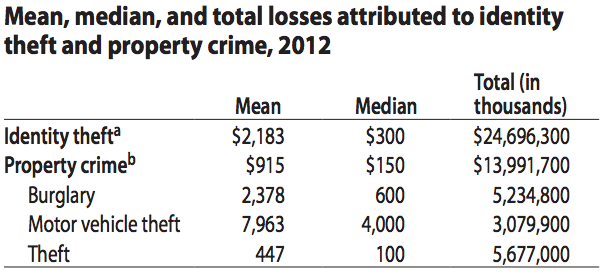
Property and violent crime affect us where we live and work, and we expect local government to do something about them. But even though these categories seem comprehensive, neither one includes identity theft. Considering identity theft now costs Americans nearly twice as Identity Theftmuch as property crime, that’s an odd omission. In a recent report, the U.S. Bureau of Justice Statistics found that total losses attributed to identity theft in 2012 were $24.6 billion, compared to $13.9 billion for property crimes. Not only is the total loss amount higher for identity theft, the mean and median loss per incident is roughly double (see the chart at right).

This isn’t to say we don’t talk enough about identity crime, because we actually talk about it a lot (mostly as it relates to personal finance and online security). But the BJS report suggests even identity theft victims don’t actually think about identity theft when they think about crime where they live. The biggest indicator? Only 9 percent of identity theft victims even contact the police.

A commenter provides a sensible explanation:

Reasons people report property crime include insurance and an overall perception that the police might catch the burglar/thieve who was physically present on the property.

Identity theft is often committed by people operating from overseas or using elaborate IT resources to conceal their own identity and location, making it very difficult to trace, let alone apprehend, especially if no major money trail was left. Even a dedicated local police office, well staffed and set on the right priorities, couldn’t do much to go after, say, a Russia-based online gang group that used the credit car info to attempt a purchase on a website from Singapore…

Sick Too Young

Three years ago, Leah Sottile’s husband was diagnosed Ankylosing Spondylitis, an autoimmune disease. She reflects on how this changed their lives:

I thought this would be the time when we’d be preparing for the rest of our lives: earning money, going on fun vacations, having families, building our careers. And we are, but at the same time, we’re doing it while we’re trying to manage pain symptoms, chase down prescriptions, and secure stable health insurance. When I was in college, I remember being prepared to survive in the workforce, but I don’t remember a class that told me how to do that if half of your household is in so much pain on some days that they can’t get to work. I’m barely over 30. I thought I had so much more time before I had to think about this stuff.

She also discovered that her husband isn’t alone:

It might be that our lifestyle is why Americans are so sick. Another theory, according to Dr. Frederick Miller of the National Institute of Environmental Health Sciences, might be that humans are being weeded out in different ways than in the past, as more communicable diseases have been eliminated.

“If you do away with the infectious disease risks that perhaps killed off a number of individuals early in life [in the past], people who may have altered immune systems, who perhaps couldn’t have handled [those infections, then] go on in adulthood to develop these diseases,” he says.

He points to the “hygiene hypothesis”: As humans have eliminated infections and led cleaner early lives, allergies and autoimmune disease incidences have increased because of our underdeveloped immune systems. “It’s not completely proven, it’s a hypothesis,” Miller says, “But it is consistent with some of the data out there.”

“There may not be too many free rides in this world,” he says. “As we move away from one disease, we may be moving toward other diseases.”