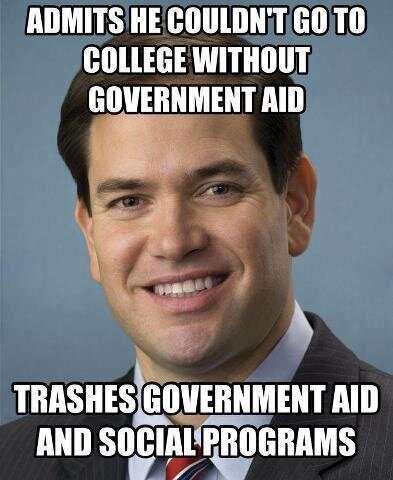
Rubio Response Reax

tumblr_mi575tBVuH1qagxppo1_400

Josh Barro identifies the main problem with Rubio’s speech:

The Republican Party’s problem isn’t the messenger; it’s the broad economic message. To fix the message, Republicans need to be for smart government. They need to signal that they have a serious policy agenda that considers programs and regulations on a case-by-case basis, rather than just demagoguing the government. They need a real agenda on health care and jobs rather than just opportunistic opposition to anything the president does.

Michael Grunwald had the same thought:

If Republicans believe that they lost in 2012 because Romney was a boring rich white guy who alienated Hispanics, they got to see a charismatic Cuban-American with humble roots but otherwise indistinguishable positions on every issue except for immigration.

McArdle, on the other hand, calls Rubio’s speech “the most effective SOTU response I’ve ever seen”:

I’m not grading the policy content of the speech, mind you–though as an aside, let’s just say that I’m not a fan of false claims that the GOP can get the economy up to 4% growth by unleashing the awesome power of the free market.  But Rubio mounted the most effective response I’ve seen to the President’s attacks on Republicans as uncaring obstructionists, and he delivered it well.

Tomasky felt that Rubio lacked gravitas:

His voice doesn’t have enough depth to it. He looks sort of young, as many have observed, but he sounds younger, and that’s the issue. He comes across like the proverbial substitute teacher. You know you can throw spitballs in his class, and he’s not going to have the authority to make you stop.

Ed Morrissey liked the speech:

[A]t least rhetorically, Marco Rubio took the correct path in responding to the usual SOTU laundry-list speech.  In his rebuttal, Rubio stayed away from offering the Republican legislative agenda, and instead stuck to the Republican and conservative philosophies of governing and economics.

And Friedersdorf heard nothing new from Rubio:

What Rubio does best is movement conservative boilerplate, so that’s mostly what he does, but he doesn’t make any effort to freshen up the ideas, or even to freshen up the rhetoric he uses to express the ideas. When he starts talking, it’s like when the Dave Matthews Band song comes on, the one you liked the very first time you heard it 15 years ago, but then the guy across the hall played it on repeat for all of sophomore year, and now when the lyrics play you can’t even conceive of them as words with a meaning.

SOTU: Your Thoughts

Ouch. My objection is to ribbons. It’s all inclusive. I hated and still hate red ribbons for AIDS, for example. The fact that we gays started this lame tradition truly saddens me. But I know it’s a lost battle. We are all ribboned now.  I just wonder how they keep coming up with new colors for new causes. Will they have to go to paint charts soon? Still, it was a moment of dyspepsia, I concede. But I regard a blog as a right to occasional dyspepsia. Another reader writes:

The Sandy Hook ribbons aren’t just ribbons in honor of it. And they’re not lame. They were originally made for the teachers and administrators to wear to the funerals so they could be identified. They were noticed, so they were made by folks at the school, one of whom is friend of mine. One day they made 700. They are selling them to raise money for the school. It’s called the Sandy Hook angel project. They are $3 each. I’ll get you one.

I won’t wear it. But I can sure see the point of identifying the teachers and administrators. That is a signifier I could happily endorse. Just not Joe Biden, please. Or every other grandstanding pol. Another:

Here in Shelby County, Alabama, my son’s elementary school now has an armed guard standing outside each morning. This doesn’t make me feel safer. It’s simply a reminder of Newtown. Today, a man entered a local middle school and held several students hostage. Today. No, he didn’t have an assault rifle. He had a pistol. But can you imagine being one of those students?

Andrew, Newtown changed me. I have two small children – a son, 8, and daughter, 3. I’m a conservative in the Bible Belt, yet I feel like a noose is tightening on our kids due to our gun culture. And I really don’t know how it stops. I emailed my senator (for whom I voted), Richard Shelby, asking him to support an assault weapons ban. Of course, I got the standard “Thanks for writing. Here’s why I don’t support a ban” letter. I think of Newtown every time I see that guard. And I wonder which school is next.

On the core question of banning assault weapons and universal background checks, and much more aggressive ATF funding and regulation, I’m with you all the way. But as you point out, even that won’t stop these horrifying events, using mere pistols, just minimize the carnage. Another quotes me:

The passion, the reason, the sincerity: this was an invigorated president, trying to shift the mood away from zero-sum partisanship to non-zero-sum citizenship. It’s what we always hoped from him, and I think it places the Republicans in a horrible bind.

How are the Republicans in a horrible bind?

The number of Republicans in the Senate is still 45 and there’s no risk of their changing for another two years.  None of the emotion and the meaning of Obama’s speeches matters a bit unless somehow 5 of those 40 have suddenly changed their mind based on this speech.  That would be a shocking turn of events to say the least.

Republicans engaged in a policy of deep, nihilistic intransigence for four years.  When they began that policy they had 41 Senators, and now they have 45 (after a brief climb up to 47).  They had 178 representatives and now have 234 (afte a brief climb up to 242).  So is there anything in our politics that would suggest to the average Republican that they should change couse?  The Republican party is like a collection of spoiled children and until they get a sense that there will be real and dire consequences for them, they will not change how they behave.

While there’s certainly some long-term concern among Republicans over the demographic trends of the country, Republicans believe the best answer to that is trying to convince conservative Latinos that the Republican party has something to offer.  Beyond that, the Republicans are still firmly wedded to zero-sum partisanship and there is nothing that Obama said tonight that will change that.

I don’t disagree, but politics change tectonically. What Obama was doing last night was what I saw him doing a long time ago:

This guy is a liberal. Make no mistake about that. He may, in fact, be the most effective liberal advocate I’ve heard in my lifetime. As a conservative, I think he could be absolutely lethal to what’s left of the tradition of individualism, self-reliance, and small government that I find myself quixotically attached to. And as a simple observer, I really don’t see what’s stopping him from becoming the next president…

I fear he could do to conservatism what Reagan did to liberalism. And just as liberals deserved a shellacking in 1980, so do “conservatives” today.

What makes this more interesting is that events have made his case stronger since. The collapse of the Wall Street casino, the relentless rise in inequality, our crumbling infrastructure, the crippling cost of policing the entire globe: these changes makes Obama’s core vision more reasonable to conservatives like me who suspect government but believe there are times when we truly, desperately need it. Another reader’s take:

That was a very strong SOTU. The President has honed his presentation of what activist government should look like in the 21st century, and, amazingly, it actually rings more conservative than the bullshit being peddled by the so-called conservatives in the chamber. And the last segment of the speech, on voting and then gun violence, was incredibly powerful. I had a tear in my eye. I can’t believe Boehner wasn’t bawling … well, then again, there’s no telling what will make the Speaker break out in tears.

Rubio, on the other hand, gave a speech that clearly had nothing to do with the SOTU address that preceded it, which made it very flat and tone deaf. It was alternately condescendingly partisan and incredibly defensive. Surprisingly weak. We know which of these two is the Alpha Male in American politics today.

What did Rubio say last night that could not have been said by a conservative Republican in 1980? It was a recitation of dogma, not a response to the actual contingent problems we face. Another notes:

The amusing thing about that Ted Nugent photo is who he was sitting next to: Thomas Lauderdale, the founder and band leader of Portland-based Pink Martini. Based on Nugent’s uncomfortable posture, I think he figured out that Lauderdale is also gay.
All About Israel, Ctd

This embed is invalid


A reader writes:

As an orthodox, born-again Christian, I find Inhofe’s statement breathtakingly crazy. All those years when Israel was in exile in Babylon, those centuries between Rome and the establishment of the modern political state of Israel – the word of God wasn’t true then? Does he realize that he has just said that humans possess the power to negate the word and promises of God? I believe that might be heresy; if not, it is at least heterodoxy.

It might also be fun to point out to Inhofe that the Palestinians are also descendants of Abram, via Ishmael, so regardless of which ethnic group is in power, the land remains in Abrahamic hands.

Another writes:

I think Inhofe is being incredibly duplicitous when he cites the book of Genesis as reason for supporting Israel and argues that we should support Israel because God decreed Israel belongs to the Jews. The real reason fundamentalist Christians support Israel is not in the first book of the Bible but the last book – Revelations. Revelations (supposedly) prophecies that the Second Coming of Christ will be preceded by the return of Israel to the Jews and by war in the Middle East. Fundamentalists support Israel today, as well as military action against Iran, Iraq, and the Palestinians, because they believe the Second Coming is imminent. See, for example, this piece in the conservative City Journal.

Mother Tongues

Scientists in Vancouver have engineered a computer that can “reconstruct lost languages using the sounds uttered by those who speak their modern successors”:

Reconstructing ancient languages can reveal details of our ancient history. Looking at when the word for “wheel” diverges in the family tree of European languages helps us date the human settlement of different parts of the continent, for instance.

Evan Fleischer considers the porous lines of the world’s languages. From his extensive list of words:

[I]f we want to … use a word that means the same in both Polish and Czech, we get “Wyrok,” as in, “sentence, verdict”; and if we’re looking for a word that exists simultaneously in Czech and Hawaiian—Czech being the mother tongue of Kundera and the stunning Josef Koudelka—we get “pukowi,” as in, “birch tree”; and if we want a word that simultaneously exists in Hawaiian and Spanish, we use “paniolo,” as in, “cowboy.”

The Palestinian Settlements

rawabi 3

Armin Rosen visits Rawabi, the “West Bank’s first Palestinian-designed planned city”, which has the potential to spawn jobs and development in the West Bank:

Rawabi represents something totally new — a visionary Palestinian-directed private sector project, with support from both Israeli businesses and a major Arab government. It has the potential to shift the conversation on the region’s future on both sides of the Green Line. It could convince Palestinians — and the rest of the world — that the future of the West Bank shouldn’t be shackled to Ramallah or Jerusalem’s vacillating willingness to hash out fundamental issues. It could prove that there’s an appetite, both among Palestinian consumers and foreign donors, for the creation of a social and economic existence in the West Bank that’s de-coupled, insomuch as currently possible, from the Middle East’s tense and labyrinthine politics.

Here’s hoping. I don’t think the Good Friday Accords that finally ended the worst of the conflict in Ireland would have happened without the astonishing economic growth of the Republic back in the days of post-Euro euphoria. Prosperity always helps compromise along.

(Photo by Armin Rosen)

The Constant Filibuster

Bernstein thinks “it’s ridiculous to claim that there’s never been a filibuster against a cabinet nomination before; every single nominee that Barack Obama has sent up has been subject to 60 votes”:

Everyone covering the Senate needs to understand that Republican are requiring 60 votes for everything; that they’ve been doing so since January 2009; that prior to 2009, filibusters were frequent (since January 1993) but not universal; that very few Republicans have voted yes on cloture but no on the underlying substance on anything since January 2009; and that the name for requiring 60 votes is “filibuster.”

A Self-Destruct Button For Your Digital Self

Felix Gillette covers Snapchat, the app that deletes a photo seconds after the receiver views it:

[Viktor] Mayer-Schönberger [author of Delete: The Virtue of Forgetting in the Digital Age] argues that all information created online should come with customizable expiration dates. Not every piece of data would have to expire after a few seconds as photos on Snapchat do. The key, says Mayer-Schönberger, is to include some form of a self-destruct button in everything created online and to give consumers the power to tinker with the settings from the outset.

Michael Scherer expects to see more tools like this emerge:

Technology has created an enormous burden on all of us. Over time, more companies will move into this space, selling not just a way for us to connect to each other–a technology that long ago left novelty and became a commodity–but a way for us better protect our connections by eliminating their trail. (Facebook already has a Snapchat mimic, called Poke.) There is no good reason that emails you wrote three years ago should be so hard to delete, or still be living on the servers of your friends’ email clients.

Previous Dish on Snapchat here. It sure would have saved me some acute embarrassment a decade and a bit ago.

Academese Ain’t All That

According to Peter Elbow:

People who care about good language tend to assume that casual spoken language is full of chaos and error. I shared this belief till I did some substantial research into the linguistics of speech. There’s a surprising reason why we — academics and well-educated folk — should hold this belief: we are the greatest culprits. It turns out that our speech is the most incoherent. …

[W]e drift into sentence interruptus: a phrase is left dangling while we silently muse — and we never return to finish it. When we academics were in graduate school, we were trained to write badly (no one put it this way of course) because every time we wrote X, our teacher always commented, “But have you considered Y? Don’t you see that Y completely contradicts what you write here.” “Have you considered” is the favorite knee-jerk response of academics to any idea. As a result, we learn as students to clog up our writing with added clauses and phrases to keep them from being attacked.

Chart Of The Day

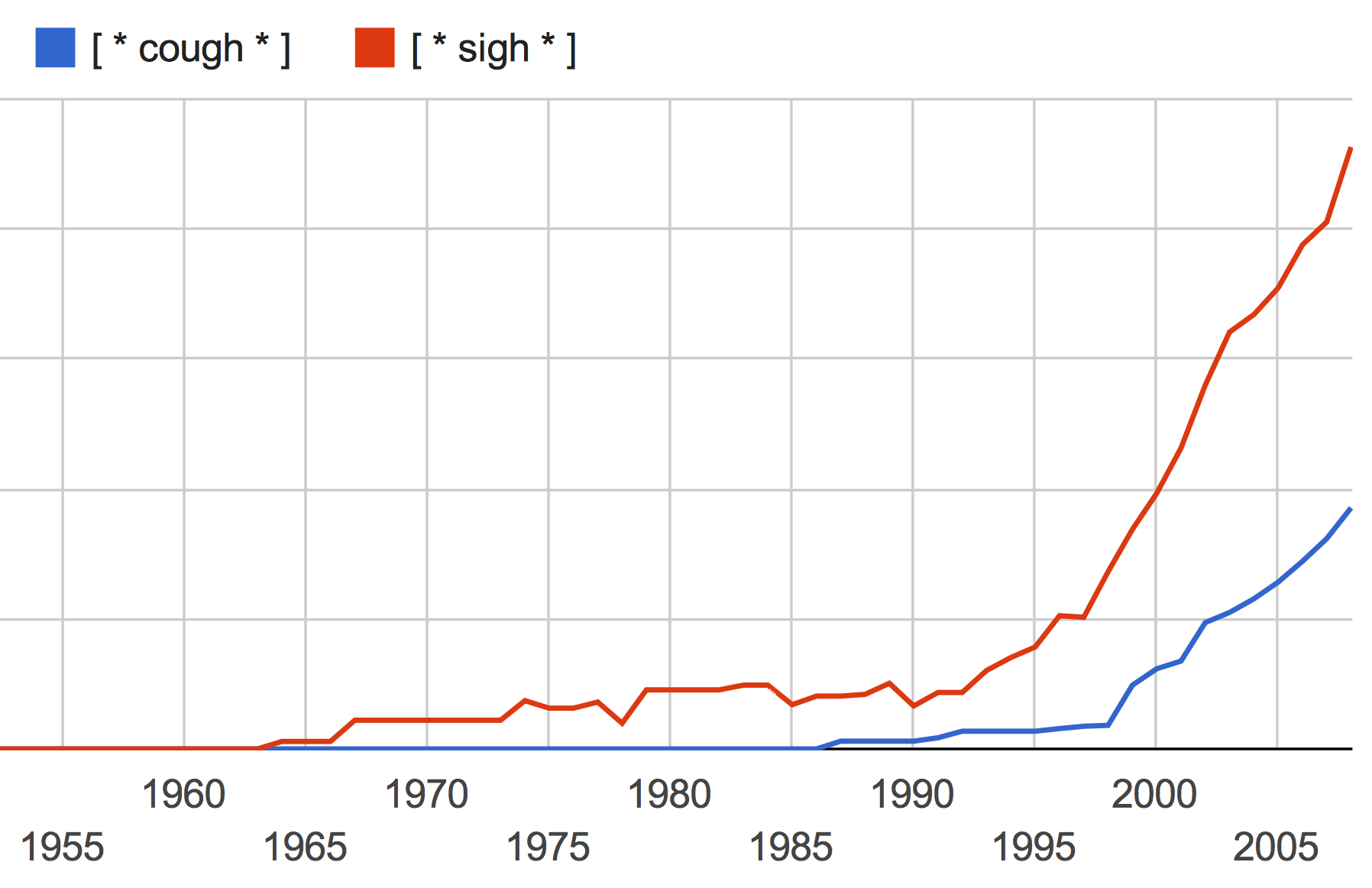
Sigh Cough

John Gruber noticed an asterisk-framed interjection (*cough*) in the New York Times and wondered about its roots:

Using asterisks this way strikes me as an Internet-ism. I would think those coughs should be italicized; using bounding asterisks is a substitute in plain text contexts, something we collectively started doing in email, newsgroups, web comments and forums, Twitter, and various other input fields where computer software doesn’t allow proper italics (or bold, or any other formatting).

With the help of Twitter, Gruber concludes *sigh* probably started in the 1960s thanks to the comic strip “Peanuts” and Charlie Brown’s constant invocation. Ben Zimmer traces longer usages (*hangs upside down like a bat*) to games like D&D:

As one “Role Play Manual of Style” explains, “Actions are enclosed in asterisks and written in third person perspective.” But this type of asterisking has thoroughly infected Usenet posts, blog comments, tweets, and anywhere else online that people feel the need to describe real-world actions in a virtual space.

The Age Of Big Data Is Here, Ctd

Nassim Taleb urges skepticism when assessing the claims of Big Data miners. He warns that big data “may mean more information, but it also means more false information”:

[B]ig data means anyone can find fake statistical relationships, since the spurious rises to the surface. This is because in large data sets, large deviations are vastly more attributable to variance (or noise) than to information (or signal). It’s a property of sampling: In real life there is no cherry-picking, but on the researcher’s computer, there is. Large deviations are likely to be bogus.