You have until noon on Tuesday to guess it. City and/or state first, then country. Please put the location in the subject heading, along with any description within the email. If no one guesses the exact location, proximity counts. Be sure to email entries to contest@andrewsullivan.com (the old address still works as well). Winner gets a free The View From Your Window book. Have at it.
A little while back, I was contributing a piece to a publication that I was thrilled to be writing for: high prestige, high visibility, great roster of fellow contributors. I was honored to be asked. And when the editor mentioned my fee, I was initially eager to say yes. But something told me to hold back (for once—I am usually a very poor negotiator). I thought about who else was contributing, what demands they or their agents might have made, the fact that there’s probably always wiggle room … and I typed this into an e-mail: “I’ll do it for whatever you pay Sam Lipsyte.”
And the editor wrote back promptly to say that sure, yes, that was fine—and he doubled his offer.
The Lipsyte choice, you should know, was not entirely arbitrary on my part. He’s not a superstar in the Michael Lewis or Malcolm Gladwell sense; it would be arrogant for me to think I can demand what such best-selling authors, true celebrities, can demand. But he is high-prestige, a writer’s writer, the kind of person who adds luster to a table of contents (he also happens to be very good; I’m really enjoying his new book of short stories). He’s not the kind of writer a New York editor would want to lowball. What’s more, he has a full-time job teaching at Columbia, and probably is plenty busy, so he wouldn’t say yes to a trivial fee. I figured he commanded more than editors were offering me—but not stratospherically more. As it turned out, I was right.
Simon Akam mourns the distinctly American transformation of a butchered pun, “replaced by something grosser, dumber, uglier”:
Examples abound: Take one of the most read websites in the world, Wikipedia, a “pun” on encyclopedia that shares nothing but its suffix. Or techpreneur, the loathsome fusion of technology and entrepreneur. Likewise mansplain, a coinage popular with Internet feminists that adroitly glosses a man addressing a woman in a condescending fashion (e.g., “Akam mansplains that mansplain is not a functioning pun.”) but is still not a functioning pun. Manscaping, the removal of all or part of male body hair, is better—there is at least assonance between the vowel sounds in man and land—but as a pun it remains perilously borderline. …
One erudite friend of mine suggests that the current crisis in American wordplay can be traced back to the Watergate scandal of the 1970s and the subsequent tendency to append any scandal-related noun with the suffix -gate. Before Nixon fell, my friend suggests, “All American puns rhymed perfectly and snappily, as if the whole country were a Cole Porter musical.”
The author seems to suffer from an inability to distinguish puns (where words are manipulated for wit and pleasure by playing on sound, meaning, and even spelling) and portmanteaus (where words are combined into one for brevity or concision). Wikipedia is not a pun; it is simply a portmanteau of wiki and encyclopedia. Ditto techpreneur, mansplain, and the -gate scandals. None of these are puns, because none of them are intended to be. They are just meant to make communication faster and simpler by combining words so that they do not have to be fully expanded every time.
Hockey, soccer and football stats are difficult to interpret:
Much work has been done in football, both at outside sites like Football Outsiders and, much more quietly, within teams. But some of football’s top analysts said that the incredible intricacy of football—the different types of scoring, the uncountable potential game situations, the byzantine mess of eleven men working in tandem, intangibly but undeniably dependent upon each other—means that only so much can ultimately be accomplished. “The sheer complexity of football makes it to my mind the hardest,” said Brian Burke of Advanced NFL Stats.
The sad truth is that most families who stretched their finances to the limit for the sake of a set of encyclopædias would have been better off spending half that money or less on books with beginnings, middles and ends that children might actually read. In many homes, by sheer weight and volume, encyclopædia sets often added up to more than all the other books in the house put together. While they were the most admired volumes on the shelf, they were also the least read.
Sure, every now and again someone would say: ‘Look it up in the encyclopædia,’ or you’d go searching for a fact that was eluding you. More often than not, however, you wouldn’t find it. I’m sure I wasn’t the only one who didn’t even really understand the difference and relationship between the 17-volume macropædia and the 12-volume micropædia; or the two-volume index and the one-volume propædia. Trying to find anything in there made me feel like the baffled child who asks how to spell a word and is told to look it up in the dictionary; how can you find the word if you can’t spell it in the first place?
Koerth-Baker follows up on her inquiry and draws a comparison to climate change science:
The IPCC never says, “Because we burned fossil fuels and emitted carbon dioxide into the atmosphere then the Earth will warm by x degrees.” Instead, those reports present a range of possible outcomes … for everything. Depending on the different models used, different scenarios presented, and the different assumptions made, the temperature of the Earth might increase by anywhere between 1.5 and 4.5 degrees Celsius. …
The problem with this [reasoning] is that it flies in the face of what most of us expect science to do for public policy. Politics is inherently biased, right? The solutions that people come up with are driven by their ideologies. Science is supposed to cut that Gordian Knot. It’s supposed to lay the evidence down on the table and impartially determine who is right and who is wrong. But how do those expectations apply if the best answer we can actually get to the question of whether guns make us safer is something along the lines of, “The likely effects of right-to-carry laws range from saving 500 lives annually to costing 500 lives annually.”
Friday on the Dish, Andrew accepted Bill Clinton’s DOMA stance without absolving him of past actions, gawked at the contortions to which Catholics would go to oppose gay rights, and remained hopeful at the chance of a Grand Bargain. He looked into the online media abyss with Michael Wolf and gave us a “talking-heads-up” for Sunday. In politics, we cautiously cheered the recent jobs report, contemporary constitutions excluded the right to bear arms, and Alan Abramovitz made an argument for the Voting Rights Act that didn’t rely on race. Internationally, hawks loved Rand Paul’s contrariness even as they disagreed with him, Sam Roggeveen contributed to the growing Iraq War retrospective, Marc Lynch dreaded the effects of Iran’s declining popularity, and the Harlem Shake meme took on a revolutionary tone.
In assorted news and views, Arthur Nelson worried about a Boomer-initiated housing bubble and Ryan Healey stripped down the effects of ending Canada’s pole-dancing visa, and Freidersdorf called outBreitbart and O’Keefe. Virginia Hughes felt ill at the idea that lobbying would trump science in allocating money to disease research while Google doled out prescription advice and Dr. Rob Lamberts experimented with his own subscription model in health care. Kevin Charles Redmon cultivated the argument for farmed Rhino horns to thwart extinction, fracking hogged scarce water resources in the West, and
Heading into the weekend, Grandpa pwned and was happier for it and Don Ward pointed out how badly our shoes need shining. George Packer updated his notion of the bare necessities, Colin McSwiggen blamed his tools, and Jill Filipovic exercised her individuality by keeping her surname. Cat Rohr helped ex-cons climb the corporate ladder and readers leaned into the discussion on Sheryl Sandberg’s new book. David Haglund noted a definition that has been around literally forever, Alice Jones fretted over the dissolving fourth wall, and Rich Juzwiak opted for the most generic hookup music possible. We previewed a brutally honest teen-party movie in the MHB, piloted a drone in the FOTD, and peeked through the blinds at Buenos Aires in the VFYW.
– D.A.
Rest of the week below the jump.
Thursday on the Dish, Andrew applauded Rand Paul’s righteous filibuster while we rounded up other reactions to the 13-hour dose of awesome, and recognized the decline of christianist influence thought in their inability to engage in secular debate. He dubbed Clinton’s DOMA announcement a “BFD” and stood in awe at the progress of gay rights during his lifetime,
In the political realm, Ponnuru looked forward to 2016 debates featuring Rand Paul, Chait found the paragon of truthiness, and we welcomed the blossoming of more conservative sanity. Readers shared their own stories from the lead-up to the Iraq War, Republicans sought “permission” to support marriage equality, and Evan Soltas declared the sequester overhyped. Overseas, the US weighed the odds in Syria, we eagerly awaited a peaceful outcome for the Kenyan election, and bookies pontificated about the next pontiff.
In miscellaneous coverage, a reader blurred the line between work and play for reporters, NPR considered all things about the Dish model, Hairpin offered Amazon alternatives, and freelancers measured payment against pageviews. Drum cast about for an explanation of the public’s climate ennui, soccer kept the lights on, stoners reclaimed 3-D printers for peaceful purposes, and a Yellow Lab chilled with some herbal help. Andrea Swensson passed on SXSW, Douthat ignored the Hathaway haters, and Peter Orszag challenged colleges to close to dropout gap.
Eslewhere, readers threw in their thoughts on san men, city-dwellers were sad (but there’s an app for that), and Harold Pollack calculated that substance abuse treatment for the mentally ill was definitely worth it. As Donnie Collins navigated the health insurance market, Gwynn Guilford solved to China’s bachelor problem, and Lauren Drain proposed that sex might be straining WBC’s ties, We compiled rude awakenings in the MHB, our hair stood on end at the adorableness of the next generation of orangutan in the FOTD, snow fell on Old Dominion in our VFYW.
Wednesday on the Dish, Andrew recalled the emotional influence of 9/11 in the lead up to the Iraq War, watched Rumsfeld’s war crimes pile up, and insisted that the government to release the Torture Memos to bring evidence to the debate surrounding torture. He lauded Israel’s airing of debate, hit Republicans for their hypocrisy on weapons expenditures and their suicidal spite on the sequester while agreeing with PM Carpenter on the shifting GOP, and declared the empirical and civil debates over marriage equality dead. In media coverage, Andrew waved as the Daily Caller left reality behind, walked us through the reasoning behind The Dish’s use of Amazon’s Affiliate program, and a reader took NBC to task for its “sponsored content”.
In politics, we gatheredreactions to Chavez’s death, including some of Hitch’s words from beyond the grave, Latin America countries diverged in their agreement with the US, and Jeb Bush erred on Evangelical Latinos. Noah Millman joined the discussion on the Iraq war and Congress started to come around on DOMA. Meanwhile, Charles Hurt’s voodoo rant garnered him a Hewitt nomination, we wrestled with visualizing inequality, and Obama’s Energy nominee walked the tightrope on fracking.
In assorted coverage, Till Roenneberg pushed for high schoolers to be able to sleep in, ADHD sufferers paid a price later in life, and Sheryl Sandberg’s views on women in the workplace stoked controversy among feminists. We rummaged through reader responses on recycling, Roger Goodell presaged an on-field death for the NFL, Kevin Ashton followed Coke across borders, and Rob Horning climbed a mountain of paperwork in pursuit of fairness.
Russell Brand gave up drugs in favor of reality, Mark Oppenheimer turned the blame on TV watchers and a reader encouraged us to suspend our disbelief when reading the gospels. Bill Gates brutalized the book Why Nations Fail, the NYT shuttered its Green blog, and negativity dominated Twitter. Frank Underwood invaded the Conclave in the MHB, NYC showed us a dreary, drizzly day in the VFYW, and we turned our gaze on police violence in India in the FOTD.
Tuesday on the Dish, Andrew meditated on the origins of modern conservative thought, saw spectres of the past in Israel’s segregated bus lines, and questioned the recent announcement of a baby “cured” of HIV. In home news, he wrapped up the first 30 days of the new Dish model.
In political coverage, Ta-Nehisi regretted his perceived powerlessness in the march to the Iraq war, while Dreher’s emotions swayed him in favor of it. Peter Person ascribed the slowdown in healthcare costs to the ACA, Adam Gopnik probed the limits of the market, and Jeb jumped back from his published stance on immigration. Seth Masket deliberated over politician perceptions, the GOP gave little ground in their latest budget, while Ponnuru made room in the party for Chris Christie. Scarborough pwned Krugman and the Daily Caller channeledFamily Guy in its Ashley Judd coverage. Abroad, the Tories tussled with a perception problem and Syria schools felt the effects of the extended conflict.
In assorted coverage, Seattle weighed a tax on bikes, the cost of flying fell without our noticing, and Vince Beiser pushed back against the idea of “peak oil”. Readers continued the thread on doctor salaries while surgeons honed their skills on their smartphones, Lori Rotenberk went to DIY University, and Judith Glaser tried to wean us off of arguing. Dylan Bergeson dug through archaeological findings in the West Bank, chimpanzees savored their first taste of freedom, and luck loomed large in Hong Kong. Ruth Clark praised Jell-O’s ability to preserve and Evgeny Morozov protested Big Data-influenced punk.
Meanwhile, journalists sold their services to Malaysia, Marie Chaix found inspiration in pain, Madhavankutty Pillai chronicled the troubles of bringing great novels to the big screen, and Twain posed topless. We resorted to the tiebreaker for our Kagoshima VFYW contest and awoke to a Cancun sunrise in the VFYW, Spidey’s romance got the BLR treatment in the MHB, and Misao Okawa celebrated the big 1-1-5 in the FOTD.
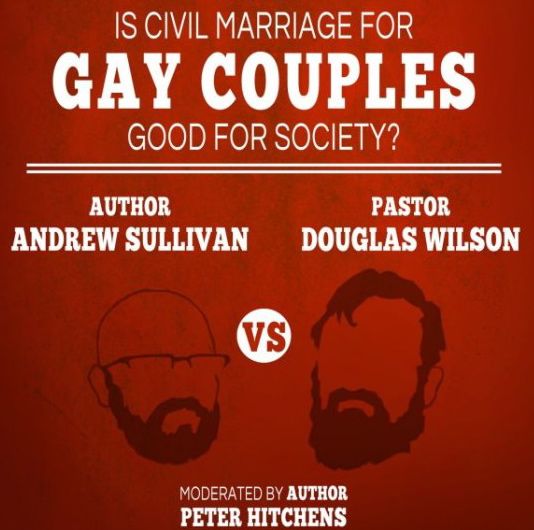
Monday on the Dish, Andrew continued his look back at his arguments for the Iraq War, pitted Cardinal O’Brien against himself and wondered if the Curia would recognize their hypocrisy. He saw apples and oranges in the South Park-Arrested Development debate, provided the latest numbers on the new Dish model, and debated marriage equality in a battle of beards. In the final installment of the “After Dark” series, Sully and Hitch contested the existence of any factual basis for the gospels.
In political news and views, Jacob Heilbrunn sounded an alarm over epistemic closure on the right, legislators’ perceptions of their constituencies skewed conservative, and TNC examined the wave of public opinion that Obama rode to power. We muddled through the data on gun violence in America, Cass Sunstein worried about coercive paternalism, the Golden State flipped on marriage equality in under 30 years, and McKibben called for colleges to green their portfolios. The sequester showed no signs of going anywhere soon, but Israel escaped its effects as Tom Doran sought a way forward in the increasingly segregated West Bank. Readers clarified the charges against Bradley Manning while the government focused on low-level leakers, the military continued to struggle with sexual assaults, and Tony Blair was unrepentant 10 years after the Iraq invasion.
In assorted coverage, Austin Considine broke down the research on BPA, MIT scientists visualized the invisible, Google Glass threatened to take away our last shred of privacy, and Ross Andersen predicted a Skynet devoid of empathy. We tracked drug prices from cultivation to distribution, Scott James waded through a same-sex couple’s tax return, and the working poor sought redemption by collecting recyclables. Don McCullin struggled to find value in his war photography, Marin Cogan’s sources failed to recognize the line between work and play, readers pointed us to other examples of “sponsored content” around the web, and we eulogized Emerson’s Atlantic.
Elsewhere, Jessica Love lamented Gladwell’s effect on social science, and Linda Besner uncovered bullies of all ages. Charles Ornstein faced a real-life situation he’d only written about before, Colm Tóibín perused Proust’s notebooks, and “nuns” shut down an Irish bar. We took a gander at the Gateway to the West in the VFYW, London spring came early in the FOTD, and babies battled it out (break-dance style) in the MHB.
(By Dan Kitwood/Getty Images.)
Last weekend on the Dish, Andrew saw signs of hope that the Right might be inching away from theoconservatism and revisited his own misguided commentary on Iraq from a decade ago. We also provided our usual eclectic mix of religious, books, and cultural coverage. In matters of faith, doubt, and philosophy, Noah Millman unpacked the problem with natural law arguments, George Saunders described his Roman Catholic childhood, and David Runciman reminded us of Hobbes’s audacious religious writing. Bryan Appleyard critiqued A.C. Grayling’s treatment of religion, Sarah Ngu explained how evil is parasitic on the good, and Hans Küng hoped for a modern pope. David Foster Wallace reached the other side of boredom, Charles Bukowski waited for the words to come, and Mahzarin Banaji considered how to overcome our hidden prejudices.
In literary and arts coverage, Ramona Ausubel relished the messiness of first drafts, Sam Sacks detailed why writers became suspicious of the visual arts, and Rose Tremain revealed how a smell inspired her to be a writer. Brad Leithauser celebrated concise writing, Justin Nobel explored the last years of Jack Kerouac, Ellen Handler Spitz asked how Maurice Sendak’s sexuality might illuminate his books, and Ron Rosenbaum reviewed Bernard Bailyn’s harrowing new book on how barbarous America was in the 17th century. Jeff Lin remembered Ang Lee’s lean years, Hannah Goldfield pondered what Amour taught her about her own grandparents, and Sophie Pinkham pointed to a fascinating new exhibit about the Cold War and homosexuality. Read Saturday’s poem here and Sunday’s here.
Fittingly for the weekend, sex and drugs were in the mix. Ferris Jabr visited a penis museum in Iceland, Jason G. Goldman highlighted the kinks of the animal kingdom, Ann Friedman continued the elusive search for a hetero Grindr, and Brett Aho mused on the connection between drug use and intelligence. In assorted news and views, Isabel V. Sawhill argued that we need more immigrants more than we need more babies, Lindsay Abrams continued the discussion on rising healthcare costs, and Khalil A. Cassimally reported on the prospect of “drone journalism.” Audrey Carlsen found that civilization was bad for your teeth, Lisa Hix caught up with collectors of African-Americans dolls, and an amazing story of adoption and marriage provided your Sunday cry. MHBs here and here, FOTDs here and here, VFYWs here and here, and the latest window contest here.
George Packer ponders inequality and our relationships with technology:
The strange thing is that technological romanticism doesn’t divide Americans. In an age when class and wealth determine everything from your food and beverage to your TV shows, news sources, mode of air travel, education, spouse, children’s prospects, longevity, and cause of death, it’s the one thing that still unites us.
I know a man in Tampa who was out of work for nine months after losing his job at Walmart, and more than once almost ended up on the street with his wife and two children. Last week, he was finally hired by a food conglomerate to drive from one convenience store to another, checking the condition of snack bags on the shelves. Like the unemployed Italian man in “The Bicycle Thief” who gets hired to put up movie posters and has to pawn his wedding sheets to buy the bike required for the job, the Tampa family had to sell some of their DVDs so the father could buy decent clothes and shoes and pay for gas.
But he didn’t need to purchase a smart phone. He already had one. And in the future, when the price drops below its current fifteen hundred dollars, the unemployed might wear Google Glass, too. Perhaps it will allow them to disappear from their own field of vision.
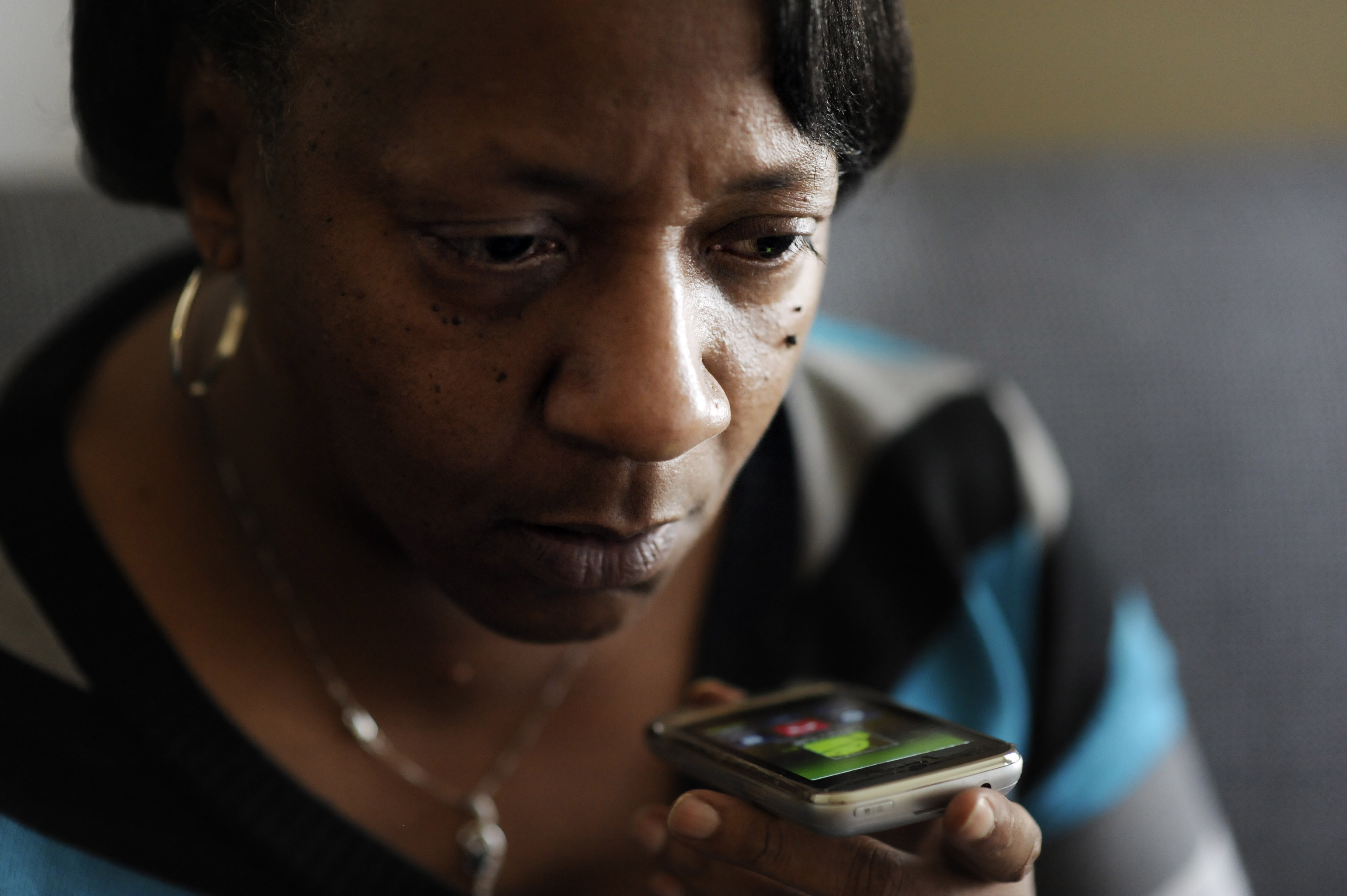
(Photo: After being homeless for years and calling the floors of Union Station home, Gail Faulkner now in her new apartment talks to a friend on her new IPhone at Erna’s House, the first permanent housing in Washington D.C. for homeless women, Wednesday, March 14, 2012. By Melina Mara/The Washington Post via Getty Images)
Rich Juzwiak counsels the world to “choose stuff that is as nondescript as possible” when selecting music to have sex to:
It’s probably best not to play anything that will remind people of their past, which means, unfortunately, the whole genre of quiet storm – the go-to soundtrack for people who say things like “making love” and lite-radio staple – is out of the question. Anita Baker may remind someone of that time he was sitting in the principal’s office after tripping someone during kickball. It was an accident or was it? You don’t want someone debating this when they should be debating whether or not you are the kind of person who likes your nipples played with. Don’t do quiet storm during sex. You aren’t Billy Dee Williams. Or, I don’t know, Usher.
You also really, really don’t want “I Wanna Sex You Up” playing while you’re loving someone down. “We can do it till we both wake up” may put impossible expectations in the head of your partner because, seriously, what do those words even mean?




 The Dish