All Politics Pack A Punch

Praising Kelsey Grammer’s political series BossProspero sets the gritty, Chicago-based thriller against the more polished and presidential House of Cards:

“Boss” is a grand, operatic tale. And yet it plays out within the modest confines of contemporary city politics. [Mayor Tom] Kane’s epic quest is not to conquer another country, amend the constitution or avenge a terrorist attack. He just wants to add some extra runways to O’Hare airport. This is very much a municipal melodrama. …

In “Boss”, small-ball is hard-ball.

The mayor and his enemies bring buckets of guile and gumption to bear on their un-presidential struggles. Municipal showdowns motivate titanic clashes, deadly conspiracies and orotund speeches. The success of the show is that it makes all this seem entirely fitting. Of course the mayor’s encroachment on the bureaucratic turf of a local housing authority must be resisted like a fascist invasion. Of course a runway expansion must stand as a monument to man’s will to imprint himself on the world. The show makes you believe that the last mile of politics is the only mile that matters. Kane can stroll through parks he has built and trespass on ghettos he has neglected. His political achievements and failures are tangible, visible, inhabitable. If politics is the “slow boring of hard boards”, then city wrangling is where the gimlet pierces the wood.
What’s Not Ok About 401(k)s

Felix points out the downsides:

[T]he 401(k) is a way for both your government and your employer to disown you, and to leave your life savings to be raided by the financial-services industry and its plethora of hidden and invidious fees. The well-kept secret about old-fashioned pension funds is that, for the most part, they’re actually very good at generating decent returns for their beneficiaries. They tend to have extremely long time horizons, and are run by professionals who know what they’re doing and who have a fair amount of negotiating leverage when they deal with Wall Street. Savers are always strengthened by being united: disaggregating them and forcing them to take matters into their own hands is tantamount to feeding them directly to the Wall Street sharks.

Yglesias and Drum have related thoughts.

The Cannibal Colony

A fresh excavation at Jamestown uncovered a body that reveals that life in the settlement was even grimmer than previously thought:

[Anthropologist Douglas] Owsley speculates that this particular Jamestown body belonged to a child who likely arrived in the colony during 1609 on one of the resupply ships.

She was either a maidservant or the child of a gentleman, and due to the high-protein diet indicated by his team’s isotope analysis of her bones, he suspects the latter. The identity of whoever consumed her is entirely unknown, and Owsley guesses there might have been multiple cannibals involved, because the cut marks on her shin indicate a more skilled butcher than whoever dismembered her head.

It appears that her brain, tongue, cheeks and leg muscles were eaten, with the brain likely eaten first, because it decomposes so quickly after death. There’s no evidence of murder, and Owsley suspects that this was a case in which hungry colonists simply ate the one remaining food available to them, despite cultural taboos. “I don’t think that they killed her, by any stretch,” he says. “It’s just that they were so desperate, and so hard-pressed, that out of necessity this is what they resorted to.”

Dana Goodyear explains why the Donner party’s cannibalism is well-known but Jamestown’s isn’t:

The difference between the tale of the Jamestown colonists and that of the Donner Party is transmission: in 1847, a noisy newspaper culture reported on every available detail; two hundred and thirty-seven years earlier, there was no domestic press. There was only word of mouth.

When Pay-What-You-Want Works

During a longer mediation on the economics of journalism, Rohin Dhar passes along some fascinating research on the subject:

In 2010 Berkeley researchers performed an experiment selling souvenir photos to people after they rode a roller coaster. They tried 4 different pricing schemes. The first was a flat fee of $12.95 for the photo. The second was a flat fee of $12.95 for the photo, but half the money went to charity. The third was to pay what you want for the photo. The final scheme was to pay what you want for the photo, with half the money going to charity.

Allowing people to name their own price was a complete disaster. Everyone lowballed the researchers. But when customers paid what they wanted and half the money went to charity, the researchers raked in money. It generated 3X more revenue per rider than any other option. Adding a charity component to the flat fee had basically no effect on whether someone would buy it.

When people can pay what they want, this experiments indicates it helps if there is a worthy cause attached to it. In that case, it works well. Otherwise, customers will choose to pay almost nothing.

The Youth Unemployment Spike

An examination of youth unemployment trends in the US and select European countries:

The Economist examines reasons why, globally, almost 290 million young people are unemployed:

Youth unemployment is often at its worst in countries with rigid labour markets. Cartelised industries, high taxes on hiring, strict rules about firing, high minimum wages: all these help condemn young people to the street corner. South Africa has some of the highest unemployment south of the Sahara, in part because it has powerful trade unions and rigid rules about hiring and firing. Many countries in the arc of youth unemployment have high minimum wages and heavy taxes on labour. India has around 200 laws on work and pay.

Deregulating labour markets is thus central to tackling youth unemployment. But it will not be enough on its own. Britain has a flexible labour market and high youth unemployment. In countries with better records, governments tend to take a more active role in finding jobs for those who are struggling. Germany, which has the second-lowest level of youth unemployment in the rich world, pays a proportion of the wages of the long-term unemployed for the first two years. The Nordic countries provide young people with “personalised plans” to get them into employment or training. But these policies are too expensive to reproduce in southern Europe, with their millions of unemployed, let alone the emerging world. A cheaper approach is to reform labour-hungry bits of the economy—for example, by making it easier for small businesses to get licences, or construction companies to get approval for projects, or shops to stay open in the evening.

The Singular “They”

John McWhorter finds that it was commonly used by various literary greats:

So why is the notion that they or their is plural as unquestionable as the law of gravity? It traces back not to some self-standing “canon” or scientific principle, but to an English grammarian who, as far as anybody can tell, just made it up in the 1740s that he should refer to both boys and girls. (For what it’s worth, this grammarian was a woman, named Ann Fisher.) The notion was then passed down through the centuries, such that Strunk & White taught us not to use it. Apparently William Strunk had a certain classroom charisma, but are we really to heed his aesthetic sensibilities over Shakespeare’s or Thackeray’s?

The Daily Wrap

nativeamericans

Today on the Dish, Andrew posted a notice for a personal assistant, took a good look at what forced feeding is like at Gitmo, remained opposed to a mission into Syria despite the chemical weapons scare, and sighed at the ongoing obstacles to liberal democracy in the Muslim world. He echoed Rauch on the human and political value of immigration equality, rethought his mantra on masturbation, gave a timely shout out to Keynes and renewed his vows to his favorite disco duo.

In political coverage, we rounded up debate over the effects of Obamacare on Medicaid, studied the blowback on senators who sunk Manchin-Toomey, and a reader pushed back against our concern over gun ads featuring kids. Jonathan Rauch recounted his discovery of sexuality as a young boy as we considered the significance of Jason Collins’ coming out as a black man. Ann Friedman shined a light on the halfway house between editorial and advertising and both Chait and Ta-Nehisi dispensed some op-ed advice. Readers asked Josh Fox how feasible it will be to leave behind fossil fuels, Edward Glaeser proposed a libertarian means to progressive ends, Derek Thompson explained why CEO pay continues to balloon and readers took on McArdle’s retro-analysis of Bush v. Gore. Finally, as Ackerman doubted that sending weapons to rebels would break the Syrian stalemate, Piro reminded us of the struggles of our veterans back from combat.

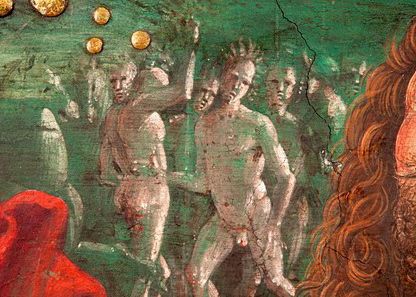
In miscellanea, a reader and a testy Alaskan responded to Brian Phillips’ trials on the Iditarod Trail, the band !!! confessed the penalties of aiming for obscure hipness, and we dug up two poseur alerts, one of them close to home. We tried to untangle America’s obsession with charity ribbons, peeked into the market of conspiracy mongering, investigated the potential boon cannabis might be to fighting HIV. Robert Zigger hawked quietude to those willing to trek the Sahara, furrowed our brows at the expulsion of a high school chemist. Readers cried out to save cursive and we played around with real atoms in the Cool Ad Watch. After the Vatican discovered Native Americans in the Face of the Day we ran Spongebob through the Pogo-filter in the MHB and gazed at Eagan, Minnesota in the VFYW.

–B.J.

Conspiracy As Commodity

Alex Seitz-Wald unpacks the business incentives of conspiracy theory mongers, like Boston-bombing truther Alex Jones:

[T]he economics explain Jones’ “crazy” behavior: He doesn’t care what you think about him — he only cares about his P1′s [hardcore radio listeners] and people who might become P1′s one day, so the incentive is always to bring some new salacious conspiracy to keep his core fans hooked. This is why every disaster is a “false flag” attack and why every item in the New York Times could be new evidence of the globalists’ nefarious plot.

This is typical of conspiracy entrepreneurs, said [historian Robert] Goldberg. “Once they’ve panned for gold in one conspiracy theory and then that one runs out, they move to another one, then they try to connect them, or you feed new details and new suppositions to keep up interest and excitement,” he told Salon. It’s not that they don’t believe what they’re preaching — Goldberg said most conspiracy entrepreneurs he’s interviewed seem like genuine believers — but this a place where the psychology and economics line up. To maintain belief, theorists have to constantly expand the number of conspirators as people debunk their theories, and that happens to also be good for the bottom line. Thus you end up with Jones’ vision of a massive worldwide conspiracy involving almost every powerful person in the world, the media, the scientific establishment and even Justin Bieber.

Previous Dish on conspiracy theories and InfoWars’ Boston trutherism here and here.

Retreating Into Silence

Robert Twigger specialized in “selling silence” by taking Western tourists deep into the Sahara:

How much silence does a person need? You can get greedy for it, addicted to it. I know people who spend half their time in the desert and the other half working out how to get back to it. They are running away from life, some say; they are certainly running away from noise. Recent research suggests that long-term exposure to noise doesn’t just damage hearing (and the average decibel level in Cairo is 85, often getting to 95 and higher, which is only slightly quieter than standing next to a jackhammer); it damages your heart. Continuous noise causes chronic stress. Stress hormones become your constant companion, circulating day and night, wearing out your heart. That must be why the first few days in the desert seem so wonderfully rejuvenating. I’ve seen an elderly man — a retired heart surgeon, coincidentally — go from doddering around the camp to springing along the edge of dunes and rocky cliffs. That’s the power of silence.

(Photo by Alfonso Ianni)

“Brand-Affiliated” “Journalism”

Jessica Bennett went from being a reporter at Newsweek (among other outlets) to becoming the executive editor of the now-defunct Storyboard, “an independent journalistic platform hosted at Tumblr.” She talks to Ann Friedman about working at a “brand-affiliated publication”:

Consumers are getting smarter about traditional advertising and marketing, she adds, and some companies are taking the unorthodox approach of directly employing journalists—whose ideas and copy they don’t directly control—to cover their brand or community … For reporters and editors tired of layoffs and buyouts, these jobs offer a middle ground between journalism and copywriting, a way to take home a decent paycheck without feeling like you’ve sold out completely.

Whose copy they don’t control? Buzzfeed would never tolerate that. Despite the fact that many of the Storyboard pieces were published in other traditional journalistic outlets, she struggled with how her work was being perceived by others:

“There is a lot of crap journalism out there, so sometimes it bothers me when people get all high and mighty about branded content. I really think it’s the story, not where it comes from.” But it’s increasingly difficult to figure out where a story comes from. As sponsored journalistic content and branded advertorial and brand-affiliated independent publications proliferate, the lines are getting blurrier and blurrier. It might be helpful for media consumers to demand more up-front information on how a story was produced—who paid for it? And who signed off on its publication? The Storyboard editors never published a statement explaining their editorial independence or decision-making process, though Bennett says, “we probably should have.”