The Most Popular Posts Of 2013

saddest-map-thumb

We haven’t done this before, so I figured: why not? One way of looking back at the past year is through the Dish’s most popular posts. And they do give a flavor of the year. None of them come close to the 62 million page-views that the home page got this past year, but they’re stand-outs nonetheless.

Our most popular by far was simply a viral breakout – the kind of thing that now defines much of online journalism. It’s a truly simple blog-post: a headline, a link, a graphic, a pull-quote and then some commentary and analysis from yours truly. It has everything a viral blog post should have, and I didn’t even spend a month at Upworthy to come up with it (which is why it’s so rare, I guess). It’s The Saddest Map In America from last February with more than 275,000 views. Next up: a summary of the entire political year: The Nullification Party, from October, with 209,000.

Then: How To Think About Obamacare, another very simple and short post that took off unexpectedly. Money quote:

The thing that staggers me about the Republican hatred of this law is its abstract quality. They never address the real problem of our massively inefficient private healthcare market, which is a huge burden on the economy. They never address how to help the millions of uninsured adults get the care all human beings need. They appear to regard a Heritage Foundation, free-market-designed, private healthcare exchange system as some kind of communist plot. They do not seem to believe there is any pressing problem at all. And they have nothing constructive to offer.

This is not about Obamacare. It is not even about politics. It is about a form of revolt against the very country they live in.

What strikes me about the traffic for a post like this is that it doesn’t have to be Buzzfeedy to work. It just has to say something and stand for something.

Fourth: a gossipy post after Pope Benedict’s resignation: Two Popes, One Secretary. Fifth: Cameron Proves Greenwald Right, my defense of Glenn’s partner, David Miranda, from creepy anti-terrorism harassment at Heathrow. Sixth: Kerry Gaffes; The Russians Blink, my post as diplomacy on Syria took a sudden lurch in early September. Seventh: A&E Cannot Bear Very Much Reality, my recent post opposing the firing of Phil Robertson from Duck Dynasty. Eighth: The GOP Calls Its Own Fiscal Bluff, my take on Paul Ryan’s bullshit on debt reduction. Ninth: The Tea Party As A Religion. Money quote:

What the understandably beleaguered citizens of this new modern order want is a pristine variety of America that feels like the one they grew up in. They want truths that ring without any timbre of doubt. They want root-and-branch reform – to the days of the American Revolution. And they want all of this as a pre-packaged ideology, preferably aligned with re-written American history, and reiterated as a theater of comfort and nostalgia. They want their presidents white and their budget balanced now. That balancing it now would tip the whole world into a second depression sounds like elite cant to them; that America is, as a matter of fact, a coffee-colored country – and stronger for it – does not remove their desire for it not to be so; indeed it intensifies their futile effort to stop immigration reform. And given the apocalyptic nature of their view of what is going on, it is only natural that they would seek a totalist, radical, revolutionary halt to all of it, even if it creates economic chaos, even if it destroys millions of jobs, even though it keeps millions in immigration limbo, even if it means an unprecedented default on the debt.

This is a religion – but a particularly modern, extreme and unthinking fundamentalist religion. And such a form of religion is the antithesis of the mainline Protestantism that once dominated the Republican party as well, to a lesser extent, the Democratic party.

Last up a guilty pleasure: my post on a certain Wall Street Journal columnist who saw in the “scandals” of the first part of this year a crippling crisis for president Obama: Noonan Just Loses It.

How do they all hold up? Your call. The only one I’m now squeamish about is the gossipy one about Benedict’s close companion Georg Ganschwein. The others? They suggest to me that the biggest story of the past year was the dysfunction and extremism of one political party that had just been defeated soundly at the polls. Sometimes, the fleeting perceptions of a passing scene may be more accurate than a view with a little distance. Right now, we’re all fixated on Obama’s crisis of leadership. But that masks a deeper one.


Presenting The 2013 Dish Awards!

[Re-posted from last week. Today is your final day to vote.]

As usual, our blue-ribbon panel – sequestered for days in an undisclosed location – has selected this year’s finalists. It was an agonizing, often nail-biting time. But we did our duty in selecting the finalists and now it’s that time of year for you to do yours in selecting the winners. Click the links listed below and vote for the 2013 Malkin Award, Hewitt Award, Hathos Alert, Moore Award, Poseur Alert, Yglesias Award, and Dick Morris Award. Polls are also open for the Chart Of The Year, Mental Health Break Of The Year, and Face Of The Year.

And, for the first time, you can pick the year’s best Window View and Cool Ad. Yes, a Window View contest everyone can win!

The Dish Awards Glossary

You have until the end of the year to pick the prize-winners. The polls will close tonight, December 31, at midnight. Winners will be announced soon after. Have at it – several of the contests are neck and neck and need your input:

Click here to vote for the 2013 Malkin Award!

Click here to vote for the 2013 Moore Award!

Click here to vote for the 2013 Dick Morris Award!

Click here to vote for the 2013 Poseur Alert!

Click here to vote for the 2013 Yglesias Award!

Click here to vote for the 2013 Hewitt Award!

Click here to vote for the 2013 Hathos Alert!

Click here to vote for the Chart Of The Year!

Click here to vote for the Cool Ad Of The Year!

Click here to vote for the Face Of The Year!

Click here to vote for the Mental Health Break Of The Year!

Click here to vote for the Window View Of The Year!

A Poem From The Year

Bible and rosary

“The Argument of His Book” by Robert Herrick (1591-1674):

I sing of Brooks, of Blossomes, Birds, and Bowers:
Of April, May, of June, and July-Flowers.
I sing of May-poles, Hock-carts, Wassails, Wakes,
Of Bride-grooms, Brides, and of their Bridall-cakes.
I write of Youth, of Love, and have Accesse
By these, to sing of cleanly-Wantonnesse.
I sing of Dewes, of Raines, and piece by piece
Of Balme, of Oyle, of Spice, and Amber-Greece.
I sing of Times trans-shifting; and I write
How Roses first came Red, and Lillies White.
I write of Groves, of Twilights, and I sing
The Court of Mab, and of the Fairie-King.
I write of Hell; I sing (and ever shall)
Of Heaven, and hope to have it after all.

Please consider supporting the work of the Poetry Society of America here.

(Photo by Godong/Universal Images Group via Getty Images)

Politico’s Defense Of Mike Allen

Here it is:

The idea — and it really wasn’t an argument what I read; it was more of a suggestion, insinuation, innuendo in a really unfair way — that the product is somehow compromised by advertisers was (a) not supported and (b) horribly, horribly unfair to what really is one of the most transparent journalistic products in the city. Anyone can read it any given day and sort of take their best guess as to why this is in there, why it’s not, who Mike had lunch with, who was giving him this, who he had dinner with, who was feeding him that. Totally transparent.

I can’t beat Chait’s elegant dissection of this claptrap, so read it.

Journalism’s Surrender

I should end the year on an upbeat note, shouldn’t I? But Time Inc. ruined it. The surrender of journalism to advertizing and public relations – not alliance with, but surrender to – was the biggest media story of 2013 that the media almost didn’t cover at all. But it’s right there in black and white, if buried on the slowest news day of the year:

Time Inc. will abandon the traditional separation between its newsroom and business sides, a move that has caused angst among its journalists. Now, the newsroom staffs at Time Inc.’s magazines will report to the business executives. Such a structure, once verboten at journalistic institutions, is seen as necessary to create revenue opportunities and stem the tide of declining subscription and advertising sales.

Now remember this is not some desperate trade magazine; this is Time Fucking Inc. Journalists at Time will report directly to those on the business side (or is that now an anachronism?) seeking advertizing revenues and sponsored content contracts. That’s what the editors now are. And listen to the howls of outrage swirling around every other journalistic institution, read the columns decrying the end of independent journalism, witness the mass exits of outraged editors, observe the talking heads fulminate and readers rebel!

Actually, there was one resignation, and it was a deeply honorable one:

Among those who expressed concern was Martha Nelson, the recently departed editor in chief. Before Mr. Ripp came aboard and brought on Mr. Pearlstine, the magazines’ editors all reported to Ms. Nelson, who was seen as a staunch defender of newsroom autonomy. Late last summer, Mr. Ripp invited Ms. Nelson to Nantucket to discuss his plans, according to several current and former Time Inc. executives. Troubled by the idea of reporting to the business side, she resigned.  “When Joe suggested a new structure that required editors to report to the business heads, I wasn’t comfortable being part of it,” Ms. Nelson said. “You can’t take apart what you have promoted and built.”

This is the way the press ends. Not with a bang but a “revenue opportunity.”

The View From Your Window Contest: Winner #185

vfyw_12-28

A reader writes:

The tall buildings side by side, vegetation and proximity to the water all suggest a hotel on the east coast of Florida. And if it weren’t for that island in the distance, I’d be pretty confident it is Miami Beach somewhere, maybe the Fontainebleu Hotel, 8th floor or so. My only hope is that most players are taking the Christmas week off and that this guess is in the right zip code.

Another:

Weathered concrete facades look like East Asia, probably South Korea. My guess is that it’s somewhere close to the southwest side of Haeundae Beach in Busan.

Another:

Seems obvious to me that it’s Vancouver, BC – the architecture, the fog, the water and the islands in the background.

Another:

I feel like I only write into this contest when it’s an Italian window. Call it laziness or a sureness in my convictions, but that’s what I recognize. Anyhow, this view looks awfully much like the view across the Bay of Naples toward Misenum from Pozzuoli, Italy. The vehicles in the look European in origin and I could have sworn (maybe my memory is playing tricks on me) that those apartment towers are in that city.

Another:

An Nahdah, Saudi Arabia? Another needle in a haystack picture. But I would probably do better if I didn’t get distracted by user pictures on Google Earth. This week I learned about Red Sea slugs and the country of Oman.

Another

Nha Trang, Vietnam? I’m probably wrong but I figured I would give it a try based on memories of being in the place. It looks like it’s outside of the main part of town, but the lack of motorbikes is what has me thinking I’m on the wrong track.

Another:

Long-time reader (and subscriber!), first-time VFYW guesser. Happy to see a familiar view. That’s the Aterro de Flamengo waterfront in Rio de Janeiro, Brazil, I think around Rua Machado de Assis. If memory serves, all that area past the buildings is landfill that moved the shoreline out (water used to lap up to where the buildings now stand). If you haven’t read it, Machado de Assis’ Dom Casmurro is a classic. The love interest is described as having captivating “eyes like the undertow” (olhos de ressaca), a phrase that always stuck with me.

Another:

From the Malecon Center building on George Washington Ave., Santo Domingo, Dominican Republic. I want to win that book.

Better luck next year! A family entry:

By now, my wife and daughter have both taken an active interest in this weekly VFYW contest. Generally, we’ll collaborate and come up with a consensus guess. Not this week. None of us spent a great deal of time researching our ideas (it’s busy holiday time after all), so our entry contains all three of our “gut” guesses. There are some bragging rights regarding who gets closest. The three guesses are Qingdao, China; Myeik, Myanmar; Canton, Equador.  As a previous contest winner, I’ll be getting some heat if my guess (the China one) isn’t closest.

Ecuador is the closest among those guesses, but the correct country is actually a little farther north:

My best guess is that this is taken from Calle Uruguay in Panama City, Panama looking out onto Av Balboa/Cinta Costera, the building on the right is the Hotel de Meridien, on the right just past this is the Club de Yates and in the distance is the Causeway. Taken in rainy season (although that makes up 9 months of the year!). Whoever took this will be enjoying the non-rainy, less humid, and slightly breezy time of year now. Other than the crazy taxi drivers, I wish they would have captured a Diablo Rojos for you!

Many readers correctly guessed Panama City, and several knew the exact building:

The view photo looks south from the Waldorf Astoria Panama located on Calle 47 Este in Panama City, Panama.  Lining up sight lines to the neighboring buildings from TripAdvisor traveler photos taken at the 7th-floor pool level and one from the 15th floor, I’m guessing that the view photo comes from the 12th or 13th floor. Let’s go with room 1320 just for kicks. From the 15th floor:

correct-guesser-panama-city

I admit to getting a bit lucky on this one; it could easily have taken up hours, but I found it, amazingly, in about 20 minutes.  The palm trees said tropics.  The shore showing a lower tide level along with the calm waters and heavy boat traffic said port/bay.  My first thoughts were maybe somewhere in the Caribbean, or Africa … so not too much to narrow it down.

I actually started with a Google search on “port city bay Africa” which returned a number of links for Port Elizabeth and Nelson Mandela Bay.  So that’s where the search began, halfway around the world from the actual view location.  I knew the distant islands/land mass with large buildings shown in the view would be a pretty good tell-tale.  Quickly I was zooming out my satellite map search beyond Africa and spinning the globe to check out the Caribbean … first Cuba, then Jamaica, then I moved over to Central America.  Panama came into view first, zooming into Panama City it all came together.

The twin islands, Perico and Flamenco, part of what I now know is the Amador Causeway, looked promising and I moved on to scanning the shoreline for the buildings shown in the view.  Soon I was plotting hotels, and the Waldorf Astoria proved to be the one.

Thanks for giving me a good diversion and a weekly nudge toward a self-imposed lesson in geography!  My wife has started ribbing me with Carmen Sandiego jokes for my contest efforts. I’m thinking next week I’ll have to get our three-year-old daughter in on the fun!

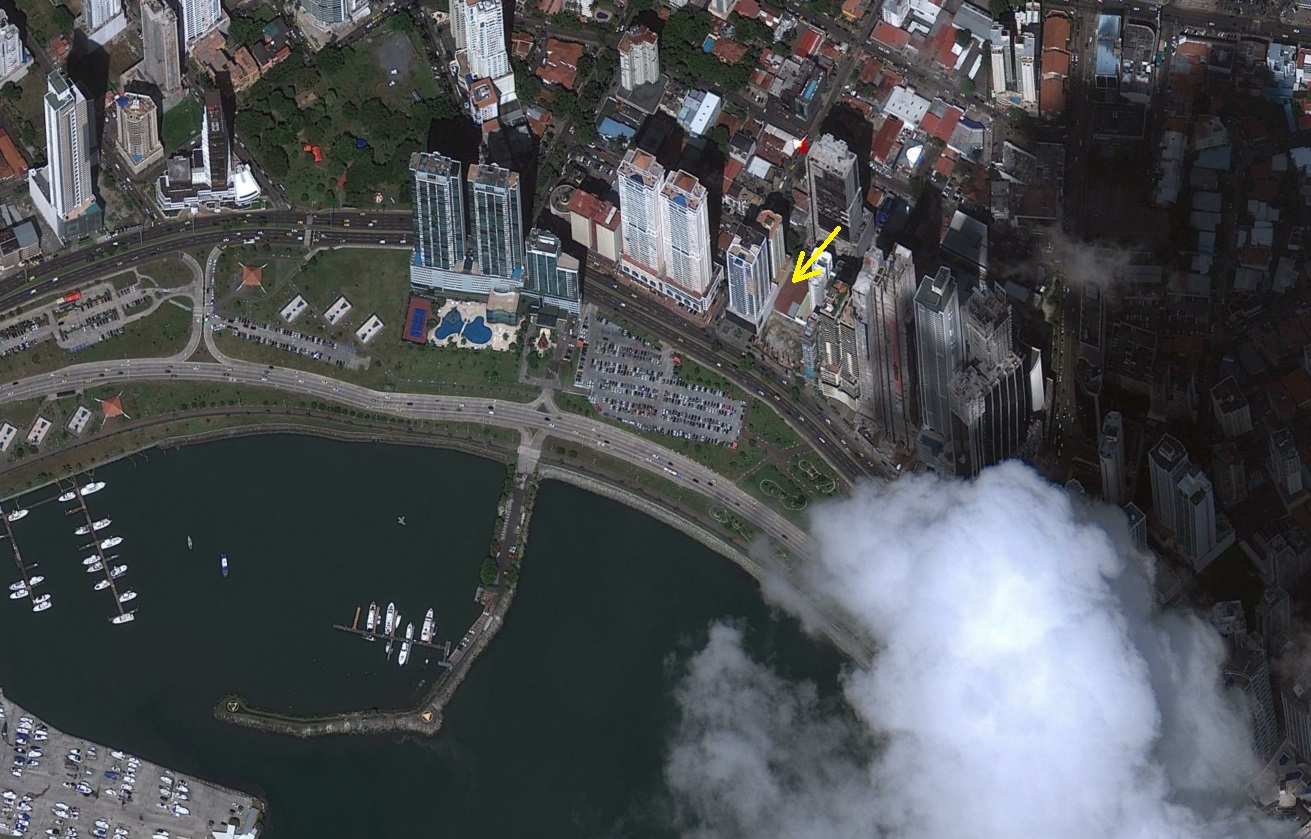
An aerial view:

unnamed

Another reader:

After years of reading the site, I finally got one. I recognized this immediately – and it probably didn’t hurt that I’m stuck in frigid Boston waiting for my Panamanian girlfriend to return from Christmas with her family. Their apartment’s view isn’t too far off from this one.

Another reader with ties to the country:

I have lived on and off in Panama since 1976, first for two years straight and then for month-long visits. I was last there from September to December, 2007. The changes to the urban fabric have been mindboggling. When I left, none of the waterfront highway extension – ciclovía, costera throughway, and parking lots – existed, nor indeed had their construction begun. Neoliberalism unbound produces a whole new cityscape of highrises that keeps expanding up and out. Happily the former US Fort Amador complex, once off limits for many years to all but a few US servicemen – and then to strongman Noriega and a few of the Panama Defence forces – is now open to all; and people throng there, especially on weekends. From it you have a view of a forest of high-rise towers across the bay that bids to eclipse Miami.

Another view from above:

panama city, bella vista

Of all the people who guessed the Waldorf, six have guessed correctly in previous contests without winning. Our winner this week just missed the right room number:

waldorfviewI think the picture was taken from the new Waldorf Astoria, at 47th and Uruguay St. The building seen to the right is the Villa del Mar apartment complex. Here’s a picture from Trip Advisor with almost the same view. Trying to guess a room/floor which would be easier with more ground-level images but I’m not finding any Google Street View available. I found another very close view a little to the right that was from 1211, so I’ll guess room 1209.

Have a happy New Year!

And a Happy New Year to all of our contest followers.  As a year-end bonus, we made a map of all contest entries from 2013:

Screen Shot 2013-12-31 at 1.15.19 PM

Zoomable version here. From the submitter of this week’s photo:

I’m a former winner (contest #73, Benghazi) and wanted to contribute for either the contest or just the regular daily view from your window. The picture was taken from Room 1207 at the Waldorf Astoria in Panama City, at the corner of Calle 47 and Calle Uruguay (there is no street number).

As for the story behind the photos, I’m nearing the end of an almost-around-the-world trip – I start a new job in January and quit the old one at Thanksgiving in order to give me some vacation time. I’m blogging about the trip here (my blogroll link to the Dish has hopefully resulted in at least a few new visitors to your site). I spent two minutes in North Korea at the DMZ, ran across some undercurrents of dissent in Shanghai (as well as a lot of non-religious Christmas displays), had a nasty ferry ride out of Macau, caught a piranha in the Amazon rainforest (where I came upon some remote oil installations), and had a few other adventures.

Even the VFYW grand champion, Doug Chini, missed the hotel room number; he went with 1212. But he was playing with a handicap this week:

I only had an hour or two of free time to search and I was fighting a toothache so strong that it had me squinting with my right eye closed. Pro tip: one-eyed-view hunting, not a good idea.

(Archive)

The Internet Hath No Vengeance Like Google Scorned

screen shot 2013-12-31 at 8.54.50 am

Last week, the search giant punished rapgenius.com for trying to game its algorithm by scrubbing the site from its search results. Jay Yarow ponders the news:

It’s pretty crazy that Google can just do this to a company. How is this legal? Google is so essential to so many companies, and yet it’s virtually unregulated and can do what it wants to decimate a company. Rap Genius had better have been committing some seriously shady SEO tricks to get this sort of a punishment. Otherwise, this seems unfair.

This has to scare the crap out of Andreessen Horowitz which invested $15 million in Rap Genius. It’s not just that Google has nuked Rap Genius. Its Google rank will come back in time if it’s on good behavior. It’s the fact that Google can flip a switch and destroy Rap Genius. As Danny Sullivan noted when the Rap Genius mess kicked up, “it’s probably an incredibly dumb business model to be doing a lyrics site that hopes for Google traffic in a time when Google, like Bing, is moving toward providing direct answers. Lyrics, to my understanding, often have to be licensed. That makes them a candidate for Google to license directly and provide as direct answers.”

Alec Liu speculates as to how Rap Genius pissed Google off:

Google likes to flaunt the notion of transparency when it suits the company, but is decidedly opaque when it comes to its proprietary search algorithm. It’s the secret sauce after all, so we’ll never know for sure what Rap Genius did to induce the wrath of the SEO gods. But there’s enough evidence to make an educated guess, including this Facebook update, since removed, posted two days before Christmas.

Enterprising bloggers that took the bait received a friendly email from Mahbod Moghadam, one of Rap Genius’s co-founders, promising “MASSIVE traffic” if they were willing to insert some code into their posts. Google’s search rankings are based partially on the number of sites linking into the site in question, based on the valid assumption that sites that get linked to often are of higher quality than those that don’t. It’s a basic tenet of search engines everywhere, and attempts to game that principle—for example, by asking other people to link to a spammy smattering of your posts, rather than linking because your posts are actually useful—largely died out years ago.

Yglesias sees value in Google punishing sites that try to game its algorithm. But:

Google isn’t just a lucrative company with some popular products. It’s a powerful company whose Web index and search algorithm are part of the critical infrastructure of 21st-century life. Antitrust law to an extent constrains Google from using its power over search to advance Google’s other business interests. But Google apparently feels comfortable zapping a company like Rap Genius. There’s a lot of wiggle room here. What if executives start pursuing personal vendettas via the search process? Back in the old days of the telephone book, I take it that Ma Bell wouldn’t have been allowed to just make some particular business “disappear” from the white and yellow pages.

“R.I.P. The Blog, 1997-2013”

Kottke argues that the once-relevant medium has evolved into something new and disparate:

Instead of blogging, people are posting to Tumblr, tweeting, pinning things to their board, posting to Reddit, Snapchatting, updating Facebook statuses, Instagramming, and publishing on Medium. In 1997, wired teens created online diaries, and in 2004 the blog was king. Today, teens are about as likely to start a blog (over Instagramming or Snapchatting) as they are to buy a music CD. Blogs are for 40-somethings with kids.

Instead of launching blogs, companies are building mobile apps, Newsstand magazines on iOS, and things like The Verge. The Verge or Gawker or Talking Points Memo or BuzzFeed or The Huffington Post are no more blogs than The New York Times or Fox News, and they are increasingly not referring to themselves as such. … Sites like BuzzFeed and Upworthy aren’t seeking traffic from blogs anymore. Even the publicists clogging my inbox with promotional material urge me to “share this on my social media channels” rather than post it to my blog.

He elaborates on his “deliberately provocative” argument:

[A]s someone who’s been doing it since 1998 and still does it every day, it’s difficult to ignore the blog’s diminished place in our informational diet.

Through various blogrolls (remember those?) and RSS readers, I used to keep up with hundreds of blogs every day and over a thousand every week. Now I read just two blogs daily: Daring Fireball and Waxy. I check my RSS reader only occasionally, and sometimes not for weeks. I rely mainly on Twitter, Facebook, Digg, Hacker News, and Stellar for keeping up with news and information … that’s where most of the people I know do their “blogging”.

How longtime blogger Om Malik sees it:

[W]hile I embrace every new social platform with gusto, I find it frustrating that my point of view is spliced across various networks. I think the blog is the one that ties it all together — a central location where you fit together all the Lego pieces. In many ways it is no different than what blogs used to be in the beginning. Instead of them being a starting point of the journey, they are now the final stop, a digital home in our social media meanderings. Marc Canter,came up with a concept called “digital life aggregators.” And he was right — blogs are just that, digital life aggregators.

My own take on “the death of blogs” is here.

Mangling A Myth, Ctd

Readers sound off on the latest installment of The Lord of the Rings, picked apart by critics here:

Allow me to summarize: Peter Jackson 2013 = George Lucas 1999 (the year The Phantom Menace debuted). The only thing missing from the Hobbit films is a clearer analogue to JarJar Binks.

Another:

I figured out why the adaptation of The Hobbit has left such a bad taste in my mouth from the moment I learned that it would be expanded to a three-part epic. Put simply, The Lord of the Rings was Peter Jackson’s masterful homage to J.R.R. Tolkien and his works. The Hobbit is Peter Jackson’s masterful homage to Peter Jackson.

Another:

This can all be boiled down to a single word: Greed. Jackson is taking a single, not particularly long book and turning it into three movies because he can make three times as much money that way.  He HAS to change stuff, a lot of stuff, to stretch it out that much.  There simply isn’t enough material in the book to make three movies.  Even the stuff he is pulling from the LOTR appendixes to try to cover his money-grubbing ass was in the appendixes and not in a revised edition of The Hobbit for a reason – Tolkien thought they detracted from the tightness of the story of the Hobbit and/or distracted from the message he was trying to convey.

Another is much less critical:

This past fall, my son and I read The Hobbit out loud over about a month as our bedtime story. This past weekend, I took him and three of his friends to see latest installment of The Hobbit for his birthday. None of the other three children had read it prior and now they are ALL reading it with their parents. That seems like a big win to me.

Several Tolkien fans scrutinize the film versions at length:

As someone who knows the entire story of LOTR about as well as any “layman”, I have always understood that any attempt to visualize the series is not going to be verbatim, and I can accept that because moviemaking is simply a different way of telling a story. I recognize that Warner Brothers is more in the business of making money than making movies, so I understand why Legolas has such a huge presence in a film based on a book he was never mentioned in, after three films where his status was raised from being one of the Fellowship to a super-soldier capable of singlehandedly slaying an oliphaunt.

Some variations of the story I didn’t mind: no one would ever dare to film the chapters that include Tom Bombadil, for example. And I thought giving Arwen a larger role in LOTR was a good thing, she’s barely mentioned in the trilogy and only says a few lines near the end. You need to go to the appendices to get more background on her. Mostly I disliked making Gimli little more than comic relief in terms of characters. And if they want to make a movie where young girls can masturbate to Legolas, just cast him as the lead in a romantic action film and be done with it.

But as a moviegoer looking at the films as films and disregarding the casual disregard for the actual story, I think all five of the films (and yes I’ve seen them all, but once only – like watching a car crash) have been just awful. Far too long with far too much reliance on effects for the sake of effects, particularly all that damn slo-mo fighting. In Desolation of Smaug, the long, drawn out battle as the dwarves ride down the river towards Esgaroth was extremely annoying, never mind that no such event took place in the book. I kept saying to myself “Christ, get to the town already!” Frankly, Rankin-Bass did a better version of the story.

A scene from that version is above. Another reader:

Jackson’s Fellowship of the Rings trilogy was spectacular as filmmaking and wholly missed Tolkien’s point from the books. Tolkien starts and ends his story with small unassuming hobbits – gardeners with woolly feet – who till the earth they live in and are quite afraid of anything non-Shire. They are not supposed to be heroes, unlike Gandalf, Aragorn, Boromir, Legolas, etc. But it is to the hobbits Tolkien assigns the hero’s quest – leaving their homes, facing obstacles seemingly beyond their measure, enduring hardships, and then returning. And it is the last part, the return, that Jackson misses entirely, and thus misses Tolkien’s point. When the hobbits arrive home, their home too has been ravaged. The outside world has reached in and destroyed their previously inviolable, safe and secluded part of the world. They must take what they have learned and fix their own homes, their own community, their own land. They have to drive out Sauroman and his henchmen. Jackson eschews (or simply misses) this and instead focuses on the parallel story line of Aragorn, essentially finishing up the movie with his coronation. Tolkien drives his point home by slowly peeling off the members of the fellowship as the hobbits return home, until they are alone, just the four. And then the razing of the shire ensues. Tolkien is reminding us that we need to “tend our own gardens” too.

As an aside, I was heartened, thinking that Jackson had understood this point, when during the Galadriel’s mirror scene Jackson depicts the Shire being burned down. I thought at the time he would then finish the trilogy both in keeping with Tolkien’s writing, and more importantly, with his meaning. He of course didn’t. The hobbits come home and all is well except Frodo has to look winsomely off a ship as a he sails away into a gossamer sunset and the other hobbits return home to the imperturbable Shire. Crapity crap crap. Jackson’s trilogy has no moral compass, only a series of arduous tasks demanding incredible endurance. (Did I mention I liked it as a movie though?)

Another:

Well of course Jackson’s approach to the Hobbit mangles it! All you need to do to understand why that’s so is read it with the eyes of an adult. Immediately it’s very apparent that The Hobbit was specifically written as a fairy tale, a myth specifically written for children. What Tolkien really wanted to publish was parts of what his son ultimately collected and published in his late father’s name as The Silmarillion, but no publishing house would consider the idea when he proposed it because no one had ever published such a work before and so there was no way to know if there was a market for such a book. One publisher was willing to publish a children’s story if he’d write one, so he reluctantly did so and named it “The Hobbit”. If I recall correctly, it had a sufficiently successful reception for the publisher to ask him to write a sequel. Tolkien began the sequel truly as a follow-up children’s story to The Hobbit, but as he went along the story that came out of his fingers became less and less a children’s story, and more and more a part of his beloved Silmarillion. That’s why the first third to a half of The Fellowship of the Ring clearly reads as “a children’s story”, but after that it reads more like a saga.

Where Jackson goes wrong in honoring Tolkien’s work is he’s taking that children’s story and treating it as though it was every bit as much of a saga as The Lord of the Rings. (If he has any sense he won’t ever try to make a movie of The Silmarillion! It’s just too much for a movie. You could easily make several different, unconnected movies from its material.)

One more:

I won’t wade into the debate directly, but anyone who thinks Tolkien’s original Hobbit required additions in order to become great drama really should listen to Nicol Williamson’s 1974 audio version (click on “VBR ZIP” to download all the MP3 files in one fell swoop – and be patient, it takes a few minutes.) The recording doesn’t want for excitement; it doesn’t add anything, and in fact takes a great deal away, necessary to limit the recording to four hours’ length; but it retains all the subtle shadings of the characters, and the story’s essential emotional heart, which is the feeling of being small and scared in a big, scary world – and facing those fears. That’s something Jackson never, ever gives a thought to.

Plus, take it from experience, this is the best road-trip story for kids: it guarantees four hours of rapt silence in the back seat … though parents will be surprised to find themselves hanging on every word, too.