After watching the video we posted of Rand Paul in 2009, Kilgore is ready to write him off:
Paul doesn’t just suggest the two-term Republican vice president was influenced by his tenure at Halliburton. He all but attributes the entire change in Bush 41 and Bush 43 policies towards the invasion and occupation of Iraq to Cheney’s personal enrichment by Halliburton. Had he gone ahead and accused Cheney of treason, it would have been entirely logical.
Cottle calls the video Rand’s “Michael Moore moment”:
Make no mistake: As someone who opposed the Iraq War, I enjoy watching Cheney get slapped around on the issue as much as the next gal. But it’s one thing to accuse the former veep of ideologically driven Machiavellianism; ’tis quite another to suggest that he did what he did out of loyalty to his Halliburton cronies. That is a far darker charge that, while already generating glee on the left, is also the kind of right-on-the-knife’s-edge-of-nuttiness conspiracy-spinning likely to bite Paul on the butt as he tries to capture his party’s nomination. …
As Paul moves closer and closer to the presidential trail, however, legions of journalists, oppo researchers, and even garden-variety voters will be rooting around in his past like hogs digging for truffles. These two speeches swiping at Cheney are unlikely to be the only colorful nuggets unearthed. Paul is a passionate, quirky pol who, until very recently, didn’t see much need to watch his tongue. Whatever else it’s doing to prep for 2016, Team Rand had better be bracing for Americans to learn about some of the senator’s fringier thoughts and theories.
Following up on the weekend’s troubling events in Donetsk, Luhansk, and Kharkiv, Alexander Motyl calculates that Russia would need a large military force to occupy Eastern Ukraine, especially in the event of an insurgency:
In light of Russia’s estimated current force levels on Ukraine’s borders (50,000–80,000), the best Russia could do under low- and medium-violence assumptions would be to invade a few southeastern provinces. If those assumptions are changed to medium or high, only one or two provinces would be within its grasp. These conclusions assume that an invasion would entail no force deterioration as a result of the Ukrainian army’s resistance. Change that assumption, and Russia’s capacity to occupy southeastern Ukraine declines even more.
In sum, Kyiv is right to worry about an invasion of all or part of its southeast—but only if Russia makes optimistic assumptions about the extent of resistance. Accordingly, Ukraine’s immediate goal should be to strengthen its southeastern defenses—preferably with American help—so as to deter a focused attack or, at the very least, to make such an attack so costly as to raise the conditions of expected violence in individual provinces. (Ukraine’s medium-term priority should of course be to develop a full-scale defensive capacity.) But, unless Putin decides to deploy most of Russia’s armed forces (which number about 750,000) against Ukraine and thereby place all of Russia on a war footing, readying bomb shelters in Kyiv may not be a Ukrainian priority.
(Map from Max Fisher, who sees an invasion as more and more likely.)
The short version of the tale is that the Associated Press reported that House Republicans and Dems had agreed to do away with the cap on deductibles for small group policies inside the exchanges, giving small businesses more flexibility in the plans they can offer, a change sought by groups like the U.S. Chamber of Commerce.
After Drudge spun this as evidence that House Republicans had agreed to — gasp! —expand the law, Boehner’s office quickly put out a statement claiming Republicans had actually succeeded in repealing a part of it. Dems had agreed to this change, believing it improves the law, making this a bipartisan fix. But as Steve Benen notes, the fact that this sparked an outcry among Obamacare foes is a reminder that for them, the only acceptable goal is “to make the ACA as punishing and ineffective as possible, in the process creating demand for destroying the law in its entirety.”
Beutler notes various tweaks the right has made to the law:
None of these modifications will substantially change the ACA’s architecture or even smooth its roughest edges. But they badly undermine longer-standing Republican claims that the law is beyond fixing. If parts of it are clearly fixable, and being fixed, then new constituencies will come out of the woodwork seeking changes of their own, and resistance to more substantial ones will become harder to maintain.
In the Brendan Eich affair, it seems to me, there are, beneath the fury and the name-calling, two core narratives in conflict, and they are driven by two different approaches to politics. For the sake of argument, let’s call one a progressive vision and the other a liberal one. Here’s Jon Lovett making a fundamentally liberal point:
The trouble, I think, is when ostracizing a viewpoint as “beyond the pale” becomes not an end but a means to an end; that by declaring something unsayable, we make it so. It makes me uncomfortable, even as I see the value of it. I for one would love homophobia to fully make it on that list [of impermissible opinions], to get to the point where being against gay marriage is as vulgar and shameful as being against interracial marriage. But it isn’t. Maybe it will be. But it isn’t. And kicking a reality-show star off his reality show doesn’t make that less true. Win the argument; don’t declare the argument too offensive to be won. And that’s true whether it’s GLAAD making demands of A&E or the head of the Republican National Committee making demands of MSNBC.
The bottom line is, you don’t beat an idea by beating a person. You beat an idea by beating an idea.
Then there is another approach, in which creating a progressive culture in which some things are unsayable is the whole point of the exercise. Here’s a piece by J. Brian Lowder with that perspective. Money quote:
Tim Teeman wrote on Friday that “the ‘shame’ axis around homosexuality has positively shifted from those who are gay to those who are anti-gay.” He may be right about that, but speaking personally, I am not interested in shaming anyone; it would be enough for me if those people who are so ignorant or intransigent as to still be anti-gay in 2014 would simply shut up.
This is not a minor disagreement. It’s a profound one. One side wants to continue engaging the debate. The other wants one side to shut up. I think you also see this difference in the responses to Jon Chait’s new piece on race in the age of Obama. Progressives see the scale of the historically-loaded injustice that African-Americans face every day and cavil at any attempts to minimize or qualify the iniquity of those on the right who still deploy its rhetorical codes. Liberals still insist on some fairness, on not jumping to conclusions about an entire party’s or a single person’s racism, on seeing that human beings are not so simple as to be reduced to such ideas as “hate”, on maintaining some kind of civil discourse which right and left can engage in, which eschews too-easy charges of bigotry.
One seeks to get to a place where a conversation ends. The other seeks never to end the conversation, and, in fact, gets a little queasy when any topic is ruled out of bounds in a free society.
Maybe if we can appreciate both traditions, we can see the underlying forces behind this debate more clearly. My own instincts on the gay rights question have always been classically liberal/small-c conservative/libertarian. I think hate is an eternal part of the human condition, and that ridding oneself of it is a personal, moral duty not a collective, political imperative. I never want to live in a society in which homophobes feel obliged to shut up. I believe their freedom is indivisible from ours. Their hate only says something about them, not me. I oppose hate crime laws for those reasons. And my attachment to open debate means constantly allowing even the foulest sentiments to be expressed – the better to confront them, expose them and also truly persuade people of the wrongness of their views – rather than pressuring them into submission or silence. Others have a different vision: that such bigotry needs extra punishment by the state (hence hate-crime laws), that bigots need to be constantly shamed, and that because of the profound evil of such thoughts, social pressure should be brought to bear to silence them. More to the point, past sins have to be recanted and repented before such bigots are allowed back into the conversation.
This is a very old fault-line in civil rights movements, and it’s amazing that the gay rights movement has been able to keep these divisions at bay as we fight for basic equality. That may now begin to change, if only because an entire generation has now grown up having deeply internalized their self-worth, and are thereby rightly all the more affronted by those still resistant to it. I understand that entirely, and am glad for this shift in consciousness – especially since I spent much of my adult life trying to bring it about. It’s wonderful for me to read young gay writers insist on their non-negotiable and full equality in terms of marriage – if only because I tried to make that case decades ago to a great deal of bewilderment and dismissal from many. This is indeed great news, as Frank Bruni noted. And, when couched in positive, constructive terms, it has won more converts among more straight people than most of us ever dreamed of.
But liberalism, for me, is not a means to a progressive end. It is an end in itself.
It seeks to guard against groupthink and social pressure as dangerous threats to freedom of thought and of the individual. It aims to protect the rights of bigots as well as the targets of their bigotry. At any one point, that can seem grotesquely unfair. And it is. It is and was deeply unfair that, in order to enjoy some simple basic rights, we gays have had to explain ourselves to the world, listen to our very lives being debated as if we were not in the room, have our lives and loves traduced and distorted and picked over by people who treat us as pawns in a political game or an intellectual exercise. But, you know what? We had no choice if we were to move forward. And, boy, have we moved forward through this difficult process.
I’m not taking this position because – to count some of the milder terms thrown in my direction in the last few days – I have internalized homophobia, I want to leverage others’ suffering for web traffic, I have never done anything to advance gay equality, I am a hypocrite/privileged white male/barebacker/Uncle Tom, and on and on. I’m taking this position because it is my honestly thought-out view. It’s laid out in Virtually Normal, which is emphatically not a progressive book. And it’s because I am also convinced that a liberal approach to politics will lead to – and has led to – more actual justice and a deeper changing of minds.
We have not won the debate this past decade or so because we have constantly exposed others’ hatred, or racked up the number of people we can condemn as homophobes. We have won because we have made the positive and reasoned case for our equal dignity and rights. We have won because we have engaged, not ostracized. And we have won more definitively because of it. How much better to have allowed this free debate to continue and to have actually genuinely changed people’s hearts and minds than to have tried to impose a settlement on the unwilling and unpersuaded, and then demanded they shut up. And this is what I would try to say to my progressive gay friends: if you really want the full justice you rightly believe in, stop trying to close down a debate which we are winning and in which we still have many people to persuade. Of course there’s bigotry and ignorance out there. But calling everyone who disagrees with you a bigot rules out a chance to persuade them, drives them further into a defensive crouch, and prevents us winning the argument in the long run.
If the liberal approach had so demonstratively failed, it would be one thing. But, in this case, it has demonstratively succeeded – perhaps more than any recent social movement. We shouldn’t forget how we got here. Or believe that somehow suddenly different tactics cannot still take this debate in a different direction. They can; and if we are not careful, they will.
A reader thinks this week’s photo was taken “somewhere wondrous”:
I haven’t been doing well with hemispheres but I’ll guess Northern. This certainly takes the prize for the best roofs in a VFYW. That flying carpet one in front of the green bottle building with the four white spears in the right background will be a wonderful clue.
Another imagines a happy giant:
This has to be Zoeterwoude, Netherlands. Where else would there be a 10-story tall Heineken bottle?
Near the Alps?
Torino, Italy. I’ve gone up in the green tower while studying abroad years ago. I think so, at least.
Another goes south to Buenos Aires. Another gets on the right continent:
I look at your view every week. For this one, about 10% of the view is black – just the window frame. A palm tree, some traffic cones, then there is what appears to be a rolling rock beer bottle in the middle of town. My guess: Singapore.
Another goes with Kuala Lumpur and another gets closer with Hanoi. Closer still:
Off to coach a Little League game, but I’m guessing Phnom Penh, because that compound in the foreground looks a like the Royal Palace, and those two towers in the background could maybe be the Gold 42 tower? I don’t know. Go Nationals!
Another gets the right country:
I don’t have the time in my life to do the research that would generate a win, but it’s still fun to play. This is clearly Thailand – the architecture gives it away for anyone who has ever visited, and the yellow royal flags confirm. Where in Thailand is a different story. Not metropolitan enough to be Bangkok, so I just went with one of the other large cities: Chiangmai. Looking forward to seeing how the winner narrows it down to the exact window.
The exact city:
Bangkok!!!
Another got a little lost:
Wow, these are harder than they look. The roof looks like nearly every Buddhist temple Google images can turn up in Bangkok, and there’s a yellow flag in the distance that could be the old Thai royal flag. The twin buildings in the background also looks like two that are visible near the Rama IX bridge in Bangkok. I’m going to guess the Wat Phra Kaew temple in Bangkok, but I wish I could find that green building.
Another recognizes a different temple:
I don’t really have time to work on the contest this week, but that sure looks like Wat Po in Bangkok. One of the best trips I ever took was a solo journey to Southeast Asia to visit friends (and friends of friends who randomly left me keys to their apartments!). It was right after 9/11 and I saw some of the most beautiful places on Earth traveling through Burma, Thailand and around Hong Kong. One of my favorite scenes was a photo I snapped at Wat Po (I’ve borrowed this image from some kind soul who posted it on the interwebs):
Would you like to see the Reclining Buddha … or massage the toilet?
Another tried in vain to find the building the photo was taken from:
Southern Hemisphere, Asian architecture, so somewhere in Southeast Asia. I focused on the temple with the unusual roof and windows. I lucked out and learned they are Thai windows, then came upon the temple compound, Wat Ratchanadda in Bangkok. I found photos with a similar orientation taken from the Golden Mount across the way, but there’s no hotel. Crap; I got the location but can’t find the freaking hotel? Aren’t all of the contest photos taken from a hotel? I think so, but I’m starting to tire, so I’ll just guess it was taken from the Golden Mount.
By the way, you learn a lot playing this game. I mostly learned that Bangkok needs to be added to my list of travel destinations.
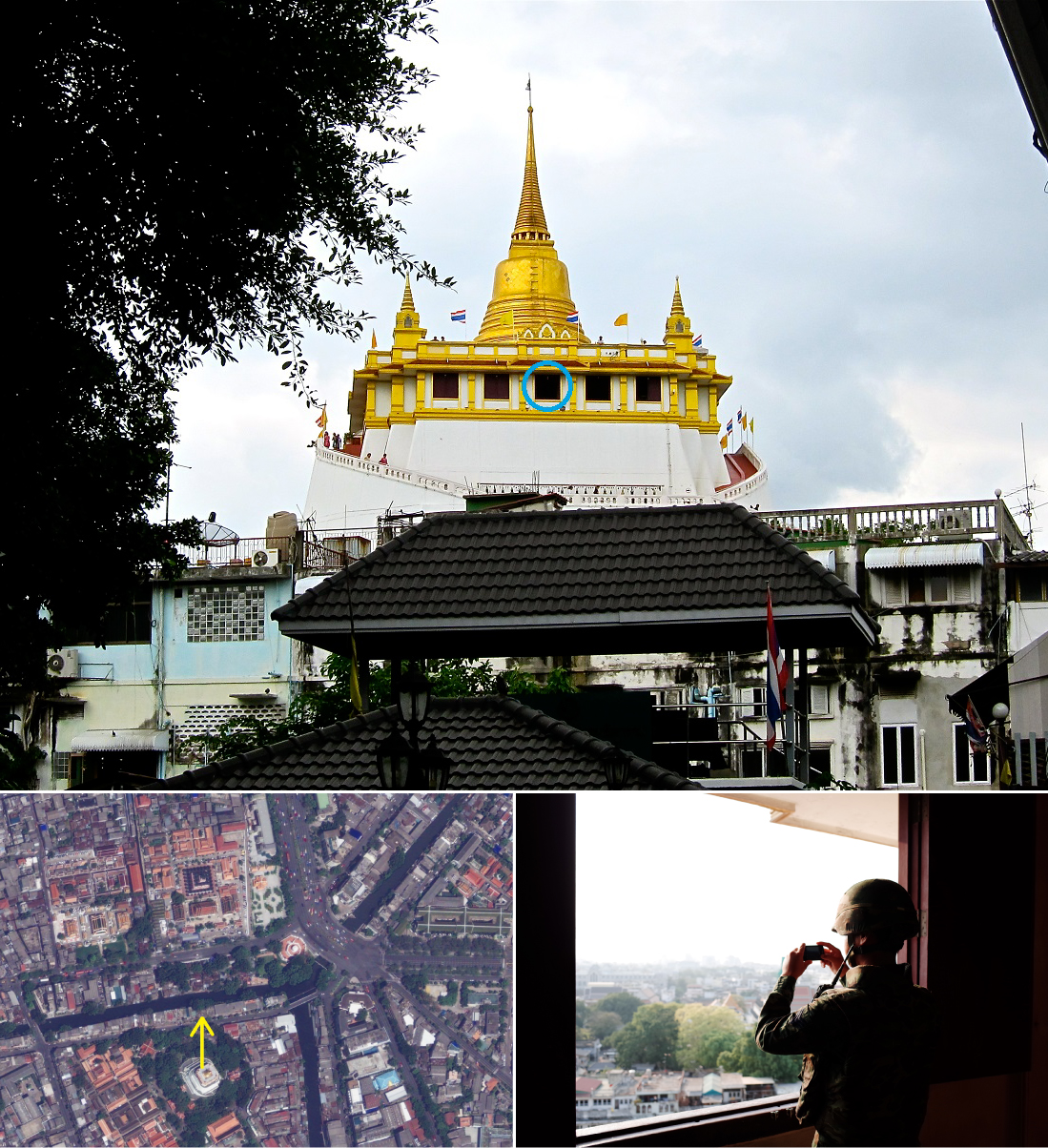
You also learn that it’s not always a hotel; this week’s view is from the Golden Mount – or more precisely:
From the northwest corner of the Golden Mount along the walkway at the Wat Saket Ratcha Wora Maha Wihan, usually shortened to Wat Saket, a Buddhist temple in Pom Prap Sattru Phai district, Bangkok, Thailand. The photo is looking west northwest toward Wat Ratchanadda.
Chas, aka Special Teams, put together this photo composite of about 20 entries – see yours?
Another reader is bemused:
So last week my gut said Western Samoa, them I saw that the clue said United States. I had a brief look at Hawaii, then American Samoa, but then family and work called and I didn’t make it as far west as Guam. I was busy at work getting things wrapped up to go on holiday.
This morning, on holiday in Koh Samui, Thailand, my wife said: we can get this week’s contest; it’s got to be Bangkok! I’d forgotten to even check (too much swimming with our 2.5 year old!) If only you’d posted this next Sunday we could have wandered down and narrowed down the view in person.
And yes, it is Bangkok. I’m on holiday and on an iPhone so no fancy pictures and diagrams. The view is of Wat Ratchanatdaram and the Loha Prasat, taken from Wat Saket – also known as the Golden Mount. I’m assuming lots of people will get this one – but in not sure how to narrow down the window. It’s taken from the base of the stupa, and appears to be the southwestern most corner. Like I said: in one week we could have gone to the wat and replicated the picture … now, back to the holiday!
A “long-time peeper, first-time player” gives it a go:
From the southern-most window (of five) facing Boripat Rd of the temple at Wat Saket วัดสระเกศ ราชวรมหาวิหาร (ภูเขาทอง) in Bangkok. It is a view of Wat Ratcha Natdaram. It appears there is some restoration going on. The only reason I know this was my wife and I were planning a trip in February to Bangkok and ended up needing to cancel our trip after the recent unrest. Ugh. Wish I was viewing this myself instead of playing a game.
Another reader, like the many who determined this week’s view, is feeling mighty victorious:
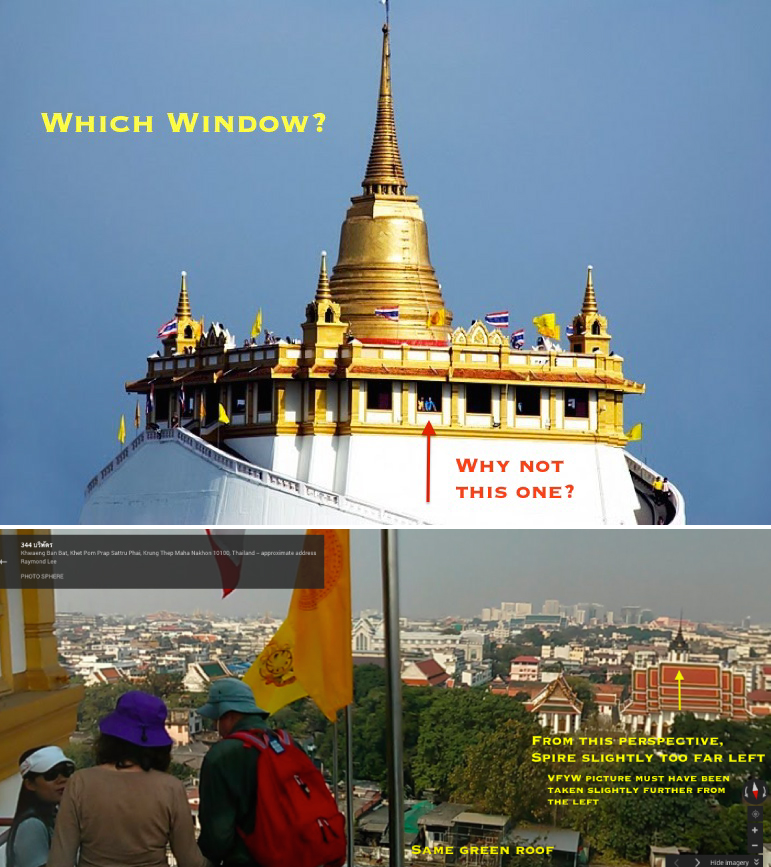
Finally! I am 99.9999% sure that I have this one. This picture was taken from the Golden Mount at the Wat Saket in Bangkok, Thailand. The window is from the North West corner (facing west). The picture yelled Chaing Mai, but after searching Chaing Mai and coming up empty, I googled Bangkok + Wat and found this place. After three more hours of trying to pinpoint the exact angle, a brilliant idea came to me; I searched YouTube. This video at the 2:57 mark shows the angle of the picture but from a slightly different window:
I bet many of your readers answered this correctly, but how many used YouTube to pick the window? This is first time I have participated in this game, and I can’t wait to do it again.
A frequent visitor to Bangkok sheds some light on the temple:
In the years of guessing in this contest, finally someplace I have more than a passing knowledge of. My husband is Thai and I have been to Bangkok over 20 times. It is my second home. The photo appears to be taken from Wat Saket, a Buddhist temple. The stupa on top of the temple is well known in Bangkok. The Golden Mount was once the tallest building in Bangkok. The location of Wat Saket was a crematorium where the bodies of the dead, who were killed by cholera, were disposed of in the early 19th century during the reign of Phra Buddha Lertla Napalai – King Rama II. The temple has windows near the top of the base of the stupa where this photo was apparently taken.
A visual entry:
Another offers an architectural lesson:
The countries of east Asia all have a unique style for the big temples. Here are some of my pictures for different nations. Thailand’s have a red, yellow, or green roof accented by another color and those golden pointy things. Korean temples are mostly red, with green and blue floral patterns painted all over the place. Japanese temples are muted affairs. Browns and whites and such.
The second clue was the window, specifically the lack of a window pane. Thanks to a confluence of economics and the city’s completely flat topography, any vantage point that high must be in an expensive building whose fancy-shmants owners want window panes – the one exception being Wat Saket, a temple built on an artificial mountain.
Down below you can see a fish-ball soup restaurant and a bunch of shops that cater to wooden door enthusiasts. Up top is a ton of smog. In the end, it seems my unpaid internship in Bangkok could actually have some recompense!
A former resident feels a pang of regret:
I don’t think I ever visited the Golden Mount while I was living there and now wish I had! Whenever you’re somewhere long-term, you neglect to do all the tourist things …
Nostalgia also moved this reader:
I was amazed to see this picture pop up on the feed tonight. I used to pass this Wat (temple) on the bus going to work every day in the early ’90s. My wife was born nearby. Now we both live in the Brooklyn-like wilds of Adams Morgan (and love it), but still occasionally miss Krung Thep Mahanakorn, the Great City of Angels.
An angel’s-eye view:
I suspect you’ll have a 100+ who know this is Bangkok, but I think many fewer will nail the location – which is the opposite direction from the classic view that looks down to Wat Saket (toward the east). In any case, your View is to the west – with the Democracy Monument being the main clue (but City Hall is also visible). I was only really sure I had it when I found the Google street view showing some matching windows. I remember getting the kids some ice cream along this street after the visit to the Mount – it was stinkin’ hot, as always in Bangkok.
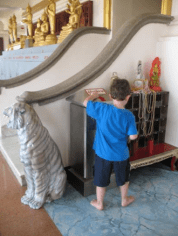
Attached is a photo of my four-year-old son making a donation inside the Golden Mount. the Buddhas inside were not particularly memorable, but he definitely remembers the tiger and ringing bells along the stairs on the long walk up.
Best way to get to the area is via the water taxis that ply the nearby narrow Saen Saep Khlong (canal) – occasionally reaching James Bond-like speeds (make sure to keep up the vinyl curtain to keep from having water hit you on the backsplash off the walls). We try to travel by water as much as we can in Bangkok, since you can get to a surprising number of places, and it always beats a taxi on the clogged roads.
Another reader is taken back:
Wow, wow, wow. Never has a View From Your Window brought back so many memories! I feel like every week some reader has a story about the time they de-wormed orphans while staying in that same hotel or attended a UN summit at the chateau in the distance. But never me. Well, until now.
Although it looks like it, that “skyline” looming in the background isn’t a financial district. It’s Siriraj hospital and it was my neighbor for six glorious months in 2005 when I was an exchange student at Thammasat University (which is directly across the river from the hospital). In fact, that large blue-roofed wat-looking structure in front of the skyline isn’t a wat at all; it’s Thammasat University’s huge auditorium complex.
This photo actually has lots of wonderful Easter Eggs. I’m sure I won’t be the only reader to point out the four fins jutting up in the middle – that’s The Democracy Monument and it’s been the site of more than a few (sometimes violent) protests over the years. That spot of greenery in front of the Thammasat auditorium is Sanaam Luang, which is sort of like Thailand’s National Mall. And just barely cropped out of the left side is the Grand Palace.
I spent eight months studying abroad in Thailand in 2005 (mostly in Bangkok, but also doing research in the northeast in Ubon Ratchathani). I’d only been back once since, but this last summer I had the good fortune to bring my boyfriend with me on his first backpacking trip (through Europe, the Mid-East and Southeast Asia). He’s never been a big traveler or had much interest in it, so it was a coup to get him to come. When I saw this photo I immediately forwarded it to him, exclaiming “Does this look familiar?!? We’ve been there!!!” He said it was either Thailand or Europe. Looks like we’ll need to do more traveling.
Another correct guesser:
Never been to Thailand, but my dad (with whom playing VFYW is our weekly bonding time) quickly pegged it as an indeterminate location in Bangkok. I was able to narrow it down from there. If I win, it will be a shared victory.
By the way, how do you keep track of prior guesses? If I guess the correct building but not the correct window, does that count as a correct guess?
Yes it does, if the contest that week is a difficult one – “difficult” defined by only 10 or fewer readers correctly guessing the location. (This week’s contest, in contrast, had closer to 100.) We keep track of such Correct Guessers and then cross-reference future potential winners against our email database. Back to Bangkok:
VFYW virgin here. I wish I had a better story, but I basically did some googling for those red/green roofs, which took me to some very similar looking wats in Bangkok. From there, it was a trial and error approach to Street View (headache accomplished!) My first thought was that the actual wat was just out of frame, or maybe under the green tarp. But then there was a Keanu-like “whoa” moment where I realized the photo could have been taken from the wat.
Heh. Okay, so which Wat window is it already? From the submitter:
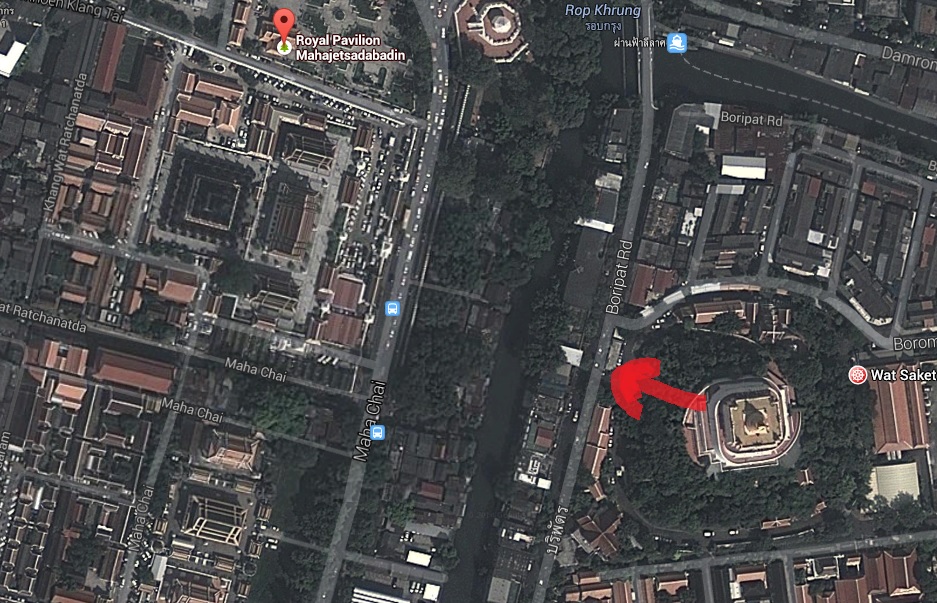
Wow, thanks for picking my photo. I have only taken part in the contest a few times but am pretty stoked on having a picture selected. The photo was taken from the west-facing window of the top floor (not the roof) of Wat Saket (Golden Mount) in Bangkok, Thailand. The building in the immediate distance is the Royal Pavilion Mahajetsadabadin. Unfortunately I can’t be more specific than that. I believe there are five windows on each side but I can’t say which one I took the photo from. Next time I will record more detail …
Don’t worry, Chini’s got your back:
I guess we had to go back a few months to the holidays to find a less challenging view than this week. But as far as the easy ones go, this one was was fun, mainly because finding the right window took a little bit of work. This week’s view comes from Bangkok, Thailand. The view looks west, northwest along a heading of 293.12 degrees from a window at the top of the Wat Saket temple.
Of the several contestants who guessed the same window as Chini, one stood out with 13 previous entries, including many correct guesses with no wins – until today:
Great contest this week! I looked at the picture on Saturday and immediately thought that it was going to be impossible, but then I noticed the temple in the background. In fact, it’s a whole temple complex. I thought perhaps Vietnam (Hanoi, maybe?) or China, but doing a google search on “buddhist temple” brought up hundreds of similar structures, mainly in Thailand. So I just added “Bangkok” to the search and after poking around Panaramio for a while, I became convinced that the temple was actually Wat Rachanatda School. A little more looking on Panaramio, and bingo! I found this picture. That’s taken from what appears to be the identical position, just with a little more zoom, and another, for good measure.
It seemed pretty obvious that this photo spot is popular, so I guessed that it was taken from a tourist destination. Drawing a line from the top of the tower covered in green scaffolding over the temple roof points directly to Wat Saket, and specifically, to the “Golden Mount” in its center, which Wikipedia calls a “popular Bangkok tourist attraction and … one of the symbols of the city.” Here’s another view, this time from the Golden Mount, looking over from the north side of the building. The window in the contest is on the west side.
The Wiki page shows a square building with five windows on each side, so at this point I have to guess: numbering the windows from #1 to #5, north to south, I guess that the picture was taken from window #3 (the middle window) from the Golden Mount, facing northwest towards the temple at Wat Rachanatda.
Congrats on the hard-fought victory! See everyone on Saturday for the next view – our 200th, in fact.
After reading Lizza’s detailed look at Bridgegate, Cassidy suspects Christie is cooked:
According to some reports, the criminal investigation could take up to eighteen months. With all this hanging over the Governor, it seems almost inconceivable that he would plunge into a Presidential campaign. If he did, he would be inviting attacks not just from Democrats but from some Republicans as well, and particularly from Thomas Kean, Sr., the former Republican Governor of the state, who for many years served as Christie’s mentor and close adviser.
Last year, for reasons that remain murky, Christie turned against Kean’s son, Thomas Kean, Jr., who was running for reëlection as the minority leader in the New Jersey state senate. Despite the Governor’s opposition, Kean, Jr., won the vote, but he and his father did not forgive and forget. In January, after Christie, in a two-hour press conference, denied knowing anything about the lane closures, the senior Kean went on MSNBC and said that, while he believed Christie, “I think there are still unanswered questions” about why his appointees did what they did. In an interview with Ryan, Kean went further, asking whether Christie had “created an atmosphere in which some of those people thought they were doing his will because they were getting back at people.” He added, “If you cross Christie, he’ll come back at you, even years later. So his people might have picked up that kind of thing.”
Political pundits don’t tend to think like lawyers; they’re focused on the horse race. It’s no wonder the narrative thus far has downplayed legal liability.
I noted this divide in January, when I predicted that Christie’s real problem was legal, not political, and that he would ultimately be brought down not by Bridgegate itself but by an unrelated investigation stemming from it in the same way that Monica Lewinsky had nothing to do with an ill-fated Arkansas land deal called Whitewater and Al Capone went down for tax evasion. Federal prosecutorial tentacles would make an octopus envious. And so despite two marathon press conferences, a 360-page report produced after an internal investigation by Christie’s lawyer Randy Mastro and beheadings for much of his inner circle, Christie is actually in worse shape than he was in when the scandal first broke.
In case you have trouble hearing the above video, here are the money quotes:
Joy Behar, the former co-host of “The View,” was even more pointed. “When I first heard that he was accused of blocking off three lanes on the bridge, I said, ‘What the hell is he doing, standing in the middle of the bridge?” After another barb, Christie interrupted her. “This is a Byrne roast,” he said. He stood up and tried to grab her notes. The audience laughed awkwardly. “Stop bullying me,” Behar said as he sat down. Christie said something out of earshot and Behar responded, “Why don’t you get up here at the microphone instead of being such a coward?” Christie stood up again and moved in front of the lectern as Behar retreated. “At least I don’t get paid for this,” he said.
Christie sat down and Behar continued, though she was noticeably rattled. “I really don’t know about the Presidency,” she said. “Let me put it to you this way, in a way that you’d appreciate: You’re toast.”
Cohn analyzes the uninsured numbers Gallup released yesterday:
The Congressional Budget Office has projected that 13 million Americans will get health insurance because of Obamacare. Gallup’s numbers would correspond to a significantly smaller decline, although the numbers depend on what you choose as a starting point. Then again, Gallup’s numbers don’t account for the end of open enrollment—when, by all accounts, large numbers of people rushed to sign up for coverage. They also don’t account for a full year of enrollment in Medicaid and the Children’s Health Insurance Program, since people can sign up for those programs all year long.
Since the Gallup poll includes everyone, not just the nonelderly, this amounts to about 5.6 million people. However, note that this 5.6 million drop doesn’t include sub-26ers who are on their parents’ insurance, since that policy change had already taken effect by 2011. Nor does it include the entire late surge in Obamacare enrollment. Add those in and the real number is probably in the neighborhood of 8-9 million. By the end of the year, we should hit 10 million or so.
Allahpundit passes along less favorable estimates:
The AP’s back-of-the-envelope math based on Gallup’s numbers puts it in the ballpark of 3.5 million (i.e. 17.1 percent uninsured a few months ago versus 15.6 percent now). Rand’s recent study, which was completed before the big sign-up surge in late March, estimated that six million people had gained insurance under the law but that only two million of them had been previously uninsured.
Jonathan Bernstein advises, because of statistical noise, to “be very careful about these polling results.” His overall remains the same:
I see no reason to change my longstanding guess about the political effects if the ACA works as expected: Few voters will seek to reward Democrats no matter how successful the law turns out to be, but it will become increasingly difficult for Republicans to take away new benefits. But in terms of the policy, the only thing we’re really learning now is that claims that the law would collapse or that it was a flat-out failure are almost certainly wrong. We still have a long way to go before knowing anything else.
Where’s that Dish merch? Summer’s coming and I wanna show off my BITS! I demand you take my money!
We have been hard at work researching all kinds of merchandise options. It’s been a little more arduous than we thought because, well, we’re perfectionists. And then there’s the question of what to put on the t-shirts. A simple Dish logo? Or something more, well, fun? We had some fun one night and started brainstorming possible t-shirt messages and designs … and then it occurred to us we should open the brainstorming to all of you. So below are some rough-and-ready t-shirt and mug messages to start with, but also an invitation to submit your own ideas.
Vote for each t-shirt message by selecting “Sweet” or “Lame”. Then submit your own merch slogan in the field below. When you’re done, be sure to click “Finish Survey”. We will update and re-post the poll with your suggestions soon. We hope the more popular ones will rise to the top. Also, if you really have time on your hands, and some skill at design, why not also come up with an overall graphic design/message – and send it our way. We’ve decided to open this whole process up, as is tradition on the Dish. Have fun with it. Pun away. Think of a t-shirt slogan that someone might actually want to wear. Subtlety counts (these are Dishheads, remember). Inside Dish jokes welcome. Email your designs to andrew@andrewsullivan.com with the subject line “Merch Design” – and you could see it emblazoned on Dishheads all around town before too long. But for everyone else: have fun with the messages. We’ll be posting updates in the coming days.
If you are using a mobile device (including tablets), please use this link to participate in the survey.
As a UK-based subscriber, I am always interested when a post comes up about my home country. I was somewhat bemused and disappointed with your comments about the UK Independence Party (UKIP). It seems you are holding the European far right to different standards than those you apply to the American far right. If UKIP were a political party in the US, they would be, at the very most, a centre-left party. In the view of many in your country, Nigel Farage and his party are radical communist-socialists. UKIP advocates continuing the state-run healthcare monopoly and proposes only minor changes to an absurdly generous welfare rules and the enormous size of the state.
I’m disappointed you say Farage is an “opponent of all immigration.”
He is not. His party wishes to allocate work visas to those wanting to come to the UK. After five years of continual work, an immigrant would be able to settle here permanently and become a UK citizen with all the benefits and responsibilities that entails. Where would such an immigration policy put UKIP on the political spectrum in the US? Full citizenship after five years? Again, he’s a radical lefty.
I’m not sure your American readers quite understand what the free movement of labour from Eastern Europe has meant for the UK and other wealthy European nations. Imagine if the entire population of Mexico was given totally free access to the US labour market. No restrictions: an absolute legal right to work and live anywhere in the US.
There are undeniable economic benefits for the host country from all the cheap labour arriving, but there is also social unrest and disquiet about the societal changes that are happening. The problem – again, I’m not sure your US readers understand this – is that the UK cannot stop or even slow down the numbers of immigrants arriving to live and work here. We cannot vote on the matter. We cannot pressure our politicians on the issue because the decisions are taken supra-nationally.
UKIP is creating a debate that would otherwise not be happening. They are ridiculed and insulted incessantly by the mainstream media, especially the Murdoch press. I’m disappointed you so quickly jumped to the same conclusions as those media organisations you usually question.
Another sends the above speech from November 2010:
I thought you might find vintage Farage interesting. You are British and probably know much more about him than I do. I’m a lefty, but I found his YouTube clips inspiring back in 2010-2012 because he was one of the only ones talking sense about the EU, particularly the way the EU bypasses democracy and imposes dangerous austerity on Southern Europe. To be clear, Farage is not a politician I support, but the fact that a xenophobic, pro-fracking, climate skeptic could get my ear for a time says something for sure.
It’s been difficult keeping up with the hundreds of emails responding to the highly-charged thread, and even more difficult finding ones that represent the many sides of the debate while moving it forward. But here is our final attempt to best represent the views coming through the in-tray:
There is something rich about a bunch of Dishheads diagnosing and psychoanalyzing a writer for getting too emotional, losing perspective, and listing toward despair. How overwhelming could the racial bias of stand-your-ground laws possibly be compared to the disappointment of Obama’s first debate performance? Or the creep of sponsored content? The thinly-veiled evil of Sarah Palin (or Hillary Clinton, depending on the year)? Hopefully these people writing in will give TNC the same courtesy that they’ve clearly given you, and keep reading even through the blue periods.
Another reader:
I liked the bit you wrote about gays moving on up, but I’d like you to consider something: A gay man or a lesbian woman can appear in any white family. They can appear in a Christian family, a wealthy family, a powerful family. In other words, being gay definitely puts you in a group that doesn’t have privilege, but it also can happen to people with remarkable sources of privilege. It can happen to the daughter of Dick Cheney and it can happen to a news anchor on CNN and it can happen to a fantastic blog writer capable of living well in PTown.
Being black, on the other hand? Well, not many families of extraordinary privilege can say that they have a black son. Not many white Methodists have a black uncle. Not many U.S. Senators have a black daughter, at least not one they acknowledge (looking at you, Strom).
In short, while the analogy works on one level, just remember that gay people largely were able to come out and succeed because gay experience cuts across huge demographic swaths.
That’s a truly important point, and it was in my first draft but I excised it for space and concision. And it means something else as well: history is therefore far more plastic for gay people than for African-Americans. One generation can experience growing up in an entirely different atmosphere than another. Not so with African-Americans, who are far more tied by the pull of history and the cultures that history spawned. And, of course, many gay people experience discrimination or judgment less baldly than African-Americans, because they can fly under the radar. That’s also a key difference. And it reinforces Coates’ larger point. Another:
Let’s turn “the culture of poverty” around and talk about “the culture of affluence” instead.
Belonging to the professional middle class, one knows many in our cohort who drink too much, or go through a messy divorce, or get laid off, or have a scrape with the law, or become mentally ill, or get unintentionally pregnant, or need emergency surgery. Yet these behaviors are not labeled as social pathology.
What happens to these people instead? They all too often have an affluent family safety net to lend them some money, or to put them in contact with a good lawyer, or to ensure the best possible medical care, or to offer a spare bedroom for a couple of months, or whatever. The reason that poor black people – even poor white people – are subjected to so many sanctimonious sermons instructing them to lead spotless, high-achieving lives is that they do not have such an affluent system of supports to prevent disaster when they do mess up. The thing about being poor (and especially poor and black) is that you pay a much higher price for failure.
On that note:
Regarding the ongoing TNC/Chait debate, I’d like to point out that the President discussed this very issue in David Remnick’s New Yorker profile “On and Off the Road with Barack Obama“:
He talked about a visit that he made last year to Hyde Park Academy, a public high school on Chicago’s South Side, where he met with a group of about twenty boys in a program called Becoming a Man. “They’re in this program because they’re fundamentally good kids who could tip in the wrong direction if they didn’t get some guidance and some structure,” Obama recalled. “We went around the room and started telling each other stories. And one of the young men asked me about me growing up, and I explained, You know what? I’m just like you guys. I didn’t have a dad. There were times where I was angry and wasn’t sure why I was angry. I engaged in a bunch of anti-social behavior. I did drugs. I got drunk. Didn’t take school seriously. The only difference between me and you is that I was in a more forgiving environment, and if I made a mistake I wasn’t going to get shot. And, even if I didn’t apply myself in school, I was at a good enough school that just through osmosis I’d have the opportunity to go to college.
“And, as I’m speaking, the kid next to me looks over and he says, ‘Are you talking about you?’ And there was a benefit for them hearing that, because when I then said, You guys have to take yourselves more seriously, or you need to have a backup plan in case you don’t end up being LeBron or Jay Z . . . they might listen. Now, that’s not a liberal or a conservative thing. There have been times where some thoughtful and sometimes not so thoughtful African-American commentators have gotten on both Michelle and me, suggesting that we are not addressing enough sort of institutional barriers and racism, and we’re engaging in sort of up-by-the-bootstraps, Booker T. Washington messages that let the larger society off the hook.” Obama thought that this reaction was sometimes knee-jerk. “I always tell people to go read some of Dr. King’s writings about the African-American community. For that matter, read Malcolm X. . . . There’s no contradiction to say that there are issues of personal responsibility that have to be addressed, while still acknowledging that some of the specific pathologies in the African-American community are a direct result of our history.”
Another digs up some of Ta-Nehisi’s writing:
No one is denying that there is still a lot of work to do and that racism and its ugly history still impact Black Americans, but the progress made is undeniable.
I’d like to bring up a few vignettes from Coates’ own life here to demonstrate this. Coates grew up in inner city Baltimore, never finished college, but based on his talent and the recognition of that talent by a number of writers and editors in the “establishment” ended up writing for a premier establishment institution. Through this work, he found a following among them an author living in Paris who started communicating with Coates. The two eventually agreed to swap apartments for a summer, and through this arrangement last year, Coates and his family came to spend a summer in Paris, where Coates spent his time learning French, writing, and enjoying Parisian life. I submit to you that the vast majority of Americans will never have the pleasure of this experience.
Even more importantly, shortly before leaving, Coates was on a train to Boston where he ate a bad nut and went into anaphylactic shock. He wrote movingly of this experience in TheAtlantic:
A doctor who happened to be seated nearby shot me up with an epipen. The train made an emergency stop in New London where the paramedics were waiting….The paramedics came in and took my blood pressure. They were moving to get me on a stretcher. I told them I could stand. They told me I could not as my blood pressure was such that I would likely faint. So they hauled me up and off, got me to the hospital, ran some oxygen through my nose and put an IV in my arm. When I got the hospital the doctors took great care of me.
Two points: First, my theory of assholes clearly should be revised; the kindness of strangers is always amazing. Second, America, whatever its flaws, is very often amazing in its efficiency and compassion. It did not escape my mind that in some other place I might have died. This is not chest-thumping or jingoism. It is a fact of my residency.
Something is happening in this world. I think of my grandfather, lecturing from the daily newspaper, drowning in alcohol, addicted to violence. I think of my father, working all summer as a child, saving his funds for a collection of recordings that promised to teach him French. He didn’t learn French, but he learned to compel his son to want to learn French.
I think of what these folks might have been had they not lived in world intolerant of black ambition. The world has changed. It has not changed totally, but it has changed significantly. When I fell out on the train, everyone on the car was white. So were all the paramedics and all the doctors and nurses. The challenge for someone trying to assess America, at this moment, is properly calibrating how far we’ve gone with how far we have to go. Too much optimism renders you naive; too much pessimism makes you cynical. What I know is I live in a time that people who made me possible only dreamed of.
Hate to use his own words against him, but it seems to me in calibrating how far we’ve gone with how far we have to go, he is definitely being too pessimistic.
One more reader:
I am 100% sympathetic with TNC. I am white, but went to a racially-mixed elementary school and high school in New York, and my current girlfriend is African-American. I grew up being comfortable and exposed to black culture since the age of 5, and have been acutely aware of how black Americans are treated differently than whites in myriad ways and how it can affects one’s perspective. So I was good with both Martin and Malcolm.
It is very easy for me to imagine TNC’s experience with his children and the taxi cab happening every day. After a while a black person has just had enough of it, as there is no morally justifiable reason or explanation for it. TNC is obviously aware that articulating this perspective can be a double-edged sword, that can exacerbate these problems makes it even more frustrating for both blacks and whites. But how frustrating is it when your white friends who mean well don’t understand what you go through. It is a lot like being Muslim or Arab in America. The pre-conceived notions held by kind well-intentioned white people in both cases is maddening and reflects an inability to understand what it feels like to live life in their skin. Whether it is dealing with the police, employers, store clerks and taxi drivers, the indignities never end. TNC’s recounting of what kind-hearted white people in the 19th Century thought about black culture still exists today, and these were white people who volunteered to help and educate black people out of the kindness of their hearts and a sincere sense of mission and service to others. What could be more selfless and well-intentioned? This conundrum is enough to move one to tears.
Look, Chait is great too and I can’t argue with his perspective either. I am reminded of the experience of reading a Brian Green physics book that addresses how the objective and scientifically verifiable truth of two individuals having different perspectives (e.g. if one is moving close to the speed of light) can be completely different yet each can still be objectively measured “truth.” That is the nature of the universe, whether it is physics or one’s political perspective. Understanding and respecting both Chait and TNC’s opinions and experiences is not that difficult for me, but the great sadness of racism’s persistent shadow does color everything for black person. It can be extremely difficult to calibrate how to express this reality to others. That doesn’t mean their perspective is incorrect, but it still may be better to train young blacks (or Muslims) that they do have to be supermen to overcome and deal with these recurrent upsetting experiences in order to overcome these obstacles. Most white people can only quasi-experience this through movies like “12 Years a Slave” and “The Butler.”
The saving grace is that many college-educated young Americans have no trouble absorbing these differing truths with a sensitivity that is also quite moving. Consider how so many young people find denying marriage equality to all to be irrational and incomprehensible, and the opponents’ bigotry is self-evident to them. You can see this perspective at work with race; when a parent tells a positive story and mentions that the person is black, the child immediately responds “why did you have to mention their race?” Even though it was in a very positive context. They get it more than most. They are the hope for a better future. Until then, the more one reads and absorbs what it feels like to be black, muslim, gay, latino etc the better.
In the end, Chait and TNC are on the same side, and so are good folks like you and I. Their different valid perspective and experienced truths better enrich all of us.


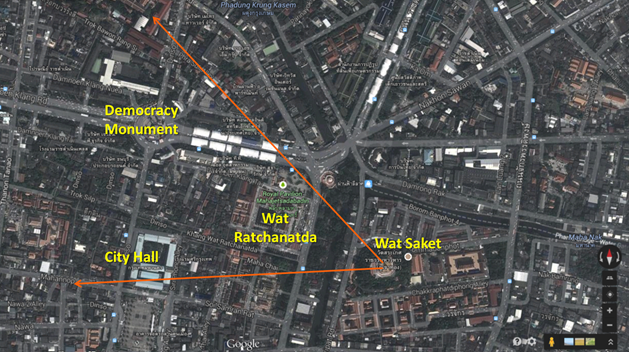
 is also visible). I was only really sure I had it when I found the Google street view showing some matching windows. I remember getting the kids some ice cream along this street after the visit to the Mount – it was stinkin’ hot, as always in Bangkok.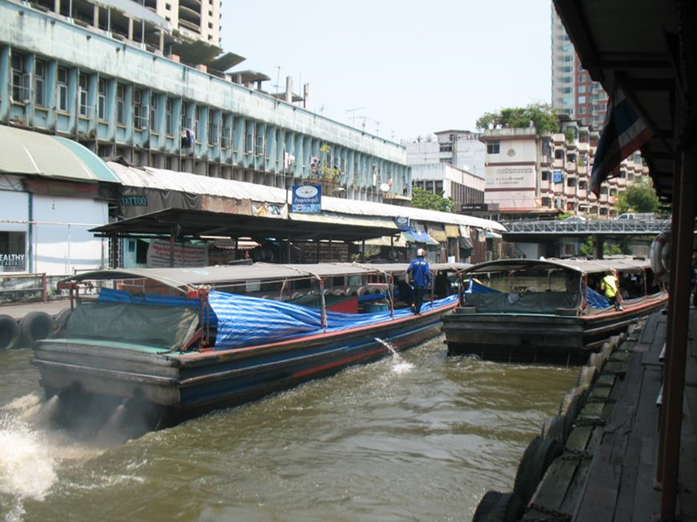




 The Dish