Bringing God On A Date

Tracing the history of Christian matchmaking, Paul Putz ponders the popularity of dating sites like Christian Mingle that help evangelicals find each other:

Evangelical marriages provide a conducive setting for children to accept and remain followers of their parents’ faith. It’s a pressing concern: The religious retention rate for evangelicals has been dropping since the 1990s, according to David Campbell and Robert Putnam in American Grace: How Religion Unites and Divides Us. They also suggest “the most important factor predicting religious retention” is whether or not a person’s family was religiously homogenous and observant. Meanwhile, the rate of interfaith marriage has more than doubled since the 1950s, accounting today for 45 percent of all marriages. That trend, according to [journalist Naomi Schaeffer] Riley, has had the unintended consequence of eroding the strength of some faith traditions, partly because “interfaith families are less likely to raise their children religiously.”

Given the reality of our increasingly online, increasingly digital world, Christian niche dating sites serve as an easily identifiable online companion to more traditional offline means used by evangelicals to find a spouse. They allow evangelicals to adopt the broader cultural turn towards individualism in the selection of romantic partners while still remaining true to conservative evangelical insistence on intrafaith marriage. “We want Christians to marry Christians,” [Sam] Moorcroft said. “We don’t want Christians to marry nominal Christians or nonbelievers at all.” And once their customers are married, Christian dating sites claim to provide help on another account: they supposedly facilitate more compatible matches, which, according to ChristianCafe.com’s Fred Moesker, will help “to decrease divorce rates.”

Back in March, however, Jonathan Merritt questioned just how well these sites reflect “Christian values”:

Christian dating sites are quick to invoke spiritual and even Biblical references in an effort to capture new users, but these marketing ploys are often taken so far out of their original context that they have been emptied of almost any meaning. ChristianMingle, for example, has been airing an ad during the History Channel mini-series, The Bible. Images of kissing and hand-holding flutter across the screen as a male voice sings, “Someday he’ll call her, and she will come running. And fall in his arms, and the tears will fall down, and she’ll pray: I want to fall in love with you.”

At first viewing, the spot is wildly effective. But those who are familiar with the song will note that the “arms” mentioned are God’s and not Prince Charming’s. Titled “Love Song,” the hit tune by Jars of Clay is about God calling us into loving relationship with Himself. But ChristianMingle has given the tune a different meaning in an effort to co-opt its familiar religious language and attract users. One has to wonder why the band would license their song for this purpose.

Worse still, the site’s header invokes Psalm 37:4 over a picture of a swooning couple: “Delight yourself in the Lord, and he will give you the desires of your heart.” The implication is that if you are a good Christian boy or girl, God will give you your dream mate. This transactional view of God is hard to reconcile with a full reading of the Christian scripture, much less personal experience, but it certainly sounds enticing.

Creepy Ad Watch

condomania-02-2014

Alfred Maskeroni captions:

“Preserve the love. Wear a condom.” Sounds like a perfectly acceptable tagline for ads promoting safe sex, right? Well, what if you were literally preserved like a slab of beef? Sounds a bit claustrophobic, no?

Condomania and Ogilvy and Mather Tokyo have binded forces to bring us some of the weirdest prophylactic ads to date. The Japanese artist known as Photographer Hal, who shot the work, finds “interesting couples” in bars and invites them into his studio to photograph them vacuum packed in plastic futon storage bags. … “Human beings aren’t completed if they’re just by themselves,” he says. “It’s when they come together, when they come really close that they’re finally completed. That’s why I pack them together.”

Marble Marbles

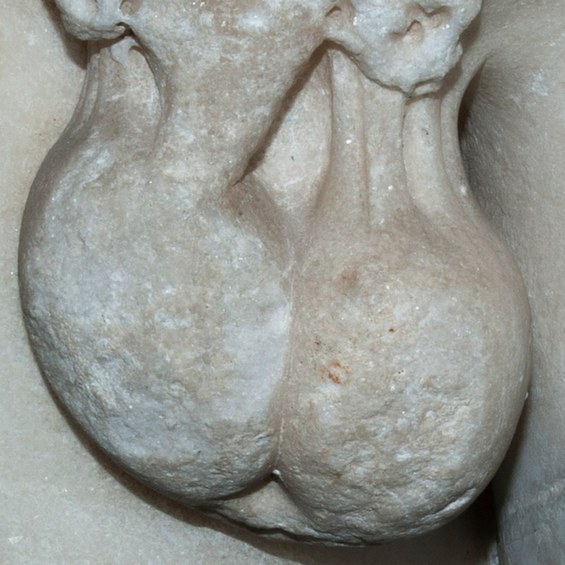
marbles_7

That’s what you’re seeing:

The photographer Ingrid Berthon Moine is taken with testicles, both figuratively and physiologically; turning to the anatomically accurate statues of Classical Greece for her project Marbles, she focuses her lens on representations of the male sex organ. Isolated from the rest of the statues, the male sex organs take on new meanings, their textured curves wrought in stone with masterly precision.

She spoke to Hrag Vartanian about her project:

Hrag Vartanian: What’s your fascination with Ancient testicles?

Ingrid Berthon-Moine: I like to look at men … the way they look at women. There is no better place than a museum to look at perfect bodies (or a stadium during athletics competitions and football matches.) I wanted to go back to the birth of the representation of the human body perfection and it happened during the Classical Greek period when sculptors’ skills drastically increased and they took great care in their attention to anatomical details. I could have worked with the penis but I preferred focusing on these often neglected parts which secrete hormones, make and store sperm.

HV: Did you notice anything you may not have seen before?

IBM: They hang more on the left side which I wasn’t particularly aware of before although I’ve had close encounters on many occasions with the designated parts. Like breasts, they are also victims of gravity and all these details are skillfully reproduced by the Greeks.

See more of Berthon-Moine’s work here. Our own NSFW scrotum coverage here and here.

Do I Sound Gay? Ctd

A NSFW take on the subject:

Another reader illustrates how “sounding gay” can vary across cultures:

I’m an American who lives in Catalonia. I’m as gay as they come but, for professional reasons, I was always “discreet” in the US. I now live as a casually out gay man in Catalonia (where nobody cares) and recently saw myself in a documentary, speaking Catalan. After decades of being mortified by my recorded gay voice, I was astonished at how butch I sounded in Catalan.

Another:

I’m an immigrant from South Asia who learned English from TV and grew up in Queens and central New Jersey. I moved back to the city when I was 18 and during the gentrification (or whatever) of the 2000s, when it seemed as though lots and lots of white dudes from liberal arts colleges around the nation started moving there, my first impression was that they were gay. I quickly realized that most of them were not actually gay, but talked in a way that would get them branded a “faggot” by most of the hood dudes I knew.

Having learned English from newscasters and ’80s action shows, I realized that I probably sounded fairly white and therefore, on that spectrum, not as straight as dudes who talked ’hood. But these guys were halfway between me and the gay men featured in that “Do I Sound Gay?” video. From that view, I guess in hip-hop culture, gayness kind of tracks with whiteness (although that’s changing). Of course that doesn’t hold when you meet a hood guy who is also effeminately gay, but it’s still a widely held view among a lot of people I know and see.

Another broadens the discussion a little more:

This paragraph reminded me of one of the ironies of straight male bullying:

In my youngest years . . .the bullies made me feel like a girl. I wasn’t badly bullied, though I had a few incidents. But the bullies taunting was usually to make other boys feel like girls, to make them feel that the bullies were the real boys and the bullied were the same as girls.

I was bullied incessantly in grammar school, not for being gay, but for being smart.  Until I got someplace (a particular high school, and then university and grad school) where being smart was valued, I shared that insecurity I now know gay and bi men experience.  The irony: a certain breed of homophobic bully uses terms like “pussy” to feminize/insult any target, gay or straight.  I can still recall the moment I turned this on its proverbial head: I was in college, working in a bar, and a local drunk I’d just cut off called me a pussy, in front of several co-workers, male and female.  I just smiled and said “Sure, I’m a pussy: you are what you eat.” This made him look like the loser, and scored me points with my female co-workers.

Another writes, “The whole Do I Sound Gay? thread reminds me of how I became a Dishhead”:

Several years ago – you were still at Time, I think; this was certainly pre-Atlantic – I had seen you on TV. It was Bill Maher or something. The following week, I was at a boring school event. My old friend and co-worker Dan Savage had his kid at the same school as my kids. Dan and I were in the corner chatting about politics. I told him I had seen this gay conservative on TV who I thought was smart. I said, “But Sullivan has the most annoying East-Coast-wannabe-William-F.-Buckley accent I’ve ever heard!” Dan laughed and laughed and told me your accent was because you were ex-pat British and said I should check out your blog. I’ve been hitting refresh several times a day ever since.

Under The Influence

Kim Triedman, a novelist, ponders how writers pick up tricks from their reading. She recounts how taking a poetry class reshaped her work:

[A]fter reading a volume of poetry, I often came to my own work with something new – a rhythm, a tone, some pattern of usage – that hadn’t been part of my writing vocabulary before. Without even realizing it, through some subliminal process of absorption, my words began moving to a new kind of music. And each week, with each new poet I encountered, they were trying out a different dance. It was not conscious imitation; it was like a new way of hearing — of receiving other voices or harmonies and letting them filter down through my own process. Though most of those early poems weren’t altogether successful, each one represented a critical experiment in expression, allowing me to broaden and refine my own distinct poetic repertoire.

It’s an interesting phenomenon, this artistic give-and-take. As writers, we read and are enriched, see possibilities for language – syntax and rhythm, repetition and rhyme and enjambment – where before there were none. At times it is quite conscious: our attention is drawn to a specific mannerism or idiosyncrasy, and – recognizing it as such – we find ourselves playing with it in our own work.  More often, though, the transfer is subterranean: our work is expanded by the simple fact of our exposures, much the way a child’s vocabulary grows simply as a function of reading. The more we hear new things and see them in context, the more they become part of our own subconscious toolkits. It is at least some small part of what binds us together as writers: the ability to find beauty and novelty in other voices and to pass along something unique in our own.

Mental Health Break

Context is key:

These ladies are ADAM, a Dutch electronic dance music band who had a great idea for their latest video: To sing their single Go to Go while using a vibrator, trying to keep a straight face, the pleasure building up until they reached climax. Brilliant concept, perfect execution.

It’s great because this is actually what EDM is all about: To build yourself up into a frenzy and lose control while dancing. You can check their Facebook page here.

Dead Again: The Novel

Will Self is the latest novelist to sound the death knell for his chosen art form, linking its demise to the rise of the Internet:

There is one question alone that you must ask yourself in order to establish whether the serious novel will still retain cultural primacy and centrality in another 20 years. This is the question: if you accept that by then the vast majority of text will be read in digital form on devices linked to the web, do you also believe that those readers will voluntarily choose to disable that connectivity? If your answer to this is no, then the death of the novel is sealed out of your own mouth. …

I believe the serious novel will continue to be written and read, but it will be an art form on a par with easel painting or classical music: confined to a defined social and demographic group, requiring a degree of subsidy, a subject for historical scholarship rather than public discourse. The current resistance of a lot of the literate public to difficulty in the form is only a subconscious response to having a moribund message pushed at them. As a practising novelist, do I feel depressed about this? No, not particularly, except on those occasions when I breathe in too deeply and choke on my own decadence. I’ve no intention of writing fictions in the form of tweets or text messages – nor do I see my future in computer-games design. … [I]t is quite impossible for me to foretell what the new dominant narrative art form will be – if, that is, there is to be one at all.

James McQuade reframes the argument:

While the truth of Self’s proposition is hard to refute—writing this, I’ve checked my Facebook, Gmail and Instagram more times than I’d care to say—I don’t think what’s really at stake is the existence of the “serious” novel (there will always be people crazy enough to write them) but the existence of solitude, or portions of our day spent in profound concentration. It seems to me that human agency is often absent in discussions of how internet access is killing close reading and serious writing. As Self relates:

I switched to writing the first drafts of my fictions on a manual typewriter about a decade ago because of the inception of broadband internet. Even before this, the impulse to check email, buy something you didn’t need, or goggle at images of the unattainable was there—but at least there was the annoying tocsin of dial-up connection to awake you to your time-wasting. With broadband it became seamless: one second you were struggling over a sentence, the next you were buying oven gloves.

I find it strange that Self makes it sound as though he went from wrestling with a rather feisty sentence to placing an order for (probably overpriced) oven mitts without making the choice to do so, as if his life flash cut from the notebook toAmazon’s homepage. When we talk about the future of ‘serious’ reading and writing, the question that needs to be asked is how do we live with the incessant distractions, since the web isn’t leaving us any time soon.

Meanwhile, rolling his eyes at Self’s declaration, Daniel D’Addario collects a century’s worth of writers’ suggestions that the novel is in its death throes. The earliest:

1902: “[Novels] will be supplanted altogether by the daily newspaper… Newspaper writers have learned to color everyday events so well that to read them will give posterity a truer picture than the historic or descriptive novel could do.” –Jules Verne

Face Of The Day

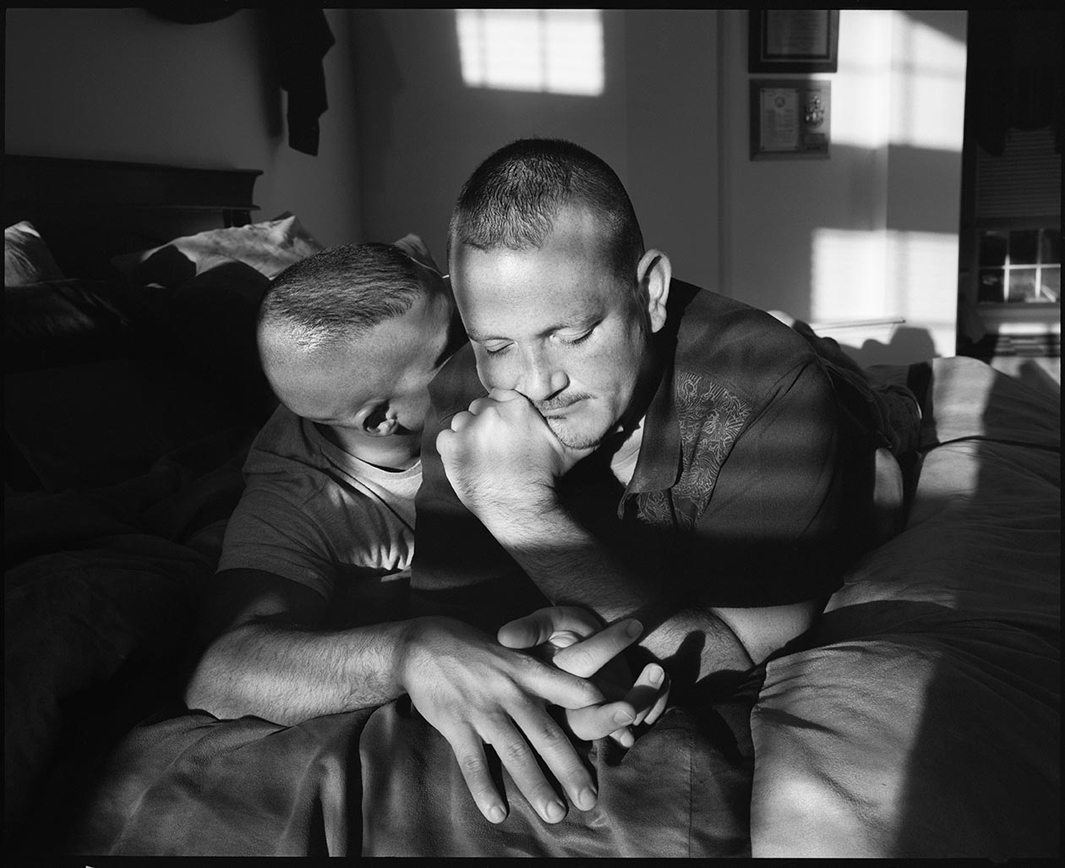
MATT MCCARY, ORANGE PARK, FL, 2011
AIRMAN FIRST CLASS E-3, U.S

Vincent Cianni photographs gays in the military:

In 2009, while listening to a radio interview, photographer Vincent Cianni was moved by the story of a mother whose son was in the Army and had been discharged under “don’t ask, don’t tell.” Although he wasn’t certain how he would create a series around the story, Cianni said the mother’s sense of love and pride prompted him to call her about contacting her son.

That initial call sparked a four-year project that took Cianni around the country interviewing and taking portraits of gay service members. His initial uncertainty about how he would develop the project eventually became a book, Gays in the Military, published by Daylight. Cianni began working on it while DADT was still policy, but the movement to repeal it was at its height, and he continued the project after the policy was lifted in 2011.

See more of Cianni’s work, and information about a book signing, here. Buy the book here.

Updike Upclose, Ctd

Adam Begley’s biography Updike continues to stir debate about its subject’s artistic merits. For the defense, David Baddiel:

He is the great poet of the ordinary life, of domesticity, of life as most people live it – as opposed to Saul Bellow, who writes mainly about life as deep-thinking intellectuals, academics and writers live it (and who was considered, mistakenly, a better writer throughout that time when the “Great Male Narcissists”, in David Foster Wallace’s phrase, ruled the literary cosmos). The problem for gravitas-chasing critics such as [Harold] Bloom and [James] Wood was that Updike writes small – and they mistook this for the size of his talent. “Small” doesn’t really do him justice. A better word would be “microscopic”: using the microscope of his extraordinary prose, Updike reveals and articulates the largest mysteries of life.  …

There is a problem with the way people read novels now, most obvious in Amazon reviews, in which readers consistently confuse whether or not a novel is good with whether or not they “like” the characters. Generally, readers imagine that if they don’t like the characters in a novel, it is a bad book. To make matters worse, whether or not they like the characters is usually based on whether or not the characters behave nicely. All of this is a disaster for literature and particularly for Updike, whose characters never behave nicely or, indeed, evilly – they just behave like people do, in a flawed way. “People are incorrigibly themselves” was his motto in creating his people.

But Jeffrey Meyers writes off Updike’s work, insisting his “prose sometimes seemed as if it had been written on a typewriter by a typewriter”:

Updike’s New Yorker reviews of literature and art were high-grade book reports with very little penetrating analysis, designed to be easily digested by his middle­brow readers. Mary McCarthy and Gore Vidal were more perceptive and amusing critics and, compared to Edmund Wilson and George Steiner, Updike was a dwarf among giants. …

Updike’s long career combined the blandness of the tranquillised 1950s with the narcissism of the Me Generation. In a brilliant, hilarious review in 1998, David Foster Wallace said that Updike’s principal character Rabbit Angstrom is “symptomatic of the prison of self-absorption and egoism that afflicted so many Americans”. He memorably called Updike “just a penis with a thesaurus” and, referring to his enormous output, asked, “Has the son of a bitch ever had one unpublished thought?”

Updike’s novels are not nearly as good as those of Saul Bellow and Vladimir Nabokov and his tame non-fiction does not match the coruscating essays of Norman Mailer and James Baldwin. In the end, for all his cataract of words, Updike not only failed to transcend the superficial and vacuous New Yorker values but also came to embody them.

Previous Dish on Updike here and here.