No Relief For America’s Sickest State

Sarah Varney covers Mississippi’s experience with Obamacare:

“There are wide swaths of Mississippi where the Affordable Care Act is not a reality,” Conner Reeves, who led Obamacare enrollment at the University of Mississippi Medical Center, told me when we met in the state capital of Jackson. Of the nearly 300,000 people who could have gained coverage in Mississippi in the first year of enrollment, just 61,494—some 20 percent—did so. When all was said and done, Mississippi would be the only state in the union where the percentage of uninsured residents has gone up, not down.

Why has the law been such a flop in a state that had so much to gain from it? When I traveled across Mississippi this summer, from Delta towns to the Tennessee border to the Piney Woods to the Gulf Coast, what I found was a series of cascading problems: bumbling errors and misinformation; ignorance and disorganization; a haunting racial divide; and, above all, the unyielding ideological imperative of conservative politics. This, I found, was a story about the Tea Party and its influence over a state Republican Party in transition, where a public feud between Governor Phil Bryant and the elected insurance commissioner forced the state to shut down its own insurance marketplace, even as the Obama administration in Washington refused to step into the fray. By the time the federal government offered the required coverage on its balky HealthCare.gov website, 70 percent of Mississippians confessed they knew almost nothing about it.

Beutler finds it “all the more galling when you recognize that, for the time being at least, Mississippi is actually paying for this outcome”:

For the next couple years, the Medicaid expansion would cost Mississippi $0. … The combined effects of non-expansion are striking. State spending on Medicaid will grow faster next year in states that declined the expansion than in states that accepted it. As Kevin Drum wrote for Mother Jones on Monday, non-expansion states “actually prefer spending more money if the alternative is spending less but helping their own poor with medical coverage.”
The Best Of The Dish Today

Today, I compared the current mid-terms to a “primal moan“. A reader differs:

I see it as a long belch prompted by indigestion, with a bile finish. And it will only get worse with the prospect of Hillary vs. the GOP nut jobs looming on the horizon. I’m 49 years old and I’ve always been highly engaged politically, but I am perilously close to saying “fuck it” and not paying attention anymore. I will always vote but I feel my energy is better spent elsewhere.

I feel his pain and blog through it every day.

Meanwhile, the “catcalling” video remained a Rorschach test for Dish readers; as did the question of “sexual assault” while both parties are drunk. In another fascinating round of responses to our book club discussion of Waking Up, Sam Harris’ scientific Buddhism got knocked around a bit today by actual Buddhists. I rather enjoyed the spectacle. Oh, and this helps.

The most popular post of the day was Catching Catcalls On Camera; followed by A Declaration of War On Francis.

Many of today’s posts were updated with your emails – read them all here.  You can always leave your unfiltered comments at our Facebook page and @sullydish. 22 more readers became subscribers today. You can join them here – and get access to all the readons and Deep Dish – for a little as $1.99 month. Gift subscriptions are available here. Dish t-shirts are for sale here, including the new “Know Dope” shirts, which are detailed here.

See you in the morning.

Prescriptive Measures

Virginia Hughes investigates the purpose of drug warning labels:

Does anyone actually read them?

There doesn’t seem to be a lot of research on that question, though the data that does exist suggests that some patients are more conscientious than I am. One report I stumbled on, surveying 1,500 patients from a community pharmacy in Germany in 2001, found that 80 percent always read the inserts. A 2007 study looked at 200 patients in Israel who were prescribed antibiotics, analgesics or antihypertensives. It found that just over half of participants read the inserts. And a 2009 study in Denmark found that 79 percent of patients “always or often” read them. On the other hand, a 2006 report of American consumers reported that just 23 percent looked at this info.

Even if patients are interested in reading those materials, they might not understand the information.

A 2011 study asked 52 adults with a high-school education or less to read the package insert and similar materials describing an antidepressant medication. Afterwards, less than 20 percent could name the the rare-but-dangerous side effect of the drug. A report from the Institute of Medicine similarly concluded that drug labeling is a big part of why patients often use drugs incorrectly.

Studies like those have led some researchers to propose ways to make labels more useful to patients. But the reason Pfizer was so concerned with the black box warning for Chantix has little to do with consumer behavior. The company was worried because of the warning’s potential influence on doctors and their prescribing habits.

Is $3-A-Gallon Gas Good News?

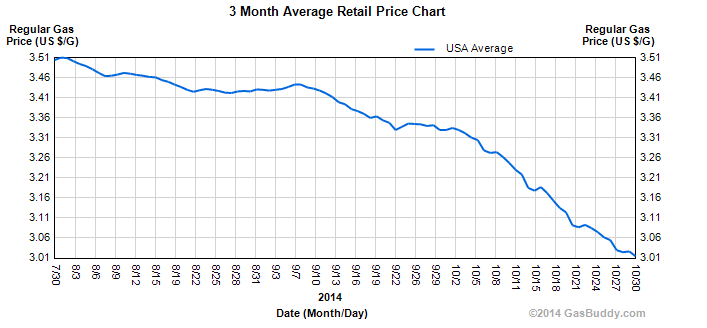
Screen Shot 2014-10-30 at 2.36.45 PM

Mataconis argues that overall, the ongoing decline in oil prices is a boon to the US and other advanced industrial nations:

Falling prices for oil will eventually filter through to the prices of the products derived from oil itself, including not only gasoline but also home heating oil and jet fuel. In the short and medium term, this would provide some relief for consumers and for companies that depend on transportation such as Wal-Mart, Amazon, airlines, and shippers such as UPS and Fed-Ex. If prices continue to fall, those benefits will become more apparent and could help to boost economic growth at least slightly, which would be good news for the jobs market and even tax revenues and the Federal Budget Deficit. Other nations that are oil dependent would likely experience similar benefits, which would be good news for areas like Europe where the economy seems to be slowing down a bit and for the world as a whole, which in turn would be good news for nations that are dependent on international trade, which is pretty much every major industrialized nation at this point.

Derek Thompson, who believes prices might fall even further, points out that some industries and regions will be hurt even as consumers celebrate:

It’s hard to say how the sliding price of gas will affect the United States, as a whole, because the economy is a messy mix of cities, industries, and consumers behaviors, each of which experience falling prices differently. In cities with lots of driving and not much energy production—e.g. throughout California—cheaper gas is simply good, the end. Three-buck gasoline gives back as much as $500 a year to the typical family with two cars, compared to the $4.50 gallons from a few years ago. But mining and energy jobs have been the fastest-growing sector of the labor market, and thinner profits for energy producers will hurt states like North Dakota and New Mexico, who have relied on energy exports to pay for new jobs and higher wages.

Jared Gilmour posits that the falling prices are “threatening to make costly US shale extraction uneconomic”:

Limited pipeline capacity and overproduction of natural gas in the Marcellus shale has pushed prices down, making it hard for producers to turn a profit. Drillers are taking on ever increasing amounts of debt to finance their operations. And there may not be as much shale oil and gas as the US government forecasts, according to a new report from the Post Carbon Institute, a California-based think tank that promotes sustainable energy. “Shale will be robust for the next four or five years, but because of declines at the well-level and field-level, it’s not sustainable in the medium and longer term,” says study author David Hughes in a telephone interview Tuesday. “Policymakers should be aware of that before they try to cash in on a bounty that may not exist ten or fifteen years down the road.”

But industry experts tell the WSJ that prices would have to fall quite a bit farther to endanger the shale industry:

Marianne Kah, chief economist of ConocoPhillips , said oil prices would need to fall to $50 a barrel “to really harm oil production” in U.S. shale basins. She said 80% of the American shale sector—in which ConocoPhillips is a major operator—is profitable at prices between $40 and $80 a barrel for benchmark West Texas Intermediate crude. Jason Bordoff, director of Columbia University’s Center on Global Energy Policy, said he believed prices would have to fall much further to put significant pressure on the U.S. energy boom. “I am not sure if $80 is enough,” he said. “You might need $60 or $65 to really see a stress test.”

(Chart via GasBuddy.com)

What The Midterms Won’t Teach Us

Sabato’s Crystal Ball spells it out:

The 2014 midterm, no matter the outcome, does not hold real predictive value for 2016. We’ve often compared this year with 1986, where Democrats bounced back to capture the Senate on a highly favorable map in President Reagan’s “sixth-year itch” second midterm. Of course, two years later, the country elected a Republican president for the third straight time. Could the current GOP meet with a similar fate? The results next Tuesday certainly won’t tell us.

Alternately, 2014 might prove to be like 2006, a great Democratic year that foreshadowed another great Democratic year. For all the legitimate talk of the Democrats’ growing demographic edge in presidential elections, the advantage could be blunted by an unpopular President Obama, who like then-President George W. Bush could drag down his party in consecutive elections. Obama’s approval rating is very important in the outcome of the next presidential election: If his approval rating continues to stagnate or sinks even lower, his standing will once again imperil Democrats, just as it did in 2010 and 2014. Democrats in and out of Congress will need to find ways to help Obama leave office on a high note, because their fortunes — and that of the Democratic nominee picked to succeed him — will still be linked to his.

Faces Of The Day

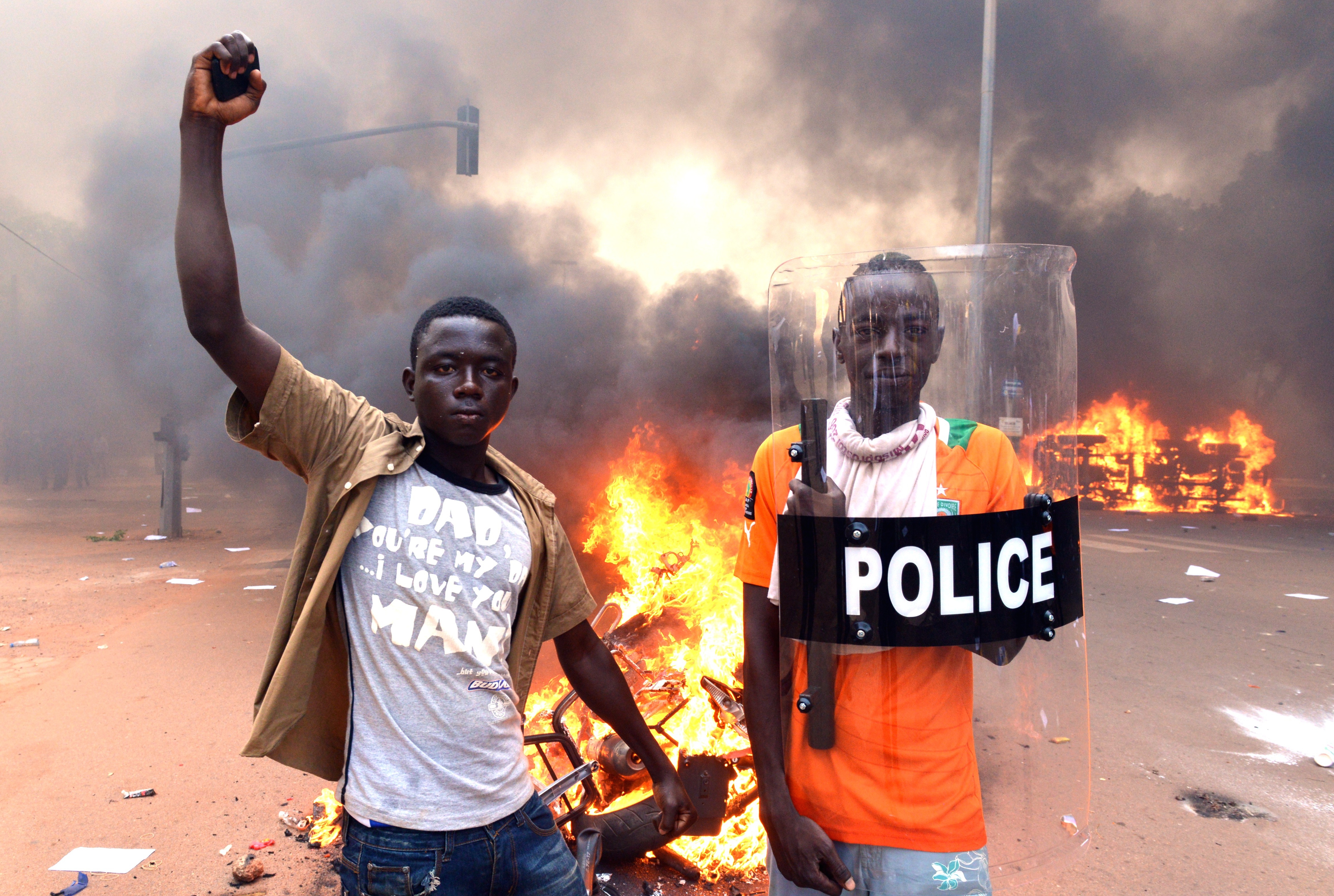
BURKINA-POLITICS-PROTEST-PARLIAMENT

Protesters pose with a police shield outside the parliament in Ouagadougou, Burkina Faso as cars and documents burn outside on October 30, 2014. Hundreds of angry demonstrators stormed parliament before setting it on fire in protest at plans to change the constitution to allow President Blaise Compaore to extend his 27-year rule. Police had fired tear gas on protesters to try to prevent them from moving in on the National Assembly building ahead of a vote on the controversial legislation, but about 1,500 people managed to break through the security cordon and were ransacking parliament. By Issouf Sanogo/AFP/Getty Images.

Change Doesn’t Need A Trigger

A reader writes:

Thanks for the interesting post [“The Complexion Of The Gun Rights Movement“]. It seems to me that in the the success of the civil rights movement owesSupreme Court Hears Arguments On California's Prop 8 And Defense Of Marriage Act almost nothing to the possession of firearms and almost everything to passive resistance and non-violence. Gun rights advocates take it as a fundamental premise that the right to bear arms is somehow essential to protecting our other liberties, but it’s hard to think of a single instance since the Revolutionary War when that has been the case. Personal safety may be protected by firearms. But rights?

If you think of any fundamental right that any American enjoys (including the right to bear arms), that right exists and is protected not because someone shot someone (or threatened to shoot someone), but because someone sued someone, and it is a wonder to me that libertarians and conservatives are not more aware of this. If you go for your gun, you have already lost. If you call a lawyer, you just might change the world.

(Photo of Edie Windsor by Chip Somodevilla/Getty)

How Soon Can You Get An Ebola Shot?

Paul Howard monitors the progress drug companies and government agencies are making:

If Uncle Sam doesn’t shell out the money to help develop and then buy an Ebola vaccine, no one else will. The Defense Threat Reduction Agency (DTRA), the only other major investor in countermeasures for early-stage research, wrapped promising drugs such as ZMAPP in red tape, and seemed more interested in publishing academic papers than in actually helping companies develop products. Not surprisingly, the government is not an effective pharmaceutical company.

Still, nothing focuses the mind of government bureaucrats like a global health crisis unfolding in real time on cable-news networks. The government and private companies are now fast-tracking vaccine-development programs. The National Institute of Allergy and Infectious Diseases at the National Institutes of Health is collaborating on developing Ebola vaccines with GlaxoSmithKline and NewLink Genetics. GSK hopes to get data from early-stage safety testing soon. If the vaccine passes, GSK intends to run a large trial with health-care workers in Ebola-affected countries by early 2015, if not sooner.

Dr. Jesse Goodman, the former chief scientist of the FDA, discusses the inherent challenges in developing a vaccine:

These are complex vaccines that involve a live virus and you always have to have very well-controlled production. Cost is one factor: I think it’s hard to predict, but these are not going to be inexpensive to produce. However, many public health experts have said that if we have a safe and effective vaccine, the cost mustn’t get in the way of it reaching communities.

With all experimental treatments, including vaccines, it’s really important not to make presumptions that they will work. It would really be a shame if we’re not able to learn what works and what doesn’t, for the next outbreak or if this one continues over an even longer period. A vaccine could be a really important tool, but if we don’t have solid studies that show that it works and is safe, I think it would be really problematic just to immunize huge numbers of people with a vaccine we don’t understand.

Meanwhile, Alexandra Sifferlin highlights a major research project at Emory University in pursuit of an effective treatment:

Scientists at Emory’s Children’s Center for Drug Discovery have extensively studied the development of drugs for HIV that stop the replication of the virus in the body. The center provided breakthroughs for HIV drug development and, more recently, the development of a drug for Hepatitis C. The viruses, though different, have similar replicating mechanisms (viral RNA replication), and now they think they can do it for Ebola.

The team, led by director Baek Kim, is fast-tracking a program to screen a library of over 10,000 chemical compounds that can treat viruses at the molecular level to see if one or more of them may show promise with Ebola. “We need to start screening many, many compounds,” says Kim, anywhere from 500 to 10,000 of them—each of which will be evaluated one by one. Emory chemist Raymond F. Schinazi, who discovered compounds used in multiple very successful anti-HIV drugs, will be working with five to 10 virologists, chemists and biochemists to get the job done.

Labour Support Collapses In Scotland

According to a remarkable new survey:

The survey, by Ipsos Mori, found Labour is currently polling at just 23 per cent in Scotland which, if replicated in May, would see the party lose all but four of the 41 MPs it currently has north of the border. Such a result would make it next to impossible for Labour to win an overall majority in Westminster and form a Government after the next election.

Massie calls this “the most astonishing survey of Scottish political opinion in living memory”:

There will be two stories in Scotland next May.

On the one hand Labour will, as always, present the election as a contest between two possible outcomes: Prime Minister Cameron or Prime Minister Miliband. This has traditionally squeezed the SNP vote in Westminster elections and Labour are counting on it doing so again. A vote for the SNP is effectively a vote for David Cameron. If, as you say you do, you hate the Tories you have no choice but to vote for a Labour government. Sure, Labour may be uninspiring but, come on people, focus on the bigger picture.

Quite so, say the Nationalists. The bigger picture is bigger than Miliband vs Cameron. The SNP will argue that only the Nationalists can truly stand up for Scotland. Only the SNP will put Scotland first. The only way to advance Scotland’s interests is to send a large delegation of SNP MPs to Westminster. There they will hold Westminster’s feet to the fire. There they will hold the balance of power and wield their influence for Scotland’s advantage. You need not believe in independence to vote for the SNP. To vote, in effect, for Scotland. Labour’s difficulty, you see, is Scotland’s opportunity. (And a Tory government is better for the SNP than a Labour one.)

The thing about it – the thing that makes this election interesting and also dizzyingly unpredictable  – is that both of these stories, both of these arguments, are true.

Larison zooms out:

There are some lessons that other parties could learn from Labour’s recent travails. The most important lesson is that a party can neglect its core supporters for only so long before they give up and move on to an alternative. Taking support from any constituency or region for granted will eventually come back to haunt the party, and this can happen at the worst possible times. If a party is effectively representing the interests of its voters, it won’t keep suffering mass defections to its competitors.