Where Death For Blasphemy Is The Norm

The staff of Charlie Hebdo were not the only people killed on Wednesday for blaspheming Islam. In Pakistan, 52-year-old Aabid Mehmood, a mentally disturbed man who had served two years in jail for claiming he was a prophet, was kidnapped and murdered – a sadly common occurrence in a country where blasphemy is a capital crime:

Mehmood was spared a death sentence, but he spent more than two years in prison. He was released several months ago because of his medical condition, said Muhammad Ayub, a local police official. On Wednesday, according to Ayub, unknown gunmen took Mehmood from his home and shot him in the head and chest before dumping his body. …

Thirty-eight people in Pakistan are serving life sentences or are on death row after being accused of blasphemy, according to Knox Thames, director of policy and research at the U.S. Commission on International Religious Freedom. Five of them were convicted in 2014, the same year that a high court upheld the death sentence for a Christian woman accused of defaming Muhammad during a 2010 argument with co-workers. For many blasphemy suspects, however, the real death sentence all too often comes at the hands of enraged mobs.

And just today, a liberal blogger in Saudi Arabia was publicly flogged for “insulting Islam”:

Screen Shot 2015-01-10 at 1.32.07 AM[Raif] Badawi, 30, was arrested in June 2012 and charged with offenses ranging from cyber crime to disobeying his father and apostasy, or abandoning his faith. He was sentenced to 10 years in prison, a fine of 1 million Saudi riyals ($266,666) and 1,000 lashes last year after prosecutors challenged an earlier sentence of seven years and 600 lashes as being too lenient. Witnesses said that Badawi was flogged after the weekly Friday prayers near Al-Jafali mosque as a crowd of worshipers looked on.
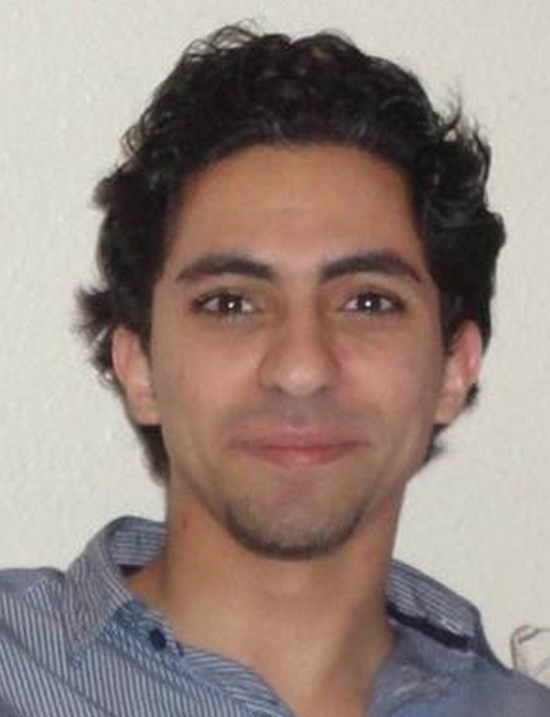

Badawi got off easy, in the sense that Saudi Arabia also considers apostasy a capital crime. So as bad as France’s blasphemy laws are, they’re nothing compared to many in the Muslim world. In the search for some constructive response to the Charlie massacre, Tomasky suggests we focus our ire on the latter laws:

[S]urely at least part of the reason that terrorists think it’s okay to kill people who blaspheme the Prophet is that too many Arab or Muslim states say it’s okay. It would be nice to see a concerted international effort to change these laws grow out of this week’s calamity.

At least Western governments like Ireland and Canada are getting that message:

Blasphemy laws are harshest and most common in the Muslim world, but aren’t exclusive to it. In the wake of Pussy Riot’s church performance, Russia’s parliament passed a new law mandating jail terms for insults to religion. Nearly a quarter of the world’s countries have blasphemy laws on their books, according to Pew, and one out of 10 bans apostasy. The Charlie Hebdo killings have already prompted some Western governments, notably Ireland and Canada, to announce that they will reconsider the blasphemy laws on their books. But in much of the world, governments, not terrorists, will continue to be the biggest threat to freedom of and from religion.

(Image of Badawi via a GlobalPost tweet)

Meanwhile, In Nigeria …

Over the past few days, Boko Haram has massacred hundreds of people in what Amnesty International is calling the deadliest attack in the jihadist group’s history:

Mike Omeri, the government spokesman on the insurgency, said fighting continued Friday for Baga, a town on the border with Chad where insurgents seized a key military base on Jan. 3 and attacked again on Wednesday. “Security forces have responded rapidly, and have deployed significant military assets and conducted airstrikes against militant targets,” Omeri said in a statement. District head Baba Abba Hassan said most victims are children, women and elderly people who could not run fast enough when insurgents drove into Baga, firing rocket-propelled grenades and assault rifles on town residents. … An Amnesty International statement said there are reports the town was razed and as many as 2,000 people killed.

Emphasis added. Aryn Baker provides some background:

The offensive started on Jan. 3 with a daring raid on a multinational military base near Baga that had been established to combat crime in the lawless border region where Nigeria, Niger, Chad and Cameroon meet. It has since been repurposed to address the growing regional threat of Boko Haram, a militant Islamist group that got its start in northeastern Nigeria in 2002 and has used kidnapping—most notably of more than 200 schoolgirls last year—as an effective tactic. The base fell to the militants early Sunday morning, Jan 4, after several hours of intense fighting.

The second assault, which started in Baga itself on Jan. 6, appears to be an attempt by the rebels to assert their authority in an area of divided loyalties, according to Roddy Barclay, senior Africa analyst at Control Risks, a political risk consultancy based in London. “Boko Haram has frequently attacked communities perceived to support the government,” he says. “The use of violence is designed to drive community fear and compliance in order to further Boko Haram’s agenda.”

Jessica Schulberg adds that Boko Haram’s last headline-grabbing atrocity remains unresolved:

Meanwhile, the more than 200 Nigerian girls who were abducted by Boko Haram last year are approaching their ninth month of captivity. The U.S. has contributed hostage negotiators, surveillance drones, and intelligence analysts to the search. In May, Robert Jackson, a State Department specialist on Africa told the Senate Foreign Relations subcommittee, “Resolving this crisis is now one of the highest priorities of the US government.”

Terrence McCoy is at a loss for what to do about this bloodthirsty insurgency:

It’s hard to find contemporary precedent for the delight Boko Haram takes in killing. Even the Islamic State, which has killed thousands and purposely targets minorities, doesn’t seem to be as wanton in its acts of carnage. It appears everyone — Muslim, Christian, Cameroonian, Nigerian — is a target for Boko Haram. … Is there any stopping it? For the time being, it appears not. The administration of Nigerian President Jonathan Goodluck and his military, beset by corruption and ill-equipped, have been unable to match both Boko Haram’s firepower, discipline and fundraising. And now, with Boko Haram’s campaign to control northeast Nigeria complete, analysts said its territorial ambitions have outgrown Nigeria’s porous borders.

A Poem For Friday

5289569464_ea8bfdd2b8_b

Dish poetry editor Alice Quinn – giving us a brief respite from all the mayhem in France right now – builds on this poem and this one from last weekend:

Our last choice (so far!) from the Irish anthology, Lifelines: New and Collected, Letters from Famous People About Their Favourite Poem, is Elizabeth Bishop’s poem “Manners,” chosen by contemporary Irish poet Vona Groarke, who wrote, “It records an age and a state of mind entirely without cynicism: a secure, small world in which no-one can lose his way. The child-like speaking voice is brilliantly achieved with rudimentary, sing-song rhymes which accommodate the jolly generosity and good faith of the child and her grandfather….

Hovering at the edge of its simplicity is something much darker, suggested by the obscured faces of the passengers in the cars: a future in which the values of the child and her grandfather will be as outmoded as their wagon seat; an impersonal, technological world which will have no place for the gentle intimacy of manners. The poem marks the belated transition from the nineteenth to the twentieth centuries, and from innocence to painful experience. Its success lies, I think, in doing so without the slightest trace of either rhetoric or sentiment.”

“Manners” by Elizabeth Bishop (1911-1979):

For a Child of 1918

My grandfather said to me
as we sat on the wagon seat,
‘Be sure to remember to always
speak to everyone you meet.’

We met a stranger on foot.
My grandfather’s whip tapped his hat.
‘Good day, sir. Good day. A fine day.’
And I said it and bowed where I sat.

Then we overtook a boy we knew
with his big pet crow on his shoulder.
‘Always offer everyone a ride;
don’t forget that when you get older,’

my grandfather said. So Willy
climbed up with us, but the crow
gave a ‘Caw!’ and flew off. I was worried.
How would he know where to go?

But he flew a little way at a time
from fence post to fence post, ahead;
and when Willy whistled he answered.
‘A fine bird,’ my grandfather said,

‘and he’s well brought up. See, he answers
nicely when he’s spoken to.
Man or beast, that’s good manners.
Be sure that you both always do.’

When automobiles went by,
the dust hid the people’s faces,
but we shouted ‘Good day! Good day!
Fine day!’ at the top of our voices.

When we came to Hustler Hill,
he said that the mare was tired,
so we all got down and walked,
as our good manners required.

(From Poems by Elizabeth Bishop © 2011 by the Alice H. Methfessel Trust. Publisher’s Note and compilation © 2011 by Farrar, Straus and Giroux. Reprinted by permission of the publisher. Photo by David Prasad)

Nous Sommes Charlie, But Do We Really Want To Be? Ctd

https://twitter.com/RaniaKhalek/statuses/553261940223778818

Update from a reader on the above image:

That cartoon looks bad, but if you understand the French, the meaning seems to me to be actually anti-racist. “La GPA” is “la gestation pour autrui,” or in English “surrogate motherhood.”  The point of the cartoon is that when wealthy white couples pay poor women of color to be their surrogates, they are exploiting them. The point is somewhat bluntly and crudely made, but not at all offensive to my sensibilities. Others may differ, I suppose.

Jordan Weissmann urges us not to be afraid to criticize Charlie Hebdo‘s over-the-top (and often lame) humor even as we stand in solidarity with the victims of Wednesday’s terror attack:

So what should we do? We have to condemn obvious racism as loudly as we defend the right to engage in it. We have to point out when an “edgy” cartoon is just a crappy Islamophobic jab. We shouldn’t pretend that every magazine cover with a picture of Mohammed is a second coming of The Satanic Verses.

Making those distinctions isn’t going to placate the sorts of militants who are already apt to tote a machine gun into a magazine office. But it is a way to show good faith to the rest of a marginalized community, to show that free speech isn’t just about mocking their religion. It’s hard to talk about these things today, when so many families, a country, and a profession are rightfully in mourning. But it’s also necessary.

In Arthur Chu’s viewCharlie often violated satire’s unspoken rule to “punch up, not down”:

I mean, Muslims in France right now aren’t doing so great. The scars of the riots nine years ago are still fresh for many people, Muslims make up 60 to 70 percent of the prison population despite being less than 20 percent of the population overall, and France’s law against “religious symbols in public spaces” is specifically enforced to target Muslim women who choose to wear hijab—ironic considering we’re now touting Charlie Hebdo as a symbol of France’s staunch commitment to civil liberties.

Muslims in France are clearly worse off overall than, say, Jean Sarkozy (the son of former president Nicholas Sarkozy) and his wife Jessica Sebaoun-Darty, but Charlie Hebdo saw fit to apologize for an anti-Semitic caricature of Ms. Sebaoun-Darty and fire longtime cartoonist Siné over the incident while staunchly standing fast on their right to troll Muslims by showing Muhammad naked and bending over—which tells you something about the brand of satire they practice and, when push comes to shove, that they’d rather be aiming downward than upward.

The firing of Siné indeed showed a shameful double standard. Jonathan Laurence’s concern is that the chorus of “je suis Charlie” will play into the hands of the far right and normalize nastiness toward Muslims:

When the shock and sadness recede, it will become apparent that despite hashtags to the contrary, not all French “are Charlie Hebdo.” Numerous Catholic and Muslim groups offended by their cartoonists regularly filed lawsuits for incitement of racial or religious hatred against the newspaper—including after they republished the Danish prophet cartoons. Despite the understandable temptation to enter into a clear-cut opposition of “us versus them,” we can only hope that other political leaders will emerge to urge caution and respect while rejecting the murderers with every fiber of their being. It would be an unfortunate irony, and a distortion of these satirists’ legacy, if “politically incorrect” became the new politically correct.

Dreher asks whether Americans would be so quick to say “je suis” if the victims were from an organization we were more familiar with:

I can’t speak for French sensibilities, obviously, but here in America, it’s easy for us on both the Left and the Right to join the Je suis Charlie mob, because it costs us exactly nothing. Nobody here knows what Charlie Hebdo stands for; all we know is that its staff were the victims of Islamist mass murder, of the sort with which we are all familiar. We know that this murder strikes at one of the basic freedoms we take for granted: freedom of speech, and freedom of the press. Feelings of solidarity with those murdered souls are natural, and even laudable.

But what makes it kitschy is that we love thinking of ourselves standing in solidarity with the brave journalists against the Islamist killers. When the principle of standing up for free speech might cost us something far, far less than our lives, most of us would fold. You didn’t see liberals wearing “I Am Brendan Eich” slogans; many on the Left think he got what he deserved, because blasphemers like him don’t deserve a place in public life. Nor did you see conservatives brandishing “I Am Brendan Eich” slogans, because they feared they might be next.

Hear hear. Beutler, for his part, doesn’t think we need to praise Charlie in order to stand against terrorism:

The massacre in Paris has awakened a liberal tendency to valorize all objects of illiberal enmity. If an Islamist kills a westerner for a particular blasphemy, then the blasphemy itself must be embraced. We saw something similar just last month when countless Americans, rightly aggrieved by the extortion of a U.S.-based movie company, became determined to find reason to praise a satirical film they would’ve otherwise panned. This is clearly not always the correct reaction to terrorism or extortion. Here, liberals can learn a lesson from Second Amendment absolutists who nevertheless condemn open-carry demonstrations in fast food restaurants.

Likewise, Drum objects to the Dish’s framing of decisions by the WaPo and other news outlets not to republish Charlie’s cartoons as “capitulations”:

Anyone who wishes to publish offensive cartoons should be free to do so. Likewise, anyone who wants to reprint the Charlie Hebdo cartoons as a demonstration of solidarity is free to do so. I hardly need to belabor the fact that there are excellent arguments in favor of doing this as a way of showing that we won’t allow terrorists to intimidate us. But that works in the other direction too. If you normally wouldn’t publish cartoons like these because you consider them needlessly offensive, you shouldn’t be intimidated into doing so just because there’s been a terrorist attack. Maintaining your normal policies even in the face of a terrorist attack is not “capitulation.” It’s just the opposite.

But the WaPo is a news organization, and these cartoons are at the heart of the news story of the Western world right now. News outlets can post the Charlie cartoons simply to show what all the fuss is about, without endorsing the images in the slightest. But as Dan Savage rightly asserts, they refuse to do so out of fear – the kind of fear that terrorists thrive on. The Dish, as it happens, has never posted anything from Charlie Hebdo outside the context of Islamists threatening or attacking them, mostly because their satire isn’t terribly good. Several years ago we posted a few cartoons from Carlos LaTuff before discovering that he’s a vile anti-Semite and that many of his cartoons reflect that (though not the two we posted), so we have since refused to feature any of his work. But if LaTuff became part of a news story like Charlie Hebdo has, we would certainly post his offending cartoons – like we did earlier this afternoon. Stephen Carter gets it right:

Many news organizations, in reporting on the Paris attacks, have made the decision not to show the cartoons that evidently motivated the attackers. This choice is sensibly prudent — who wants to wind up on a hit list? — but from the point of view of the terrorist, it furnishes evidence for the rationality of the action itself. Killing can be a useful weapon if it gets the killer more of what he wants. Terror seeks to raise the price of the policy to which terrorists object. In that sense it’s like a tax on a particular activity. In general, more taxes mean less of the activity. If you don’t want people to smoke, you make smoking more expensive. If you don’t want people to mock the Prophet Muhammad, you kill them for it. The logic is ugly and evil, but it’s still logic. …

The terrorist knows what scares us. He believes he also knows what will break us. Our short-run task is to prove rather than assert him wrong. In the long run, however, the only true means of deterrence is the creation of a new history, in which the terrorist is always tracked to his lair, and never gets what he wants.

2014: A Great Year For Jobs

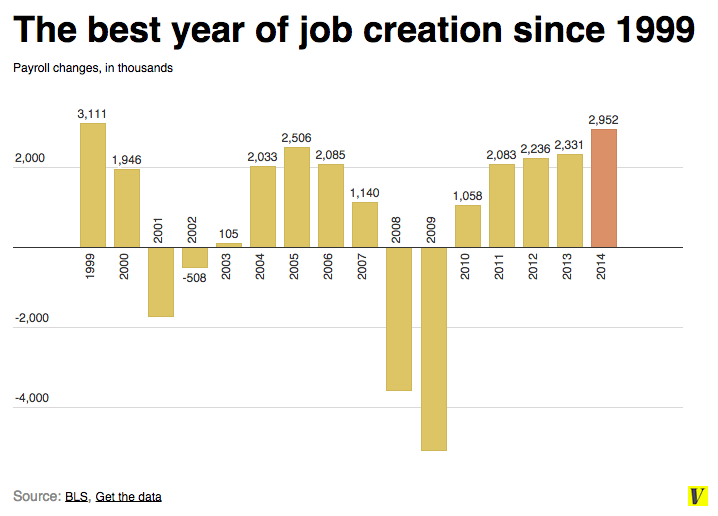
Danielle Kurtzleben illustrates the ones we added last year:

Job Creation

Chait expects this to transform politics:

The recovery is not complete — wages remain stubbornly suppressed — but this fact itself suggests an upside: The absence of higher pay is also the absence of any kind of inflationary pressure that might cause the Federal Reserve to apply the brakes to the recovery. This in turn suggests job growth is not finished. The 2016 elections could well take place against a backdrop of full employment. The entire predicate of the Republican argument since 2009 — that Obama’s massive expansion of spending, taxes, and regulation has snuffed out job creators’ incentive or ability to work their capitalistic magic — will be moot.

In 1996, the recovery was still embryonic enough that Bob Dole could lamely assert that Americans were suffering from “the Clinton crunch.” Four years later, George W. Bush had to acknowledge widespread prosperity, while casting himself as the ideological heir to Clinton’s moderate policies and running on “honor and dignity.” That is the sort of reversal currently under way.

Ben Casselman is more cautious:

It’s possible that the economy is poised for a breakout in 2015 and we just don’t know it. Average wages are a blunt measure, lumping together everyone from CEOs to fast-food workers, so it can be hard to pick up trends bubbling beneath the surface. There are at least a few individual sectors in which earnings are rising faster.

But after five years of dashed expectations, it’s probably wise to stay in a “show me” mind-set. The economy finally showed us job growth in 2014. For wages, though, we’ll have to wait to see what 2015 reveals.

Pethokoukis throws some cold water:

Some analysts think the next 12 months will show a big step-up in GDP and earnings growth, thanks in no small part to the 50% drop in oil prices. Citi just raised its projection for GDP growth by ½ percentage point to a robust 3.6% for 2015. We’ll see. As BTIG strategist Dan Green puts it, “The simple fact is we cannot consider an employment report a success, no matter how healthy the headline may be, if wage data does not begin to accelerate.”

Bloomberg View’s editors speculate that, “to some extent, the decline in global oil prices may be holding U.S. wages down”:

The average wage in mining and logging, a category that includes oil extraction, has fallen at an annualized rate of almost 5 percent during the past three months.

But McArdle sees the low oil prices as a major economic stimulus:

In 2009, economist James Hamilton suggested that most of the GDP loss in the Great Recession could be explained by looking at the very high price of oil that preceded it. A more recent paper from the Fed assigns a lesser role, but still a significant one.  The current confluence of strengthening jobs numbers and falling oil prices may suggest that they are right–not that jobs and GDP will fluctuate month to month along with the price of oil, but that positive and negative price shocks may also produce correspondingly positive and negative effects on our economy.

Neil Irwin digs further into the report:

One mild curiosity in the report is that the size of the labor force actually fell, with 273,000 people no longer either holding a job or looking for one. That may be a statistical aberration, but even over a longer period of time the steep drop in the labor force since 2008 has not reversed itself. It’s partly demographic, with more baby boomers nearing retirement age. But the wage numbers also suggest another reason: When employers are so reluctant to raise pay, it shouldn’t be shocking that more Americans choose to sit at home and remain out of the labor force.

Drum looks at the big picture:

Overall, this jobs report is decent news, but hardly great. Until we start to see steady employment growth and steady wage growth, the labor market still has a lot of slack no matter what the headline unemployment rate is. Given this, in addition to possible headwinds in the rest of the world, the Fed needs to continue to keep interest rates low for quite a while longer. It’s not yet time to tighten.

Who Won’t Republish Charlie’s Cartoons? Ctd

A reader makes a good point:

In general, I completely agree with the notion that the offending cartoons are newsworthy and should be published (I recently changed my Facebook photo to the “kissing a Muslim man” Charlie Hebdo cartoon precisely to make that point). But I do want to call attention to one major difference about out about the various media outlets that Christopher Massie refers to. “Legacy” organizations have journalists working on the ground throughout the world while newer digital outlets generally don’t. I wouldn’t be surprised if the primary factor in the decision not to publish those cartoons was protecting the safety of  reporters and safeguarding their ability to continue reporting from around the globe.

If BuzzFeed and Slate had journalists and photographers on their payroll working in Riyadh, Jakarta, or Damascus, I’m not convinced those organization would be so quick to reprint the offending images. It’s a heck of a lot easier to post a cartoon of a crying Mohammed when you’re in Manhattan than if you’re working for a news bureau in Cairo.

Update from a Dutch reader:

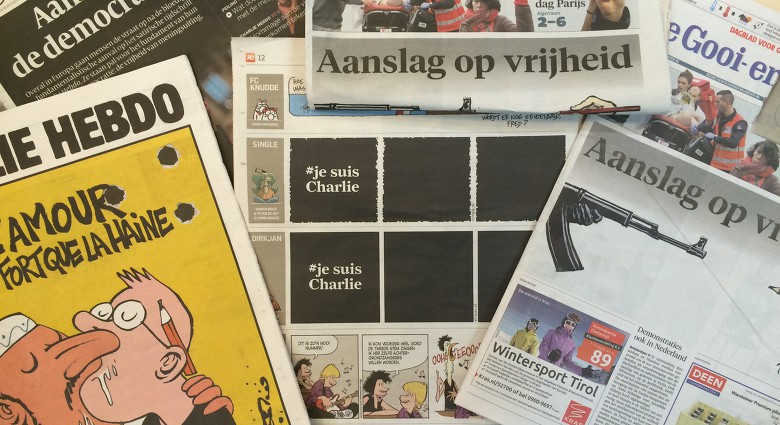
I have to call bullshit on that. Here are some Dutch front-pages from the day after:

dutch

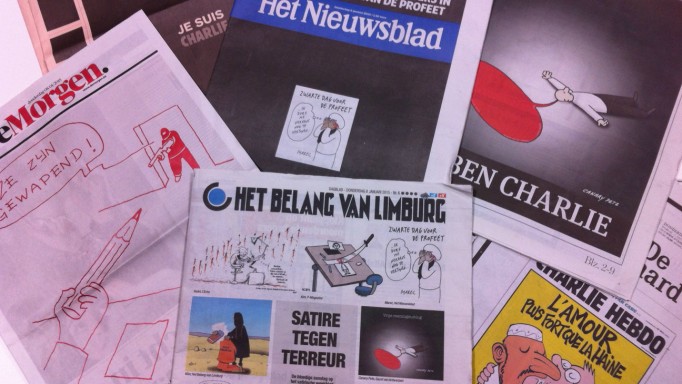
And Flemish front-pages:

flemish

So plenty of Dutch and Flemish newspapers had Charlie cartoons on their front-pages, and all had them inside. And from Germany:

german

And here’s a slideshow of other front-pages from around the world. You think those papers have no international correspondents?

Not publishing insulting religious cartoons is a typical American problem. I read a comment somewhere in the Dutch or Flemish media that suggested that since America is so much more religious than Europe, mockery of religion in general is a no-go area in the US. And that’s true. There is no serious mockery of religion in the US. Bill Maher may be the exception to that rule, and see how much crap he gets for it. The sharpest criticism of religion comes from Stephen Colbert, a devout Catholic himself.

Remember the mess when South Park wanted to show Muhammed in an episode? No-go, said Comedy Central.

Though Matt and Trey were able to get away with this crap-fest in lieu of Muhammed:

Another reader points to a notable exception in the US:

I hate to burst the first reader’s bubble about legacy new orgs, but Bloomberg News has reporters all over the world and in the places the reader mentioned, and it published every one of the “offensive” cartoons. Here’s the main one I’m thinking of, and other images have run with various stories Bloomberg writers have covered on different aspects of what’s going on.

And as we noted earlier, the WaPo did in fact publish a Charlie cover featuring Muhammed, in the opinion section. Money quote from Fred Hiatt:

I think seeing the cover will help readers understand what this is all about.

Precisely.

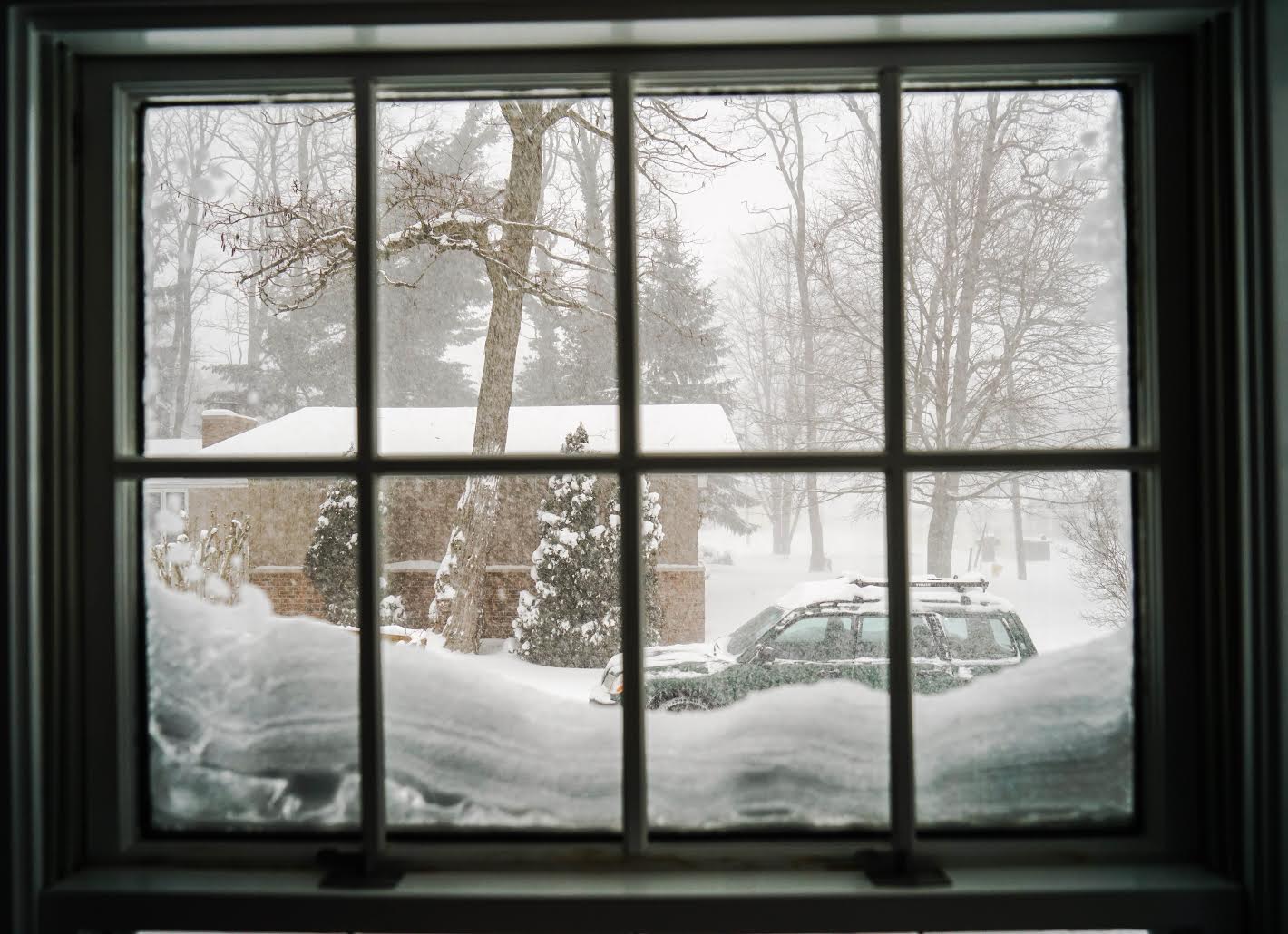
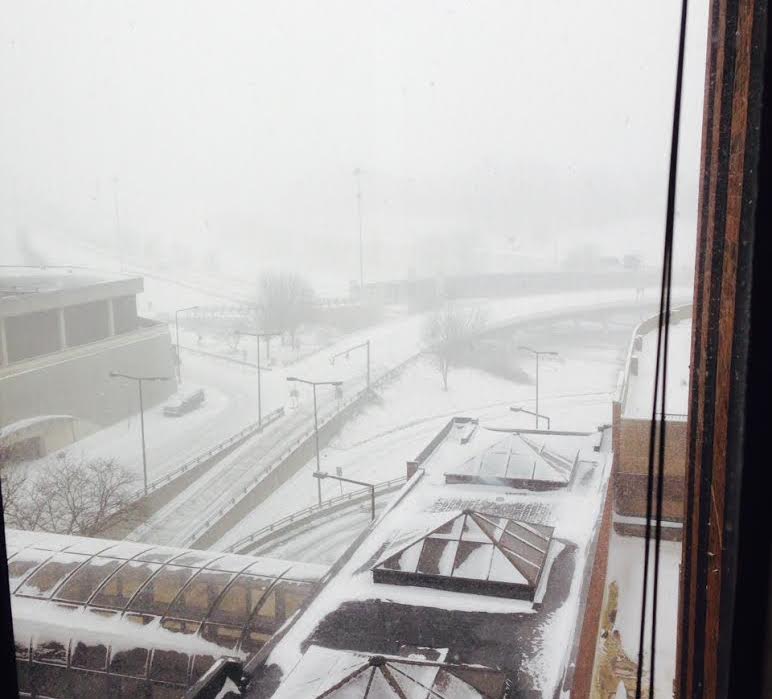
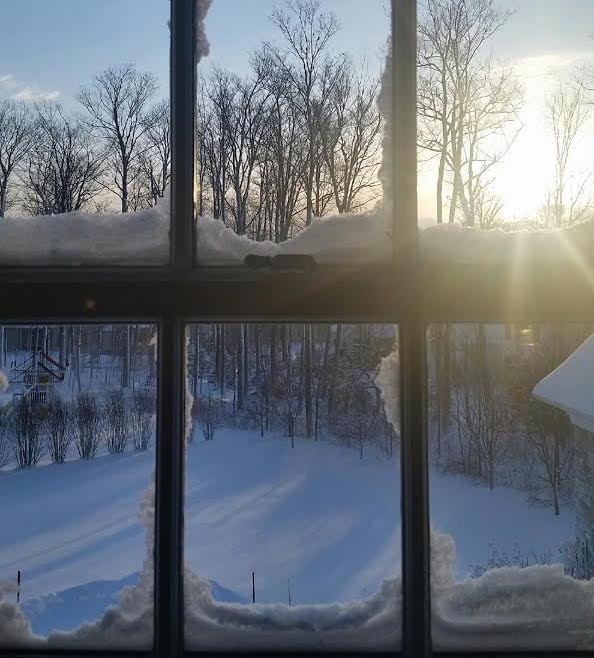
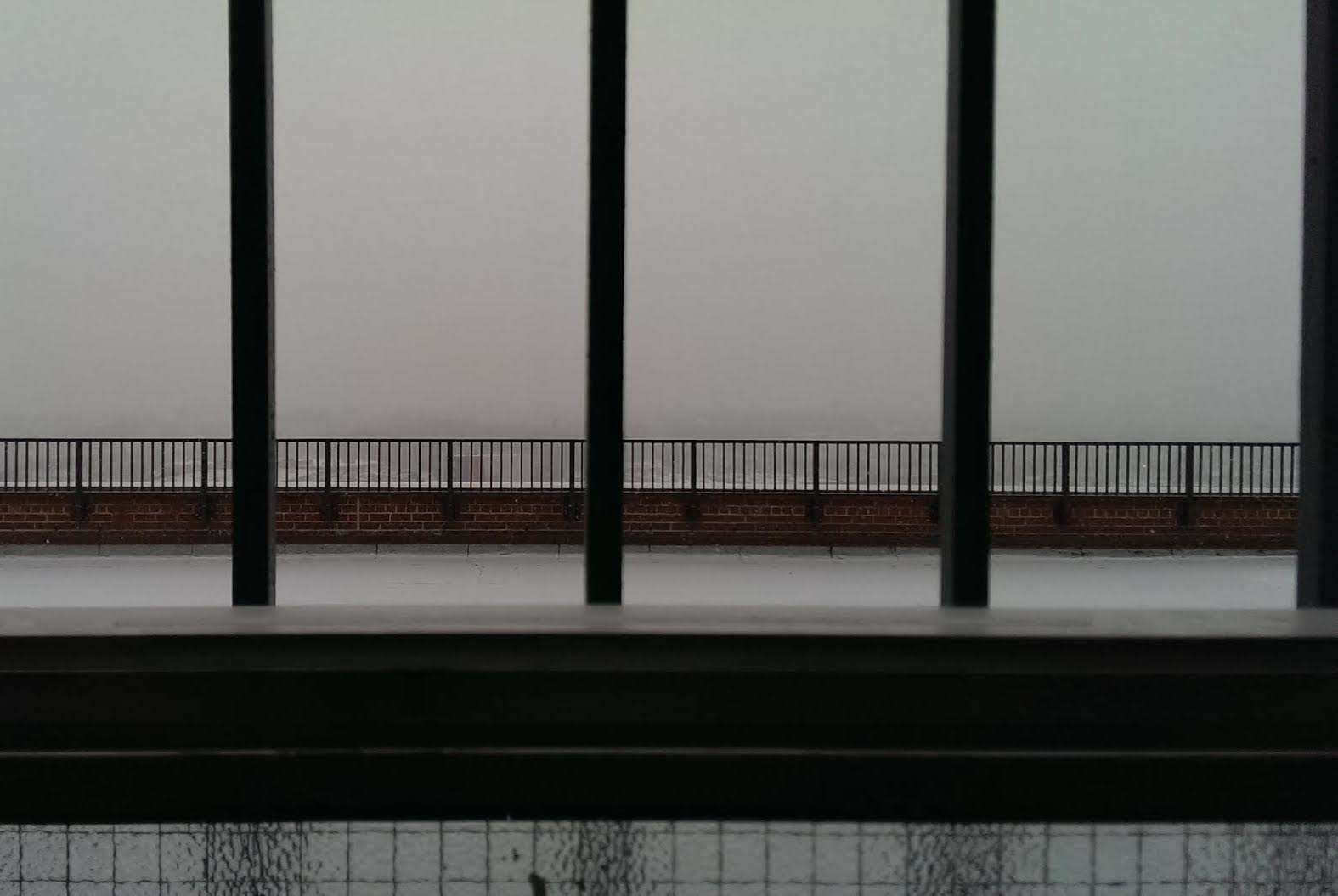
The View From Your Winter Freeze

Winnipeg, Manitoba at 2-50pm

Winnipeg, Manitoba, 2.50 pm.

Many more after the jump:

It's a blizzard in Norton Shores, Michigan.  About 4-45pm

“It’s a blizzard in Norton Shores, Michigan. About 4.45 pm”

Akron-OH-1242pm

Akron, Ohio, 12.42 pm

West Hartford, Ct, 4PM

West Hartford, Connecticut, 4 pm

Providence, RI-957am

Providence, Rhode Island, 9.57 am

buffalo-8am

Clarence, New York, 8 am

Essex Junction, Vermont 12.06 pm

Essex Junction, Vermont, 12.06 pm

Queens-901 AM

Queens, New York, 9.01 am

It's fucking cold today in New Haven, CT. It's pretty, like Siberia is pretty.

“It’s fucking cold today in New Haven, CT. It’s pretty, like Siberia is pretty.”

Update from a reader:

stop-whining

“It’s pretty, like Siberia is pretty.”

*snort*

Memo to the East Coast: Stop whining.

Another retorts:

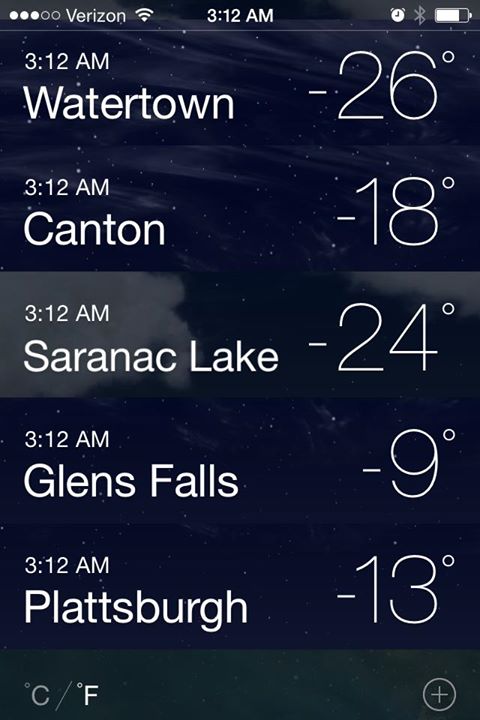
Proud New Yorker here – that would be the state, but not the city – and thus certifiable East Coaster. Am I supposed to be impressed that it’s 4°F in Wisconsin? Dude, yesterday it was -18°F in my hometown, and that was warm for the area:

NCPR-temps

Get a grip, Midwest.

PS — I hope Andrew feels better soon!

What Mike Huckabee Is Selling

Julie Bykowicz read his new book, which will be released later this month:

God, Guns, Grits and Gravy doesn’t get into many policy specifics; some of what Huckabee proposes he dubs “Redneck Remedies.” Like his head-shaking at Miley, his political views are hardly surprising: Obama is bad. Same-sex marriage is a sin. Guns save lives. Government is intended to be as local as possible. The IRS is a criminal enterprise. Climate change is probably hot air.  The “Get Off My Lawn” chapter wraps up with Huckabee boldly asserting that “part of the solution is better citizens obeying the laws we already have so we don’t have to pass new laws to further explain and expand the old ones.” Good luck with that.

David Catanese posts highlights from the book. He notes that Huckabee “devotes an entire chapter to same-sex nuptials, laying out his Biblical-based rationale for his position as well as raising several hypothetical scenarios about the future of the institution of marriage”:

He laments a court system that is forcing businesses to cater to gay weddings, even if violates their own religious beliefs. Given the current trend in judicial and public opinion, he floats the possibility of a future that expands marriage to more than two people.

“Shouldn’t a bisexual be able to have both a male and female spouse? Wouldn’t restricting that person access to both genders be denying the bisexual his or her marriage ‘equality?'”

Huckabee still fears the slide toward marriage equality is devaluing the entire tradition, but he also concedes that the true impact of gay marriage is unknown.

“When advocates of same-sex marriage say, ‘What’s the harm?’ the honest reply is that at this point, we simply don’t have enough reliable accumulated data to be able to say.”

That’s a considerable concession for such an unflinching figure at the helm of the culture war.

Brian Tashman instead concludes that “Huckabee has one message for his fiercely conservative base and a more nuanced message for a wider audience”:

Huckabee, of course, has repeatedly claimed in front of right-wing audiences that he knows exactly what will happen to society if same-sex marriages become legalized: divine punishment.

“There is no doubt in my mind that this country would not exist had it not been for the providential hand of God,” Huckabee said during his speech at the National Organization for Marriage’s June march against marriage equality in Washington D.C. [reordered] “And I’m also convinced that if we reject his hand of blessing, we will feel his hand of judgment.”

Olivia Nuzzi calls the book “an achievement in the genre of poorly written pandering”:

It is “not a recipe book for Southern cuisine, nor a collection of religious devotionals, nor a manual on how to properly load a semiautomatic shotgun.” Instead, “It’s a book about what’s commonly referred to as ‘flyover country.”

Clad in a blue, striped button-down, a silver watch adorning his left wrist, Huckabee beams on the cover. He stands, one assumes on a porch, which overlooks a prairie. “After you finish the book,” he writes, “you might just say, ‘Dang, those good ol’ boys ain’t so dumb after all.

In other Huckabee hucksterism, Andrew Kaczynski catches the candidate’s email list hawking a “secret biblical cancer cure”. Waldman face-palms:

Right now there’s a devout couple in their 80s who just found out that their 55-year-old daughter has cervical cancer. They’re terrified. They’d do anything to help her. And then they get an email from that nice Mike Huckabee, pointing them toward a miracle cure for cancer hidden right there in the Bible. It must be legit, because Mike Huckabee wouldn’t rope them into a scam. So they head right over to the web site, watch the video about the “Matthew 4 protocol” and the “frankincense extract,” then they send away for the free bonus gift of “The Bible’s Healing Code Revealed” which comes with a one-year subscription to Dr. Mark Stengler’s Health Revelations—half price if you’re a senior citizen!—and they whip out that credit card and start ordering all the supplements they can. They tell their daughter, with pain and fear in their voices, that this is what can cure her if only she’ll believe and they keep buying.

These are the people—gullible, afraid, at the most desperate point of their lives—that Mike Huckabee sees as marks just waiting to be scammed.

Les Limites De La Liberté

B60MfNeIgAAnudL-540x272

Judah Grunstein discusses how France’s conception of “free speech” differs from the more robust American version:

Both France and America make the sanctity of free speech a core principle. But at various times over the past 14 years that I have lived here in France, I have been called on by my American friends to “translate” just what the French mean by “free speech.” In particular, they have been perplexed by the willingness to place limits on speech and, relatedly, religious expression here. This first became visible in the context of the law against wearing veils in public schools and government buildings. More recently, it arose when the government banned the one-man show of the ostensible comic Dieudonné, due to offensive jokes about the Holocaust and gas chambers.

Put simply, in France, racist and anti-Semitic speech, as well as historical revisionism regarding the Holocaust, is illegal, as is all speech that can be considered an incitement to hate. That is something that very few Americans understand—or approve of.

Jonathan Laurence notes a crucial caveat to France’s hate-speech protections: they’re not extended to Muslims:

The last lawsuit to be filed against Charlie Hebdo in 2014 was declared ineligible only because Islam doesn’t qualify for the special legal regime that criminalizes blasphemy against Christianity and Judaism in the Alsace region. And the British Muslims in 1989 wanted authorities to invoke British blaspehemy laws, not the shar’ia, to sanction Salman Rushdie’s novel – but there too Islam did not qualify for protection.

Greenwald calls out hypocrisy among those defending Charlie Hebdo on the basis of free speech, and passes along some cartoons – of which the one above is the least offensive – that he suspects we would not be so quick to defend:

[I]t’s the opposite of surprising to see large numbers of westerners celebrating anti-Muslim jews_image081-540x702cartoons – not on free speech grounds but due to approval of the content. Defending free speech is always easy when you like the content of the ideas being targeted, or aren’t part of (or actively dislike) the group being maligned.

Indeed, it is self-evident that if a writer who specialized in overtly anti-black or anti-Semitic screeds had been murdered for their ideas, there would be no widespread calls to republish their trash in “solidarity” with their free speech rights. In fact, Douthat, Chait and Yglesias all took pains to expressly note that they were only calling for publication of such offensive ideas in the limited case where violence is threatened or perpetrated in response (by which they meant in practice, so far as I can tell: anti-Islam speech).

The Dish, of course, is an equal opportunity republisher of trash, as long as it’s relevant and newsworthy. In a sharp post, Sullum argues that France’s hate speech laws indirectly enabled Wednesday’s violence:

I am not saying yesterday’s massacre can be blamed on France’s hate speech laws. Although at least two of the perpetrators were born and raised in France, there is no evidence that they cared about the content of these statutes or that they needed any additional justification beyond their own understanding of Islam. But it is hypocritical and reckless for a government that claims to respect freedom of the press to criminalize images and words based on their emotional impact. Although such laws are defended in the name of diversity and tolerance, it is the opposite of enlightened to invite legal complaints aimed at suppressing offensive messages.

Instead of facilitating censorship by the sensitive, a government truly committed to open debate and freedom of speech would make it clear, in no uncertain terms, that offending Muslims (or any other religious group) is not a crime. Sacrilege may upset people, but it does not violate their rights. By abandoning that distinction, avowed defenders of Enlightenment values capitulate to the forces of darkness.

On the other hand, as Luke O’Neil notes, there’s plenty of free speech hypocrisy to be found right here in the USA:

[T]he self-professed most patriotic citizens in this country harp on our military’s presence in countries like Afghanistan and Iraq, insisting that, if not for these brave soldiers, the very foundation of our culture—our speech freedoms—would collapse overnight. Yet those who question the unwavering justness of any action by the American military are often invited to shut their mouths, or given directions to the nearest port of exit. It wasn’t that long ago that entertainers like the Dixie Chicks were being roundly denounced and taken off the air for having the temerity to question our country’s wars.

Nick Gillespie is sad to say that he “will not be surprised if the Charlie Hebdo massacre has the effect of increasing support for hate-speech laws in the United States “:

Many Americans who don’t particularly care about freedom of speech may look on the carnage and conclude it makes sense to avoid such scenes by stifling expression. Social Justice Warrior types will take another long look at Jeremy Waldron’s 2012 book, The Harm in Hate Speech, and gussy up their interest in controlling thought and social interactions with philosophical language and social-scientific “rigor.” Conservatives, sniffing out a possible way to screw liberals and libertarians, may rediscover The Weekly Standard’s case for censorship and decide, hell, it makes a lot of sense. Aren’t Christians the folks who are picked on in America and treated unfairly by the media and intellectuals? It’s always “Piss Christ” and never “Piss Mohammed,” right?

Which makes it more important not simply to show solidarity with the dead and wounded in France but to rehearse the arguments for unfettered trade in ideas and speech.

Update from a reader, who remarks on the cartoon seen at the top of the post, created by the anti-Semitic Carlos LaTuff:

This is a completely false equivalency, and really gets to the heart of the cultural gap at play. To secularists like the cartoonists at Charlie Hebdo, Mohammed is a man like any other, he is no prophet, he is aggrandized by a religion, and is therefore a legitimate target of satire, just like the the Pope, or Jesus, or even the Dalai Lama if one is so inclined. The Holocaust was systematic genocide based on religion/ethnicity. I’m not saying that jokes against the Holocaust should be off limits, there should be no limits.

A better choice would be a “Cartoons of Jesus, or Moses, or John the Baptist” in the place of the “Cartoons of Holocaust.” (If you did, you would be as likely to find the Westerner laughing at both. Unless it is Bill Donahue, who is incapable of laughter.) You simply cannot equate the murder of millions to making fun of a religious figure. One is a group of real human beings. The other is an idealized version of a person who claimed God spoke to him in a cave.

The reason for drawing Mohammed is less about a specific set of religious beliefs, it is about, (forgive me), forbidden fruit. Don’t tell me not to take a taste of that apple, or draw that picture. There is something wonderfully defiant in the human spirit when told we cannot have, or do something. I’m grateful to the cartoonists who were killed for having that spirit, and expressing it.