“A Comparison To Jackie Robinson Is Not Entirely Inappropriate”

Readers sound off on the coming out of Michael Sam:

It is also encouraging that he plays in the SEC – basically the Bible Belt conference. An African-American NFL prospect came out to his teammate in a conference that runs through some of the most conservative parts of the country. An inconceivable idea not that long ago.

Another:

He came out before the draft. He knew this would possibly negatively impact his chances of being a top draft pick, and he still came out. There are already anonymous NFL sources saying it will negatively impact his draft chances. How “brave” of the NFL sources to remain anonymous as they predict his chances.

Another:

I moonlight as a college football writer, so I feel I can contribute on the Michael Sam coming out party. First, I think the acceptance by his Mizzou teammates speaks volumes.

You will sadly find NFL execs who say “the players’ culture isn’t ready for a gay teammate.”  This is such obvious bullshit, and reflects the homophobia of the execs themselves.  They tend to be older white men who rose up through the culture of homophobia that is the NFL.

Michael Sam is a fine football player, but as an NFL prospect, there are some question marks.  Sam is a defensive lineman who weighs in at 260, very small by NFL D-line standards.  Sam is also not quite nimble enough to move to linebacker.  He is what is known as a tweener.

What Michael Sam has is tenacity and intelligence.  In short, he is a bulldog on the field, but also has clearly responded to coaching and knows how to position himself to make plays.  Guys like him get overlooked and devalued in the NFL draft every year.  Before coming out, Sam was projected as a third round draft pick.

The question is, what happens now?  If Sam drops below the fourth round, I smell a rat.  Unless his pre-draft combine workout is abysmal, which is highly unlikely, Sam’s stock should remain what it was before coming out. That is, unless the team execs decide they don’t want a “distraction.”  If this is the case, and Sam falls to the late rounds, it is a very sad indictment of just how off mainstream thinking the NFL is on this issue.  The NFL is a win-at-all-costs and win-now league.  For execs to pass on the SEC Defensive Player of the Year simply because he is gay would show the just how deep their bigotry runs.

NFL locker rooms are full of hypocrites – guys who blather on about Jesus during the day and meet their mistresses at night.  What will be infuriating is the constant talk of the “sin” of homosexuality. Wherever he ends up, Michael Sam is going to have to deal with some pretty ignorant nonsense being spewed his way.

I know he would be accepted here in Detroit.  This town wants a winner so badly, so Sam would be judged solely by his play on the field.  If the other teams are foolish enough to pass on him, hopefully the Lions pick him up.

A comparison to Jackie Robinson is not entirely inappropriate.  From what I know about Sam, he has the character to withstand the ignorance, and the dignity to make them look like the fools that they are.  I wish him nothing but the best and will be rooting for him wherever he ends up.

And so will we. Update from a few readers, who take the rare opportunity on the Dish to talk sports:

I wanted to comment on the college football writer, who seems to get a lot of the facts right, and then somehow came to an entirely wrong conclusion. He says that “Guys like him get overlooked and devalued in the NFL draft every year”. I’d argue the other way, that college fans tend to overrate tweeners. But either way, NFL teams don’t tend to like tweeners. As your reader says, he is too small to be a traditional 4-3 DE. In other words, about 2/3 of NFL teams aren’t going to want him since he doesn’t fit their defensive system. For the other 1/3 teams he has the right body type, but would need to move from DE to outside linebacker, something your reader questions whether he’s fast enough to do. And the one game where he did play linebacker he didn’t look good.

After acknowledging all that, your reader claims, “Unless his pre-draft combine workout is abysmal, which is highly unlikely, Sam’s stock should remain what it was before coming out.” It’s exactly the opposite. He needs to impress at the combine, an average performance will almost certainly drop him. Now that the professional NFL teams are going to be able to work him out, as opposed to amateurs and judging him by his playing against inferior competition where his body type isn’t a liability, he is exactly the type of player who tends to drop on draft boards unless he impresses at the workout. Otherwise, just like your reader said, NFL teams will “devalue” him because that’s what they always do to tweeners. He is the classic example of a guy who “falls” from where the amateurs think he should go. And even if a team does like him, say in the 3rd round, since they know he doesn’t fit most team’s defenses, they might grab someone who is rated roughly at the same level as him since there’s a good chance he will be available later and the other player won’t.

I wish him all the luck in the world, but I’m worried to see how many places I’ve seen him mentioned as a 3rd round talent. People who don’t follow the NFL will think that any fall from that position will be because of his coming out, and it’s just not true. Mid-level prospects like him can go up 1-2 rounds by impressing teams, and drop 3-4 rounds by not. And dropping is a lot easier. Any projection of where he should be drafted that is made before the combine is not likely to be a fair evaluation of his potential as an NFL player, and people shouldn’t assume if he falls below the 4th round it’s because of him coming out.

Another:

I just wanted to chime in with an observation regarding Michael Sam’s commendable announcement: I’m assuming that some of the anonymous responses are in the vein of anonymous front-office commentary in the lead-up to every draft. Executives and agents engage in a complicated annual drama, with the former trying to obscure their interest in players and even deflate their draft value, while the latter try to elevate the draft position of their clients.  From the executive’s position, it’s a coup to draft a third round talent in later rounds: They’re balancing drafting early enough to get the player, but otherwise as late as possible to maximize their return on early picks. It’s a deeply cynical calculation until the picks are in.
A Conversation With Masha Gessen

gessen-featured-img

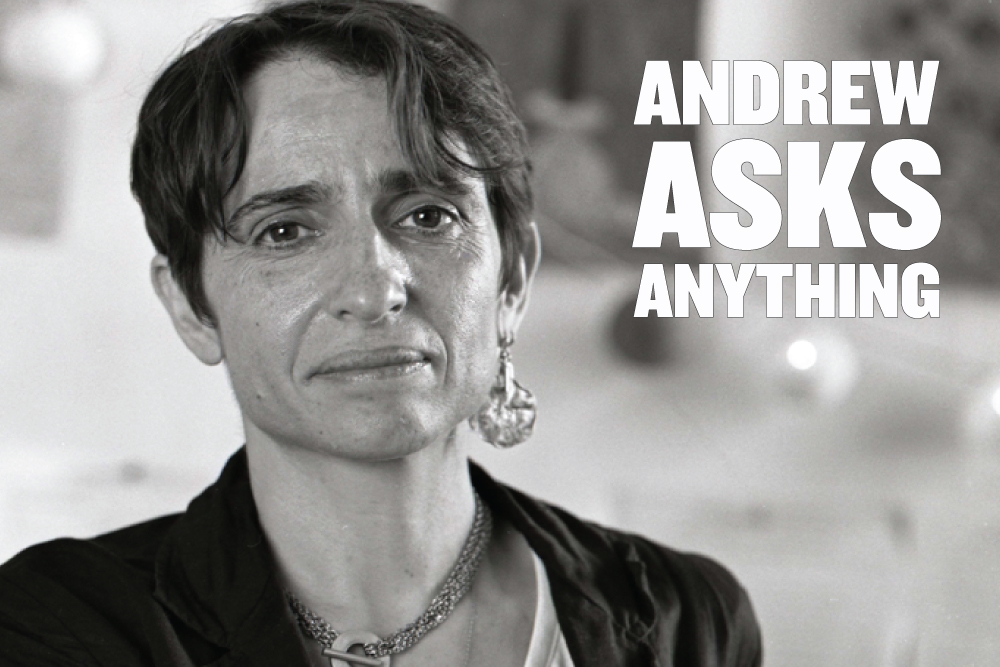
For our latest Deep Dish podcast, I sat down and chatted with Masha Gessen, whose work I’ve read, admired and even edited over the years.  Masha’s books include The Man Without a Face: The Unlikely Rise of Vladimir Putin and, most recently, Words Will Break Cement: The Passion of Pussy Riot. Our politics are somewhat different, but it’s impossible not to admire her long coverage of Russia, where she was born and grew up, where she immigrated again as an adult, and whence she and her family are now emigrating back to the U.S.

One of the things that has been nagging at me about the clash between Russia and the West over gay dignity and equality is whether we may be projecting too much of our own views onto a culture that simply hasn’t yet had to time to evolve as we have. Could our good intentions be actually making life worse for gay Russians, rather than better? Should we not be a little more circumspect in lambasting Russia when America was not far off where Russia is only a couple of decades ago? I mean: many states have laws banning marriage equality in their very constitutions. Is our high horse a little too high right now?

Well, I certainly aired these worries and Masha definitely pushed back:

 
Listen to the whole conversation – about Russia, homosexuality, the Olympics, and more practical and effective ways to help Russia’s beleaguered gay population. You can read Masha’s work  as featured in the past on the Dish here.

If The GOP Takes The Senate

Scott Galupo tries to look on the bright side:

Things may actually improve slightly under a unified GOP Congress. Look at it this way: if Republicans win the Senate, their next prize, obviously, will be the White House. That’s a different ballgame altogether—a bigger, browner electorate. Suddenly the imperative to obstruct the Obama agenda begins to recede. A different incentive structure will take shape: the party will have to govern, or at least appear as though it’s trying.

“A Man’s-Man Game”

Missouri v Mississippi

Marc Tracy eagerly awaits the draft, which is in May:

A comparison to Jason Collins, the National Basketball Association player who came out last spring, is instructive … Collins came out at age 34 and near or at the conclusion of his career as a professional athlete, having made a living playing ball for 12 years. Sam came out at age 24 and the very beginning of his career, with all of his earning years ahead of him. Especially given where they respectively are, Sam is simply better, and therefore risking more.

Sports Illustrated lets anonymous NFL insiders sound off:

“I don’t think football is ready for [an openly gay player] just yet,” said an NFL player personnel assistant. “In the coming decade or two, it’s going to be acceptable, but at this point in time it’s still a man’s-man game. To call somebody a [gay slur] is still so commonplace. It’d chemically imbalance an NFL locker room and meeting room.”

All the NFL personnel members interviewed believed that Sam’s announcement will cause him to drop in the draft. He was projected between the third and seventh rounds prior to the announcement. The question is: How far will he fall?

“I just know with this going on this is going to drop him down,” said a veteran NFL scout. “There’s no question about it. It’s human nature. Do you want to be the team to quote-unquote ‘break that barrier?'”

A “man’s-man game.” What’s interesting to me is how that assessment of football is used to exclude homosexuals!

But that’s simply a function of ignorance. That formulation equates homosexuality with femininity, but it’s a much more complicated and diverse phenomenon than that. There are, it seems to me, many homosexualities – across the entire male-female spectrum, with many different routes to adulthood. Yes there are many gays who identify with women and the company of women. But there are also many who identify with men and the company of men (and along the entire spectrum in between). There are hyper-masculine gays as well as hyper-feminine ones and everything in between. (There’s also, I’d argue, more muted diversity along these lines among straight men as well.)

What we’ve been witnessing these last couple of decades, as the stigma against gayness has abated, is the emergence of more and more gay men who could have passed for straight and remained closeted or even married to a woman in days gone by. These gay men are often invisible both to gay insiders who revere and enjoy more traditional manifestations of gayness and to straight people who simply assume that more traditionally masculine-type men are never gay. But these gay men exist, are out in increasing numbers, and deserve just as much dignity and acceptance as anyone else. What Sam’s honesty has done is help explode crude and overly-narrow assumptions about gay men – particularly among sports-fans and African-Americans. And yes, I think his race is important. The stereotypes about gay men as intrinsically feminine are deeply embedded in African-American culture. If black gay men are to have the future they deserve, the stereotypes need to end. Michael Sam just opened up a whole new arena for mutual understanding and human dignity.

Ian Crouch also pushes back against the SI piece:

[I]t is deeply unfair and disingenuous of N.F.L. personnel to somehow suggest that Michael Sam has made himself into a distraction by coming out. Rumors about his sexual orientation were reportedly already being passed around by teams. And, last year, the word leaked that, before the draft, teams were asking prospective players questions like “Do you have a girlfriend?” and “Do you like girls?” Sam hasn’t made his sexual orientation a so-called “issue,” he simply took control of his story before the N.F.L. could.

Tyler Lopez expects Sam to make the team that drafts him a lot of money:

Contrary to the age-old “gays hate sports” stereotype, the LGBTQ community is currently embracing sports. And it’s not just the homoerotic spectacle of uniformed men grinding it out on the gridiron. The gay sports world has never been more profitable. … Mike Sam will unite legions of gay sports fans behind one player like never before. (David Beckham doesn’t count.) Aside from bringing more LGBTQ fans to stadiums across the country, Sam’s drafting will signal a sea change for fans who previously feared the testosterone-laden beer pits of the past. While some homophobic fans will avoid your merchandise, Sam won’t be the only player to come out in the next few years. But he will always be the first.

TNC zooms out:

When black soldiers joined the Union Army they were not merely confronting prejudice—they were pushing the boundaries of manhood. And when the Night Witches flew over German lines, they were confronting something more—the boundaries of humanity itself. Groups define themselves by what they are and what they are not: Niggers are never men, ladies are never soldiers, and faggots don’t play football. When Michael Sam steps on a football field, he likely will not merely be playing for his career but, in some sense, for his people.

In that sense he will be challenging a deep and discrepant mythology of who is capable of inflicting violence and who isn’t.

(Photo: Michael Sam #52 of the Missouri Tigers participates in pregame activities prior to a game against the Ole Miss Rebels at Vaught-Hemingway Stadium on November 23, 2013 in Oxford, Mississippi. Missouri defeated Ole Miss 24-10. By Stacy Revere/Getty Images.)

Will The Government Go After Greenwald?

Glenn will return to America, despite the risk:

Greenwald believes he and his reporting partner Laura Poitras face unique threats for four reasons.

1) Greenwald and Poitras went to Hong Kong to meet with Snowden and discuss the documents, “for almost two weeks — six days before the first story came out and every day after that until he went into hiding.”

2) They were in contact with Snowden, and perhaps under surveillance themselves, at the time that he went into hiding and have remained in very regular contact with him since then.

3) Greenwald has paired his reporting with forceful advocacy: “vehemently condemning the U.S. government, defending Snowden.”

4) Unlike U.S.-based reporters, he and Poitras have been freelancing stories at publications all around the world.

“Everybody I’ve talked to, including experienced lawyers — nobody has said ‘this is crazy,’” Greenwald added, stipulating that he doubts he’d actually be charged with anything — less than 50 percent chance of that in his mind. Nevertheless, “Everybody recognizes that there’s some risk.”

It’s great to see the new site, Intercept, launch. It’s simple, well-organized and the lead story is fascinating. It reveals how electronic data – and electronic data alone – have been integral in the targeting of drone strikes. Money quote:

The NSA often locates drone targets by analyzing the activity of a SIM card, rather than the actual content of the calls. Based on his experience, this former drone operator has come to believe that the drone program amounts to little more than death by unreliable metadata. “People get hung up that there’s a targeted list of people,” he says. “It’s really like we’re targeting a cell phone. We’re not going after people – we’re going after their phones, in the hopes that the person on the other end of that missile is the bad guy.”

For me, this is an important piece of information, because it shifts the morality of such acts. I disagree with Glenn on this question in principle, since I believe it is morally defensible to target terrorists actively attempting to launch attacks – but only if innocent life is spared as far as is humanly possible, and the intelligence is rock-solid. But if you’re targeting drone strikes by SIM cards, all of that goes distinctly wobbly. As the piece notes:

Some top Taliban leaders, knowing of the NSA’s targeting method, have purposely and randomly distributed SIM cards among their units in order to elude their trackers. “They would do things like go to meetings, take all their SIM cards out, put them in a bag, mix them up, and everybody gets a different SIM card when they leave,” the former drone operator says. “That’s how they confuse us.” As a result, even when the agency correctly identifies and targets a SIM card belonging to a terror suspect, the phone may actually be carried by someone else, who is then killed in a strike.

From this launch, I’d say the rationale for a super-blog like the Intercept is solid. It’s particularly smart to revive Glenn’s blog.

I miss it – even though he really can go on at times – because it bristles with his energy, fanaticism, mastery of the hyper-link, and gob-smacking attention to detail. Starting a general site without that critical personal touch would not have had the same alchemy – and I suspect Glenn is best suited to pursuing his passion than in managing a newsroom. Poitras, Scahill and Wheeler are also, to my mind, all superb at what they do, whatever Screen Shot 2014-02-10 at 12.17.58 PMyour view of their respective politics.

My one reservation is that the site inherently leverages vital public information – the NSA docs – to help fund and launch a website. If your sole goal is to responsibly air the documents you have, then you simply release them (with rigorous redactions) as soon as possibe and let the web do its best. You don’t withhold them, threaten to embarrass governments with them, and then reveal them in stages, while launching a new website based on their news-worthiness. And if you do, you’re running the risk of appearing too much like the NSA itself. You’re withholding critical information from the public and releasing it in a way that benefits you financially. That’s not exactly entirely public interest journalism.

Of course, that’s true of most newspapers, which already have an economic interest in securing and publishing vital public information. But it gets a bit more troublesome when you are launching a website originally devoted primarily to disseminating the information in those docs. Still, if it means more accessible and clear stories about those very docs, it can be justified. And today’s lead story does just that. If more arrive that are as well-done as that one, three cheers for Glenn.

America And The Protestant Work Ethic, Ctd

Matt Steinglass is unfazed by the idea that Obamacare will enable some Americans to work less:

Americans work more hours per person than citizens of almost any other wealthy nation. If America suffered from a shortage of max_weber_1917-SD-thmblow-wage labour, we would likely see the evidence in the form of rising wages at the lower end of the spectrum. Instead, the opposite is true: wages for the bottom quartile did not even keep pace with inflation over the past ten years. It seems then that America has a surplus of low-wage labour. If some of those workers decide that, because they’re receiving a new benefit, they can work less and spend more time raising their kids, playing basketball, launching home renovation projects, taking night classes, cooking, going to church, playing video games, or whatever it is they want to do with their free time, I can’t see what the problem is.

Pareene thinks liberals should embrace an agenda of freeing people from work for work’s sake:

It’s easy for the thought-leader and executive classes to embrace a “do what you love and love what you do” philosophy when they are wealthy enough to work hard only voluntarily, and when their jobs grant them status. But this is a truth most Americans know in their bones: Most work sucks and people don’t like doing it. The song “Take This Job and Shove It” spent 18 weeks on the country charts in 1977. 1970s country music fans had a clearer understanding of the ennui of wage-slavery than modern elites.

Josh Marshall expands on the “wage slavery” metaphor:

Obamacare doesn’t create a disincentive to work. To be more precise is removes one incentive to work. And no, this is no mere semantic difference. One incentive that keeps some people either in their current job or in the labor market in general is the risk of themselves or their family facing a catastrophic health care situation without insurance.

One might note that abolishing slavery also removed a powerful incentive to work, namely whippings, torture, various deprivations and in some cases death. We could also incentive people to work by threatening them with the loss of their children if they did not hold full time jobs. But in a capitalist economy, the primary incentive to work is supposed to be money, not the risk of being prevented from purchasing a life saving commodity.

Chait thinks Republicans are being disingenuous:

One could easily imagine any number of legislative changes that might satisfy the right’s newfound concern for prodding the middle class to work harder. Republicans aren’t going to accept any such solution because the main impetus of its gleeful embrace of the CBO report is not any policy reform at all, but to generate a new message about Obamacare welfare queens mooching off your hard work.

Philip Klein proposes encouraging older Americans to work more and retire later:

One obvious move would be to gradually raise the Social Security and Medicare retirement ages and then index them to gains in life expectancy. Another option would be to change the way benefits are calculated to encourage Americans to work longer. A 2006 paper from researches at Stanford University described a number of disincentives to longer careers created by the Social Security system. For instance, Social Security calculates benefits based on an average of the highest 35 years of earnings and thus, “an individual who has already worked for 35 years has a diminished incentive to work an additional year.”

Lastly, Benjamin Kline Hunnicut looks at how the American approach to work has changed over time:

For more than a century before 1930, the average American’s working hours were gradually reduced—cut nearly in half. Labor played a part in these reductions, but they were largely a product of the free market, reflecting individuals’ choices to work less and less.

Most Americans approved, counting work reductions as the better half of industrial progress (higher wages and shorter hours). No one expected this progress would end. Quite the contrary. Through the last century, observers such as John Maynard Keynes, Julien Huxley, Dorothy Canfield Fisher and Eric Sevareid regularly predicted that soon America would enter an age of leisure in which we would chose to devote more and more of our lives to the “pursuit of happiness” promised in the Declaration of Independence.

Previous Dish on Obamacare and work here and here. My take is here.

Face Of The Day

Screen Shot 2014-02-10 at 11.38.04 AM

Adrian Chesser photographed friends and family right after revealing he’s HIV+:

When I tested positive for HIV and was diagnosed with AIDS, I had an extreme physical reaction whenever I thought about having to tell my friends and family. Looking at this reaction more closely, I realized that it was the same reaction I had as a kid whenever I had to disclose something uncomfortable to my parents, fearing rejection or even abandonment if larger secrets were revealed. It occurred to me that it might be possible to overcome this paralyzing fear by photographing my friends as I told them about my diagnosis. I invited each friend to come to my studio to have their picture taken, a simple head shot for a new project. They weren’t given any other information. For a backdrop I used the curtains from the living room of the house I grew up in. I put everyone through the same routine, creating a formal process that proved to be transformative. At the beginning of each shoot I would start by saying, “I have something to tell you”.

All of us who have this virus went through something similar. Twenty-one years ago, of course, the reactions were more extreme. I saw some faces look at me as if I were already dead. The shift in their expressions carried with them all the baggage of stigma, horror, and, worst of all, pity. My mum’s face barely changed – she simply refused to believe it, and went on for a while as if nothing had happened. My dad’s face fell like a sudden mini-avalanche. Every small point of animation collapsed. It registered in a second all the fear and terror and sadness I had been experiencing – and oddly made me begin to resist all three. If only to help my family cope.

More photos from the series here.

We Can’t Bend The World To Our Whim

Fred Kaplan defends Obama against the charge that he is too disengaged from global events:

No one country can shape the world the way it once did, because the world has grown less malleable. The turning point, in this regard, wasn’t 9/11 but 11/9—Nov. 9, 1989, the date the Berlin Wall fell, followed soon after by the collapse of the Soviet Union and, with it, the Cold War. The Cold War was a time of dread, but it was also the dominant feature of global politics since the end of World War II. It set the alliances, rules, and measures of power that fostered and fed America’s rise.

With the system’s implosion came a global diffusion of power. Take Egypt. In the mid-1970s, when President Anwar Sadat broke away from the Soviet orbit, he turned to the United States—and, as a consequence, had to change his country’s policies on a number of issues, especially relations with Israel—because he had no choice; he needed protection from one superpower or the other. In today’s multipolar (or, in some ways, polarless) world, Egypt’s ruling generals can pursue their own interests as they see them, consorting with and dangling a number of countries. If our interests collide with theirs, no American president can do much to rein them in.

Fully Loaded Home Decor

Screen shot 2014-02-05 at 5.21.07 PM

Jasper White photographed bedrooms of young Israeli soldiers:

In his series Young Guns, British photographer Jasper White gives us a peek inside the bedrooms of Israel’s young ‘fighters’ as they are called—the men and women who are required by law to enter into the military at age 18. At the time of this compulsory conscription, youth are issued guns that they must keep with them at all times during their three-year service. Working with a local assistant who had recently left the army, White gained access to the bedrooms of young fighters between the ages of 18 and 22.

Robert Epstein covered the project back in December:

The participants’ guns were placed by White in the centre of each scene, but as he explains, “It’s not meant to be a literal representation – nor is it meant to be sensationalist. It’s more about the idea.” The idea being the discrepancy between youthful innocence and the “everyday” quality of the weaponry.

(Photo by Jasper White)

China’s Bachelor Society

Nicholas Hune-Brown looks ahead to its consequences:

China’s unbalanced sex ratio has existed for years. Now, though, as that generation’s first group of men reach marrying age, we’re about to see the results. A recent study by Catherine Tucker and Jennifer Van Hook in Population and Development Review attempts to assess the seriousness of the problem. Gender imbalance at birth, after all, isn’t identical to imbalance at marriage. Men tend to have a higher mortality rate, and there’s usually an age gap between husbands and wives.

Examining the figures, however, Tucker and Van Hook come up with some scary predictions.

By 2030, they estimate, a full 25 percent of the male population will be single—a bachelor society of 30 million men. And even if sex-selective abortions stop tomorrow and the male-female ratios level out, it will take until 2050 for the percentage of single men to drop below 10 percent. What that kind of world looks like is hard to imagine. The authors muse about an increase in commercial sex, a rise in HIV/AIDS, widespread poverty, higher levels of criminality and violence. Certainly the loneliness and depression that marked the lives of many of the men living in North America’s bachelor societies will be reproduced on a vast, national scale.