Last Call For Renewals!

[Re-posted from earlier today]

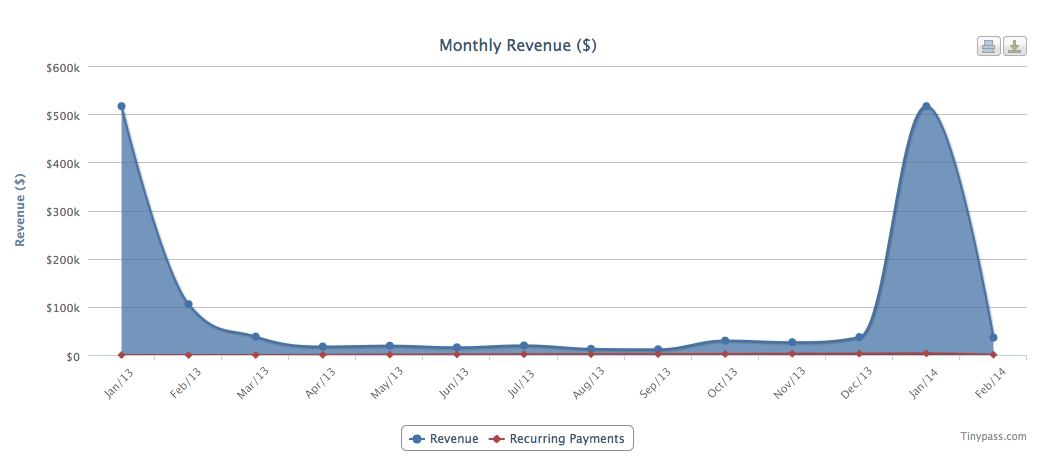
Today is the Dish’s first anniversary of going independent on our own site with our own company. We launched for real on February 4, 2013. And that’s when I, along with a large swathe of you, started my subscription. Today it expires, and sooner or later, if you haven’t yet renewed, you’ll have the irritating prospect of being blocked by our meter system. We always promised transparency so here’s the state-of-play of the last thirteen months as of this lunchtime:
Screen Shot 2014-02-04 at 2.11.50 PM

As you can see, we matched January 2013’s total in January 2014. Actually, we beat it by a smidgen last Friday night. That’s a pretty extraordinary result and an amazing start for the year. But it’s not enough to sustain us for the year ahead with even last year’s budget and February remains a critical month for us, as you can see from the graph above. More to the point, we know there are many of you out there who subscribed last January and February and who’ve understandably been putting off renewing until you absolutely have to. I get that, because it’s the kind of procrastination I’m pretty good at myself. But the moment when you actually have to renew in order to avoid any future interruptions is now here. Today is the last day you can simply renew your subscription and never get your reading intercepted by our meter. After today, you can still subscribe, of course, but you’ll have to start again as a new subscriber.

So if you’ve been procrastinating on this but always intended to renew – and we totally understand why – howler beaglecount this as a friendly nudge to get it over with. It’s a truly simple and quick process, and you can get it done in a couple of minutes tops. Take a moment to ask yourself what the Dish is actually worth to you over the year – and plug it into the renewal box. It’s still only a minimum of $1.99 a month or $19.99 a year – but many renewing subscribers have picked price points more tailored to them. It could be the double chai option of $3.60 a month; or a pledge to support our coverage of the marijuana legalization debate at $4.20 a month; or a decision to back this new model for online journalism by upping your subscription to $100 a year (541 hardcore Dishheads have so far); or just a simple renewal at the same minimum price as last year. Our most popular price point right now is $25 a year; but the $50 a year is our fifth most popular, and our average price this year is still around $37.

We’ll leave it to you to create a price point tailored to you. And we’re thrilled to have you along for the ride at whatever price point you can afford. But today is the last day you can simply renew and avoid any future hassles or interruptions.

So renew here! Renew now! And make sure your Dish reading experience is never interrupted again. If you run into any problems renewing, please email us at support@andrewsullivan.com.

Update from a new subscriber, who throws another price-point in the mix:

Following in the new tradition of adding a tip to the bill, I paid 31.41 – because I’m a nerd.

Another reader’s formula:

I renewed my subscription at $32.99 because the Dish it is the first thing I check every morning and several times throughout the day. I think it is probably worth $40.00 a year, but I deducted $7.00 for the God stuff and a penny for the dogs. I hate dogs.

One more reader:

Yes, I was a straggler. Part of it was procrastination. Part of it was just wanting to push you to the edge (sorry!). Part of it was money struggles. But today I put fifty bucks into your till because, frankly, you’re irritatingly worth it. And I really don’t want to miss Deep Dish.

Keep up the good (yet sometimes infuriating) work. Thanks to you, Andrew, and the entire team. You help keep me sane.
Where The Nonbelievers Are

us-nonreligious

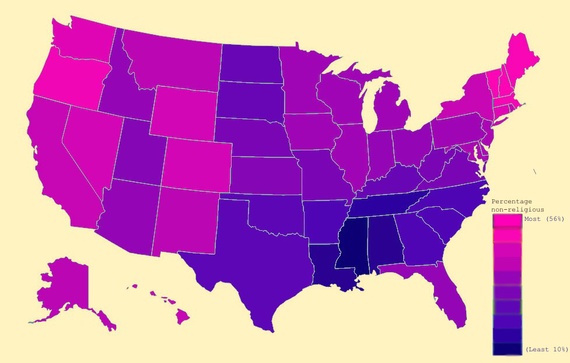
New Gallup data on religion breaks down by state how many Americans identify as “none”:

Take a look at the map. Vermont and Mississippi are on opposing ends of the spectrum: 56 percent of those surveyed in the Green Mountain State aren’t religious, while only 10 percent of those surveyed from the Magnolia State said the same. But each of those states represent an extreme, outranking the next most- and least-religious state by five percentage points. Compared to the rest of the country, Vermont is more the exception than the rule—the average for the U.S. skews toward the bottom end of the spectrum, at just 29.4 percent.

In one part of a larger essay, Beinart looks at how America’s religiosity is fading:

Americans remain far more willing than Europeans to affirm God’s importance in their lives (although that gap has closed somewhat among the young). But when the subject shifts from belief in God to association with churches, America’s famed religious exceptionalism virtually disappears.

In 1970, according to the World Religion Database, Europeans were more than 16 percentage points more likely than Americans to eschew any religious identification. By 2010, the gap was less than half of 1 percentage point.According to Pew, while Americans are today more likely to affirm a religious affiliation than people in Germany or France, they are actually less likely to do so than Italians and Danes.

Even more interesting is the reason for this change. Many of the Americans who today eschew religious affiliation are neither atheists nor agnostics. Most pray. In other words, Americans aren’t rejecting religion, or even Christianity. They are rejecting churches.

One cause Beinart identifies:

In Europe, noted the late political scientist James Q. Wilson in a 2006 essay on American exceptionalism, the existence of official state religions led secularists to see “Christians as political enemies.” America, Wilson argued, lacked this political hostility to organized religion because it separated church and state. But today, even without an established church, the Religious Right plays such a prominent and partisan role in American politics that it has spurred the kind of antireligious backlash long associated with the old world. Barack Obama is the beneficiary of that backlash, because voters who say they “never” attend religious services favored him by 37 percentage points in 2008 and 28 points in 2012. But he’s not the cause. The people most responsible for America’s declining religious exceptionalism are the conservatives who have made organized Christianity and right-wing politics inseparable in the minds of so many of America’s young.

What’s The Point Of Learning French? Ctd

A reader rolls her eyes:

Why learn French? Well, it’s the official language of 29 countries and is the 12th most spoken language in the world. It’s a working language and an official language of the United Nations, the European Union, UNESCO, NATO, the International Olympic Committee, the International Red Cross and international courts, and it is the seventh most common language used on the Internet.

Another adds:

McWhorter’s snobby dismissal of French as the language of art-house subtitles ignores the more than 115 million French speakers in Africa, as well as the francophone Caribbean countries, not to mention Switzerland, Canada, and so forth. I get that he was making a basic point about utility, but French is an actual language used by real people the world over, many of them living and working in this country.

Another suggests that French is just as useful as Arabic:

Remember when France tried conquering the Arabic world? A lot of those countries still speak French, at least to some degree. Learning French is usually much easier for English speakers than learning any of the many spoken dialects of Arabic, arguably making it a more practical means of communicating with parts of the Arabic world.

Another wonders how long Chinese and Arabic will remain the hot languages of the moment:

In the 1980s and early 1990s, Russian and Japanese were the languages that the really smart kids learned to conquer the world. Then the Japanese (who had learned already English much sooner anyway, because it is more widely used and easier) stopped spending money and their economy sat in the doldrums, and the Iron Curtain fell. Who knows what may happen to China by the time someone learns Chinese fluently? (Maybe we’ll all be talking about learning Persian after President Palin’s invasion of Iran.) You can’t tell, and it’s foolish to guess. But one could do a lot worse than French.

Face Of The Day

Turkish Prime Minister Erdogan Holds Rally In Berlin

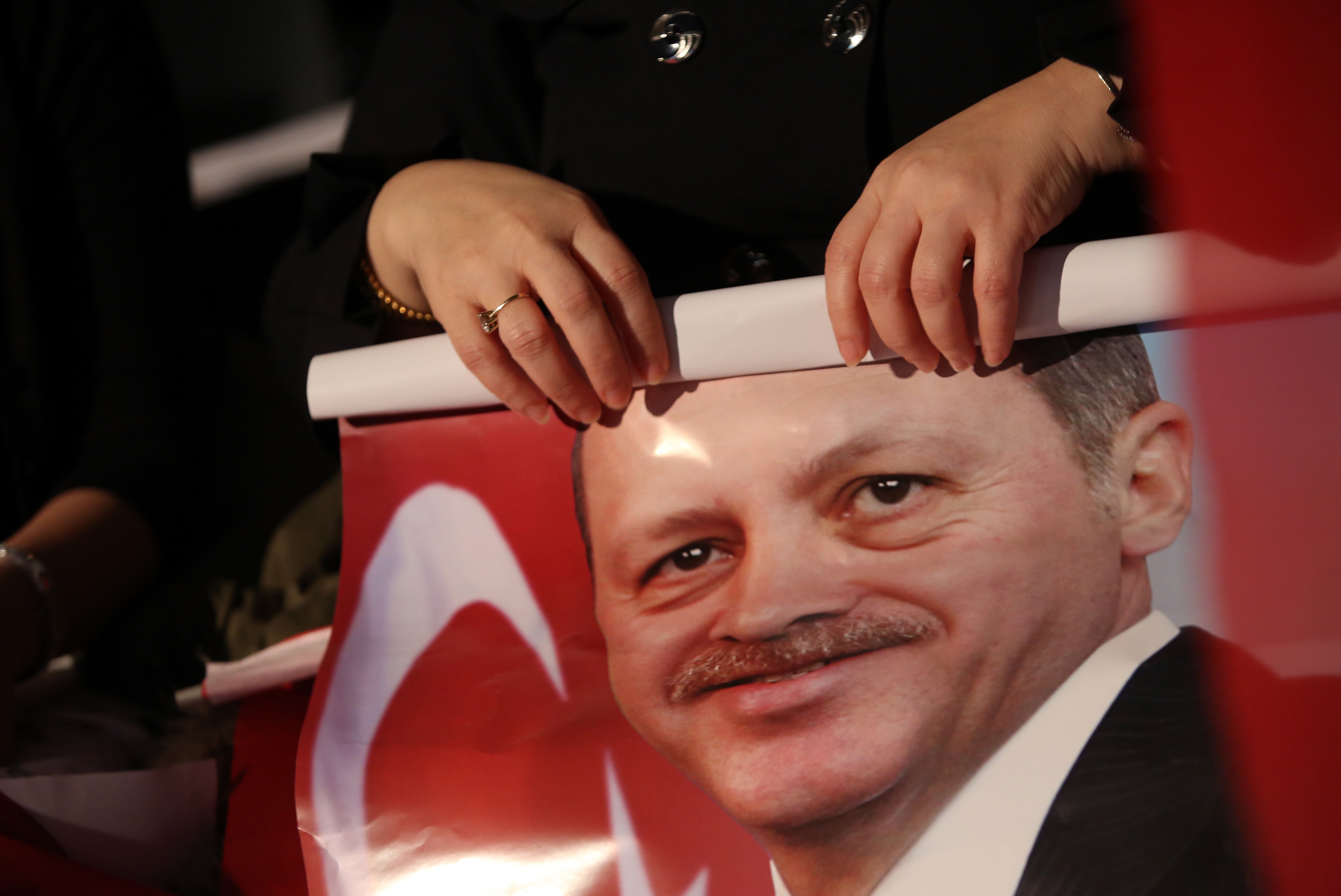
A supporter of Turkish Prime Minister Recep Tayyip Erdogan unrolls a poster at a rally at Tempodrom hall in Berlin, Germany on February 4, 2014. Turkey will soon face parliamentary elections and Erdogan is vying for the votes of expatriate Turks. Berlin has the highest Turkish population of any city outside of Turkey. By Adam Berry/Getty Images.

Strap-On Atomic Bombs? What Could Go Wrong?

Adam Rawnsley and David Brown share the the incredible story of the B-54 Special Atomic Demolition Munition (SADM), otherwise known as the “backpack nuke”:

Soldiers from elite Army engineer and Special Forces units, as well as Navy SEALs and select Marines, trained to use the bombs, known as “backpack nukes,” on battlefronts from Eastern Europe to Korea to Iran – part of the U.S. military’s effort to ensure the containment and, if necessary, defeat of communist forces [during the latter half of the Cold War]. … Cold War strategy was filled with oxymorons like “limited nuclear war,” but the backpack nuke was perhaps the most darkly comic manifestation of an age struggling to deal with the all-too-real prospect of Armageddon. The SADM was a case of life imitating satire. After all, much like Slim Pickens in the iconic finale of Dr. Strangelove, American soldiers would strap on atomic bombs and jump out of airplanes as part of the opening act of World War III.

The convenient thing about backpack nuke was that you could take them, well, almost anywhere:

Navy SEALs and Army Special Forces were trained to reach their targets by air, land, and sea. They could parachute behind enemy lines from cargo planes or helicopters. Teams specializing in scuba missions could swim the bomb to its destination if necessary. (The AEC built an airtight, pressurized case that allowed divers to submerge the bomb to depths of up to 200 feet.) One Special Forces team even trained to ski with the weapon in the Bavarian Alps, though not without some difficulty. “It skied down the mountain; you did not,” said Bill Flavin, who commanded a Special Forces SADM team. “If it shifted just a little bit, that was it. You were out of control on the slopes with that thing.”

Previous Dish on nuking the Cold War fridge herehere, and here.

The Most Interesting Woman In The World, Ctd

alexandra_david-neels

More readers offer their nominations:

My vote goes to Alexandra David-Néel: explorer, opera prima donna, anarchist, spiritualist, and author. She was an acquaintance of the 13th Dalai Lama and the Panchen Lama, studied Buddhism at the Royal Monastery of Sikkim (becoming the Maharaja’s lover), trespassed into Tibet disguised as a pilgrim, traversed China, traveled through the Soviet Union during WWII, completed a circumambulation of the holy mountain Amnye Machen. She died in France at age 100, having written over 30 books about Eastern religion, philosophy, and her travels. Her ashes were mixed with those of her lifelong traveling companion and dispersed in the Ganges.

Another:

As a general rule, the women featured on the site Badass of the Week (especially the real-life ones) are pretty damn interesting. Some examples include a Somali gynecologist who gets terrorists to stand down with stern dressing down (Hawa Abdi) and the “Joan of Arc” of India (Rani Lakshmibai). Plus, I need to throw in a nomination for a personal heroine of mine, Dr. Francis Kelsey, a.k.a the woman who saved the United States from the ravages of thalidomide.

Another:

Thank you for this. I find myself needing to search for interesting and inspiring people, to renew my faith in humanity. I have two nominees who may be unknown to many Dish readers:

Celia Sánchez and Emily Hahn.

Alice Walker, at the beginning of her article on Sánchez, wrote: “Nothing makes me more hopeful than discovering another human being to admire”:

My wonder at the life of Celia Sánchez, a revolutionary Cuban woman virtually unknown to Americans, has left me almost speechless. In hindsight, loving and admiring her was bound to happen, once I knew her story. Like Frida Kahlo, Zora Neale Hurston, Rosa Luxemburg, Agnes Smedley, Fannie Lou Hamer, Josephine Baker, Harriet Tubman, or Aung San Suu Kyi, Celia Sánchez was that extraordinary expression of life that can, every so often, give humanity a very good name.

Hahn was a free spirit, an adventurer, and a book-lover who said, “I have deliberately chosen the uncertain path whenever I had the choice.” She was called “Ms. Ulysses” in her obituary in the New Yorker. She lived in the Congo in the 1930s, “young and impulsive, because I’d always wanted to.” She lived in China in the 1930s and 1940s, immersing herself in writing and politics and love (with a touch of opium addiction). After the war, after her lover, a British intelligence officer, was released from a Japanese prisoner-of-war camp, they married and lived in England, when “she called herself a ‘bad housewife’ since, in reply to his concern about money, she said: ‘Then let’s not spend money on anything else, except books.‘”

This little search has made my day.

(Photo of Alexandra David-Néel in Tibet circa 1933 via Wikimedia Commons)

The Minds Of Minors

Rebecca Schwarzlose surveys research about how children develop a theory of mind, or “the ability to reason about other people’s thoughts and emotions”:

Studies have shown that when mothers refer more often to mental states (thoughts, emotions, and desires) in conversations with their young children, these children tend to perform better on theory of mind tests a few years down the line. But is this effect just a matter of learning a few keys words a little sooner or can it lead to long-lasting differences in theory of mind ability? Rosie Ensor, Claire Hughes, and their colleagues at University of Cambridge tackled this question by testing children over the course of eight years. … They found that the number of times mothers used ‘thought words’ with their two-year-olds predicted the children’s performance on theory of mind tests at six and ten years of age. …

Will talking to a two-year-old about others’ thoughts and beliefs make a child better at social reasoning down the line? It’s hard to say. These latest results are based on correlations and can’t prove that one thing causes another. Still, they are intriguing and suggestive. Encouraging young children to think about others’ beliefs and feelings may strengthen theory of mind abilities or simply get children into the habit of considering others’ thoughts in ways that persist into their middle-school years.

Beard Of The Week

photo (37)

A subscriber, by sending the above photo, panders successfully:

I just renewed and bumped up the price to $25 for now, and likely more to come later. I’ve been a reader for a solid decade, and for a busy person with limited reading time, the Dish offers an incredible value with a great balance of breadth and depth. We’re all richer for it.

Another:

Holy shit. It’s taken me this long to figure out that the Dish and my firstborn have the same exact date of birth (one year ago today). I’ve been procrastinating on the renewal, but obviously the universe wants me to knock it off. Anyway: I renewed for $23.273 (which I rounded up to $23.28), which is how you spell “beard” on a standard keypad.

Republicans Endorse Obamacare Lite, Ctd

Laszewski criticizes the GOP’s Obamacare alternative:

The problem for Republicans is that they have such a visceral response to the term “Obamacare” that they just can’t bring themselves to fix it. The notion that Obamacare might be fixed and allowed to continue as part of an Obama legacy and as a Democratic accomplishment is something they can’t get past. So, the only way Republicans can propose an alternative to Obamacare is to first wipe the health insurance reform slate clean and start over. There is a problem with that strategy. Have you heard the one about, “If you like your health insurance you can keep it?”

He believes “we will ultimately see a bipartisan agreement to fix Obamacare––most likely after the 2016 elections”:

But by putting a repeal and replace plan on the table, rather than focusing on a fix from the point we are at today that creates obvious losers, Republicans may have handed the Democrats a big political gift.

Bernstein looks on the bright side:

[E]ven if the Coburn/Hatch/Burr plan doesn’t go anywhere, and even if it’s not really quite at the legislative stage, and even if real legislators are still vastly outnumbered in Republican ranks by the clown show, it’s still a lot healthier to have moved to a (still-small) group of serious legislators than it was when the only Republicans trying to draft policy were a handful of bloggers and wonks who were constantly at risk of being excommunicated for their heresies. Given the Republican decline over the past few years, if Coburn, Hatch, and Burr are merely defeated (or ignored), rather than branded as RINOs, that’s a solid step in the right direction.

Earlier Dish on the proposal here and here.