Alejandro Hope pours cold water on the idea that legalizing marijuana in the US would end the bloodshed south of the border:
But surely Mexico would experience less violence if marijuana was legal? Yes, to some extent, but the decline wouldn’t be sufficient to radically alter the country’s security outlook. In all likelihood, marijuana production and marijuana-related violence are highly correlated geographically. Marijuana output is concentrated in five states (Chihuahua, Durango, Sinaloa, Michoacan and Guerrero) that accounted for approximately a third of all homicides committed in Mexico in 2012. Assuming improbably that half of all murders in those areas were marijuana-related, we can estimate that the full elimination of the illegal marijuana trade would reduce Mexico’s homicide rate to 18 per 100,000 inhabitants from 22 — still about four times the U.S. rate.
Funny, isn’t it, that so many of those now backing the AIPAC new sanctions bill in order to avoid the use of force, have long since gone on record in favor of war and against diplomacy altogether. Have they changed their minds? Or are they engaging in their usual shenanigans?
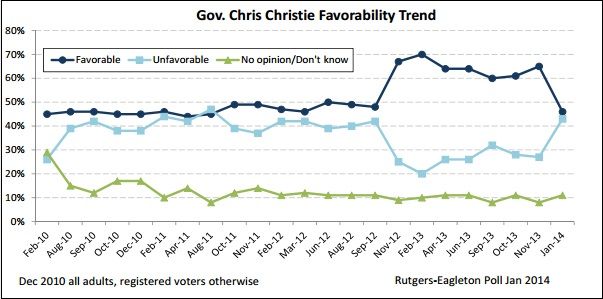
The above chart is from the poll’sinternals (pdf), showing Christie’s support over the course of four years. Note, the governor enjoyed steady-but-not-overwhelming popularity for a long while, only to see his support soar with the Sandy crisis.
According to the new data, that bump has now evaporated. Also note, the latest Quinnipiac poll offers some additional bad news – independents seem to be moving away from Christie rather quickly, which offered results roughly in line with the Pew Research poll we discussed yesterday.
President Barack Obama so often seems powerless before an intransigent Congress that it’s become common to hear people yearn for an LBJ-like executive — one who knows how to get things done. “LBJ-nostalgia is a reaction to Barack Obama’s presidency,” wrote the Economist. That nostalgia, however, is focused more on LBJ’s victories than on his methods. If the president tried to wield power in a similar fashion today, he would be driven from office.
Christie has been a beneficiary of LBJ nostalgia.
He’s a tough Republican governor in a blue state facing a Democratic legislature. He yells at people who oppose him. He swaggers across the national stage. He gets things done — including big things, such as pension reform — which encourages people to believe that maybe, just maybe, he’s a political leader who could make Washington work again.
Jon Chait instead compares Christie to Nixon, who “happily cut deals with Democrats in Congress.” Chait sees “no reason why a politician can’t abuse power and cooperate with the other party”:
Working with a legislature controlled by the opposite party is a shrewd way for an executive to maximize his power and influence. Genuine ideological opposition may prevent such deals, but if your only goal is power and influence, then you’re less likely to let that stop you. Indeed, the sort of threats and rewards Christie characteristically deploys would have little force if he were reliably partisan. It is only his willingness to cross party lines to help pliant Democrats — or punish disagreeable Republicans, like Tom Kean Jr. — that gives him the flexibility to be an effective bully. A reliable partisan would be locked into alliances with his fellow partisans, and locked into rivalries with the opposing party.
Barro feels that, on plenty of occasions, Christie was just doing his job:
I’ve seen a lot of “shocked, shocked” interviews with New Jersey politicians over the last few weeks, in which they are stunned to discover that political support for the governor might influence where a DMV office gets located or whose calls get returned. But those rewards and punishments are tools a smart executive uses to build legislative coalitions, pass budgets and policy reforms, and keep the state running smoothly. They are how Republicans and Democrats can work together effectively.
New Jersey residents shouldn’t want a governor whose staff causes traffic jams on purpose. But they shouldn’t want a governor who doesn’t try to instill favor in his allies and fear in his opponents — unless they want an end to bipartisanship.
The protests at Eastside Catholic High School, sparked by a gay vice principal being fired for getting married, have caused the school’s president to resign. Dreher reflects on the news:
This is big, it seems to me. Notice that the school is private, not archdiocesan; it’s interesting to think of how the archdiocese would have handled the situation. Still, the school identifies itself as Catholic, and it’s a big deal that protests by students, parents, and alumni drove the principal to resign. She probably did the right thing, inasmuch as she had apparently lost the ability to lead. This is an unambiguous victory for gay-rights supporters among Catholics. Catholic schools nationwide are going to be seeing a lot more of this. There has been a lot of “don’t ask, don’t tell” related to gay teachers and administrators in Catholic schools (hypocrisy is the necessary lubricant for much social life), but the legalization of same-sex marriage forces the issue.
So we now have two resignations – the chair of the board and the president. Mary Elizabeth Williams chimes in:
Sister Mary Tracy’s decision to leave may yet indicate the stirrings of true change in the church. And her choice to leave the school may have stemmed from more than just bad publicity. There may have been an element of conscience. Earlier this month, she told the school’s openly gay freelance drama instructor Stephanie Merrow that Merrow’s work status wasn’t an issue, and that’s she was “welcome” to stay on at the school. And most tellingly, she let her own students share a statement she gave to them, in which she told them, “I look forward to the day where no individual loses their job because they married a person of the same sex.”
Things are coming to a head sooner than anyone expected. I suspect Pope Francis understands this. Which makes this year’s Synod on the family and marriage a potential watershed of sorts.
I just wanted to share a story from a stoner who made a non-sluggish subscription purchase many hours before the 4:20 deadline.
About 8 months ago, I had a small personal garden and I’d sell my excess meds on Craigslist. I was selling such small quantities that I really didn’t worry about the DEA ramming down my door, but I didn’t feel comfortable associating my actual phone number with the Craigslist ads. So I found a company that basically charged $5/month to set up dummy telephone number and forwards any calls/texts to your actual number (Protip: they also have a free version that will store all your passwords across all your various devices). Long story short, my landlord informed us she intended to put the house up for sale, and I felt it was best to remove the garden to avoid any awkward moments during walkthroughs with potential new landlords. But I kinda just forgot to cancel my $5/month subscription until the company prompted me to use the phone masking function when I was booking a plane tickets earlier. Over the same time span, I was one of the people who rationalized that I couldn’t possibly afford 20 whole dollars to read the full version of The Dish. But upon seeing your plea this morning, I decided to cancel the subscription and transfer that $5/month, which I didn’t even know I was paying, to you guys instead.
So I guess the moral of this story is that I bet a lot of your readers don’t have to give up a single thing to enjoy the full Dish experience; they just have to find money they’re spending unknowingly and put it to better use.
Despite his organizational strength, Ron Paul’s libertarian views capped his support in Iowa, preventing him from winning over more traditional conservatives. But in 2016, Rand Paul will be less of an ideological outlier than his father was in 2012. That’s partly because he has avoided some of his father’s edgier views. (He’s more supportive of foreign aid and sanctions against Iran, for instance.) And it’s partly because more Republicans now share his suspicion of the national-security state.
Last summer, more than 40 percent of House Republicans voted to curb NSA data collection. “Rand has a much broader appeal than his father,” Robinson says. Polls reflect that: A survey last December for the Des Moines Register found Paul with a lower unfavorability rating among Iowa Republicans than either Christie or Jeb Bush.
If Paul is, arguably, the early leader in Iowa, he may be the early frontrunner in New Hampshire as well. While Ron Paul placed third in Iowa in 2012, he placed second in New Hampshire, losing only to Mitt Romney, the former governor of neighboring Massachusetts and a national frontrunner with a vast financial edge.
It’s way too soon to game this out, of course. But those who dismiss the chances of Paul are missing something, I think. Something fascinating is happening beneath the surface of the Republican-conservative debate. There is a revival – a clear, strong revival – of a conservatism perhaps best represented by The American Conservative of an authentically conservative worldview that is federalist, fiscally austerian, non-interventionist, and more skeptical of government’s national security claims. It’s always been there – a useful new primer on its history by Daniel McCarthy is here – but it is now much stronger vis-a-vis the Cold War liberalism and neoconservative orthodoxy that dominated the movement for so long. Someone will have to run under that banner in 2016, and it’s hard to see anyone tapping into the passionate activist support for it more effectively than Paul.
The Pauls are natural insurgents. And the GOP remains roiled by populist currents. That doesn’t mean Paul will win. It does mean he matters.
Some other reactions to the new HBO series, Looking, which I reviewed yesterday. We’ll be airing your views soon as well. Eric Sasson calls it “the first truly post-DOMA show, luxuriating in the mundaneness of gay men’s lives without needing to dress them up in mainstream television’s usual tropes of same-sex marriage, gay parenting and ‘acceptance.” Emily Nussbaum reaches a similar conclusion. But many are not so impressed. J. Bryan Lowder:
[Looking]is an almost unbearably boring television show. Alessandra Stanley of the New York Timesand Rich Juzwiak of Gawkerhave said so directly, and more positive reviewers have still intimated as much. But the adjective, one I would normally consider critically lazy, is so apt in this case that repetition is warranted. Looking is so boring, so utterly flat in terms of narrative or characterization, so in need of occasional pauses in which to perform a few jumping jacks to bring one’s heart rate up to resting, that I would opt out entirely if we gay men—or at least gay male culture critics—weren’t contractually obliged to watch.
Gays have largely been depicted in television and movies as either extremely fun and funny (Will and Grace; The Birdcage) or starkly sad and depressing (Philadelphia; Angels in America) so perhaps it’s time for a Hollywood portrayal of gay life as normal, tedious, and bland. Makes straight guys seem together and interesting by comparison, though. And if this show really takes off, prepare yourselves for a world of boring gay men who blend in and will probably talk to you about last night’s game and drink bourbon.
And that would be wrong because … ? Stingley’s throwback piece was updated with this note:
We apologize to anyone offended by our attempt at humor in this piece. It reflects one man’s viewing experience. He does not think all gay people are boring. Just this show, a little.
I have to say that I think, in this regard, the show is way ahead of this particular critic. In the first place, it doesn’t attempt to explain a gay show to straight readers.
It assumes we are all in the mix and that straight guys will understand – and even be diverted – by a simple dramedy about life, sex and love in a big city. Esquire is still obsessing over the gay-straight divide, while this show is past that. Equally, there’s Stingley’s dated attempt to insist that gay men really should be more fun, more super-thanks-for-asking, more witty and interesting than straight men. There’s this sentence that leaps out:
If this show really takes off, prepare yourselves for a world of boring gay men who blend in and will probably talk to you about last night’s game and drink bourbon.
For me, that is not a bug of this show, or of the gay rights movement. I have longed for the day when gay guys and straight guys can both talk about last night’s game over a bourbon, if they want to. Stingley sees the dawn of a new equality and yearns for the past. Looking looks directly into the face of the present and begins to imagine a future.
“I have strengths and I have weaknesses, like every President, like every person … I think I’m pretty good at keeping my moral compass while recognizing that I am a product of original sin. And every morning and every night I’m taking measure of my actions against the options and possibilities available to me, understanding that there are going to be mistakes that I make and my team makes and that America makes; understanding that there are going to be limits to the good we can do and the bad that we can prevent, and that there’s going to be tragedy out there and, by occupying this office, I am part of that tragedy occasionally, but that if I am doing my very best and basing my decisions on the core values and ideals that I was brought up with and that I think are pretty consistent with those of most Americans, that at the end of the day things will be better rather than worse …
I think we are born into this world and inherit all the grudges and rivalries and hatreds and sins of the past. But we also inherit the beauty and the joy and goodness of our forebears. And we’re on this planet a pretty short time, so that we cannot remake the world entirely during this little stretch that we have,” – president Barack Obama, channeling Niebuhr again.
By decoupling support for Israel with support for new sanctions against Iran, the group is making it easier for lawmakers inclined to support the White House. “We’ve been working diligently on Capitol Hill and in the Jewish-American community to raise support for the president’s diplomatic efforts vis-a-vis Iran, and oppose any legislation which would threaten it,” said Dylan Williams, director of government affairs at J Street. “We feel very strongly that the current bill in the Senate would threaten diplomacy.”
J Street’s influence is also clear in the money it spends. Among pro-Israel groups, JStreetPAC was the largest single political donor during the 2008 and 2012 cycles, contributing nearly $2.7 million to federal candidates, parties, and outside groups. And some lawmakers supported by J Street have been vocal in support of the group’s position. Senate Intelligence Committee Chairwoman Dianne Feinstein, for instance, has spoken out strongly against the new Iran sanctions. As one congressional aide put it, “Those are the political calculations that are made easier when a group like J Street gives you cover.”
Sargent notes that Patty Murray and Elizabeth Warren now oppose a vote on the sanctions bill:
Those who favored a vote were far more vocal at first — as of now, 16 Dem Senators have signed on. But the continued silence of many Dem Senators signaled a broad unwillingness to join the bill, even as many were unwilling to publicly declare this to be the case, since Dems apparently see allowing negotiations to proceed, without getting a chance to vote in favor of getting tougher on Iran, as a politically difficult position to take.
If current conditions remain, a vote is starting to look less and less likely. Right now, the bill has 58 co-sponsors. On the other side, 10 Dem Senate committee chairs have signed a letter opposing a vote. Around half a dozen Dem Senators subsequently came out against it. With Murray and Warren, the number of Dems against a vote has comfortably surpassed the number who want one.
Which means the US will not be the actor in this that sabotages negotiations. Which is good for the US, Israel and Iran.
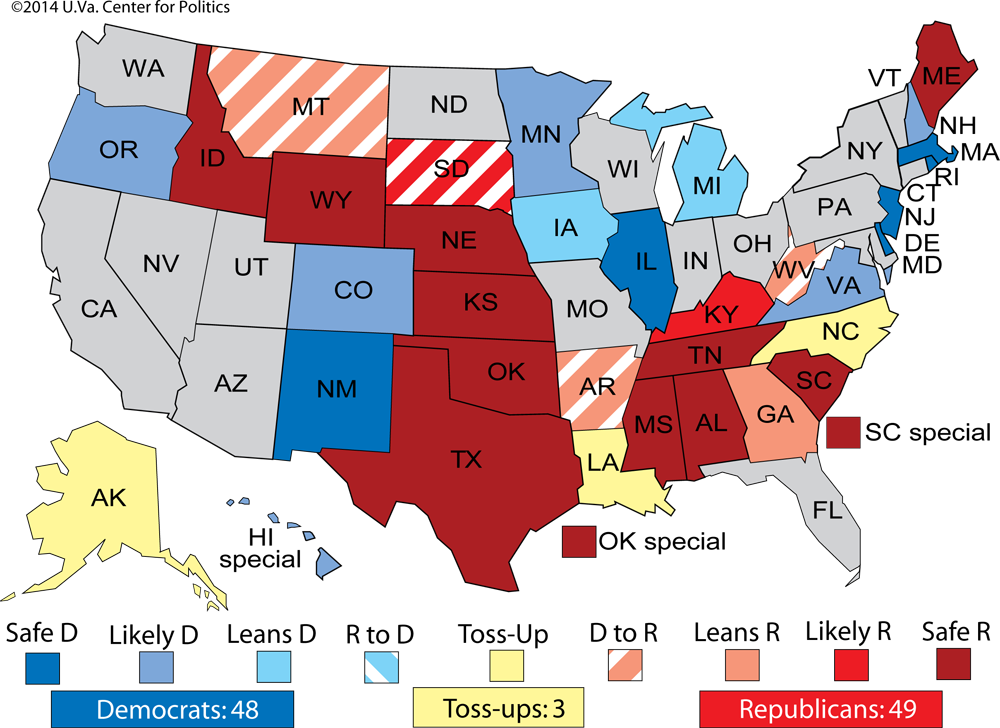
We now favor Republicans in four Democratic-held seats: Montana, South Dakota and West Virginia, as well as — in a ratings change — Arkansas, where Sen. Mark Pryor (D) appears to be at least a slight underdog to Rep. Tom Cotton (R) in a reddening state. Assuming Republicans can win those, they have roughly even odds to win in three other states where there are Democratic incumbents: Alaska, which we’ve long classified as a Toss-up, and Louisiana and North Carolina, which we’re switching back to Toss-ups after having them in that category for much of last year. It’s possible that the race for the Senate will come down to these three Toss-ups, with the party that wins at least two of the three controlling the Senate.
Sean Trende expects Obama’s approval numbers to have a major impact on the result:
If the president’s job approval is still around 43 percent in November — lower than it was on Election Day in 2010 — the question would probably not be whether the Democrats will hold the Senate, but whether Republicans can win 54 or 55 seats. Given the numbers right now, that should not be unthinkable.
But there’s a flip side to this. If Obama’s job approval does bounce back — which is exactly what happened in 2012 — there’s a reasonable chance that Republicans could walk away from this cycle with just a handful of pickups.
In a later post, Trende explains why the number of seats the GOP wins matters so much:
[I]f the GOP wins a bare majority in 2014, the odds are very, very good that the Senate will revert back to Democratic hands in 2016. In fact, if GOP gains are confined to the “traditional seven” Democratic races (the three open seats and the four incumbents in states Mitt Romney carried), they’re still favored to lose the chamber two years later. On the other hand, if Republicans get to 54 seats, their chances of retaining control are very good, and given the horrific playing field for Democrats in 2018, they would be extremely unlikely to lose it that year.