The Comfort In Killing Cold War Enemies

Gamers are still fighting the Soviets, according to a study on first-person shooters:

North Korea and China, nation-states that might be considered more pressing and relevant rivals to the West, only show up as enemies in games once each. On the other hand, Russia shows up as the enemy 11 times. Either as a future Russian Federation or Ultra Russian nationalists, the most prevalent outcome for an enemy is the Russian context. Terrorists likewise might be considered the most promising enemy in digital games, yet they still are not as prevalent as one might think appearing seven times, mostly in various Tom Clancy series. Tom Clancy series also tend to use Latin American terrorists rather than Middle Eastern. Iraq, Iran, Libya, and Serbia do not appear as enemies at all, but Iraq, Iran, and Pakistan do sometimes appear as locations in campaign modes of some games. …

There are various reasons for these results, but I am interested in hearing what the public might think of these outcomes. The “Russia” result is likely because they are ongoing rivals with the US, it is hard to shake Cold War images, and the fact that China represents a large market for video games and other entertainment forms that is best not annoyed (see my book on Tibet and China for similar themes). The reason we see few games covering terrorism is likely because these fights might hit too close to home and lose the element of fun important in games. Medal of Honor Warfighter was a huge failure for this reason, killing the entire franchise.

Marijuana’s Next Electoral Battles

Adam O’Neal stares at the political horizon:

With even more states considering full legalization, 2014 could end up as a banner year for pot. In Alaska — where possession of less than four ounces and personal cultivation has been already been decriminalized — residents will likely have the chance to vote on an getty-potinitiative that would regulate and tax marijuana and allow for the opening of recreational cannabis shops. A poll from last year showed 60 percent of the state’s residents support full legalization. In Oregon, voters are also expected to consider legalizing the substance, just two years after a similar initiative failed in a statewide vote. As with the 49th state, a poll taken last year in Oregon showed strong support for legalization. Advocates and opponents of legalization both point to Oregon and Alaska as the likely battlegrounds for the issue this year. Though that excites activists, the two states have a combined population of less than 5 million.

To really send a message to federal lawmakers in 2014 — who activists hope will become increasingly deferential to states as more enact legalization — and create momentum going forward, advocates are looking for a major victory. And the already pot-friendly state of California (where medicinal usage has been permitted since Proposition 215 passed in 1996), with its population of nearly 40 million, might provide it. After all, if California legalized marijuana, then roughly one in five Americans would live in a recreational-use state.

He goes on to detail the various legalization ballot initiatives fighting to make it on the California ballot. Meanwhile, Reid Cherlin wonders whether a Republican winning back the White House would reverse the progress being made:

It’s probably safe to assume that if Democrats retain control of the White House, the new president will, at minimum, keep in place the Justice Department’s laissez-faire stance. (There has been little talk of actually amending the Controlled Subtances Act.) Less predictable is what would happen under a Republican—or how the issue might play out in a volatile Republican primary. No one expects marijuana to be the deciding issue, but then again, it might well be a helpful way for the contenders to highlight their differences.

Richard Skinner expects marijuana to be a bigger issue for the Dems:

There’s no organized group backing legalization that has the clout of the gay lobby. (No, NORML doesn’t count). But liberal Democratic voters tend to be more supportive of legalizing pot. With her maternal image, Hillary Rodham Clinton doesn’t seem likely to back legalization. This provides an obvious opportunity for a liberal challenger. But it wouldn’t be hard for her to drift towards a federalist approach. Which is what I suspect she’ll do.

How he suspects it will play out in the general election:

It’s an easy issue to pass off to the states. I suspect both nominees will back a federalist approach, with the Democrat probably expressing more sympathy for those who support legalization. The experiences of Colorado and Washington State will probably have significant impact.

(Photo: Getty Images)

Spraying The Crops

field

Sam Brasch tracks the rise of human pee as fertilizer:

Across the Atlantic, studies have long established urine as a powerful fertilizer. A study conducted by the Stockholm Water Company in the late 1990s diverted urine from four housing projects to a grain farmer outside the city. The scientists concluded not only that urine could replace quick-acting mineral fertilizers, but also calculated that one Northern European adult pees enough plant nutrients to grow 50 to 100 percent of the food requirement for another person. Other successful trials have taken place in China and Mexico, though none as detailed as the Swedish one.

Rich Earth acknowledges that the biggest hurdle to their work is public perception of lingering buckets of pee, or the so-called “ick factor.” Urine is actually sterile when it exits the body, save for rare cases of a bladder infection or salmonella poising. REI has nevertheless developed two strategies for eliminating the risk of pathogens, either by solar pasteurization or long-term storage in a warm greenhouse. Both have proven effective.

A real concern for REI? Left over pharmaceuticals that end up in urine.

(Photo by Michal Fabik)

How Not To Write About Parenting

Gobry hates the slew of internet stories about parenting:

Apparently parenting stories are the new cat photo slideshows for high(middle)brow websites (thank you Amy Chua) because I see more and more of them (the most popular story on Quartz right now is this cruel, insufferable one about how to brag on the internet about mistreating your kids). And each time it is like an ice cream headache. The parenting stories that are all the rage have all the hallmarks of why our current bourgeoisie is insane.

He singles out articles with a “ridiculous pseudo-empiricism” as “perhaps the most infuriating”:

Here’s the thing: there’s almost nothing that proves less than a parenting study because it is one of the fields where the causal density is the highest and where it is nigh impossible to isolate one potential cause from the others. The vast majority of parenting studies are just throwing darts on the wall, and the few that have some credibility merely corroborate common sense. As bad as it is that journalists seem to interpret “Study Says” as “SCIENCE PROVES” it seems to be the worst in parenting stories, both because of their overreliance on it and the intrinsic faultiness of the evidence at hand. In this sense, almost everything you read about parenting on the internet is wrong.

Of course, these trends reinforce each other. If all you accept for parenting information is “studies” then all your metrics are going to be things like income level which means that’s how you will be measuring what successful education is. But what lies at bottom of all of this is a dramatic poverty of moral imagination. It is not allowed, it is not done, it is not even considered to ask what education, what raising a child, is for and how one should raise their higher faculties. Instead, the summum bonum is tips and tricks that can get your kid into Harvard.

Kalashnikov’s Regret

AK47

The designer of the AK-47, who died last month, had serious misgivings about his invention:

In 2010 Kalashnikov wrote the Russian Orthodox Church to ask if all the blood shed by the wildly popular weapon over the years was on his hands. It’s quite poignant. “My spiritual pain is unbearable,” he wrote. “I keep having the same unsolved question: if my rifle claimed people’s lives, then can it be that I… a Christian and an Orthodox believer, was to blame for their deaths?”

He’s not the first weapon inventor to feel pangs of regret. Alfred Nobel—yep, the guy the Nobel Peace Prize is named after—created dynamite hoping it would help achieve peace, but instead it wreaked havoc throughout WWI. The inventor of pepper spray was horrified when police used it violently against protesters. The group of nuclear scientists that developed the first atomic bomb then pleaded with the president not to drop it.

The church told him not to worry:

The press secretary for the Russian Patriarch, Cyril Alexander Volkov, told the paper the religious leader had received Kalashnikov’s letter and had written a reply.

“The Church has a very definite position: when weapons serve to protect the Fatherland, the Church supports both its creators and the soldiers who use it,” Mr Volkov was quoted as saying. “He designed this rifle to defend his country, not so terrorists could use it in Saudi Arabia.”

Dreher agrees with this position:

The Russian Church’s judgment is wise, I think; it responded that Kalashnikov created his weapon to defend his country against the Nazi invaders. It is hard to see where he bears real fault for the subsequent misuse of it.

John Michael McGrath considers the millions the gun has killed:

Because history is sometimes funny, Kalashnikov didn’t get his design approved for manufacture until two years after the Red Army took Berlin—it started rolling off the lines in 1947, hence the world’s most ubiquitous weapon, the AK-47. It was put to use killing people in large numbers beginning in the 1950s, and even in comparatively quiet times is now estimated to be killing a quarter of a million people a year.

But he doesn’t blame Kalashnikov:

If we take it out of the world of morality and put it in the world of economics, you could say the AK-47 permanently increased the cost of war—it’s like a peculiar form of inflation. But war was already, almost everywhere and always, a terrible idea before 1947. (Look at the countries that started World War II. It didn’t end well for any of them.) Despite the examples of the 20th, and now the 21st century, it still seems only the dead have seen the end of war. But it’s not Kalashnikov’s fault he lived on a planet of slow learners.

Lastly, The Economist looks at why the AK-47 remains so popular:

The gun is nothing special. Its controls are unsophisticated; it is not even particularly accurate. But this simplicity is a reason for its success. Compared with other assault rifles, the AK-47 has generous clearance between its moving parts. That is bad for accuracy, but it means that the mechanism is unlikely to jam, no matter how clogged it gets with Sudanese sand or Nicaraguan mud. Designed to be operated by Soviet soldiers wearing thick winter gloves, it is simple enough for untrained recruits (including children) to use. These features explain why the gun has remained in demand. But its success is also down to supply. The Soviet Union wanted to standardise military equipment among its allies, and so shipped giant caches of the weapons to friendly states, where it also established factories to churn out the rifles by the hundreds of thousand. (The USSR was unconcerned with copyright, too, meaning that knock-offs proliferated.) The gun has spread all over the world. But where the Soviet Union had less influence, the AK-47 was less popular. To this day, bandits in the Philippines are more likely to use variants on the M16, an American-made assault rifle supplied to the Philippine army by the United States.

(Photo by Flickr user zomgitsbrian)

The Death Row Science Experiment

Now that states are having a harder time getting the drugs they need for lethal injections, Ian Steadman reports that they are trying out new drug combinations, some of which are completely untested:

On October 15, for the 1986 rape and murder of 21-year-old Angela Crowley, Florida executed 51-year-old William Happ using the sedative midazolam hydrochloride. Allen Nicklasson, 41, was executed for murder on December 11 in Missouri using pentobarbital, after a temporary stay of execution in October after controversy over the alternative drug that the state wanted to use—the general anaesthetic propofol, which is similar to valium, and which has never been used to execute anyone before. The state refused to comment on who manufactured the pentobarbital used, or where it was bought. … Several states, led by Ohio, have since 2009 been moving away from the three-drug cocktail towards simply using pentobarbital on its own—it can cause the body’s lungs to stop working when given in high enough doses. However, the difficulty in procurring even that single drug means that not only are alternative drugs being used without much knowledge of their efficacy, prisons are turning to unregulated “compound pharmacies”. These are where two or more other drugs are mixed to approximate the effects of another drug—a process that is unreliable at best, and which has led to outbreaks of diseases like meningitis in areas where the method has been tried with prescription drugs.

(There’s further irony here that the nation most responsible for the international War on Drugs is now forced to seek out an alternative dealer—one which peddles an inferior-quality product, with unknown risks attached—now that its preferred brand is unavailable.)

Recent Dish on lethal injection here, here, and here.

Dish Renewal: Your Thoughts

dish-community copy

[Re-posted from earlier today]

The emails that have come into the in-tray in the last day or so have moved all of us here:

I’ve been waiting for this moment to renew since this whole experiment began – this opportunity to double down, to show solidarity. Because the Dish is what I wish every intellectual conversation to be: a frank exchange of competing ideas in the pursuit of truth and common understanding, with forgiveness for offenses given and taken, with generosity of spirit, and with gratitude that comes from the realization that no matter the outcome of the argument, each side will walk away smarter and more enriched than before. That’s what I get from the Dish every day. I would give more if I could.

Another is less psyched:

When I read your pro-Iraq war pieces, I was so appalled that I thought I might not resubscribe to andrew-sullivan-i-was-wrong-coverthe Dish. But I have softened in that stance and will go ahead and pledge a hundred dollars to your cause. One thing though: while I realize it’s an hour-by-hour blog, and you can write what you will, I remember the last time Hillary Clinton ran for president, you twice wrote that she was “Dick Cheney in a pants suit.”

That is not political commentary, I think, but rather Ann Coulter hysteria. Also, I did not find your most recent column on the Clintons convincing, in all its faux evenhandedness. And while I do not expect this sentence to bring about any change in your writing, I do want you to know that if you fall back into your old bad ways, and start the Dick Cheney shit (or anything even close), you will close the door forever on my yearly hundred bucks, and likely many others’ money as well.

I’m grateful for the subscription. I will, however, continue to write what I believe in. I don’t know any other way to write. I will at some point piss you off, possibly mightily. That’s a promise. But what makes Dish readers different, in my experience, is their ability to handle this. Whenever I bump into a Dish reader, he or she almost always says something along these lines: “I love the Dish. I don’t always agree with what you have to say though …” In fact, I haven’t yet met a Dishhead who does agree with me even most of the time. And that, as you well know, includes me sometimes, after a bit of reflection.

And what I hope we’ve been able to do these past few years – and it was prompted by my Iraq fiasco – is to ensure I am fully accountable for my errors of judgment (hence the “I Was Wrong” e-Book or routine clarifications and corrections like this one from earlier this week); and also, critically, to air opposing views in their strongest and best formulation and give the best dissents a thorough airing. The Dish team has that as one of their tasks – to push back against me, my biases and my flaws. So I hope that even if I drive you nuts at times, you’ll see that the Dish is now far more than me; it’s a community’s conversation with itself, with me as a biased facilitator and occasional provocateur (although I promise no more NSFW scrota). One reason we really hope you renew your subscription is that this model of public discourse is very rare in the often-polarized cacophony online. If you care about re-building a more civil, yet always lively, public conversation, it’s worth supporting.

Another renewed subscriber:

I just got your lovely email to founding members. What a privilege it is to be part of this amazing, vibrant community! Last year, I joined immediately at $50; it’s what I could afford at the time, as I was only employed part time. I’ve been back at full-time employment for awhile now, and I just renewed at $200. It feels so great to be able to support all of the Dish’s hard work. You all RULE!

We’re still processing the data and will report back with a couple days’ numbers tonight, as we promised. But we can report one thing: many readers have substantially increased their subscription rate this year over last (like the reader above). I asked if you could add $5 if you have the means. And you delivered. We just ran the numbers. In the first 36 hours of our launch last January, the average subscription price was roughly $31; after 30 hours this year in renewals, it’s $37.80. When you realize that no one has to pay more than $19.99 for full access, you begin to see the devotion of many readers to their favorite site. We’re just immensely grateful. If you keep this average up, it will be one hell of a leap forward. But if $19.99 is all you can afford in your budget, we’re delighted to have you stay as a fully equal part of the Dish community. Another reader writes:

I have been a regular reader of your work since 2004.  In a journalistic world marred by undisclosed advertorial, Murdoch propaganda and the confected “balance” of mainstream editorial policy, your site is an absolute necessity.  You were the clearest voice on torture and marriage equality. You remain the most incisive voice on the sickness in “conservative” politics.  You and your team introduced me to Twitter, TNC, Walt Whitman, Michael Oakeshott and Nate Silver.

I believe that in order to engage in genuine debate, one must be prepared to fully and honestly disclose and examine both the reasoning and factual foundation of opinions held.  You do that.  I hope that the Internet – with its search, verification and referencing capability – can banish the bare assertion from intelligent debate.  You are part of that. I hope that your founding subscribers will give you the support you need.  That is why, instead of simply renewing, I have “doubled down” and auto-renewed for $40 a year.

Another went with the monthly option:

I’ve been reading the Dish for the past three years or so, and because I read posts through an RSS feed, I managed to spend the past year freeloading. I don’t always agree with Andrew’s opinions – sometimes, I want to scream at him outright – but I’ve found myself being more careful, considerate and understanding in my own professional interactions, mirroring what I’ve seen through the dialogue you hold with your readers. You’ve built up a real community here, and I’ve been an all-too-silent (and cheap) observer. So I’m giving you $10 a month. It’s not the world – more like the price of two beers – but I’m certain that at some point, when my debts have shrunk, I’ll give you more. For now, let’s consider this the $2 monthly minimum, a $2 monthly atonement and $6 for three others who haven’t gotten around to subscribing yet.

Another got creative with the gifting option:

Happy anniversary and congratulations to you and your talented team. I have been an admirer of your writing for quite a few years – dinerLove Undetectable and Virtually Normal are on my short list of favorite books. I started subscribing in the middle of last year, and I will be delighted to renew now, in advance of the renewal date. Your encouragement to renew at a voluntary, higher rate caught my attention.  I seriously considered doing so – the educational and entertainment value far exceeds the subscription price.  But rather than double or triple my subscription price, I have decided to give a one-year subscription to one or two friends who I believe will appreciate the Dish.  This will increase your revenue and hopefully broaden your subscriber base.

We’re so grateful. A new subscriber writes:

I’ve been a regular reader for years, and I’ve been gaming the meter for a year with multiple devices, iPad, iPhone, multiple computers.  I finally decided it was time to [tinypass_offer text=”sign up for real”]. I obviously don’t agree with you about everything, but the Dish has been the most interesting and eclectic blog on the web for years.  Thanks for doing what you do. For $1.99 a month, it’s a steal.

One more reader:

Glad to see you altered your position on the poor woman in Texas. Your ability to consider other view points and change, or at least moderate, your position is one of the things that I value about very-gradual-changethe Dish. There are times when I profoundly disagree with your positions (and the poor woman in Texas is an example – and yes we can all agree that it’s a tragedy for everyone concerned), times when I’m just irritated by stupidity (some of the religious stuff – well actually most of it). But I truly value the insights you folks provide, the social commentary and the stuff that I wouldn’t otherwise find for myself.

I’ll definitely be renewing, and am happy to put the renewal on autopilot. I wish all of you the very best for the second year of this interesting experiment.

So a plea: renew now and help us stabilize and continue this adventure. Renew here. And thanks for everything. Drop us a note if you end up renewing; we love to hear from readers. One of the best emails we got today:

I wanted to let you know that I’ve been looking forward to renewing for some time. I’ve been reading the Dish religiously since 2000, including during my time in Army basic training. My mom would copy and paste several days of postings onto computer paper and mail them to me because we weren’t allowed to read newspapers or magazines, but we could receive letters.

(Top photos of Dish subscribers used with their permission)

The Dish, Year 2: Renewal Time

[Re-posted from yesterday]

It’s hard to believe now, but it was only a year ago that a handful of us jumped off the cliff to independence and 25,000 of you caught us. After the first six eddy-dusty-rocks years as a one-man blog, and the next seven attached to bigger, corporate media, we decided to become a small independent company in one of the toughest business climates in journalism in memory. It’s been a wild ride – but entirely because of you, we made it through our first year, almost hitting our highly ambitious subscription revenue target of $900K (we amassed around $850K), and gaining 34,000 subscribers in twelve months.

What have we created? Every now and again over the years, I’ve tried to figure it out. A blog? A magazine? A blogazine? A website? But every year, it changes again, as the new media shift, and as the world turns and as small experiments – like the Window Views or the reader threads – become ramparts of the whole thing. Do we, the staffers, write this blog? Sure, we do. But so do you, every day, with emails and testimonies and anecdotes that bring dry news stories to vivid personal life. Do we curate the web? Sure. Every day, we scour the vast Internet for the smart or the funny, the deep and the shallow, the insightful and the abhorrent. But you send us so many links and ideas VATICAN-POPE-AUDIENCE every day that the creators of the Dish are better understood as a community, you and us, correcting, enlightening, harshing and moving each other.

What I hope is that we’ve created an ongoing conversation – about politics and religion and technology and nature and love and life and sex and friendship. And like all conversations, it has no fixed direction, just a desire to keep it going, and never to shut it down. And part of me believes that this spontaneous, free-wheeling but edited conversation is what the Internet is best at. I’m riveted every day by the conversation we continue to have – from the misery of miscarriage to the deaths of pets to the hopes of a new papacy. And it’s a conversation made possible by the simple quality and sincerity and anonymity that all of you bring to the table. It feels at times like a truth-seeking missile, if we only get out of the way of the arguments and insights we collate every day and night.

house-of-turds-SD

But we’ve also pioneered a new business model online, if it qualifies for such a grandiose term. By “new” business model, we mean asking you to pay directly for what we do. Very few other websites do this, because very few websites have the kind of readership we do. And the good news is that we made a small profit in our first year (since I didn’t take a salary); we are indebted to no-one but you; we added staffers to handle business, technology and administration (which was done for us at bigger companies); and we ran a very tight ship, with just six staffers, and now three (amazing) interns, on the payroll.

We also decided everyone should have health insurance, including interns, and that we’d promote everyone from within the team – an often unsung group of some of the most talented young writers, editors and journalists of their generation. They’re all in their twenties and early thirties, and if you ever met them, you’d see why I’m so honored and proud to work with them. More to the point, we ran no “sponsored Supreme Court Hears Arguments On California's Prop 8 And Defense Of Marriage Act content”, no corporate ads, no gimmicks, and also showcased a prototype for publishing long-form journalism (Deep Dish), which we’d love to have the resources to continue and expand. In an era in which media has become desperate for revenues from any source, we decided to stick to the simplest option: asking readers to pay for content they enjoy.

It was a big gamble, but we felt we knew our readers and believed you’d be there for us, when we needed you. And you were. 25,000 of you signed up almost at once in an avalanche of support; another 9,000 of you have subscribed since last March. We remain blown away by the enthusiasm and generosity.

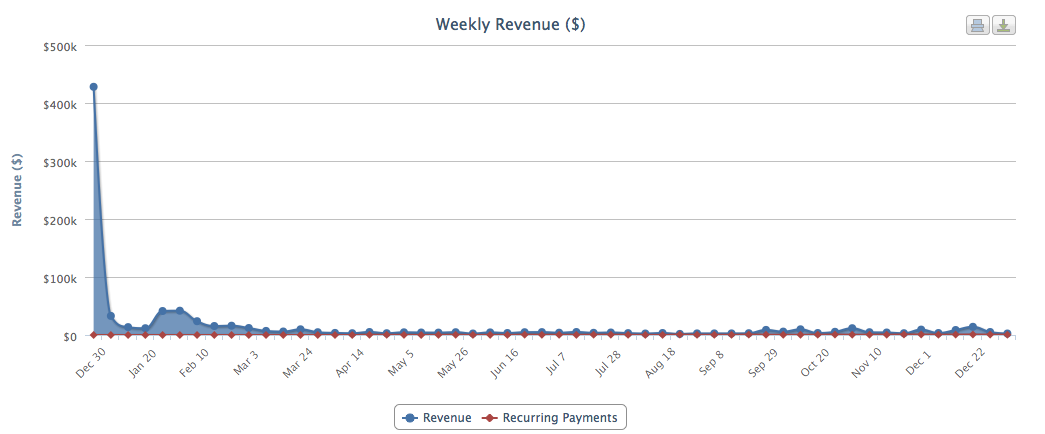
But it remains a fragile achievement. There’s a flip-side to this extraordinary wave of support. More than half of it came in the first week of 2013 – and all those early founding subscriptions are all up for renewal at once at the beginning of next month. None of them was on auto-renewal (which we were only able to execute once we had our own site operating and finessed the Tinypass software).

Here’s an exciting and yet also sobering graph of our total revenues since the day we went independent:

Screen Shot 2014-01-09 at 6.26.31 PM

Check out that massive sum at the very left. That runs out completely at the beginning of next month. After that, we have no assurance that the Dish can survive another year. That’s why the looming renewal moment is absolutely critical. What we’re asking now of our Founding Members is pretty simple: to turn your original membership into a stable, ongoing subscription that will enable us to budget, plan and work every day and night of the year to bring you the Dish for the foreseeable future.

If you renew now, your subscription will still last through your usual twelve months, starting when your current annual subscription expires next month (you can see the precise date you’re up photo(2) for renewal in the little box at the very top right of the page; if your date is 3/21/2014 or later you are already on auto-renew and don’t need to do anything for your subscription to continue).

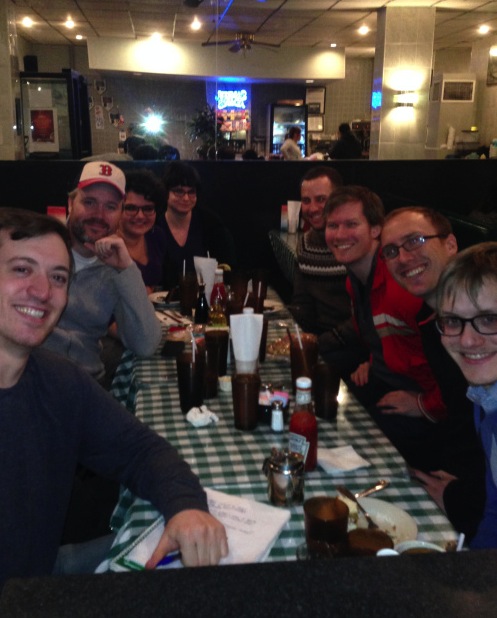
You can pay what you paid last year if you want and we’d be very grateful to keep you as a subscriber – and the minimum is still only $19.99 a year or $1.99 a month. But we’re asking our Founding Members, if you have the resources, to set your annual subscription price for the coming years as generously as you can. We pulled off this year by the skin of our teeth, but if we are going to retain our staff, if I’m going to get a salary, and if we are to have a chance at getting the resources to get Deep Dish beyond the prototype phase, we need to more than replicate our first year’s budget. And yes, we’ve kept our expenses low: no office, but a weekly dinner at a local diner (that’s us from last week).

Ask yourself what you think the Dish has been worth to you last year and throw in some more if you can. The more you give us, the more we can do. And we’ll keep the promise we made to you this time last year and have kept: maximal transparency and accountability. Think of it not just as a way to keep the Dish alive but as a way also to prove that transparent, reader-supported journalism can survive in an era of listicles, sponsored content, algorithms and endless slideshows.  We believe it can; and we hope over this past year we’ve proved it.

But we need to get this on a stable footing; we need to figure out a budget; we need to plan. So take this as my last pitch for getting the Dish eddybowiefinally off the ground (once everyone is on auto-renew, these annual pitches will mercifully end). You kickstarted us last January and February; we need you just as urgently to put us on a long-term stable footing with one final act: auto-renewing your subscription before it runs out. The average Founding Member subscription price last year was $28. If every one of you added $5 or more to that, we could begin to expand Deep Dish, retain our staffers, pay me, and prove that independent, reader-financed journalism isn’t dead. It’s just beginning to rise from the ashes.

Renew today! Keep us alive. And thank you so much for this past year. You carried us; we hope you feel we deserve another year of your support. We can’t wait to get started. Please don’t wait to help us one more time. Renew here. Renew now.

(Photos of Francis and Edie Windsor from Getty)

Considering A Career Change?

MilkyWayNoLabels_CarterRoberts935x593-full

There’s never been a better time to be a planetary scientist:

For almost all of [the field’s] history, it could study only the eight planets that make up the local solar system. But the boom in exoplanet research over the past decade or so has furnished the field with a wealth of data from elsewhere in the galaxy. Much of this has come from a specially designed space telescope called Kepler, some of the discoveries of which are illustrated in the artist’s impression above, along with objects from the local solar system, for comparison. Kepler’s discoveries, and others, have done plenty of exciting violence to old theories of what planets are and how they form. Several papers discussing what is happening were presented at the meeting of the American Astronomical Society which took place this week in Washington, DC.

Astronomers are particularly interested in planets intermediate in size between rocky Earth and gassy Neptune, which along with Uranus is one of the solar system’s two “ice giants,” and which has a radius 3.8 times that of Earth and is around 17 times as massive. Planets of this intermediate size are common, but because the local solar system does not host one, they are also mysterious. Are they scaled-up Earths, scaled-down Neptunes or a mixture of the two? And, if they are a mixture, where is the boundary between the rocky ones, known as super-Earths, and the gaseous ones, known as mini-Neptunes?

(The Kepler telescope has identified 238 planets and 3,538 “planet candidates” in this section of the Milky Way. Photo: Carter Roberts.)

Carting Out Confucius

Evan Osnos reports that the Chinese government – which just a few decades ago blamed Confucianism for fostering “monsters and freaks” – has found a new use for the ancient scholar:

In the eighties, the Party studied how Confucian values had helped to stabilize other countries in East Asia. Generations of Chinese thinkers had dreamed of finding the optimal recipe for “national studies” – the mixture of philosophy and history that might insulate China from the pressures of Westernization. After the democracy demonstrations at Tiananmen Square in 1989 ended in a violent crackdown, leaders needed an indigenous ideology that might restore the Party’s moral credibility. The Communists gave speeches at meetings devoted to Confucianism, and state television launched a series about traditional culture intended, it said, “to boost the people’s self-confidence, self-respect, and patriotic thought.” In 2002, the Party officially stopped calling itself a “revolutionary party” and adopted the term “Party in Power.” The Prime Minister, Wen Jiabao, declared, “Unity and stability are really more important than anything else.”

The view from Qufu, Confucius’ home town:

In 2007, the city’s International Confucius Festival was cosponsored by the Confucius Wine Company. Thousands of people filled a local stadium, giant balloons bearing the names of ancient scholars bobbed overhead, and a Korean pop star performed in an abbreviated outfit. Near the cave where Confucius is said to have been born, a five-hundred-million-dollar museum and park complex is under construction; it includes a status of Confucius that is nearly as tall as the Statue of Liberty. In its marketing, Qufu has adopted comparisons to Jerusalem and Mecca and calls itself “The Holy City of the Orient.” Last year it received 4.4 million visitors, surpassing the number of people who visited Israel.