India Eradicates Polio

india_polio

Dylan Matthews details the good news:

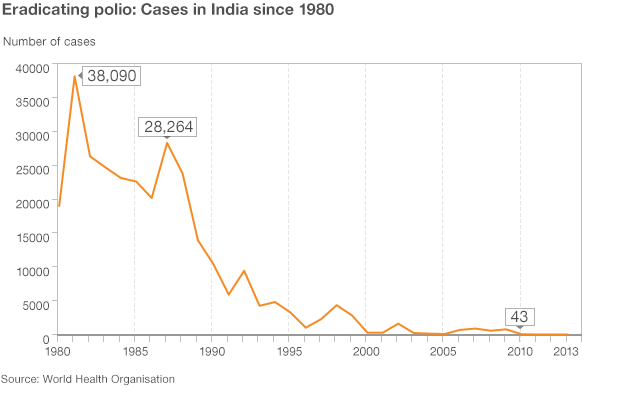
More than 50 years since Jonas Salk discovered the first successful polio vaccine, the disease persists in developing countries. According to the Global Polio Eradication Initiative, 372 cases were reported in 2013, up from 223 in 2012. So it’s encouraging that India — which had 741 cases as recently as 2009 —  appears to have finally eradicated the illness, with the last reported case occurring three years ago.

Bill Gates applauds the diligence of the Indian government:

Five years ago, India was home to nearly half of the world’s new polio cases. At the time, if you asked any health expert, they would have said India would be the last place on earth to end polio.

India’s population density and high birth rate (27 million new children are born each year), combined with poor sanitation, was like a petri dish for polio. But the government of India, with help from the organizations that make up the Global Polio Eradication Initiative including Rotary International launched an all-out effort to stop the disease. The country deployed 2 million vaccinators to reach children who had never before been reached with polio vaccines or any other health services—children who live in flooded regions or hard-to-find rural towns, or are regularly in-transit with their families.

One of the most powerful images I’ve seen during my visits to India is that of parents proudly holding vaccination cards showing that their children were protected from deadly diseases for the first time. And now that these children have been found, health workers can supply them with much more than just polio drops. They can provide other critical health services like measles vaccines, clean water, and information about how to deliver their babies safely and care for them during their first weeks of life.

Keating examines how the disease still hangs on in some parts of the world, a problem the Dish recently highlighted:

Globally, there’s a strong link between polio and political instability. The disease has recently made a comeback in both the Horn of Africa and Syria, where years of brutal fighting have broken down national vaccination campaigns. There’s also a striking contrast between India, where 170 million children are immunized annually as part of a nationwide campaign involving hundreds of thousands of volunteers begun in the 1990s, and neighboring Pakistan, where a similarly aggressive campaign has been hampered by extremist attacks on volunteers. At least a dozen government vaccinators, whose efforts are portrayed by the Taliban as a Western conspiracy, have been killed or wounded in northwest Pakistan, in the past three months. Eighty-three new cases of the disease were reported in the country last year, making it one of only three in the world—along with Afghanistan and Nigeria—where polio remains endemic.

Francie Diep looks ahead:

Should the day come when polio is truly gone from the world, it would be the second vaccine-preventable disease that humans have eradicated. The only precedent is smallpox. The next, [epidemiologist Carol] Pandak thinks, may be measles and rubella. There are a couple of reasons those diseases are promising. Like polio and smallpox, they don’t have any animal carriers, which means no wrangling with microbes lying in wait in monkeys, bats or mosquitoes. There are also safe, effective vaccines for measles and rubella that work in children.

Democrats For War With Iran, Ctd

https://twitter.com/JeffreyGoldberg/status/421715207652515840

Sargent is concerned about the growing support for a new Iran sanctions bill, which threatens to derail negotiations:

The basic storyline in recent days has been that the pro-sanctions-bill side is gaining in numbers, while the anti-sanctions-bill side hasn’t — even though the White House has been lobbying Dems very aggressively to back off on this bill, on the grounds that it could imperil the chances for a historic long-term breakthrough with Iran. As Josh Rogin puts it, “the White House’s warnings have had little effect.”

We’re very close now to the 60 votes it needs to pass. The Dem leadership has no plans to bring it to the floor, but there are other procedural ways proponents could try to force a vote. And if the numbers in favor of the bill continue to mount, it could increase pressure on Harry Reid to move it forward. Yes, the president could veto it if it did pass. But we’re actually not all that far away from a veto-proof majority. And in any case, having such a bill pass and get vetoed by the president is presumably not what most Democrats want to see happen.

Steve Benen adds:

Congress passed sanctions to entice Iran to come to the table, and Iran came to the table. Pressure from sanctions was intended to encourage Iran to reach a deal, and Iran reached a deal. If Congress could resist the urge to destroy its own success – new sanctions would derail all talks, force Iran from the table, and tell the world the United States isn’t serious about peaceful solutions – real progress could move forward.

Ryan Cooper thinks Democratic senators, like sanctions-supporter Cory Booker, are making a mistake:

It may seem to Booker et al. that dynamiting sanctions is the smart political play, given the strength of AIPAC and other neoconservative groups. Or it could be that he really believes this stuff: Booker has long been strongly pro-Israel, and has key rabbinical allies with similar views. Or perhaps he hasn’t grasped the danger yet. As Peter Beinart has pointed out, the anti-war left has never been very good at teaching politicians to head off conflicts in the making, as opposed to punishing them for it after the fact.

Regardless of the reason, Booker and company are making a serious error if they think that the anti-war left is dead forever, or that they’ll pay no price if they manage to successfully sabotage these negotiations.

Weigel points out that all the Senate Democrats facing tough reelection campaigns have supported new sanctions on Iran. On Friday, Trita Parsi looked at the situation from Iran’s perspective:

Khamenei supports Rouhani’s diplomacy not because he agrees with it, but because he has turned it into a win-win for himself. As long as he patiently waits till the talks either succeed or collapse due to American foul play – courtesy of senators Menendez and Kirk – he will strengthen his position both internationally and domestically.

If diplomacy succeeds, he will take credit for it. If diplomacy fails as a result of American sabotage, he will claim vindication. His mistrust of the West will have proven correct, as will his line that Iran’s interest is best served by resisting rather than collaborating with the West. Iran’s moderates and pragmatists will once again be pushed to the margins of Iranian politics. Rouhani will be weakened and momentum will shift back to Khamenei and the hardliners.

My take here.

The Right Backs Affirmative Action!

Gay Marriage Becomes Legal In California

It’s a surprising move, but perhaps the only possible shred of an argument they have left in the fight to deny marriage equality to gay citizens. In Utah, the state has tried to muster legal arguments as to why they have an interest in marginalizing gay unions as opposed to heterosexual ones. Their first try was to argue that heterosexual-only marriage was important for “responsible procreation.” The Judge agreed, but couldn’t understand why allowing civil marriage for gays would somehow undermine that. In fact, he made the socially conservative counter-point that by mandating that gay couples remain unmarried, “the state reinforces a norm that sexual activity may take place outside of marriage.”

So they came up with a second argument: that by asserting the importance of heterosexual-only marriage, the state was making it more likely that children would be born into stable, two-parent homes, where they would fare better. The judge was puzzled again:

Utah’s ban, he wrote, “does not make it any more likely that children will be raised by opposite-sex couples.” But it certainly demeans and humiliates the thousands of children being raised by same-sex couples in the state, he said.

So Utah tried another tack in appealing to the state Supreme Court (and no, I’m not making this up). They said that having a woman and a man in a marriage was important for … wait for it … diversity. Money quote:

“The state does not contend that the individual parents in same-sex couples are somehow ‘inferior’ as parents to the individual parents who are involved in married, mother-father parenting,” the state said.

But, drawing on Supreme Court decisions endorsing the value of diversity in deciding who may attend public universities, the state now said it was pursuing “gender diversity” in marriages. “Society has long recognized that diversity in education brings a host of benefits to students,” the brief said. “If that is true in education, why not in parenting?”

“Gender diversity” is an argument I haven’t yet heard in the two and a half decades I’ve been debating this question. I have heard that in Catholic teaching, a mother and a father are vital complements to each other because of their differing genders.

But that’s an argument from natural law, and doesn’t actually hold up in the many studies of how well children do in same-sex and opposite-sex households. The idea of diversity like a university is somewhat different. But it begs a further question. If gender diversity is important, why not religious diversity? Or racial diversity? If the state has an interest in providing “diversity” in parenting, should it not privilege inter-racial marriage or religiously mixed ones? That’s an interesting argument in social engineering, but not one, I suspect, that can hold much water in front of a court.

When I first read it, it actually made me laugh out loud it seemed so transparently desperate as an argument. And that’s the core thing about this debate. As it has gone on, the logic of equality has proven far stronger than the logic of exclusion. In the courts, often denigrated, the standard of logic applies more rigorously than in the emotional and human maelstrom of democratic votes. If the arguments just don’t stand up to reasonable inspection – and they sure haven’t – what is even a conservative court supposed to do? And if Utah‘s supreme court cannot provide a convincing case to retain this kind of public discrimination, what hope the others?

This began as a strange outlier. Maybe, as the court deliberates over the next couple of months, it will end up in a much more radical place.

(Photo: Same-sex couple Ariel Owens (R) and his spouse Joseph Barham walk arm in arm after they were married at San Francisco City Hall June 17, 2008 in San Francisco, California. By Justin Sullivan/Getty Images)

Christie Is Busted?

This sure doesn’t look good to me: Christie is photographed yukking it up with David Wildstein and Bill Baroni of the Port Authority three days into the GWB traffic scheme to punish a Democratic mayor for not endorsing him. That follows the governor’s insistence that he could barely remember any serious interaction with Wildstein “for a long time”. That could still be true, depending on your definition of a long time, but it sure looks fishy to me. And it will, I presume, to potential primary voters.

One other bell that rang for me about this the other day. Why, I wondered, was it so important for Christie to get endorsements from Democrats in a campaign he was winning anyway in a landslide? Because it was really part of a presidential primary argument that only he, among the possible contenders, can deal with Democrats! So this was all part of scheming for the presidential nomination and nothing to do with New Jersey at all. Which makes it even more, well, calculated and icky.

Obamacare By The Numbers

Ages Buying Obamacare

Yesterday, the government released detailed data on Obamacare enrollments. Cohn provides the chart seen above:

The figure bound to get most attention is the age breakdown. Insurers rely on premiums from healthier people to offset the costs of people with significant medical bills. And young people are a reasonably good proxy for healthy people—or, at least, as good a proxy as we have right now. According to a recent study by the Kaiser Family Foundation, about 40 percent of the population that could enroll in Obamacare exchange plans are between the ages of 18 and 34. But, according to the government’s new data, only 24 percent of the people signing up for coverage are in that age range. In short, the people who have gotten insurance through the Obamacare marketplaces so far are significantly older than the people who could, in theory, be buying insurance from them.

But is that really a big deal? In Massachusetts, according to analysis from MIT economist (and Obamacare architect) Jonathan Gruber, younger people tended to sign up later.

Philip Klein pushes back:

Though there’s a plausible case to be made that younger Americans will wait until later to sign up, the administration is still in a deep hole. Because the current number of young adult signups is significantly less than 40 percent, to make up ground, signups in the coming months will have to be significantly higher than 40 percent.

As an example, let’s just say all of the roughly 2.2 million Americans whom HHS says have signed up for insurance pay their premiums and complete enrollment, and the total paid enrollment number through March ends up being 5 million people. To meet the original demographic goal, about 1.4 million of the remaining 2.8 million enrollees — or roughly half — would have to be between the ages of 18 and 34.

Sarah Kliff digs deeper into the numbers:

Even more important than these top-line numbers is what’s happening in each state. Insurance rates are set on a state-by-state basis, so even if thousands of young people are signing up in California, it doesn’t effect the premiums in neighboring Nevada.

The new Health and Human Services report does show some variation by state, although most exchanges tend to hover somewhere in the 20-percent range. In the District of Columbia, 44 percent of enrollees are young adults, the highest for any exchange (and remember: This is just the individual marketplace, not the small business exchange where Congressional staff shop). Arizona and West Virginia have the lowest rates of young adult sign-ups, who make up 17 percent of their marketplace.

Avik Roy considers what happens if the exchanges skew older:

As Philip Klein notes, a recent article by Larry Levitt, Gary Claxton, and Anthony Damico of the Kaiser Family Foundation described an enrollment of 25 percent among 18-34 year olds as a “worst-case scenario,” estimating that insurers would lose money on these plans, because “overall costs…would be about 2.4% higher than premium revenues.” 2.4 percent may seem like a small number, but given that the average insurer has profit margins of 4 to 6 percent, a 2.4 loss on premiums—before we even count overhead costs—is a serious problem. It’s why Humana reported to the Securities and Exchange Commission that it expected meaningful losses in its exchange-based plans.

McArdle looks at the percentage of enrollees receiving subsidies:

Five million people were deemed eligible to buy a policy on the exchanges; 2.7 million, or 54 percent of them, were eligible for subsidies. But of people who actually selected a plan, 1.68 million, or 80 percent, were subsidized. To put it another way, 62 percent of the people eligible for subsidies selected a plan, but only 8.5 percent of those who weren’t eligible for subsidies actually purchased one. That is very different from the information we were getting in December, when most of the people who selected plans were not eligible for subsidies. … This is much closer to what the Congressional Budget Office was projecting, in terms of subsidized enrollment; it had predicted that about 85 percent of the people on the exchanges would get subsidies. So in one sense, it’s not novel. But it does show enrollment looking a lot more like the wonks had been projecting, and that’s important. The next step for the administration is to get the mix of young and healthy people more in line with initial forecasts.

Sprung looks on the bright side:

Signup rates are impressive in many large states in which Republican governors and legislatures have worked actively to undercut the law. On 12/28, the open enrollment period (Oct. 1 – Mar. 31) was just shy of half over — and signups were miniscule through the first week of December. Any state that had reached more than say one third of the CBO projection for first-year exchange signups might be deemed more or less on course. Major non-cooperating states that passed that threshold (as tracked by Charles Gaba’s invaluable spreadsheet)include Florida (33% of CBO projection, 158.0k signups), Michigan (47%, 75.5k), New Jersey (36%, 34.7k), North Carolina ((56%, 107.7k), Pennsylvania (39%, 81.3k), Virginia (35%, 44.6k) and Wisconsin (52%, 40.7k).

More good news: only about 20% of those choosing plans on the exchanges have opted for the cheapest bronze plans, where deductibles average $5,000 per person. Benefits are benchmarked to the second cheapest silver plan in each state, and subsidies that reduce deductibles. and maximum out-of-pocket costs, offered to buyers with incomes below 200% of the federal poverty level, are only available to silver plan buyers. Further, 79% of those who have enrolled in plans thus far have qualified for subsidies. Put those numbers together and it appears that most exchange buyers thus far may indeed find their coverage and care affordable.

Democrats For War With Iran

The Senate is full of them. The list of Democratic Senators who favor a march to war with Iran rather than allowing the current negotiations to proceed unhindered is here. I note a few remarkable members of the war chorus: Michael Bennet of Colorado – a key Obama supporter; Cory Booker of New Jersey (ditto); Mark Warner of Virginia; Richard Blumenthal of Connecticut; Ben Cardin of Maryland; and, of course, Chuck Schumer of New York. All of these Democrats are in favor of humiliating the president of the United States and refusing to allow him to pursue negotiations without being trumped by deliberate, pre-meditated sabotage.

I wonder how many of their Democratic constituents really want them to sabotage their own president’s negotiations to avoid what would otherwise be a relentless march toward another war in the Middle East? Do these Democrats seriously want war as the only option with Iran’s newly emergent moderate government? Do they want to do to Obama what no Republicans did with Reagan over his rapprochement with the Soviet Union? Do they really want to sabotage a negotiation years in the making, created by crippling sanctions, and now possibly about to bear fruit? Why on earth can they not wait until the final deal is done, if it is?

The View From Your Window Contest: Winner #187

vfyw_1-11

A reader writes:

Okay, if that ain’t the angel Moroni on top of that spire in the distance, sitting on top of a structure looking very much like a Mormon temple, then I don’t know what that could possibly be.  The surrounding area looks a lot like San Jose, Costa Rica, but given that the temple in that city doesn’t look anything like the one in this picture (according to the LDS website), I’m going with Tegucigalpa, Honduras, looking south towards the temple from the Colonia Ciudad Neuva, off Calle de Los Alcaldes.

Another:

The LDS temple is first big hint. The church is growing/recruiting heavily in the South Pacific. Quick search of LDS temples in this region returns Apia, Samoa as a pretty close match. Not that many tall buildings in Apia, so perhaps the photo was taken from one of the hotels on the water.

Another Samoa entry:

This LDS temple looks closest.  So I’ll guess that the photo was taken from the Tanoa Tusitala Hotel at Beach Road, Sogi, Apia, Samoa, 7th floor.

Another reader:

I’m a low achiever with these contests. I basically just ask myself, “Does that look like Brazil? No? Well then, who knows.” But this was one of the ones that did look like Brazil, in particular, southern Brazil, and I even noticed that, hey, that’s a Mormon temple! So I googled for a minute or two and decided Curitiba, Brazil. Good enough for this week.

Another:

Mountains in the background and a Mormon temple a few blocks away?  Provo, Utah, OBVIOUSLY (they must be having a mild winter).  Try to make it difficult next time!

Another continent:

This is Kiev, Ukraine, looking toward the newly constructed Mormon temple.  Angel Moroni clad in gold on the spire is a dead giveaway.

Another:

Though I’ve never seen any photos of the city before, it took me two minutes to determine it is a view of Accra, Ghana. A Mormon Temple in a non-US tropic setting is a huge clue, needing only a cross reference to an LDS temple photo site. Pinpointing the window’s location is a little harder. I’ve decided that it is a view east looking toward the rear of the Temple from the area of the Accra High School, probably the Alisa Hotel North Ridge 3rd or 4th floor which I see is between the school and the temple on Google Maps. I can’t get more exact than that.

Another gets a tad frustrated:

It’s official. I hate you.

I spotted this one and thought, “This’ll be a snap. I won’t win, of course, because I won’t create a map with animated arrows and GPS coordinates and a story of how I recovered from dengue fever in a room on the floor below.  But at least I will have the satisfaction of getting the location right.”

Why did I think it would be an easy one?  The Mormon temple.  Having been married in one (the first time), it popped right out at me.  Mormon temple, tropical setting in developing country … how many can there be?  Too many as it turns out.  I went to www.ldschurchtemples.com and looked at photos of every temple they have that was even a remote possibility.  Wasn’t as easy as I thought.  Looked at every damn tropical spire where Moroni would be sweating in the tropical sun and NONE appeared to be a match.

Hence my hate – enticing me to waste two hours looking at pictures and Google Earth and getting basically nowhere.  You’re an awful man.

Guayaqui, Ecuador seemed the closest.  But I don’t think it’s right. Fuck.

Another:

I used the helpful LDS world map to figure out where this might be. The closest match to me looked like Cochabamba, Bolivia, possibly taken from the Instituto Americano. The map is an interesting look at where the Mormons have been more (or less) successful. Africa only features three active temples, for example, while Oceania has 10 and South America 15 (with 7 under construction). Asia only has 9 temples, with none in China (unless you count Taiwan) or India. Anyway, if I’m not right, I know more now about the Mormon global presence that I normally would have, and those kind of random learnings are what I enjoy the most about the VFYW contest.

Another nails the right city:

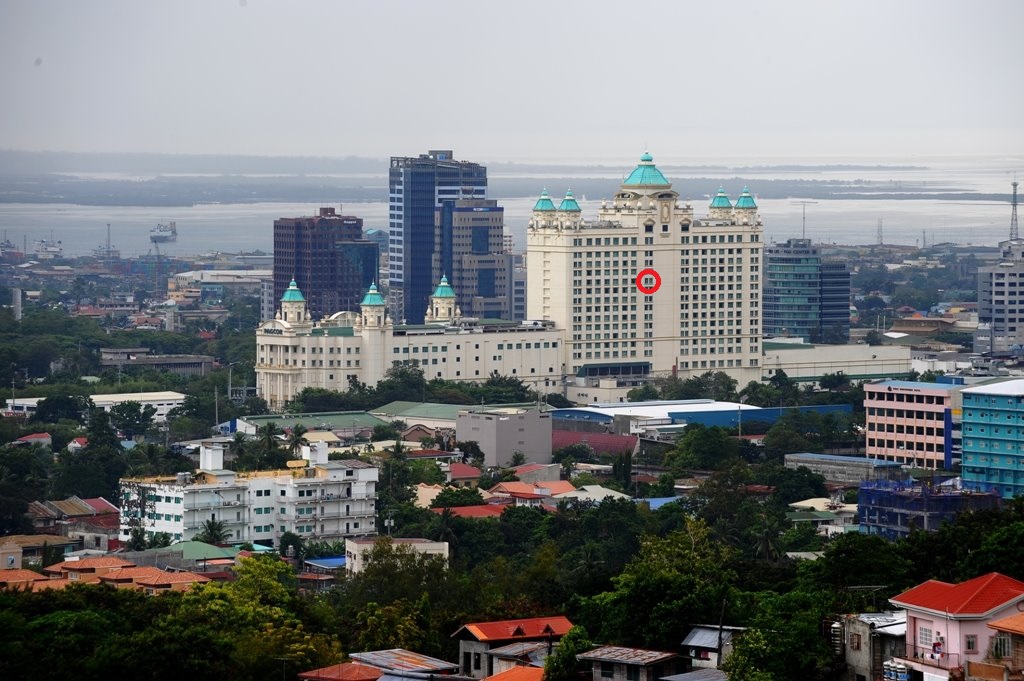
OK, I have enjoyed this contest for years and continue to be amazed at how your readers meet the weekly challenge. First clue in the Jan 11, 2014, image is the greenery. No Polar Vortex. Second, the white spire in the center of the image. It looked similar to the LDS temple I have seen here in Albuquerque. The Google search “white Mormon temple” brings up the church’s locator map, which kindly furnishes an image for each existing temple. From there, it is deduction. Not South America, not Central America, not Mexico, and not the Caribbean.  A journey to Asia puts us in the Philippines, and … Oh, hello, Cebu City.

Next, it’s a matter of locating the rooftops and streets on the Google Map satellite image. The image is taken from a high vantage point, and the websites for the area budget hotels didn’t appear to have the same window frame as the one in the contest image. So, guessing on the exact location, I wager it is the Waterfront Cebu City Hotel & Casino, from the, um, lucky 7th floor.

Mormons and gambling. Nice one.

Another:

After a couple weeks of near-impossible ones, this was a nice reprieve. The Mormon temple in the middle was the dead giveaway. I did my undergrad at UCLA and there’s a Mormon temple in West LA that looks strikingly similar in style. The scenery screamed Asia to me, so on a hunch I googled “Mormon temple Philippines” and voila, our beautiful temple showed up:
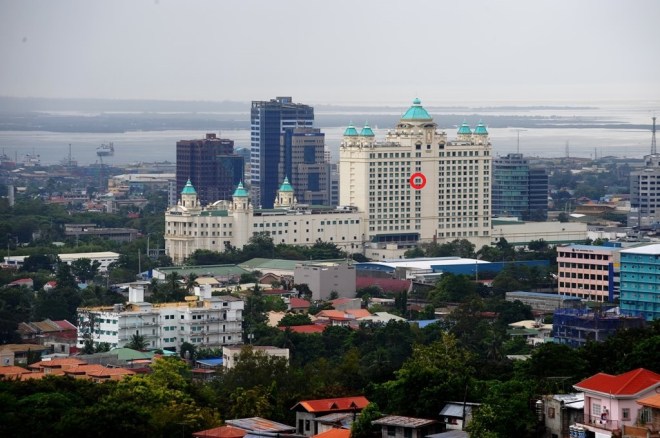
unnamed

I’ll bet I’m not the only one who made the Mormon connection, so something tells me you’re gonna have a host of correct answers this week!

About 200 in fact. Another Cebu City entry:

That view of the lovely church just screamed out to me, “Mormon Temple!” perhaps because just a few days ago I saw the raucous (and highly offensive – in a good way) “The Book of Mormon” in San Francisco. And the tropical feel of the surroundings led me in just a few clicks to the Mormon Temple in Cebu City, Philippines, which can be seen clearly from the Waterfront Cebu City Hotel and Casino. A similar photo was posted on Trip Advisor by someone staying in room 803 last August:

Waterfront_Cebu_City_Hotel___Casino_-_Hotel_Reviews_-_TripAdvisor

Based on the perspective from that room, I’m guessing the VFYW hotel room was on a higher floor and to the north, so I’m guessing Room 1127 of the Waterfront Cebu City Hotel.

Another:

I’ve never been any good at solving these VFYW locations, but the scenery looked vaguely like some of the towns I used to travel to when I lived in the Philippines as a child. We’re talking 35 years ago, so my memory is very fuzzy, where to begin? The church in the background didn’t look familiar to me, but with so many beautiful churches across the country, I thought a Google image search might yield something. Nada. Upon closer inspection of the photo, I thought the building looked more like something the LDS church would build, so I googled “LDS temple Philippines”, and found several photos of an LDS temple in Cebu City that looked like it could be a match:

mormon-temple-Cebu-Philippines1

I actually visited Cebu City in 1979, but as you might have guessed this temple hadn’t been built. Apparently the temple was completed in 2010. With the address in hand (Gorordo Avenue Barangay Lahug 6000, Cebu City, Central Visayas, Philippines) it was on to Google Earth, where I see a hotel just a mile or so southeast of the temple. I believe the photo was taken at this location, The Waterfront Hotel, 1 Salinas Drive Lahug,, Cebu City, Cebu, Cebu, 6000, Philippines. My best guess is the photo was taken from a guest room on the eighth floor or above.

Win or lose, it was fun to take this little trip down memory lane. Thanks!

A visual entry:

Cebu map

Only one reader guessed the exact room number, and his entry was short and sweet:

Window is in the Waterfront Cebu City Hotel in 1 Salinas Drive Lahug Cebu City, Philippines. Nice view of the LDS Temple. Just guessing the room #1417.

Great guess! From the submitter:

I’m in Cebu City, Philippines for my brother’s wedding tomorrow. This view is from the 14th floor (room 1417) of the Waterfront Hotel and Casino City Center, looking west towards the mountainous interior of the island. It’s my first time in this country and seeing the widespread poverty surrounding the pockets of wealth is shocking.  Cebu City is the “headquarters” of typhoon relief, with an international airport able to handle cargo planes and relief workers (and John Kerry – insert joke about his ego). My flight on Monday had a group of workers from Hungary. Oh, and the city was affected by the earthquake a few months ago, too.

By the way, here’s the entry from Chini, who basically has a permanent place in the contest at this point:

The last time the VFYW contest was in the Philippines (VFYW #153), it was an absolutely brutal challenge to find the right spot. But this one was far easier, thanks mostly to the Mormon temple sitting smack dab in the middle of the frame. This week’s view comes from Cebu City. The picture was taken from the Waterfront Cebu City Hotel and Casino from, let’s say, the 12th floor. The view looks west north west along a heading of 296.5 degrees. A marked overhead view and a pic of the possible window are attached:

VFYW Cebu City Overhead Marked - Copy

(Archive)

Torturing The Mentally Ill

Reporting on the shocking treatment of mentally ill inmates in South Carolina’s prisons, Andrew Cohen asks why the state has refused to do anything about it:

On Wednesday, in one of the most wrenching opinions you will ever read, a state judge in Columbia ruled that South Carolina prison officials were culpable of pervasive, systemic, unremitting violations of the state’s constitution by abusing and neglecting mentally ill inmates. The judge, Michael Baxley, a decorated former legislator, called it the “most troubling” case he ever had seen and I cannot disagree. Read the ruling. It’s heartbreaking. The evidence is now sadly familiar to anyone who follows these cases: South Carolina today mistreats these ill people without any evident traces of remorse.  Even though there are few disputed material issues of law or fact in the case, even though the judge implored the state to take responsibility for its conduct, South Carolina declared before the sun had set Wednesday that it would appeal the ruling—and thus likely doom the inmates to years more abuse and neglect. That’s not just “deliberate indifference,” the applicable legal standard in these prison abuse cases. That is immoral.

But what makes this ruling different from all the rest—and why it deserves to become a topic of national conversation—is the emphasis Judge Baxley placed upon the failure of the good people of South Carolina to remedy what they have known was terribly wrong since at least 2000.

Nicole Flatow examines the horrors the inmates suffered:

Jerome Laudman, a schizophrenic, intellectually disabled inmate in South Carolina, was placed in solitary confinement, although he was neither aggressive nor threatening. During his transfer to the “Lee Supermax” facility, he was sprayed with chemical munitions and physically abused by a correctional officer. Although the transfer should have been recorded, the videotape turned up blank. While Laudman was confined naked in his cell, officers observed that Laudman had stopped eating and taking his medication, and appeared sick and weak. They did not report it. A week later, he was found laying in his own feces with 15-20 trays of molding food in his cell, vomiting. Nurses and an officer refused to retrieve his body. When two inmates were eventually sent to remove him, he was transferred unconscious to a hospital, where he died of a heart-attack. …

Other plaintiffs in the case were held naked in restraint chairs for hours at a time without treatment of their injuries, left to urinate in place and forced to stay in a painful “crucifix” position for hours. In one instance, blood pooled beneath an inmate held in a restraint; in another, an inmate’s intestine was protruding from his abdomen as officers tightened restraints surrounding the wound. One inmate was restrained with his arms in a twisted position, soaked in water, and then left outside on a December night.

A Franciscan Era?

The Dish is thrilled that a new online site has been formed to explore and examine the lives, minds and bodies of animals, and our relationship with them. It’s called “The Dodo” and it’s edited by the extremely talented Kerry Lauerman, formerly of Salon.

dish_fotdsun12Dish-readers know that this is an area we’ve been covering more and more – particularly as neuroscience and research in general is slowly breaking down the absolute boundaries between the human animal and our cohabitants on this planet, and as our manic compulsion toward greater material comfort leads to the transformation of our climate and seals the fate of so many species. I have to say I don’t regard this as some kind of side-issue in politics and culture. I think it’s in the vanguard of our moral evolution as a species.

Some introductory stories from the Dodo: Do Dogs Tilt Their Heads When Confused? And As Blackfish Soars, Will SeaWorld Sink?

It’s easy in the age of Upworthy to think the web cannot provide new, smart, engaging content which isn’t just linkbait or page-view whoring or social media p.r. The Dodo proves them wrong. Good luck, guys. We’ll be reading and linking.

(Photo: Tri Joko, photo-shopped)

Malkin Award Nominee

“That was [governor Cuomo’s] anti-gun legislation, which he had promised not to do, but then he had a little convenient massacre that went on in Newtown, Conn., and all of a sudden there was an opportunity for him,” – New York Post columnist Fredric Dicker, on his WGDJ talk-show in Albany, yesterday.