Paul Solotaroff covers the efforts of animal-rights activists to expose and change living conditions for livestock:
If you want to perform your version of “euthanasia” by hanging downer pigs execution-style from a forklift – as an Ohio farmer was fond of doing till being filmed by an [Human Society of the United States] agent (a judge later found him not guilty, ruling that Ohio has no standards forbidding the strangulation and hanging of farm animals) – by all means do so without fearing a knock from jackbooted federal cops. If you want to mislead the public, as Perdue is accused in a class-action lawsuit of doing with labeling its Harvestland brand of chickens as “humanely raised,” feel free, knowing that no regulator will call bullshit on your claims.” …
There are laws in every state barring cruelty to house pets, but almost none that safeguard farm animals. To the extent that prosecutors can bring charges, they’re typically misdemeanors that call for small fines and a ban on taking farm jobs in the future. “Despite everything we know about animals now – that they think, they feel, they form connections – we still treat them worse than dirt,” says [Mary Beth Sweetland, who is the investigative director for the Humane Society of the United States.]
Ian Tattersall describes how human beings shifted from shelters toward more permanent homes:
Archaeologists begin to see proto-houses during the Ice Age, some 15,000 years ago. Hunter-gatherers at the Ukrainian site of Mezhirich built four oval-to-circular huts that ranged from 120 to 240 square feet in area, and were clad in tons of mammoth bones. Out there on the treeless tundra, their occupants would have cooperated in hunting reindeer and other grazers that migrated seasonally through the area. The Mezhirich people dug pits in the permafrost that acted as natural “freezers” to preserve their meat and let them spend several months at a time in the “village.” With so much labor invested in the construction of their houses, it is hard to imagine that the Mezhirich folk did not somehow feel “at home” there.
But if an archaeologist had to pick an example of the earliest structures that most resembled our modern idea of home, it would probably be the round houses built by the semi-sedentary Natufians, an ancient people who lived around the eastern end of the Mediterranean Sea (Israel, Syria, and environs) at the end of the last Ice Age, some 12,000 years ago.
A typical Natufian village consisted of several circular huts each measuring about 10 to 20 feet in diameter; these villages testify to a revolutionary change in human living arrangements. Finally, people were regularly living in semi-permanent settlements, in which the houses were clearly much more than simple shelters against the elements. The Natufians were almost certainly witness to a dramatic change in society. … [E]ven before early people settled down to permanent agriculture and animal husbandry, the Natufians had laid a huge amount of the physical and social groundwork necessary for a fateful economic development that literally changed the world. And in a busy Natufian village, buzzing with life, we can readily imagine that everyone had a sense of belonging, both to the village itself, and to the individual homes that sheltered them. It seems that the formation of a community was an important turning point in the evolution of human society.
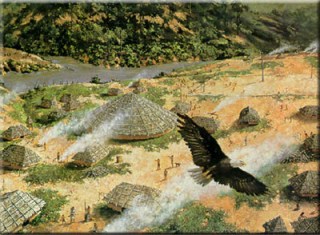
(Image: Yuchi Town by Martin Pate, 1776. The archeological sites on Fort Benning, U.S.A., include both prehistoric and historic Native American sites. There is evidence of occupation or use as far back as approximately 12,000 years ago. Via Wikimedia Commons.) Update from a reader:
The picture is not one of a prehistoric pad, but a quite historic pad. That is an artist drawing of one of the Yuchi towns in Georgia prior to Andy Jackson’s genocidal death march, AKA Indian Removal to Oklahoma, where the Yuchis reside today, mainly around Sapulpa and Glenpool, although the Brown allotment (he was a bothlan – “chief” at Pole Cat Creek ceremonial ground”) is in Tulsa about a mile from my parent’s house. It is now a shopping center.
Getting connected could be a big problem in North America in the 1890s, especially in the vast open spaces of the rural west. You could buy a telephone set from a mail-order catalogue, but what about the phone line itself? The Bell Telephone system was putting all its effort into connecting urban areas and had little interest in stringing wires to remote communities.
It didn’t take long for a few enterprising ranchers to notice, though, that the west was already covered with wire – the barbed-wire fences that divided the range to keep each rancher’s stock separate. At its peak, more than a million kilometers of the stuff was being laid each year. Why not just let it do double duty as a phone line? After all, they figured, wire is wire, and the ranchers were eager to communicate with their cowpokes working at outlying camps.
A reader sends the above photo – “not great quality but it’s the best I could get from my vantage point”:
I couldn’t help but think of you when I saw this scene a few minutes ago: a line stretching all the way down the block at a medical marijuana dispensary about a half mile from my house in Denver. Sales of recreational marijuana started at licensed shops [yesterday] morning at 8 am (many of the existing medical dispensaries got recreational licenses, such as the one people are lined up for in the picture). I don’t smoke marijuana, but I voted to end prohibition in my state in 2012, and I love your coverage of the issue.
Another reader on New Year’s day:
Predictions are hard to get right, and I’m not particularly good at them. But I think today is the beginning of the end of the drug war as we know and loathe it. Once legal marijuana gets established in Colorado, other states will probably follow their example very quickly. I imagine it will legal almost everywhere in the US in 10 years, and that other countries in the Americas will legalize production to help fill the demand.
It’s hard to think about any really big changes in society without coming back to marriage rights. Those changes have happened so quickly, and it’s been so profound, that it seems like you have to compare or contrast everything else to it. I believe that the collapse of prohibition will be swift, as the expansion of marriage rights has been, for the same sort of reason. The opposition is irrational, and once the thing is tested in the real world, the argument will be over.
The drug war is an obscenity. It ruins lives, decimates communities, and functions as the main practical foundation of racial inequality in our country. The drug war is the main engine behind the creation of a criminal class in the US. It’s a profoundly destructive and immoral set of policies. The drug war is one of the worst things about America. And today, the drug war has been dealt a death blow.
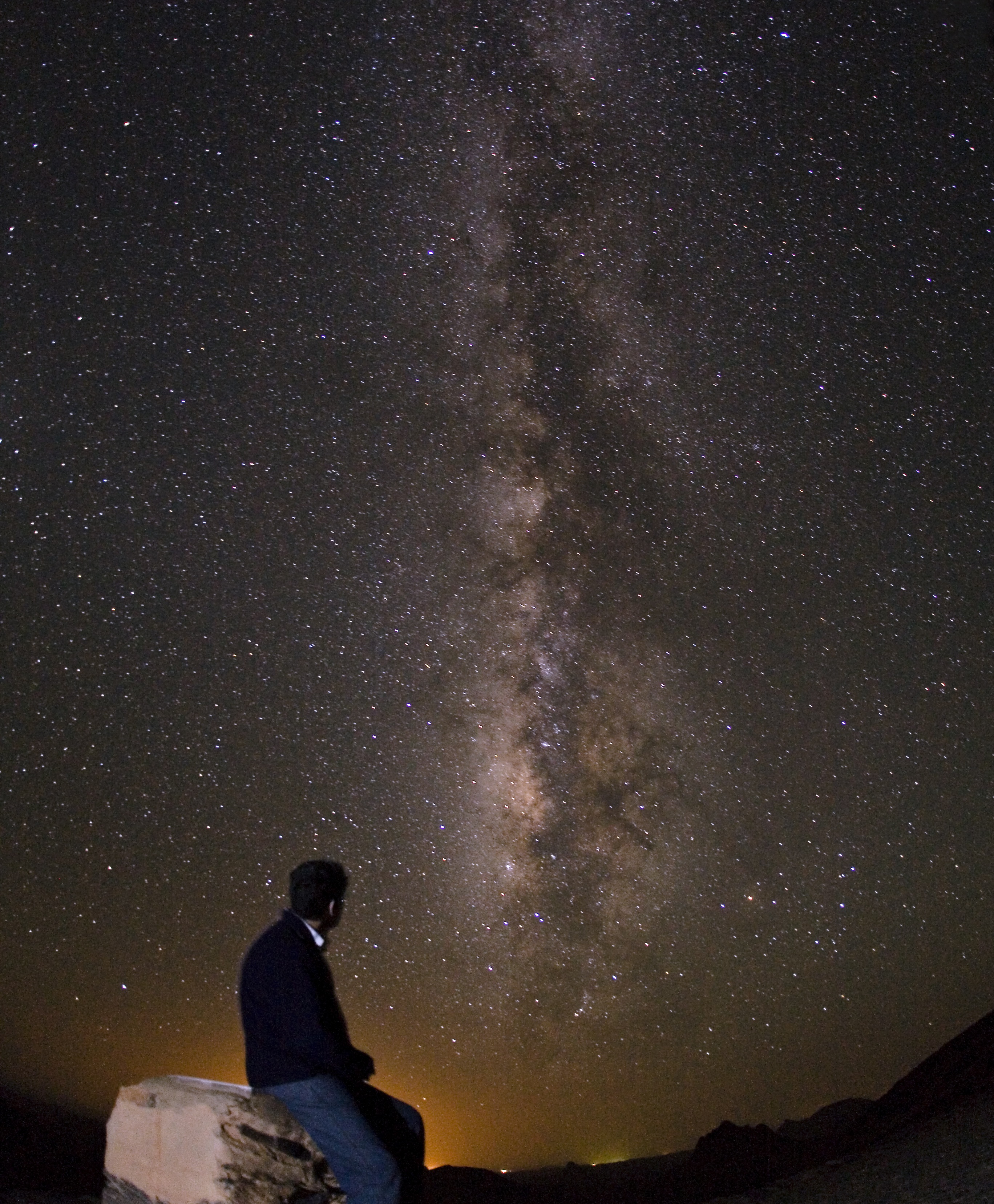
Our galaxy is set to merge with its closet neighbor four billion years from now, give or take:
Recent observations confirm that Andromeda is heading straight toward us at about 60 miles per second, and will traverse the 2.5 million light-year distance currently separating our galaxies in about four billion years. While the collision of two galaxies might conjure up images of mass devastation, the event will be largely imperceptible to our descendants, if any are still around. (They will have had to find another home: By that time, the increasing luminosity of our sun will have rendered Earth uninhabitable.) Galaxies are mostly empty space, so almost no stars or planets will actually collide.
Nonetheless, the Milky Way as we know it will cease to exist. Initially, the two galaxies will slide past each other and draw apart until gravity hits the brakes and pulls them back together. As Andromeda and the Milky Way merge, both will lose their disk-like structure, forming a single elliptical galaxy that some astronomers have dubbed “Milkomeda.”
(Photo: A stunning view of the Milky Way from Assekrem (meaning “the end of the world” in old local language) in the Hoggar Mountains, Sahara, southern Algeria. By Babek Tafreshi/SSPL/Getty Images)
Tyler Williams of Blanchester, Ohio selects marijuana strains to purchase at the 3-D Denver Discrete Dispensary in Denver, Colorado on January 1, 2014. Legalization of recreational marijuana sales in the state went into effect at 8am this morning. By Theo Stroomer/Getty Images.
John Banville reviews Isaiah Berlin’s third collection of letters, praising the philosopher as a man “unshakable in his commitment to his version of liberalism and what is called value-pluralism, ‘the conception that there are many different ends that men may seek and still be fully rational, fully men, capable of understanding each other and sympathizing and deriving light from each other'”:
IB was one of the great affirmers of our time, a man to be admired not only for his intellectual achievements but for his loyalty, his humor, his modesty, his delight in the world and the people in it. He was neither a temporizer nor a meliorist, yet all his thought was directed toward a humane estimation of life and its possibilities. Here he is, writing in 1969 to his friend Dorothea Head:
Nothing is less popular today than to say that there is no millennium, that values collide, that there is no final solution, that one can only gain one value at the expense of another, that whatever one chooses entails the sacrifice of something else—or that it is at any rate often so. This is regarded as either false or cynical or both, but the opposite belief is what, it seems to me, has cost us so much frightful suffering and blood in the past.
It was certainly unpopular—it still is—to say such things, but IB never faltered in his determination that they should be said, and said again.
Robots will neither be common nor very good in 2014, but they will be in existence. The I.B.M. exhibit at the [1964 World’s] fair has no robots but it is dedicated to computers, which are shown in all their amazing complexity, notably in the task of translating Russian into English. If machines are that smart today, what may not be in the works 50 years hence? It will be such computers, much miniaturized, that will serve as the ‘brains’ of robots. In fact, the I.B.M. building at the 2014 World’s Fair may have, as one of its prime exhibits, a robot housemaid – large, clumsy, slow-moving, but capable of general picking-up, arranging, cleaning, and manipulation of various appliances. It will undoubtedly amuse the fairgoers to scatter debris over the floor in order to see the robot lumberingly remove it and classify it into ‘throw away’ and ‘set aside.’ ”
Disgruntled by news of a forthcoming David Foster Wallace biopic starring Jason Segel, John Gallagher worries that popular perception is corrupting DFW’s influence:
Maybe things started to change when Wallace went viral. His commencement address to a Kenyon College graduating class in 2005 was a massive hit online. Published as This Is Water: Some Thoughts, Delivered on a Significant Occasion, about Living a Compassionate Life, it’s a pitch-perfect exhortation to mindfulness in everyday life, and a challenge to practice “simple awareness; awareness of what is so real and essential, so hidden in plain sight all around us, all the time”. And it’s beautiful.
But Wallace isn’t an aphorist. For me, what makes his fiction so good is that it’s hard – not “difficult” in an elitist sense, but just in that it wants you to work with him, to dig towards something half-remembered and hard to grasp and maybe, just maybe, true. The Wallace of This Is Water – and the Wallace of popular culture – is a fortune-cookie merchant: the artist as life coach.
This is why the idea of a Wallace movie makes me so uneasy. Not just because it’s insensitive, and not just because there’s no way it won’t get twisted into some awful, jarring morality tale about genius and suicide. It’s because a Hollywood DFW feels like the final step in the canonisation – or maybe the Cobainification – of David Foster Wallace.
Ze Frank’s commentary on the natural world wins silver for Mental Health Break:
Paul Krugman was close second for the Dick Morris Award. He was nominated for his remarkably incorrect 1998 prediction about the Internet:
The growth of the Internet will slow drastically [as it] becomes apparent [that] most people have nothing to say to each other…. By 2005 or so, it will become clear that the Internet’s impact on the economy has been no greater than the fax machine’s.
The Chart Of The Year runner up shows the damage global warming is doing:
Joe Romm looks ahead to the future implied by Andy Haveland-Robinson’s “death spiral” chart of Arctic Ocean ice coverage over time:
Ian Bogost’s thoughts on McRib nearly won the Dish’s award for bad writing:
The McRib is like Holbein’s skull: we experience it as (quasi-)foodstuff, as marketing campaign, as cult object, as Internet meme, but those experiences don’t sufficiently explain it. To understand McRib fully, we have to look at the sandwich askew. … The McRib’s stochastic return mcdonalds-mcribmakes visible the relationship between the eater and the McDonald’s menu. It produces a stain, a tear in the order of things that reveals the object-cause of desire for McDonald’s, but only briefly before it evaporates like faux-cartilage. The fragile conditions that make the McRib possible also insure that desire for McDonald’s food more generally speaking is maintained.
Desire is a delicate system. For Lacan, the lover “gives what he does not possess,” namely the objet a that incites desire rather than sustaining it. Likewise, McDonald’s sells what it does not sell: the conditions of predictability, affordability, and chemico-machinic automated cookery that make its very business viable. … Industrialism is also a kind of magic, the magic of the perfect facsimile. Eating at McDonald’s—eating anything whatsoever at McDonald’s—connects us to that magic, allows us to marinate inside it and take on its power.
This comment by Richard Cohen almost earned him the Malkin Award:
People with conventional views must repress a gag reflex when considering the mayor-elect of New York — a white man married to a black woman and with two biracial children. (Should I mention that Bill de Blasio’s wife, Chirlane McCray, used to be a lesbian?)
Earlier this year, Copyranter wondered the Cool Ad Of The Year runner-up was “the best gun control commercial ever produced”:
This ugly comment made North Carolina State Representative Larry Pittman runner-up for the Hewitt Award:
Someone had posted something with a picture of Barack Obama and across it said ‘traitor.’ And, you know, I don’t always agree with the guy, I certainly didn’t vote for him but I gotta defend him on this one. I just don’t think it’s right at all to call Barack Obama a traitor. There’s a lot of things he’s done wrong but he is not a traitor. Not as far as I can tell. I haven’t come across any evidence yet that he has done one thing to harm Kenya.
Ramesh Ponnuru was the Yglesias Award runner-up for this admission:
[Republicans] have no real health-care agenda. Voters don’t trust them to look out for middle-class economic interests. Republicans are confused and divided about how to solve the party’s problems. What they can do is unite in opposition to the Obama administration’s scandals and mistakes. So that’s what they’re doing. They’re trying to win news cycles when they need votes.
And second place for the Moore Award goes to Mike Malloy for this rant against Limbaugh:
This guy, this Limbaugh, this is one of the most vile human beings ever to live! If Limbaugh had the power, he would open gas chambers! If Limbaugh had the power, he would line people up against the wall and execute them! If Limbaugh had the power, he would destroy children because he can’t have any! The only thing he sees in children is sex partners! This is a sick, degenerate, evil man!
 that ranged from 120 to 240 square feet in area, and were clad in tons of mammoth bones. Out there on the treeless tundra, their occupants would have cooperated in hunting reindeer and other grazers that migrated seasonally through the area. The Mezhirich people dug pits in the permafrost that acted as natural “freezers” to preserve their meat and let them spend several months at a time in the “village.” With so much labor invested in the construction of their houses, it is hard to imagine that the Mezhirich folk did not somehow feel “at home” there.