How To Make Friends And Influence People: Spambot Edition

by Dish Staff

When researcher Luca Maria Aiello and colleagues at the University of Turin began to map out aNobii.com, an Italian social network similar to Goodreads, they created a user account for an automated crawler. They watched as the bot, named lajello, built social cred simply by “visiting” pages of other members, prompting the team to investigate the question, “Can an individual with no trust gain popularity and influence?”

The results surprised them. Every time lajello began its round of visits, it triggered a burst of comments on its public wall. When it finished its round, people quickly stopped sending messages but resumed at the same intensity when the bot started visiting again. By December 2011, lajello’s profile had become one of the most popular on the entire social network. It had received more than 66,000 visits as well as 2435 messages from more than 1200 different people.  In terms of the number of different message received, a well-known writer was the most popular on this network but lajello was second.

“Our experiment gives strong support to the thesis that popularity can be gained just with continuous “social probing”,” conclude Aiello and co. “We have shown that a very simple spambot can attract great interest even without emulating any aspects of typical human behaviour.”

The researchers then tested whether the bot had any influence over real people:

[T]hey started using the bot to send recommendations to users on who else to connect to. The spam bot could either make a recommendation chosen at random or one that was carefully selected by a recommendation engine. It then made its recommendations to users that had already linked to lajello and to other users chosen at random. Again, the results were eye-opening. “Among the 361 users who created at least one social connection in the 36 hours after the recommendation, 52 per cent followed suggestion given by the bot,” they say. …

It is not hard to see the significance of this work. Social bots are a fact of life on almost every social network and many have become so sophisticated they are hard to distinguish from humans. If the simplest of bots created by Aiello and co can have this kind of impact, it is anybody’s guess how more advanced bots could influence everything from movie reviews and Wikipedia entries to stock prices and presidential elections.

The Diseases We Neglect

by Dish Staff

Ebola

Charles Kenny remarks that new Ebola treatments are in the works only because “the Department of Defense had taken interest in the disease as a bioterror threat and was financing development of the drug ZMapp as a potential response”:

Ebola is the exception: Only a little more than 1 percent of new drugs approved between 1975 and 2004 were designed to address tropical diseases that account for more than 10 percent of the years lost to premature death and disability worldwide. Research and trials for tropical diseases focusing on cheap prophylactics, such as vaccines, and easily administered treatments for sufferers should be a priority for global support.

Funding is only part of the problem.

A lot of resources at the country level are wasted on doctors who don’t bother to diagnosehealth-care workers who don’t turn up, and expensive hospitals catering only to the elite. While the WHO has some significant accomplishments in global health—not least negotiating the International Health Regulations themselves and leading the fight to eradicate smallpox and polio—it is far from a paragon of effectiveness. The WHO has undertaken some reforms since then, but a 2011 U.K. government review of the organization suggested it was “weak” in some areas, from financial resource management through transparency to its focus on poor countries.

Jeremy Youde points his finger at thrifty governments rather than the WHO:

For an international organization tasked with overseeing global responses to health emergencies, WHO is woefully under-resourced. Over the past two years, the organization has seen its budget decrease by 12 percent and cut more than 300 jobs. The current budget saw cuts to WHO’s outbreak and crisis response of more than 50 percent from the previous budget, from $469 million in 2012-13 to $228 million for 2014-15. This is the very budget line that the organization needs to rely upon in order to respond to Ebola. After it announced it needed $71 million to implement its Ebola response plan, WHO now has to hope member-states or private organizations agree to contribute.

(Chart from Quartz.)

The Whitening Of Southern Politics

by Dish Staff

Jazon Zengerle’s TNR cover-story examines the state of racial politics in the South:

Because of increasingly racially polarized voting patterns in the South, party has become a stand-in for race. As University of California at Irvine law professor Rick Hasen recently wrote in the Harvard Law Review, “The realignment of the parties in the South following the Civil Rights movement of the 1960s has created a reality in which today most African American voters are Democrats and most white conservative voters are Republicans.” That means that, as Democrats have lost ground in statehouses in Alabama and elsewhere across the South, so have African Americans. According to research by David Bositis, in 1994, 99.5 percent of black state legislators in the South served in the majority. By 2010, the percentage had fallen to 50.5. Today, it’s a mere 4.8 percent.

Political scientists distinguish between descriptive representation and substantive representation. The former focuses on the number of, say, African Americans who are elected to a legislative body, while the latter focuses on the effect of those African American representatives on the legislation passed by that body. It was easy to see, by the early ’80s, that the Voting Rights Act had successfully achieved descriptive representation for African Americans in the Southern state legislatures. But, as time went on, it began to achieve substantive representation, as well. “There was a thirty-year period in the South, from about 1980 to 2010, where there really was biracial collaboration and cooperation in politics,” says Bositis. “And it was a genuine biracial politicsmore genuine than in some northern states.”

But nowadays, according to Zengerle, “the GOP-controlled governments of Southern states are behaving in ways that are at times as hostile to the interests of their African American citizens as Jim Crow Democrats were half a century ago”:

As David Bositis told me, “Black people in the South have less political power now than at any time since the start of the civil rights movement.”

Of course, that flies in the face of the newly popular notion that Southern blacks have never enjoyed more political clout. Whether it was black Mississippians helping Senator Thad Cochran win the Republican run-off in Mississippi in June or the potential for African American voters in North Carolina, Georgia, and Louisiana to carry Democratic Senate candidates in those states to victory this November, “black voters,” Nate Cohn recently wrote in The New York Times, “are poised to play a pivotal role in this year’s midterm elections.” But these will likely be pyrrhic victories. At the state level, Republicans can continue to win by catering exclusively to white voters, pushing the parties even further apart and making state laws ever more extreme. The fact that black people in the South still have the right to vote, and they’re still able to elect black politicians at the state and local levels, is what makes the end of the Second Reconstruction so much more insidious than the end of the First. Lacking white politicians to build coalitions with, those black politicians are rendered powerless. As Kareem Crayton, a University of North Carolina law professor, told me, “The situation today has the semblance of what representation looks like without very much ability to actually exercise it.”

Chart Of The Day

by Dish Staff

Marijuana Use

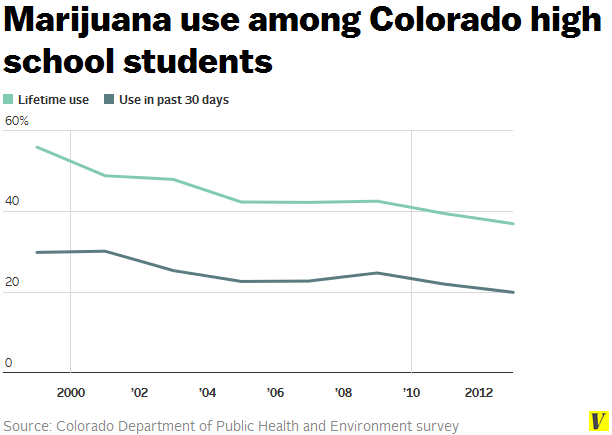
The legalization of marijuana in Colorado has coincided with fewer teens using the drug:

About 20 percent of teens surveyed by the Colorado Department of Public Health and Environment (CDPHE) said they had used marijuana in the past 30 days in 2013, down from 22 percent in 2011. The survey also found a decline in reported lifetime use, from 39 percent in 2011 to 37 percent in 2013. CDPHE said the declines were not statistically significant. But previous data suggests the drops are part of a longer-term trend that began even before Colorado voters approved the legalization of medical marijuana in 2000.

Sullum analyzes the report:

It is still possible, of course, that legal recreational sales, which began in Colorado only this year, will increase teenagers’ access to marijuana (not through direct sales but through diversion from adult buyers), which might lead to an increase in consumption. Colorado officials express a somewhat different concern. According to a press release from the health department, “Health experts worry that the normalization of marijuana use in Colorado could lead more young people to try it.” In other words, they worry that allowing adults to legally purchase marijuana for recreational use will encourage teenagers to take a more positive view of cannabis, which will make them more likely to use it. Call it the “permitted fruit” effect. Prohibitionists such as former drug czar Gil Kerlikowske raised the same complaint against medical marijuana laws, but their fears seem to have been misplaced.

Are We Still Torturing?

by Dish Staff

Nico Hines and Sami Yousafzai pass along a disturbing new Amnesty International report indicating that the US military “has systematically covered up or disregarded “abundant and compelling evidence” of war crimes, torture, and unlawful killings in Afghanistan as recently as last year”:

[The report] includes detailed investigations of 10 incidents in which at least 140 civilians, including 50 children, were killed in dubious circumstances. In the aftermath of nine of these, eyewitnesses and families report that no one was ever interviewed by the U.S. military. … Among the most disturbing allegations are claims of forcible disappearance, torture, and extrajudicial killings carried out by a rogue unit in Wardak province from the fall of 2012. “We interviewed a former detainee that had a really horrific story of just raw torture,” [report author Joanne] Mariner said. “It’s not only the testimony of this former detainee but a lot of bodies were found showing horrendous crimes of torture—people missing body parts and people whose corpses were badly mutilated.”

One of 125 victims and eyewitnesses interviewed by Amnesty in compiling this report was Qandi Agha, 51, an employee at the provincial Ministry of Culture, who says he was captured by U.S. forces who broke into his home and spirited him away to a dark wooden cell. “On the first night,” he said, “the Americans told me they were going to try 14 different types of torture on me. If I survived, they said, they’d let me go.”

He said he suffered electric shocks, beatings, simulated drowning, hanging from the ceiling, partial burial in freezing conditions, and the extraordinary and degrading torment of having a length of string tied tightly around his penis. “They left the string around my penis for four days. My abdomen was bulging. I wasn’t able to pee for those four days,” he said.

He was lucky. He says half of the men he was incarcerated with did not survive the ordeal, and he claims to have watched one man be beaten to death by a redheaded American commando.

Introductions

by Dish Staff

Please give a warm welcome to our first two guest-bloggers for the month while Andrew is away (read his departing message here if you missed it). Various Dish staffers will chime in occasionally but the lion’s share of original content will be provided by our featured writers, who will change weekly. Please continue to send all your comments and dissent to the main Dish inbox at dish@andrewsullivan.com. Here’s a brief intro from Phoebe Maltz Bovy:

photo (1)

Hi, Dish readers! I’m Phoebe, Dish intern and, this week, guest-blogger. I blog at What Would Phoebe Do and have written some other places as well. I have a Ph.D. in French and French Studies from New York University, and will womansplain to all who’ll listen about pre-Portnoy Jewish intermarriage, the Dreyfus Affair, and anything else relating to nineteenth-century French Jews. My free time is spent walking a squirrel-obsessed miniature poodle, cooking elaborate Japanese meals (or trying), and watching 1990s British sitcoms.

And here is Elizabeth Nolan Brown’s intro:

esme

Hi, Dish readers! I’m Elizabeth. I’ll be guest-blogging here this week alongside Phoebe (whose gratuitous poodle pic has inspired the kitten photo). We blogged together once before, way back in 2008, at a short-lived “conservative feminists” blog. It was the first time I’d ever been called a conservative, but they let me in by virtue of my libertarianism. (I don’t presume to label Phoebe ideologically, but we were both on the more socially-liberal side of things there.) Flash forward to 2014, and I still embrace the “libertarian” and “feminist” labels. I offer this by way of shorthand for what you can expect from me this week.

I’m now a staff editor at Reason, where I write about things like civil liberties, reproductive rights, sex work, criminal justice reform, millennial politics, and food and drug policy. I came there from, most recently, a stint on the women’s blog circuit and a brief-ish love affair with health writing. I’m psyched to be blogging here at The Dish this week (thanks, Andrew and gang, for having me!) and hope you won’t mind it too much either. And do follow me on Twitter @enbrown if you’re so inclined. Cheers!

Getting Broadband A Nanny?

by Dish Staff

In an interview with Rose Dwyer, Astra Taylor explains why she argues for more government regulation of the Internet in her book The People’s Platform:

In the book I challenge the techno-libertarian insistence that the government has no productive role to play and that it needs to keep its hands off the Internet for fear that it will be “broken.” The Internet and personal computing as we know them wouldn’t exist without state investment and innovation, so let’s be real. Related to this, there’s a pervasive and ill-advised faith that technology will promote competition if left to its own devices (“competition is a click away,” tech executives like to say), but that’s not true for a variety of reasons.

The paradox of our current media landscape is this: our devices and consumption patterns are ever more personalized, yet we’re simultaneously connected to this immense, opaque, centralized infrastructure. We’re all dependent on a handful of firms that are effectively monopolies — from Time Warner and Comcast on up to Google and Facebook — and we’re seeing increased vertical integration, with companies acting as both distributors and creators of content. Amazon aspires to be the bookstore, the bookshelf, and the book. Google isn’t just a search engine, a popular browser, and an operating system; it also invests in original content, having opened video-production studios in various cities, and offered fiber-optic broadband in select cities, not to mention all of its other endeavors and acquisitions, including robotics, home appliances, satellites, you name it.

So it’s not that the Internet needs to be regulated but that these big tech corporations need to be subject to governmental oversight. After all, they are reaching farther and farther into our intimate lives. They’re watching us. Someone should be watching them.

What The Hell Is Maliki Doing?

by Dish Staff

Baghdad’s political crisis appears to have gone off a cliff, with the embattled prime minister in the driver’s seat. Mary Casey sums up the news since yesterday:

Maliki has accused the country’s new president, Fouad Massoum, of staging a “coup against the constitution and the political process” for refusing to designate him prime minister. On Monday, Massoum asked Deputy Speaker Haider al-Abadi to form a government. U.S. Secretary of State John Kerry said the United States supports Massoum and warned Maliki not to interfere with the constitutional process and the formation of a new government. However, an Iraqi court ruled that Maliki’s State of Law coalition is the largest bloc in parliament and should be given the first opportunity to form a new government. Meanwhile, the United States has begun to directly provide arms to the Kurdish pesh merga forces who are battling Islamic State fighters in northern Iraq. The U.S. administration had previously sold weapons only to the Iraqi government in Baghdad. U.S. airstrikes over the weekend have helped the pesh merga to retake the towns of Gwer and Mahmour.

Maliki has not only threatened to sue Massoum for neglecting his constitutional duties, but has also deployed security forces loyal to him throughout Baghdad, ostensibly to forestall a coup against him but more likely, some fear, to be ready to carry one out on his behalf (NYT):

As he spoke in the middle of the night, extra security forces, including special forces units loyal to Mr. Maliki, as well as tanks, locked down the Green Zone and took up positions around the city, heightening the sense of drama. There were no immediate signs Monday afternoon that Mr. Maliki had taken further steps to use military force to guarantee his survival. And Mr. Maliki was scheduled to make a public statement on television, along with other members of his Dawa Party who remain loyal to him. Mr. Maliki’s television appearance, in which he appeared to be trying to intimidate Mr. Massoum by mentioning the army in the context of protecting the constitution, alarmed American officials, and left Baghdad wondering if a coup was underway.

To Zack Beauchamp, this kind of strongman behavior perfectly illustrates the point Obama made in his Saturday press conference that the only permanent solution to the crisis is an Iraqi political solution. After all, Maliki’s heavy-handed dealings with Iraq’s Sunni minority played a major part in enabling the rise of ISIS:

“The Sunnis have lots of different grievances,” Kirk Sowell, a political risk analyst and expert on Iraqi politics, says. Some of these are the current government’s fault. Prime minister Maliki has treated the Sunnis badly, including forcibly breaking up a peaceful protest movement in 2013. His seemingly authoritarian turn on Sunday shows just how far Maliki remains from moving towards a more inclusive style of governance. …

While these grievances of course don’t transform Iraqi Sunnis into ISIS-style theocrats, it does make Sunni communities more open to at least seeing if ISIS will be better for them than Baghdad. And so long as ISIS has at least passive support from the Sunni population, it will be almost impossible for the Iraqi government to dislodge them from the mostly Sunni territory they hold.

This behavior has even invited comparisons to Bashar al-Assad:

“The Assad approach” is how Maliki’s detractors, both rival politicians in Baghdad and civilians caught up in the government’s fight against Sunni militants, describe the Iraqi leader’s military strategy, comparing the men’s use of military force to address internal social and political problems. In Syria, Assad’s use of military force in response to popular protests, some argue, was partially to blame for how the originally peaceful protests morphed into an armed uprising that eventually created a security vacuum in which al Qaeda-inspired militants flourished. Some Iraqis say the same is true of Maliki’s decision to clear the Ramadi protest [in January]. Some Syrians say so, too. “Sometimes I laugh when I see this Iraqi dictator following Assad’s footsteps,” said Omar Abu Leila, a spokesman for the Free Syrian Army’s Eastern Front.

Ed Morrissey throws up his hands:

Kerry’s bluster aside, the US has no real influence in Baghdad any longer, which the White House made clear with its earlier unmet demands for political reform as a prerequisite for intervention. Maliki made it official last night. The only option left to the US is to arm the Kurds to get an effective fight against ISIS, and apparently leave Baghdad to Iran. If Masum can wrest power away from Maliki and get a Shi’a PM who can work with Kurds and Sunnis, that would be terrific — but he might have to fight through Maliki’s elite forces and Moqtada al-Sadr’s irregulars to have a chance now, and the US endorsement will hardly be a boon to that cause.

And Josh Marshall takes this moment to revisit the question of whether the unitary Iraqi state is worth trying to preserve:

Many of you will rightly say, this is hardly our decision. And I agree with that. But our policy inevitably looks toward and tries to shape what we see as the preferred outcome. The US and Europe tried to keep Yugoslavia together until it obviously couldn’t be kept and then we gave up trying. At the moment we’ve kept our closest friends, the Iraqi Kurds, on a tight leash and actually have a tanker of their oil held off the coast of Texas, all to help along the move toward unity in Baghdad, which Maliki seems set on preventing.

We’re told that Maliki missed the opportunity he was given with the Sunni Awakening in 2007-08 and went back to a Shia sectarian approach to governance, in essence triggering another uprising on the order of the one from the last decade, just now in a different guise and turbocharged by the immolation of Syria. This is no defense of Maliki. But what if he’s just the symptom – the symptom of a state that can’t be held together without the tyrannical grip we liberated it from more than a decade ago?

Erdogan Pulls A Putin

by Dish Staff

In yesterday’s vote, current Turkish Prime Minister Recep Tayyip Erdogan decisively won his election for Turkey’s presidency, a position which is which normally is “largely ceremonial.” Alexander Christie-Miller explains the situation:

Erdogan has insisted on the campaign trail that he will not overstep the role’s constitutional powers, but members of his Justice and Development Party have fallen over themselves to make clear that he will remain, in effect, the leader. … A loyal placeholder will occupy the role of prime minister, allowing Erdogan to remain in effective control, in a manner similar to Dmitry Medvedev’s one-term puppet presidency for Vladimir Putin in Russia, according to Sinan Ulgen, chairman of the Istanbul-based Center for Economics and Foreign Policy Studies.

“For all practical purposes, he will be trying to be both president and prime minister,” says Ulgen.

Cenk Sidar casts doubt on whether Erdogan’s scheme will go as planned:

By far the biggest roadblock on Erdogan’s path toward the accumulation of greater power, however, is the parliamentary election next summer. In order to give the new presidential office the broad powers he wants, Erdogan will need to change the constitution — and that requires a clear majority for his coalition in parliament. The governing coalition will be able to amend the constitution outright if it has two-thirds of the seats in parliament (367); a three-fifths majority (330) will be enough to pass amendments that must then be approved in a national referendum. In Turkey’s last parliamentary election in 2011, the AKP fell just short of the two-thirds threshold. But this time, post-Gezi Park, Erdogan and his allies will be facing the legacy of an unprecedented year-long wave of national discontent. Turkish civil society has been galvanized by Erdogan’s power grab, and the effects are likely to have a discernible effect on the elections.

But, according to Piotr Zalewski, changing the constitution might not be necessary:

The current document, say some legal experts, already gives him enough power to do so. Enacted in the aftermath of an army coup, Turkey’s constitution allows the President to chair Cabinet meetings, veto laws, issue governmental decrees and decide on the internal rules of the national parliament, says Riza Turmen, an opposition lawmaker and a former judge of the European Court of Human Rights. “He can decide to call early elections, he appoints the head of the general staff, the members of the board of higher education, rectors of state universities, members of the Constitutional Court, and [some] members of the Supreme Board of Judges and Prosecutors,” says Turmen.

Turkish Presidents, including Abdullah Gul, Erdogan’s predecessor, have heretofore refrained from using the full range of these powers. “But Mr. Erdogan is a different case,” says Turmen. “One difference is that he will be the first directly elected President of Turkey. The other is character. He wants to control everything.”


Halil Karaveli contends that Turkey’s business community won’t tolerate Erdogan’s growing authoritarianism:

In Turkey, the relationship between the state — the military and the bureaucracy — and the business community has been symbiotic. Business interests have been paramount; the state has looked after them since the founding of the republic. Moreover, Turkey’s integration in the global economy since the 1980s has made the state even more sensitive to the dynamics of capitalism. Over time, however, the relationship between economic political freedoms has changed. In 1980, business interests were served by an authoritarian regime. Two decades later, however, business had come to have a vested interest in democratization. Economic necessities forced the Turkish government to introduce political liberalization, in order to gain the confidence and support of the European Union.

Meanwhile, Michael Koplow and Steven Cook look at the role of religion in Turkish politics. They argue that “the secular old guard has lost the battle with the political forces that represent piety and religious conservatism”:

The AKP’s success has been built on many factors besides for an appeal to religion, including nationalism, economic growth, and regional political power. Even if a majority of AKP voters—in the last parliamentary elections AKP voters represented a majority of the country—do not vote for AKP primarily because of its religious appeal, they are nevertheless made comfortable by the religious sensibility that the party conveys. The CHP and MHP have finally bowed to the demands of the electorate and through Ihsanoglu have communicated that they understand this message. The dividing lines in the presidential race have nothing to do with religion, but rather revolve around the role of the state, Turkey’s place in the West, its treatment of minorities, and economic inequalities. Those looking for staunch defenders and guardians of a secular tradition that never really existed to begin with are fated to be eternally disappointed.