John Rizzo’s Decision To Commit A War Crime

The former CIA lawyer claims he could have prevented the agency from torturing people. Why he didn’t:

I couldn’t shake the ultimate nightmare scenario: another attack happens, and Zubaydah gleefully tells his CIA handlers he knew all about it and boasts that we never got him to tell us about it in time. All because at the moment of reckoning, the Agency had shied away from doing what it knew was unavoidable, what was essential, to extract that information from him. And with hundreds and perhaps thousands of Americans again lying dead on the streets or in rubble somewhere, I would know deep down that I was at least in part responsible. In the final analysis, I could not countenance the thought of having to live with that.

Psychologically, you can understand this dynamic. I think it explains a lot about how men like Rumsfeld and Cheney adopted the methods of the Communist Chinese in torturing prisoners under American control. But Rizzo knows better. The very premise is wrong. Both one internal CIA review and the Senate Intelligence report found that the resort to torture helped our intelligence gathering not one bit – which is why, of course, both reports remain unavailable for public perusal and study and, if they do come out, will probably have John Brennan’s massive Sharpie blocking out the actual totalitarian-style horrors the US succumbed to.

Besides, torture in all the gruesome varieties deployed by George W Bush across every single theater of the war is relevant to the top lawyer at the CIA for one reason: to judge if they are legal or not. That’s all Rizzo should have concerned himself with. And they were of course illegal – outlawed most categorically in every single form by Ronald Reagan in the UN Convention Against Torture. The language of that legally binding treaty allows for no nuance, no wiggle room, and certainly no EITs. Some choice quotes:

Torture means any act by which severe pain or suffering, whether physical or mental, is intentionally inflicted on a person for such purposes as obtaining from him or a third person information or a confession … No exceptional circumstances whatsoever, whether a state of war or a threat or war, internal political instability or any other public emergency, may be invoked as a justification of torture.

How does a lawyer defend openly breaking such a law? Why hasn’t he been disbarred? And this “lawyer” was knee deep in overseeing and authorizing the torture of the most brutal kind:

Rizzo traveled with David Addington, the Vice President’s chief of staff; William Haynes, General Counsel of the Department of Defense; and Michael Chertoff, then the head of the Criminal Division of the Department of Justice, to consult with officers at the Guantanamo Bay detention camp in late September 2002. One week later, a CIA lawyer told personnel with the military intelligence interrogation team at Guantanamo that, “if the detainee dies, you’re doing it wrong.”

Again, I do not know why a war criminal like this – a man who destroyed the rule of law when his job was to uphold it – is still treated with anything but horror in this country’s elite.

And, of course, you see his own defense of the indefensible with the usual diversion (one used by David Gergen in a recent debate on AC360 Later): Rizzo says he finds it “ironic” that it “is far less legally risky, and in many quarters considered far more morally justifiable, to stalk and kill a dangerous terrorist than it is to capture and aggressively interrogate one.” When you put it like that, of course he’s right. But if you change “aggressively interrogate” a prisoner with “torture”  prisoner, as Orwell would note, it reads differently.

As a brief reminder, here’s what such “aggressive interrogation” meant, under the authority of General Stanley McChrystal in the US torture Camp Nama:

[The prisoner] was stripped naked, put in the mud and sprayed with the hose, with very cold hoses, in February. At night it was very cold. They sprayed the cold hose and he was completely naked in the mud, you know, and everything. [Then] he was taken out of the mud and put next to an air conditioner. It was extremely cold, freezing, and he was put back in the mud and sprayed. This happened all night. Everybody knew about it. People walked in, the sergeant major and so forth, everybody knew what was going on, and I was just one of them, kind of walking back and forth seeing [that] this is how they do things.

But Rizzo, having given the green light to these moral outrages, doesn’t expect torture to return:

I can’t imagine the Agency ever again coming close to running detention facilities or engaging in any sort of even mildly coercive interrogation practices. Given the enduring controversy over the legacy of “waterboarding” and “black sites”—the widespread vitriol generated by the popular 2012 film Zero DarkThirty is but one example of this phenomenon—I can’t see any president ever reopening that can of worms. What’s more, no CIA director in his or her right mind would ever let the organization go down that path again. To do so would be beyond folly. I don’t think even another catastrophic 9/11-like attack will change that.

I would respectfully predict that future presidents will not only continue to be in the business of killing, but will double down on it. And that the CIA will salute the commander in chief and be in the middle of it, without hesitation or resistance.

One small point. In just war theory, it is permissible to kill an enemy combatant in self-defense in wartime. There is no justification in just war theory for capturing a human being and torturing him. It is always and everywhere evil.

Previous Dish on Rizzo’s new book is here and here.

(Thumbnail image: Project on Government Oversight)
Exit Cheney, Far, Far Right

Former Vice President Dick Cheney is int

The end of Liz Cheney’s misbegotten act of arrogance and entitlement (trying to unseat a well-liked Senator Mike Enzi) may well be the end of her political career. I can’t see how she wins Wyoming back after this opportunist debacle. But it also appears plain that the reason cited is a genuine one – some crisis in her family – and she deserves some privacy and time to deal with it, and support for putting family first.

But can we please, please find a way to limit the role of pure nepotism in American politics? I know it’s as old as the republic, but it’s just one of those weird, strange things in a country of well over 300 million people, with a robust and rowdy political scene, that it picks the sons and daughters or wives of previous pols and just keeps running them, like mini-royals. It’s even worse in Liz Cheney’s case because much of her agenda is designed (like much of her father’s classless public eruptions these past five years) to maintain a legacy for the former vice-president that isn’t just presiding over the worst national security breach since Pearl Harbor, losing two wars at massive expense, and committing blatant war crimes and bragging about them.

I don’t think the voters of Wyoming should have their Congressional representation hijacked to protect one of the worst vice-presidents in history from getting the historical obloquy he so richly deserves. I’m sorry if that sounds cruel. But I’m not proposing to mock-bury Cheney in a tiny box or string him up like a carcass in an abattoir to make his very existence a living hell. That’s his mojo – and his daughter’s.

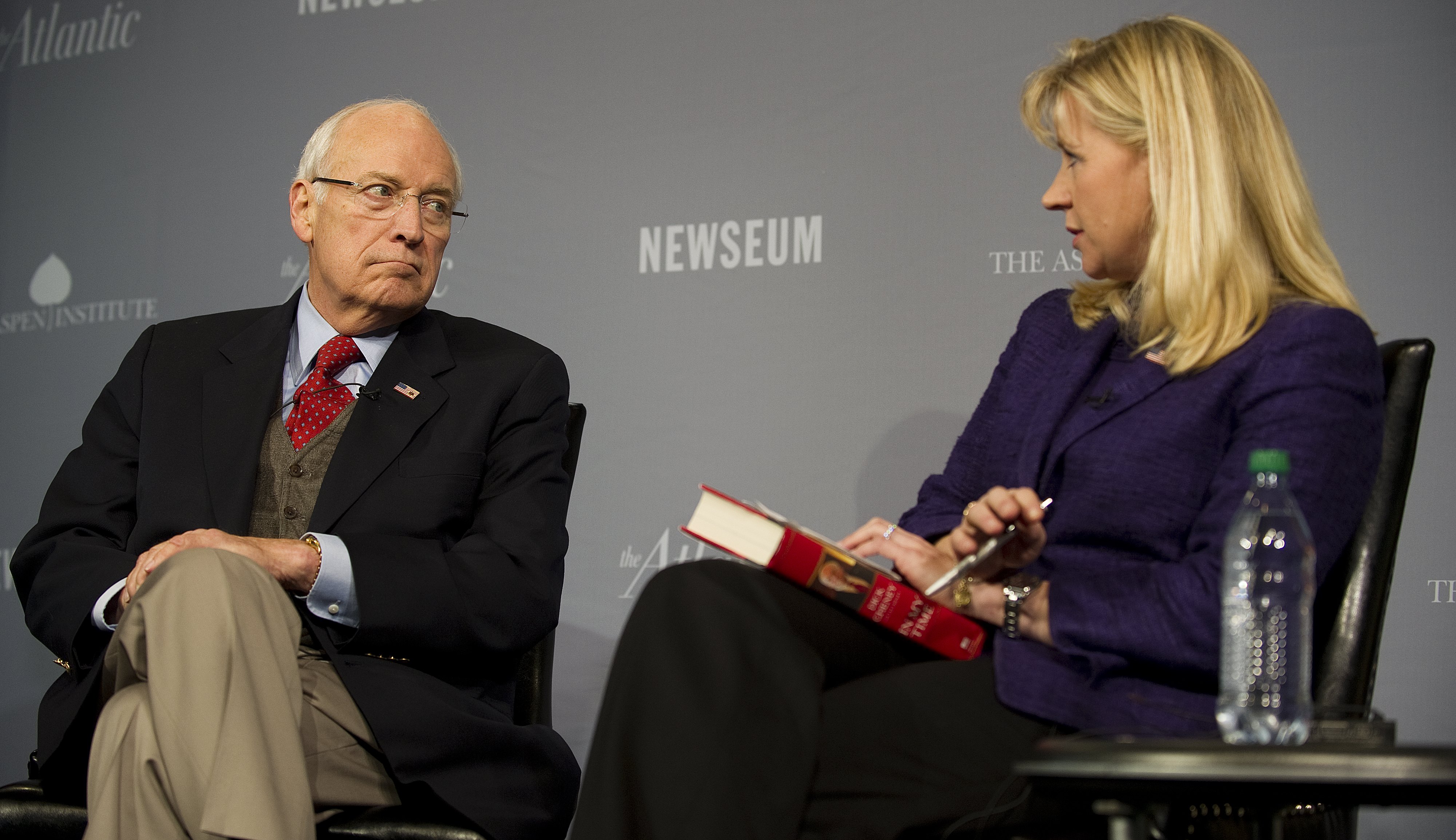
(Photo: Former Vice President Dick Cheney is interviewed by his daughter Liz during the 2011 Washington Ideas Forum at the Newseum in Washington, DC, October 6, 2011. By Jim Watson/AFP/Getty Images.)

Talking Heads For Prohibition

Scarborough repeats tired, intellectually lazy arguments against the legalization of marijuana:

You’ll notice a few things about this inane discussion. There is close to zero informed understanding of marijuana, its physical and psychological effects. You don’t find discussions about how marijuana hurts the adult mind or how it’s as addictive and socially disruptive as alcohol (because those arguments disintegrate as soon as you try to substantiate them). There is a completely anecdotal premise that a drug used by the last three presidents – and countless truly creative and accomplished people – simply makes everyone “dumb.” You’ll notice above that the entire smug boomer crew on Scarborough’s show has no real response to the point that alcohol can also make you dumb (and violent and out-of-control). They dismiss that scenario if you drink alcohol in moderation. So why not pot in moderation? But my point is this: they haven’t even gotten past that basic stage of the debate because they haven’t spent more than a few seconds mulling it over. To wit:

That should be “our being a fatter, dumber, sleepier …” But I guess a little weed is what’s going to kill off grammar.

Almost all the anecdotes, moreover, are from the distant past and are about white, teenage or college use (something legalizers are keen to discourage). Little data are presented; no specific social harms are identified. In other words: cable news. The other thing I notice is something I saw very early on when a whole bunch of pundits realized they had to say something to oppose gay marriage. These people simply don’t know a lot about the subject, do not regard it as serious enough to be better informed, and offer arguments that are so weak or irrelevant to the central question that they are setting themselves up for total failure in this debate. I give you Ruth Marcus:

Please do not argue that Colorado’s law, like those proposed elsewhere, bans sales to those under 21. Ha! I have teenage children. The laws against underage drinking represent more challenge to overcome than barrier to access. And although alcohol seems to be the teen drug of choice among the adolescents I know, the more widely available marijuana becomes, the more minors will use it. If seniors in fraternities can legally buy pot, more freshmen and sophomores will be smoking more of it.

This would make sense if not for one fact: teens have said for years that marijuana is currently easier to get than alcohol. Prohibition has made it so. All of which is a warm-up for David Brooks’ column today, reminiscing about his former pot-smoking and adding a moral disapproval to pot he would never assign to alcohol:

Laws profoundly mold culture, so what sort of community do we want our laws to nurture? What sort of individuals and behaviors do our governments want to encourage? I’d say that in healthy societies government wants to subtly tip the scale to favor temperate, prudent, self-governing citizenship. In those societies, government subtly encourages the highest pleasures, like enjoying the arts or being in nature, and discourages lesser pleasures, like being stoned.

In legalizing weed, citizens of Colorado are, indeed, enhancing individual freedom. But they are also nurturing a moral ecology in which it is a bit harder to be the sort of person most of us want to be.

But what if pot enhances the higher pleasures – like listening to or making music, or appreciating fine wine or great food? And why doesn’t alcohol fit squarely into the same category? Millions of grown adults (not giggly teens) use the drug the way others use alcohol – with far less socially damaging or physically dangerous effect. What David doesn’t do either is address the real issue at hand: the social costs of prohibition versus the social costs of legalization. On that note, Matt Welch fires back at Brooks:

“Healthy societies” don’t throw millions of people into human meat lockers to satisfy the moral urges of social engineers. It is “a bit harder to be the sort of person most of us want to be” after you go to jail for engaging in the same recreational activity as a teenage David Brooks. The “moral ecology” got a whole better on Jan. 1, and will get better still when people stop using the criminal code as a laboratory experiment on their fellow human beings.

Gary Greenberg, who’s the full-on stoner whose life was apparently ruined in Brooks’ column, joins the conversation [Update: Greenberg clarifies: “What follows here is satire of the Juvenalian variety. I thought I embedded enough tipoffs, but then again I forgot how much stranger than fiction truth can be. So to those who thought it was real and suffered pain as a result, I apologize.] Tom Chivers calls Brooks’ column “startlingly smug, patronising and complacent”:

[W]hat I will say is this: notice that, in David Brooks’s youthful experimentation, his “been there, done that” memoirs, in which no real harm is done to him by this relatively safe drug, there is not a section in which he is arrested, imprisoned for possession, given a criminal record and barred from several professions later in life. And in fact most of these “I took drugs in my youth, but it was a youthful indiscretion, and I regret it, so we shouldn’t legalise them” memoirs are all similar in a noticeable way: they’re written by successful people whose lives weren’t ruined by a criminal prosecution. That’s the “subtle tip of the scale”, that’s the way the government apparently “encourages the highest pleasures”: by locking up people and destroying their future lives.

Matt Lewis adds:

Brooks’ column only serves to prove that many kids will quit on their own, and — in any event — the experience won’t stop them from going on to be highly successful pundits. In fact, the only way his marijuana use might have hurt Brooks (and possibly ruined his life) would have been if he had been arrested. And that danger is now almost completely out the window in Colorado. And so, we are left with a very well-written and thought-provoking column that ultimately fails to make a coherent argument.

Nicole Flatrow also focuses on arrests:

If you’re black in America, you’re four times more likely to be arrested for marijuana, even though all races use marijuana at the same rate. In some states, the disparity is as high as 8 to 1. The overwhelming majority of these arrests are for possession. If you’re poor and black, or if you live in a particular inner city neighborhood, your arrest is a near certainty.

Lastly, a lone Brooks defender: Dreher wishes legalization supporters would treat Brooks, and those like him, more civilly:

I hate the way many liberals and libertarians are so zealous about the issue, in a way that shuts down deliberation. Somebody on my Twitter feed today said that pot legalization is for the left what guns are for the right: the issue on which there can be no legitimate dissenting position.

I sure hope I’ve treated David’s arguments, such as they are, civilly. Ditto my friend David Frum’s. I know they are well-intentioned, and the idea that there can be no cost to ending prohibition is silly. The real argument is that the benefits of legalization far outweigh the costs – an argument David simply doesn’t address. I wish he would. I also wish that every pundit who writes about their youthful folly would do us a favor and research the current state of marijuana use and production, examine the far more sophisticated mixtures of CBD and THC, of sativa and indica, that this amazing plant is now grown to produce, and would acknowledge the medical uses of pot, which research is beginning to show are bewilderingly manifold. I wish they would not insult so many of their fellow adults and fellow citizens by arguing that their pleasure of choice is simply a way to be “dumb.” Calling those who disagree with you dumb is not that civil.

The Pope Speaks; The GOP Flails

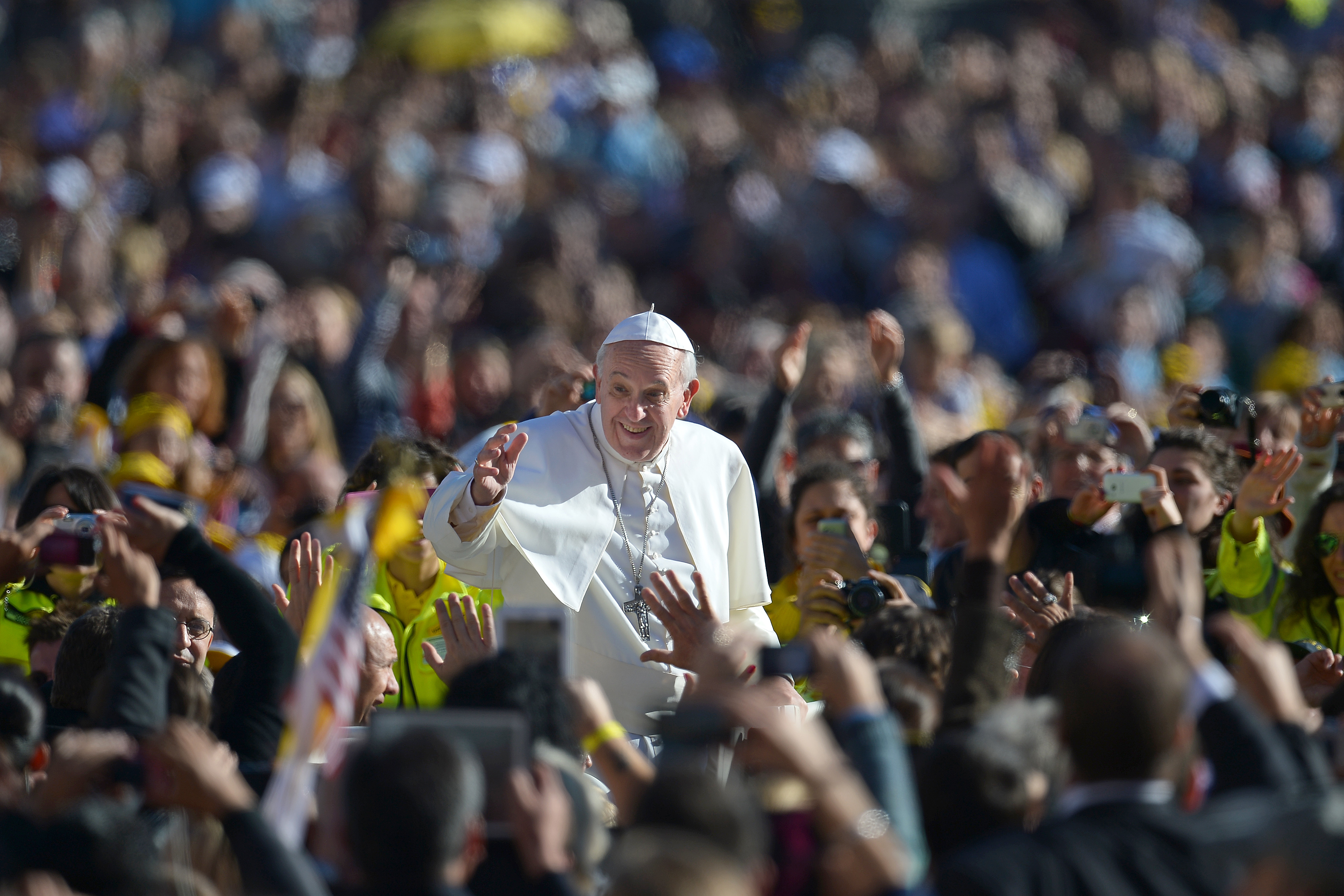
VATICAN-RELIGION-CHRISTIANITY-POPE-AUDIENCE

The new line, deployed against Pope Francis’ dismay at the materialism and ideological fixity of global market capitalism, is that the Pope was only referring to Argentina. Global capitalism in Argentina, according to the theocons and neocons, is so different than in the United States that Pope Francis’s critique is simply a regional one. In Argentina, he’s only referring to crony capitalism, entwined with government, combined with an entrenched lack of social mobility. If the Pope were to understand American capitalism better, he’d realize it was a truly free market, empowering social mobility, creating wealth and disseminating it on a massive scale. On CNN last week, that was essentially Newt Gingrich’s argument against the Pope’s Apostolic Exhortation (which I explore in considerable detail here).

A mega-rich donor to the American Catholic church is so offended by the Pope’s words on the importance of poverty that he is allegedly hesitant to pay for a large amount of the restoration of Saint Patrick’s Cathedral. Cardinal Dolan, the reactionary now left stranded by the new papacy, has struggled to rebut the implications of the Pope’s somewhat unequivocal words. Arthur Brooks, a Catholic running the American Enterprise Institute that favors torture, unfettered global capitalism, and pre-emptive war, makes the case as succinctly as he can:

Arthur Brooks … said he agrees that the pope’s beliefs are likely informed by his Argentine heritage. “In places like Argentina, what they call free enterprise is a combination of socialism and crony capitalism,” he said. Brooks, also a practicing Catholic who has read the pope’s exhortation in its original Spanish, said that “taken as a whole, the exhortation is good and right and beautiful. But it’s limited in its understanding of economics from the American context.” He noted that Francis “is not an economist and not an American.”

So America is so unlike Argentina that the Pope should not be taken seriously. The trouble with this assessment is that the Pope clearly was not restricting himself to Argentina in his Exhortation. His remit was much wider. Here’s a critical passage and it’s quite clear that the Pope is referring not to a single country but to the ideology of a global system, rooted in the economy of the United States and its unipolar power since the end of the Cold War:

The current financial crisis can make us overlook the fact that it originated in a profound human crisis: the denial of the primacy of the human person! We have created new idols. The worship of the ancient golden calf (cf. Ex 32:1-35) has returned in a new and ruthless guise in the idolatry of money and the dictatorship of an impersonal economy lacking a truly human purpose. The worldwide crisis affecting finance and the economy lays bare their imbalances and, above all, their lack of real concern for human beings; man is reduced to one of his needs alone: consumption. While the earnings of a minority are growing exponentially, so too is the gap separating the majority from the prosperity enjoyed by those happy few.

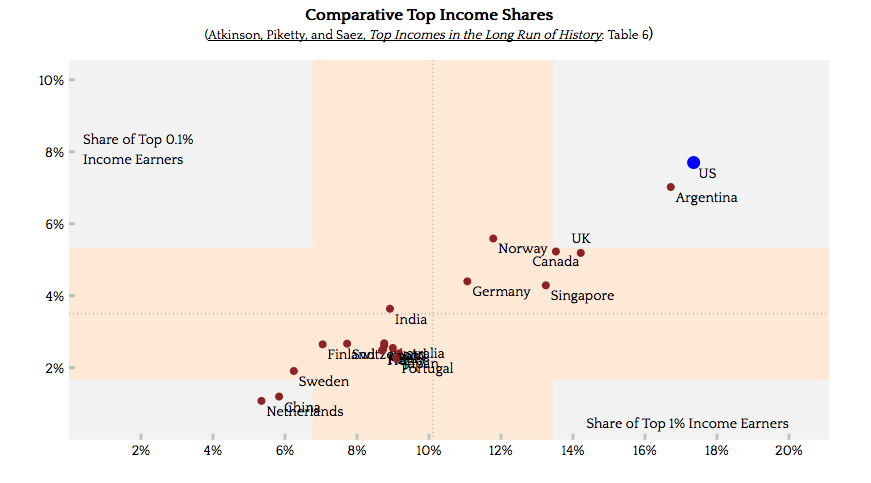
The question is: is this only true of Argentina and not of the US, as Arthur Brooks and Newt Gingrich claim? Let’s take a look at each countries’ one percent, and then the top 0.1 percent, and see how much of a country’s wealth they each represent. Here’s a graph from 2005 that shows where various countries fit on that scale:

Screen Shot 2014-01-02 at 10.27.20 AM

Funny, isn’t it, how utterly similar the US and Argentina are in terms of inequality? Since that date, the US’s top one percent have moved from earning around 17 percent to more than 20 percent.

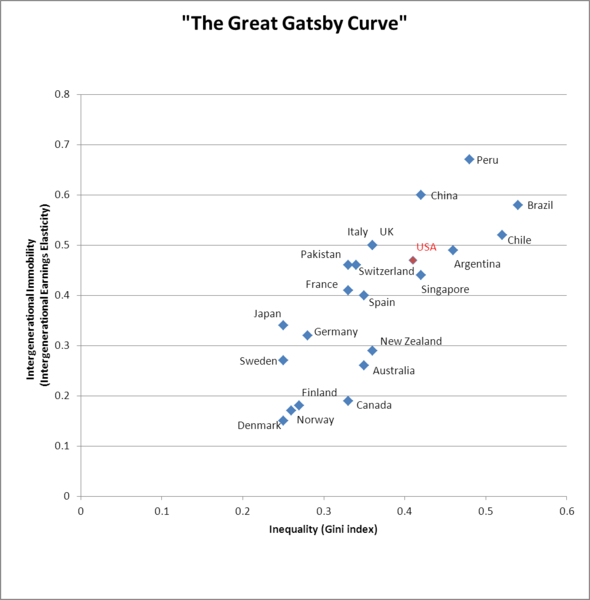
On the core question of social mobility, Argentina and the US are also very close together as the following chart shows:

590px-The_Great_Gatsby_Curve

So in terms of both income inequality and social mobility, the US and Argentina are basically the same country. So why does the Pope’s arguments apply only to Argentina and not to the US? I’m not an economist, so maybe there’s another dimension here that I’ve overlooked. As always, I’d be more than happy to post any correctives or clarifications to this basic reality. But right now, it seems to me that the Catholic right is simply wrong. Their American exceptionalism has morphed from a thoroughly admirable national pride at America’s achievements to a fixed and rigid idolization of a single country along with an idolization of wealth. Both, to put it mildly, are heresies. And perhaps the biggest impact of the new Pope on American politics will be more forthrightly denying the denialist, ideological right any Catholic crutch to peddle their snake-oil with.

(Photo: Vincenzo Pinto/AFP/Getty)

The 2013 Dish Awards: The Winners!

Edie Windsor had the Face Of The Year:

Supreme Court Hears Arguments On California's Prop 8 And Defense Of Marriage Act

Edith Windsor, 83, acknowledges her supporters as she leaves the Supreme Court on March 27, 2013. The Supreme Court heard oral arguments in the case ‘Edith Schlain Windsor, in Her Capacity as Executor of the Estate of Thea Clara Spyer, Petitioner v. United States,’ which challenges the constitutionality of the Defense of Marriage Act (DOMA), the second case about same-sex marriage this week. By Chip Somodevilla/Getty Images.


Rep. Steve Stockman (R-TX) is the winner of this year’s Malkin Award, which is given for intemperate right-wing rhetoric. The winning rant:

Democrats do not want abortion to be safe or rare. Democrats oppose even the most basic of health and safety standards for abortion mills. Democrats don’t care how many women are maimed, infected with diseases or die on the routinely-filthy abortion mills. Democrats worship abortion with same fervor the Canaanites worshipped Molech.


The Window View Of The Year:

McCall-ID-730am

McCall, Idaho, 7.30 am


The Moore Award, for divisive left-wing rhetoric, goes to Health And Wellness Publisher Maria Rodale for this remark:

Yes, Syria has undoubtedly used chemical weapons on its own people. Maybe it was the government; maybe it was the opposition; maybe you [President Obama] know for sure. But here’s what I know for sure: We are no better. We have been using chemical weapons on our own children – and ourselves – for decades, the chemical weapons we use in agriculture to win the war on pests, weeds, and the false need for ever greater yields. While the effects of these “legal” chemical weapons might not be immediate and direct, they are no less deadly. … We’ve been trying to tell you for years that chemical companies like Monsanto, Syngenta, Dow, DuPont, Bayer Crops Sciences, and others are poisoning our children and our environment with your support and even, it seems, your encouragement. Just because their bodies aren’t lined up wrapped in sheets on the front pages of the newspapers around the world doesn’t mean it’s not true.


Hathos is the attraction to something you really can’t stand; it’s the compulsion of revulsion. Below is this year’s Hathos Alert winner – by a mile:

Hathos_Alert_1.17

David Atkins plays the world’s smallest violin:

So this is apparently a real thing from the Wall Street JournalThe Onion couldn’t top this. Whether it’s the sad faces of all these put-upon dejected rich people, or the elderly minority couple who is depressed despite not paying extra taxes (or was that the point?), or the distressed single Asian lady making $230,000 who might not be able to buy that extra designer pantsuit this year, or the “single mother” making $260,000 whose kids presumably have a deadbeat, indigent dad just like any other poor family, or that struggling family of six making $650,000 including $180,000 of pure passive income and wondering how to make ends meet, mockery is almost superfluous. The thing mocks itself.


Paul Ryan earns the Dick Morris Award for his stunningly wrong underestimation of the president:

Oh, nobody believes [Obama’s vows to not negotiate on raising the debt ceiling]. Nobody believes that. He himself negotiated Bowles Simpson on the debt limit with Democrats. That was Kent Conrad’s requirement. He himself negotiated the Budget Control Act with the debt limit. Graham Rudman. Bush Andrews Airforce Base. Clinton Gore ‘97. All of those major budget agreements were debt limit agreements. I see this time as no different and I believe he does too. I think most people believe he’s just posturing for now.


Cool Ad Of The Year was made by Guinness. The twist at the end gave Copyranter goosebumps. Likewise:


Colin McGin, a philosophy professor who resigned this year from the University of Miami following allegations that he sent sexually explicit emails to a female graduate student, won this year’s Poseur Alert, awarded for really bad writing intended to appear profound. The passage he was nominated for:

What kind of hand job leaves you cleaner than before? A manicure, of course. Why does this joke work? Because of the tension between the conventional idiomatic sense of ‘hand job’ (a certain type of sex act) and its semantic or compositional meaning (in which it is synonymous with ‘job done by or to the hand’). When you think about it, virtually all jobs are ‘hand jobs’ in the second semantic sense: for all human work is manual work—not just carpentry and brick laying but also cookery and calligraphy. Indeed, without the hand human culture and human economies would not exist. So really ‘hand jobs’ are very respectable and vital to human flourishing. We are a ‘hand job’ species. (Are you now becoming desensitized to the specifically sexual meaning of ‘hand job’? Remember that heart surgeons are giving you a ‘hand job’ when they operate on you; similarly for masseurs and even tax accountants.)

I have in fact written a whole book about the hand, Prehension, in which its ubiquity is noted and celebrated.

I even have a cult centering on the hand, described in this blog. I have given a semester-long seminar discussing the hand and locutions related to it. I now tend to use ‘hand job’ in the capacious sense just outlined, sometimes with humorous intent.
Suppose now a professor P, well conversant in the above points, slyly remarks to his graduate student, who is also thus conversant: ‘I had a hand job yesterday’. The astute student, suitably linguistically primed, responds after a moment by saying: ‘Ah, you had a manicure’. Professor P replies: ‘You are clearly a clever student—I can’t trick you. That is exactly the response I was looking for!’ They then chuckle together in a self-congratulatory academic manner. Academics like riddles and word games.


The Chart Of The Year goes to the simple bar graph below. It illustrates that most Americans have no idea that the deficit is falling:

Deficit Poll

Derek Thompson captions:

The point isn’t that Americans are stupid. They have busy lives and concerns that have nothing to do with the annual gap between taxes and outlays. Instead, the point is that public-opinion polls don’t belong on the same plane as facts and informed analysis, because they qualify as neither. … Public polls are a fine gauge of public opinion, but they’re not to be treated as a barometer of reality. Pretending otherwise mixes up the regurgitated misinformation of readers with the careful analysis of people who are in the business of busting misinformation.


Jon Huntsman won The Yglesias Award, given for risking something for the sake of saying what you believe, for this statement supporting marriage equality:

While serving as governor of Utah, I pushed for civil unions and expanded reciprocal benefits for gay citizens. I did so not because of political pressure—indeed, at the time 70 percent of Utahns were opposed—but because as governor my role was to work for everybody, even those who didn’t have access to a powerful lobby. Civil unions, I believed, were a practical step that would bring all citizens more fully into the fabric of a state they already were—and always had been—a part of.

That was four years ago. Today we have an opportunity to do more: conservatives should start to lead again and push their states to join the nine others that allow all their citizens to marry. I’ve been married for 29 years. My marriage has been the greatest joy of my life. There is nothing conservative about denying other Americans the ability to forge that same relationship with the person they love.


The year’s top Mental Health Break:

As one YouTube commenter puts it:

this video solved racism


The Hewitt Award is for egregious attempts to label Barack Obama as un-American, alien, and treasonous. Orson Scott Card was the top vote-getter for this “experiment in fictional thinking” that “sure sounds plausible”:

Where will [Obama] get his ‘national police’? The NaPo will be recruited from “young out-of-work urban men” and it will be hailed as a cure for the economic malaise of the inner cities. In other words, Obama will put a thin veneer of training and military structure on urban gangs, and send them out to channel their violence against Obama’s enemies. Instead of doing drive-by shootings in their own neighborhoods, these young thugs will do beatings and murders of people “trying to escape” — people who all seem to be leaders and members of groups that oppose Obama.

2013: An Alternative History

Chicago's Gay Community Celebrates Passing Of Same-Sex Marriage Law In Illinois

[Re-posted from last night]

Like many a columnist, I was tasked with an end-of-the-year column, and couldn’t really decide what to say. Here’s what I felt: 2013 was one of the most dreary and depressing I can remember. Politically, it seemed scarred by the Republicans’ ever greater extremism and by the Obama administration’s surprising incompetence. Brutal, dispiriting gridlock and the lame embers of an exhausted culture war set the tone for the rest. It was a year in which most of the forces propelling our culture and politics seemed played out: Obama reached his delivery moment, and he was horribly exposed. The GOP had already seen their electoral crisis the year before, and yet they failed to grasp the nettle of immigration reform and, if anything, took pure nullification to newly manic levels in the states and the Congress. No deal on long-term debt; no immigration reform; no serious infrastructure investment; and a horrible roll-out of healthcare reform.

Still, I had no sooner spelled out these core, depressing facts than I kept thinking of the other, less noticed ones. There were, after all, plenty of reasons for be cheerful in 2013. The number of US troops killed in Afghanistan reached a new low of 161, down from 711 three years’ ago. The war in Iraq remained over. Growth accelerated to 4.1 percent in the third quarter and looks set to continue next year. The Dow is now comfortably over 16,00o – more than double where it was five years ago, at the trough of the recession. The budget deficit shrank 37 percent in 2013, and was falling faster than at any time since the end of the Second World War. Yes, perhaps the austerity was premature and the big fiscal crisis has yet to hit. But an economy that’s growing and a deficit that’s fast shrinking is a pretty good combo for the time being. For good measure, the US is now in the full throes of a domestic energy revolution and is scheduled to be energy independent by 2020, a goal sought for decades. In part because of this, the US position in the Middle East is far less constrained, enabling a potentially world-changing detente with Tehran. Terror attacks – widely aca-sign-upsthought after 9/11 as a new norm – have dwindled to negligible levels in the West. Crime perked up a little, but was still way, way down from its past heights, despite the recession.

And in the US, one huge social shift cemented itself. The last few years have seen a revolution in the way in which gay people are integrated into society. 2013 saw not only the Supreme Court place the federal government firmly behind state-sanctioned gay civil marriages, but democratic legislatures also accelerated the trend across the country. There were many ways in which this titanic year for civil rights could have ended, but civil marriage for gay couples in Utah was pretty damn good. Nine more states now issue marriage licenses for gays than did this time last year – doubling the entire roster in just twelve months. Another, Illinois, will see its first weddings next June. In 2013, England, Wales, Scotland, Brazil, Uruguay, New Zealand, Mexico and France introduced marriage equality. The new Pope, for his part, defused the extremely tense religious and cultural debate by refusing to “judge” a gay person genuinely seeking to follow Christ. By any standards, this was a watershed year for an issue that has vexed humanity for centuries.

And, of course, I mention the Pope. In a few months, he has almost miraculously reasserted Christianity against all the modern “isms” of our time, utterly eviscerated the supreme papacy as envisaged by his two predecessors, and reminded billions of the core and simple message of Jesus. If he has initiated a rebirth of Christianity – as is my devout hope and wish – then this year was a turning point for the world, a moment when hope showed its endurance. And although the Affordable Care Act has gotten off to the rockiest start it could have, it remains a fact that more than nine million Americans have reliable health insurance for the first time in their lives because of it. The graph above was compiled by Amy Fried Charles Gaba on Christmas Eve. Many more applied for insurance in the following week. But the point is: these policies will be very hard to take away. I may be wrong, but I’d say the odds are solid that 2013 will eventually be seen not as a triumph for any system of medical care, but as the moment when everyone got into the same, insured boat, and we began to figure out how seriously to control costs.

usgs_line.phpIt was also the year in which the post-9/11 security state was put back on its heels. I have deeply mixed feelings about what Edward Snowden did, and deep misgivings about the utopian idea that governments should exist with no secrecy. But it is hard not to observe that, as the president’s own commission has found, the US government was doing far, far more snooping than any of us realized, that much of it is of extremely dubious value in foiling terror plots and can be highly counter-productive in the conduct of foreign policy. It felt to me as if a tide had turned. Without Snowden? Not so much.

I’d also argue that October’s simultaneous humbling of the president and exposure of the GOP leadership was a deeply salutary thing. The president needs to understand that he has to get one domestic policy right in the next three years and that’s the implementation of the ACA. Nothing else compares in importance. If the debacle of October means a leaner, more focused domestic agenda from the White House in 2014, focused on executive branch delivery and not partisan politics, then it will have been worth it. (The speed with which the website was fixed certainly gives some confidence.) As for the GOP, the Ryan deal and Boehner’s new disdain for the Tea Party suggest some mild movement back to sanity. It’s too soon to celebrate. But it is no longer crazy to hope.

So count me a revisionist. Everything on the surface this past year was horrible; but the tectonic shifts from below were anything but. We’ll see what lasts. But it helps not to forget what recedes ever so slightly from our news-cycle horizon.

Know hope. Or perhaps that requires reformulation.

Know pope.

(Hat tip for the ACA graph: Amy Fried)

(Top Photo: gay men in a bar in Chicago celebrate the dawn of marriage equality in Illinois. By Getty Images.)

A&E Cannot Bear Very Much Reality

ABC's "Good Morning America" - 2013

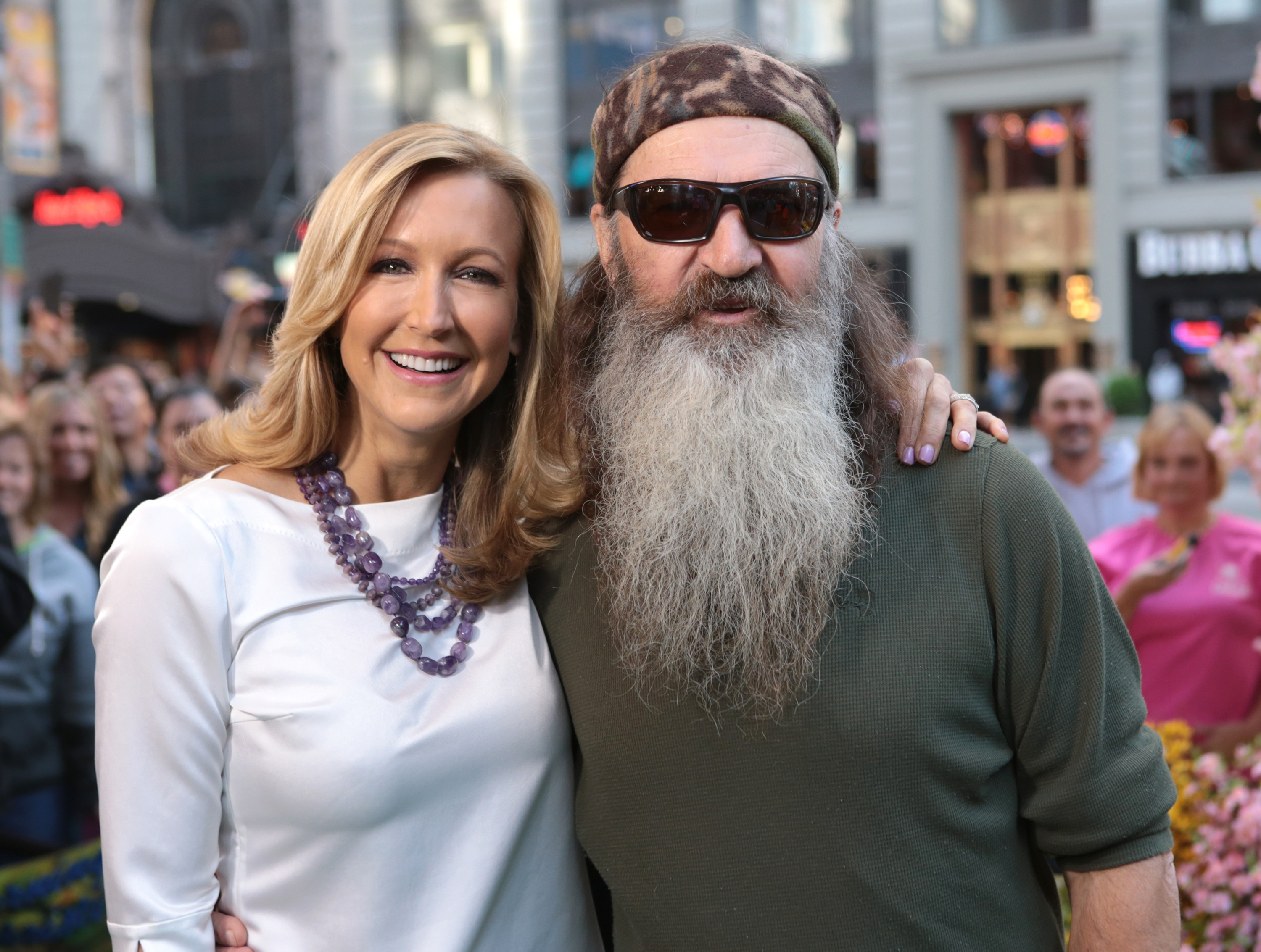
I have to say I’m befuddled by the firing of Phil Robertson, he of the amazing paterfamilias beard on Duck Dynasty (which I mainly see via The Soup). A&E has a reality show that depends on the hoariest stereotypes – and yet features hilariously captivating human beings – located in the deep South. It’s a show riddled with humor and charm and redneck silliness. The point of it, so far as I can tell, is a kind of celebration of a culture where duck hunting is the primary religion, but where fundamentalist Christianity is also completely pervasive. (Too pervasive for the producers, apparently, because they edited out the saying of grace to make it non-denominational and actually edited in fake beeps to make it seem like the bearded clan swore a lot, even though they don’t.)

Now I seriously don’t know what A&E were expecting when the patriarch Phil Robertson was interviewed by GQ. But surely the same set of expectations that one might have of an ostensibly liberal host of a political show would not be extended to someone whose political incorrectness was the whole point of his stardom. He’s a reality show character, for Pete’s sake. Not an A&E spokesman. So here’s what he said – which has now led to his indefinite suspension (but he’ll be in the fourth season, apparently, which has already wrapped):

“Everything is blurred on what’s right and what’s wrong … Sin becomes fine. Start with homosexual behavior and just morph out from there. Bestiality, sleeping around with this woman and that woman and that woman and those men … “Don’t be deceived. Neither the adulterers, the idolaters, the male prostitutes, the homosexual offenders, the greedy, the drunkards, the slanderers, the swindlers—they won’t inherit the kingdom of God. Don’t deceive yourself. It’s not right … “

This is a fascinating glimpse into the fundamentalist mind. You’ll notice that, for the fundamentalist, all sin – when it comes down to it –  starts with sex. This sexual obsession, as the Pope has rightly diagnosed it, is a mark of neurotic fundamentalism in Islam and Judaism as well as Christianity. And if all sin is rooted in sex, then the homosexual becomes the most depraved and evil individual in the cosmos. So you get this classic statement about sin: “Start with homosexual behavior and just morph out from there.”

This emphasis is absolutely not orthodox Christianity. There is nothing primary about sexual sin as such in Christian doctrine. It sure can be powerfully sinful – but it’s not where sin starts. And to posit gay people as the true source of all moral corruption is to use eliminationist rhetoric and demonizing logic to soften up a small minority of people for exclusion, marginalization and, at some point, violence.

If you think I’m hyperventilating, ask yourself what the response would be if in talking about sin, Phil Robertson had said, “Start with Jewish behavior …” The argument would be totally recognizable, once very widespread, and deeply disturbing. What we’re seeing here – and it’s very much worth debating – is how fundamentalist religion seizes on recognizable, immoral minorities to shore up its own sense of righteousness. You can gussy it up – but it’s right there in front of our nose.

Then Robertson says something that tells us nothing except he has never had an honest conversation with a gay person about what it is to be gay.

He simply assumes that all men must be heterosexual, and that making themselves have sex with another man must be so horrifying it mystifies him:

“It seems like, to me, a vagina—as a man—would be more desirable than a man’s anus. That’s just me. I’m just thinking: There’s more there! She’s got more to offer. I mean, come on, dudes! You know what I’m saying? But hey, sin: It’s not logical, my man. It’s just not logical.”

No, it isn’t logical if it were a choice for a straight guy. But it isn’t. All we’re seeing here is the effect of cultural isolation. The only thing I find objectionable about it – and it is objectionable – is the reduction of gay people and our relationships to sex acts. Mr Robertson would not be happy – indeed, rightly be extremely offended – if I reduced his entire family life and marriage to sex with a vagina.

But look: I come back to what I said at the beginning. Robertson is a character in a reality show. He’s not a spokesman for A&E any more than some soul-sucking social x-ray from the Real Housewives series is a spokeswoman for Bravo. Is he being fired for being out of character? Nah. He’s being fired for staying in character – a character A&E have nurtured and promoted and benefited from. Turning around and demanding a Duck Dynasty star suddenly become the equivalent of a Rachel Maddow guest is preposterous and unfair.

What Phil Robertson has given A&E is a dose of redneck reality. Why on earth would they fire him for giving some more?

(Photo: Phil Robertson of ‘Duck Dynasty’ as a guest on ‘Good Morning America,’ 5/7/13, airing on the ABC Television Network. By Fred Lee/ABC via Getty Images.)

Deep Dish #2: Why Francis Matters

[Re-posted from earlier today]

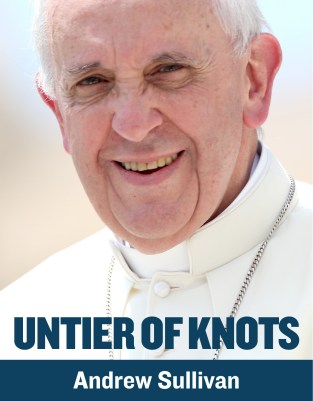
Subscribers are already digging into the latest Deep Dish offering, Untier Of Knots, my essay on Pope Francis released last night:

Thank you. Sublime. Beautiful. A gobsmacking refutation of fundamentalism and affirmation of what remains the best of Christianity.

Another:

This is a very fine essay on Pope Francis, I believe. Raised as a pastor’s son and steeped in the Protestant tradition, I am fairly ignorant of Catholic tradition, but I learned an awful lot here. I’m not one to kiss ass, and I’m an obsessively critical nit-picker, but this essay was profound and Untier-Of-Knots-Cover-Imagearticulate and intellectual without being elitist. This is a hard thing to craft. I appreciate your context on his Argentine history and the connection to St. Francis. I am very agnostic and not practicing these days, and am certainly not about to convert to Catholicism, but I have found some meaning and comfort in the humble tradition of discernment in the past year or so. I truly admire this man for humbly living out the Gospel, rather than perpetuating dogma and disconnection from the poor and the planet.

Isn’t it also something of an absurd blessing that a man such as this came into the Papacy, an institution encrusted with privilege, authoritarianism, and hypocrisy, as you and others have documented? By that I mean, in what other institution could such a man have this sort of platform and power today? We have a habit of ignoring, slandering, imprisoning, or killing off those who truly seek, speak, and act out this modus vivendi. I know he’s a man like you and me, and I don’t mean to elevate him to sainthood (something I’m deeply skeptical of), but I can’t think of any other way he could achieve this sort of stature without being dismissed as a crazy person, a phony intent on his 15 minutes of fame with serving-others publicity stunts, or a political ideologue.

I may only be restating your own arguments here, but anyway, I thank you for this essay and look forward to much more from Deep Dish! Keep up the good work.

Subscribers can read the Francis essay – and listen to my long, bawdy conversation with Dan Savage in the same issue – here. On the Dan podcast, another reader writes this morning:

Well, I loved it. The frankness, the fun, the openness, the charm, the filth … wonderful.

savage-podcastYou want me and Dan unplugged? It’s all here – on sex, love, gay history, lefties, marriage. Recording a podcast with someone who’s been a real friend for a long time – as opposed to someone, like Mikey Piro, whom I’d just met – was an eye-opener. It’s so easy to forget the microphone, because in so many chats over the years, there has never been one. Which is to say that there are probably passages in the podcast I really should regret. But it’s too late now.

A spot-on take from a subscriber:

I could listen to Dan Savage forever. He’s so fucking smart and clear-eyed. I’ve been reading him since I was a 20-something in Seattle when he first started his column. Like a lot of my peers, I was a reflexively homophobic straight guy. Not crazy, just more like, “I need to make sure nobody thinks I’m gay.” Through his column Dan stripped that shit right out of me. He even taught me how to eat pussy. Now I take pride in him as a representative of our generation. He is an American hero, embodying the best of this country: self determination, rebellion and humanity.

If you want access to the podcast and the essay, but haven’t yet subscribed to the Dish, you can do so [tinypass_offer text=”here”] for just $1.99/month. Another subscriber writes:

I don’t know if I’m approaching a spiritual crossroad, but the more I read your religious views, the more I feel something stir in me that wants what you describe. Maybe Pope Francis was what you’ve been waiting for, and I was waiting for you to find someone to share with me that I could relate to in a way other than as a representative of a cold, indifferent defender of authority. I had enough of that rammed down my throat for being gay in a fundamentalist Christian home and community.

The Advocate just named Pope Francis as their Person Of The Year, and in the past I would have objected on the grounds of Benedict’s legacy alone that such a selection was insane. But I could not do that with Francis. Like you said, Francis became very popular very fast and I just happened to be tuned in and watching, so I know the man is the genuine article. The doctrine hasn’t changed, but the emphasis of the Church certainly has.

And he’s the kind of guy you feel like patiently waiting on to untie all the knots. You can’t imagine him any other way than for his goodness. I try not to get emotionally wrapped up in people like him. When I do and then they stumble, I usually hit the pavement harder than they do. So I’m watching him like kids watch a scary movie; sort of peeping between my fingers during the scary parts and hoping for something good to happen.

I’ll try to be patient. I think he’s worth it.

I think he is too. Update from a few more readers:

I’m one of those non-Catholics who have been following Pope Francis with increasing astonishment and joy since I first saw him wash the feet of the prisoners at Casal de Marmo. I subscribed as soon as you announced the new Dish, and UNTIER OF KNOTS instantiates why I will be resubscribing. My hand is already aching a bit from copying long portions out into my notebook. I’m still living with this latest piece, re-reading it and savoring it, but want to take a moment to call attention to the earbud metaphor, which struck me as odd at the start of the paragraph but had won me over entirely, emotionally, by the time I got to the word “practice.” It’s really such a lovely thing you did there. Thank you.

Another:

As a lapsed Catholic and atheist, I was moved by your piece. It reminded me of the church I attended as a young boy with a dynamic young priest (Father Baxter) who attracted us with sports and made us love his church and become altar boys and thoughtful people. He was the first adult (after my father) to really have an impact, as he taught us about the love of Jesus and the tolerant message of the church of John XXIII. Yes, this was the Sixties and the talk of love was everywhere, but the atmosphere that pervaded was pretty darn close to what you described in your piece.

It wasn’t the god of the Old Testament, the judgmental god, but rather the God of Love, the Jesus God that loved me warts and all. Not the protestant god by any means, not the god of Robertson and Falwell et al. No fire and brimstone for us. Our God was a patient and understanding one, a God that deserves the capital G. We rarely heard talk of Hell or damnation, though we were surrounded by the French Catholic clergy of Quebec that practised that approach! Ours was an English Catholic parish serving mostly Italian immigrant children going to English Catholic schools in French speaking Quebec – talk about confusion!

What does this have to do with your piece on the pope? Well, obviously this is where your Deep Dish dive has brought me back to the future, I hope. Not that I am about to believe in god any time soon, but it did clarify for me the reason I have trouble listening to proselytizing atheists of the Dawkins type. No Grace, as you put it so well. No forgiveness, no understanding, no love – just pure materialism, pure ideology and condescension. They can only point to the evils of the church, none of which were practised at my church.

In fact, that teaching carried over to my later experience in college where I met my first full-blooded homosexual. He was one of my teachers, an American having fled the draft and attracted to Montreal’s gay culture. He made me think about homosexuality and conditioning that I, as an Italian immigrant’s child coming from a fairly macho culture, had never really confronted. We were not peculiarly cruel, and we didn’t use words like “fag” or “sissy” all that much, but we had the usual prejudices and attitudes. However, it seems that the teachings of Father Baxter had an effect, and I never felt threatened by my teacher and learned quite a lot from him. He took a few of us to a gay bar and introduced us to gay culture (well, a certain gay culture that you and Savage talked about in your podcast).

Fournier Digs In

US President Barack Obama uses an umbrel

Like many other veterans of the Village, the former McCain supporter, Ron Fournier, has never liked the Obama era. Its implicit repudiation of so much that came before still rankles many in the capital’s permanent chattering and political class. And so Fournier’s dogged and constant attempts to drag this presidency to the low levels of its predecessor are not exactly surprising. But the latest is a classic, down to its melodramatic title: “This Is The End Of The Presidency.” The thesis is that Bush and Obama are essentially the same failures in the same way and for the same reasons. And when the analogies are laid out as an analogy as far as it can … well, it’s so preposterous and lazy an argument it beggars belief.

Here’s the gist of Fournier’s Obama-Is-Bush absurdity in its various stages. Obama, like Bush, allegedly began his second term by going far out on an ideological limb. If only Obama had listened to Fournier! The president would never have supported immigration reform (even though it was temporarily deemed even by Republicans as the sine qua non if they were ever to win the White House again). He would have presumably abandoned the healthcare reform that had already been passed and had been at the center of a furious campaign. He would have chosen to “spend [his] political capital wisely, taking advantage of events without overreaching,” as Fournier brilliantly suggested a year ago in a far-seeing column of surpassing prescience and non-falsifiable vagueness.

So he would have seized on Sandy Hook by proposing a moderate package of gun control, with overwhelming public support, right? Wrong! He shouldn’t have done that either! What should he have done? Er, hard to tell from Fournier’s column, which simply lumps together random things he doesn’t like about Obama and compares them with random things that everyone now concedes were dreadful under George W. Bush.

But what Obama shouldn’t have done is

rub Republican faces in defeat. Obama forced his rivals to accept higher taxes on the wealthy. It was his prerogative; he won the election. And he set the tone for a harsh and humiliating 2013.

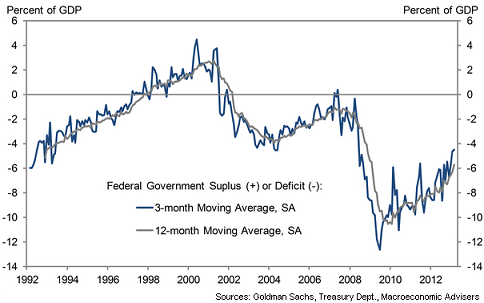
Let’s just unpack that a little, shall we? If Obama had done nothing at the end of 2012, tax rates would have gone up dramatically on most Americans, with revenues increasing by almost 20 percent, as the Bush tax cuts’ self-imposed expiration finally arrived (after their massive failure to create growth and a massive success in creating unprecedented debt). Obama – in an act of overbearing hubris – only let the tax cuts expire for a tiny proportion of Americans earning more than $400,000 a year, halving the total tax increase and concentrating it only among the very rich, whose wealth and incomes had exploded since 2000. On spending, the sequester remained in place, keeping government spending at levels tighter than in almost every previous recovery’s, very much including Reagan’s. Here’s the impact on the deficit of this and other measures that Obama agreed to, from the Wall Street Journal:

deficits0413Talk about liberal over-reach! This decision to prevent much larger automatic tax rises and to reduce spending and the deficit by these amounts during a still-lingering downturn is what Fournier regards as rubbing “Republican faces in defeat.” Seriously.

But Fournier is not done yet. Both Bush and Obama had first term “successes” that turned to defeat in their second term. Bush’s first term success was – wait for it – the Iraq War, whose core casus belli Bush had lied about. And so obviously the analogy with Obama is to the ACA, a first term success some of whose provisions Obama had also lied about.

How does one note that a war that killed more than a hundred thousand people, and destroyed America’s moral credibility and global power is not really in the same universe as a health reform law, modeled on a Republican governor’s, that, so far, has done nothing but provide access to health insurance for many, forced some to buy more expensive and comprehensive coverage, frustrated millions by being launched on a faulty website, and possibly already arrested soaring healthcare costs? I guess it’s possible to see both things as equivalent – a brutal, lost war and a fledgling overhaul of the country’s healthcare system. But I think most sane people not captive to Beltway narratives would beg to differ.

But then, according to Fournier, both Bush and Obama failed to cop to errors! Yes, Obama had that brutal press conference where he owned up completely to failure on Healthcare.gov, and beat himself up again and again in apologizing. But that, according to Fournier, wasn’t any better than Bush’s flailing around in the obvious catastrophe of Iraq, keeping Rumsfeld until 2006, and dithering until the mid-terms gave him the courage to do something more tangible than wait and watch. Again: I simply beg to differ. The difference between Obama’s response to error and Bush’s is the difference between night and day.

Ditto the difference between partisan Democrats keeping after Bush in 2005 (while never voting to curtail his war and acquiescing in most of its abuses) and the near-pathological attempt to destroy Obama by Republicans in 2013. What was stunning this year was the revelation that the GOP was prepared to wreck the entire global economy and the credit of the US government, if it could get them one small political edge over a re-elected president. This negotiating tactic was a new level of extremism, as Americans rightly understood. And if Obama had won the same Republican support for healthcare reform that Bush had from Democrats on Iraq, the last five years would have been much, much different. Or was that Obama’s fault as well?

All these critical, central facts for the last five years do not fit anywhere in Fournier’s analysis. And the truth is: nothing this president has done compares even faintly with the damage wrought by his predecessor. Bush exploded the deficit in a time of growth; Obama has cut it dramatically in a time of near-depression. Bush gave us two disastrous wars; Obama has largely ended both, and set in process diplomatic initiatives in Syria, Iran and Israel-Palestine that, if successful, can defuse potential new ones. Obama has tackled a huge domestic problem – the accessibility and cost of healthcare – which Bush allowed to fester and on which the current GOP has no policies except a return to the disastrous status quo ante. Bush initiated the first ever American-run program of torture of prisoners. Obama ended it. Bush presided over the worst breach of national security since Pearl Harbor. Obama killed Osama bin Laden and decimated his forces on the ground in Afghanistan and Pakistan. Bush presided over the total collapse of the free market system in the US; Obama has painstakingly rebuilt it.

If you exclude all this context and focus on superficial Washington games and tropes, you can maybe concoct a theory of the past five years that makes Fournier’s analysis seem plausible. It’s just that you have to erase the actual events from your brain and your memory.

It tells you a lot about Washington that doing that will make you the editor of National Journal.

How Anti-Christian Is Fox News?

It has been fascinating lately to watch Fox News go after the Pope for reiterating long-standing Catholic and Christian doctrine about the false god of materialism. By echoing Jesus’ insistence that you cannot know the kingdom of Heaven if you are bound up in wealth and possessions, the Pope drew charges of Marxism (which is anathema to Christians for the same reasons that unrestrained market capitalism is) and engaging in politics (from a channel that has long insisted that Christianity cannot and should not be relegated to the private sphere). Maybe it’s because they have not subjected their own views to anything passing as critical engagement for so long that they have forgotten that Christianity is deeply, profoundly opposed to any system of government that values human beings by the material wealth they create. The worship of money that you see in the incoherent rants of Stuart Varney or Larry Kudlow has no place whatever in Christian thought – and remains a daily assault upon it.

Now comes Megyn Kelly with a flat assertion that “Jesus was a white man, too.” Let’s go to the clip, which has now become famous in the world of Stewart and Colbert:

Now it’s clear this was an ad lib, not really thought through, so we should cut Kelly some slack. But she’s wrong on two levels – wrong because Jesus was not a Northern European white person, but a Middle Eastern Jew. And as a Middle Eastern Jew under the Roman empire, Jesus was at the bottom of the heap in the power-structure of his time. And that’s the point. The Messiah came from the lowest rung, not the highest. The comfort that white people feel when they are a majority in a democratic society is about as far away from Jesus’ experience of the world as it is possible to get.

She’s also wrong in even considering the color of Jesus’ skin – something unmentioned in the Gospels – as relevant. Of the great Pauline statements about Christianity, the following is among the most thrillingly liberating:

There is neither Jew nor Gentile, neither slave nor free, nor is there male and female, for you are all one in Christ Jesus.

The categories of race, of gender, and of social class are abolished in the Christian vision. This doesn’t mean they cease to exist as part of the world, for reasons of biology and social construction. But it does mean that Christians will never seek to underline these distinctions, to build a politics out of them, or to identify a nation according to them. Some on the left do this, as do some on the right. But Christians shouldn’t.

When you absorb the constant racial undertones on Fox, and its constant worship of the god of money, when you absorb their long list of fears about the “other”, whether immigrants or gays or the poor, when you recall their glee at the torture of human beings, or their passion for the death penalty, you can’t help but wonder if they are not one of the most powerful forces against Christianity in our culture. They have competitors out there, but Roger Ailes is never satisfied with being Number Two, is he?