A Declaration Of War On Francis, Ctd

Ross has written a moving and eloquent response to my post and other critiques of his recent column. I urge you to read it – it has all the usual marks of Douthat’s extreme intelligence and nuanced reasoning, with more than a little humility thrown in. It reminds me once again how converts can sometimes see the faith with more stringent acuity than those of us for whom Catholicism is both a faith and the background music to our entire lives.

And I’m not going to differ with him on the radical nature of Catholicism’s teachings on sex and marriage. The prohibition of divorce made VATICAN-MOZAMBIQUE-POPEJesus different – although you can interpret the context and meaning of that prohibition in different ways (such as Jesus defending women’s dignity and rights within a marriage, as opposed to mere aversion to adultery). I’m not arguing – and I see no one arguing – for an end to this prohibition as such. What the Pope is proposing is a new pastoral approach toward those who, for truly human reasons, have seen their marriage fail, have managed to construct a new one, and who want to be fully part of the church again. That is all.

But for Ross, this proposed change is far more significant. By allowing such individuals to receive communion, he worries that the entire edifice of the church’s sexual teachings – and possibly more – will crumble. For me, that’s an exaggerated fear. There is a balance between truth and mercy here, as I think we all agree. The question is: where does that balance best lie? I find the church’s withholding of the sacraments from one class of flawed Christians as a way to buttress a particular doctrine to be far too lacking in mercy. But then I find all deliberate withholding of the sacraments to be lacking in mercy. To publicly say to an entire group of people, “Sure, you can come to Mass, but never approach the altar for communion” is to create the very division between the outwardly obedient Catholics and a phalanx of black sheep that Jesus so often railed against.

What is more integral to our faith: that we do not mistake the outward signs of virtue for virtue itself, or that we uphold the doctrines even if they give us two classes of Christians? I think what Francis is saying is: God will judge, and the church’s primary mission is to treat the sick, nourish the wounded, and bring everyone to Christ’s table who seems to be earnestly seeking to follow God. Yes, in an individual case, a priest may decide that someone is not really ready for communion – but only on an individual, pastoral basis. And he may also come to the opposite conclusion. But to insist on an absolute rule for an entire class of people can damage the church and distort its deepest mission. That’s the core of Francis’s message about gay Catholics as well: how do we really know that these long marginalized Christians are really the problem, and that an arrogant and self-righteous hierarchy isn’t? That’s why I immediately associate this question with the teachings on how “the last shall be first and the first last,” or with the deeply counter-intuitive parable of the Prodigal Son.

In that parable, we really do have justice pitted against mercy; and Jesus is clear that God is about mercy before anything. It is indeed not fair that the faithful older brother is utterly taken for granted and never given the extraordinary mercy and love that the younger son is suddenly showered with. But what matters is the sincerity of the younger son’s desire to be with his father again. Ross will counter that the prodigal son isn’t asking to retain some aspects of his previously sinful life. But in the parable, the father does not put any conditions on his welcome for the younger son. It is unconditional:

The son said to him, ‘Father, I have sinned against heaven and against you. I am no longer worthy to be called your son.’ But the father said to his servants, ‘Quick! Bring the best robe and put it on him. Put a ring on his finger and sandals on his feet. Bring the fattened calf and kill it. Let’s have a feast and celebrate. For this son of mine was dead and is alive again; he was lost and is found.’

The older son has a legitimate grievance. If he has walked the walk of no sex outside marriage, and entered into a life-long, monogamous marriage always open to life, what on earth is the church doing embracing someone who has failed to live up to these standards? But the father is pretty clear in his response:

‘My son,’ the father said, ‘you are always with me, and everything I have is yours. But we had to celebrate and be glad, because this brother of yours was dead and is alive again; he was lost and is found.’

I think that is what the Pope is trying to say in these respects: that the church should not become a club for insiders that turns away those who have publicly failed in some of its strictures. And when you come down to it, actually enforcing the rules that Ross favors requires believing that the debate is

over whether to admit the divorced-and-remarried, people in unions that the church has traditionally considered adulterous, back to communion while they’re still in a sexual relationship with their new spouse.

So this is the real stopping point.

Are you now or have you ever been having sex with your re-married spouse? And here again, I think the Pope is saying: do we really have to go there? And do we ask these kinds of questions of others more publicly and outwardly obedient to the church? Do we ask married couples how much sex they’re having, if any? Do we actually inquire into their use of contraceptives? Their porn-habits? Their sexual objectification of their spouse? The truth is: as a practical matter, we don’t police these sins as a class when it comes to giving communion. So why should the relationships of gay couples or re-married ones be so marked for exclusion? Just because they are more easily labeled and identified?

Does less judgment and more mercy in these respects threaten the entire super-structure? Ross quotes another convert, Richard John Neuhaus, to the effect that it will. And there lies a key difference. I believe that the truths of the church are far, far larger than any teachings about sex; that adherence to an edifice of unchangeable and detailed orthodoxy is not the core reason for being a Catholic; that we have emphasized sexual morality in the recent past – to the exclusion of so much else – far beyond what is justified by a healthy perspective on these matters; and that a little Catholic mercy in these murky waters is not the beginning of the end of everything.

I may be wrong. But I do know, from my own experience as a gay Catholic, that the hierarchy has been terribly rigid, cruel and mistaken about sexual matters in ways that have inflicted enormous pain and anguish on many people simply trying to love God and their neighbor. The hierarchy’s own sexual crimes – where mercy toward child-rapists was, for a long time, the reflexive response – brought the hypocrisy of this into a more glaring light. We can learn from this and enter into a debate about how to move forward without fearing at every moment that everything is at stake.

Or as John Paul II once said:

Be not afraid! Of what should we not be afraid? We should not fear the truth about ourselves.
There He Goes Again

VATICAN-POPE-AUDIENCE

Here’s a quote for the day from Pope Francis:

When we read about Creation in Genesis, we run the risk of imagining God was a magician, with a magic wand able to do everything. But that is not so. He created human beings and let them develop according to the internal laws that he gave to each one so they would reach their fulfilment. The Big Bang, which today we hold to be the origin of the world, does not contradict the intervention of the divine creator but, rather, requires it. Evolution in nature is not inconsistent with the notion of creation, because evolution requires the creation of beings that evolve.

None of this is new, of course. Catholics in general do not buy the irrational and anti-intellectual delusions of evangelical Protestants with respect to Creation and the origins of the universe. But what it does is reinforce a very American dimension to the Francis effect in the Catholic church: the church has effectively switched sides on several key issues in the American culture war.

Damon Linker has a typically insightful piece on this question with respect to the core cultural battles over sex, marriage and family that have divided Americans for several decades now. And this helps explain Ross’s adoption of resistance to Francis’ pastoral revolution: a key, legitimizing rampart of the social right in America – the Vatican – has been partly kicked away. If the Pope sees value in some aspects of gay relationships, for example, how does a Catholic remain committed to the party of Rick Santorum and Gary Bauer?

On the question of evolution, the value of gay relationships, the validity of climate change, and the utter impermissibility of torture, Francis has made the life of the conservative Catholic Republican a lot more complicated. The GOP, for example, is dominated by white evangelical Protestants. On evolution, they are regressing, not reforming:

Americans entered 2013 more opposed to evolution than they have been for years, with an amazing 46 percent embracing the notion that “God created humans pretty much in their present form at one time in the last 10,000 years or so.” This number was up a full 6 percent from the prior poll taken in 2010. According to a December 2013 Pew poll, among white evangelical Protestants, a demographic that includes many Republican members of Congress and governors, almost 64 percent reject the idea that humans have evolved. Among Democrats, acceptance of evolution increased by 3 percent, to 67 percent, while among Republicans it decreased from 54 percent to 43 percent.

On climate change, the Pope has been emphatic (and in a way that has commanded far more attention than Benedict’s identical musings) on about our moral responsibility for conserving the earth:

Creation is not a property, which we can rule over at will; or, even less, is the property of only a few: Creation is a gift, it is a wonderful gift that God has given us, so that we care for it and we use it for the benefit of all, always with great respect and gratitude. Safeguard Creation. Because if we destroy Creation, Creation will destroy us! Never forget this!

Compare that with the Fox News view that climate change is a massive hoax. On torture, rendition and indefinite detention without trial in Gitmo, the Pope was recently unequivocal:

Francis took aim at practices that have been hotly debated in the U.S, such as the so-called “extraordinary rendition” of terror suspects to other countries, which the pope described as the practice of “illegal transportation to detention centers in which torture is practiced.” The pope called out both the nations that use such practices and those who allow it to happen on their territory or allow the use of their air space for other countries to transport detainees.

Notice that the Pope, unlike his predecessor, doesn’t duck the core question of American torture at Gitmo and other black sites. On the death penalty and life imprisonment, he is just as clear:

“All Christians and people of good will are called today to struggle not only for abolition of the death penalty, whether legal or illegal, and in all its forms, but also to improve prison conditions, out of respect for the human dignity of persons deprived of their liberty,” the pope told delegates from the International Association of Penal Law. “And this I connect with life imprisonment,” he continued. “Life imprisonment is a hidden death penalty.”

On prison reform, Francis has, happily, some Republican pols on his side. But when you observe the rhetoric from a man like Senator Pat Roberts on Gitmo and super-max prisons in general, you can see the huge gulf between the Pope and the id of the American right.

Let me be clear here. I’m not now invoking a religious authority to determine a view of secular politics in the US. Francis’s arguments, like anyone else’s, should succeed or fail on purely secular terms. And to claim Francis for the Democrats or the American left would be deeply misleading and pernicious. He remains, to take one obvious example, opposed to the taking of human life at any stage of development; and he does not believe that gay relationships can be described as marriages. All I’m saying is that the social right and Republican base has long counted on the papacy as a natural ally in the vortex of the American culture war. They can count on it no more. Which means that the evangelical-Catholic alliance, entrenched under Benedict XVI, and a key component of the American right’s fixation on abortion, gays and religious freedom as primary public issues, is teetering.

May it soon collapse entirely. It would be good for the right; and good for Catholicism.

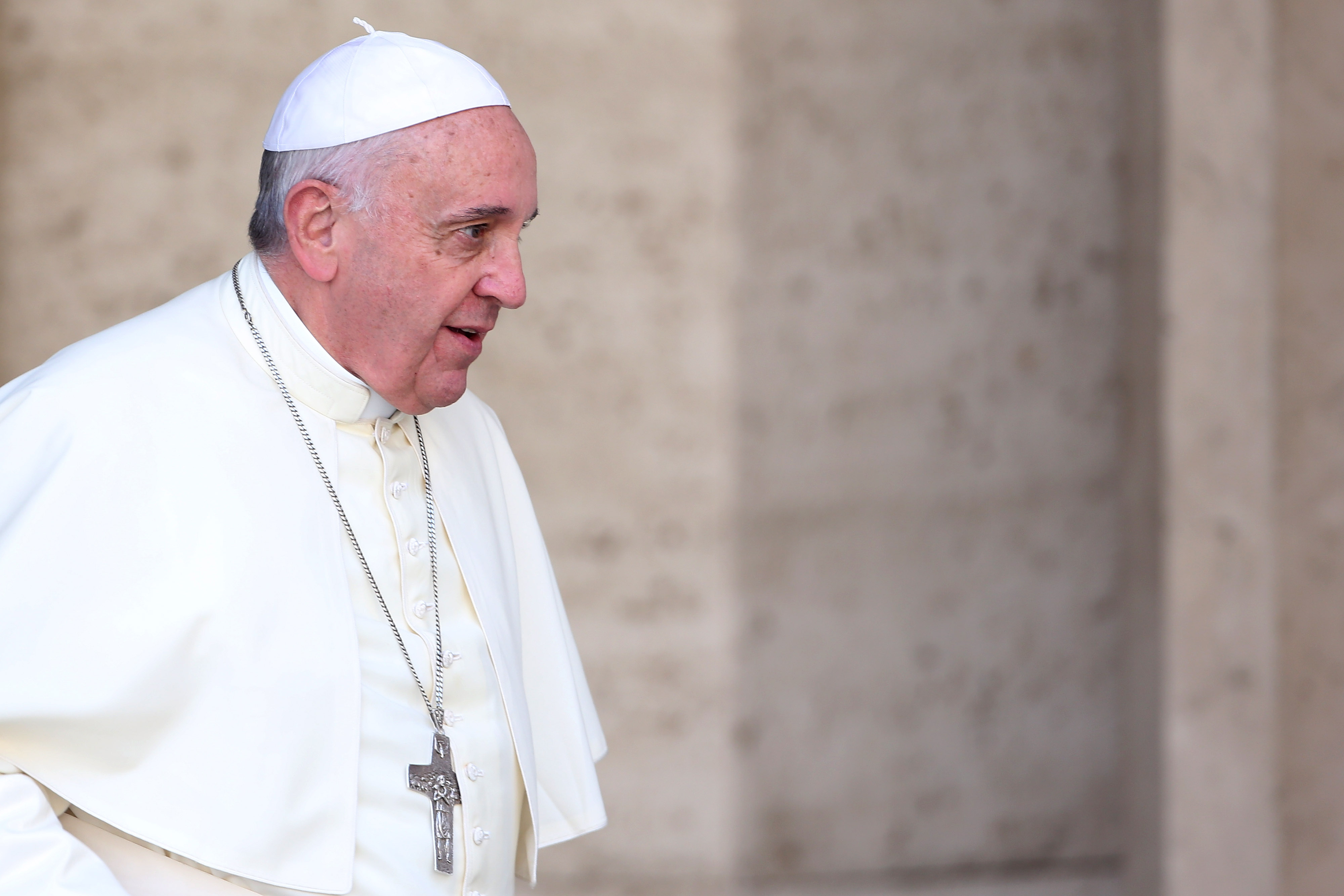
(Photo: Alberto Pizzoli/AFP/Getty)

A Declaration Of War On Francis

VATICAN-RELIGION-CHRISTIANITY-POPE-UNITALSI

So this is why it took Ross Douthat so long to utter an opinion about the recent Synod on Family Life in Rome. He was weighing whether to call for schism! For the record: for all my questioning and concern about the direction Benedict XVI was taking the church, I never wrote a column that actually called for open revolt against him. The theo-conservative reaction to Francis reminds me a little of the wing of the GOP that simply cannot tolerate the give and take of democratic life, and as soon as a president of the other party is handily elected, and actually dares to enact a clear campaign pledge, declares the end of the republic!

But, of course, the Catholic church is not a democracy, so the analogy won’t work. But neither is it a dictatorship – least of all under this Pope who, from the very beginning, insisted that he was merely a bishop among bishops. And in Ross’s column, there is a clear assumption that his side of the debate owns the church, that any contrary views to his are an outrageous, treasonous and unprecedented attack on the institution itself, that any accommodation of mercy for those caught in the cross-hairs of the teachings on sex and marriage and family is somehow a “betrayal” of the core faith. Not a misguided idea – but a betrayal.

This is nonsense and panic, but it is a useful insight into the theo-conservative psyche. Notice the language used to describe a civil, rare and open debate of issues that the church is grappling with. This process – in which the theocons won on their core issues – is “a kind of chaos,” it’s “medieval” and “dangerous,” it sows “confusion.” It is as if these questions cannot even be debated (which was, of course, the view of John Paul II and Benedict XVI), as if faith itself is so fragile and so rooted in unquestioning blind obedience to a body of teaching that makes no distinction between central and more marginal issues, that any Pope that actually seeks to have a conversation about these questions is a threat to the church itself.

And what are these questions that are so dangerous to consider? That some divorced Catholics who sincerely want to be part of the life of the church should be allowed some participation in the sacraments; that a gay relationship should not be defined and condemned solely for its sexual nature – but can be appreciated for other virtues, such as mutual love and sacrifice; that doctrine should never be imposed without an option for mercy. These are not violations of the core teachings – that marriage is for life and must be always open to life; that non-procreative sex inside or outside marriage is always sinful – but attempts to acknowledge that human beings are involved here, and that exclusion and cruelty and contempt are not the only options for those following the teachings of Jesus.

But for Ross, it appears that mercy is an attack on inviolable truth, rather than its essential Christian complement. And it also appears that allowing the Vatican to reflect the actual debate going on among actual Catholics in our real lives is some kind of threat to the faith itself. Please. If your faith cannot admit of doubt, of debate, of conversation … then it is a white-knuckled faith in the religion of total certainty, rather than the calm faith of those who know we do not have all the answers to every pastoral question.

Ross seems to think, for example, that Francis is proposing an end to the idea that marriage should be monogamous and life-long. That’s just bizarre. What Francis is encouraging us to debate is not whether those whose marriages failed should be re-married in the church, but merely, depending on the circumstances, whether they can be allowed to participate in the full sacramental life of the church. What Francis is suggesting in another respect is that gay people’s real human lives and loves cannot be reduced to a psychological and moral “disorder.” You can see these suggestions as an attack on Jesus’ austere view that marriage is inherently life-long or it is nothing, if you really want. Or you can see this as a reflection of Jesus’ constant, persistent empathy with the sinner, love for the individual and mercy toward the flawed. I suspect most Catholics would instinctively see this as a function of the latter.

And Ross agrees that his is a minority view. Which explains a little of his rage.

For the first time in more than thirty years, the rigid traditionalists, who were always a minority of Catholics, had a Pope very much on their side. Their champion was Joseph Ratzinger who viewed even the Second Vatican Council as dangerously open to the currents of modernity and who, as John Paul’s doctrinal enforcer, ruined countless careers, and policed any error, and shut down any dissent to his understanding of orthodoxy. Many of us who disagreed did not throw a hissy fit, threaten schism, or call for open revolt. And we refused to do this even as our very identities were deemed inherently directed toward evil, as we were blamed for the violence sometimes directed against us, as we were blamed for the child abuse of pedophiles, as we had to endure the staggering hypocrisy and venality of a hierarchy that tolerated their peers’ rape of children but reserved their strongest condemnation for gay couples in committed relationships.

But we, it seems, are not the real Catholics. We are not the people who keep the church alive. We are somehow parasitical on the true believers. The real Catholics are

the people who have done the most to keep the church vital in an age of institutional decline: who have given their energy and time and money in an era when the church is stained by scandal, who have struggled to raise families and live up to demanding teachings, who have joined the priesthood and religious life in an age when those vocations are not honored as they once were. They have kept the faith amid moral betrayals by their leaders; they do not deserve a theological betrayal.

It’s an almost textbook case in which those who regard themselves as morally superior claim ownership of a church created … for sinners. There is a clear rebuke to that mindset:

So the last will be first and the first last, for the called are many and the chosen ones are few.

Let us leave such distinctions to God, shall we? And try to struggle together in a church which no faction owns and in which truth is always tempered with mercy and in which faith is always leavened with doubt.

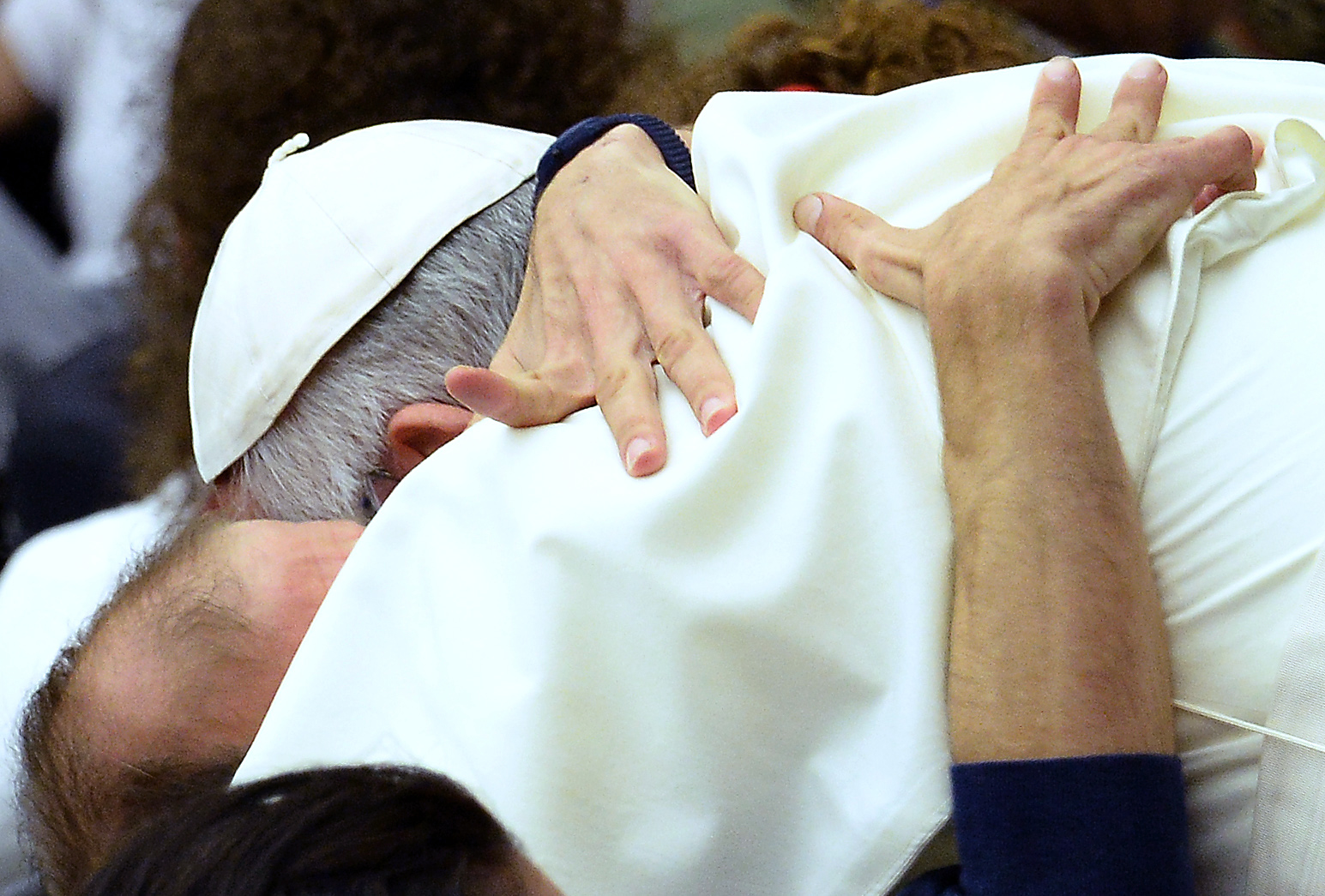
(Photo: Pope Francis hugs a disabled man during a meeting with the UNITALSI, the Italian Union responsible for the transportation of sick people to Lourdes and the International Shrines in PaulVI hall, at the Vatican, on November 9, 2013. By Filippo Monteforte/AFP/Getty Images.)

The Struggle For Accountability On Torture

Redacted Document

A new story in the Huffington Post confirms what I’ve been fearing for a while now: that the Obama White House, in particular chief of staff Denis McDonough, is now pulling out all the stops to protect the CIA as far as humanly possible from any accountability over its torture program. If you want to know why the report has been stymied, and why something that was completed two years ago cannot even get the executive summary in front of the American people, the answer, I’m afraid, is the president.

You’d think his chief-of-staff would have better things to do right now than plead with Senators to protect and defend John Brennan, the CIA director who has put up a ferocious fight to avoid any accountability. But no:

During the last weeks of July, the intelligence community was bracing itself for the release of the Senate investigation’s executive summary, which is expected to be damning in its findings against the CIA. The report was due to be returned to the Senate panel after undergoing an extensive declassification review, and its public release seemed imminent.

Over the span of just a few days, McDonough, who makes infrequent trips down Pennsylvania Avenue, was a regular fixture, according to people with knowledge of his visits. Sources said he pleaded with key Senate figures not to go after CIA Director John Brennan in the expected furor that would follow the release of the report’s 500-page executive summary.

Weird, huh? What is at the heart of this Brennan-McDonough alliance? And then this staggering detail:

According to sources familiar with the CIA inspector general report that details the alleged abuses by agency officials, CIA agents impersonated Senate staffers in order to gain access to Senate communications and drafts of the Intelligence Committee investigation. These sources requested anonymity because the details of the agency’s inspector general report remain classified. “If people knew the details of what they actually did to hack into the Senate computers to go search for the torture document, jaws would drop. It’s straight out of a movie,” said one Senate source familiar with the document.

All of this is out of a really bad movie: CIA goons torturing prisoners with abandon, destroying evidence of war crimes, hacking into the Senate Committee’s computers, impersonating Senate staffers and on and on.

What really seems to have set off the alarm bells is what’s called the Panetta Report, an internal CIA review of its own torture program that somehow (almost certainly accidentally) got included in the document dump given to the Committee. That report is, by all accounts, damning about the torture program, especially its vaunted “effectiveness.” And you can see why Brennan panicked. How will the CIA attack the Senate report if its own report had come to the exact same conclusion? That’s what set off this drama – because Brennan knew at that point that the CIA was busted. Since then he and McDonough have done all they can to bury the truth, even as they are “debating” whether to allow a loophole for torture if conducted overseas.

What’s also disturbing is the weakness of the Democrats, with a few exceptions (thank God for Wyden and Udall). Feinstein seems to have retreated to her usual supine role, and there’s a sense that the political climate – with ISIS hysteria at epic levels – makes this kind of accountability politically toxic. You get a flavor of how the CIA will play this from this quote in the HuffPo piece:

“At a time when ISIS is on the march and beheading American journalists, some Democrats apparently think now is not the time to be advocating going soft on terrorists. The speculation I hear is that the Senate Democrats will wait until the elections are safely over,” said Robert Grenier, a veteran CIA officer who was the top counterterrorism official from 2004 to 2006.

No one is advocating “going soft” on terrorists. We’re advocating the rule of law and core adherence to the Geneva Conventions and a thorough review of war crimes under the last administration. Those are not weaknesses in a democracy’s fight against Jihadist terror. They are strengths. And they are not negotiable.

What I worry about is if the Republicans win the Senate next month, they could bury the report for good. I simply have to hope – remember that? – that the president means what he has always said, and that massive evidence of war crimes is not buried, even if no one in the CIA or the Bush administration will ever be held accountable for anything.

Release the report. And if it is so damning that Brennan has to go, that’s the price of democratic accountability. No one is indispensable. And no one should be somehow claiming in a democracy that they are.

(Image: A heavily redacted document from the CIA released in 2008)

What Catholics Really Believe

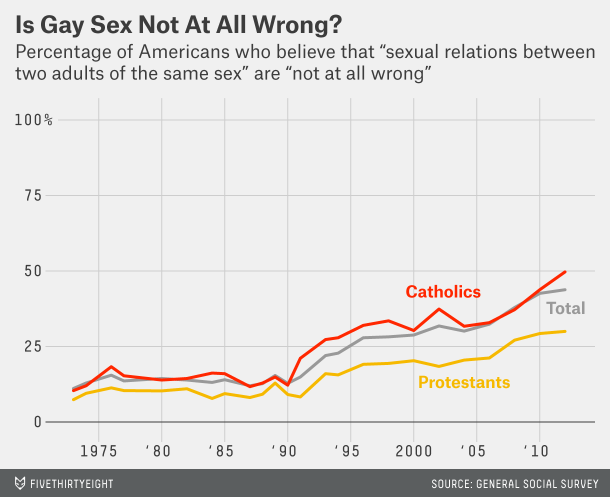
As we enter a year of debate and discussion about the family in Catholic teaching, it’s obvious, thanks to Pope Francis’ skillful airing of the divides, that there is no consensus on the issues of treating the divorced or single parents or homosexuals, and a majority of bishops in favor of the status quo. But it’s worth noting at the same time what American Catholics actually believe. They are increasingly one of the most socially progressive groups in American society and culture. When I am asked by many outsiders how I can remain in a church that does not welcome me or my kind, I have to respond that I have rarely experienced anything but welcome. My fellow Catholics are almost always obviously comfortable around their gay fellow-parishioners, as are, mercifully, many priests.

Check out this graph, for example, on the question of sodomy – yes, full-fledged sodomy – over the decades in American life:

bialik-datalab-vatican-31

If you wanted a religious vocation that was all about endorsing gay sex (not something I would ever recommend), you should rush to be a Catholic! Carl Bialik’s data-driven analysis even finds the correlation between Catholicism and social liberalism to endure across cultures and countries:

We didn’t have data broken down by religion in individual countries, so instead I examined how attitudes within countries corresponded with the percentage of their population that is Catholic. In general, the higher a share of a country’s residents are Catholic, the higher percentage of residents express tolerance toward divorce and towards gays. The effect isn’t huge, but it’s consistent.

I immediately went to read Rod Dreher to see his head exploding. In fact, he agrees:

I think most conservative Catholics intuit this, which accounts partly for their anxiety over the prospect of Rome’s waffling. They know that they are minorities within their own church, and they grieve over the possibility that the Church itself may undercut their convictions.

Rod’s point is that only this minority can really be counted upon to support the church’s work and so any liberalization in pastoral outreach to the gays or the divorced would be counter-productive. I’m not sure where he gets this idea. The liberal parishes I have attended seem brimming with volunteers and life. And notice that Francis has not argued that the doctrine should change anyway. He is pushing for the pragmatic embrace of those whom the hierarchy regards as “intrinsically disordered” or “living in sin.” He is arguing that Catholics’ general empathy for the outsider and the downtrodden – and forgiving response to sinners – should be reflected in the hierarchy as well. He is arguing for the church to be more what it is already.

As for those conservative Catholics, whose presence in the church is vital and important, one has to ask a simple question. Why are their convictions so weak that they require constant reaffirmation from Rome or the pulpit? Why is it impossible to coexist with others of a more liberal mindset – and not fight to the death over these issues as if they had the same potency and salience of other far more vital aspects of Christianity? Why can they not hang in with the church the way so many more liberal Catholics have during the papacies of John Paul II and Benedict XVI?

I think most Catholics’ response to these issues is the Pope’s: who am I to judge? And that response is essentially a Catholic one – and, in my experience, it cuts across the “conservative” and “liberal” positions to a more humane equipoise.

Obama And Torture: Another Win For The CIA?

Obama Departs The White House En Route To New York

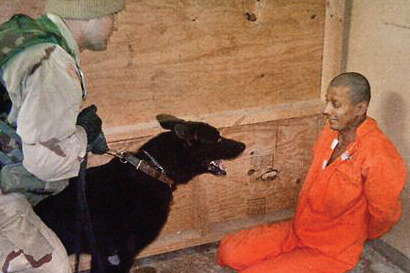
There have been posts I’ve written over the past decade and a half on this blog that have left me with a very heavy heart. Absorbing the full meaning of what was revealed at Abu Ghraib was one; reflecting on the horrifying child-abuse in the Catholic church was another; reacting to president Bush’s endorsement of a Federal Marriage Amendment or president Obama’s half-assed decision to re-fight the Iraq War one more time were not exactly easy posts to compose. I confess I find it hard to write dispassionately about these kinds of things. The abuse of children; the torture of prisoners; the madness of permanent warfare; and the citizenship and dignity of gay people: these are first order questions for me. I understand, as we all must, that politics is an inherently flawed, imperfect, deeply human and always compromised activity. But some things are not really open to compromise. And torture is one of them.

The mounting evidence that president Obama’s long game may well mean the entrenchment and legitimization of torture and abuse of prisoners is a deeply painful thing to report on. He’ll say otherwise; they’ll reach out and insist otherwise. But the record, alas, is getting clearer by the day. We have seen Obama’s rock-solid support for John Brennan’s campaign to prevent any accountability, even to the point of spying on the Senate Committee tasked with oversight, across his two terms. We have watched as the White House has refused to open up its own records for inspection, as it has allowed the CIA to obstruct, slow-walk and try to redact to meaninglessness the Senate Intelligence Committee’s still-stymied report on torture. Our jaws have dropped as the president has reduced one of the gravest crimes on the statute book to “we tortured some folks,” while doing lots of “good things” as well.

Now for the moment when the stomach lurches. The Obama administration is actually now debating whether the legal ban on torture by the CIA in black sites and brigs and gulags outside this country’s borders should be explicitly endorsed by the administration in its looming presentation before the UN’s Committee Against Torture (which might well be an interesting session, given the administration’s consistent refusal to enforce the Geneva Conventions).

One has to ask a simple question: what on earth is there to debate? Torture as well as cruel, inhuman and degrading treatment has already been banned by the executive order of the president, and it is not bound by any geographical limits. Here, moreover, is the text of the Detainee Treatment Act, pioneered by torture victim John McCain, making it even more explicit:

(a) No individual in the custody or under the physical control of the United States Government, regardless of nationality or physical location, shall be subject to cruel, inhuman, or degrading treatment or punishment.

(b) Construction. Nothing in this section shall be construed to impose any geographical limitation on the applicability of the prohibition against cruel, inhuman, or degrading treatment or punishment under this section.

Well: here is the explanation, as given by Charlie Savage in the NYT yesterday:

Military and intelligence lawyers are said to oppose accepting that the treaty imposes legal obligations on the United States’ actions abroad. They say they need more time to study whether it would have operational impacts. They have also raised concerns that current or future wartime detainees abroad might invoke the treaty to sue American officials with claims of torture, although courts have repeatedly thrown out lawsuits brought by detainees held as terrorism suspects.

The CIA’s lawyers want more time to study whether banning torture and cruel, inhuman or degrading treatment of prisoners in line with the law and Obama’s executive order would have “operational impacts”. But how could it when torture and mistreatment are hereby forever banned? Doesn’t it imply that the CIA still sees an option for restoring torture in the future, especially if a pro-torture Republican wins the presidency?

A strong case for this interpretation can be read here in a post by David Luban. It’s essential, if complex, legal reading for anyone concerned that Obama, by taking the CIA’s side in this debate and promoting and exonerating those implicated in past torture, has actually left open the real possibility of this darkness descending again.

Savage has tweeted in response that “operational impacts” could merely refer to conditions of confinement, or force-feeding, rather than to torture and abuse more broadly understood. But the question is still vague – and we know enough about the appalling record of the CIA in this matter to suspect that even the tiniest loophole in the anti-torture regime – like those dutifully carved by Yoo, Bybee et al. – can lead to more war crimes, whose very existence can be suppressed.

You can see the inherent danger here:

Bernadette Meehan, a National Security Council spokeswoman, said Mr. Obama’s opposition to torture and cruel interrogations anywhere in the world was clear, separate from the legal question of whether the United Nations treaty applies to American behavior overseas.

Say what? Is she really saying that all that matters is that Obama personally opposes torture, regardless of whether the law says so or not? Does the administration think we’re that easily placated? Does the president think that another empty rhetorical gesture to his base will suffice – even though his administration intends to be mealy-mouthed about torture in front of the UN Committee and leave a gaping loophole for the next president to exploit?

Presidents come and go; Congressional majorities go back and forth; but the CIA remains. Because this administration never even considered enforcing the Geneva Conventions on the US – by refusing to investigate and prosecute acts of torture and abuse by government officials under the previous administration – the CIA knows it can get away with war crimes in plain sight. Emboldened by that knowledge, and eager to prove that its previous actions were completely legit, it seeks now to find ways to cover up the record, and get the Obama administration to endorse a loophole for the perpetuation of torture, thus cementing a bipartisan protection of war criminals and of war crimes and prisoner abuse. It does all this for the future: so that it will never be held accountable by any body, domestic or international, and so that it can torture and abuse again, if it decides it’s in the country’s best interests. And only it will make that decision. We know by now it needs no other sanction – just some legal shenanigans to cover its own ass.

So we have a true test of what this president is made of, as the administration preps for its first appearance before the UN Committee. Is this president serious about torture? Or is he a pawn, like so many before him, of a rogue agency that is accountable to no one?

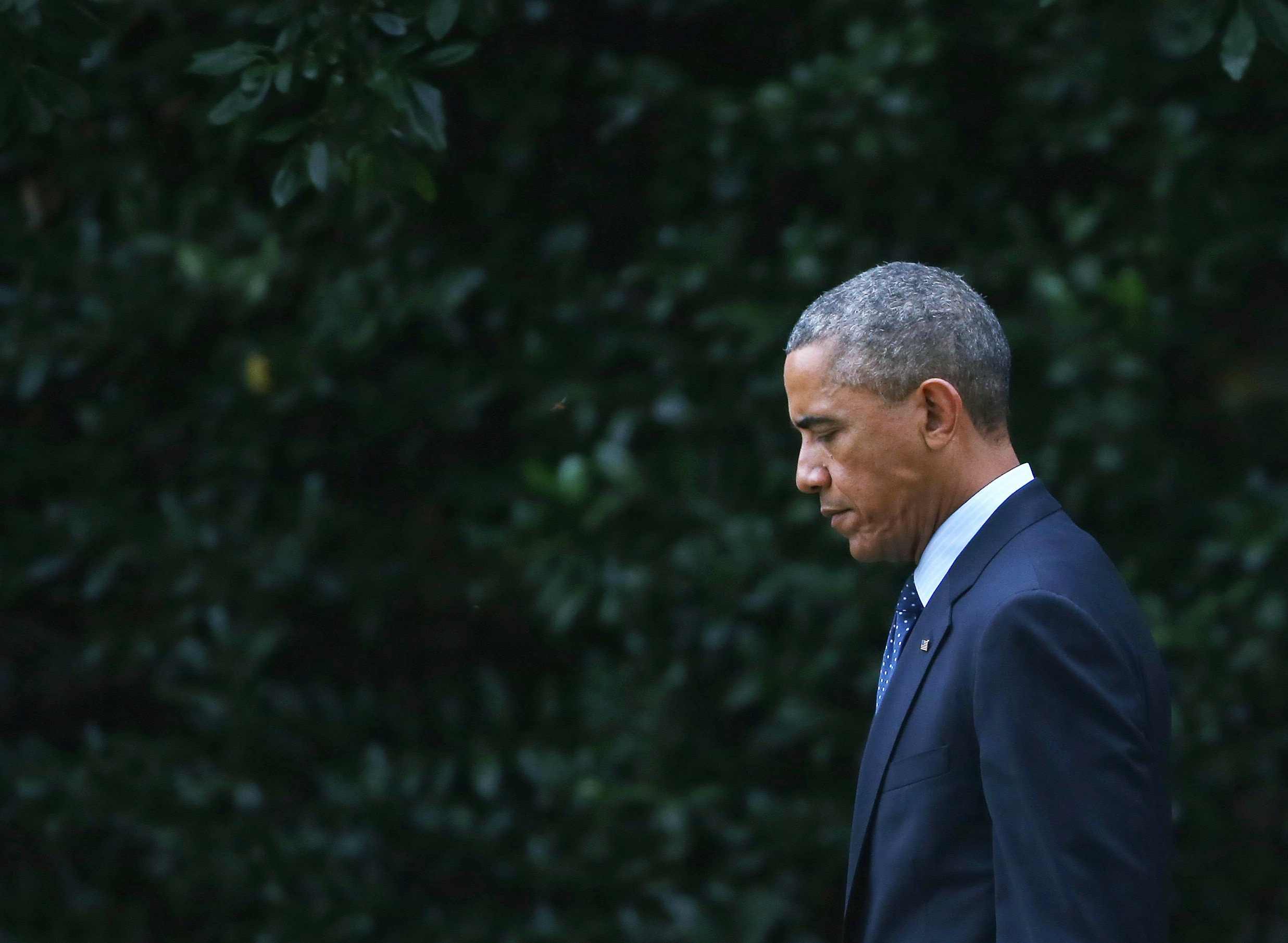
(Photo by Mark Wilson/Getty Images)

Two Steps Forward, One Step Back

Synod On the Themes of Family Is Held At Vatican

[Re-posted from earlier today]

The inevitable media headline from the final Relatio of the Synod on the Family will be: “Bishops scrap welcome to gays.” And this is literally true. The astonishing mid-term Relatio’s language of outreach, inclusion and welcome shrank last night into much more arid, cold and unsparing prose.

We don’t yet have an official English translation of the critical paragraphs, but the gist is clear. Gone are the paragraphs that extol the “gifts and qualities” of gay people; gays are no longer to be “welcomed” in a “fraternal space” but merely “accepted with respect and sensitivity”; the church should no longer “value” homosexual orientation; it should merely accept people with “homosexual tendencies.” Of the three paragraphs in the mid-term report, the two with the most positive language have been excised completely; and the remaining one reaffirms the tone and language of Benedict XVI and John Paul II. Here it is – in my unofficial Google-enabled version:

55. Some families live with members with homosexual orientation. In this regard, our view of the pastoral care appropriate to this situation refers to what the Church teaches: There is no foundation whatsoever to assimilate or to establish  same-sex unions as even remotely analogous to the plan of God for marriage and the family. “Nevertheless, men and women with homosexual tendencies must be accepted with respect and sensitivity. In their regard should be avoided every sign of unjust discrimination” (Congregation for the Doctrine of the Faith, Considerations Regarding Proposals to Give Legal Recognition to Unions Between Homosexual Persons, 4).

Notice the very Ratzingerian foot-stamping:

There is no foundation whatsoever to assimilate or to establish same-sex unions as even remotely analogous to the plan of God for marriage and the family.

It’s not exactly subtle. My marriage, according to this version of the text, is light years away from the marriage of my own sister. There isn’t even a remote analogy between her family and mine. In fact, there is no foundation whatsoever to compare the two relationships in any way. Let me simply respond by saying what most Catholics who have encountered these relationships in our own lives would say: it is indeed hard to read this and believe it. This is not because I differ one iota from the church’s view that the life-long, procreative marriage between a man and a woman is a precious, beautiful and unique thing. Two men or two women cannot replicate it, if only because of basic biology. The sacrament of matrimony is a celebration of this unique institution – and cannot be re-fashioned into something else without diluting its central truth.

But where I differ from the old guard is in their refusal to see anything good or precious in the mutual love, responsibility and sacrifice that are as integral to same-sex unions as they are to heterosexual ones. To see nothing worthwhile there, nothing to value, nothing to affirm seems, well, untrue to the reality more and more of us live. As Cardinal Marx of Germany said earlier this week:

“Take the case of two homosexuals who have been living together for 35 years and taking care of each other, even in the last phases of their lives. How can I say that this has no value?”

He cannot, which is why this paragraph – along with two others on the pastoral care of divorced or re-married people – failed to win the 2/3 majority vote for it to be part of the official text.

But it was included anyway – with the vote tallies appended. And there you see why it is not wishful thinking to believe that something profound has indeed occurred so far in this Synod. Neither of the two previous popes would ever have allowed the original language to even see the light of day – Ratzinger as arbiter of church doctrine for decades could sniff heterodoxy on this like a beagle with a distant potato chip – and stamp it out with relentless assiduity. Both John Paul II and Benedict XVI would have excised the outreach to gay people altogether. And the idea of a transparent vote tally – revealing a vigorous internal division on these questions – would have been unthinkable.

The true headline of this past remarkable week is therefore: the Vatican hierarchy cannot find a consensus on the question of pastoral care for gays, the divorced and the re-married, and the Pope is happy for this fact to be very, very public. These remain open questions for a year of continued debate and discussion before the second stage of the Synod this time next year and the Pope’s subsequent summary. That these are open questions is the real result of this Synod.

I also think its worth reading Pope Francis’ concluding speech to the Synod, which was granted a four minute standing ovation. It is a beautiful text – certainly more so than the unavoidable consensus-speak of what might be called the interim communiqué. Here is Francis’ Obama-style weighing of two different temptations to avoid:

A temptation to hostile inflexibility, that is, wanting to close oneself within the written word, (the letter) and not allowing oneself to be surprised by God, by the God of surprises, (the spirit); within the law, within the certitude of what we know and not of what we still need to learn and to achieve. From the time of Christ, it is the temptation of the zealous, of the scrupulous, of the solicitous and of the so-called – today – “traditionalists” and also of the intellectuals.

The temptation to a destructive tendency to goodness [it. buonismo], that in the name of a deceptive mercy binds the wounds without first curing them and treating them; that treats the symptoms and not the causes and the roots. It is the temptation of the “do-gooders,” of the fearful, and also of the so-called “progressives and liberals.”

Avoiding both these temptations is the goal – which has to be accomplished pastorally and with prudential judgment. In his speech, Francis nods to the traditionalists by quoting Benedict XVI verbatim, but then says this:

We will speak a little bit about the Pope, now, in relation to the Bishops [laughing]. So, the duty of the Pope is that of guaranteeing the unity of the Church; it is that of reminding the faithful of  their duty to faithfully follow the Gospel of Christ; it is that of reminding the pastors that their first duty is to nourish the flock – to nourish the flock – that the Lord has entrusted to them, and to seek to welcome – with fatherly care and mercy, and without false fears – the lost sheep. I made a mistake here. I said welcome: [rather] to go out and find them.

It’s hard not to see a little playfulness here. After all, the word “welcome” was one of the most contentious of the Synod, in so far as it was extended to gay people. And if the final Relatio turned that “welcome” into the more neutral “accept”, Francis turns it into something more radical still: to go out and find the lost sheep.

Just as vital in Francis’ vision is the open, tough and lively dialogue that this Synod represents. Nothing like this has been experienced since the Second Vatican Council. And in his concluding speech, Francis reveled in the turmoil:

It has been “a journey” – and like every journey there were moments of running fast, as if wanting to conquer time and reach the goal as soon as possible; other moments of fatigue, as if wanting to say “enough”; other moments of enthusiasm and ardor. There were moments of profound consolation listening to the testimony of true pastors, who wisely carry in their hearts the joys and the tears of their faithful people. Moments of consolation and grace and comfort hearing the testimonies of the families who have participated in the Synod and have shared with us the beauty and the joy of their married life. A journey where the stronger feel compelled to help the less strong, where the more experienced are led to serve others, even through confrontations. And since it is a journey of human beings, with the consolations there were also moments of desolation, of tensions and temptations.

The church is not a political party, voting on a platform, and shifting from one convention to the next. Its core doctrine is unchanged and unchangeable. But it has evolved and grown and changed in the way it has encountered the world throughout history. It has absorbed and assimilated new ways of thinking and newly discovered truths about humankind and attempted over the centuries to integrate them into its internal dialogue. So you have to look at a Synod like this one and not get too caught up in developments from last Monday to Sunday. You have to look beneath that surface to the tectonic shifts beneath. And the real shift, I’d argue, has been the glasnost of Francis – which may or may not lead to perestroika. The intellectual life of the church was a dark and stifling and deadly silent place until very recently. There is now a crack in the window, where light has been let in, and words said that can be excised from the final text but not expunged from the collective consciousness. And at the end, no consensus on the most contentious questions at hand. And a year to debate them further.

Those knots? They keep unraveling.

(Photo: Franco Origlia/AFP/Getty.)

Obama And Torture: The Record Gets Worse

US-POLITICS-OBAMA-INTELLIGENCE

We are still, of course, waiting for the Senate Intelligence Committee Report to be released to the public. It’s been forever since it was finished, and forever since the CIA managed to respond, and the endless process goes on and on – even after John Brennan’s attempt to spy on the very committee supposed to oversee his out-of-control agency, and then lie about it. The very fact that Brennan is still in his job – after displaying utter contempt for the Constitution and the American people – tells you all you really need to know about where Obama really stands on this question. He stands for protecting the CIA – and Denis McDonough, his chief-of-staff, has become the CIA’s indispensable ally in enabling not only its immunity from any prosecution for war crimes, but from even basic democratic accountability.

So it does not, alas, surprise me to find this anecdote in Leon Panetta’s memoir:

The extent of the Obama’s fury over the [Senate Committee’s] study was revealed in a memoir by former CIA Director Leon Panetta that was released this month. The president, he wrote, was livid that the CIA agreed in 2009 to give the committee access to millions of the agency’s highly classified documents. “The president wants to know who the f— authorized this release to the committees,” Panetta recalled then-White House Chief of Staff Rahm Emanuel shouting at him. “I have a president with his hair on fire and I want to know what the fuck you did to fuck this up so bad!”

We don’t have merely passive indifference to the CIA’s record on torture, we have active opposition to the entire inquiry from the very beginning of Obama’s term in office. If you want to know why we are still waiting for the report almost two years since it was finished, and if you want to know why the White House refused to provide mountains of internal documents that would have added to the report’s factual inquiries, just absorb the anecdote above. And if you want to know why the White House did nothing to discipline the CIA after it hacked into the Senate Committee’s own computers, ditto. It’s impossible not to conclude that Obama wants as little of this material made public as possible. His pledge for the most transparent administration in history ends, it seems, at Langley.

The question is: why? The answer, I’d wager, is pretty simple and deeply depressing. From the very beginning, Obama was told (and apparently believed) that if he attempted to investigate or cooperate in any inquiry into the CIA’s war crimes, he would “lose the agency,” as they say in Washington. It’s a curious phrase when you come to think about it: “lose the agency”. In what other branch of abu_ghraib_thumbgovernment would cooperating with a Congressional investigation into alleged misconduct risk “losing the agency”? There’s an implicit sense here that the CIA can and will retaliate against presidents who dare to hold it to account. And that kind of conventional wisdom is what led Emanuel and now McDonough to protect the CIA at nearly any cost.

The current battle – in which McDonough is apparently indistinguishable from John Brennan – is over the extent of the redactions in the report. They’re already voluminous, but the CIA is now asking for unprecedented concessions in order to make the report as hard to understand as possible and to render critical narratives impossible to follow. So, for example, they are objecting to the use of pseudonyms to identify individuals who crop up often in the report, alleging that they somehow risk agents’ lives.

But the pseudonyms in the report are not the pseudonyms that agents use to protect their actual identities; they are merely completely fictional names in order to clarify an individual’s role over time in the torture program. Without them it could become close to impossible to make sense of the torture narrative. In the past, moreover, all sorts of reports that have emerged from government inquiries – from the Church Committee to Iran-Contra – have used real names for some individuals, and pseudonyms for others, in laying out their conclusions. But not this time, apparently. And even from the CIA’s perspective, this battle makes little sense. If all identifying pseudonyms are turned into black spaces, it can lead to the impression that the agency as a whole was responsible for various war crimes, as opposed to pseudonymous individuals within it. Removing pseudonyms actually paints the entire CIA with a much broader and darker brush than it deserves – for there were many in the CIA appalled and shocked by the amateurish brutality of the program, and many who were integral to ending it.

Then there is an attempt to redact parts of the report that include the history of intelligence before the torture program was put into effect. The CIA wants this removed as irrelevant, but in the context of the report, it can be highly relevant. If, for example, it can be shown that a certain piece of intelligence was already known in the CIA before the torture program, and a torturer subsequently claimed it was discovered in a torture session, then it is highly relevant for that history to be known. For it proves that torture was not necessary and that many of the claims for its success were without key context and therefore deeply misleading.

Yesterday’s McClatchy story leads with the notion that the report does not follow the trail of responsibility up to Bush, Cheney, Tenet, Rumsfeld et al, and is thereby somehow toothless.

But the committee was an investigation specifically into the CIA’s records on the program, to get a full accounting of what happened within that agency. It was not tasked with the essentially political job of holding the White House responsible. And it may be, in fact, that even some of the most powerful individuals in the Bush administration were actually unaware of what was really going on, or that they were merely repeating what the CIA was telling them, and the CIA was lying to cover its ass. That does not minimize the political responsibility of president Bush and others for presiding over such a grotesque torture program; but it’s essential context for understanding what actually happened.

That’s what this Committee report is really about. It is not about assigning responsibility for torture. It is merely the legislative branch’s completely legitimate inquiry into how on earth a democratic society could have sunk so low so fast in the war on Jihadist terrorism. It is the beginning of that process of truth and accountability, not its end. But even that minimal task of fact-finding has been stymied, obstructed and foiled by the CIA from the very beginning. And in that process, the president has been one of the CIA’s strongest defenders and enablers.

In no way does that mean that Obama bears the responsibility for this hideous stain on this country’s integrity and values. It does mean, however, that we have a government agency that is effectively beyond any democratic accountability – even when it commits war crimes. Something is rotten in this national security state. And it is our duty to expose it – and do what we can to make it better.

(Photo: Director of the Central Intelligence Agency John Brennan (L) talks with the Director of National Intelligence James Clapper before President Barack Obama spoke about the National Security Agency and intelligence agencies surveillance techniques at the US Department of Justice in Washington, DC, on January 17, 2014. By Jim Watson/AFP/Getty Images.)

Fight Prohibition With A New Dish Shirt!

know-dope-shirts

So we figured as we put out our first round of Dish merch that, every now and again, we might offer a special message t-shirt, if the moment was right. And with less than a month to go before seismic votes on legal cannabis in Oregon, Alaska and my home-town of DC, why not create a t-shirt for legalization for Dishheads – especially those of you who enjoy our daily 4.20 pm Mental Health Breaks and those who choose to subscribe at $4.20 a month (for some reason). Legal cannabis has been a cause here since 2000, and, along with marriage equality and the Obama candidacy, has been easily the most successful. But we’re not there yet – so try these on for size.

Buy the standard “Know Dope” t-shirt here. Buy the DC one here. All you Oregonians out there, get your version here. Alaskans, yours is here. All of the shirts are just $20. And all of them help us keep this blog able to pay its way as well. So if you just want to help us out, and take a stand for personal freedom and drug sanity, you know what to do.

A big thanks to the t-shirt’s designer, Dave Stenken (aka BiggStankDogg), whose other work you can peruse at TeePublic or his Facebook page. And another thanks to our BustedTees guy, Jerzy Shustin, for helping us launch our latest merch (our regular Dish t-shirts are still always available here). If you end up getting a “Know Dope” tee, email us a pic at dish@andrewsullivan.com.

The Best Of The Dish Today

Sydney Locals Create Bondi's Largest Fluro Wave

A reader writes:

I have had to correct this misstatement numerous times with friends, and now I’m disappointed to see you parroting Kristof, who is parroting Allah-knows who else. The data from the Pew Report [pdf] showing majorities in many Muslim countries in favor of the death penalty for apostasy come only from those Muslims who believe Sharia law should be the law of the land.

So not all Muslims, by any means. What percentage of Muslims across the diverse Muslim world favor Sharia law? The key graph from Pew on executing apostates is below. And when you do the math (and yes, fair warning that I usually do it wrong), you find that 63 percent of Egypt’s Muslims, 58 percent of Jordanian Muslims, 78 percent of Pakistani Muslims, and 53 percent of Malaysian Muslims believe that if you decide you don’t believe in Islam any more, you should be executed. Think about that for a minute.

Screen Shot 2014-10-09 at 6.57.21 PMCentral Asian and South-Eastern European Muslims are very different, as are Indonesians. You’ll notice also that in one of the least devout of the Muslim countries in the Middle East and North Africa, Tunisia, only 16 percent favor the death penalty for non-belief. It does not shock me that Tunisia’s democratic revolution is the only one that has survived.

The more devout you are, the more you tend to favor the state enforcing religious doctrine, Pew also finds. Not how poor you are, how devout you are.

But variety and diversity exists as well. And nowhere has Islam come closer to a reconciliation with modernity than in America. American Muslims are far more like American non-Muslims than Muslims in any other country. On the core question of religious liberty, 56% of American Muslims “believe that many religions can lead to eternal life … Across the world, a median of just 18% of Muslims worldwide think religions other than Islam can lead to eternal life.” Here’s another big difference between Islam in America, and Islam elsewhere:

About half of U.S. Muslims say that all (7%) or most (41%) of their close friends are followers of Islam, and half say that some (36%) or hardly any (14%) of their close friends are Muslim. By contrast, Muslims in other countries nearly universally report that all or most of their close friends are Muslim (global median of 95%). Even Muslims who also are religious minorities in their countries are less likely than U.S. Muslims to have friendships with non-Muslims. For example, 78% of Russian Muslims and 96% of Thai Muslims say most or all of their close friends are Muslim.

I think it’s essential that this is better known in America, and that dumb conflations of Islam here and around the world – leading to foul prejudice and discrimination and fear – be challenged at every point. At the same time, I just don’t think the extreme and barbaric views of so many Muslims around the world can be denied. They are dangerous for their own societies and for ours. No one should not be intimidated into silence about it.

Today, the debate about Islam continued – see the thread here. We have updates on the Senate races where the GOP is in some trouble – in South Dakota and Kansas. I pushed back against the Beltway bullshit that the Obama presidency is suddenly a failure – au contraire! The intervention in Syria is another almighty clusterfuck that the US should have avoided at all costs; and our experiment in new media is chugging along.

The most popular post of the day was my defense of Sam Harris and Bill Maher against Ben Affleck and Nick Kristof; followed by my defense of religious freedom in Gordon College.

Many of today’s posts were updated with your emails – read them all here.  You can always leave your unfiltered comments at our Facebook page and @sullydish. 29 more readers became subscribers today. You can join them here – and get access to all the readons and Deep Dish – for a little as $1.99 month. And drop us an email; we love hearing from new subscribers.

(Photo: Sydney locals line up along the waters edge dressed in fluro costumes in an attempt to create Bondi’s largest fluro wave stretching from South Bondi to North Bondi at Bondi Beach on October 10, 2014 in Sydney, Australia.  The event is to raise awareness on World Mental Day and show support for everyone who has ever suffered, or knows someone who has suffered with depression and other disorders including bi-polar and anxiety. By Ryan Pierse/Getty Images.)