The Misery Of Materialism

Just in time for the very last round of Christmas shopping, George Monbiot has issued a cri de coeur against consumerism. He notes that there “has long been a correlation observed between materialism, a lack of empathy and engagement with others, and unhappiness”:

[A] series of studies published in the journal Motivation and Emotion in July showed that as people become more materialistic, their wellbeing (good relationships, autonomy, sense of purpose and the rest) diminishes. As they become less materialistic, it rises. In one study, the researchers tested a group of 18-year-olds, then re-tested them 12 years later. They were asked to rank the importance of different goals – jobs, money and status on one side, and self-acceptance, fellow feeling and belonging on the other. They were then given a standard diagnostic test to identify mental health problems. At the ages of both 18 and 30, materialistic people were more susceptible to disorders. But if in that period they became less materialistic, they became happier. …

Another paper, published in Psychological Science, found that people in a controlled experiment who were repeatedly exposed to images of luxury goods, to messages that cast them as consumers rather than citizens and to words associated with materialism (such as buy, status, asset and expensive), experienced immediate but temporary increases in material aspirations, anxiety and depression. They also became more competitive and more selfish, had a reduced sense of social responsibility and were less inclined to join in demanding social activities. The researchers point out that, as we are repeatedly bombarded with such images through advertisements, and constantly described by the media as consumers, these temporary effects could be triggered more or less continuously.
Festive Foliage

Americans prefer real Christmas trees to artificial ones:

Rick Dungey, of the NCTA [National Christmas Tree Association], dismisses the artificial sort as “plastic tree-shaped decorations”. Americans tend to agree, buying more real trees than fake ones. Of 35m sold every year, 70% sprout from the ground. Despite a rise in sales a decade ago, fake trees have lost their sparkle since the financial crisis. But according to the American Christmas Tree Association, a trade group that claims to represent both types of tree, 83% of homes have a fake shrub.

Leslie Horn insists on authenticity:

[U]nless you’re a slight scrooge or suffer from severe seasonal allergies, you must go with the real thing. Douglas Fir, Blue Spruce, Scotch Pine—pick your pleasure. The smell is part of the fun, and car air fresheners or kitchen candles just don’t give the same seasonal effect.

Last year, Timothy Taylor reviewed research on how real and artificial trees affect the environment:

One artificial tree has greater environmental impact than one natural tree. However, an artificial tree can also be re-used over a number of years. Thus, there is some crossover point, if the artificial tree is used for long enough, that its environmental effect is less than an annual series of trees. For example, the [2009] ellipsos study [pdf] finds that an artificial tree would need to be used for 20 years before its greenhouse gas effects would be less than those of an annual series of natural trees.

Taylor considers other factors:

[T]he environment effect of the ornaments on the trees may be as large or greater than the effect of the tree itself. Data from the U.S. Census Bureau shows that America imported $1 billion in Christmas tree ornaments from China (the leading supplier) between January to September 2012, but only $140 million worth of artificial Christmas trees. Thus, spending on ornaments is something like six times as high as spending on [artificial] trees. The choice of what kind of lights on the tree, or whether to drape the house and front yard with lights, is a more momentous environmental decision than the tree itself.

Previous Dish on Christmas trees here and here.

It’s The Cash That Counts

According to a NSFW parody of a Christmas classic:

Derek Thompson weighs in:

Cash is the most efficient gift, according to economists. Cash is also a terrible gift, according to economists. By guaranteeing that the recipient can buy exactly what she wants, you guarantee that the recipient will consider you an unemotional robot.

That’s why the vast majority of economists in the University of Chicago’s IGM poll said it’s absurd to give cash to loved ones for the holidays. “In some cases,” Steven Kaplan said, in a stirring defense for thoughtful gifts, “non-pecuniary [not cash-related] values are important.”

The 2013 Dish Awards: The Malkin Award

It’s a close race for the prize, which is given “for shrill, hyperbolic, divisive and intemperate right-wing rhetoric.” As of this writing, Rep. Steve Stockman (R-TX) is narrowly ahead, earning 29.36% of the vote for this rant:

Democrats do not want abortion to be safe or rare. Democrats oppose even the most basic of health and safety standards for abortion mills. Democrats don’t care how many women are maimed, infected with diseases or die on the routinely-filthy abortion mills. Democrats worship abortion with same fervor the Canaanites worshipped Molech.

About a point behind, with 28.09%, is Richard Cohen, who was nominated for his infamous column on Bill de Blasio:

People with conventional views must repress a gag reflex when considering the mayor-elect of New York — a white man married to a black woman and with two biracial children. (Should I mention that Bill de Blasio’s wife, Chirlane McCray, used to be a lesbian?)

Who deserves highest dishonors? Review all the candidates and decide here. Use the links below to vote for the other awards.

Click here to vote for the 2013 Moore Award!

Click here to vote for the 2013 Dick Morris Award!

Click here to vote for the 2013 Poseur Alert!

Click here to vote for the 2013 Yglesias Award!

Click here to vote for the 2013 Hewitt Award!

Click here to vote for the 2013 Hathos Alert!

Click here to vote for the Chart Of The Year!

Click here to vote for the Cool Ad Of The Year!

Click here to vote for the Face Of The Year!

Click here to vote for the Mental Health Break Of The Year!

Click here to vote for the Window View Of The Year!

Hymns For The Holiday

Turns out Elvis is the king of modern carols:

According to the latest data and certifications of the Recording Industry of America, Elvis’ Christmas Album, recorded by Elvis Presley (who else?) has shipped at least 13 million copies since its original release in 1957. That makes it the biggest-selling Christmas album of all time. The album has been re-issued and repackaged several times, and continues to be a perennial holiday best-seller. It sold three million copies upon its original release in 1957 and has sold an additional ten million copies in the various forms it has been reissued in.

Titi Nguyen surveys the history of Christmas songs:

The songs that most of us recognize as carols date back thousands of years. They were originally pagan songs sung during celebrations of fruitful harvests and seasonal solstices in Europe. During the early seventeenth century, after Christians adapted these songs to celebrate the birth of Christ, carolers began singing door-to-door, in public spaces, and at home. Peasants roamed about singing for their suppers at the doors of the wealthy, and the celebration of the birth of Christ was an especially generous time when lords invited poor villagers to their manors to feast and drink. Groups of young men called wassailers would sing good tidings in exchange for food or money. Neighbors learned the same songs and sang them in unison with and for each other; caroling was a community event.

Meanwhile, Robert Bound considers contemporary offerings:

So what makes a good Christmas song? Well, not being too good is key. There’s a kitschness to Christmas that’s not the opposite of quality but a sister to silliness (see Slade’s “Merry Xmas Everybody”). Smells and bells in both musical and metaphorical form are also important at Christmas. This is when you can add the extras that would seem extraneous in other seasons. “All I Want For Christmas Is You”, belted out by Mariah Carey with the full compliment of trills and vocal tricks seems just about suitable when there are sleigh bells and choirs in (and on) the mix. Like wearing a reindeer-busy Christmas jumper for sitting around the house, this is a time when there’s almost no such thing as too much.

An extensive collection of Christmas songs from around the world is here.

Seasonal Salutations

dish_christmasgreetings

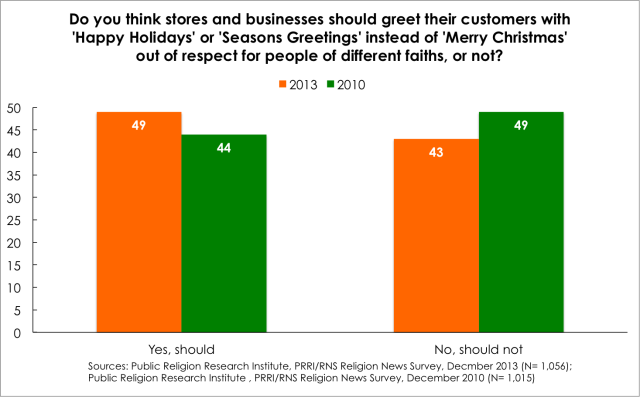
A new survey suggests that American shoppers are warming to more secular holiday greetings:

Nearly half (49%) of Americans agree stores and businesses should greet their customers with “happy holidays” or “season’s greetings” instead of “merry Christmas” out of respect for people of different faiths. However, a substantial minority (43%) disagree. Support for saying “happy holidays” or “season’s greetings” is up slightly since December 2010, when 44% preferred that businesses use less religious greetings. … The political divisions are stark. Roughly 6-in-10 (61%) Republicans favor using “merry Christmas” over “happy holidays,” while nearly as many (58%) Democrats say the opposite.

Matthew Schmitz reviews historical objections to “Merry Christmas”:

Queen Elizabeth, a woman of serious low-church piety, is said to prefer “happy” to “merry” because she dislikes “merry’s” connotation of boisterousness, even slight intoxication. (Similarly, in Holland some of the more strictly reformed Dutch prefer Zalig Kerstfeest—“Blessed Christmas”—to Vrolijk Kerstmis—“Merry Christmas.”) This moral suspicion of “Merry Christmas” dates back to the Methodist churchmen of the Victorian era who sought to promote sobriety among the English working class. Merrymaking of the ancient, alcoholic sort was frowned on year-round, perhaps never more so than during the celebration of the Savior’s birth. The phrase “Merry Christmas” would hang on, but the image of a family sharing a bottle of port or wine in the first commercial Christmas card was to give way to more temperate holiday depictions.

Yesterday we covered Schmitz’s defense of using “Merry Xmas!”

A Poem For Christmas Eve

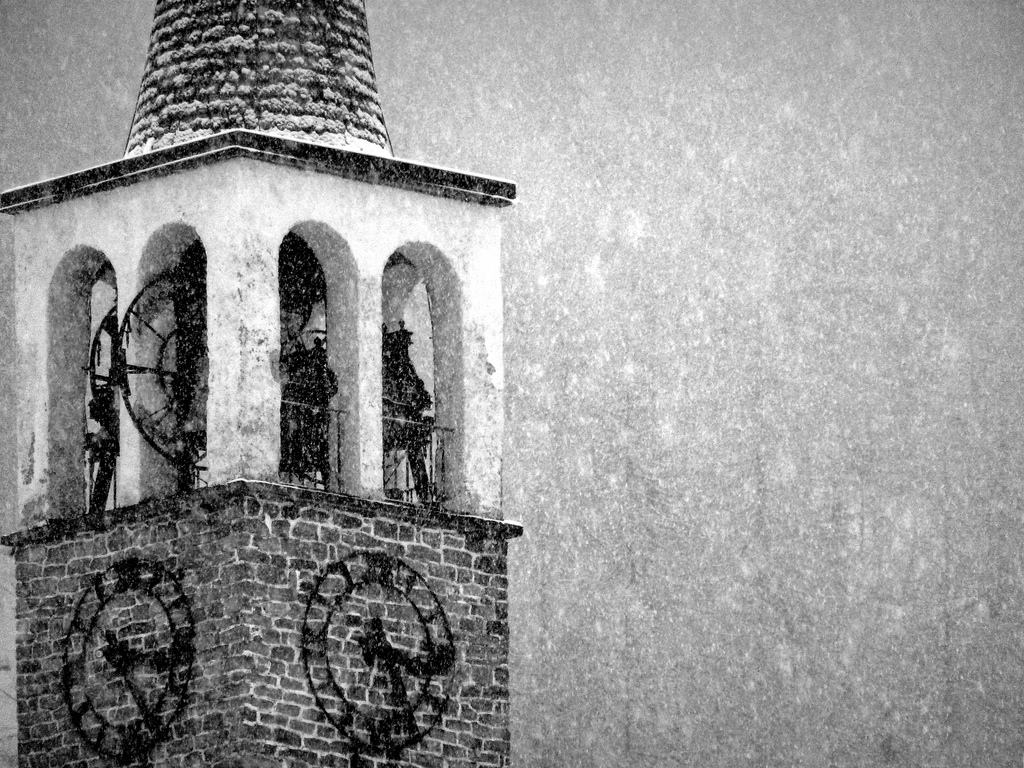
churchbells

From “The Bells” by Edgar Allan Poe:

Hear the sledges with the bells—
Silver Bells!
What a world of merriment their melody foretells!
How they tinkle, tinkle, tinkle,
In the icy air of night!
While the stars that oversprinkle
All the heavens, seem to twinkle
With a crystalline delight;
Keeping time, time, time,
In a sort of Runic rhyme,
To the tintinnabulation that so musically wells
From the bells, bells, bells, bells,
Bells, bells, bells—
From the jingling and the tinkling of the bells.

Please consider supporting the work of the Poetry Society of America here.

(Photo by Angelo Amboldi)

The Reason For The Season

Daniel Luzer looks at how Hanukkah and Christmas in the US became co-opted by commercialization:

Ashton’s Hanukkah in America: A History explains that by the 19th century “the rising consumer economy and expansion of department stores embraced and promoted the new Christmas customs.” Prior to that time, Christmas celebrations, “where they occurred at all, tended toward ‘carnivalesque’ revelries often involving alcohol consumption and the firing of muskets in the streets, a general rowdiness usually decried by civic and religious elites,” Ashton writes. As the way we celebrate Christmas shifted over time, so too did our celebrations of Hanukkah. In short, they both became more commercial. … Many department store owners realized, correctly, that a gift-based Hanukkah could be very good for business. Only two percent of Americans are Jewish, but many of them settled in cities, where large department stores are easy to find. This meant that they could be a great addition to the market during the Christmas shopping season, so much so that for many gentiles this industry was really their only knowledge of Judaism, at least until relatively recently.