Alexis de Tocqueville long ago wrote that the democratic age is upon us. By this he meant that the “links” to family and tribe that held us fast in the aristocratic age were breaking apart before our eyes. The political consequence of this social de-linkage, however, was not necessarily benign democratic governance. Indeed, he worried that attempts would be made to refortify the old links, to reaffirm roles at the moment when delinked persons were emerging. What we today often identify as “Islamic Fundamentalism” is just such an attempt to re-fortify the old links, to re-enchant the world. Herein lays the dilemma of the Middle East. Caught in the matrix of the political and social arrangements of the twentieth century that defy credulity, drawn and at the same time repulsed by the fugitive freedom they see on Western shores but only dimly understand, nascent citizens more than occasionally dream of returning to an enchanted world for which an imagined Islam provides a ready guide.
Under these wildly unstable conditions, U.S. foreign policy-makers should take the long view. Democratic governance will not arrive soon in the Middle East. If it does at all, it will emerge only when families and tribes become much less important than they now are. Citizens and entrepreneurs―the building blocks of democratic governance and of market commerce―do not spring up spontaneously out of societies where families and tribes still retain their hold on the imagination. The slow process by which that changes, moreover, cannot easily be accelerated by U.S. foreign policy.
In the meantime, in the interludes of peace, diplomatic and cultural outreach and, above all, higher education initiatives intended to help the younger generation understand and thrive in the disenchanted world it will inherit offer perhaps the most constructive ways to engage the region.
I used to believe – and a part of me still does – that the question of homosexuality was not that big an issue for Catholicism. Gays are only a tiny minority of the population at large; the power and beauty of the church’s core understanding of heterosexuality sustains most people’s interest and commitment; and the central teachings of Jesus – of forgiveness of sins, redemption, charity, mercy – are so much more important than issues relating to human sexuality and romantic love.
When I was asked – with mind-numbing regularity – how I could remain happily gay and a Catholic, I answered honestly that, for those very reasons, I could live with institutional dissonance, as any thinking member of a hierarchical church has to, from time to time. But I think now that I misread a couple of things – and that the whole question may be a much bigger deal than I once believed and hoped. Here’s a story that underlines the problem:
A Catholic church in Montana has told two gay men that they can no longer receive communion simply because of their gay marriage and, in order to do so again, they must file for divorce. The two men, Paul Huff, 66, and Tom Wojtowick, 73, have been together for over 30 years and were married in Seattle in 2013. They’ve attended Saint Leo The Great Catholic Church in the town of Lewistown since 2003 and have also been members of the church’s choir. The’ve also now been denied participation in that church group.
Maybe years ago, removing two faithful choir members because they’re gay would have passed some kind of muster. First off, the couple wouldn’t have been out of the closet and so the entire don’t-ask-don’t-tell paradigm would have allowed the pastor to ignore the fact that two gay men were in the choir – or to keep their expulsion on the down-low; second, they would probably have been too ashamed to protest, and their peers too embarrassed to support them. But those two conditions are now no longer close to being met:
Huff and Wojtowick have received support from many of the church’s congregation. Forty members have reportedly either voiced their disapproval of the church’s offensive decision or have quit attending mass there altogether. One parishioner has suggested the title of a song sung at the church be changed from “All are Welcome” to “Some are Welcome.” How apt.
The controversy has now led to the bishop intervening and holding a meeting with 300 parishioners to air views. The bishop claims there is polarization in the congregation over this and is now mulling the decision to bar the couple from the sacraments and from participation in their church – unless they get a civil divorce and sign a statement supporting civil marriage as exclusively heterosexual. Yes, the church is now in favor of divorce as a condition for being a Catholic! If that sounds perverse, you’re not wrong.
Here’s the problem: maintaining doctrinal orthodoxy requires penalizing two men, aged 66 and 73, who have been committed to each other for thirty years and are pillars of the local community. Here’s a brief profile of who these two men are:
Huff and Wojtowick have both historically been active in their community and in their church. Huff is a two-time past-president of the local Kiwanis Club, chairman of the Fergus County Fair Board, board member of the Lewistown Art Center and formerly served as an organist and cantor in the St. Leo’s church choir.
Wojtowick recently retired as executive director of the Central Montana Council on Aging, and has served as either a board member or chairman of the Lewistown Public Library, Lewistown Art Center, and as an adviser to the Central Montana Medical Center Home Health and Hospice Program. Wojtowick is a four times elected representative of the Fergus County Community Council.
It’s kinda hard to portray these two as some kind of subversive force. More to the point, the core reason behind the church’s position is the natural law teaching barring all non-procreative sex. I don’t know how much non-procreative sex the two men are now having, but it’s not entirely crazy to assume it’s no more than any heterosexual couple past menopause and in retirement. So the sodomy question has to be pretty moot.
And the action against the men came not because they are gay but because they decided to celebrate their love and friendship with a civil marriage license. So they’re not really being targeted for sex; they are being targeted for their commitment and responsibility and honesty. And the only reason they have been excluded on those grounds is because they are gay.
If the church upholds this kind of decision, it is endorsing cruelty, discrimination and exclusion. Pope Francis’ view is that this is exactly the kind of thing that requires the church to exercise mercy not rigidity. But allowing a married gay couple to sing in the choir as an act of “mercy” would merely further expose the fragility of the church’s thirteenth century views of human sexuality. It would put the lie to the otherness of gay people; to the notion that it is essential or even possible for a tiny minority to live entirely without intimacy or love or commitment. It also reveals that gay men have long been a part of the church – and tolerated, as long as they lied about their lives and gave others plausible deniability with respect to their sexual orientation. It is an endorsement of dishonesty.
None of this is compatible with the core moral teachings of the church – about fairness, truth, compassion, forgiveness, mercy and inclusion. And this is clear to large numbers of Catholics – especially the younger generation who will rightly view this kind of decision as barbaric and inhuman. There is only so much inhumanity that a church can be seen to represent before its own members lose faith in it. I recall the feelings of my own niece and nephew who lost a huge amount of respect for the church when they heard a homily denouncing the civil marriage of their own uncle. I notice the outcry among Catholic high school students when a teacher was fired for the very same reason. When a church responds to an act of love and commitment not by celebration but by ostracism, it is not just attacking a couple’s human dignity; it is also attacking itself.
What was once a blemish can become a defining wound. It has split one small parish. It may slowly wreck the whole church.
Update from a reader:
Question: Why would the church need these two men to get a “divorce”… for a “marriage” that isn’t even recognized by the Roman Catholic Church?
Possible Answer: Did a member of the Roman Catholic clergy just recognize and affirm the existence of a gay marriage?
I have to say I’m sensing a groundswell around this issue – of a kind I once saw with marriage equality. Once an issue hits around 50 percent, the consensus doesn’t stand pat; it tends to evolve more swiftly to a definitive resolution of the question at hand. Even MoDo is hanging out with Willie Nelson, who makes a simple case for his own use of cannabis over alcohol:
“Everybody’s got to kill their own snakes, as they say. I found out that pot is the best thing for me because I needed something to slow me down a little bit.” He was such a mean drunk, he said, that if he’d kept drinking heavily, “there’s no telling how many people I would have killed by now.”
Know dope.
Update from a reader with “another Willie Nelson reefer story”:
A couple of years ago he gets busted on his tour bus (can’t remember where) for possession of a small amount of marijuana. At the same time the news is full of stories about spinach being recalled across the country because of E.coli. A lot of people are hospitalized, some serious. The cameras are waiting for Willie as he leaves the cop shop. All he says (with a wonderful cockeyed grin) is: “Well, at least they didn’t catch me with any spinach.”
Philip Klein calls the NFL’s tax-exempt status “bad policy that exemplifies the problems with the nation’s disastrous tax code”:
The NFL’s nonprofit status was enshrined into law in a 1966 act meant to protect the league from antitrust issues surrounding its merger with the rival AFL (which was considered a lesser league until my Jets pulled off the greatest upset in football history in the 1969 Super Bowl). The same law added, “professional football leagues” to the part of the tax code listing entities granted nonprofit status.
Though the league distributes lucrative television and licensing revenue among the 32 teams, which do pay taxes on their earnings, the teams also send dues to the NFL league office. The office does not pay taxes on those dues, and the fees could be deducted from the teams’ taxes.
The NFL reported total revenue of $326 million for the 2012 tax year, according to its most recent publicly available filing with the Internal Revenue Service. During that year alone, the NFL paid $44.2 million in compensation to commissioner Roger Goodell. Goodell earned $105 million over the course of the five-year period from 2008 through 2012, according to a CNN report – more than any player.
Well, it might fall under the religious exemption, no? At this point, it requires blind faith to believe in its future. But Jordan Weissmann notes that revoking the NFL’s tax-exempt status “wouldn’t drastically change its finances”:
Only the league office, which considers itself a trade association for its clubs – just like the U.S. Chamber of Commerce or the National Dairy Council—is a nonprofit; the teams themselves are purely for-profit. As a result, pro football’s copious TV revenues are taxed once they’re passed down to the franchises. A separate, for-profit company called NFL Ventures, co-owned by the teams, handles the league’s merchandising and sponsorship earnings. Finally, the league office often operates at a loss—in 2011 it finished more than $77 million in the red, while in 2012 it only had $9 million left at year’s end. Without profits, of course, there’s nothing for the government to tax. …
Congress itself doesn’t think the NFL’s tax bill would be that big. [Tom] Coburn has suggested that taxing the NFL and NHL alone would raise about $91 million per year. But the Congressional Joint Committee on Taxation – probably a bit more credible in this instance – believes ending tax exemptions for all sports leagues would bring in just under $11 million per year. Booker hopes his bill would raise about $100 million over a decade, which would go to support domestic abuse programs. That’s a mere trickle compared with the geyser of cash the NFL generates each year.
However, he adds:
If money isn’t really the issue, what is? It’s about principles. Letting the NFL operate tax-free makes a mockery of the entire concept behind nonprofits, which is that we should give a special break to organizations that do the useful, unprofitable work normal corporations won’t.
Update from a reader with expertise on the subject:
As an accounting professor specializing in nonprofits, I wanted to reiterate the view that the NFL is not really avoiding any taxes with its status (true, it has a lot of revenues, but it shows even more expenses, so the profits are really held by the for-profit teams). I would also like to add that one big benefit of the NFL’s nonprofit status is that it requires the NFL to make its financial statements and executive pay public (without the required form 990, we never would have known that Goodell got a $40 million bonus in 2013). Here is a bit more on the misconceptions about the NFL’s nonprofit status.
In short, does the NFL deserve its nonprofit status? Probably not. Does stripping the status accomplish anything? Again, probably not.
By the way, thanks for your team’s consistently great work.
In his new book, The Half Has Never Been Told: Slavery and the Making of American Capitalism, Edward E. Baptist details how “the commodification and suffering and forced labor of African Americans is what made the United States powerful and rich.” Excerpt from the book here. Yglesias puts Baptist’s approach in context, explaining that he is countering “a tradition which views slavery as a kind of archaic institution … a New World form of feudalism that was doomed by the growing tide of industrialization”:
First, he shows that the slave economy was as modern as any other aspect of the mid-19th Century. There were, for example, slave-backed mortgages and other sophisticated financial products. So the genre of social history which pits old-timey southern agrarianism against modernizing northern industrialism is simply mistaken — major proprietors on both sides of the Mason-Dixon line participated in the rise of modern financial institutions.
Second, he argues that the slave economy’s success was critical to the larger success of what we call the Industrial Revolution. This is commonly portrayed as a question of technology — spinning jenny, mechanical loom, etc. — but developing the modern textile industry also required an enormous amount of fiber as inputs. All that technology would have run into fundamental ecological limits if you’d tried to fuel the factories with British wool. There isn’t nearly enough space for all the sheep.
Riding to the rescue was American cotton. In the 70 years between the adoption of the Constitution and the outbreak of the Civil War, US production rose 2,000-fold from 1.2 million pounds to 2.1 billion pounds.
Update from a reader:
The North absolutely profited from slavery, but the United States as a whole became a whole lot richer by ending it. This post from Scott Sumner is a good summary for all the reasons why.
(Photo of a slave market in Atlanta, Georgia, 1864, via Wikimedia Commons)
I used to think people were saying they need to “make a piss stop” when going to the restroom at work, instead of pitt stop. One day I earnestly asked a female colleague, “Are they saying ‘piss stop’ or is it ‘pitt stop’??” And so she spit out her water and broke out on laughter, and then, you know how a woman will look at you like you’ve totally lost your mind again. But I really didn’t know.
Another eggcorn:
From a student paper, several years back: “It’s a doggie-dog world.”
Another:
My wife had, for the past 20+ years, always said “connipshit” instead of “conniption.” I finally made her repeat it to me after she said it two-three times in a day and verified she thought the word was “connipshit.” But I can’t say I blame her; people in a conniption are usually in a connipshit as well.
Another:
I recently wrote an email to a client where I said that allowing something to happen would set a “very bad president.” (For the record, it was not a Freudian slip; I’m an Obama supporter.)
That’s actually a malapropism, which many readers are still confusing for an eggcorn (though often the distinction can be tricky). Here’s Wiki again:
The unintentionally incorrect use of similar-sounding words or phrases in speaking is a malapropism. If there is a connection in meaning, it can be called an eggcorn.
Or:
I had a friend in college that swore up and down that it was a “greatfruit”. But in his defense, they are nothing like a grape and they are pretty great.
Another:
My wife likes to tell how when she was younger and watched Star Wars, they said the Jedi used a “Life Saver” instead of a Light Saber. They were trying to save people, after all.
And here’s a “gem of an eggcorn from my father, a reporter at a local newspaper”:
One of our writers on Tuesday was reporting on a homicide near a brothel. Or as he inadvertently put it, “a house of proposition.” (It did not get into print.)
Another paper doesn’t seem as diligent:
Here’s another eggcorn from yesterday’s WaPo: “Now, North Korea has decided to take a different tact.”
Another reader:
When I was a precocious youth, I thought that “&” was called a “standsforand” rather than an “ampersand”.
Another:
I hear this one often “This doesn’t jive with what he was saying” rather than “jibe”. I admit I prefer jive.
On a more colloquial note, when I was a child and asked for something that my mother thought I should get for myself, she would say “What are you? Lady Cement?”. Years later I realized she was saying “Laid in cement”. I never thought to question her use of “what” instead of “who”. Maybe I just liked being a “Lady”.
Another:
I grew up Catholic, when I was making my First Holy Communion and learning the prayers associated with the rosary. I asked my mother why we would say “Hell, Mary full of grace.” What can I say, I grew up in West Texas and “hell” sounded like “hail” to me.
Another:
I hear “butt naked” for “buck naked” all the time here in Utah.
Another:
I’m a marine biologist, and I was at a curriculum meeting last Friday where I said that we didn’t want students to be “floundering” in a poorly organized course. My colleague, a fish biologist, got a little smile on his face. He told me that I shouldn’t malign the flounders like that. I still didn’t get it until he and another colleague clarified that the word is “foundering”, like a ship founders (apparently, I haven’t read enough Horatio Hornblower…). Well, I won’t embarrass myself or insult the Pleuronectiformes again!
Update from a reader:
Your writer who was corrected by his colleagues actually used the word “flounder” appropriately. It’s definition (as a verb) is “to struggle clumsily or helplessly (e.g. “He floundered helplessly on the first day of his new job.”)” So his statement that “we didn’t want students to be ‘floundering’ in a poorly organized course” works just fine.
Another:
Until the day I die I’ll remember Archie Bunker from “All in the Family” saying “Groin Ecologist” when referring to Edith’s gynecologist.
Dish editor Chris chimes in:
I used to say “lacks-adaisical” instead of “lackadaisical” until my girlfriend corrected me one day. I guess I subconsciously made a connection between the similar meanings of “lax” and “lackadaisical”.
Several more eggcorns:
I’m sure at least one other reader has written to you about the affable British comedy duo Adam & Joe, who used to have a radio show on BBC 6 Music. They got a lot of mileage out of eggcorns from their listeners, ranging from funny but understandable: “the pot calling the kettle back” and “curled up in the feeble position” to the quite bizarre: “this room looks like a bombsy tit.”
Check out the above video for more. Another reader:
One of my favorite eggcorns (at least I think it is) was from my days at a large telecom company. An account manager wrote in an e-mail that went to several folks, including directors: “We expect our customers to pay us in the rears! [not ‘arrears’]” Heh. I knew our sales people were pains in the butt, but I had no idea they thought of our customers that way! (BTW: please withhold my name if you include this in your list)
Also, thanks for all you do and thanks for having this post. The news is killing me these days and this added a touch of sanity to the week.
If you need another mental health break in the future, check out the Eggcorn Database. Update from a reader:
Don’t you think the most fitting eggcorn for today is “Will Scotland succeed?”
The “newest member of Club Tripod in DC” will cheer you up:
The last few weeks have been so depressing news-wise, I thought I’d pass along something upbeat. Jack came back from Sierra Leone with me two years ago with a limp and arthritis due to an injury that had healed poorly (there’s only one vet in the entire country). When it got worse this summer, I visited an orthopedic surgeon who suggested a range of options, from physical therapy to arthroscopy. She didn’t mention amputation, but when I asked about it, she said that this was the best option, though pet owners tend to react poorly to the suggestion.
It’s been just three weeks since the surgery and she already moves as if her leg were never there. Dogs are amazingly resilient. On our walk this morning, a little boy pointed to her and told his mom to “look at how fast that dog is!”
When people see little Bowie charging like a bullet down the beach after her favorite yellow tennis ball (as seen below), they gawk in wonder:
Bowie remains utterly indifferent to the missing leg. It’s all about the ball. Even when she sometimes wipes out (it happens on stairs), she immediately tries again, and almost always succeeds.
And yes, when the world seems too grim, these are the things you live for. I can’t imagine getting through the day without her untrammeled joy at being alive.
Update from a reader:
If you aren’t familiar with it, you should check out the moving, beautiful story of Haatchi and Little B. Haatchi was abandoned on railroad tracks, hit by a train, and left for dead. He lost one of his rear legs and most of his tail. After being rescued, he was adopted by Little B.’s family, and he really helped Little B., a disabled boy with a rare genetic disorder, come of his shell.
If you can watch this video without crying, you’re made of stone:
Vikings running back Adrian Peterson has been accused of beating his kid. Amy Davidson runs through what appears to have happened:
This preschooler wasn’t paddled or, as Peterson put it to police, “swatted”; he was whipped with a stick and left with open wounds on his body. It’s also not obvious that Peterson has been at all straightforward. (This is something a jury or judge will work out.) In his statement, Peterson said, “I have to live with the fact that when I disciplined my son the way I was disciplined as a child, I caused an injury that I never intended or thought would happen.” This is apparently a reference to the specific wound to the child’s scrotum and a particularly ugly one to the leg. (In another text message, he told the boy’s mother the same thing, adding, “Got him in nuts once I noticed. But I felt so bad, n I’m all tearing that butt up when needed!” He also wrote that she would probably get “mad at me about his leg. I got kinda good wit the tail end of the switch.”) Peterson claimed to the police that he hadn’t noticed that the “tip of the switch and the ridges of the switch were wrapping around” the boy’s thigh.
Reactions from around the NFL imply that “love” is a valid reason for beating a child. “I got a ass whippn at 5 with a switch that’s lasted about 40mins and couldn’t sit for 2days. It’s was all love though,” Arizona Cardinals defensive end Darnell Dockett tweeted in Peterson’s defense. Added New Orleans Saints running back Mark Ingram Jr.: “When I was kid I got so many whoopins I can’t even count! I love both my parents they just wanted me to be the best human possible!”
Khadijah Costley White asks for less emphasis on race:
[I]f you think the media coverage of men like Ray Rice or Adrian Peterson make black people look bad, then just think what it looks like when you defend and justify their abuse. …
More than 1,500 children died from abuse and neglect in 2012 alone, most of them younger than four. So, all of those folks upholding Peterson as a symbol of black male oppression or denigration need to take a step back. The bruises on that little boy’s body are not symbolic. His fear and trauma are not due to some grand media conspiracy. And hiding and rationalizing violence against weak and helpless people represents the very worst of humankind.
Assuming that Peterson is sincere in his recognition of having taken the punishment with the switch too far and has learned from the experience, perhaps he and his son can move forward with the understanding that improper behavior will still bring a punishment, but it will be scaled to a reasonable degree. Absent more evidence, it doesn’t seem to be our place – at least in my opinion – to deem him an unfit parent or to lock him up and throw away the key. (Though some reasonable degree of punishment for the father may still be in order. That’s for a court to decide.)
We should note, however, that another report has surfaced at Deadspin claiming that he causes a facial scar on a different son. You may assign whatever level of credibility to Deadspin that you wish, but some other sources are picking it up as well. If this turns out to be a recurring situation, the picture changes.
Regardless, Jonathan Cohn thinks the NFL is going to have to pay. He suggests “setting up a foundation whose mission was to fund domestic violence research and services”:
League owners could pay into the fund, at first with a one-time endowment gift and subsequently with ongoing contributions. In the future, when players commit acts of domestic violence and serve suspensions, the wages they relinquish could supplement the funds.
Corporal punishment teaches itself. Peterson thought he was teaching the opposite. According to reports, he was punishing his son for pushing and scratching another child. He says he explained this to the boy. “Anytime I spank my kids, I talk to them before, let them know what they did, and of course after,” he told investigators.
But when you hit a child for hitting another child, the hitting does all the talking. That’s the upshot of a recent study of more than 100 children and their parents. Every parent who approved of spanking a child for hitting a sibling passed this belief on to their kids. And 79 percent of kids who came from homes with lots of spanking said they’d hit a sibling for trying to watch a different TV show—almost the same scenario that led to Peterson’s beating of his son. According to the researchers, “Not one child from a no-spanking home chose to resolve these conflicts by hitting.” The kids absorbed the model, not the lecture.
Zooming out, Freddie questions the left’s response to abuse cases:
The recent scandals involving NFL players Ray Rice and Adrian Peterson, for me, have revealed again this central contradiction in contemporary left-of-center thought. We have broad consensus on the left wing that we imprison too many people in America and that our police forces, in general, are overly aggressive and overly protected from punishment when they are guilty of abuse or corruption. And yet there’s also a constant impatience with any advocacy of due process, the presumption of innocence, or rights of the accused. I encounter this personally most when I am looking at Facebook or comments on websites like Gawker. People that I know to be self-identified as left-wing, or online groups that tend to be left-wing like the commenters at Gawker, are nonetheless convinced that every celebrity defendant is guilty, before the process has been given the chance to play out. Yet that due process is one of the only checks we have against the aggressive policing that, after Ferguson, we are trying to fix.
Update from a reader:
Whatever the merits of Freddie’s comments in other contexts, it’s hard to see why the presumption of innocence, due process, and “innocent until proven guilty” have much application to Rice and Peterson. For one thing, Rice has apparently escaped prosecution through the diversion program; for another, the existence of the tape, coupled with his admissions, leaves very little doubt indeed about what actually happened.
Peterson hasn’t escaped prosecution yet, but there’s still not much reason to withhold judgment as to the facts of what happened: between his own statements, the text messages, and the photos (the authenticity of which has not, as far as I know, been challenged).
So aside from a reflexive need to attack the “left,” it’s not clear that these two situations have any relevance at all to his professed concern about “aggressive policing,” or Ferguson either. If Freddie wants to complain about the left’s supposed tendency to assume that every celebrity is guilty “before the process has been given the chance to play out,” perhaps he should find better examples?
The in-tray has been brimming with backlash over my criticism of the president on Iraq. I’m glad to air it – and it’s made me think hard about it again. And this email stung a little – but made me laugh:
[The above] commercial popped into my head after reading you on Obama, and I thought to myself, “I swear it’s Andrew, bless his hysterical heart.”
I share every one of your concerns regarding Obama‘s initiative against ISIS, and yet there is a word in my thoughts that you, as far as I am aware, haven’t mentioned and that president Obama mentioned only once in his speech and in a passing way: genocide.
By both word and deed, ISIS has unequivocally declared its intent to exterminate any and all non-Sunni (and eventually non-Salafist) persons that it can. ISIS has clearly shown itself committed to a level of atrocity far above any usual sectarian blood-letting. They may well have the capacity to kill in numbers that rival Rwanda, perhaps even the Nazis. This thought disrupts my inclination to stand back. Don’t we suffer remorse over past genocides we failed to act against? Can we do much to stop this one? Probably not. Does that take away the moral burden to try? Probably not.
That simple lesson is as follows: American military force to pummel Jihadists from the skies can create as much terror as it foils. Our intervention can actually backfire and make us all less safe. How many Jihadists, for example, did the Iraq War create? Our intervention gave al Qaeda a foothold in Iraq and then, by creating a majority Shi’a state for the first time, helped spawn Sunni support for the Caliphate.
It’s not fair to compare an invasion, followed by nearly a decade of occupation and so-called “nation-building,” to the air campaign and soldier training that Obama is waging against ISIS. For one thing, there’s a great deal of support from Arab nations in the region and moderate Muslims around the world. Yes, we’re doing their dirty work, to some extent. But because that work doesn’t entail our soldiers traipsing through their streets – and since they’ve asked for our help, it’s a totally different dynamic.
In short, we’re the good guys to moderate Muslims who are repulsed by ISIS. As for the extremists who like ISIS, well … we’re never going to win them over anyway, and maybe a show of force will have a deterrent effect on their enthusiasm for ISIS propaganda.
This issue is much too serious to play the strawman game where you ridicule the notion of this kind of intervention eradicating extremism. However strong the president’s language was last week, no one actually thinks this is the cure for Sunni-based violent extremism. It’s merely a way to prevent genocide, empower moderates in the region, and, over the long-term, advance the idea that we aren’t driven entirely by oil interests and imperialism.
And you’re right that it probably won’t be an unqualified success, but one thing I respect about this administration, which I thought you respected as well, is that it takes on issues where the likelihood of complete victory is remote, because they know that any progress is better than doing nothing. It was true with the stimulus. It was true with health care reform. It was true with gay marriage. And it’s true in Iraq.
I take our reader’s point. I would cavil with the idea that “we’re the good guys to moderate Muslims who are repulsed by ISIS”. We have no evidence of that. We have a hell of a lot of evidence that our interventions – especially bombing Sunni areas from the skies – can backfire and alienate the very people we are trying to support. And the idea that, at this point, Iraqis view the US as anything other than a blight on what was once their country seems too naive for me. Another reader:
Were you opposed to Obama‘s campaign to degrade and defeat al-Qaeda’s leadership? No; you kind of liked it. Although Islamic State is apparently not actively targeting the U.S. at this very moment, I see no difference between IS and al-Qaeda in terms of their long-term threat to the Homeland. I think we would be negligent to let them grow in strength unchallenged. The job to degrade them is incredibly difficult and we may fail. We may make it worse if we kill too many civilians again. But I don’t believe ISIS will go away or change their plans if we ignore them. I don’t believe that they will be grateful if we leave them alone to commit genocide or enslavement. Obama could have punted on ISIS, but he didn’t. He is taking seriously and doing the best he can.
Obama is not stupid or craven or cynical or excessively politically motivated. I think he is sad and tired. His vision of humanity and historical progress has taken a beating. The Arab Spring turned out to be pretty disappointing. There are tens of thousands of young Muslim men in ISIS that are objectively evil and inhumanly cruel to innocent and helpless fellow human beings. It is hard not to get depressed about human nature. He is being forced to cough up his legacy of disengagement in Iraq.
The Ferguson incident has revealed that race relations remain fraught in this country despite his attempts to transcend the prejudice and hatred. Both blacks and whites blame him for not doing the right thing (whatever that is). Hispanics think that he is a traitor for delaying on immigration reform. Meanwhile, his approval rating is in the toilet, the Senate is likely to fall to the Republicans, and his last two years may be completely stymied. His supporters have fled. This is the reward he gets for being cool-headed, thoughtful, rational, measured, and brave. Almost everything going wrong is not his fault. Of course he makes a few mistakes now and then, like getting photographed golfing at the wrong time or wearing the wrong suit or saying he isn’t done yet making a strategy. If I were him I would feel mighty, mighty unappreciated.
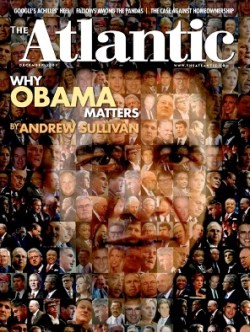
Andrew, you were the one who could envision the potential of Obama and explain it to the world. That is how I became a reader of your blog in December 2007. You need to try to get back into his head and appreciate what he is up against and why Obama still matters. I still trust him more than anybody I can think of to be leading our country.
One more:
I am an Obama voter, a Dish subscriber, and generally find your take on national and world events well reasoned, thoughtful, and principled. But when it comes to your position on US military action against ISIS, you seem to be over-compensating for your past mistake in supporting the Iraq war.
I am certainly no psychologist (I am an attorney), but I think it is fair to say that you carry tremendous guilt for supporting the Iraq war (I mean, you dedicated an entire Deep Dish e-book to how wrong you were and how awful you feel about it). Certainly, much of America is war weary – rightfully so – but your skepticism and doom-and-gloom take in particular seems to carry more guilt than your typical rational and reasoned analysis.
For what it’s worth, I was against the Iraq war before it become the mainstream popular opinion. I have a pretty good BS-meter, and I knew the pretense for a war in Iraq was a farce from the get-go. It was, and remains, an utter catastrophe. The untold human, financial, and political cost will not truly be known for decades. But you know what? I support this latest fight against ISIS.
Imagine being the President of the United States, Andrew. Even though you campaigned on ending “dumb” wars, and drew down the wars in Afghanistan and Iraq, your absolute, number one constitutional priority as president and commander-in-chief remains: the safety and security of the American people. A large group of well-funded and trained terrorists have taken over swaths of land in the Middle East, brutally maiming and killing innocent civilians along the way. They have publicly declared their intention to attack the US. In essence, they have declared war on America. While they are not large enough, nor capable enough, to actually carry out such an attack at this time, they are only growing, receiving more money, and training more fighters.
As president of the most powerful nation on earth, you have quite a number of options, but they basically boil down to two: You can either take military action or not. I am sorry to be the one to break this to you, Andrew, but there is no president, current, past, or future, that would ever sit back and let such a threat grow to the point of carrying out an attack on America. Certainly not in the post-9/11 world we live in. And you know what? That’s how someone in charge of our security should act. It is the responsible thing to do.
You want to be a violent terrorist organization and declare war on America? Well, now your going to have deal with those consequences. You’re going to be extinguished. And if ISIS is systematically degraded and destroyed, particularly with support from allies and Middle East partners, that will be the right message. The United States, and the world, will have zero-tolerance for this. Zero. Fucking. Tolerance.
The President did not try and BS us by hyping the immediate threat to the homeland; he told us a reality that a war-weary America did not want to hear: that this is the approach you have take with violent fanatics. It is an unfortunate reality that we have to respond to violence with violence, but this is the world we live in. Perhaps there will be a paradigm shift someday when I’m old and grey, and that won’t be the case anymore, but in the meantime, I support this president to uphold his constitutional duty – dealing with these violent fanatics who will never be part of the civilized world the only way they should be dealt with: extermination.
Update from a reader, who notes something that can’t be reiterated enough:
Your reader who wrote this is completely wrong:
Imagine being the President of the United States, Andrew. Even though you campaigned on ending “dumb” wars, and drew down the wars in Afghanistan and Iraq, your absolute, number one constitutional priority as president and commander-in-chief remains: the safety and security of the American people.
The presidential oath states:
I do solemnly swear (or affirm) that I will faithfully execute the Office of President of the United States, and will to the best of my Ability, preserve, protect and defend the Constitution of the United States.
His number one priority is not the safety of Americans; it’s to uphold the Constitution. And the last time I checked, that means letting Congress declare war.
“Get it or regret it!” read the description for a “vintage,” one-of-a-kind Kent State sweatshirt that Urban Outfitters briefly offered for just $129. However, the fact that there was just one available for purchase is far from the most regrettable part of the item: the shirt was decorated with a blood spatter-like pattern, reminiscent of the 1970 “Kent State Massacre” that left four people dead. …
As outrage spread, Urban Outfitters issued an apology for the product on Monday morning, claiming that the product was “was purchased as part of our sun-faded vintage collection.” The company added that the bright red stains and holes, which certainly seemed to suggest blood, were simply “discoloration from the original shade of the shirt and the holes are from natural wear and fray.” The statement added: “We deeply regret that this item was perceived negatively.”
Update from a reader:
I was disheartened to see you jumping onto this pathetic bandwagon. The fact that this became a story, with each outlet attempting to out-outrage the others, shows just how lazy we’ve all gotten. This shirt was a single vintage item that had naturally faded and aged into the (admittedly, very unfortunate) finish shown in the photos. It’s “SOLD OUT” because there was only one of them. That’s how vintage clothing works. This key bit of information was completely missed by nearly everyone who covered this non-story. The Daily Beast went so far as to demand – DEMAND! – that Urban Outfitters tell them “who designed” this item. The answer, of course is: “A few decades of runs through the average American washer and dryer.”
The political consequence of this social de-linkage, however, was not necessarily benign democratic governance. Indeed, he worried that attempts would be made to refortify the old links, to reaffirm roles at the moment when delinked persons were emerging. What we today often identify as “Islamic Fundamentalism” is just such an attempt to re-fortify the old links, to re-enchant the world. Herein lays the dilemma of the Middle East. Caught in the matrix of the political and social arrangements of the twentieth century that defy credulity, drawn and at the same time repulsed by the fugitive freedom they see on Western shores but only dimly understand, nascent citizens more than occasionally dream of returning to an enchanted world for which an imagined Islam provides a ready guide.





 The Dish

