New York Shitty Update, Ctd

Best tweet ever, Mr Cumstien. I read this, by the way, in a coffee shop in Soho where they don’t have a restroom! Another NYC specialty. From the inevitable backlash from the in-tray:

Oh no!  Overbooked hotels!  Lofts with insufficient drapery!  Cry me a river.

Another:

I am a loyal Dish reader, but I cannot stand your consistent whining about NYC. New York is the only true city in America. It’s diversity, creativity, density, wealth, and knowledge cannot be matched. Even with it’s problems of income inequality, stop and frisk, and a lack of affordable housing, NYC is still one of the greatest engines for social mobility and creativity in the world. The five boroughs of New York represent the American ideal more than any other place in the US. In no other place in this country do you see a welcoming of people, ideas, and the sharing of public space in the way you see it in NYC. New York is an egalitarian city by nature, forcing people to share the streets, subways, and public places. Humanity comes to New York to express itself. If you don’t like New York, you don’t like people.

New York has never been easy, but what good things in life are?

DC is a suburb and a one-industry town. To compare DC – or for that matter any city in the US – to NYC would be like comparing foie gras to dog food; at first glance they may seem the same but in reality they are worlds apart. So as Jimmy Walker said so many years ago, “I’d rather be a lamppost in New York than the Mayor of Chicago” – and let’s face it, Chicago is a better city than DC.

The blog is great. Your views on NYC are suspect.

I’m sorry but my point is simply about the livability of the city. And when people say that NYC is the only true city in America, or that “humanity comes to New York to express itself,” I have to say it sounds like a cult not a judgment. And you do need something of a cult mentality to put up with all the horrendous hassle. Chicago, in my view, is the quintessential American city. You can smoke weed legally in Denver. You could get gay-married in Iowa before NYC. What Los Angeles offers in terms of livability and climate knocks New York into the dust. DC is – especially now – cleaner, more modern, more livable and also culturally rich. San Francisco is far more beautiful; New Orleans far more exotic. New York is an amazing place – but it is a gigantic, chaotic, incompetent mess. Another reader turns the tables:

The last time I stayed in DC, the hotel’s fire alarm went off around 4am. Loud speakers were announcing that the hotel should be evacuated. People were wandering around the halls in their bathrobes looking for an exit. I was standing on the sidewalk outside the hotel when I learned that the evacuation was due to a small, contained, grease fire in a basement kitchen.

You live in DC and don’t stay in its hotels. You know the city and know when a cab driver is going blocks out of the way and you don’t have to rely on Google Maps. And, of course, no such thing would happen in Chicago, Paris, Rome or to anyone visiting DC. Everywhere has its pros and cons.

I love ya. And one of the reasons I do is because you make me want to slap you now and then – no different than the few I hold as close friends.

Another has the right idea:

I can’t wait ’til you get to Provincetown and chill the fuck out for a while.

Update from another:

Your reader is wrong; DC is not a one-industry town. I grew up there and neither of my parents worked for the government. And it’s not a suburb. A suburb to what city? His precious NYC. I might be biased because I grew up in Alexandria, but DC is an amazing city with a lot to offer. And so much of it is free. Yes, it can be argued that it is more of a town than a city, but that’s the best part. You can see the sky, and live in an apartment or condo or house all in the same city. You can have a lawn and be in the city limits. And just like every other American city, there is the depressing economic apartheid, but at least you don’t have to be in your 20s and willing to live in a hole or be super fucking wealthy to enjoy it. Yes, the Beltway fucking blows, but driving on Rock Creek Parkway makes up for it. And when you go into a deli and order breakfast you aren’t snarled at by other patrons for not spitting out your order fast enough. Ordering food as a tourist in NYC is panic inducing.

Another:

Chicago, in my view, is the quintessential American city.”

AMEN. I tell all the foreigners I know who are planning on visiting the US: if you only have one week in America, spend four days in Chicago (and two days at the Grand Canyon.) Chicago is a perfect microcosm of the entire American experience: a big industrial port city with a huge immigrant population and a vibrant African-American community. Somehow it is midwestern, northern, coastal, and a little bit southern (all those Kentucky transplants, plus great soul food) all at the same time. It even feels a little Canadian in places. OK, it lacks the fresh-scrubbed natural beauty of western cities like SLC or Seattle, but you do get a taste of it — Chicago was once at the edge of the frontier, too. Great music scene and global cuisine, but with strong regional roots. Museums and sport stadiums and other touristy stuff up the wazoo.

Importantly: its suburbs sprawl endlessly, as do all American cities, so you get the quintessentially American experience of driving hours across the sprawl to get somewhere (just like LA!) — but with decent trains if you hate driving. Other cities, like Boston, New Orleans, LA, San Francisco and even, yes, NYC are tiny nations unto themselves. Boston is Boston (and New England) before it is America. NYC in particular is a city of the world before it is anything else. But every time you turn around in Chicago, you’ll see AMERICA.

Time To Punish Maduro?

José R. Cárdenas wants sanctions against Venezuelan officials involved in human rights abuses:

By its own admission, the [Obama] administration believes that if it acts unilaterally in Venezuela, it would “bilateralize” the conflict; that is, it would give the Venezuelan government a new drum to bang in its ongoing cacophony of anti-American rhetoric, thus diverting attention away from the protestors’ grievances. That, however, is giving credence to a problem that doesn’t exist. The view that sanctioning human rights observers will somehow make Venezuelans think any less of skyrocketing inflation, rampant street crime, and shortages of everything from electricity to basic consumer goods is as divorced from reality as is the Venezuelan government’s belief it can beat its people into continued submission.  …

As the saying goes, when you exhaust all your other options, you may as well do the right thing. The crisis in Venezuela has churned for four months now because the government hasn’t had to face any costs for its truculent behavior. The Obama administration has an opportunity to change that equation through the principled application of sanctions against behavior no one who wants what is best for the Americas should accept.

The State Department appears to have backed down from its opposition to a bill that would do just that:

“I’m not saying that the State Department loves it,” Rep. Ileana Ros-Lehtinen, the Miami congresswoman who introduced the bill, said on Tuesday. “But this time they’re not actively against it. …

Ros-Lehtinen’s bill, which would freeze assets and ban entry to the U.S. for people found guilty of human rights abuses against Venezuelan protesters, passed the House Foreign Affairs Committee earlier this month despite a campaign by the State Department to pause the bill and its counterpart in the Senate. Ros-Lehtinen hopes to pass it by a voice vote on Wednesday.

Roberta Jacobson, the State Department’s assistant secretary of state for western hemisphere affairs, had argued that the Venezuelan opposition had said they were against the bill — something Venezuela’s opposition coalition, known as MUD, later denied. The opposition has engaged in talks with the government aimed at resolving months of political unrest that have resulted in the deaths of more than 40 people.

David Noriega compares South Florida’s pro-sanctions Venezuelan-American community to the Cubans of Miami, who have spend decades lobbying for tougher anti-Castro policies:

There were about 250,000 Venezuelans living in the United States in 2012, according to census data, of which almost 65,000 are American citizens. But what defines the population is not its size but its political cohesion: The vast majority of Venezuelan immigrants have arrived in one way or another as a consequence of the rise to power of Hugo Chávez, whose regime was marked by aggressive wealth redistribution, expropriations of private enterprise, and other measures that negatively impacted the wealthier sectors of Venezuelan society.

“Compared to, say, Mexicans or Dominicans or other Latino populations, these are almost exclusively people from the middle class and upper middle class,” said David Smilde, a senior fellow and Venezuela expert at the Washington Office on Latin America and a professor at the University of Georgia. “This is a diaspora of people who are very anti-Chávez and now anti-Maduro, whose interests have been touched upon, who fear the rise of a dictatorship, or who have been victims of some kind of political persecution.”

Update from a reader:

I think that American sanctions against Venezuela would be a horrible, terrible, very bad, not good idea, and a godsend gift to President Maduro. Let me explain.

I am originally from Latin America. Even though it is hard to believe for people outside of it, much of the Latin American Left still believes that Cuba is the worker’s paradise. Whenever some rational person points out the poverty that Cubans live in today, the immediate answer is “American Sanctions!” The sanctions have became a magical trick that the Latin American Left can use to explain anything that it is wrong with Cuba.

The exact same thing will happen in Venezuela. Forget the fact that the economic difficulties have been going on for quite some time: the second that the United States imposes sanctions, the Left will immediately start blaming the sanctions for the Venezuelan economic hardships. In fact, it will feed the old Latin America mystique, that some brave leaders like Fidel and Chavez (and, by extension, Maduro) had risen to fight for the poor people in Latin America against the American imperialists. That way, sanctions would actually give credence to Maduro: he can turn to the protesters and say “You are either with Venezuela (and me) or with the American imperialists”.

What is currently happening in Venezuela is gut wrenching. Our natural impulses are to do something about it. But, please, the best thing America can do for Venezuela is to stay as far away as it can.

Creepy Ad Watch

mexico-city-breastfeeding-hed-2014

Rebecca Cullers frowns:

Activists and health advocates are rightly upset over this poorly executed campaign to get Mexico City mothers to breastfeed. It shows topless celebrities with a carefully placed banner running right over their breasts that says, “No les des la espalda, dale pecho,” which translates to, “Don’t turn your back on them, give them your breast.”

The first problem is how overtly sexualized the women are. The act of breastfeeding is not a sexual act. It vacillates between being painful, annoying, exhausting, inconvenient and heartrendingly sublime. The sexualization of breastfeeding is a large part of the reason so many people shame mothers for breastfeeding in public, and a factor in low breastfeeding rates. (This campaign by two students nicely illustrates this part of the problem.)

Update from a reader:

I think something may be getting lost in translation.

The problem the Mexican advocates have with this campaign is that it seems to blame mothers, suggesting that not breastfeeding is “turning your back” on your child.  Mexico has very low rates for exclusive breastfeeding, but that is because most women breastfeed and supplement with formula (about 94% of babies in Mexico are breastfed, compared to 77% in the US).  Part of that is because many Mexican women see formula as offering something extra to the baby (it is scientifically formulated!), so in that sense having celebrities advocating nursing might make sense. (One of the most effective pro-breastfeeding campaigns in the ’80s featured then telenovela queen Veronica Castro.)

However, the thing that started the controversy with this campaign was that the creator stated that this campaign is targeting women who do not breastfeed because they want to maintain their figure. That is such an ignorant and ridiculous take on the true barriers for breastfeeding mother in Mexico I don’t even know where to start taking it apart. But the complaints are not about the pictures sexualizing breastfeeding. As a foreigner, it seems to me that seeing these ads as sexualizing breastfeeding says more about American hang-ups with bare breasts than about anything else. I’ve never heard of a woman being asked to breastfeed in a restaurant’s restroom in Mexico, for example.

Maya Angelou RIP

Garden Party Celebration For Dr. Maya Angelou's 82nd Birthday

Ronda Racha Penrice pays homage:

[For Angelou,] a poet, memoirist, dancer, singer, actress, playwright, producer, director, teacher, civil rights activist and women’s rights advocate, there were no limits to her outlets for creative expression or her capacity to champion justice and equality. Her life was a testament to the power of possibility as well as an affirmation of courage and daring.

Emma Brown captures the sweep of that life:

As a child growing up in the Jim Crow South, Maya Angelou was raped by her mother’s boyfriend; as a young woman, she worked briefly as a brothel madam and a prostitute. From those roots in powerlessness and violence, she rose to international recognition as a writer known for her frank chronicles of personal history and a performer instantly identified by her regal presence and rich, honeyed voice.

From her desperate early years, Ms. Angelou gradually moved into nightclub dancing and from there began a career in the arts that spanned more than 60 years. She sang cabaret and calypso, danced with Alvin Ailey, acted on Broadway, directed for film and television and wrote more than 30 books, including poetry, essays and, responding to the public’s appetite for her life story, six autobiographies. She won three Grammy Awards for spoken-word recordings of her poetry and prose and was invited by President-elect Bill Clinton to read an original poem at his first inauguration in 1993, making her only the second poet in history, after Robert Frost, to be so honored.

As Margalit Fox notes, Angelou never intended to be known for her autobiography:

[S]he remained best known for her memoirs, a striking fact in that she had never set out to be a memoirist. Near the end of “A Song Flung Up to Heaven,” Ms. Angelou recalls her response when Robert Loomis, who would become her longtime editor at Random House, first asked her to write an autobiography. She demurred at first, still planning to be a playwright and poet. Cannily, Mr. Loomis called her again. “You may be right not to attempt autobiography, because it is nearly impossible to write autobiography as literature,” he said. “Almost impossible.”

“I’ll start tomorrow,” Ms. Angelou replied.

The effects of that decision are still being felt:

Joanne Braxton, a professor at the College of William and Mary, says Angelou’s willingness to reveal the sexual abuse she suffered as a child in I Know Why the Caged Bird Sings was unprecedented at the time. The critical acclaim and popularity of the book opened doors for both African-American and female writers. “Maya Angelou brought about a paradigm shift in American literature and culture,” Braxton says, “so that the works, the gifts, the talents of women writers, including women writers of color, could be brought to the foreground and appreciated. She created an audience by her stunning example.”

In addition to being a poet, author, artist, teacher, and activist, Angelou was a prolific tweeter. Evan McMurry is struck by her final message:

This tweet, sent five days ago, may be Angelou’s final public statement after seven decades of them:

For a writer who so transformed her own experiences into an autobiographical art at once personal and communal – those 400K followers were there for a reason – that tweet could serve as an epitaph.

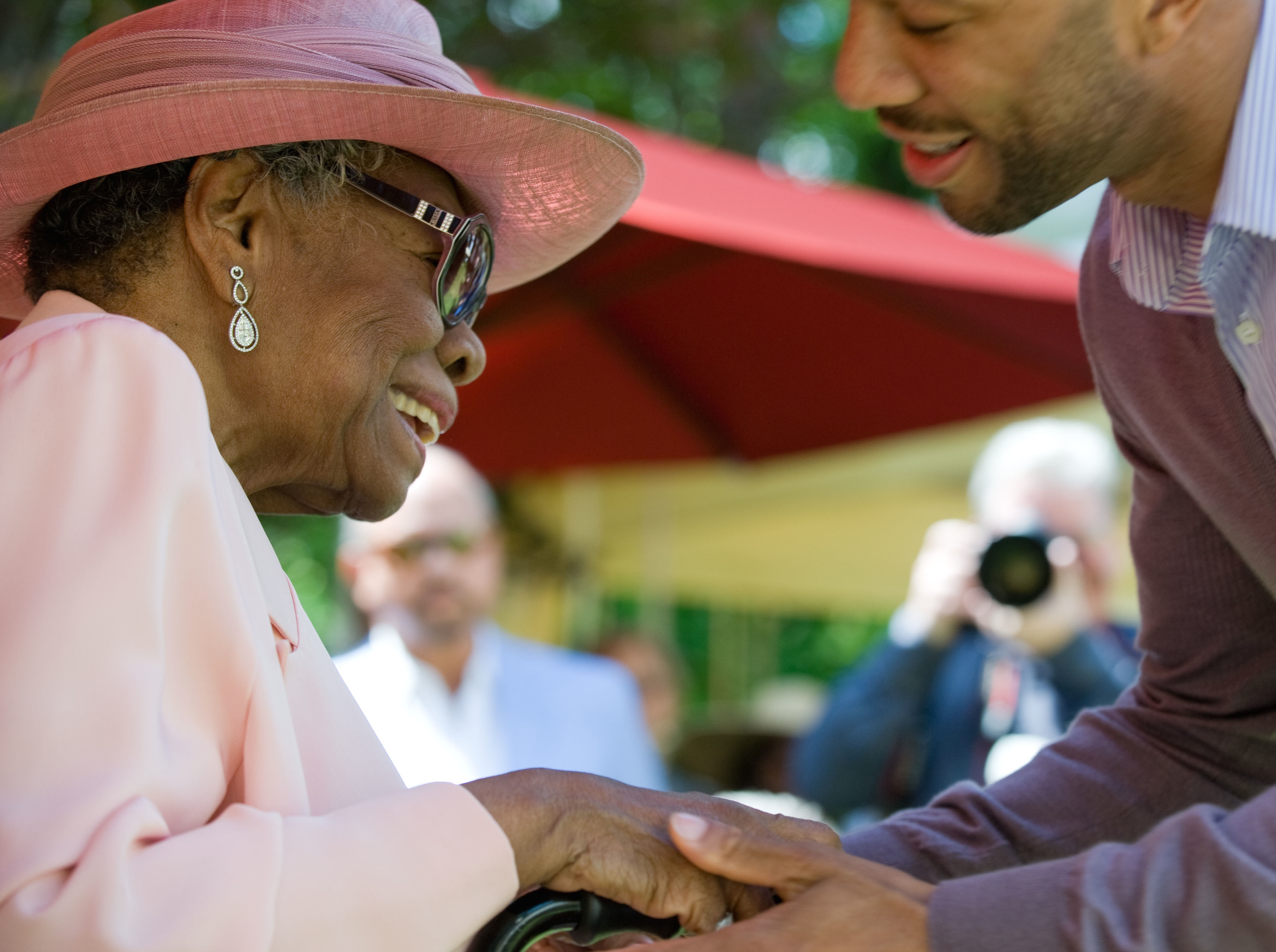
(Photo: Poet Dr. Maya Angelou and musician Common attend Angelou’s 82nd birthday party with friends and family at her home in Winston-Salem, North Carolina on May 20, 2010. By Steve Exum/Getty Images)

Update from a reader:

Beyond Angelou’s poetry and prose, she had an uncanny ability to focus compassion for others, and in this case, for one’s self that I’ll also remember about her. You can see the impact it had on Dave, not to mention Tupac:

Iconoclasts: Maya Angelou and Dave Chappelle from DERTV on Vimeo.

“Traditional Masculinity Has To Die” Ctd

A reader writes:

You posted a tweet with the hashtag #yesallwomen (no issue with that), but then you refer to the sad events this past weekend as “in the wake of the misogyny-fueled rampage near UCSB.” While I agree that Rodgers hated women, if you look at anything he’s put online, he clearly hates other men as well. In fact he seems to hate everyone, including members of his own family. He hated people for many, many reasons, including “you” appearing to be “better” than him. This was true if you had a nicer car than he did, as well as if you had a girlfriend – doubly so if Rodgers found her attractive.

He snapped this past weekend. He had a lot of targets. For whatever reason he started with his roomates, then he went to target some of the women who stood in for women who have turned him down. No doubt given enough time he would have gone after other people he was jealous of.

It is reckless to refer to this as a women’s only issue or to pretend that the only victims or targets were women. By framing it as you did, you imply that. He was a young man who had serious mental issues and had been doing his best to avoid the treament his family was trying to get him. That is the real issue – that, and how he got himself a gun.

Another quotes me:

“What we need is not grandiose and thereby doomed projects of cultural re-education, but a more powerful appeal to men to be gentlemen, to see maleness at its best as a tamed wildness.” Some of the most misogynistic men I have ever met considered themselves to be perfect gentlemen. They claimed that because they would never treat a woman like all those other assholes do, would never ever take her for granted, that they were better. But in reality they felt owed, just like Rogers did.

My ex is a prime example.

When we broke up, after years of me trying to explain, he clearly still didn’t understand why I didn’t just love him back. He was, according to him, the perfect boyfriend! He deserved my love. This totally disregards the fact that he had no respect for my intellect or my ability to think for myself. He treated me like a fragile doll and never understood that I just wanted to be treated like a person. I’m in no way perfect and did not want to be held to his incredibly unrealistic standards. But he always opened the door for me and bought me whatever I insinuated I would maybe eventually like to own. In return, I owed him love, right?

He would be deeply insulted to be called a misogynist. But that’s what he was/is. He never saw me as a fully formed person. I am a woman, so I am different. I am “less than”. I am a trophy to be earned or bought. And he was what you would call tame. I can only imagine what he would have been like if he was “wild”.

A male perspective:

By the end of your counterpoint to deBoer, I think you’ve actually ended up in very nearly the same place as he is (“we need … a more powerful appeal to men to be gentlemen, to see maleness at its best as a tamed wildness”). And if your desire is an appeal for bros to be gentlemen, then I think you’re pretty well asking for an end to (modern American) “traditional masculinity” as we know it. If you’re a gentleman, you don’t exhibit an over-the-top, hyper sense of “aggression, dominance and power.” If you wish to tame those very base instincts, then you’re ending up with a very different version of masculinity than “Murrican dudebro.”

Maybe it’s more of a “macho American” thing, but I was definitely brought up with the societal expectation of being more sexually aggressive. And that’s not just making the first move with a woman; outside of my mom, I was never really pushed back on for chasing girls or ogling them (without considering if it caused them any discomfort). I’m only in my early 30s, but I look back on the teenage me as a not-very-nice person. I’m sure everyone feels that way, but I feel it far more acutely now that my best friends are women.

Forget “expected male” behavior. If all we are is a pack of randy cocks whose excuse is “well it’s testosterone,” then we shortchange ourselves and insult our own capabilities. And forget “taming.” A “tame” animals merely tolerates the presence of humans. I don’t want to merely tolerate women; I strive to be their equal.

Update from a reader:

It seems a tad harsh for your reader to accuse her ex-boyfriend of misogyny for mimicking the classical virtue of chivalry as an attempt to get her to love him back. Based on what she reported, he was guilty of nothing more than ineptitude or incompetence.

Is every male failure, especially in their interactions with women, now an expression of misogyny? What hope do we have when we become contemptible and loathsome women-haters merely by not knowing what we’re doing?

I feel such a conflation not only trivializes the word “misogyny” but all male-female relations. We can now decide whether a male is relating successfully to women by measuring him on this simplified misogyny scale. I have a feeling that male-female relations are actually much more complex than that, given the whole thing is clouded over with issues of self-worth and self-esteem, which men deal with just as intensely – if differently – than women.

The entire discussion all seems besides the point. As other readers have pointed out, Rodgers problem wasn’t being rejected, and it wasn’t women. He had a severe neuropsychiatric disability and mental illness. The argument could be made that in his illness he internalized some of the worst aspects of our culture, and his mental illness amplified those aspects towards violent ends. However, this doesn’t justify cherry-picking aspect of his pathology and ignoring all others.

We need laws in place to empower mental health professionals and law enforcement to stop episodes like this in their tracks, to protect people from those whose mental illness leads them to make tragic, irreversible decisions, and to protect the mentally ill from themselves. That’s the primary, urgent, life-or-death discussion we should be having right now. Trying to pigeonhole this tragic story into a story about misogyny distracts us from this conversation.

Another:

In reference to the reader you quoted regarding Rodger’s hatred of men, yes, he hated other men, but that was quite clearly secondary:

I hated all of those obnoxious, boisterous men who were able to enjoy pleasurable sex lives with beautiful girls, but I hated the girl’s even more, because they were the ones who chose those men instead of me. It was their choice. They are the ones who deprived me of love and sex.

He didn’t just snap this past weekend. It had been premeditated for a long time, and he was quite specific about why he started with his roommates:

On the day before the Day of Retribution, I will start the First Phase of my vengeance: Silently killing as many people as I can around Isla Vista by luring them into my apartment through some form of trickery. The first people I would have to kill are my two housemates, to secure the entire apartment for myself as my personal torture and killing chamber. After that, I will start luring people into my apartment, knock them out with a hammer, and slit their throats.
[…]
This First Phase will represent my vengeance against all of the men who have had pleasurable sex lives while I’ve had to suffer.

His “Second Phase” represented his “War on Women”, beginning with the sorority house. Women were undoubtedly the main focus of his hatred. He certainly didn’t have any rants about men comparable to this:

Women are like a plague. They don’t deserve to have any rights. Their wickedness must be contained in order prevent future generations from falling to degeneracy. Women are vicious, evil, barbaric animals, and they need to be treated as such.

He then goes envisions his perfect world:

The first strike against women will be to quarantine all of them in concentration camps. At these camps, the vast majority of the female population will be deliberately starved to death. That would be an efficient and fitting way to kill them all off. I would take great pleasure and satisfaction in condemning every single woman on earth to starve to death. I would have an enormous tower built just for myself, where I can oversee the entire concentration camp and gleefully watch them all die. If I can’t have them, no one will, I’d imagine thinking to myself as I oversee this. Women represent everything that is unfair with this world, and in order to make the world a fair place, they must all be eradicated.

Why Take Vacations? Ctd

A reader responds to the question:

Vacations are the best way to build a family. When out in a tent for a week with the kids, the whole family is doing nothing but family activities and building family memories. Same applies now that the kids are out of the house.  A vacation with my wife is “us time”.  Vacations together bind families together.

Another adds, “Because when I’m dead, my daughters aren’t going to say to each other, ‘I really wish that when Daddy was alive, he’d spent more time at work.'” Another:

I’m not sure “happiness” is the proper measure for why or why not, vacations should be taken. I don’t travel to increase my happiness.

I think you could make the argument that if one never took a vacation and never saw something new, one might be happier never having known the vast diversity of all things on this earth. It’s like that expression, the grass is always greener; if one never knew about the grass on the other side, then perhaps one would be content with their own grass on their own side. I travel because I want to visit that grass, to smell it and see it, and to compare it with my own. Had I never travelled to Europe as a teenage, backpacking for a couple months on my own, I would never know how disgusting soda is warm with no ice, or how fantastic fresh pasta tastes when its authentically prepared, as they do in Rome.

I take vacations in order to explore the world. To see the diversity of lifestyle, of cuisine, geography and language. Exploring the world doesn’t make me happier; it just makes me, me. And with each passing trip, be it a trip to Peru or a plop vacation to an island, I learn a little bit more about myself, a little bit more about what I like and what I don’t, and in doing this I feel more at peace with myself. Vacations are good in that way. They help define who we are when we return home.

Another puts it this way:

One of the best parts of vacation is making home seem new again.

Update from a reader:

In a truly wonderful letter, Kurt Vonnegut advised a group of students to “Practice any art, music, singing, dancing, acting, drawing, painting, sculpting, poetry, fiction, essays, reportage, no matter how well or badly, not to get money and fame, but to experience becoming, to find out what’s inside you, to make your soul grow.”

I write to make my soul grow. It’s also why I travel.

When I move through the world with open eyes, I gain a few inches. I earn a little valuable perspective. The dullness of everyday life is swapped out with an intense curiosity that wipes clean my mind’s carefully constructed sensory adaptation. That to which I was once blind is temporarily laid bare in plain sight. Like a good night’s sleep restoring the well of willpower, travel rejuvenates my dwindling childlike wonder. Music, food, nature and people are furiously alive with rich detail and flavor.

When I travel, I am reminded of our fundamental goodness as I my see comfort zones, slide past them ungracefully and get by with the help of strangers and newfound friends. Because everything seems so different, the bonds between people get a fresh take and deep look as I see mothers caring for children, brothers jostling each other out of childhood, or friends soaking up the familiar rhythm of their rapport.

When it’s all over, travel remains with me. My self-imposed demands to be less blind and see more of what I call home. The new imperatives to be less passive and act more. The stories I relate to friends and family among the soft early mornings and the hazy late nights. The hopeful wanderlust and sense that adventure is just over the horizon.

Most of all, what remains from travel is the becoming and the growth of my soul. If nothing else, that’s why you’ll find me hunting the world for the unknown. To become. To grow my soul.

Map Of The Day

3020722-inline-1200scribners-1880-popular-vote1

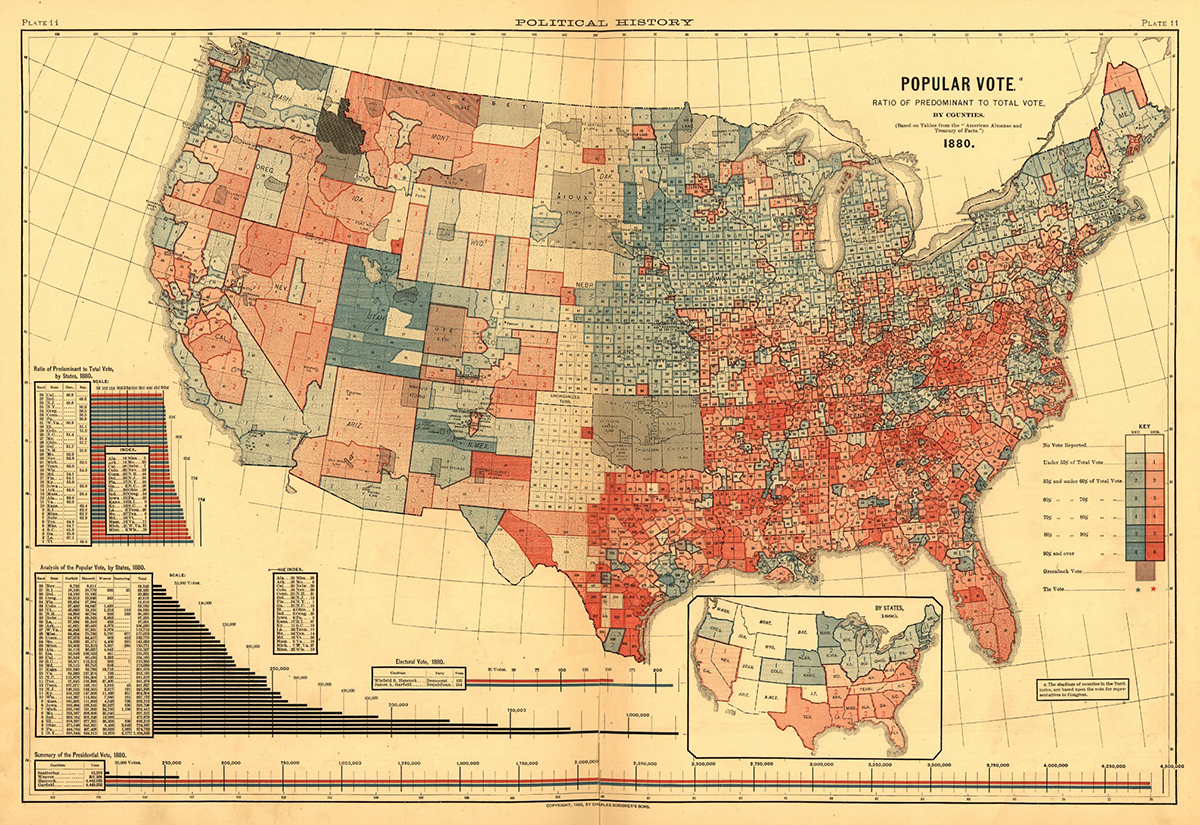
While flipping through “Scribner’s Statistical Atlas of the United States,” first published in 1883, Susan Schulten marvels at the above map from 1880, “the first American attempt to map the outcome of an election”:

The Popular Vote map was the creation of Henry Gannett, superintendent of the census and future president of the National Geographic Society. It was the first map to use shading techniques to visualise American political behaviour. I was struck by the spatial patterns:

the dense chequerboard of eastern counties contrasting sharply with the open crazy-quilt patchwork out West. Then my eye was drawn to the patterns of colour in the eastern states. Just as now, red and blue were used to show which party had prevailed in each county.

The map even looked a little like the 2012 electoral picture, with a preponderance of blue through what we now regard as the Democratic stronghold of the north-east, and red spilling across the Republican South. It took a minute to see that the colours were reversed: here red represents the Democrats and blue the Republicans. So while the map looks familiar, the political landscape has flipped. … [I]t was not until the election of 2000 that NBC’s “Today” show indelibly fixed the colours of American politics: red for the Republicans and blue for the Democrats.

Update from a reader:

I find it fascinating that Utah is one of the only locations that has completely switched (or didn’t switch, depending how you look at it). It’s an interesting artifact of Mormon history and the change of it’s theology and relationship to American culture.

What’s The Truth About Gluten?

A gastroenterologist well known for a 2011 study that “served as as one of the strongest pieces of evidence to date that [gluten intolerance] is a genuine condition” has backed down from that position:

A study [Peter] Gibson published last summer suggests that, when it comes to gut distress, gluten is getting a bad rap. The study focussed on thirty-seven people who identified themselves as having both NCGS [non-celiac gluten sensitivity] and irritable bowel syndrome (IBS), an ailment characterized by a range of gut issues, including diarrhea or constipation, bloating, and stomach pain. The subjects all said that they felt better when they avoided gluten. To test whether the protein was really to blame, Gibson put them on one of three diets: gluten-free, low-gluten, and high-gluten. Each diet consisted of the same foods; the only difference was the amount of gluten. … It turned out that gluten seemed to have no measurable harmful effects.

What gives? As Robert T. Gonzalez puts it, “it is the pursuit of more definitive scientific evidence that makes Gibson’s research so noteworthy”:

That Gibson’s team found no specific response to gluten is not surprising in and of itself. (News flash: Scientific research often appears to contradict itself. For more on this reality as it pertains to health research, see this timely NatGeo piece by Virginia Hughes on the ongoing effort to determine whether resveretrol – a compound found in red wine – is or is not good for you.) Rather, it was Gibson’s willingness to call his own research into question – his readiness to double back and reevaluate his previous research on more rigorous terms – that we found not only striking, but encouraging for the future of research in this area.

Which suggests that headlines like “Researchers Who Provided Key Evidence For Gluten Sensitivity Have Now Thoroughly Shown That It Doesn’t Exist” and “Being Gluten-Free is Dumb” may be oversimplifying matters a bit. As gastroenterologist William Chey says:

It’s really hard to design and execute studies that really separate out constituent effects of food. … We’ve still got a long ways to go.

So I’ll keep avoiding the wheat. Update from a reader I can definitely relate to:

As one of those reviled gluten-sensitive folks, those terrible headlines you mention are truly annoying, but I’m definitely all for more research on this topic! After years of extremely annoying and embarrassing rashes and hives, and then a negative test for celiacs, my doctor (who has celiacs) recommended I try a gluten-free diet for a month anyway, just to see. I went (mostly) gluten free in June 2013 and haven’t had a major rash since. The occasional beer or sandwich with real bread doesn’t seem to bother me, but when I go overboard (as I definitely did on a recent trip to Napa) I get the faint beginnings of hives and eczema-like rashes, which then go away after I’m good for a few days.

Is it all in my head? Is it something else in gluten-containing foods doing this to me? I’d love to find out, but in the meantime this works!

Another reader:

I thought I would write because anyone who read the reader comments might have got the wrong idea about celiac disease. Your reader referred to a negative test for celiac disease – presumably he/she meant the anti-transglutaminase antibody test. While that is a typical test done for celiac disease, it is not conclusive on its own. This link is from Dr. Fasano naming the 4-out-5-rule criteria. The gold standard test for celiac disease is the small bowel enteroscopy. I would also note that many patients with celiac disease think they are fine with a bit of gluten here and there based on symptoms, but that is actually very dangerous; it could lead to EATL – Enteropathy-associated T-cell lymphoma.

I have celiac disease as well as three generations of my family including my grandfather who died of cancer because of untreated celiac disease. Anyone who thinks they may have celiac disease should NOT go on a gluten-free diet before seeing their doctor. Please see any of the national celiac associations for more advice.

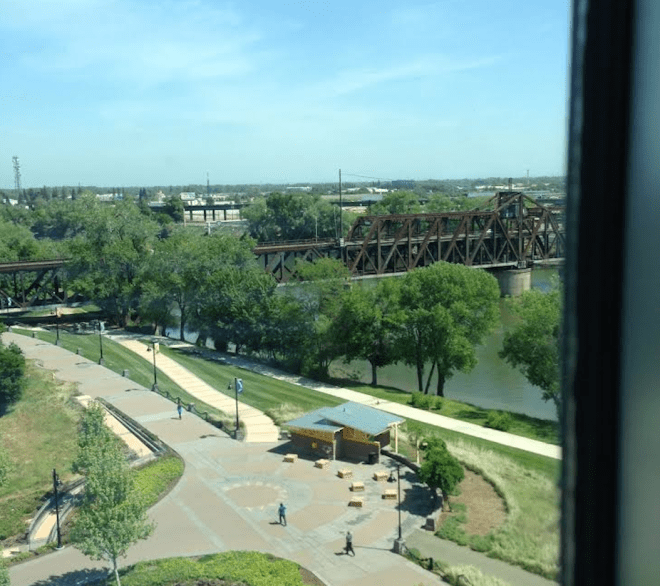
The View From Your Window Contest: Winner #206

vfyw_5-24

A reader writes:

This looks to me like a view of the Alexandra Bridge that connects Ottawa, Ontario with Gatineau (Hull), Québec, taken on the Gatineau side (call it 2km NE of Parliament Hill). I used to ride my bike along the Ottawa River, on both the Ontario and Québec sides, and this looks familiar, if not 100% right. But I can’t name the building.

Another totally e-mails it in:

The blue banner on the light post is clearly shaped like Vietnam, so (equally clearly) the picture must be from Hanoi.

Another:

I’m pretty sure this is taken from the eastern bank of the Schuylkill River in Philadelphia. I feel like I’ve walked on that bridge and that is the fairly new bike path they’ve built. This is my first time entering. I do love the contest. It would be baller to get it right the first time!

Another rookie:

Very first attempt! My guess is Louisville, in the park along the Ohio River, where there is a memorial to Abraham Lincoln. The bridge is a former railway bridge to Indiana, and is now used as a bike or running bridge.

Another stays in the South:

Probably not right, but it looks so damn much like Brown’s Island Park in Richmond, VA. I’ve run on the James River North Bank Trail that ends at that park. The bridge design and river look so insanely like Richmond, but the picture’s just slightly off. Who knows, maybe I’m insanely wrong.

Or wanting to be:

Augusta, Georgia. I hope I’m wrong.

Several others were wrong about the man from Hope:

Clinton Presidential Museum, Little Rock, Arkansas. I knew it the minute I saw the railroad trestle.  The museum is nestled just on the edge of Little Rock in one of the prettiest settings.  I visited it during an International Master Gardener Conference a few years ago.

Little Rock was the most popular incorrect guess this week. The most popular correct guess attracted 117 entries – a whopping 84% of the total submitted. One of those correct readers:

First impression was: Upper Midwest due to the rail bridge, somewhere in Minnesota or Iowa on the Mississippi. Then I realized way too flat for Saint Paul or Minneapolis and the adgate snip west scramentorest of the Mississippi valley. Usually my gut is right on these things, but a bit of searching for a double-decker bridge brings one to West Sacramento, California.
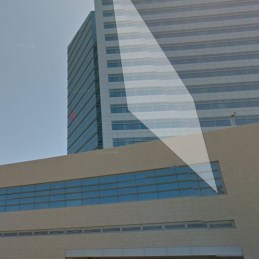
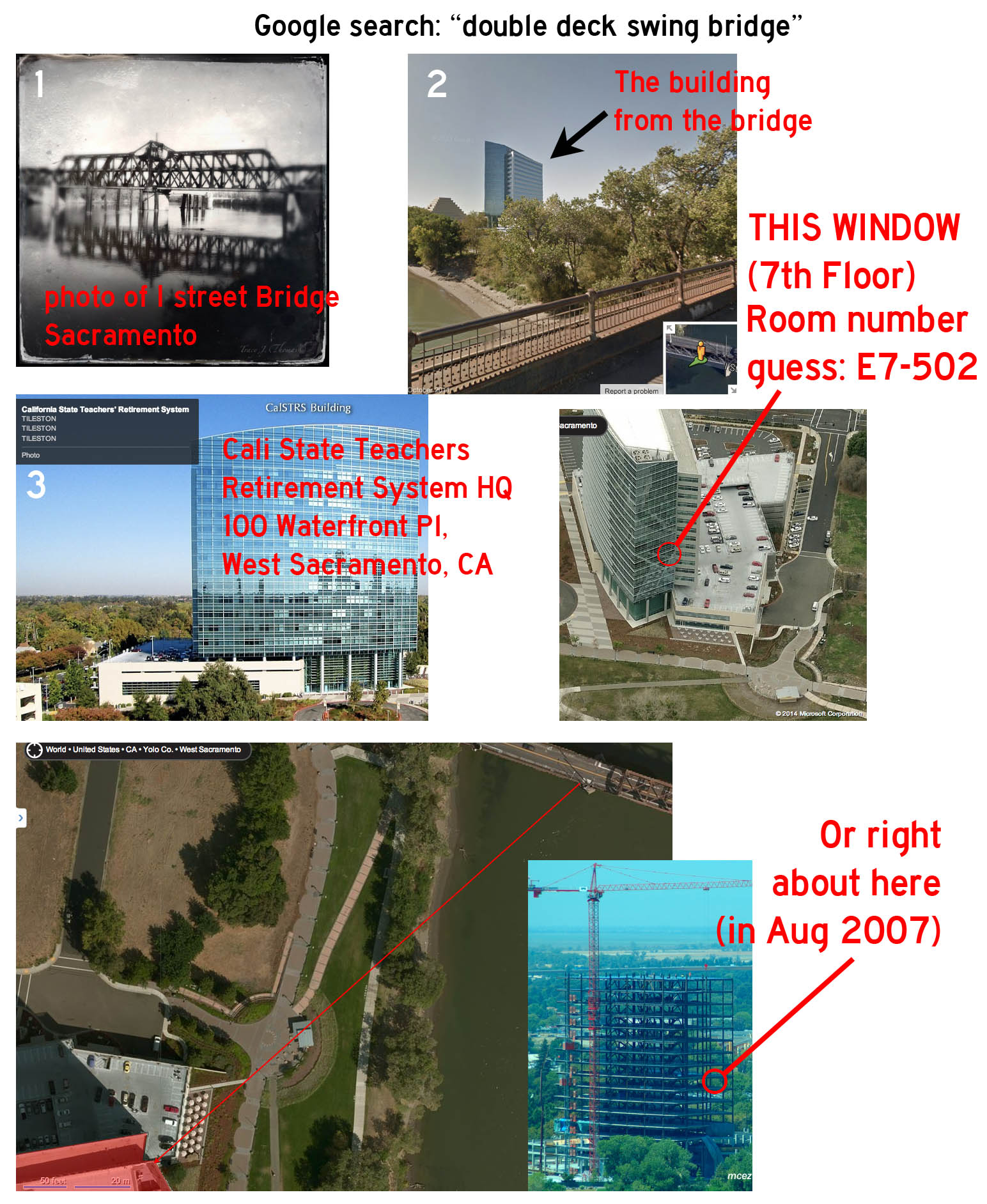
You’ll have lots of people who’ll get the location, but Google Streetview only has a 2007 photo of the building under construction or a more recent bad angle shot from the street (damn you Google for not having the foresight to send a rogue self driving car to that spot).  Nonetheless I’ve attached my guess on the right window. The obsessive Dishheads will spend hours on the angles, cosines, etc, and a few may resort to psychotropics, peak beard, or a bear with a divining rod. Lacking access to any of these I’ll go with with the 6th floor, room 659 and the fat red X. I await being corrected by Doug Chini. But the city location was easy: if a slacker like me can find it in 15 minutes, the heat map of West Sacramento will show one huge blue dot.

He’s sure right about that:

This embed is invalid


Another reader squeals:

IGotOneIGotOneIGotOne!  As all the train-and-bridge spotters have figured out, a Google search of “railroad swing bridge double” served up the “I” Street bridge in Sacramento lickety quick, and maps revealed the 100 Waterfront Place building.  I’m sure the pros have already sussed out the latitude, longitude, elevation, time of day, temperature, paint color, bar menu, beagle population and average beard length of the neighborhood, and then taken the rest of the afternoon off for beer and volleyball.  They can have it; i’ll just bask in the satisfaction knowing I beat one of these things.

An elaborate visual entry:
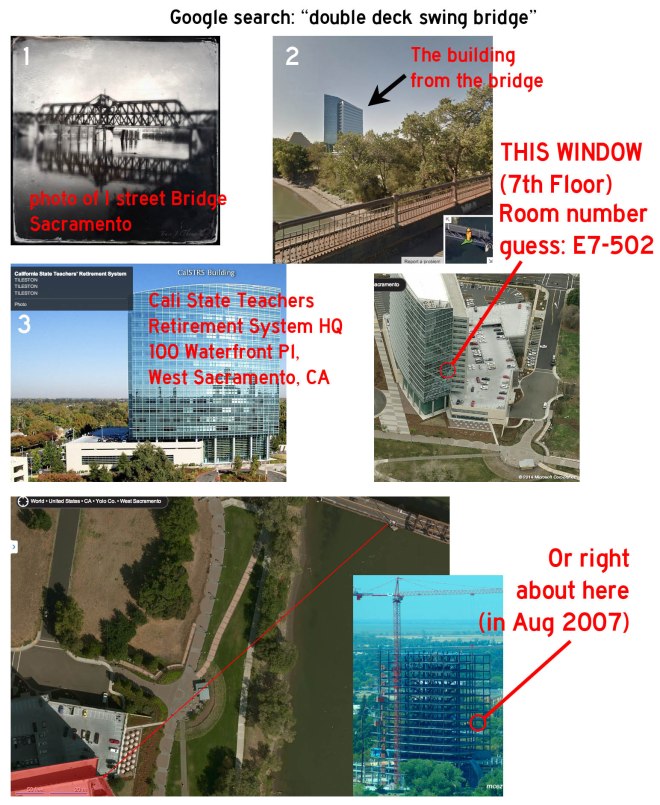
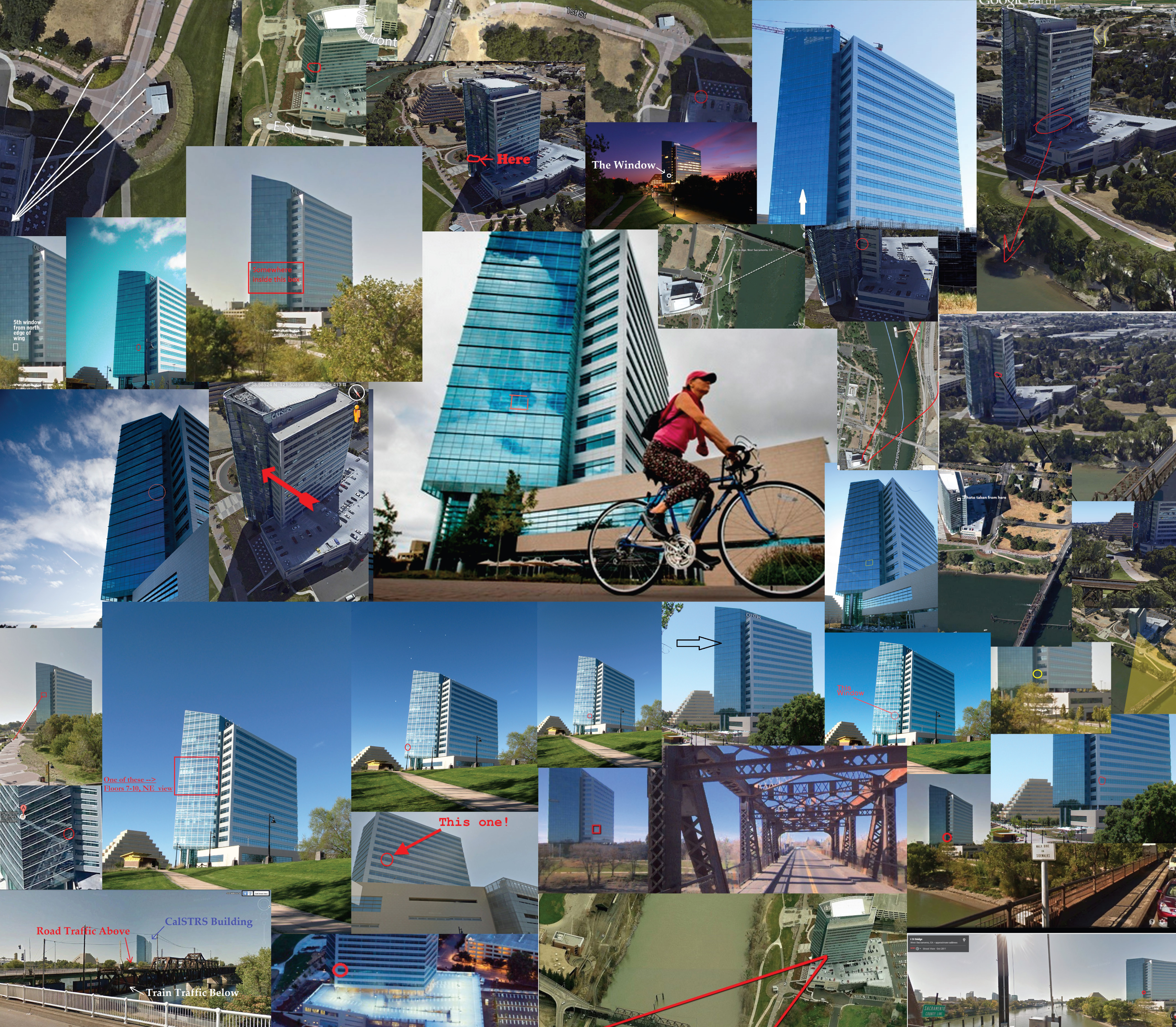
this-window

Marriage finally pays off for this contestant:

My lovely wife of nearly 40 years is pretty tolerant of me, especially when I call her over to the computer, point at a VFYW picture, and ask where she thinks it is. Usually she just shrugs, says “no idea”, and heads off to more important things. To my amazement, this week she looked at the picture for about 5 seconds and said “I Street Bridge”, not as a question but as a statement. She is a Sacramento native, so I guess I should not be too surprised.

Another goes into detail about one of the central clues:

The first thing I did was search for images of double-decker railroad bridges. The search led within a few minutes to this page showing the I Street Bridge on the site bridgehunter.com. It describes the bridge in detail and includes a photo gallery, map links and street views. (Bridgehunter.com, by the way, looks like it’s going to be an invaluable resource in future window contests involving American bridges.)

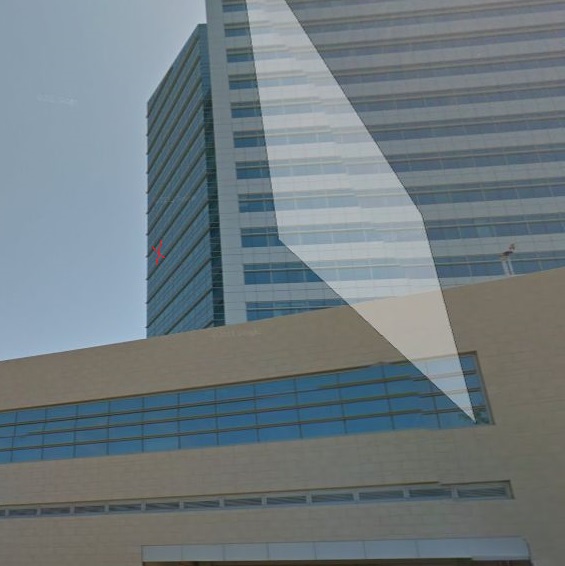
From there, identifying the building the window is in was as easy as falling off a piece of cake: California State Teachers’ Retirement System, at 100 Waterfront Pl in West Sacramento, California. This modified Google Earth view shows the angle of the photograph indicating roughly where the window is.

VFYW 5-26 Camera Angle1

The I Street Bridge, by the way, was completed in 1911; its two decks accommodate rail and highway traffic. It’s of a type known as a swing bridge, which means that the center span of the bridge pivots to allow boats to pass, as seen here:

1227680

Several readers flagged this blog post about the I Street Bridge written by California bridge engineer Mark Yashinsky:

A swing railroad bridge has stood at this site since 1858. The current double-deck bridge was built in 1911. Note the round pivot pier supporting the swing span. This bridge is 840 ft long with a 340 ft long swing span. A 34 ft tall boat can pass under it at low tide. Otherwise, the captain must signal to the bridge operator to get through. Boaters need to check with the US Coast Guard when planning a trip to find out the bridge’s hours of operation. …

This is one of the largest center bearing swing bridges ever built. It weighs about 6800 kips. At the turn of the 19th century, such big swing bridges had rim bearings with rollers along the perimeter. When this large bridge was successfully built and operated with a center bearing, no one wanted to go through the trouble of fabricating the conical rollers that supported a rim bearing swing bridge and they were no longer built.

Another reader found an additional bridge resource:

Once more the VFYW contest has been a learning opportunity.  I came to realize after some hours of poking about that without a base in bridge terminology, finding this thing wasn’t going to be a snap.  I tried every combination I could think of involving steel bridge, railroad-bridge, double-decker, riverwalk, river park.  Eventually a likely-but-too-tiny-to-tell icon showed up, and that led me to historicbridges.org, which would have been great if only I’d already known where in the world I thought this bridge was to search their database efficiently. But historicbridges.org introduced me to the descriptors I needed: steel truss bridge, swing bridge.  If only I’d known those terms to begin with!  A search for “steel truss bridge” delivered the culprit about 200 images down in a few moments of skimming the Google images result, unmistakable (it’s amazing how subtly distinguishable steel truss bridges are one from another, though).

Then I realized that I had ridden Amtrak over that very bridge on my way home to the Bay Area from Manhattan just two months ago.

Another skipped the bridge for a different clue:

Three in a row for me, and a chance to avenge a past near-miss! Early last year I had narrowed a view to Sacramento on little more than hunches, a red curb, and fertile farmland near a sizeable city. But having no luck scanning Google Earth or proof I even had the right city, I called off the search. In my personal tally it wears an asterisk, a badge of shame on my record.

But goddammit, this week we’re straight-up comin’ atcha from the neighboring town of West Sacramento, CA. Nothing fancy this week – didn’t even flex my bridgespotting muscles. Just stared at the letters on the pavement and wrote out twelve blank spaces on a sheet of paper, Wheel of Fortune-style. Funny thing, I was listening to a recording of Bruce Springsteen’s recent Charlotte show when I finally made out what it read: E Street Plaza. A few of those about, but not hard to whittle down.

The pic is from the California Teachers Retirement System Building, seventhish floor. No doubt shot from the employee break room, where somebody recently ate Alice’s sandwich even though she clearly wrote her name on it. Turkey and Swiss with avocado because it’s California.

More word-gaming:

I started with the letters on the walkway. I could tell there are 12 letters, but they were very difficult to make out. Did you know that ‘Extravaganza’ is the only english word I could find with 12 letters and ends with za?

Eventually I went with “streetplaza”, although I could not make out the first letter and had to go through the alphabet until I found a picture of a train trestle crossing a river. It is actually a train/automobile swing bridge – the I Street Bridge – that spans the Sacramento River and connects West Sacramento to Sacramento. One can see Interstate 5 in the background. Based on the shadows the picture was taken in the late morning.
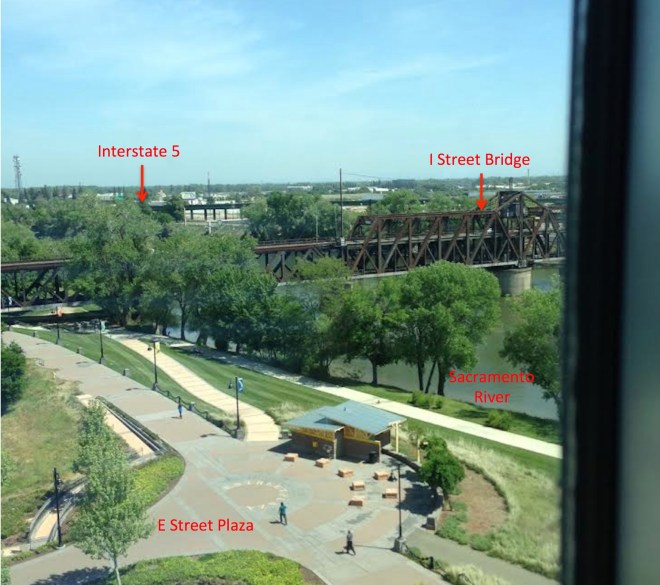
annotated-206

This reader had to step back:

The giveaway clue is the yellow writing – which, in this case, was a “full Monet”: more easily decipherable from a distance, rather than zooming in. I got the “STREET PLAZA” pretty quickly, but what was that first character? It had to be a letter – so my first instinct was to go to DC, but the lack of East Coast buildup suggested otherwise.

I started Google Mapping “[letter] STREET PLAZA”, and discovered that several towns in California are named by single letters – San Diego, Modesto, Merced – and checking for cities with rivers, and especially railroad bridges over them, Sacramento’s E Street Plaza was quickly identifiable!

Another method focused on the economic evidence:

I was pretty certain this was somewhere in the Midwest, based on the flat terrain and old-style railroad trestle. After doing some unsuccessful image searching for railroad bridges in Iowa and Illinois, I started thinking about that riverfront walk. Not just any city can afford to re-do their riverfront like that (with the old-style lightposts, the landscaping and the facilities). This would need to be a medium-sized city with a decent economy to justify that kind of public spending on their riverfront. I started thinking of cities that were focusing on riverfront redevelopment, and as a native Californian, Sacramento popped into my head. Sure enough, that bridge came up at the top of my search, making this one of my fastest (and luckiest) VFYWs yet!

A former winner geeks out with some labels and factoids:
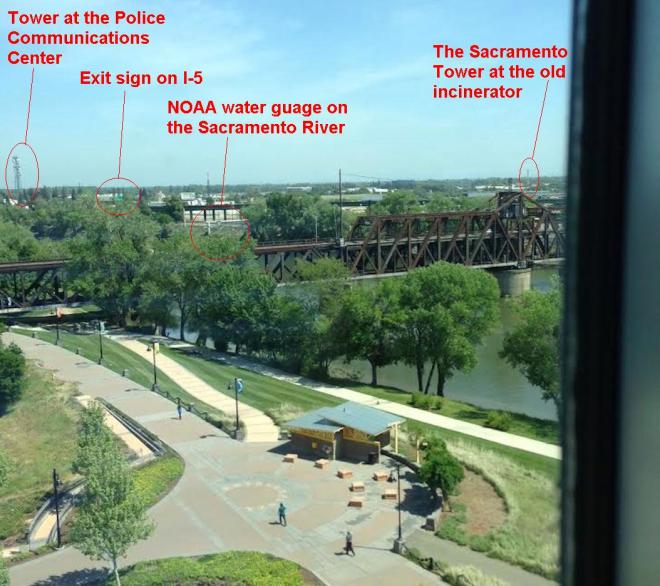
contest pic with labels

Several peculiar items can be seen in this week’s picture. First, the large tower on the left side of the picture is part of a police communications center.  Watch one of the dishes being removed here.  Second, in the middle of the picture there seems to be a pipe climbing out of the berm across the river.  It turns out to be one of NOAA’s numerous water gauges that monitors river crests and flooding.  Third, the faint smokestack on the right hand side of the picture is the Sacramento Tower.  Built over a hundred years ago at the city incinerator, it was climbed for the first time by a local rock climber.  He dedicated his ascent to the Americans taken hostage by Iran.  Slightly odd and inefficient means of communication, but I’m sure the hostages appreciated the gesture.

Another provides some detail about the building:

The photographer took this from CalSTRS, which according to Wikipedia “is the largest teacher’s retirement fund in the US”. It’s also the 8th largest public pension fund in the US. But it pails against the largest public fund in the state – CalPERS, which is #2 over all. CalPERS funding is also a bone of contention here in the state because of the unfunded contributions owed to it by many cities, counties and of course the state itself. Because of these unfunded liabilities, a couple of cities have filled for bankruptcy. Many more might follow.

Another casts a critical eye:

I don’t know much about economics and stuff, but even I know that the pension fund for California’s underpaid state teachers should not be headquartered in a 19-story, $266 million gorgeous monstrosity of glass and steel that was built for the purpose:
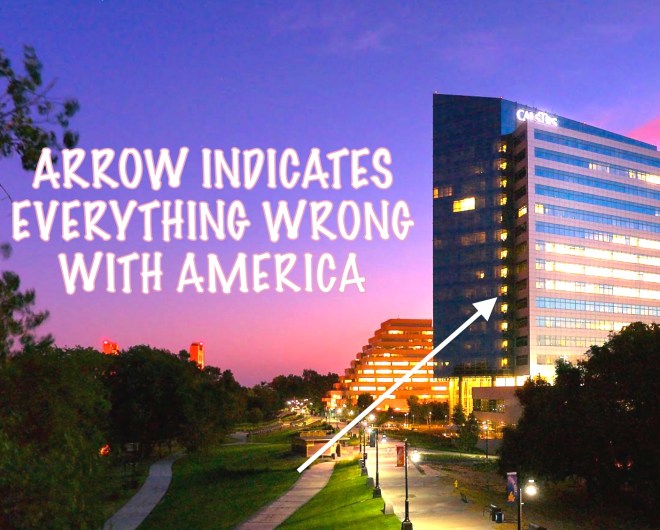
sacramentoVFYW

I’ll leave it to more qualified readers to say if this is capitalism run amok or socialism run amok, but it’s clearly one or the other, and quite possibly both. Seriously, CALSTRS. When you’re dwarfing the neighbors, and the neighbors happen to live in a ziggurat, that’s when you know you’ve overdone it.

Update from a reader who works at the building:

CalSTRS is the 2nd largest public pension fund in the US (by value of assets), not the 8th. CalPERS is the largest.

As far as socialism or capitalism running amok, I’ll just say that the workers here – a very dedicated lot, in my opinion as an outside consultant in organizational behavior – were in multiple and decrepit quarters before this building was built, and now they are in an environmentally healthy and sustainable building. And the only reason it dwarfs its neighbors is that it’s not in downtown Sacramento. Were it a bit more to the east, it would be dwarfed by a bunch of … wait for it … banks.

Finally, the view was taken from a conference room. The employee break room is in the middle of the floor. Nobody here steals anyone else’s sandwich.

On to the winner selection. The photo was taken from the fifth floor, but as is often the case, many readers wrote that their choice was the fifth floor but then circled a window on another floor. Most of these guesses started with the exterior window and then attempted to discern the floor number incorrectly. The following reader found a useful link for better understanding the layout of the building and which floor is which:

The CALSTRS office was finished in 2007 and was constructed to have low emissions and energy-use, enough so that some researchers at UC-Berkeley used it in a case study of environmentally-friendly building design.

The photo’s submitter said that the window “is in the northeast corner of the building on the 5th floor.” That makes the following reader the only one to guess it exactly right:

We’re looking out at the I Street Bridge. A quick image search for double-decker truss bridges got things narrowed down. I have no idea how the building offices are numbered, but I’m going to guess that this was taken from the 5th floor corner window closest to the river, facing the bridge.

Congrats to our winner on what is essentially an upset over many more experienced players. Among them:
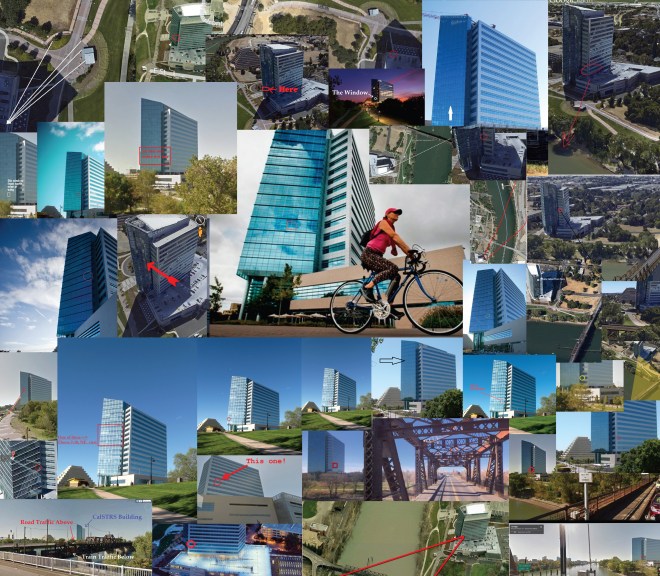
vfywc-206-guess-collage

Meanwhile, a former winner writes:

I dunno, 12th floor? Chini’s going to be like, “Well it looks like from the ground it’s about a 65.12265578456132° angle and it was taken about 10 minutes after the submitter, who’s a Scorpio, had a turkey sandwich and a Sprite at their desk, which is located approximately 52 feet from the elevator.” Seriously how has the CIA not contacted him yet? OR HAVE THEY?

Chini, who was actually off by two floors this week, marks his second anniversary with the contest:

The first view I ever found was posted on May 26, 2012 (VFYW #104), so it’s nice that we’ve returned to the state where this odd little journey began two years ago. Back then the contest seemed impossible, so I was disappointed when my entry for that week wasn’t published. But if at first you don’t succeed, try, try again …

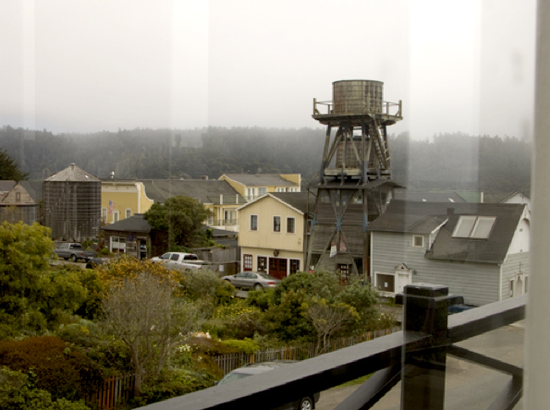
Here’s that entry from his first week:

Years of reading the Dish and finally I got one! This week’s VFW shows a row of buildings on Albion Street in Mendocino, California. The picture was taken from the southernmost of three side windows on the second floor of Odd Fellows Hall located at 10480 Kasten Street between Albion and Ukiah, or 39°18’20.01″N and 123°48’5.94″W. Originally built in 1878 as a meeting house, it’s used today primarily for local art exhibitions.
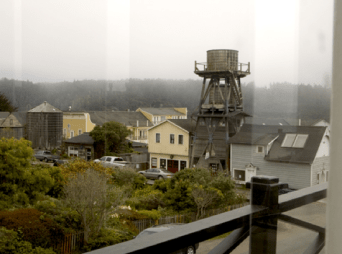
As for locating the reader’s building, the key was the water tower. A Google search for wooden water towers will bring up quite a few in Mendocino, including a view that is a near mirror image of the one your reader submitted. Much like last week’s contest, the buildings’ style threw me off a bit, as my first guess was Maine. (According to Wikipedia the town was settled by former New Englanders who brought their architecture with them, so much so that Mendocino was used as the setting of the fictional Cabot Cove, Maine in the TV show Murder, She Wrote).

Finding the particular window was a bit harder. The rearmost of the three second floor windows is blocked up, but the first two were prime candidates. To choose between them I focused on the reflections of the building’s thin front windows that are faintly visible in your reader’s picture. The rapid increase in their apparent width looking left to right meant that the shot was likely taken from the front-most side window; from a position near the middle side window, those reflections would appear much more uniform in width.

Finally, having never been there, but having been to the Marin Headlands down the coast, it sure seems like a nice place for a getaway weekend!

(Archive: Text|Gallery)

Global Gentrification?

ifj67sQ

Surowiecki sees something like that in action:

The globalization of real estate upends some of our basic assumptions about housing prices. We expect them to reflect local fundamentals – above all, how much people earn. In a truly global market, that may not be the case. If there are enough rich people in China who want property in Vancouver, prices can float out of reach of the people who actually live and work there. So just because prices look out of whack doesn’t necessarily mean there’s a bubble. Instead, wealthy foreigners are rationally overpaying, in order to protect themselves against risk at home. And the possibility of losing a little money if prices subside won’t deter them, [urban planner Andy] Yan says, “If the choice is between losing 10 to 20 per cent in Vancouver versus potentially losing 100 percent in Beijing or Tehran, then people are still going to be buying in Vancouver.”

The challenge for Vancouver and cities like it is that foreign investment isn’t an unalloyed good. It’s great for existing homeowners, who see the value of their homes rise, and for the city’s tax revenues. But it also makes owning a home impossible for much of the city’s population.

Emily Badger wonders whether taxing foreign investors could be an answer:

Taxing them for the privilege – beyond existing property taxes – probably won’t deter foreigners who have a lot of money to shell out in the first place … But maybe that revenue could be spent mitigating some of the consequences of international investment. What if cities used that money to create new affordable or moderate-income housing, as communities in London are considering? Or to help pay for a proposal like Mayor Bill de Blasio’s $41 billion plan to ensure 200,000 affordable-housing units in New York? Or to support programs and infrastructure that benefit the residents who do live in town?

Cities already require such concessions of real estate developers, who have to fund public parks, affordable housing or new school construction in exchange for the right to develop a project. What would happen if we thought in similar terms about the investors who later come in to buy that finished real estate?

Update from a reader:

That graphic is pretty obviously wrong. It suggests that real estate in the most expensive market in the world, Monaco, costs $400 a square foot, which is considerably less than what it costs in suburban Boston, from whence I write. It also claims that real estate in New York will cost you $58 per square foot, and that real estate in London is almost three times as expensive as in New York. I looked at the original source, and it looks like the person who made the chart converted from square meters to feet squared (i.e. the original source says $1m will buy you 15 square meters, and 15 meters is 50 feet, so the graphic presents that as $1m will buy you 50 feet squared, whereas 15 square meters is in fact about 160 square feet, and the conversion error becomes much bigger as the sizes get bigger). So, in fact, the original data say that real estate in Monaco is about $6,200 a square foot, New York is a little over $2,300 (presumably they’re talking about relatively prime real estate), and London is just over 50% more expensive than New York.

(Graphic by Simran Khosla/GlobalPost)