$420K!

We made it! With two hours to spare. Who said stoners are sluggish?

Renew now! Renew here!

Update from a reader:

I just wanted to share a story from a stoner who made a non-sluggish subscription purchase many hours before the 4:20 deadline.

About 8 months ago, I had a small personal garden and I’d sell my excess meds on Craigslist. I was selling such small quantities that I really didn’t worry about the DEA ramming down my door, but I didn’t feel comfortable associating my actual phone number with the Craigslist ads. So I found a company that basically charged $5/month to set up dummy telephone number and forwards any calls/texts to your actual number (Protip: they also have a free version that will store all your passwords across all your various devices). Long story short, my landlord informed us she intended to put the house up for sale, and I felt it was best to remove the garden to avoid any awkward moments during walkthroughs with potential new landlords. But I kinda just forgot to cancel my $5/month subscription until the company prompted me to use the phone masking function when I was booking a plane tickets earlier. Over the same time span, I was one of the people who rationalized that I couldn’t possibly afford 20 whole dollars to read the full version of The Dish. But upon seeing your plea this morning, I decided to cancel the subscription and transfer that $5/month, which I didn’t even know I was paying, to you guys instead.

So I guess the moral of this story is that I bet a lot of your readers don’t have to give up a single thing to enjoy the full Dish experience; they just have to find money they’re spending unknowingly and put it to better use.

Who’s The GOP’s New Frontrunner?

Senators Call For Passage Of Military Justice Improvement Act

Beinart thinks it’s Rand Paul:

Despite his organizational strength, Ron Paul’s libertarian views capped his support in Iowa, preventing him from winning over more traditional conservatives. But in 2016, Rand Paul will be less of an ideological outlier than his father was in 2012. That’s partly because he has avoided some of his father’s edgier views. (He’s more supportive of foreign aid and sanctions against Iran, for instance.) And it’s partly because more Republicans now share his suspicion of the national-security state.

Last summer, more than 40 percent of House Republicans voted to curb NSA data collection. “Rand has a much broader appeal than his father,” Robinson says. Polls reflect that: A survey last December for the Des Moines Register found Paul with a lower unfavorability rating among Iowa Republicans than either Christie or Jeb Bush.

If Paul is, arguably, the early leader in Iowa, he may be the early frontrunner in New Hampshire as well. While Ron Paul placed third in Iowa in 2012, he placed second in New Hampshire, losing only to Mitt Romney, the former governor of neighboring Massachusetts and a national frontrunner with a vast financial edge.

It’s way too soon to game this out, of course. But those who dismiss the chances of Paul are missing something, I think. Something fascinating is happening beneath the surface of the Republican-conservative debate. There is a revival – a clear, strong revival – of a conservatism perhaps best represented by The American Conservative of an authentically conservative worldview that is federalist, fiscally austerian, non-interventionist, and more skeptical of government’s national security claims. It’s always been there – a useful new primer on its history by Daniel McCarthy is here – but it is now much stronger vis-a-vis the Cold War liberalism and neoconservative orthodoxy that dominated the movement for so long. Someone will have to run under that banner in 2016, and it’s hard to see anyone tapping into the passionate activist support for it more effectively than Paul.

The Pauls are natural insurgents. And the GOP remains roiled by populist currents. That doesn’t mean Paul will win. It does mean he matters.

(Photo: Alex Wong/Getty.)

Finding, Ctd

Some other reactions to the new HBO series, Looking, which I reviewed yesterday. We’ll be airing your views soon as well. Eric Sasson calls it “the first truly post-DOMA show, luxuriating in the mundaneness of gay men’s lives without needing to dress them up in mainstream television’s usual tropes of same-sex marriage, gay parenting and ‘acceptance.” Emily Nussbaum reaches a similar conclusion. But many are not so impressed.  J. Bryan Lowder:

[Looking] is an almost unbearably boring television show. Alessandra Stanley of the New York Times and Rich Juzwiak of Gawker have said so directly, and more positive reviewers have still intimated as much. But the adjective, one I would normally consider critically lazy, is so apt in this case that repetition is warranted. Looking is so boring, so utterly flat in terms of narrative or characterization, so in need of occasional pauses in which to perform a few jumping jacks to bring one’s heart rate up to resting, that I would opt out entirely if we gay men—or at least gay male culture critics—weren’t contractually obliged to watch.

Mick Stingley was also bored:

Gays have largely been depicted in television and movies as either extremely fun and funny (Will and Grace; The Birdcage) or starkly sad and depressing (Philadelphia; Angels in America) so perhaps it’s time for a Hollywood portrayal of gay life as normal, tedious, and bland. Makes straight guys seem together and interesting by comparison, though. And if this show really takes off, prepare yourselves for a world of boring gay men who blend in and will probably talk to you about last night’s game and drink bourbon.

And that would be wrong because … ? Stingley’s throwback piece was updated with this note:

We apologize to anyone offended by our attempt at humor in this piece. It reflects one man’s viewing experience. He does not think all gay people are boring. Just this show, a little.

I have to say that I think, in this regard, the show is way ahead of this particular critic. In the first place, it doesn’t attempt to explain a gay show to straight readers.

It assumes we are all in the mix and that straight guys will understand – and even be diverted – by a simple dramedy about life, sex and love in a big city. Esquire is still obsessing over the gay-straight divide, while this show is past that. Equally, there’s Stingley’s dated attempt to insist that gay men really should be more fun, more super-thanks-for-asking, more witty and interesting than straight men. There’s this sentence that leaps out:

If this show really takes off, prepare yourselves for a world of boring gay men who blend in and will probably talk to you about last night’s game and drink bourbon.

For me, that is not a bug of this show, or of the gay rights movement. I have longed for the day when gay guys and straight guys can both talk about last night’s game over a bourbon, if they want to. Stingley sees the dawn of a new equality and yearns for the past. Looking looks directly into the face of the present and begins to imagine a future.

Quote For The Day II

“I have strengths and I have weaknesses, like every President, like every person … I think I’m pretty good at keeping my moral compass while recognizing that I am a product of original sin. And every morning and every night I’m taking measure of my actions against the options and 51WM131iMLL._SY344_BO1,204,203,200_possibilities available to me, understanding that there are going to be mistakes that I make and my team makes and that America makes; understanding that there are going to be limits to the good we can do and the bad that we can prevent, and that there’s going to be tragedy out there and, by occupying this office, I am part of that tragedy occasionally, but that if I am doing my very best and basing my decisions on the core values and ideals that I was brought up with and that I think are pretty consistent with those of most Americans, that at the end of the day things will be better rather than worse …

I think we are born into this world and inherit all the grudges and rivalries and hatreds and sins of the past. But we also inherit the beauty and the joy and goodness of our forebears. And we’re on this planet a pretty short time, so that we cannot remake the world entirely during this little stretch that we have,” – president Barack Obama, channeling Niebuhr again.

The Other Israel Lobby

J Street is fighting against the new Iran sanctions bill:

By decoupling support for Israel with support for new sanctions against Iran, the group is making it easier for lawmakers inclined to support the White House. “We’ve been working diligently on Capitol Hill and in the Jewish-American community to raise support for the president’s diplomatic efforts vis-a-vis Iran, and oppose any legislation which would threaten it,” said Dylan Williams, director of government affairs at J Street. “We feel very strongly that the current bill in the Senate would threaten diplomacy.”

J Street’s influence is also clear in the money it spends. Among pro-Israel groups, JStreetPAC was the largest single political donor during the 2008 and 2012 cycles, contributing nearly $2.7 million to federal candidates, parties, and outside groups. And some lawmakers supported by J Street have been vocal in support of the group’s position. Senate Intelligence Committee Chairwoman Dianne Feinstein, for instance, has spoken out strongly against the new Iran sanctions. As one congressional aide put it, “Those are the political calculations that are made easier when a group like J Street gives you cover.”

Sargent notes that Patty Murray and Elizabeth Warren now oppose a vote on the sanctions bill:

Those who favored a vote were far more vocal at first — as of now, 16 Dem Senators have signed on. But the continued silence of many Dem Senators signaled a broad unwillingness to join the bill, even as many were unwilling to publicly declare this to be the case, since Dems apparently see allowing negotiations to proceed, without getting a chance to vote in favor of getting tougher on Iran, as a politically difficult position to take.

If current conditions remain, a vote is starting to look less and less likely. Right now, the bill has 58 co-sponsors. On the other side, 10 Dem Senate committee chairs have signed a letter opposing a vote. Around half a dozen Dem Senators subsequently came out against it. With Murray and Warren, the number of Dems against a vote has comfortably surpassed the number who want one.

Which means the US will not be the actor in this that sabotages negotiations. Which is good for the US, Israel and Iran.

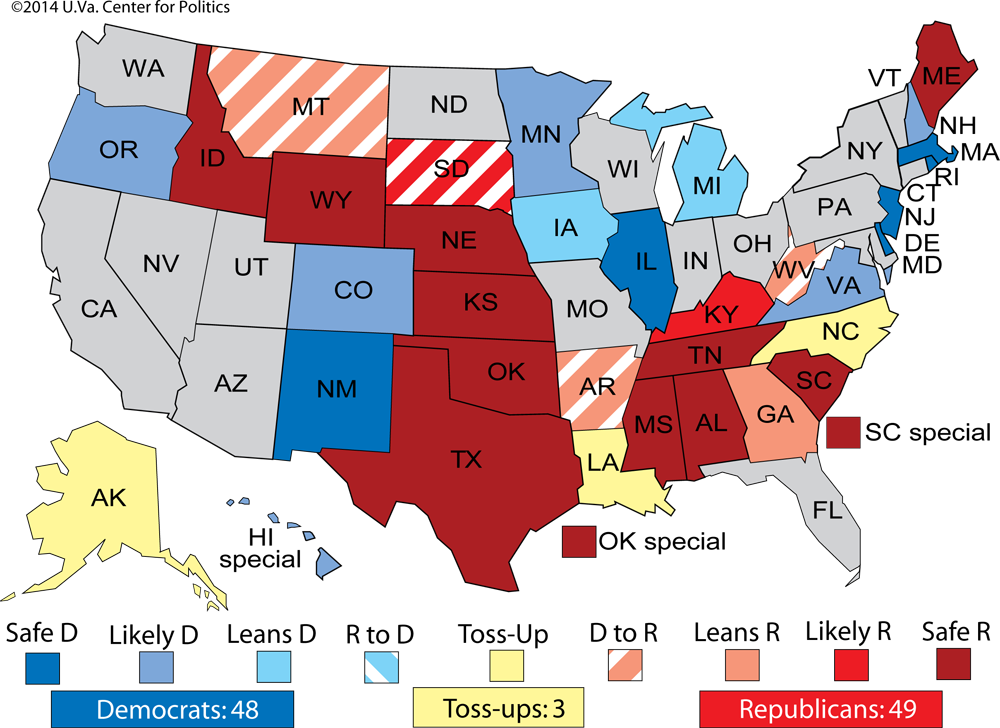
The Senate Is A Toss-Up

Senate Rankings

Sabato sizes up the Senate races:

We now favor Republicans in four Democratic-held seats: Montana, South Dakota and West Virginia, as well as — in a ratings change — Arkansas, where Sen. Mark Pryor (D) appears to be at least a slight underdog to Rep. Tom Cotton (R) in a reddening state. Assuming Republicans can win those, they have roughly even odds to win in three other states where there are Democratic incumbents: Alaska, which we’ve long classified as a Toss-up, and Louisiana and North Carolina, which we’re switching back to Toss-ups after having them in that category  for much of last year. It’s possible that the race for the Senate will come down to these three Toss-ups, with the party that wins at least two of the three controlling the Senate.

Sean Trende expects Obama’s approval numbers to have a major impact on the result:

If the president’s job approval is still around 43 percent in November — lower than it was on Election Day in 2010 — the question would probably not be whether the Democrats will hold the Senate, but whether Republicans can win 54 or 55 seats. Given the numbers right now, that should not be unthinkable.

But there’s a flip side to this. If Obama’s job approval does bounce back — which is exactly what happened in 2012 — there’s a reasonable chance that Republicans could walk away from this cycle with just a handful of pickups.

In a later post, Trende explains why the number of seats the GOP wins matters so much:

[I]f the GOP wins a bare majority in 2014, the odds are very, very good that the Senate will revert back to Democratic hands in 2016. In fact, if GOP gains are confined to the “traditional seven” Democratic races (the three open seats and the four incumbents in states Mitt Romney carried), they’re still favored to lose the chamber two years later. On the other hand, if Republicans get to 54 seats, their chances of retaining control are very good, and given the horrific playing field for Democrats in 2018, they would be extremely unlikely to lose it that year.

Get Us To $420K!

Right now, renewals have brought in $414,000 for our second year of independence. If you believe, as we do, in the urgency of ending the prohibition of marijuana, and think the Dish has helped generate a real and constructive debate on the matter, here’s an idea. Renew now or [tinypass_offer text=”subscribe for the first time”] to get us to the critical $420K. Maybe we can even do it by 4.20 pm, just in time for today’s Mental Health Break. As soon as we reach that target, I’ll post the news. Feel free to, er, celebrate at that point, if that’s your thing.

Renew now! Renew here! And we’ll continue the fight. Update from a reader:

I’ve loved this blog since you were solo with a tip jar, so there was never any doubt about renewing.  But in honor of your request, I did it TODAY for $4.20 per month (bet I’m not the only one). I’ll think of you and the great journalism of the Dish every time I see it on my statement.

Another is nudged off the couch:

Fine. FINE. I subscribed. The stoner appeal finally did it.

The View From Your Window

image (7)

Somerset, England, 2 pm. Update from a reader:

I recognized the shot immediately. It’s Burrowbridge Mump. When I first went there, my English girlfriend and I took a room at the pub just next door after a long day of touring. Sandy asked the landlord, “Where are we, actually?” The landlord said, “Athelney is just down the road.”

“Where King Alfred burned the cakes!” said Sandy. “Where King Alfred burned the cakes,” agreed the landlord. I later asked Sandy what the point of the burnt cakes story was. “No point,” she explained, “It’s just that King Alfred burned the cakes in Athelney. Everyone knows it.”

I have marveled ever since that the English people have kept this tale going for century after century. The only history book I found it in was written for children in the Victorian era. And it was fun to read David Harspool’s 2006 book Why Alfred Burned the Cakes. It’s an examination of Alfred, the legends that attached to him, and how such legends are made and adapted over time.

Quote For The Day

“On the foreign policy front … I find myself wondering why we cannot regard another country, in this case, Iran, as just that, one more country which we would regard as neither friend nor foe, with whom we are prepared to deal on a day-to-day basis, neither idealizing it nor running it down, keeping to ourselves (here, of course, I am speaking about our government) our views about its domestic political institutions and practices, and interesting ourselves only in those aspects of its official behavior which touched our interests – maintaining in other words, a relationship of mutual respect and courtesy, but distant,” – George Kennan, intellectual architect of containment of the Soviet Union, in his diary, March 8, 1998 (via TNR).

Burma’s Religious Civil War

Graeme Wood reports from Burma, whose glasnost has done little to ease the plight of its Rohingya Muslims:

[O]n the streets of Rangoon, Burma’s Great Unclenching is a beautiful thing. The Burma I first visited in 1998 was a snakepit of secret police and muzzled dissent. But last fall, I heard people openly express love for the leader of Burma’s democratic opposition, Burma Muslims face Buddhist FuryNobel Peace laureate Aung San Suu Kyi. On every street corner, kiosks sold dozens of vibrant tabloids free from routine censorship. Burma’s economic isolation once forced foreign visitors to pack in bundles of crisp hundred-dollar bills. Now brand-new ATMs disgorge money just like in Paris or Buenos Aires.

But Arakan state looked a lot better when things were still clenched.

Muslims and Buddhists who recently lived with each other peacefully now squat on opposite sides of barbed-wire fences and plot each other’s elimination. Old women and children too infirm to run from raiding parties have been speared or beaten to death in their homes. The fortunate ones are fleeing to other countries on overladen, leaky boats. In Sittway, the state capital, Buddhists have surrounded the old Muslim quarter, starving its residents into submission. “It’s a concentration camp,” a diplomat in Rangoon told me.

The U.S. government has sent diplomats to monitor Arakan, and at key junctures in the blossoming of bilateral relations, Obama has brought up the Rohingya issue. But the Rohingya are, so far, unlucky casualties of progress, and their ongoing ethnic-cleansing hasn’t been enough to sour Obama’s rapport with the Burmese president, Thein Sein. Nor, it seems, has it managed to stir the outrage of Aung San Suu Kyi, whose lack of comment has made activists, once piously reverent, now treat her as something between demoness and fool.

(Photo: In March 2013 in the he city of Meiktila, Muslims were attacked by Buddhist extremists. Khaing Thinzar Oos, aged 23, holds a photograph of her younger brother, who was murdered in the violence. The waves of anti-Muslim violence has paralyzed Burma and threatens the democratization of the country. By Jonas Gratzer/LightRocket via Getty Images)